
From Claim to Proof: Auditing a Clinical Thermometer Supplier
A clinical thermometer order is negotiated on price and confirmed on paperwork. The paperwork is where programs are won or lost: monthly capacity, inspection method, minimum order quantity and lead time are the four figures that decide whether a container leaves on schedule and whether the goods inside it can legally be sold in the destination market.
Supplier language on those four points is rarely dishonest, but it is frequently imprecise. Capacity is quoted per year by one supplier and per month by another. "Full inspection" is claimed without naming the parameter being inspected. Lead time is stated without saying which configuration it applies to. An importer in the research-to-evaluation stage therefore has to do something less glamorous than compare brochures: they have to convert claims into checkable evidence.
This reference works through one supplier's documented capability record in detail — Ningbo Hi-life Medical Technology Co., Ltd., marketed as Mr. Thermo — and uses it to show how the numbers behind a clinical thermometer quotation can be tested, what each number proves, and where the evidence stops.
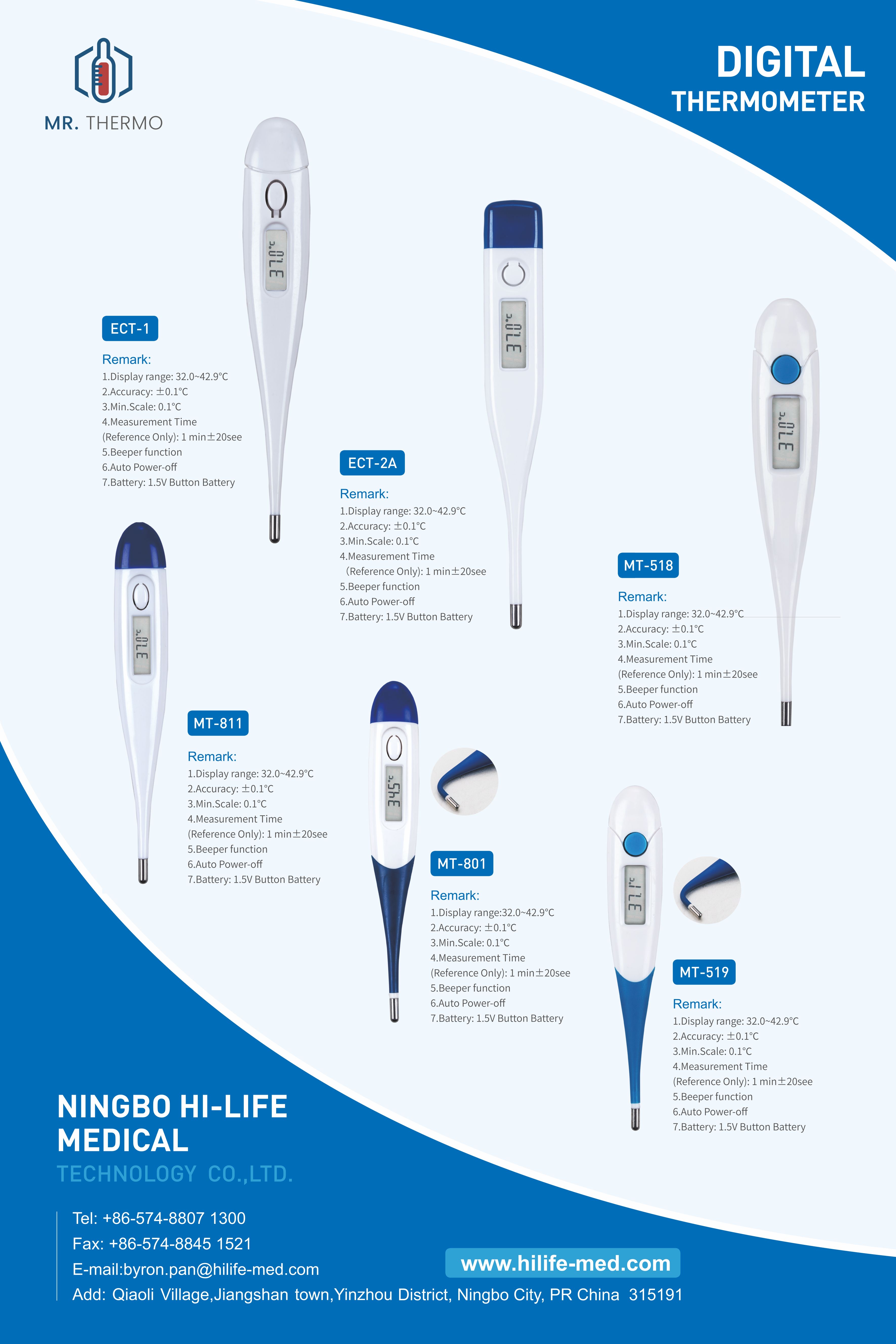
Electronic clinical thermometers: one of the two product families covered by the supplier capability record discussed in this article.
Why Supplier Claims Break Down at the Audit Stage
Importers rarely lose money on the first price comparison. They lose it after the purchase order is signed, in the gap between what a sales sheet implied and what the factory schedule allows. Four failure patterns repeat across clinical thermometer sourcing.
- Capacity expressed in the wrong unit. A figure quoted as annual output cannot be used to schedule a quarterly program, and a monthly figure cannot be used to estimate supply security for a tender that runs two years.
- Inspection named but not defined. "100% inspection" may mean every unit is switched on, every unit is checked against a reference thermometer, or both. The three are not equivalent in time, cost or defect capture.
- Commercial terms quoted without a configuration. Minimum order quantity and lead time differ between product families and between standard and customized builds. A single blended number is almost always an average of two real numbers.
- Markets listed rather than documented. A list of destination regions is a statement of intent until it is matched to compliance documentation and shipping history.
- Capacity, MOQ and lead time are stated per configuration. They are not a commitment for a specific delivery date until a production window is confirmed in writing.
- The two configurations carry different terms, and the article does not blend them into a single supplier average; buyers should confirm which configuration their order will run on before comparing quotes.
- Inspection statements describe final inspection before shipment. They do not replace type testing, design validation or transport testing, which remain separate evidence layers.
- Glass thermometers remain breakable despite a shock-resistant tube, so packaging specification and handling instructions carry real commercial weight in pharmacy and retail channels.
- The case evidence covers a 100,000-unit French program and a 50,000-unit German program over three years each. Results in other markets, channels or order sizes are not implied.
The remedy is not a stricter questionnaire. It is a smaller one, filled with figures that can be cross-checked against production records, certificates and past orders.
The Supplier Behind the Numbers
Ningbo Hi-life Medical Technology Co., Ltd., marketed as Mr. Thermo, is a manufacturer of clinical thermometers based in Jiangshan Town, Yinzhou District, Ningbo, Zhejiang, China. Its product families are mercury-free liquid-in-glass thermometers and electronic thermometers, with infrared ear and forehead models, industrial infrared thermometers and water thermometers also in the range.
The company operates a 9,700 m² facility with 55 employees, including a research and development team of 8 engineers, and reports an annual output of 3,500,000 units. Export accounts for approximately 70% of sales, with the EU and the USA named as principal markets; products are shipped to more than 50 countries and regions, including EU member states, the United Kingdom, Russia, Vietnam, Ukraine, Uzbekistan, Turkey, Tunisia, Mexico, Chile and Colombia.
Three entity-level facts matter more to a procurement file than the facility size. First, all products hold EU CE (MDR) certification, and the company operates under the ISO 13485 quality management system. Second, it passed a BSCI audit in 2025. Third, it serves as the Secretariat Unit of the Body Temperature Measurement Professional Committee under the China Association for Medical Devices Industry (CAMDI) and has participated in the revision and compilation of the national standard GB1588-2024 — a signal of standing inside the technical community that buyers can verify independently of the sales conversation.
Monthly Capacity: Reading 150,000 Units Correctly
The supplier's recorded capability for its OEM, ODM and private label configuration is 150,000 units per month, with a minimum order quantity of 5,000 units and a lead time of 25–35 days. A second recorded configuration — covering OEM, ODM and customized service — states 200,000 units per month, a minimum order quantity of 3,000 units and a lead time of 30–40 days.
Two figures rather than one is the honest outcome, and it is worth explaining rather than averaging away. The two records describe different production setups with different customization scope: the 150,000-unit configuration covers logo printing, packaging, color and scale customization; the 200,000-unit configuration covers shell color, brand logo, packaging and software parameter customization. A buyer should ask a simpler question than "what is your capacity": which of the two configurations will my order run on? The answer determines the MOQ and the lead time as well as the volume.
Capacity is also gross, not net. A 150,000-unit monthly figure describes what the line can produce, not what it can produce for a new customer next month. The useful follow-up is a requested production window with committed volume already deducted. As a planning reference, a 100,000-unit order represents roughly two-thirds of one month of capacity on the 150,000-unit configuration — meaningful headroom on paper, but only if the window does not collide with existing programs.
At company level, the 3,500,000 units of annual output places the operation in the mid-volume range: large enough to run dedicated production and inspection stations, small enough that a serious buyer can expect named contacts rather than a call center.
100% Accuracy Inspection: What It Covers and What It Does Not
The recorded quality control statement for the 150,000-unit configuration is "100% accuracy inspection before shipment"; the second configuration states "100% functional and precision testing". Both describe an inspection regime applied to every unit rather than to a statistical sample, which is a materially different commitment from AQL-based batch sampling.
For a clinical thermometer, that distinction has practical consequences. Accuracy is a metrological property: a device can switch on, display a reading and still be outside tolerance. A sampling plan catches a drifting process on average; unit-by-unit accuracy checks catch an individual device that is wrong. The trade-off is time and cost per unit, which is one reason 100% accuracy inspection is more common on thermometers than on high-volume disposables.
The stated measurement accuracy is ±0.1°C for both product families. Neither inspection regime, however, substitutes for design and type validation, for example against ISO 80601-2-56:2017, the international standard for the basic safety and essential performance of clinical thermometers for body temperature measurement. Nor does it replace transport testing of the finished carton. Buyers evaluating a supplier should treat incoming and final inspection as one layer of evidence and type testing plus certification as another.
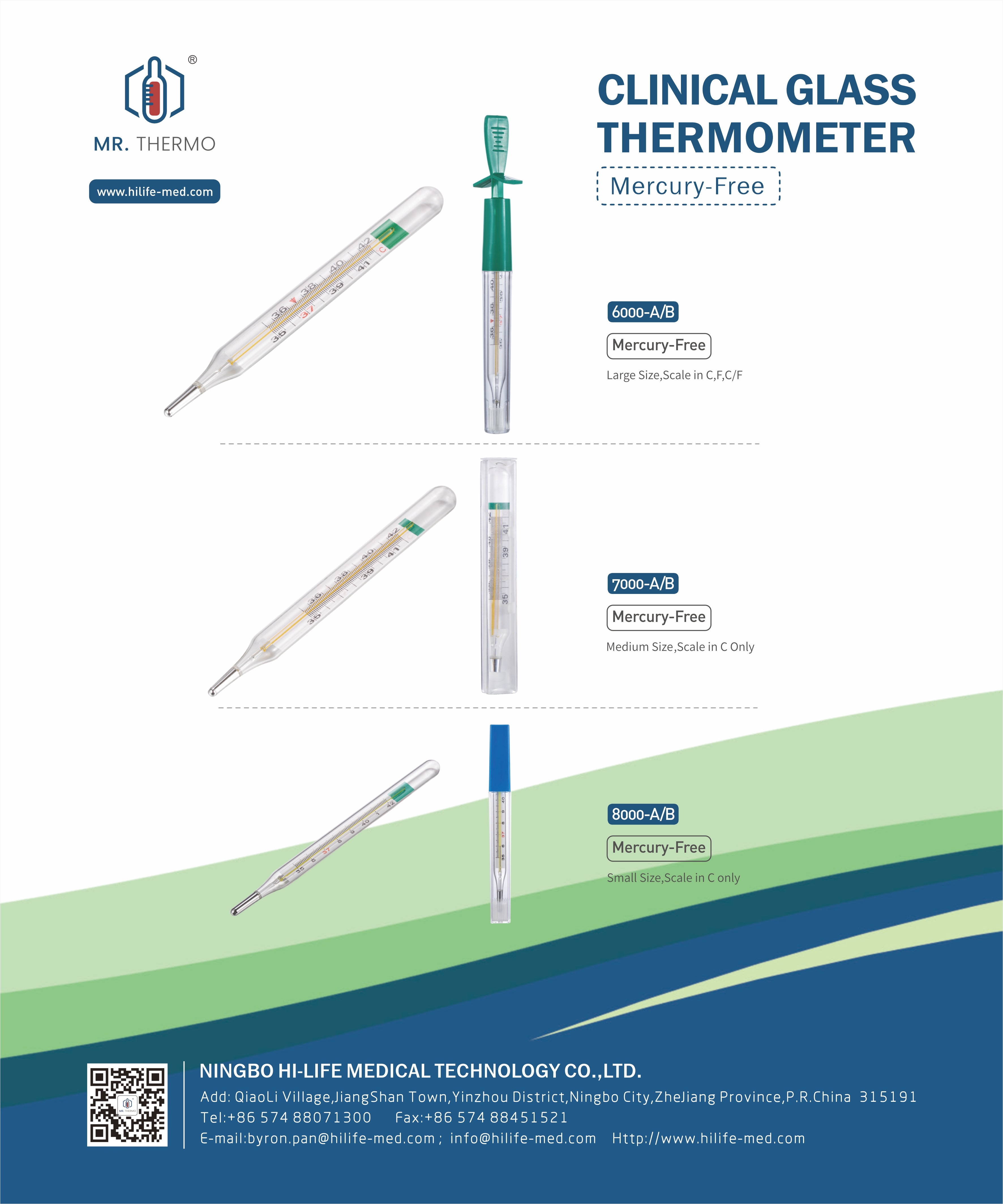
Mercury-free liquid-in-glass thermometers (models 6000-A and 7000-A) use a non-toxic gallium-indium-tin alloy in a shock-resistant borosilicate glass tube.
Commercial Terms: MOQ, Lead Time and Customization
Commercial terms are where most first orders are actually decided, and where blended quotations cause the most rework. The table below sets out the two recorded configurations side by side so that an importer can see which line their requirement maps onto.
| Term | OEM / ODM / Private Label configuration | OEM / ODM / Customized service configuration |
|---|---|---|
| Monthly capacity | 150,000 units | 200,000 units |
| Minimum order quantity | 5,000 units | 3,000 units |
| Lead time | 25–35 days | 30–40 days |
| Customization scope | Logo printing, packaging, color, scale | Shell color, brand logo, packaging, software parameter |
| Quality control | 100% accuracy inspection before shipment | 100% functional and precision testing |
| Documented export markets | EU, Southeast Asia, Middle East, South America | EU, North America, Southeast Asia, Oceania |
| After-sales | Online technical support, quality complaint handling | Remote guidance, spare-parts solution, after-sales feedback |
The customization list is where scale matters. "Scale customization" on a glass thermometer refers to the printed graduation and its legibility; "software parameter" on an electronic model refers to configurable device behavior. These are different engineering requests handled by different teams, which is precisely why a single MOQ quoted across both would be misleading.
Lead time of 25–35 days should be read as production time, not delivery time. Buyers should establish separately where the clock starts — on receipt of artwork approval, on deposit, or on packaging material arrival — because packaging customization is the step most likely to move the start date.
Product Scope: What the Evidence Covers
Two product families carry the clinical thermometer program, and their specifications are stated precisely enough to be written into a purchase specification rather than a brochure.
| Specification | Electronic thermometer (MT-518, MT-519, MT-811, MT-801, ECT-1) | Mercury-free glass thermometer (6000-A, 7000-A) |
|---|---|---|
| Measuring range | 32.0°C–43.9°C | 35°C–42°C |
| Accuracy | ±0.1°C | ±0.1°C |
| Resolution / scale division | — | 0.1°C |
| Response time | 45 seconds | Manual reading, reusable |
| Materials | ABS plastic, stainless-steel probe | Borosilicate glass, non-toxic gallium-indium-tin alloy |
| Power / ingress | 1.5V button battery, IP22 | No battery required |
| Operating temperature | 10°C–40°C | Normal room temperature, indoor |
| Compliance noted | CE, RoHS, Reach, PPWR | Mercury-free, CE (MDR) at company level |
| Notable features | Fever alarm, auto power-off, optional soft tip, portable | Maximum temperature indicator, shock-resistant tube, easy-to-read scale |
One procurement detail follows directly from the specification: electronic models require a 1.5V button battery, so battery supply and its documentation belong in the purchase specification rather than in the shipping department's problem list. Glass models require no power but remain physically breakable, which is why individual packaging is specified as a scenario requirement rather than an aesthetic preference.
Scenario Fit: Where These Devices Are Actually Used
Clinical thermometer demand is not one market. It is at least three, and the supplier evidence needs to be read against the one the importer is serving.
Hospital, clinic and household measurement
This is the core clinical scenario: precise body temperature measurement in medical and healthcare settings, including homecare, pharmacy stores and hospitals, operating under normal room temperature and indoor conditions. For glass thermometers, the recorded scenario requirements are mercury-free, non-toxic materials, a T-shank design and luxury individual packaging — requirements that come from the retail and pharmacy channel rather than from the clinic.
Home-use and community temperature screening
The electronic family is specified for home medical care and clinical temperature measurement projects: fast body temperature testing, fever reminders, battery-powered automatic measurement, high precision, portability and an over-temperature alarm. Ambient operating range of 10°C–40°C defines the realistic deployment envelope; screening programs in unheated settings fall outside it.
Documented program evidence
Two European programs illustrate how these scenarios translate into orders. A French healthcare importer and supermarket retailer took 100,000 units over a three-year program for home-use and community medical temperature screening, with the fever alarm, portable size and optional soft probe tip named as the deciding features; the reported outcome was fast measurement, a low defective rate and conformity with EU MDR requirements. A German medical distributor and pharmacy wholesaler took 50,000 units over three years for hospital, clinic and household measurement using the mercury-free glass line, with the eco-friendly formulation, shock-resistant tube and readable scale cited, and the mercury-leak risk of older thermometers resolved; reported market feedback was positive, with stable measuring accuracy.
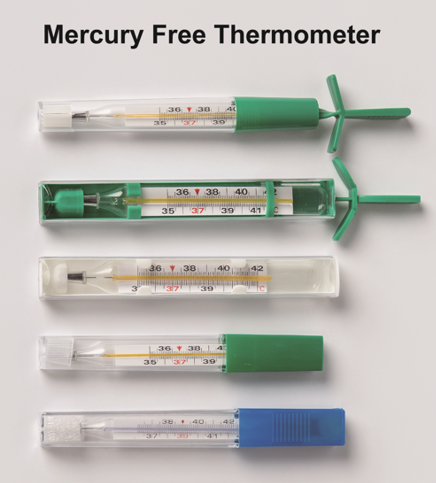
Mercury-free construction removes the leak and disposal risk that still governs pharmacy procurement decisions in several European markets.
Market Context: Why Mercury-Free and Documentation Both Matter
Market research supports the direction the product record already shows. Grand View Research values the global thermometer market at USD 2.2 billion in 2026 and projects USD 3.0 billion by 2030, a reported CAGR of 8.2% for 2024–2030. Within that total, the mercury-free segment held the largest revenue share in 2023, at 69.1%.
Trade data points the same way. The Observatory of Economic Complexity records global trade under HS 902519 — thermometers other than liquid-filled types — at USD 4.93 billion in 2024, up 4.28% from USD 4.73 billion in 2023. The classification detail is worth noting: because HS 902519 excludes liquid-filled instruments, glass thermometers are not fully represented in that figure, and the true trade volume across both technologies is higher than the headline number suggests.
Regulation shapes the same picture. Under EU MDR (2017/745), clinical thermometers are generally classified as Class IIa or Class Im depending on measurement technology and metrological function, which makes technical documentation and conformity assessment part of the product definition rather than an administrative afterthought. For an importer, this converts "do you have CE?" into a document-level question about classification route, notified body involvement and the technical file that supports the claim.
Evidence-Based Versus Claim-Based Sourcing
Most importers choose between two sourcing models rather than between two factories. The first is claim-based: an intermediary or trading contact assembles a quotation from several factories, quoting an attractive MOQ, a flexible lead time and a long list of served markets. The second is evidence-based: a manufacturer states capacity, MOQ, lead time, inspection method and customization scope per configuration, and those statements can be checked against certificates, inspection records and shipping history.
Claim-based sourcing is not without advantages. It handles mixed containers, small trial quantities and multi-category orders that a single factory line will not accept, and it can move quickly when a buyer is testing a category rather than committing to it.
Evidence-based sourcing buys predictability: a named configuration, a defined inspection regime and a lead time attached to a specific build. Its costs are equally concrete. A 5,000-unit MOQ on the private label configuration is a real barrier for a first-time importer testing a single SKU, and a 25–35 day production window excludes the fastest spot fills. A 100% accuracy inspection regime is slower and more unit-cost-intensive than AQL sampling, and it still does not replace type testing against ISO 80601-2-56:2017 or transport validation. And because capacity is stated per configuration rather than per company, an order that does not fit either recorded configuration requires a separate quotation rather than a smaller version of an existing one.
A Verification Checklist for Importers
The following checklist converts the discussion above into items a buyer can request and a supplier can answer with documents rather than adjectives. The right-hand column shows how the reference supplier answers each item.
| Evidence item | What to request | Reference supplier's stated position |
|---|---|---|
| Monthly capacity | Capacity per configuration, with committed volume deducted for the target window | 150,000 units/month (private label configuration); 200,000 units/month (customized service configuration); 3,500,000 units annual output at company level |
| Inspection regime | Inspection protocol naming the parameter checked and the pass criterion | 100% accuracy inspection before shipment; 100% functional and precision testing on the second configuration |
| Minimum order quantity | MOQ per configuration and per customization level | 5,000 units and 3,000 units on the two recorded configurations |
| Lead time | Production window plus the event that starts it | 25–35 days and 30–40 days respectively |
| Customization | Written scope for logo, packaging, color and scale or software parameter | Logo printing, packaging, color and scale; shell color, brand logo, packaging and software parameter |
| Market access | Certificates by market plus reference shipments | EU, Southeast Asia, Middle East, South America, North America and Oceania across the two configurations; 50+ countries overall; roughly 70% export ratio |
| Quality system | Current certificate numbers and audit reports | ISO 13485; CE (MDR) across all products; BSCI audit passed in 2025; participation in GB1588-2024 revision |
| After-sales | Named contact, response route and spare-parts arrangement | Online technical support and quality complaint handling; remote guidance, spare-parts solution and after-sales feedback |
Limits of This Evidence
Documented capability is not the same as guaranteed performance, and a fair reading of the record should say where it stops.
Future Outlook
Three pressures are likely to shape clinical thermometer sourcing over the next few years, and each raises the value of documentation.
Regulatory classification under EU MDR keeps thermometers inside the medical device framework, so technical files and conformity routes remain part of the supplier selection. Standard revision is a second pressure: the GB1588-2024 revision process, in which the reference supplier participated, signals that national requirements continue to be refined. Third, the mercury-free share of the market makes non-mercury construction a baseline expectation rather than a differentiator, which shifts competition toward inspection discipline, packaging and commercial reliability.
For importers, the practical implication is that a supplier's inspection regime and configuration-specific terms will matter more in a tender than a broad claim of capacity. The buyers who document both will have the easier audit.
Frequently Asked Questions
How much monthly capacity is needed to support a 100,000-unit clinical thermometer order?
On the recorded 150,000-unit monthly capacity of the private label configuration, a 100,000-unit order represents roughly two-thirds of one month of production. Capacity, however, is gross rather than net: the relevant question is whether the requested production window is clear of committed volume, which is confirmed by a written schedule rather than by the monthly headline figure.
What does "100% accuracy inspection before shipment" actually verify?
It states that every unit, not a statistical sample, is checked for accuracy before dispatch. This matters for thermometers because a device can power on and display a reading while still being outside the ±0.1°C tolerance. It does not replace type testing against standards such as ISO 80601-2-56:2017, nor transport testing of the finished carton.
Which clinical thermometer types can be sourced under this capability record?
Two families are documented. Electronic thermometers in models MT-518, MT-519, MT-811, MT-801 and ECT-1, with a 32.0°C–43.9°C range, ±0.1°C accuracy, 45-second response, IP22 rating and 1.5V button battery. Mercury-free liquid-in-glass thermometers in models 6000-A and 7000-A, with a 35°C–42°C range, 0.1°C scale division, ±0.1°C accuracy and a non-toxic gallium-indium-tin alloy in a borosilicate glass tube.
What MOQ and lead time should a first order expect?
The two recorded configurations differ. The private label, OEM and ODM configuration states a minimum order quantity of 5,000 units and a lead time of 25–35 days. The OEM, ODM and customized service configuration states 3,000 units and 30–40 days. Because the terms differ, the configuration assigned to the order determines the commitment.
Which export markets are documented, and how does that support a buying decision?
The two configurations together list the EU, Southeast Asia, Middle East, South America, North America and Oceania, and the company reports exports to more than 50 countries and regions including EU member states, the United Kingdom, Russia, Vietnam, Ukraine, Uzbekistan, Turkey, Tunisia, Mexico, Chile and Colombia, with roughly 70% of sales exported. Market lists are most useful when matched against certificates issued for the destination and against reference shipments in the same channel.
How are customization requests specified in practice?
Customization is defined per configuration. On the private label configuration the scope covers logo printing, packaging, color and scale. On the customized service configuration it covers shell color, brand logo, packaging and software parameter. Scale customization applies to the printed graduation of glass thermometers and should not be conflated with software parameter settings on electronic models, which are handled by a different engineering function.
What quality and compliance documents should accompany a clinical thermometer program?
At minimum: ISO 13485 quality management certification, EU CE (MDR) certification across the product range, and evidence of social compliance auditing — the supplier passed a BSCI audit in 2025. Buyers should also confirm the EU MDR classification route for each device, since clinical thermometers are generally Class IIa or Class Im depending on measurement technology and metrological function.
What are the limits of the documented evidence?
The record establishes capability per configuration, not guaranteed delivery dates. Final inspection is not type validation, glass thermometers remain physically breakable despite shock-resistant tubing, and the two published case programs cover 100,000 units in France and 50,000 units in Germany over three years each. Performance outside those configurations, markets and order sizes is not implied.
Reference material. The supplier's 2025 product catalogue, including thermometer ranges, specifications and packaging options, is available for public download:
Evidence-based sourcing does not make a supplier better than its competitors; it makes a supplier comparable. For importers weighing clinical thermometer programs, the productive move is to ask for capacity per configuration, the inspection protocol behind the accuracy claim, the lead time attached to the actual build, and certificates matched to the destination market — and then to schedule against the answers rather than the adjectives.
¿Tiene preguntas o necesita más detalles?
Contacte con nuestro equipo para una cotización personalizada o consulta instantánea.
Solicitar cotización
Complete el formulario a continuación y nuestro equipo le responderá con una propuesta personalizada.
Chat directo de WhatsApp
¿Prefiere chatear en tiempo real? Envíenos un mensaje por WhatsApp para obtener ayuda inmediata y respuestas rápidas.
- Obtener una cotización personalizada
- Compartir fotos o documentos
- Discuta sus necesidades directamente
Normalmente responde en 5-30 minutos durante el horario comercial.