
From Certifications to Custom Gel: Auditing a Teeth Whitening Strips Supplier
From Certifications to Custom Gel: Auditing a Teeth Whitening Strips Supplier
A teeth whitening strips supplier should be audited at entity level before the first purchase order is placed: certificate scope, register-verifiable intellectual property, documented limits of gel and packaging customization, and written commercial terms. A sample pack proves that one batch exists. It does not prove which legal entity manufactured that batch, which quality system governed the run, whether the strip line sits inside the certified scope, or what remedy applies if the third shipment fails inspection.
Jiangxi DentalBright Technology Co., Ltd., which operates as Glorysmile Factory, is an oral care manufacturer based in Jiangxi Province, China, founded in 2008 with its current factory completed in 2013. Its production lines include teeth whitening strips in models GS-004H/V/C/P, GS-V34-S07 and DB-004L, alongside whitening kits, pens, gel, powder, toothpaste, mouthwash, electric toothbrushes and dental impression material. The company reports exports to 102 countries, a 90% export share and the EU, USA and UK as main markets; its product and certification information is published at Glorysmile.
The audit below follows the sequence a buyer actually works through, from evaluation to execution: identity and site, then certification scope, then IP and register checks, then customization documentation, then commercial terms and after-sales. Each layer either survives scrutiny or returns a specific question to the supplier.
Why a Sample Cannot Carry the Audit
A sample strip demonstrates adhesion, residue behaviour, flavour and appearance for one production lot. It cannot demonstrate that the formulation is reproducible at volume, because reproducibility lives in the quality system rather than in the sachet. It cannot demonstrate that the gel is made on a certified line, that the packaging artwork carries compliant labeling for the destination market, or that the supplier has agreed a remedy for a failed inspection.
That distinction changes the order of questions. Buyers commonly open with price per piece and a sample request, and only later discover that the certificate they were shown covers a different product family, that the patent number in the sales deck belongs to a design rather than a formulation, or that the minimum order quantity quoted in the brochure does not match the custom packaging they need. Reversing the sequence — evidence first, sample second — removes most of that rework.
The audit rule: every capability claim should be traceable to a document that names the same legal entity that will appear on your invoice, and should be checked while it is still valid.
Certificates: Read the Scope, Not the Logo
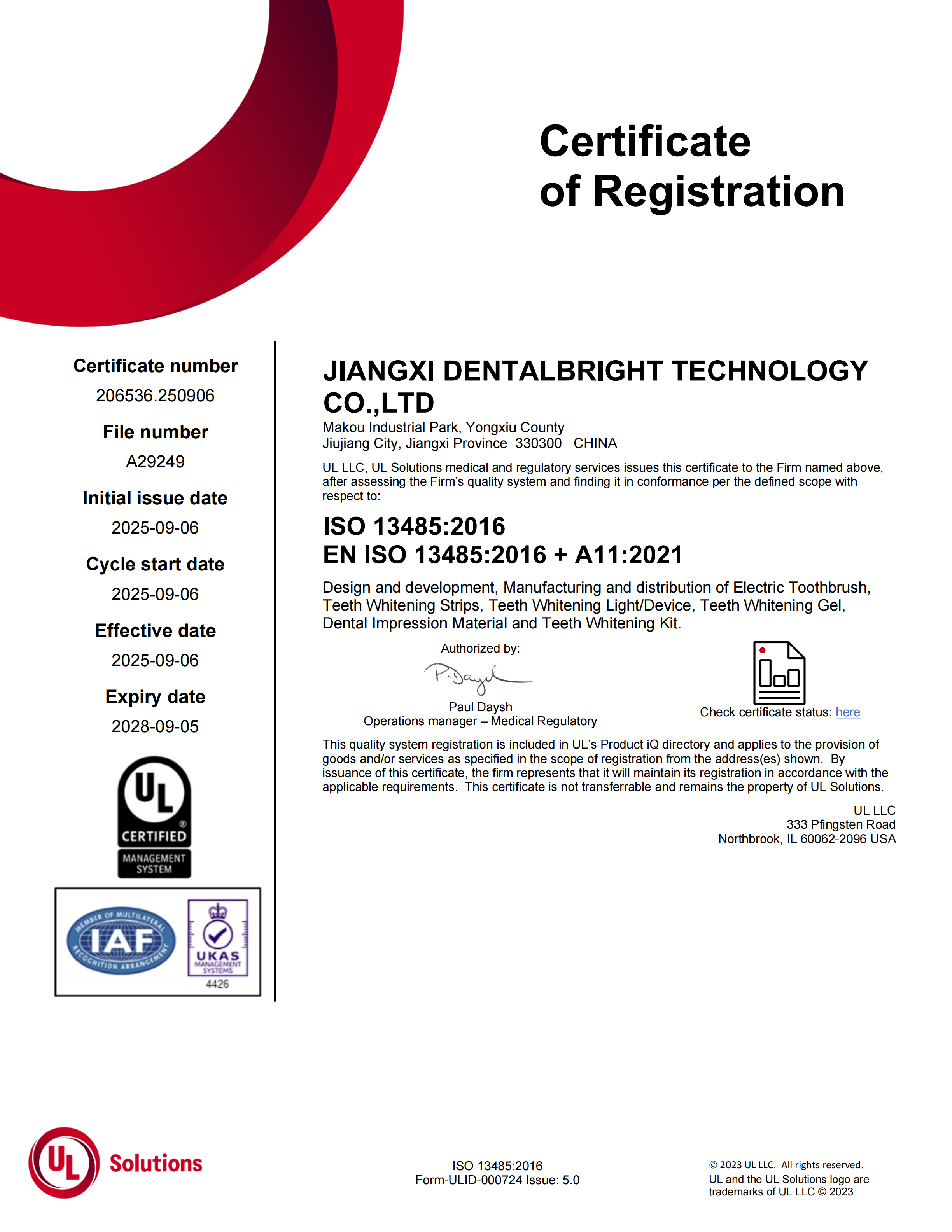
A certificate is evidence of a management system, and only within the scope printed on it. The useful question is not how many certificates a supplier lists but whether the wording covers strips, gel and kit assembly, and whether the holder is the contracting entity.
| Document | Issuer / reference | Scope as recorded | Valid to |
|---|---|---|---|
| ISO 13485:2016 / EN ISO 13485:2016 + A11:2021 | UL LLC — certificate 206536.250906 | Design, development, manufacturing and distribution of electric toothbrush, teeth whitening strips, whitening light/device, whitening gel, dental impression material and whitening kit | 5 Sep 2028 |
| ISO 22716:2007 (cosmetics GMP) | Intertek — certificate SZ2312B8 | Manufacture of whitening pens, strips, gels, powders, foams, mouth spray, purple corrector serum and toothpaste tablets; packaging of whitening kits | 12 Dec 2026 |
| GMPC — US FDA Cosmetic GMP Guidelines (2022) | Intertek — certificate SZ2312B9 | Same manufacturing scope plus packaging of whitening kits | 12 Dec 2026 |
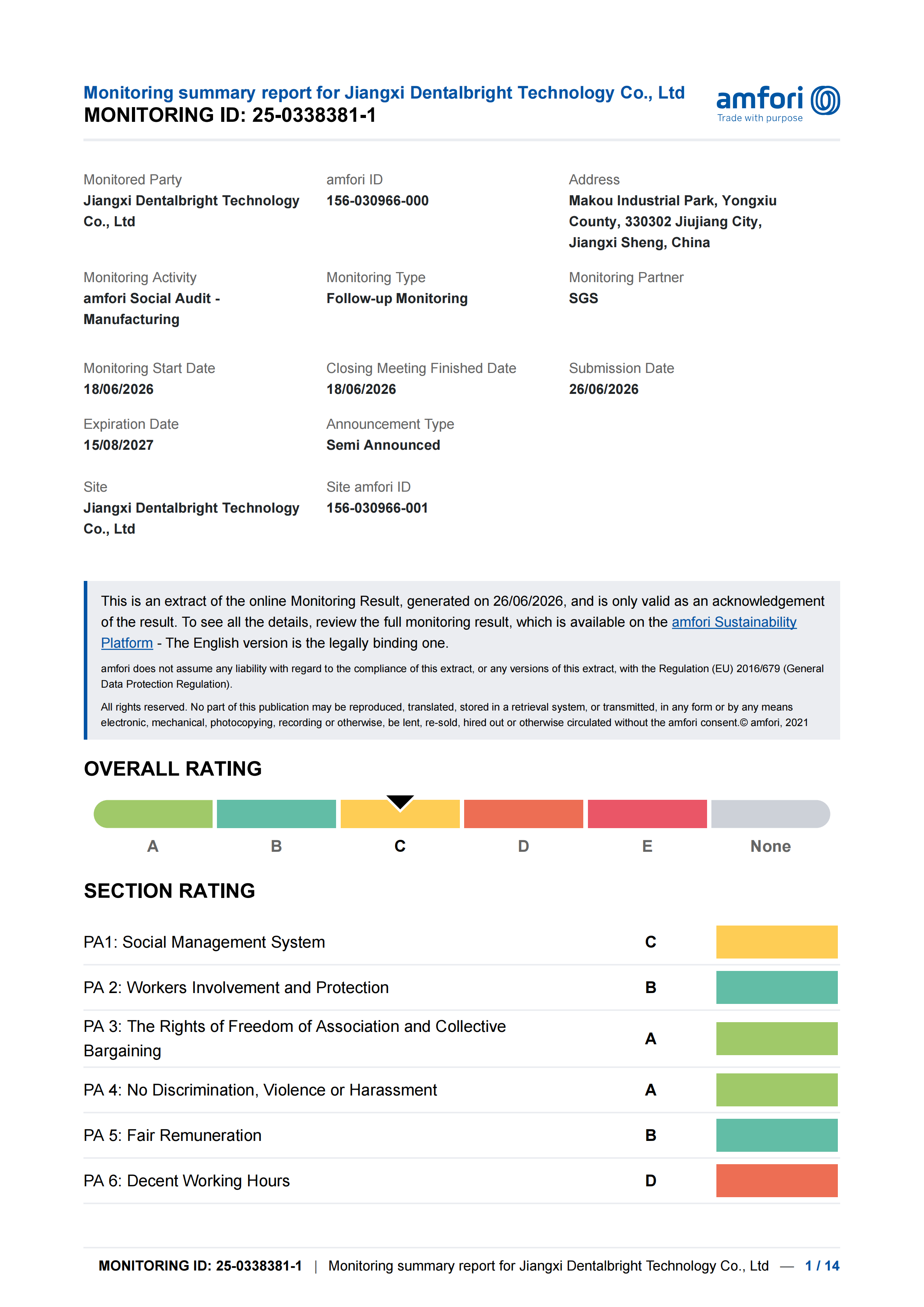
| amfori BSCI social audit | SGS — Monitoring ID 25-0338381-1, amfori Site ID 156-030966-001 | Manufacture of whitening gel, whitening light/device, whitening strips, toothpaste, electric toothbrush and mouthwash | 15 Aug 2027 |
Two of these documents do different jobs. ISO 13485 covers design and development as well as manufacturing, which means formulation and device changes should travel through a documented design-control route rather than an informal bench adjustment — the practical benefit for a buyer is that a mid-project formula change is more likely to be visible on paper before it reaches your packaging. ISO 22716 and GMPC are cosmetic GMP frameworks covering the gel, strip, pen and kit-packaging operations that a strip order actually uses.
MDSAP is listed among the site's certifications in the manufacturer's own profile. Because MDSAP audit scope is defined per site and per device family, the current certificate should be requested and its audited scope confirmed against the strip and kit lines rather than accepted as a general credential.
Dates are part of the evidence
The ISO 22716 and GMPC certificates carry a validity date of 12 December 2026, so renewal evidence should be part of order confirmation for 2027 delivery rather than a document assumed to roll forward. The same discipline applies to the product-level and market-level certificates: a VEGAN certificate numbered 22521 from the International Vegan Alliance covers 23 SKUs to 21 April 2027; a HALAL certificate numbered 52185957421871 from the Halal Foundation Center covers 22 SKUs with a stated validity of 21 November 2026, which a buyer planning 2027 shipments should confirm as the renewed version; and a Certificate of Free Sale for Indonesia, CFS No. 2026YB0548, runs to 1 March 2028.
Market dossiers sit beside the certificates
Certificates do not replace market filings. For the EU, the supplier states that cosmetic products can be supported with CPSR, CPNP notification and PIF, with an EU Responsible Person appointed, and that medical-device products hold MDR-CE certification with a complete technical file. For the United States, MoCRA-compliant cosmetic facility registration and product listing have been completed for teeth whitening strips; whitening lights, electric toothbrushes and oral irrigators hold FDA medical device registration, and the silicone impression material has completed 510(k) registration. Buyers should read those statements as documentary support for your own filings, not as authorisation to sell your SKU.
Patent and Design Registers: Verifying What a Supplier Claims to Own
Patent numbers are the part of a supplier presentation most often repeated and least often checked. A registration functions as a capability signal only when four elements line up: the number exists at the issuing office, the status is current, the proprietor matches the contracting entity or a disclosed affiliate, and the subject matter matches the product you intend to buy.
The most directly relevant record for a strip buyer is a United States utility patent, US 12,350,120 B1, granted 8 July 2025 with a stated term to 12 December 2044. It covers a gum-protecting and teeth-whitening strip built on an acrylic copolymer gelling agent with a marginal sealing effect, described as residue-free, together with the method of preparing it. Unlike a packaging registration, it speaks to formulation and process, which is the layer that determines whether a residue-free claim can be sustained across batches.
The portfolio also contains design registrations rather than formulation protection, and the distinction matters during due diligence. These include US D864,399 S for the ornamental design of teeth-whitening equipment (2019 to 2034), EU Registered Community Design 008220263-0001 for an upright rechargeable whitening apparatus (2020 to 2045), EU Registered Community Design 015146594-0001 and UK registered design 6535921 for a lips-integrated whitening device combining whitening and lip-plumping functions (2026 to 2031), and US D1,080,877 S for a diamond-shaped whitening device (2025 to 2040). They are relevant when a strip order is bundled with a device in a kit, and largely irrelevant to a strips-only programme.
Two limits to state plainly: a design registration protects appearance and does not establish whitening efficacy, and a patent granted in one jurisdiction says nothing about freedom to operate in another. A supplier deck that mixes design and utility records into a single "patented technology" line has told you less than it appears to.
Custom Gel and Strip Engineering: What Can Actually Be Specified
Customization is where supplier claims and production reality most often diverge. For the strip line, the recorded customization fields are strip type, active ingredient, residue-free or standard formulation, colour, flavour, packaging and labeling. Gel-bearing formats extend the same logic to viscosity and delivery-system compatibility, while kits add LED wavelength configuration, housing colour, logo printing, packaging structure, kit composition, and custom manuals and compliance labeling. Pens add formula composition, flavour, colour, packaging design, product form and efficacy combination.
Formula family first, price second
Three formula families are offered: PAP (peroxide-free), carbamide peroxide and hydrogen peroxide. The mechanism behind the choice is what determines positioning. Hydrogen peroxide and carbamide peroxide are small-molecule actives that penetrate enamel into dentin and break down deeper pigment through free-radical oxidation — fast and powerful, with a higher likelihood of temporary sensitivity, and regulated as a drug in most markets. PAP is a large-molecule surface-acting acid that does not penetrate tooth structure and oxidises surface stains instead — gentler, with slower visible change, and easier to launch as a cosmetic in many countries.
That single decision propagates through the whole project: the claim language on the carton, the filing route in the destination market, the sensitivity position on the listing page, and the market in which the product can be sold without reformulation. Choosing the gel before choosing the claim is the correct order.
Dry versus wet carrier
Dry strips adhere well, resist slipping, leave minimal residue and cost more. Wet strips adhere less firmly, tend to shift during wear and leave more residue, but cost less — and wet is the recommended carrier for purple V34 strips, where the higher residue helps the pigment stay in contact with enamel to produce a physical colour-correction effect. A buyer comparing quotes for "the same strip" may be comparing two different carriers.
Where customization stops
Not every combination of formula, flavour, packaging and MOQ is simultaneously available, because customization routes through sampling and quotation rather than a catalogue. The harder boundary is regulatory: a peroxide-free claim applied to a peroxide formula, or a drug-style efficacy claim attached to a cosmetic filing, is a compliance failure rather than a design preference, and it will surface at the border rather than in the sampling room.
MOQ, Delivery Terms and the Execution Handover
For this supplier, standard packaging carries a minimum order of 5 boxes, while OEM orders with customized packaging run from 100 to 1,000 boxes depending on the product and the packaging minimum, with the exact figure confirmed during quotation and sampling. Delivery terms offered are EXW, FCA, FOB and CFR; payment terms are 30% deposit in advance with the 70% balance before shipment; buyers may inspect on site, and the quality department can conduct pre-shipment random inspection.
Capacity claims should be read as company-reported figures and matched against your own volume. The strip line is stated at 29.2 million pieces per month, with annual output stated at 300 million strips. The site covers 36,000 m², including 20,000 m² of 100,000-class cleanrooms and a 1,000 m² laboratory with a 100-class cleanroom for microbiological testing, staffed by 256 people including 17 R&D engineers and 11 QC specialists, with a packaging design team of 6. Lead time varies with order volume, specification, customization complexity and the current production schedule, and a precise delivery timeline is provided at order confirmation.
The execution handover is where audits are usually undone. Before production, the following should be fixed in writing rather than agreed verbally: a retained golden sample signed by both parties, approved artwork and label copy per destination market, the pre-shipment inspection criteria and sampling plan, and a change-notification clause covering formulation, supplier of gelling agent, packaging material and printing origin. That last clause is what protects a brand from a silent substitution six months into a repeat order.
Warranty and After-Sales: What Belongs in Writing
Warranty language deserves the same treatment as a certificate. The useful question is not whether a supplier mentions a twelve-month period in a proposal, but what that period covers, what triggers a claim, who bears the evidence cost, and what the remedy is. A warranty converts support promises into obligations, and only the written clause does that.
The manufacturer documents a 24-hour after-sales response mechanism and full-lifecycle product quality assurance, with long-term strategic partners additionally receiving market intelligence briefings and national regulatory compliance guidance. These are support commitments rather than remedies. A supply agreement should therefore name the covered failure modes — adhesion loss, gel dry-out, seal integrity, sachet leakage, label non-compliance — the evidence a claim requires, the remedy in the form of replacement, credit or rework, and the response window against which the 24-hour mechanism is measured.
Where a twelve-month term is proposed, three details decide whether it has value: the start date, since cover dated from shipment and cover dated from arrival behave very differently on a 30-day sea leg; the interaction with your own shelf life and channel returns policy; and whether renewal orders inherit the original term or restart it. Extended partner support is described in general terms, so it should be scoped in the agreement rather than assumed at the quotation stage.
Application Fit: Where the Audit Changes the Answer
The same supplier can be a strong fit for one programme and a weak fit for another, because different channels gate on different evidence.
- Private-label e-commerce launch. The lowest MOQ path matters most, and the gating documents are the US MoCRA listing and the EU CPSR and CPNP package. Formula choice decides claim language, so PAP and peroxide programmes diverge before pricing is discussed.
- Pharmacy and supermarket promotional sets. Retail compliance teams ask for social-compliance evidence first, which is where the BSCI report and its scope wording become decisive, together with multi-language manuals and compliance labeling. A supplier-reported reference covers 7 million units over two years for pharmacy and supermarket promotional gift sets, with third-party BSCI and ISO audits and no returns recorded in large-batch inspection.
- Sensitive-teeth ranges. PAP and low-sensitivity formulas are the relevant options, and the positioning depends on keeping the sensitivity claim consistent with the filing route.
- Travel and hospitality kits. Individually wrapped strips, kit composition and packaging structure carry the value, and the customization fields above apply rather than the formula ones.
- Professional and clinic channel. The relevant products shift to whitening kits, gel and devices, where MDR-CE certification and the technical file matter more than the strip-line certificates.
Sample-Only versus Entity-Level Verification
The two approaches answer different questions, and the gap between them is the reason audits exist.
| Evidence | What it establishes | What it cannot establish |
|---|---|---|
| Sample pack | Appearance, adhesion, residue, flavour of one lot | Which entity manufactured it, or whether the next lot matches |
| Certificate copy | That a management system was audited for a stated scope and period | That your SKU is authorised in your market, or that the scope covers your product |
| Patent or design number | That a specific filing exists with a named proprietor | Whitening efficacy, or freedom to operate in another jurisdiction |
| Written MOQ, delivery and warranty clause | The commercial obligations and remedies that apply to your order | Production capacity, unless supported separately |
| Social audit report | Third-party assessment of labour and social compliance at the site | Product quality or formulation consistency |
Boundaries of This Evidence
Four limits should travel with the file. First, certification is system-level: it evidences audited process, not a marketing authorisation for your specific SKU in your specific market. Second, patents are jurisdictional and do not establish efficacy — a residue-free formulation patent describes a composition and method, not a measured whitening outcome. Third, capacity and output figures are company-reported and are not presented here as third-party audited data. Fourth, validity dates move: certificates dated to December 2026 or November 2026 need current copies at order confirmation, not the version filed during the first enquiry.
A fifth limit applies to MOQ. The 5-box and 100-to-1,000-box figures describe category-level terms that depend on product and packaging, so the binding number is the one in the signed quotation, not the one in this article.
Outlook: Documentation Depth as a Selection Criterion
If a launch market requires a cosmetic safety report, a CPNP notification, an EU Responsible Person or a MoCRA product listing, then the supplier's ability to produce those documents on a schedule becomes a selection criterion alongside price per strip. That is a conditional statement rather than a market forecast: it holds where the filing requirement applies, and it does not apply equally to every destination or every formula family.
The practical consequence is a shift in what buyers ask for in the first meeting. A supplier that can move from certificate scope to register entry to customization field to written warranty clause in one conversation is easier to audit than one that answers each question with a brochure page — and the difference is visible before a single strip is sampled.
FAQ
Which certifications should a teeth whitening strips supplier be able to show?
At minimum, a quality management system certificate whose written scope names whitening strips and gel, a cosmetics GMP certificate covering strip and gel manufacture, and a social-compliance audit report if your channel requires one. For this supplier the documented set includes ISO 13485:2016 and EN ISO 13485:2016 + A11:2021 under certificate 206536.250906 issued by UL LLC, ISO 22716:2007 under certificate SZ2312B8 and GMPC under certificate SZ2312B9, both issued by Intertek, and an amfori BSCI audit monitored by SGS under Monitoring ID 25-0338381-1. MDSAP is listed among the site's certifications, and its audited scope should be confirmed against the strip and kit lines on the current certificate.
How can a buyer verify a supplier's patent claim?
Check four things at the issuing office: that the number exists, that the status is current, that the proprietor is the contracting entity or a disclosed affiliate, and that the subject matter matches the product being bought. Distinguish utility from design records. For strips, the relevant example is US utility patent 12,350,120 B1, granted 8 July 2025 with a stated term to 12 December 2044, covering a gum-protecting residue-free strip based on an acrylic copolymer gelling agent and its preparation method. Design registrations such as EU RCD 008220263-0001 or UK registered design 6535921 protect the appearance of whitening devices and do not evidence formulation capability.
What is the difference between the standard and private-label minimum order quantity?
Standard orders in existing packaging carry a minimum of 5 boxes. OEM orders with customized packaging run from 100 to 1,000 boxes depending on the product and the packaging minimum, because the binding constraint is usually the custom packaging rather than the strip itself. The exact figure is confirmed during quotation and sampling, and it should appear in the quotation rather than only in correspondence.
Which elements of a whitening strip or kit can be customized?
For strips, the recorded fields are strip type, active ingredient, residue-free or standard formulation, colour, flavour, packaging and labeling. Kits add LED wavelength configuration, housing colour, logo printing, packaging structure, kit composition, and custom manuals and compliance labeling. Pens add formula composition, flavour, colour, packaging design, product form and efficacy combination. Formula family — PAP, carbamide peroxide or hydrogen peroxide — should be decided first, because it determines claim language and the applicable filing route.
What should a supply agreement cover on warranty and after-sales?
The covered failure modes, the evidence a claim requires, the remedy in the form of replacement, credit or rework, and the response window. If a twelve-month term is proposed, the start date should be stated explicitly, whether from shipment or from arrival, and the interaction with your own shelf life and returns policy should be defined. The supplier documents a 24-hour after-sales response mechanism and full-lifecycle product quality assurance, which set the support expectation that the written clause then converts into an obligation.
Does a supplier's certificate authorise my product for sale in my market?
No. Certification evidences an audited management system within a stated scope; it is not a market authorisation for your SKU. Market entry depends on your own filings, supported by supplier documentation such as CPSR, CPNP notification and PIF with an appointed EU Responsible Person for EU cosmetic products, MDR-CE certification and a technical file for medical-device products, and MoCRA-compliant facility registration and product listing for teeth whitening strips in the United States.
Conclusion
Auditing a teeth whitening strips supplier is a document exercise before it is a product exercise. Certificate scope establishes which manufacturing system stands behind the order, register entries establish whether a claimed capability is real and what kind of protection it actually is, customization fields establish what can be specified and where regulatory claims stop, and the written MOQ, delivery and warranty terms establish what happens when something goes wrong. Samples belong in that sequence, but they belong after the evidence rather than instead of it.
A downloadable overview of the manufacturer's product range and capabilities is available in the company catalogue (PDF).
¿Tiene preguntas o necesita más detalles?
Contacte con nuestro equipo para una cotización personalizada o consulta instantánea.
Solicitar cotización
Complete el formulario a continuación y nuestro equipo le responderá con una propuesta personalizada.
Chat directo de WhatsApp
¿Prefiere chatear en tiempo real? Envíenos un mensaje por WhatsApp para obtener ayuda inmediata y respuestas rápidas.
- Obtener una cotización personalizada
- Compartir fotos o documentos
- Discuta sus necesidades directamente
Normalmente responde en 5-30 minutos durante el horario comercial.