
From C5 to IP66: Decoding the Environmental Certifications of the SolisStorage ESS Line
From C5 to IP66: Decoding the Environmental Certifications of the SolisStorage ESS Line
The environmental ratings of an energy storage system describe the conditions a unit is engineered to survive, not the conditions it was conceived for on paper. For the SolisStorage ESS line, two ratings recur in project specifications and technical documentation: IP66 ingress protection on the power electronics, and, for coastal and industrial outdoor sites, a C5 anti-corrosion requirement. Understanding how those two designations are structured — and where their boundaries sit — has become a routine part of technical due diligence in energy storage procurement.
SolisStorage is the energy storage subsidiary of Ginlong (Solis) Technologies Co., Ltd., a power electronics company founded in 2005 and listed on the Shenzhen Stock Exchange (stock code: 300763). Its product portfolio spans residential energy storage, commercial and industrial (C&I) systems, and utility-scale applications, manufactured at a facility covering 98,114.69 square meters with an annual production capacity of 80 GW, and deployed in more than 100 countries. Third-party tracking by Wood Mackenzie placed Ginlong (Solis) first worldwide in residential PV inverter shipments in 2023 and third among inverter manufacturers globally — a useful reference point, though it says nothing directly about enclosure ratings.
That distinction matters. A company can hold a strong position in power electronics while still needing to prove, project by project, that its enclosures, coatings, and thermal architecture match a specific site. This article examines what IP66 and C5-class anti-corrosion actually describe, how the SolisStorage portfolio maps onto those requirements, and which parts of the environmental envelope buyers should verify themselves rather than assume.
Why environmental ratings decide whether an ESS project ages well
Most energy storage tender packages lead with rated energy capacity, inverter power rating, and cycle life. Site exposure is frequently relegated to a footnote — an assumption that "outdoor rated" is a single, uniform condition. It is not. Outdoor installation covers everything from a shaded residential courtyard in Central Europe to a salt-fog-exposed coastal industrial yard and a high-altitude site with wide daily temperature swings. Each of those environments stresses an enclosure differently.
The failure modes associated with under-specified environmental protection are well documented at the industry level: moisture ingress through cable entries and seals, dust accumulation that degrades cooling paths, progressive corrosion of fasteners and cabinet surfaces in chloride-rich air, and thermal stress that shortens the service life of power electronics. None of these appear as an electrical specification. They appear years later as elevated maintenance cost, unplanned downtime, and, in the worst cases, disputed warranty or insurance claims.
The commercial consequence is straightforward. A C&I storage asset is typically planned against a 10 to 15 year operating horizon, and the environmental specification defines how much of that horizon is spent generating revenue rather than absorbing intervention. For a residential system, the equivalent question is whether a homeowner can mount the unit in an outdoor position — exposed to rain, dust, and temperature cycling — without it becoming an annual service item.
Reading the two rating systems: IP codes and corrosion classes
Two separate rating languages appear side by side in ESS documentation, and they answer different questions.
Ingress protection (IP). An IP code carries two digits. The first describes protection of people and equipment against solid objects and dust; the second describes protection against liquids. In the SolisStorage documentation, IP66 is described as dust-tight and protected against powerful water jets. IP55, applied to the EverCore battery cabinet, is a lower liquid-jet classification and a different dust classification than IP66 — both ratings protect against dust and water, but at different severities. The practical implication is that an IP55 enclosure and an IP66 enclosure should not be treated as interchangeable in a specification table.
Corrosion class (the C-scale). Separate from ingress protection, the C-category system used in project specifications grades the corrosivity of an atmospheric environment, from the mildest category upward, with C5 representing a demanding corrosive environment of the kind associated with coastal salt fog and aggressive industrial atmospheres. A coating or enclosure declared at a given C-class is a durability statement about the material system, not about water or dust entry. In the SolisStorage application scenario data, the outdoor household and industrial outdoor scenario is explicitly tied to a requirement of IP66 and IP55 protection together with C5 anti-corrosion.
Where the SolisStorage line sits: a rating-by-rating map
The SolisStorage portfolio is organized around three product families with different scopes. The table below consolidates the published specifications most relevant to environmental qualification. Where the published data used here does not state a value, that is noted rather than inferred.
| Product | Application scope | Battery | Rated energy / power | Ingress protection | Cycle life |
|---|---|---|---|---|---|
| IntelliHome | Residential, household and household outdoor | LiFePO4, 100 Ah rated cell capacity, 44.8–57.6 V operating range, 50 A recommended charge/discharge current | 5 kWh nominal capacity | IP66 | >6,000 cycles, corresponding to 10 years |
| EverCore ESS | C&I, renewable energy and power grid industry | LFP, EVE 3.2 V / 314 Ah cells | 100.5 / 120.6 / 261.2 kWh; inverter 50 / 60 / 125 kW | Cabinet IP55, inverter IP66 | 8,000 cycles |
| FlexCore-ID | Stackable, small farms, shopping malls, hospitals, large residences, small C&I | LFP, 314 Ah cells; pack model FlexCore-ID-BAT20kWh | Not stated in the published data used here | Not stated in the published data used here | ≥8,000 cycles at 25±2°C, 0.5P, EOL70% |
All three families are built on an aluminum alloy casing with core electronic components. The two environmental figures that a buyer can act on immediately are the IntelliHome IP66 rating at the residential end and the split IP55/IP66 architecture at the C&I end. FlexCore-ID is best evaluated on its stackable architecture and cycle-life data; its published specification does not include an ingress protection or corrosion class figure, and that gap is itself something a buyer should close with the supplier before shortlisting.
Why the inverter carries IP66 and the cabinet carries IP55
The split rating on EverCore is not an inconsistency in the specification; it is a direct outcome of the platform's AC-DC separation architecture. In that design, the hybrid energy storage inverter (AC side) is physically separated from the battery cabinet (DC side), with each component occupying its own dedicated enclosure rather than sharing a single thermal and environmental volume.
The design produces three consequences that a technical buyer can evaluate.
Thermal separation. Because the inverter sits outside the battery cabinet, roughly 6 kW of power-stage heat is dissipated directly into the ambient environment, leaving approximately 3.5 kW of electrochemical heat to be managed inside the cabinet. The company describes the resulting cell temperature uniformity as approaching that of liquid-cooled designs while retaining an air-cooled architecture — on the reasoning that reducing heat generation is more efficient than increasing heat-dissipation capacity.
Protection separation. As an independent unit, the hybrid energy storage inverter is rated IP66, while the battery cabinet is maintained at IP55. SolisStorage states that, based on its power electronics experience, this separated protection design reduces the system's full-lifecycle failure rate by 50%. That figure originates from the manufacturer and should be read as a design-intent statement rather than an independently audited outcome.
Structural separation. The separated DC side also enables independent expansion: a single inverter can connect up to six battery cabinets in parallel, allowing storage capacity to be added linearly without additional inverter investment. The company puts the associated reduction in system expansion cost at approximately 10% — a directly relevant figure for C&I owners who plan phased construction against limited initial capital budgets.
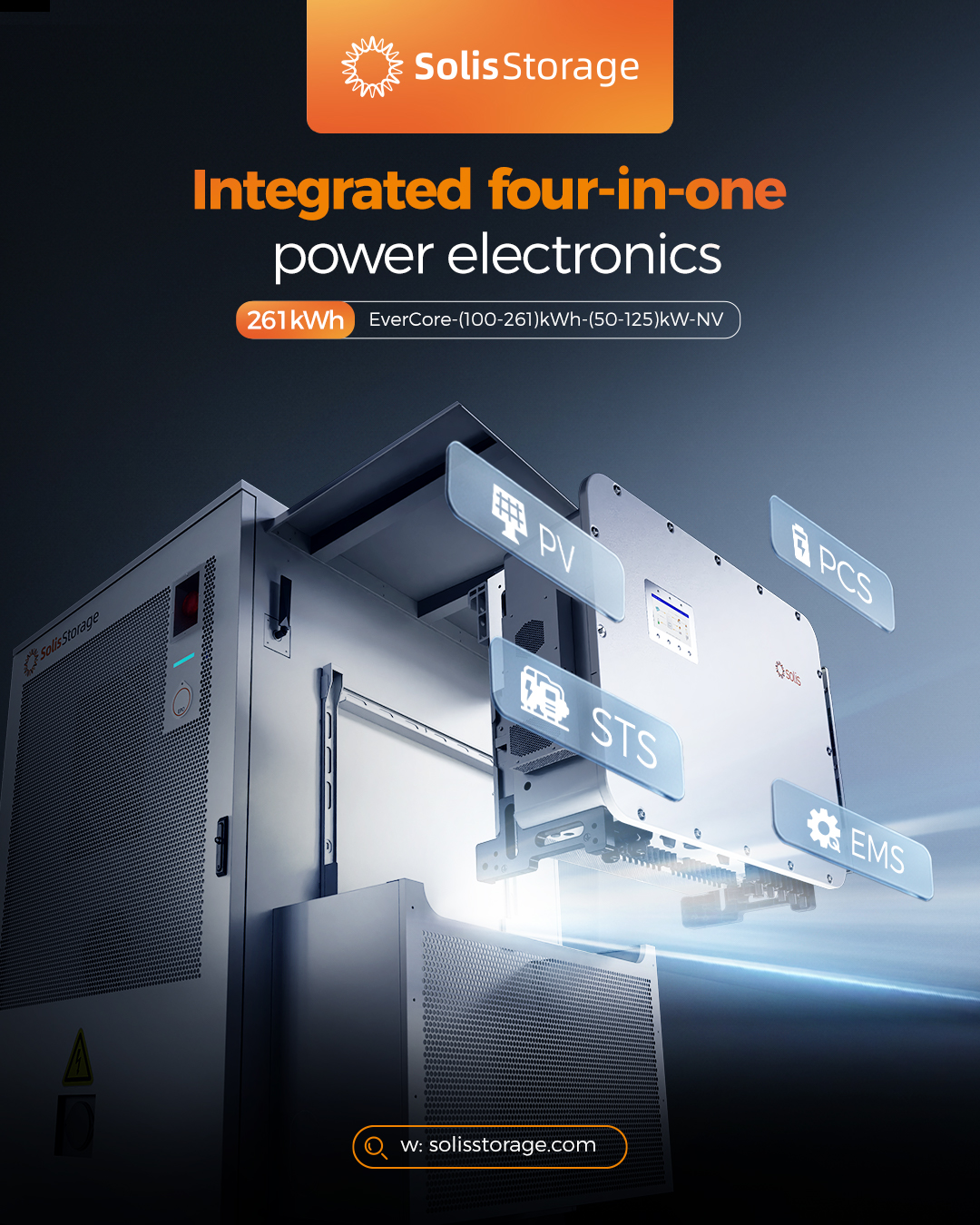
The same integrated philosophy extends to the inverter itself: SolisStorage integrates PCS, static transfer switch, PV inverter, circuit breaker protection, and EMS into a single 50–125 kW hybrid unit. The company states that this achieves seamless grid-tied to off-grid switching in less than 10 ms without an external STS, supports both DC and AC coupling with a PV over-sizing ratio of up to 200%, and allows up to six units to be connected in parallel for direct grid connection without an external grid cabinet. Control is handled by a single central controller rather than independent CPUs for BMS, PCS, EMS, and STS — a design choice that reduces the number of communication links and, with them, protocol compatibility and fault-location risk.
The C5 question: corrosion class in coastal and industrial outdoor sites
Project documentation for coastal and industrial outdoor deployments commonly specifies C5 anti-corrosion performance alongside IP66 and IP55 ingress protection. That combination appears in the SolisStorage application scenario data for outdoor household and industrial outdoor installations subject to coastal salt fog, high altitude, and wide temperature ranges — conditions found in markets such as Australia, Germany, France, and other countries where the scenario is listed as typical.
Where does the product stand against that requirement? Two different pieces of information are involved. The published specification for the EverCore ESS reports its anti-corrosion class field as IP55 (cabinet) plus IP66 (inverter) — that is, it reports ingress protection. The company's technical description of the platform separately references C4-grade anti-corrosion coating standards, and links that coating specification with stable operation from −25°C to 55°C and at altitudes up to 4,000 meters.
This is precisely the kind of gap that separates a clean handover from a delayed one. Corrosion documentation is rarely the largest line item in a storage budget, but it is frequently the one that determines whether an owner is arguing about a warranty in year six or replacing fasteners and cabinet panels.
Temperature and altitude: the rest of the environmental envelope
Ingress protection and corrosion class describe the enclosure's resistance to its surroundings. Temperature and altitude describe whether the system can perform inside those surroundings in the first place.
SolisStorage states that EverCore operates across an ambient range of −25°C to 55°C and at altitudes of up to 4,000 meters — a stated envelope that spans high-temperature desert conditions and cold European winters. Supporting that claim is an air-cooled thermal design built on three separate air ducts: a diversion air duct for the hybrid energy storage inverter, combined with airflow attachment across battery pack surfaces. The company reports that this combination improves system heat dissipation efficiency by 30% compared with traditional air cooling, and describes it as breaking the assumption that large-capacity cells necessarily require liquid cooling.
The deployment context behind those numbers is continuous operation: 24/7 running, grid-tied and off-grid modes, and seamless backup switching, applied to peak load shifting, backup power supply, and self-consumption of PV power. In project terms, the system is intended for energy storage integration, grid stability retrofitting, peak shaving and frequency regulation, and virtual power plant related work — duty cycles in which unplanned thermal derating translates directly into lost revenue or lost backup capability.
Environmental ratings are not safety certification
A frequent source of confusion in early-stage procurement is the assumption that a strong IP or corrosion rating covers fire safety obligations. It does not. These are parallel and complementary certification tracks.
For North American market access, energy storage systems must comply with UL 9540 for system safety and UL 9540A for thermal runaway fire propagation testing, according to UL Solutions. For industrial and energy storage battery cells and packs, IEC 62619 is the key international safety standard. Neither addresses whether an enclosure will resist a salt-fog environment for a defined period, and an IP66 enclosure does not by itself satisfy a fire-propagation test protocol.
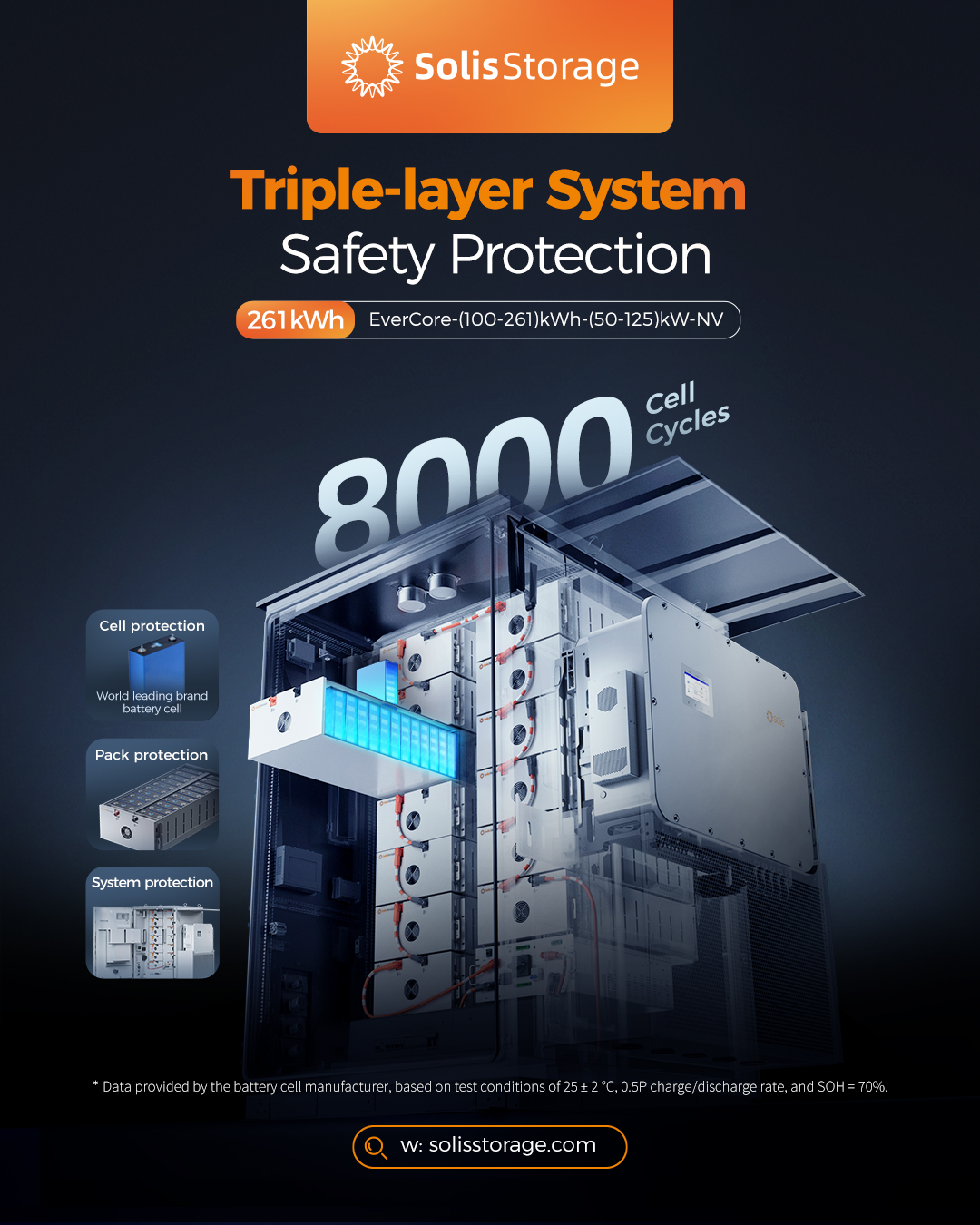
How the two tracks interact is worth understanding. SolisStorage describes a 15-layer protection system spanning cell, pack, and system levels, with thermal insulation material rated to resist 1,000°C placed between packs to block lateral thermal runaway propagation, and a three-stage fire suppression approach covering pack-level aerosol, cabinet-level aerosol, and fire-fighting water channels. The cell itself is an A-grade 314 Ah LFP cell developed for C&I applications, quoted at an internal resistance of 0.15±0.05 mΩ against 0.17 mΩ for standard 280 Ah cells. Because every 10% reduction in internal resistance reduces charge-discharge heat generation by approximately 20%, the choice is also a thermal-management decision. The company quotes 8,000 cycles at 0.5C with remaining capacity of at least 70% — an improvement of roughly 14% over the 7,000 cycles of traditional 280 Ah cells, extending the stated economic lifecycle from approximately 14 years to 16 years at 500 cycles per year.
Read together, the environmental and safety specifications answer different questions for different stakeholders: ingress and corrosion ratings speak to asset durability and maintenance exposure, while fire-safety certification speaks to permitting, insurance underwriting, and owner confidence.
Market context: more capacity is being placed in harder conditions
The commercial relevance of enclosure ratings scales with deployment volume and with where that volume is installed. Global Market Insights values the global energy storage systems market at approximately USD 668.7 billion in 2024, projected to reach USD 5.12 trillion by 2034. That figure spans all storage technologies. Battery-focused estimates run considerably lower — an important caveat, since market-size figures for this category vary substantially depending on whether pumped hydro and other non-battery technologies are included in the scope.
Within the battery segment, MarketsandMarkets estimates the residential energy storage market at USD 2.69 billion in 2024, growing to USD 4.58 billion by 2030 at a CAGR of 9.3%, and values the long-duration energy storage market at USD 4.85 billion in 2024 with a CAGR of 13.6% through 2030. On the supply side, Reuters reported that China's exports of lithium-ion batteries for energy storage and non-automotive uses exceeded USD 65 billion in 2024, a 51.4% increase year on year — an indicator of how much hardware is now moving into field installation.
The procurement implication is that specification committees are increasingly comparing offers whose headline capacity and power figures have converged. Once capacity, power, and chemistry are broadly similar across shortlisted systems, the differentiators shift to durability documentation: subsystem-level ingress ratings, coating classes with test evidence, derating data, and the maintenance model over a 10 to 15 year horizon.
Boundaries and trade-offs buyers should verify
A neutral evaluation of any environmental specification should include its limits. Four are worth raising in the context of the SolisStorage line.
Air cooling depends on maintained airflow. The EverCore architecture retains air cooling rather than liquid cooling. That choice removes liquid coolant circuits, fluid replacement, and the associated service procedures. Against it, air-cooled systems depend on duct integrity, filter condition, and unobstructed air paths over the full operating life; a neglected filter changes the thermal behaviour of the system. SolisStorage quantifies the trade-off in lifecycle terms, stating that over the full project lifecycle EverCore saves customers approximately €9,500 per unit in O&M costs by eliminating liquid cooling fluid replacement (€2,500), simplifying PCS replacement (€1,500), simplifying pack replacement (€1,500), and reducing routine inspection complexity (€4,000). These are manufacturer figures based on industry experience and should be validated against the buyer's own service model and labour rates.
An IP55 cabinet still depends on installation practice. The battery cabinet's IP55 rating is achieved at the enclosure level. Cable entries, sealing, and field assembly determine whether the installed system performs at that level. Buyers should confirm installation and sealing requirements as part of the scope, not as an assumption.
The stated envelope has edges. −25°C to 55°C and 4,000 meters describe the conditions the manufacturer states the product operates within. They are not a flat performance guarantee across the whole range — temperature and altitude typically affect available power and thermal margin. Site conditions beyond the stated envelope should be treated as outside the standard specification.
Coating class must match the site, not the catalogue. As noted earlier, the distinction between a C4-grade coating reference and a C5 project requirement is a real one, and it is resolved by documentation and, where necessary, project-specific specification rather than by assumption.
A pre-shortlist verification checklist
The following checklist translates the discussion above into items that can be requested in writing during the research and evaluation stage.
| Verification item | Why it matters |
|---|---|
| IP rating stated per subsystem (inverter, battery cabinet, ancillary equipment) | A single system-level IP figure can conceal a lower-rated enclosure; EverCore's published data distinguishes IP66 inverter and IP55 cabinet. |
| Corrosion class offered for the specific site, with supporting test documentation | Determines whether the offer satisfies a C5-category requirement in coastal salt fog or aggressive industrial air. |
| Stated ambient temperature range and any derating curves | Distinguishes a stated envelope of −25°C to 55°C from guaranteed full output across that range. |
| Maximum altitude rating | Relevant for high-altitude sites; the stated figure for EverCore is up to 4,000 m. |
| Safety certification scope (UL 9540, UL 9540A, IEC 62619) | Environmental ratings do not cover fire propagation or system safety obligations. |
| Cooling architecture and maintenance access requirements | Air-cooled designs require duct, filter, and airflow maintenance planning over a 10–15 year asset life. |
| Applicable cell specification and cycle-life test conditions | Cycle-life figures are only comparable when the test conditions (for example 0.5P, 25°C, EOL criteria) are stated. |
Future outlook
Environmental qualification is shifting from a compliance formality to a documented procurement requirement. Three forces are pushing in the same direction.
First, deployment geography is broadening. Residential and C&I storage is increasingly installed in outdoor positions in coastal, high-altitude, and high-temperature locations where corrosion and thermal stress are the dominant aging mechanisms rather than an edge case. Second, revenue models are becoming more demanding. As C&I assets move from simple peak-valley arbitrage toward grid ancillary services, demand response, and virtual power plant participation, availability itself becomes a revenue variable — a system offline for enclosure or thermal maintenance is a system not earning. Third, procurement teams are standardizing their checklists. As more tenders ask for subsystem-level IP ratings, declared coating classes with evidence, and derating data, suppliers that publish those values clearly will face fewer clarification loops.
For buyers at the research stage, the practical takeaway is narrow and useful: treat environmental ratings as a document set to be requested and verified, not as a single number to be compared. The questions worth asking early are the ones that are expensive to answer late.
FAQ
What does IP66 mean on an energy storage system?
IP66 is an enclosure rating expressed in two digits. The first digit refers to protection against solid particles and dust, where 6 indicates dust-tight construction; the second refers to protection against liquids, where 6 indicates protection against powerful water jets. On the SolisStorage line, the rating applies to specific subsystems rather than to a whole plant: the IntelliHome residential energy storage system carries an IP66 rating, and on the EverCore C&I system the hybrid energy storage inverter is rated IP66.
Why does the EverCore C&I system list two different IP ratings?
Because the system is built with physically separated AC and DC sides. The hybrid energy storage inverter operates as an independent unit and is rated IP66, while the battery cabinet is rated IP55. The published anti-corrosion class field for the EverCore ESS is therefore written as IP55 (cabinet) plus IP66 (inverter). For comparison purposes, subsystem-level ratings are more informative than a single system-level figure.
What is the difference between C4 and C5 anti-corrosion requirements in storage projects?
C4 and C5 refer to corrosion classes applied to coatings and enclosures, with C5 describing a more demanding corrosive environment of the kind associated with coastal salt fog and aggressive industrial atmospheres. In the SolisStorage documentation, the technical description of the EverCore platform references C4-grade anti-corrosion coating standards, while the outdoor application scenario data for coastal salt fog, high altitude, and wide temperature range lists a C5 anti-corrosion requirement. Projects specifying C5 should confirm the coating class offered for their specific site and obtain the associated documentation, since coating class is determined by the installation environment.
Can an air-cooled C&I energy storage system operate in high-temperature or coastal environments?
SolisStorage states that the air-cooled EverCore design operates in ambient temperatures from −25°C to 55°C and at altitudes of up to 4,000 meters. The company attributes this to a three-duct thermal architecture that it reports improves heat dissipation efficiency by 30% compared with traditional air cooling, and it pairs the design with IP66/IP55 protection levels. Air-cooled systems depend on duct integrity, filter condition, and unobstructed airflow, so maintenance planning forms part of the operating requirement. Liquid-cooled alternatives manage heat differently, and the appropriate choice depends on the site's ambient profile and the owner's service capability.
Do IP and corrosion ratings replace UL 9540 or IEC 62619 certification?
No. They address different questions. IP ratings and corrosion classes describe how an enclosure resists dust, water, and atmospheric corrosion. UL 9540 covers energy storage system safety and UL 9540A covers thermal runaway fire propagation testing for access to the North American market, while IEC 62619 is the key international safety standard for secondary lithium cells and batteries used in industrial and energy storage applications. A complete project package generally requires both environmental documentation and the applicable safety certifications.
Reference material: Solis Global Brochure (PDF) — Solis-Global-Brochure-V3.9.pdf