
From Arch Wires to Face Masks: Orthodontic Scenario Fit
From Arch Wires to Face Masks: Orthodontic Scenario Fit
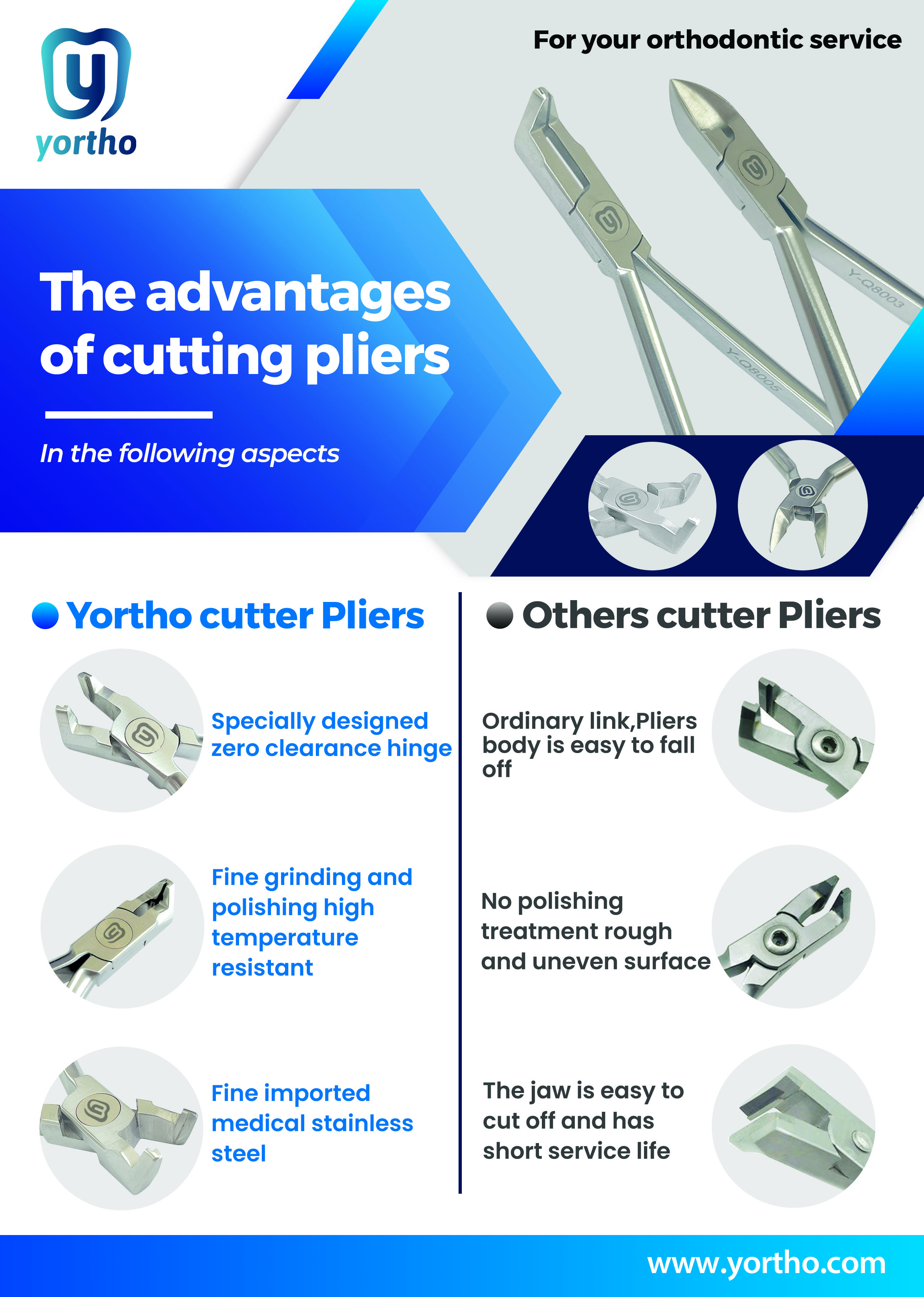
Chairside instruments sit at the centre of scenario-fit procurement: one practice may need a light wire cutter, a distal end cutter and a band remover within the same treatment week. Image: Yortho.
Orthodontic practices do not buy materials as an abstract category. They buy whatever a specific patient needs on the tray that morning: a low-force nickel-titanium wire for an early alignment appointment, a distal end cutter for a finishing adjustment, or a preformed pediatric crown for a primary molar that has to hold space until the permanent tooth erupts. The question behind most orthodontic purchasing decisions is therefore not how large a catalogue is, but whether one supply relationship covers the scenarios a practice genuinely treats.
This reference maps the Yortho orthodontic materials portfolio to seven clinical scenarios - alignment, chairside procedures, force management, attachment needs, palatal development, maxillary protraction and pediatric restoration - and sets out the decision logic that links each scenario to a product category. Yortho is an orthodontic materials brand under YAM Global Limited, supplied by Zhejiang YO Medical Technology Co., Ltd, a manufacturer based in Huzhou, Zhejiang Province, China that operates its own factory and exports orthodontic, pediatric dental and dental laboratory products to more than 70 countries. Where figures appear below with the label manufacturer-reported, they are the supplier's own production or clinical claims and are identified as such rather than presented as independently verified results.
Why scenario fit matters more than catalogue size
Two figures frame the problem. Global orthodontic supplies were valued at USD 14.8 billion in 2024 (Global Market Insights), while the narrower consumables segment alone was estimated at USD 3.1 billion in 2024 with a projection of USD 4.3 billion by 2030 (Grand View Research). These numbers do not contradict each other; they measure different scopes, and treating them as a single benchmark is a common sourcing error.
Where demand is decided matters as much as how large it is. More than 50% of end-user demand flows through orthodontic clinics and standalone practices (Grand View Research), which means the scenario decision - which wire, which instrument, which appliance - is made chairside rather than in a central purchasing department. Case mixes are broad: malocclusion prevalence is estimated at between 39% and 93% of adolescents depending on population and assessment criteria (J Dent & Oral Disord), and the 13-19 age band is identified as the primary growth driver for orthodontic treatment globally (Straits Research).
The procurement consequence is straightforward. A clinic or distributor serving a mixed caseload needs coverage across several scenario categories at once. A portfolio that addresses only one of them pushes the remaining coordination back onto the buyer: separate vendors, separate document sets, separate reorder cycles, and compatibility questions that surface during treatment instead of before it.
Seven clinical scenarios and what each one requires
1. Alignment phases - arch wires
Arch wires carry the mechanics of alignment and levelling. The Yortho range covers four material lines: Y-SN super-elastic NiTi, Y-HN heat-activated NiTi, Y-TMA titanium-molybdenum alloy wires and Y-SS stainless steel wires. All four are supplied in round and rectangular cross-sections from 0.012'' to 0.020'', in upper and lower arch versions, and in arch forms including Square, Natural, Damon, Oval, Europa-I and Broad.
The decision logic follows material behaviour rather than brand preference. Nickel-titanium alloys are chosen during initial alignment and levelling because of their super-elasticity and shape memory; TMA wires are used where a clinician needs formability with moderate stiffness; stainless steel is used for finishing and for mechanics that require higher stiffness and more predictable torque expression. Nickel-titanium arch wires are widely described in orthodontic technical literature as the reference material for continuous low-force alignment, a property that depends on cross-section tolerance and surface finish rather than on the alloy name alone.
Manufacturer-reported specifications for the heat-activated NiTi line include an Af phase-transition tolerance of plus or minus 0.8 ℃, a surface roughness of Ra ≤ 0.08 μm, permanent deformation of ≤ 7%, and a stated replacement interval of 6-8 weeks. These are supplier figures. Their practical value is as a specification reference for a sample or incoming-goods check, not as a substitute for one.
2. Chairside procedures - pliers and hand instruments
Chairside work consumes a different product category altogether. The portfolio includes light wire cutters and heavy cutters (Y-Q8001 light wire cutter 0°, Y-Q8005 distal end cutter, Y-Q8008 heavy cutter), forming and utility pliers (Y-Q6015 Kim pliers, Y-Q6018 Tweed loop pliers, Y-Q6026 crimpable hook pliers, Y-Q6030 light wire pliers, Y-Q3002 tear drop pliers, Y-Q3001 hole punch pliers), removal instruments (Y-Q5001 bracket removing pliers, Y-Q5005 band remover with long tips) and supporting hand instruments (Y-Q5010 Mathieu needle holder, Y-X101 and Y-X104 bracket positioning gauges, Y-X201 lingual bracket tweezers, Y-X202 bracket tweezer, Y-X203 tube tweezers with long tips, Y-X303 intraoral mirror).
The parameters that matter here are hardness, sterilization tolerance and tip geometry. Plier hardness is specified between HRC 58-63, HRC 55-60 or HRC 50-55 depending on the model, with a maximum sterilization temperature of 180 ℃. Tweezers are autoclavable up to 134 ℃. The intraoral mirror is supplied in stainless steel and glass in large, small, occlusion and lateral types.
Manufacturer-reported claims for the plier range include a service life of at least five years and roughly 30% improvement in surface smoothness and material gloss compared with the products the supplier benchmarks against. For a buyer, the operational point is that reusable instruments behave like capital equipment: hardness and sterilization tolerance determine whether the tool survives repeated autoclave cycles, and that is a lifecycle cost question, not a unit price question.
3. Force management - ligatures, power chains and auxiliaries
Force delivery between appointments is handled by elastic and auxiliary components. The range includes Y-S80201 ligature rings (Normal and Ring clear, packed 40 pcs/bag and 10 pcs/bag), Y-S80101 power chains in open long, closed continuous and open short types (1 roll per pack), Y-F314 lingual chain and Y-F321 power arm, all based on high-elasticity polymers. Medical-grade polyurethane is the material most commonly used for power chains and elastic ligatures across the orthodontic industry.
Manufacturer-reported figures for the power chain line describe permanent deformation reduced by 60%-73% and simulated breakage reduced by 75%-85% relative to the comparison products the supplier cites.
The boundary here is genuinely clinical. Elastic components are consumables with a finite force profile; force decay, replacement interval and patient compliance remain with the treating clinician, and no material specification removes that. Latex sensitivity is a separate consideration for practices treating allergic patients, which is why the material composition of elastics is worth confirming at the specification stage rather than the complaint stage.
4. Attachment needs - lingual buttons, crimpable hooks and terminal hardware
Attachment hardware determines where force is anchored and how much chairside time it takes to apply. The portfolio covers bondable lingual buttons Y-F303 (round, 80# mesh base) and Y-F305C ceramic bondable lingual buttons, bondable lingual eyelets Y-F307 and the Y-F308 eyelet traction hook, crimpable hooks Y-F102 (0.022'', medium 2.4 mm) and Y-F201 (0.022'', 2.4 mm), spiral crimpable hooks Y-F105L and Y-F105R (0.022'', 8.7 mm, left and right), and the Y-F204 mini round tube stop (0.019''). Terminal attachment hardware includes the Y-T1 buccal tube and Y-T2 self-ligating buccal tube (Roth or MBT, low or high torque, slot sizes 18 and 22, stainless steel) and the Y-H6002 first molar band.
Decision logic: the auxiliary attachment must match the archwire slot in use - 0.022'' or 0.019'' - and the base type must suit the bonding protocol, which is why mesh-base buttons and round-base eyelets are listed separately rather than treated as interchangeable.
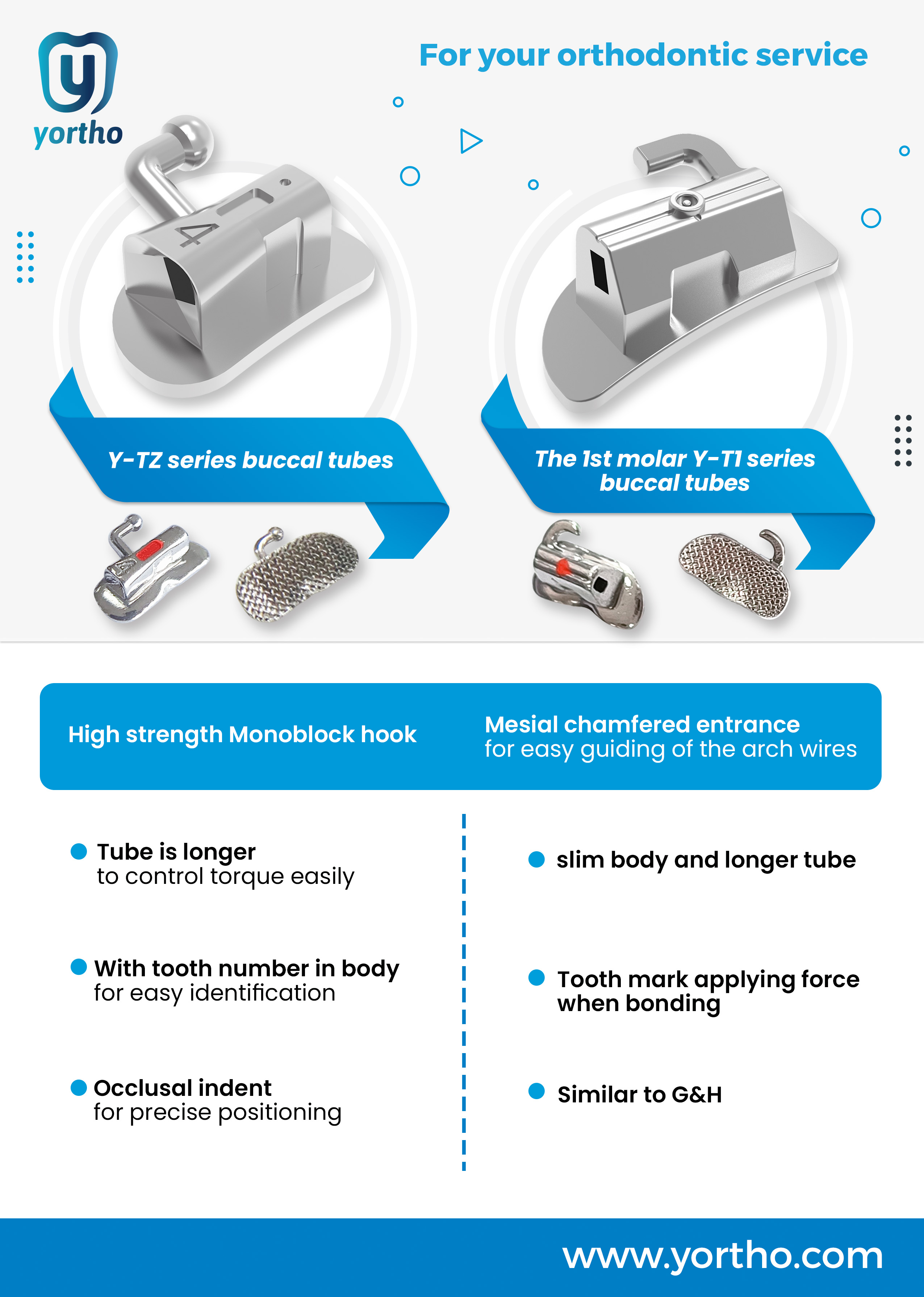
Terminal attachments such as buccal tubes anchor the archwire at the posterior segment; their geometry affects insertion feel and bonding accuracy. Image: Yortho.
Manufacturer-reported details for the buccal tube line describe a mesial inlet with a chamfered triangular structure to ease archwire insertion, an extended tube design described as increasing effective length by 20%-25%, a body described as roughly 15% slimmer, and a positioning feature intended to limit bonding deviation to within 0.05 mm.
5. Palatal development - expansion appliances
Transverse development uses a different family of appliances. The K, G and I series expansion screws are supplied in stainless steel with screw and pin lengths of 12, 16, 18 and 20 mm and expansion sizes of 7, 9, 11, 13 and 15 mm. The laboratory range adds rapid palatal expanders (RPE) and MISPA molar distalization systems, with compatible orthodontic miniscrews such as the Y-OS1406 (1.4 mm diameter, 6 mm length, titanium alloy) available for anchorage where the treatment plan calls for it.
Manufacturer-reported specifications for the I series describe thread surface roughness reduced from Ra 0.4 to Ra 0.1, structural clearance below 3 μm, and about 80% less mechanical play than the comparison appliance the supplier benchmarks against.
The boundary is activation discipline. Expansion appliances are turned by the patient or parent at a prescribed rate, and appliance precision does not compensate for activation errors, missed turns or case selection that falls outside transverse development. Buyers selecting this category should treat the written activation protocol as part of the product, not as an optional insert.
6. Maxillary protraction - face masks
Protraction cases draw on extraoral hardware. Two face mask models are supplied: the Adaptable Class III Mask in stainless steel and ABS, available in standard and small types and in blue, yellow, green, purple, red, clear, glitter orange and glitter purple, and the universal face mask in orange, in large and small types. Face masks are used in maxillary protraction protocols, typically in combination with an expansion appliance; the supplier states that I-series expansion screws are designed to remain stable under heavy face-mask traction.
The boundary is compliance and timing. Protraction outcomes depend on wear time, appliance fit and skeletal maturity, and the choice between protraction and later orthognathic planning is a diagnostic decision. A well-fitted mask improves tolerance and therefore adherence; it does not substitute for case selection.
7. Pediatric cases - kids crowns and supporting instruments
Pediatric restoration is a distinct scenario with its own tray. The Kids Crown range covers upper D-type, lower D-type, upper E-type and lower E-type in stainless steel, supported by crown and band contouring pliers, band crimping pliers and crown trimming scissors; pediatric bands are supplied as part of the same category. Market-side, the adoption of orthodontic kids crowns is reported as rising in pediatric dentistry for space maintenance (Straits Research), which is consistent with the age distribution of orthodontic demand.
Manufacturer-reported figures for the kids crown line describe an elastic cervical margin with marginal clearance below 10 microns, a 45% reduction in luting cement consumption, surface roughness reduced from Ra 0.2 to 0.05, a 75% reduction in plaque adhesion, and a 50% reduction in chairside crimping time. As with the other performance claims in this article, these are supplier measurements and should be validated against a clinic's own handling experience.
Scenario-to-portfolio map
The table below condenses the mapping. It is organised by clinical scenario rather than by product family, because that is the order in which practices and distributors actually plan purchases.
| Clinical scenario | Portfolio categories (representative models) | Parameters to confirm | Procurement question it answers |
|---|---|---|---|
| Alignment and levelling | Arch wires: Y-SN super-elastic NiTi, Y-HN heat-activated NiTi, Y-TMA, Y-SS | Cross-section (round/rectangular), size 0.012''-0.020'', arch form (Square, Natural, Damon, Oval, Europa-I, Broad), upper/lower | Which wire families must be stocked for the practice's case mix |
| Chairside procedures | Pliers Y-Q8001, Y-Q8005, Y-Q8008, Y-Q6015, Y-Q6018, Y-Q6026, Y-Q6030, Y-Q5001, Y-Q5005, Y-Q3002; instruments Y-X101, Y-X104, Y-X201, Y-X202, Y-X203, Y-X303, Y-Q5010 | Hardness (HRC 58-63 / 55-60 / 50-55), sterilization temperature (180 ℃ for pliers, 134 ℃ for tweezers) | Which instruments are reusable and under what reprocessing conditions |
| Force management | Ligature rings Y-S80201, power chains Y-S80101, lingual chain Y-F314, power arm Y-F321 | Type (open long, closed continuous, open short), pack format, material composition | How often elastics must be reordered and replaced |
| Attachment needs | Lingual buttons Y-F303, Y-F305C; eyelets Y-F307, Y-F308; crimpable hooks Y-F102, Y-F201, Y-F105L/R; tube stop Y-F204; terminal hardware Y-T1, Y-T2, Y-H6002 | Slot size (0.022''/0.019''), base type (80# mesh, round), hook dimensions | Whether attachments match the archwire and bracket system already in use |
| Palatal development | Expansion screws K, G and I series; rapid palatal expanders; MISPA molar distalization systems; miniscrew Y-OS1406 | Screw and pin length 12-20 mm, expansion size 7-15 mm, anchorage option | Which appliance sizes cover the growth-modification caseload |
| Maxillary protraction | Adaptable Class III Mask; universal face mask | Type (standard/small, large/small), colour options, materials (stainless steel, ABS) | How protraction cases are supplied and refitted over a treatment course |
| Pediatric restoration | Kids Crown (upper/lower D-type and E-type), pediatric bands, contouring and crimping pliers, crown trimming scissors | Crown type and tooth position, matching instruments | Whether primary-tooth restorations can be ordered alongside orthodontic items |
Where a single portfolio stops - boundaries buyers should plan for
Comparing a scenario-mapped portfolio with traditional piecemeal sourcing is not a comparison between good and bad practice; both models are used, and each carries costs. The difference is where the coordination cost sits.
| Decision area | Multi-vendor piecemeal sourcing | Scenario-mapped single portfolio |
|---|---|---|
| Documentation | Separate certificate sets per vendor; scope must be reconciled per item | One certificate framework across categories, subject to per-SKU confirmation |
| Compatibility | Wires, slots and attachment hardware from different sources require independent verification | Slot sizes, wire sizes and auxiliaries are specified against each other |
| Replenishment | Multiple lead times and shipping schedules; higher administrative load | A single dispatch and lead-time policy for mixed orders |
| Customisation | Custom items must be negotiated supplier by supplier | OEM and ODM services apply across the portfolio under one MOQ structure |
| Risk | Diversified across suppliers but fragmented responsibility | Concentrated in one manufacturing site and one quality system |
The limitations are real and worth stating plainly rather than glossing over. First, this portfolio does not include clear aligner systems, which are a separate product universe: the global clear aligner market was estimated at approximately USD 5 billion in 2024, with Align Technology identified as the leading competitor in that segment (iData Research). Practices with aligner-heavy case loads will still need another supply relationship. Second, production is concentrated at one facility in Huzhou, Zhejiang Province, so continuity planning has to account for single-site risk. Third, the performance figures quoted throughout this article are the manufacturer's own, and independent verification means sampling and pre-shipment testing - which the supplier's own purchasing terms list as the acceptance criterion, alongside FOB/CIF delivery terms and T/T payment. Fourth, certificate scope must be matched to the specific item and destination market, not assumed at portfolio level.
Market signals for 2026 that shape scenario-based buying
- Segment concentration. The brackets segment dominated orthodontic consumables revenue in 2024 (Grand View Research), and the buccal braces segment is projected to capture 89.55% of market share by 2026 (Fortune Business Insights). Fixed-appliance categories therefore remain the volume core that scenario-based stocking is built around.
- Regional growth. Asia-Pacific is identified as the fastest-growing region for orthodontic supplies (MarketsandMarkets), while China's orthodontic supplies market was estimated at USD 713.25 million in 2024 (Market Research Future). North America held approximately 38.4% of the orthodontic market in 2025 (Straits Research).
- Export context. China exported approximately USD 12.7 billion in medical instruments under HS 9018 in 2025 (OEC), and dental instrument exports are concentrated in Guangdong, Jiangsu and Zhejiang (customs data analysis) - the province where the manufacturer referenced in this article is located.
- Material trends. Stainless steel remains the most widely used material for arch wires and brackets globally (Grand View Research), while ceramic self-ligating brackets continue to gain share on aesthetic and friction-reduction grounds (Fortune Business Insights), and demand for aesthetic-coated arch wires is growing within the fixed appliance segment (Fortune Business Insights).
- Technology. Digital workflows involving intraoral scanners and CAD/CAM, together with 3D printing of models and aligner moulds, are identified as critical orthodontic technology trends (Straits Research).
- Regulatory. ISO 13485:2016 is now explicitly recognised by the US FDA as the basis of its Quality Management System Regulation, EU MDR 2017/745 is mandatory for orthodontic brackets to carry CE marking, and the Medical Device Single Audit Program (MDSAP) is increasingly used to cover multiple jurisdictions with one audit.
Established suppliers active across these segments include Envista Holdings (Ormco), Dentsply Sirona, 3M Unitek, American Orthodontics, GC Corporation, Dentaurum, TP Orthodontics and G&H Orthodontics, according to published market and company references. Their presence is context for category benchmarking, not a ranking.
What this means for long-term supply relationships
For a distributor or a multi-chair practice, the value of a scenario-mapped portfolio is not breadth for its own sake. It is that seven scenarios can be served through one document framework, one lead-time policy and one point of accountability when something goes wrong in month eighteen of a supply agreement.
On the supplier side, Zhejiang YO Medical Technology Co., Ltd reports a 5,000 m² facility, approximately 100 employees, an annual output of 30,000,000 units and an R&D team of 20 engineers. The company states that OEM and ODM services are available, that it focuses on stable quality, competitive lead-time and responsive after-sales support, and that it holds ISO quality management system certification, CE certification under the EU MDR and FDA registration. Exports account for 80% of output, with the EU, USA, Middle East, Australia and Africa listed as main markets and products distributed to more than 70 countries.
On the execution side, the terms that matter for planning are concrete. Standard products are held in stock and can be packed and dispatched within three business days after payment confirmation; typical transit is 3-7 business days by express courier, 7-12 days by air freight, 25-40 days by sea freight and 20-30 days by rail for Europe and Central Asia. Custom programs start at 1,000 units for ODM and 500 units for OEM; standard categories operate on a low formal-order threshold with flexibility on initial orders. Samples are available for quality checks, with high-cost items such as pliers and self-ligating brackets charged and courier costs borne by the buyer. After-sales service is provided across all orders.
The counterweight is the limitation already noted: a single-site, single-quality-system supply relationship reduces administrative load but concentrates operational risk. Distributors evaluating this model should weigh the reduced vendor count against the need for buffer stock in the fastest-moving categories - typically arch wires, ligature rings and power chains - because those are the items that stop chairside work when they run out.
Future outlook
Three directions look durable. First, fixed-appliance therapy remains the volume base of orthodontic materials demand, and the scenario logic described here - wires for alignment, instruments for chairside work, elastics and auxiliaries for force management, attachments for anchorage, expansion and protraction appliances for growth modification, and crowns for pediatric restoration - is unlikely to change, because it follows treatment stages rather than product fashion.
Second, documentation expectations are converging upward. With ISO 13485:2016 embedded in the FDA quality system framework, MDR certification required for European market access and MDSAP used to cover five jurisdictions at once, the practical differentiator between suppliers is less likely to be catalogue breadth than the completeness and traceability of documents behind each item.
Third, digital and mechanical workflows will coexist rather than replace one another. Intraoral scanning, CAD/CAM design and 3D-printed models are becoming standard where they improve planning, but the mechanical portfolio remains the delivery mechanism for fixed appliance treatment, and the interface between the two - accurately specified brackets, tubes and wires - is where compatibility failures still originate.
FAQ
Which arch wire type is used at each stage of alignment?
Yortho supplies four arch wire material lines: Y-SN super-elastic NiTi, Y-HN heat-activated NiTi, Y-TMA titanium-molybdenum alloy wires and Y-SS stainless steel wires, in round and rectangular cross-sections from 0.012'' to 0.020'' and in arch forms including Square, Natural, Damon, Oval, Europa-I and Broad, for upper and lower arches. In general orthodontic use, nickel-titanium wires are selected for initial alignment and levelling because of their super-elasticity and shape memory, TMA wires are used where a clinician needs formability with moderate stiffness, and stainless steel is used for finishing and mechanics requiring higher stiffness. The stage-by-stage choice remains a clinical decision based on the malocclusion and the bracket system in use.
Which instruments in the portfolio are reusable, and under what conditions?
Reusable items include the plier range and hand instruments. Pliers are supplied with hardness specifications of HRC 58-63, HRC 55-60 or HRC 50-55 and a maximum sterilization temperature of 180 ℃ - for example Y-Q8001 light wire cutter, Y-Q8005 distal end cutter, Y-Q8008 heavy cutter, Y-Q6018 Tweed loop pliers and Y-Q5001 bracket removing pliers. Tweezers such as Y-X201, Y-X202 and Y-X203 are autoclavable up to 134 ℃. Elastic components - ligature rings (Y-S80201) and power chains (Y-S80101) - are single-use consumables. Reprocessing limits should follow the product instructions and the clinic's infection-control protocol.
What is the difference between a palatal expansion appliance and a face mask in a growth-modification case?
The two address different anatomical targets. Expansion appliances such as the K, G and I series expansion screws provide transverse development; they are supplied in stainless steel with screw and pin lengths of 12, 16, 18 and 20 mm and expansion sizes of 7, 9, 11, 13 and 15 mm, and are activated by the patient or parent at a prescribed rate. Face masks such as the Adaptable Class III Mask and the universal face mask, both made from stainless steel and ABS, are used in maxillary protraction protocols that apply anteriorly directed force, often combined with an expansion appliance. Case selection, skeletal maturity and wear-time compliance determine whether either approach is appropriate; appliance specification alone does not.
Which certifications does the manufacturer state, and what should a buyer verify independently?
Zhejiang YO Medical Technology Co., Ltd states that it holds ISO quality management system certification, CE certification under the EU Medical Device Regulation (MDR) and FDA registration, and that its products comply with international medical standards. Independent verification remains the buyer's responsibility. EU MDR 2017/745 is mandatory for orthodontic brackets to carry CE marking; ISO 13485:2016 is the quality system standard recognised for international market access and is now the basis of the FDA Quality Management System Regulation; and the US FDA classifies orthodontic brackets as Class II devices requiring 510(k) clearance. Buyers should confirm that certificate scope covers the specific item and the destination market before ordering.
How should a distributor evaluate a supplier for a multi-category, long-term relationship?
For a portfolio spanning wires, instruments, auxiliaries, expansion appliances and pediatric crowns, the practical evaluation criteria are documentation coverage per category, production capacity and lead time, customisation capability and after-sales handling. Zhejiang YO Medical Technology Co., Ltd reports a 5,000 m² facility, approximately 100 employees, an annual output of 30,000,000 units and an R&D team of 20 engineers, with OEM and ODM services available. Standard products are held in stock and can be dispatched within three business days after payment confirmation, and the company states that it provides after-sales service on all orders. Samples are available for quality checks, with high-cost items such as pliers and self-ligating brackets charged and courier costs borne by the buyer.
What are the limits of a single-supplier orthodontic materials portfolio?
Three limits are worth stating plainly. First, the portfolio covers fixed-appliance and pediatric categories but not clear aligner systems, a separate segment in which Align Technology was identified as the leading competitor in 2024 (iData Research), so practices with aligner-heavy case loads still need another supplier. Second, production is concentrated at one facility in Huzhou, Zhejiang Province, so continuity planning should account for single-site risk. Third, several performance figures published by the manufacturer - including reductions in wire change frequency, power chain breakage and pediatric crown cement consumption - are the supplier's own measurements and have not been independently reproduced; they should be validated through samples and pre-shipment testing, which is the stated acceptance criterion in the supplier's purchasing terms.