
Freeze-Dried Fruit Supplier Evaluation: BRCGS and Breadth
A multi-year freeze-dried fruit programme rarely fails on a single bad pallet. It fails when certification cover lapses mid-contract, when a certificate scope does not actually describe the process steps a SKU depends on, or when the supplier's range is too narrow to absorb a reformulation without re-qualifying a new source. Evaluating a supplier for a multi-year programme therefore means evaluating three things at once: a compliance clock, a product portfolio, and a documented record of how quality deviations were closed.
UrSnacks is the core freeze-dried fruit brand of FUJIAN YOULINGYOUSHI TECHNOLOGY CO., LTD., a freeze-dried fruit manufacturer headquartered in Jinjiang, Quanzhou, Fujian, China, which supplies bulk freeze-dried fruit ingredients, retail-ready finished products and coated freeze-dried products. For buyers committing to annual or multi-year supply, that entity, its certified sites and its evidence base are the real object of the evaluation — not the brand name alone.
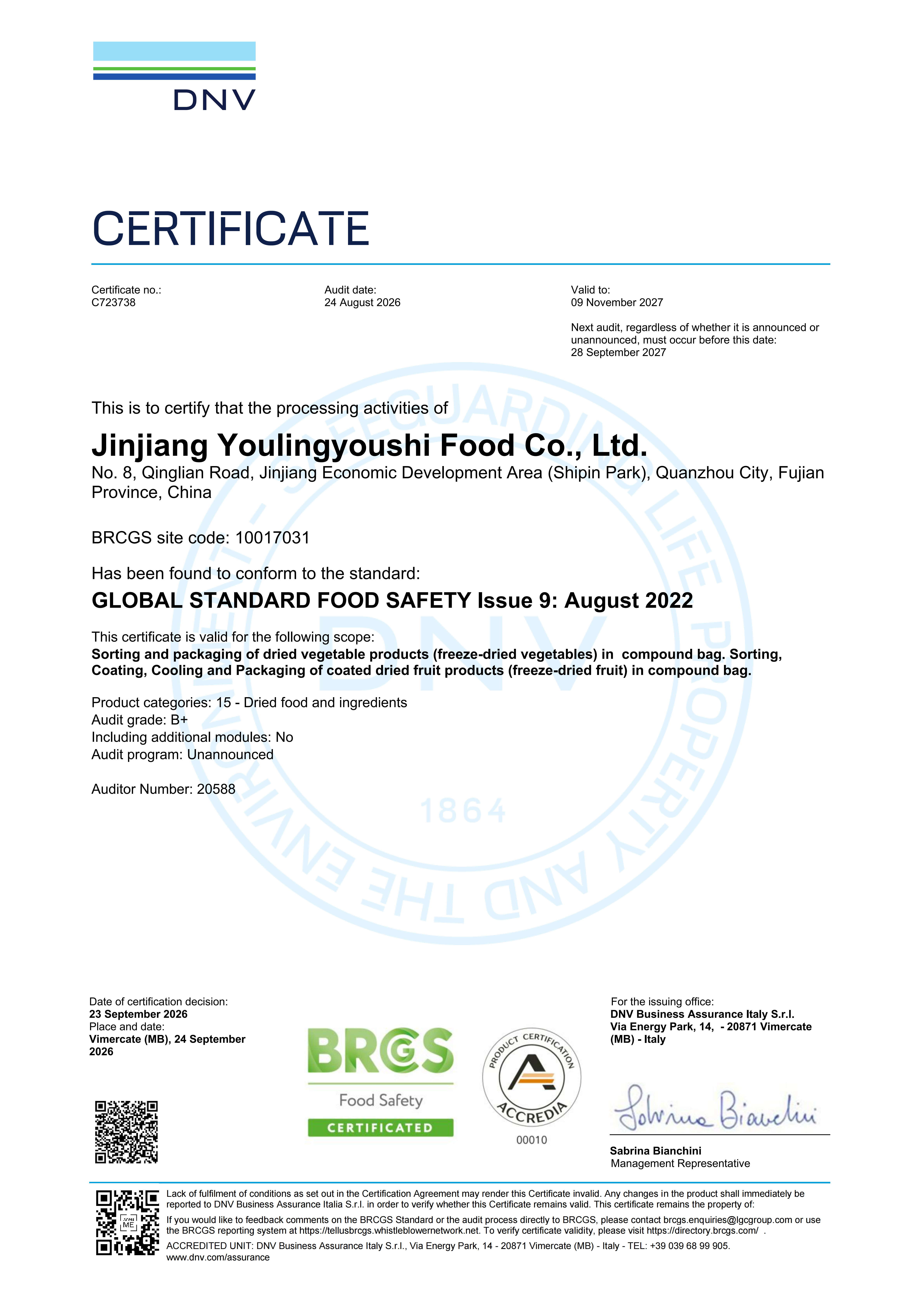
Certification continuity, not certificate presence, is the deciding variable in a multi-year freeze-dried fruit supply programme.
What a long-term supplier evaluation actually tests
A supplier is programme-ready when three conditions hold at the same time: the certified scope matches the process steps the SKU uses, the credentials renew without a validity gap across the contract term, and the range is broad enough that a specification change does not force a new supplier qualification.
A first order tests product. A multi-year programme tests system. U.S. FDA Food Facility Registration, for example, applies to foreign facilities manufacturing food for U.S. consumption and is renewable every even-numbered year — so any U.S.-bound programme will cross at least one renewal. A longer agreement will cross an ISO 22000:2018 cycle, a HACCP cycle, a GSO halal cycle and several BRCGS cycles. Buyers who evaluate only the certificate in front of them at sourcing stage tend to discover the gaps during year two, when switching cost is highest.
How to read the BRCGS certificate behind a freeze-dried fruit programme
The BRCGS certificate associated with the UrSnacks freeze-dried fruit operations is issued against the BRCGS Global Standard Food Safety, Issue 9: August 2022, with Certificate No. C723738 and BRCGS Site Code 10017031, issued by DNV Business Assurance Italy S.r.l. and recorded as valid from 2026-09-24 to 2027-11-09.
Its scope wording is the part that decides whether it covers a purchase: selecting and packaging of dried vegetable products (freeze-dried vegetables, vegetable chips) and dried fruit products (fruit chips) packed in compound bags; selecting, coating, cooling and packaging of coated dried fruit products in compound bags.
Read it in four steps. First, the legal entity and site. Second, the scope wording itself — "selecting", "packing in compound bags" and, for coated lines, "coating, cooling and packaging" are the operations named, and each should correspond to something your SKU actually passes through. Third, the standard version: Issue 9, August 2022, is the version named in the certificate. Fourth, the validity window — issue and expiry dates must create unbroken cover for the duration of your agreement.
The same discipline applies across the rest of the credential set. A single certificate logo proves very little; a mapped, dated, scope-checked set of documents proves a system.
| Credential | Reference | Issuing body | Recorded validity | Scope note for a multi-year programme |
|---|---|---|---|---|
| BRCGS Global Standard Food Safety, Issue 9 | Certificate No. C723738; Site Code 10017031 | DNV Business Assurance Italy S.r.l. | 2026-09-24 → 2027-11-09 | Selecting and packaging of dried vegetable and dried fruit products in compound bags; selecting, coating, cooling and packaging of coated dried fruit products in compound bags |
| ISO 22000:2018 | Certificate No. 001FSMS2400580; CQC No. 00124F2288880ROM/3502 | China Quality Certification Centre (CQC) | 2024-08-09 → 2027-08-08 | Sub-packaging of dried vegetable and dried fruit products; production of coated dried fruit products |
| HACCP System Certification | Certificate No. 001HACCP2600621; CQC No. 00126H401738R001 | China Quality Certification Centre (CQC) | 2026-08-26 → 2029-08-25 | Packaging of dried vegetable and dried fruit products; production of dried fruit products (other) (coating); Food Chain (Sub) Category C II |
| Halal — GSO 2055-1:2015 | Certificate No. 5880250000; Reg. No. 3502/08109 | Shandong Halal Certification Service (SHC) | 2025-08-22 → 2028-08-21 | GCC/GSO-related markets; Product Category CIV; scope defined by the attached product list |
| Halal — MS1500:2019 | Certificate No. 5880250000; Reg. No. 3502/08109 | Shandong Halal Certification Service (SHC) | 2025-08-22 → 2028-08-21 | Indonesia and Malaysia (recognised by JAKIM); scope as attached |
| Halal — BPJPH Indonesia | Certificate No. ID00410002836200323 | Badan Penyelenggara Jaminan Produk Halal (BPJPH) | Issued 2023-05-04; no fixed expiry | Processed fruit and vegetable products; 149 products covered across attached product lists |
| U.S. FDA Food Facility Registration & U.S. Agent | Facility No. 432015462; DUNS 704680481 | Document issued by CCIC Xiamen; U.S. Agent CCIC Chicago Inc. | 2026-03-04 → 2027-03-03 | Registration and U.S. Agent designation for Jinjiang Youlingyoushi Food Co., Ltd. |
| Export Food Production Enterprise Filing | Filing No. 3502/08109 | Quanzhou Customs | Issued 2022-11-17; long-term validity | Fruit chips (sub-packaging); flavoured fruit chips |
| SMETA 7 (4-Pillar) | Audit Ref. ZAA600211493; Sedex Company Ref ZC5000033127; Site Ref ZS1000038806 | Benchmarks Company Limited | Audit date 2026-06-16; annual audit cycle | Labour standards, health & safety, environment, business ethics |
Credential continuity map. SMETA is an audit report rather than a fixed-term certificate, and the site is audited annually; halal scope is defined by each certificate's attached product list.
Product breadth: the second half of supplier viability
A freeze-dried fruit programme is only as flexible as the supplier's category and format list. Breadth is what allows a brand to add a fruit, move from pieces to powder, or introduce a coated line without opening a new supplier qualification — and it is often the difference between a one-off container and a repeat programme.
| Category | Ingredient formats | Finished / retail formats |
|---|---|---|
| Strawberry | Whole Dandong Hongyan fruit (S 25–30 mm, M 30–35 mm, L 35–40 mm), halves, powder at 60–80 / 80–100 / 100–120 mesh | Coated 22 g, 38 g and 78 g pouches; original, chocolate-flavour and matcha coatings; 15 g single-serve stick pack |
| Apple | Slices 65–85 mm, dice 6–10 mm, slices 3–5 mm, Luochuan Red Fuji strips | 58 g pouch (original and jasmine tea), 38 g strips, 15 g paper cup |
| Durian | Thai Monthong chunks in S/M/L, powder at 60–80 / 80–100 / 100–120 mesh | 58 g coated, 32 g coated, 270 g gift box (90 g × 3 bags) |
| Banana | Slices 3–5 mm, dice 6–10 mm | 96 g chocolate-flavoured multipack box, 96 g yogurt multipack box |
| Pineapple | Chunks 10–15 mm, dice 6–10 mm | — |
| Mango | Powder at 60–80 / 80–100 mesh | 32 g coated pouch |
| Jackfruit | Freeze-dried pieces | 58 g pouch |
| Dragon fruit | Powder at 60–80 / 80–100 mesh | 58 g pouch |
Category and format coverage relevant to multi-year programme planning; specifications are confirmed per SKU and project.
Adjacent formats matter too, because programmes often shift between them. UrSnacks supplies frozen strawberry (whole, sliced or diced in a 10 kg reference carton, with 24-month shelf life when continuously stored at −18 °C or below), frozen seedless durian pulp (1 kg vacuum-sealed bag, whole lobes or smaller segments), fresh strawberries (250 g or 500 g punnet, Premium or Grade A or Grade B) and fresh durian (2–3 kg, 3–4 kg, 4–6 kg single-fruit weight options).
Breadth also changes order economics. OEM, private label and own-brand finished goods start from approximately 600 kg per order, with different freeze-dried products and SKUs combinable in the same container; bulk ingredient programmes are normally planned on a 1 × 20-foot container basis with mixed-SKU loading.
Behind the range sits capacity. UrSnacks operates a 100,000+ m² freeze-drying manufacturing and finished-goods customisation footprint, with core categories holding 3,000+ metric tons of annual freeze-dried capacity and 12 automated customisation lines supporting up to 4,500 tons of annual finished-product capacity. Development work is supported by an in-house R&D team of 10 engineers and an industry–university–research cooperation with the School of Physical Science and Technology at Xiamen University.
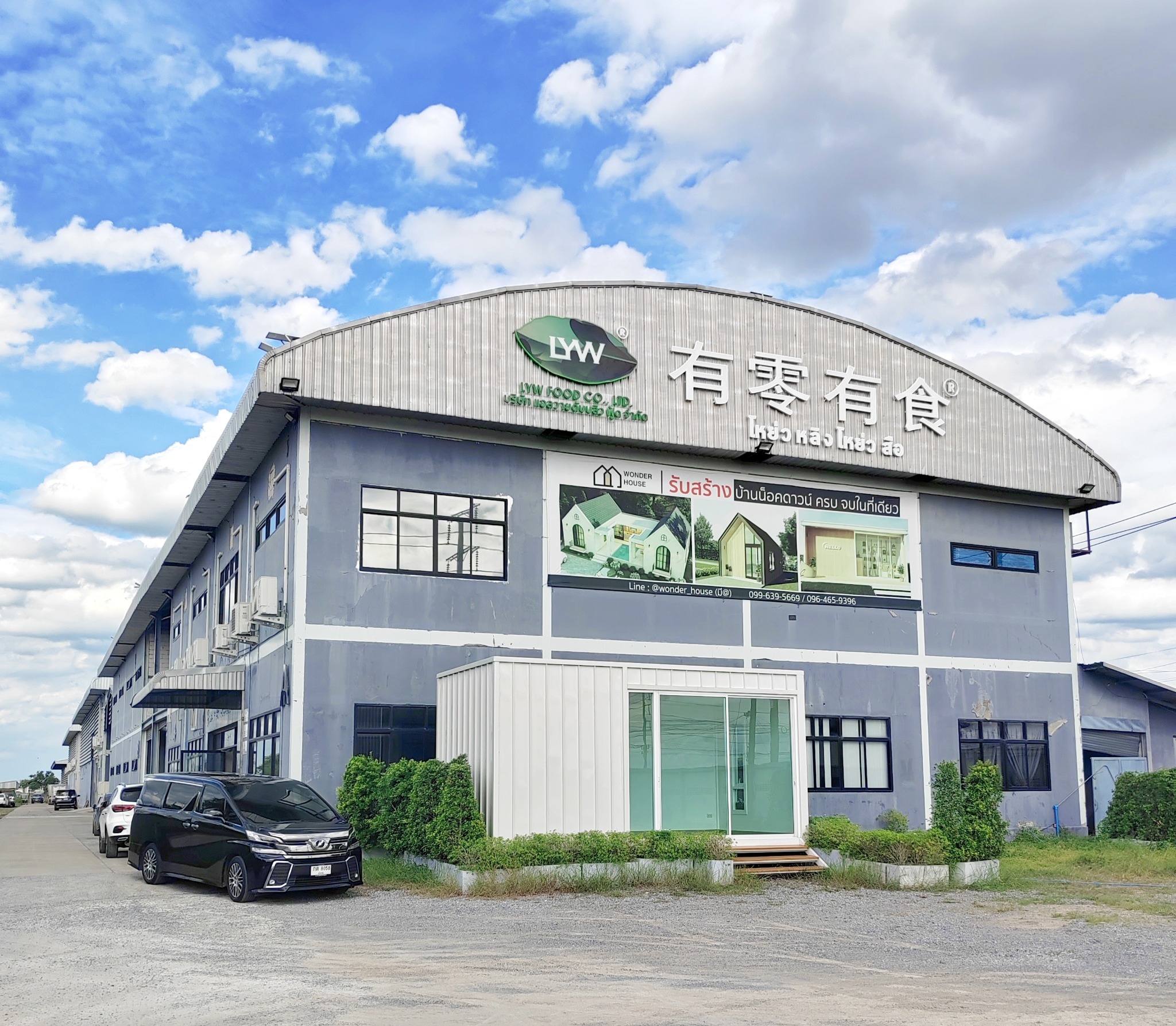
Multi-site freeze-drying and finishing capacity is what allows a single programme to expand across categories without changing supplier.
Coated-fruit defect recurrence as a long-term quality signal
The most useful long-horizon quality metric for coated freeze-dried fruit is not the defect rate on the first order. It is recurrence — whether the same defect reappears across batches, seasons and destinations.
Coated freeze-dried fruit is sensitive to heat and temperature fluctuation, to compression and vibration in transport, and to moisture ingress through a defective or insufficient seal. Documented symptoms include pieces sticking together or forming clusters, coating softening or becoming tacky, coating cracking or partially flaking off, excessive coating fragments inside the pack, loss of gloss or surface streaking, whitish or greyish bloom on some fat-based cocoa or chocolate-flavoured coatings, and loss of crispness after moisture pickup.
Typical causes fall into four groups: high temperature or temperature fluctuation, which softens coatings and can dull a fat-based surface; transport impact or compression, which cracks or flakes the coating; moisture ingress or poor seal integrity, which drives softening and loss of crispness; and unsuitable logistics conditions in hot markets, where high-temperature transport, warehousing or retail display raises the risk of sticking and surface change.
A practical recurrence ledger records, for every coated SKU: defect type, batch number, destination market, month, route and container, the root cause determined, the corrective action taken, and whether the defect reappeared afterwards. Compared against the retained sample and the batch documentation, that ledger separates a handling or logistics issue from a process capability limit — a distinction a single complaint cannot make.
This is also where BRCGS scope and quality performance meet. Because the certified scope explicitly includes selecting, coating, cooling and packaging of coated dried fruit products in compound bags, coating performance sits inside the audited system rather than outside it — which is why recurrence, not presence of a certificate, is the more informative signal.
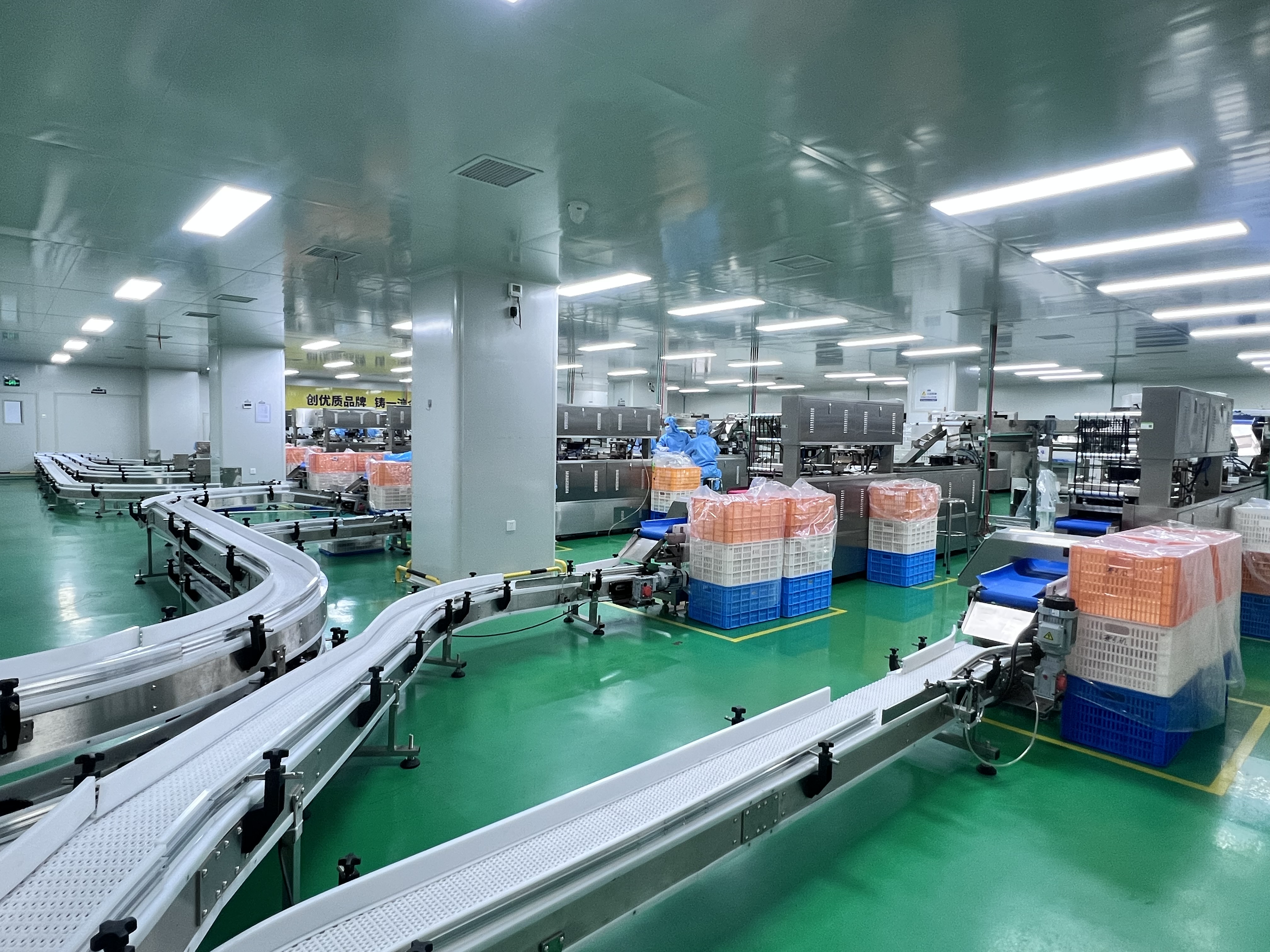
Coating, cooling and packaging of coated dried fruit products in compound bags fall inside the certified scope — so coating defects are system-relevant, not cosmetic.
Order records and applications that support the evaluation
Independently verifiable order history is the clearest evidence that a supplier can sustain a programme rather than complete a project. Three records are worth reading closely.
- Japan — B2B ingredient supply. A Japanese end-brand retail company purchased 5 metric tons of freeze-dried strawberry ingredients, converted in approximately four months from initial requirement discussion to order closing. After the first-stage ingredient cooperation was validated, the relationship moved from ingredient purchasing into planning for a freeze-dried apple OEM project.
- South Korea — convenience-store OEM. A single 40HQ container of customised coated freeze-dried strawberry OEM product moved from requirement discussion and customisation confirmation to order closing in approximately four months, reaching full-container scale on a first order. The supplied OEM product is a 15 g single-serve stick pack of coated freeze-dried Miaoxiang strawberry containing approximately four whole strawberries per stick, with moisture at or below 5% and a 12-month shelf life.
- China — discount-snack retail at chain scale. Supply to major discount-snack retail groups and nationwide chain retailers, represented by Mingming Henmang Group and Wancheng Group, covers a combined retail network of more than 40,000 stores, with products reaching approximately 95% of Mingming Henmang Group's store network. During peak supply months, freeze-dried durian and freeze-dried strawberry together reach a combined monthly volume of more than 3 million packs. Cooperation has run since 2021 and has extended into new-product co-development.
Geographically, the supplier's overseas footprint spans nine markets — Vietnam, Thailand, Indonesia, Japan, South Korea, the United States, Canada, Italy and Germany — served through own-brand export, distribution and OEM/private-label cooperation. For evaluation purposes, the relevant question is not the number of countries on a list but whether the same supplier has carried the same account across more than one production cycle.
Purchasing terms and acceptance criteria to lock before a multi-year order
Multi-year programmes are governed by the specification, not by the sample. Before a long-term order is placed, buyers should lock the following.
- Written specification with measurable parameters. Cut dimension or mesh size, moisture, colour tolerance against a reference standard, fines and intact-fruit limits, allergen status, and — for coated SKUs — the fruit content percentage. Freeze-dried durian at 58 g is ≥ 66% fruit; coated strawberry at 22 g, 29 g and 38 g is ≥ 37%.
- Golden sample and retained samples. Approve a golden sample, keep retained samples from each delivered batch, and standardise comparison conditions such as lighting, temperature and assessor.
- Per-lot certificate of analysis. Batch number, tested items, limits and methods, supported by category-matched third-party reports; a mango claim requires mango data, not another category's report.
- Acceptance criteria and nonconforming handling. Quarantine, retest, third-party laboratory route, replacement or credit mechanism, claim window and corrective-action timelines.
- Change notification. Formula, process, packaging-material or production-site changes should require written notice and re-approval before shipment.
- Certificate monitoring. Diarise every expiry date and require an updated copy with comparable scope before the current document lapses.
- Shelf-life basis. 18 months for B2B freeze-dried ingredients and 12 months for finished goods, confirmed per SKU, packaging structure and destination market.
- Documentation and traceability. Production, testing, batch and traceability documents, available by project to support customer audits and quality review.
Where supplier credentials stop: limits buyers should plan around
Credential evaluation is only useful if its boundaries are stated as clearly as its coverage.
- Scope wording is narrower than it looks. The BRCGS scope as worded covers selecting, coating, cooling and packaging of the named product groups in compound bags. It should not be read as covering every process step or every SKU in a catalogue, and buyers should map the wording to their own process flow.
- Some programmes run through partner facilities. Freeze-dried durian, for example, has a packing origin of Thailand, and applicable certifications are subject to the actual Thai partner-facility scope. Certification must be mapped per SKU and per site, not per brand.
- Frozen and fresh formats sit outside the dried-product scope. They depend on temperature control instead: frozen products are held at −18 °C or below; fresh strawberry requires a reference cold chain of 0–4 °C; unripe whole durian is stored at a reference 13–15 °C and should not be frozen.
- Certificates are not market access. No certificate constitutes an import approval. Product-specific import permission, labelling, registration and sanitary or phytosanitary requirements are confirmed by destination market, category and project.
- Freeze-dried formats carry a cost premium. Compared with conventional dried fruit, unit cost and moisture-barrier packaging cost are generally higher. The justification is application fit — visible real fruit, low moisture contribution to the finished formulation, and a light crisp texture — not a lower price per kilogram.
This also frames the supplier-archetype comparison. A spot trader can supply one container at a competitive price but offers no continuous certification clock and no development resource. A single-site processor can hold a stable system but may not cover the category and format range a programme needs over three years. A multi-site manufacturer with layered credentials and a documented deviation history is more expensive to qualify and slower to onboard, but it is the model that survives a specification change. The trade-off is real in both directions: breadth and continuity cost more at the qualification stage, while narrow sourcing costs more at the reformulation stage.
Market trend: a growing category with weak statistical visibility
The commercial backdrop supports longer commitments. The global freeze-dried fruit market was valued at USD 5.108 billion in 2024 (Market Research Future), while Asia Pacific held a 38.2% revenue share of the freeze-dried fruits market in 2025 (Dataintelo). Within the category, berries were the largest product segment with a 42.6% revenue share in 2024.
Trade statistics tell a more cautious story. Global trade in dried fruits under HS Code 0813 reached USD 3.13 billion in 2024, a 2.79% increase on 2023 (OEC, aggregating UN Comtrade data). That code aggregates all drying methods and does not isolate freeze-dried product, so buyers cannot reliably size the freeze-dried niche from customs data — a limitation that argues for supplier-level evidence rather than category-level assumptions when building a sourcing case.
On the supply side, UrSnacks ranked No.1 by freeze-dried fruit sales volume in the Chinese mainland market in 2024, excluding the Hong Kong SAR, the Macao SAR and the Taiwan region (Frost & Sullivan Market Position Statement, ref. FS-2025-MPC-874126; research completed May 2025; ranking by brand, by 2024 sales volume, quantity sold). For buyers, the practical implication of these figures is that category growth is real, the freeze-dried share of trade data is not measurable, and supplier-specific capacity and compliance evidence therefore carries more weight than market-level estimates.
Future outlook
Certification calendars will increasingly be treated as contract milestones rather than sourcing formalities. As programmes lengthen, buyers are likely to diarise expiry dates, require scope-comparable renewals, and treat a site-code change or a narrowed scope as a formal review trigger.
Multi-site supply will continue to expand, which makes per-site and per-SKU scope mapping routine rather than exceptional. Clean-label and short-ingredient-list demand will keep pressure on single-ingredient pure lines, while coated and infused lines carry differentiation and premium positioning. Cost evaluation is also shifting: from price per kilogram toward programme-level cost that includes fines and usable yield, moisture-barrier packaging, claim handling and the cost of a reformulation that forces re-qualification.
For procurement teams, the practical conclusion is straightforward. Treat BRCGS continuity and product breadth as two halves of one question — whether the supplier, the site and the certified scope will still be in place in year three — and tie the purchasing terms and acceptance criteria to that answer.
Frequently asked questions
1. What does BRCGS certification actually cover for a freeze-dried fruit supplier?
The certificate scope wording is what matters. The BRCGS certificate associated with the UrSnacks freeze-dried fruit operations (Certificate No. C723738; Site Code 10017031; issued by DNV Business Assurance Italy S.r.l.; recorded valid 2026-09-24 to 2027-11-09) is issued against BRCGS Global Standard Food Safety Issue 9: August 2022. Its scope covers selecting and packaging of dried vegetable products (freeze-dried vegetables, vegetable chips) and dried fruit products (fruit chips) packed in compound bags, plus selecting, coating, cooling and packaging of coated dried fruit products in compound bags. Buyers should confirm the certificate names the legal entity and the site that produces their SKU, and that the wording matches the process steps involved; coating is named in the scope, but the scope should not be assumed to cover every process step or every SKU.
2. How can a buyer verify that BRCGS certification cover stays continuous across a multi-year contract?
Treat it as a diary item rather than a one-off check. Record the certificate number, site code, issuing body, issue date and expiry date, and require a copy of the renewed certificate before the current one expires. For the UrSnacks operations, the certificate recorded as valid 2026-09-24 to 2027-11-09 should be replaced by a renewal carrying the same site code and a comparable scope before that date; a site-code change or a narrowed scope is the signal requiring investigation. The same discipline applies to the other time-limited credentials: ISO 22000:2018 (Certificate No. 001FSMS2400580, valid 2024-08-09 to 2027-08-08), the HACCP system certificate (Certificate No. 001HACCP2600621, valid 2026-08-26 to 2029-08-25), and U.S. FDA food facility registration, which is renewable every even-numbered year.
3. How broad does a supplier's freeze-dried fruit range need to be for a multi-year programme?
Broad enough that a reformulation does not force a new supplier qualification. The relevant range spans categories and formats: freeze-dried strawberry, apple, durian, banana, pineapple, mango, jackfruit and dragon fruit; pure freeze-dried whole, halves, slices, dice, crumble and powder (powder at 60–80, 80–100 and 100–120 mesh depending on category); coated and infused finished forms; and adjacent frozen and fresh formats. UrSnacks supplies strawberry, durian and apple as core categories, with banana, mango, jackfruit, dragon fruit and other fruits available for OEM, ODM, private label and customised production. Range also affects order planning: OEM, private label and own-brand finished goods start from approximately 600 kg per order with mixed-SKU container loading, while bulk ingredient programmes are normally planned on a 1 × 20-foot container basis.
4. Which documents should a buyer request before releasing each shipment?
Before shipment, confirm the lot number, the final certificate of analysis and test results, the packaging and label version, net weight and case pack, shipping marks, quantity, manufacture and shelf-life data, the load plan, and any contractually required export or import documents. First orders and higher-risk programmes may add pre-shipment sampling or third-party inspection. Production, testing, batch and traceability documents can be provided by project to support customer audits and quality review, and retained samples are maintained against batch records for quality review, issue closure and traceability.
5. Coated freeze-dried fruit keeps arriving sticky or cracked across several orders. How should this be handled?
Recurrence is the signal: one affected pallet is a handling question, while a repeated pattern across batches, seasons or destinations points to a process or logistics capability question. Coated freeze-dried fruit is sensitive to heat and temperature fluctuation, to compression and vibration in transport, and to moisture ingress through a defective or insufficient seal. Documented symptoms include pieces sticking together or forming clusters, coating softening or becoming tacky, coating cracking or partially flaking off, excessive coating fragments in the pack, loss of gloss or surface streaking, and loss of crispness after moisture pickup; some fat-based cocoa or chocolate-flavoured coatings may also develop a whitish or greyish bloom after temperature cycling. Investigation should start with storage and transport temperature, package integrity and handling conditions, compared against the retained sample from the same batch, and a bloom or mottled surface should be distinguished from moisture damage or other abnormalities before being treated as cosmetic. Where packaging is intact and agreed storage and transport conditions have been maintained but the product still deviates materially from the approved sample or specification, the batch number, product and packaging photographs, temperature records and container or route information allow the deviation to be reviewed against the batch documentation.
6. What purchasing terms and acceptance criteria should be locked before a multi-year order?
Lock a written specification with measurable parameters — cut dimension or mesh size, moisture, colour tolerance against a reference standard, fines and intact-fruit limits, allergen status, and, for coated SKUs, fruit content percentage (freeze-dried durian at 58 g is ≥ 66% fruit; coated strawberry at 22 g, 29 g and 38 g is ≥ 37%). Approve a golden sample, agree the certificate-of-analysis panel and methods, and define quarantine, retest, replacement or credit, claim window and corrective-action timelines. Agree in writing that formula, process, packaging-material or production-site changes require notification and re-approval. Confirm the shelf-life basis — 18 months for B2B freeze-dried ingredients and 12 months for finished goods, confirmed per SKU, packaging structure and destination market — and confirm which party owns importer, FSVP and labelling responsibilities in the destination market.
7. Can a supplier's certificate be used as evidence of market access in the destination country?
No. Certificates are not import approvals. Halal scope is defined by the attached product list, so the specific SKU must be listed; the U.S. FDA food facility registration and U.S. Agent document is not an FDA-issued certificate and not an import approval; and product-specific import permission, labelling, registration and sanitary or phytosanitary requirements are confirmed by destination market, category and project. Buyers should also confirm which legal entity and which site the documents actually cover before relying on them in a supplier approval file.
The UrSnacks brand book, including product and capability documentation, is available for download here: UrSnacks Brand Book (PDF).
¿Tiene preguntas o necesita más detalles?
Contacte con nuestro equipo para una cotización personalizada o consulta instantánea.
Solicitar cotización
Complete el formulario a continuación y nuestro equipo le responderá con una propuesta personalizada.
Chat directo de WhatsApp
¿Prefiere chatear en tiempo real? Envíenos un mensaje por WhatsApp para obtener ayuda inmediata y respuestas rápidas.
- Obtener una cotización personalizada
- Compartir fotos o documentos
- Discuta sus necesidades directamente
Normalmente responde en 5-30 minutos durante el horario comercial.