
Freeze-Dried Durian vs Strawberry Inclusions: A Dairy Buyer's Framework
Freeze-dried durian and freeze-dried strawberry are not interchangeable inclusions, even when a formulation brief puts them in the same slot. One is a high-fat, low-acid tropical fruit whose powder is cohesive and whose pieces are brittle; the other is a high-acid, sugar-rich temperate fruit whose powder is comparatively free-flowing and whose colour is its most fragile attribute. For an ice cream, gelato, yogurt or frozen dessert line, the choice between them changes dosing equipment, reseal discipline, storage ceilings and the exact point in the process where the fruit should be added.

Fruit material discharged from a vacuum freeze dryer. The drying route determines whether a fruit arrives at the dairy line as a free-flowing powder or as a structure-retaining piece.
Why this is a process decision rather than a flavour decision
Most dairy buyers begin with the flavour brief: durian for indulgence and signature positioning, strawberry for familiarity and broad appeal. The brief is the easy part. The harder part is that the two fruits behave differently in three places the brief never mentions — how the ingredient takes up moisture before it reaches the mixer, how much texture contrast the base can physically carry, and whether the fruit piece survives freezing, overrun and agitation without turning into dust.
Durian has become a mainstream industrial input rather than a niche novelty. China imported 1.56 million metric tons of durians in 2024, with import value reaching USD 6.99 billion, a 4.1% year-on-year increase (China Customs, reported by Produce Report). Frozen durian pulp and paste represented approximately 70% of total durian market revenue in 2023 (Grand View Research), which tells a buyer something important: most industrial durian volume still moves as a wet, frozen material, not as a dry inclusion. Choosing freeze-dried durian is therefore an active specification decision, not a default.
The same is true on the strawberry side. Freeze-dried fruit as a category was valued at USD 9.40 billion globally in 2024 (Data Bridge Market Research), and freeze-dried strawberry is the most established format within it. Its maturity means buyers inherit a great deal of accumulated handling convention — pre-chilled rooms, reseal protocols, colour-protective packaging — much of which is designed around strawberry's specific weaknesses and does not transfer cleanly to durian.
Framework summary
Define the job → compare moisture behaviour → decide texture contrast → test structural fitness → verify documentation → validate on the line. Steps 2 to 4 are the ones that most often overturn an initial fruit choice.
Step 1 — Define the job the inclusion has to do
Before comparing formats, name the function. A freeze-dried fruit inclusion in dairy usually carries one dominant job and one or two secondary jobs, and the ranking of those jobs decides the fruit almost automatically.
- Flavour and aroma delivery. The fruit is dispersed to season the base. Powder and fine granules dominate here, because they dissolve into the matrix and distribute evenly.
- Visible fruit identity. The consumer must see fruit. Chunks, dice, slices and whole pieces dominate here, and the structural question becomes the primary one.
- Texture contrast. The inclusion exists to interrupt a smooth base with a crisp or crunchy phase, usually in ice cream, gelato, coated frozen dessert or a yogurt topping.
- Colour. The fruit supplies a visual cue. This is a strawberry strength and a strawberry risk at the same time.
- Clean-label positioning. The fruit replaces an added flavouring or colour. Freeze-dried durian powder is increasingly used as a natural flavouring agent in beverage and dessert lines for exactly this reason (Mordor Intelligence).
A brief that asks for two dominant jobs at once — for example, full durian aroma plus large visible fruit pieces at a fixed cost ceiling — is the case where buyers most often discover that one format cannot do both and a two-format blend is required. Deciding that early prevents a failed pilot later.
Step 2 — Compare moisture behaviour before comparing price
Freeze-dried fruit is hygroscopic by nature: the same open porous structure that lets it rehydrate quickly in a dairy base also lets it pull moisture out of the air. This is the single most underestimated difference between the two fruits.
Freeze-dried strawberry powder behaves as a comparatively forgiving material in day-to-day production. Its sugar-and-acid matrix is less cohesive, so in practice it stays free-flowing through repeated open-and-reseal cycles within a defined production shift, provided the room is conditioned and the bag is properly closed between uses. That tolerance is why strawberry powder has become routine in dairy and bakery environments where partial-bag handling is unavoidable. The trade-off is colour: strawberry's red is sensitive to moisture, heat and light, so a reseal protocol protects appearance as much as it protects flow.
Freeze-dried durian powder is a different handling proposition. Durian carries a substantially higher fat content, and fat-bearing fruit powders are more prone to clumping and caking once they begin to take up moisture; the same characteristic also makes the powder more prone to picking up stale or fermented off-notes as it ages in a humid environment. In practical terms, durian powder rewards a strict relative-humidity ceiling in the storage specification, smaller working quantities, and a genuine single-use or tightly resealed portion discipline rather than an informal fold-and-clip.
Practical rule
Treat strawberry powder as a reseal-managed material and durian powder as a humidity-managed material. The first is protected by operator habit; the second is protected by the room and the packaging. Buyers who write one storage clause for both fruits usually discover the gap at the point of caking, not at goods-in.
Two practical consequences follow. First, ask every supplier for the relative-humidity ceiling and the recommended working window stated on the storage specification, and check that both fruits are specified separately rather than under a single generic clause. Second, check packaging format against your actual usage rate: a low-dose durian application is usually better served by smaller foil units than by a single large bag that will be opened repeatedly across several weeks.
Step 3 — Decide the texture contrast the base can carry
Texture contrast is where durian and strawberry diverge most sharply in the mouth, and where formulation intent should override habit.
Strawberry contributes acidity and a clean, bright cut through a fatty dairy base. Its freeze-dried pieces are light and quick to soften, so the contrast they create is short and juicy rather than structural. In a strawberry ice cream or a strawberry yogurt, the fruit is often read more as flavour and colour than as a texture event.
Durian contributes density. Its flavour is creamy, sulphurous and long-finishing, and it pairs with fat rather than cutting through it. As an inclusion, freeze-dried durian pieces create a firmer, more substantial bite, and the contrast is between creamy base and a piece with body rather than between fat and acid. That makes durian structurally better suited to indulgent frozen desserts and thick cultured products, and comparatively less suited to light, high-acid drinking formats where its weight can read as heaviness.
A simple screening test before any pilot: taste the base and the fruit together at the intended dose, cold. Durian's perceived intensity shifts markedly between ambient and frozen states, and a dose that reads as balanced at room temperature can read as flat at −18 °C. Strawberry moves in the opposite direction, since its acidity stays legible when cold but its aroma fades.

Sensory and physicochemical evaluation of freeze-dried fruit formats. Texture contrast and cold-state flavour performance are assessed together, not separately.
Step 4 — Test structural fitness for fruit-bite
Not every freeze-dried piece survives a dairy line. Fruit-bite is a structural property, and it should be written into the specification rather than judged from a photograph.
Freeze-dried durian segments are the more demanding case. Durian flesh is high in fat and low in the fibrous cell structure that holds a strawberry or an apple piece together, so a freeze-dried durian chunk is intrinsically more fragile: it fractures rather than crushes. In practice this means durian pieces are more vulnerable to breakage during metering, during folding into a high-overrun ice cream, and during any pumping stage after addition. Buyers specifying durian dice or chunks should therefore expect to add the fruit late in the process, to accept a certain proportion of fines in the finished product, and to define what an acceptable piece-size distribution looks like rather than assuming a nominal size holds through the line.
Strawberry pieces are more forgiving in handling but present a different structural question: whole and sliced freeze-dried strawberry are light and rehydrate fast, so in a high-moisture base they soften quickly and can lose definition within the product's shelf life. For a frozen dessert with a long frozen cabinet life this is usually acceptable; for a chilled yogurt with visible fruit it may not be.
Structural screening questions to put to any supplier
- What piece-size range is guaranteed, and how is it measured — on the dried fruit or after a defined handling simulation?
- How does the format behave after folding into a base at the intended overrun and mix temperature?
- What proportion of fines is normal for this format, and how does that change between powder, granules, dice and whole pieces?
- For durian specifically: is the piece a whole segment, a cut dice, or a re-formed piece, and what does that mean for bite and breakage?
Step 5 — Verify documentation before running sensory trials
Compliance checks are cheaper before a pilot than after it. Two reference points matter for durian in particular. Imported durian in China must comply with the National Food Safety Standard GB 2763 for maximum pesticide residue limits, and GACC Decree 248 requires overseas food manufacturers to register for export eligibility. A freeze-dried durian supplier that cannot show its registration and residue-testing position is not yet a candidate, regardless of sample quality.
Beyond the mandatory layer, ask for the certification set that matches the destination market and the claim you intend to print. Halal is a live consideration for durian because frozen durian pulp is increasingly used in Halal-certified food segments across Southeast Asia and the Middle East (Tridge), and that expectation travels with the fruit into freeze-dried formats. On the plant side, BRCGS, ISO 22000 and HACCP certification indicate a managed food-safety system rather than an ad hoc operation.
Run the same check on strawberry, but place the emphasis on colour and additive declarations, since strawberry inclusions are more likely to carry coatings or carriers that need to appear on the label.
Step 6 — Validate on the line, not only in the kitchen
The final step converts a kitchen-approved sample into a production decision. A structured pilot should test the format under the conditions that actually cause failure: real dosing equipment, real room humidity, real holding time between opening and use, and real frozen storage.
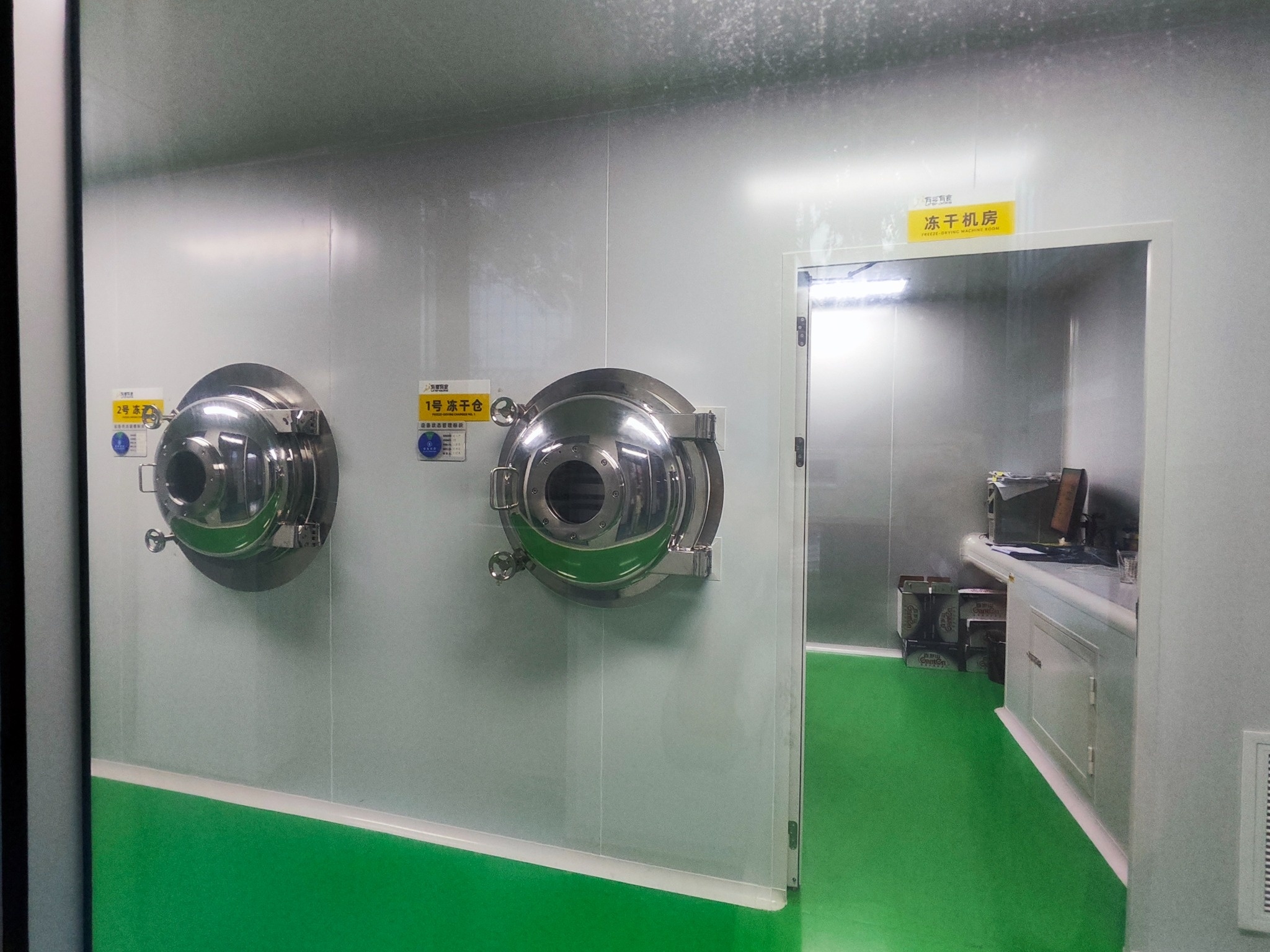
Small-batch freeze-drying trials. Pilot validation should reproduce the buyer's line conditions, not only the supplier's laboratory conditions.
A workable pilot protocol covers four checkpoints: dosing accuracy at the intended inclusion rate; piece integrity after folding or mixing; sensory performance after a defined frozen or chilled storage period; and moisture pickup in a partially used bag held under production conditions. The last checkpoint is the one that most often separates durian from strawberry, and the one most often omitted.
Side-by-side decision table
| Decision criterion | Freeze-dried durian | Freeze-dried strawberry |
|---|---|---|
| Dominant functional strength | Flavour intensity and indulgence positioning; substantial bite in piece formats | Bright acidity, familiar flavour, strong colour cue |
| Powder handling | Humidity-managed: higher fat content makes caking and off-note pickup a real risk once moisture is absorbed | Reseal-managed: comparatively free-flowing through repeated open-and-reseal cycles in a conditioned room |
| Storage specification emphasis | Relative-humidity ceiling, smaller working units, tighter reseal discipline | Moisture control plus light and heat protection to preserve colour |
| Texture role in dairy | Density and body; contrast against creamy base rather than against acid | Short, juicy contrast; softens quickly in high-moisture bases |
| Piece structural risk | Higher — low-fibre flesh fractures rather than crushes; late addition advised | Lower — pieces tolerate handling but lose definition in wet systems |
| Best-fit dairy applications | Ice cream, gelato, frozen dessert, thick cultured products, indulgent fillings | Yogurt, drinking yogurt, frozen dessert, variegates, toppings |
| Compliance focus | GB 2763 residue position, GACC registration, Halal where claimed | Colour and carrier declarations, coating and additive labelling |
| Typical buyer misstep | Assuming a large piece will survive the line unchanged | Assuming colour will hold without protective packaging |
Where this framework breaks: the limits of freeze-dried formats
Freeze-dried inclusions are not automatically the right answer, and a framework that pretends otherwise is not useful to a buyer.
The clearest limitation is cost per unit of flavour. Removing water removes weight, and buyers pay for the drying step. Where the fruit is present only to season a base and visible pieces are not required, frozen durian pulp remains the more economical route, and it is also the reason pulp and paste still account for roughly 70% of durian market revenue. Freeze-dried formats earn their place when shelf stability, precise dosing, or a visible dry piece is genuinely required.
The second limitation is aromatic fidelity. Freeze-drying preserves structure well but does not preserve every volatile compound, and durian's most distinctive aroma notes are volatile by nature. A freeze-dried durian powder will typically read as recognisably durian but softer and less pungent than a good frozen pulp. Buyers seeking maximum aroma punch should expect to blend formats rather than rely on a single dry input.
The third limitation is that freeze-dried fruit adds texture and flavour but not sweetness or body. It cannot substitute for a fruit prep, a variegate or a puree where the formulation depends on sugar solids, viscosity or water activity contributed by the fruit itself.
What supplier capability has to cover for this framework to work
The framework above creates demands that a trading intermediary cannot easily meet: separate humidity specifications per fruit, piece-size control, format flexibility, and documentation that survives a customer audit.
UrSnacks (有零有食) is the core freeze-dried fruit brand of FUJIAN YOULINGYOUSHI TECHNOLOGY CO., LTD., a freeze-dried fruit manufacturer headquartered in Jinjiang, Quanzhou, Fujian, China, established in 2016. The company operates a manufacturing and finished-goods customization footprint of over 100,000 m², with 3,000+ metric tons of annual freeze-dried capacity across its core categories and a customization centre designed for 4,500 metric tons of annual finished-product capacity supported by 12 automated packing lines. Product and process development is supported by an in-house R&D team of 10 engineers and a cooperation with the School of Physical Science and Technology at Xiamen University focused on the fundamental mechanisms of freeze-drying.
For buyers running the durian-versus-strawberry decision, the relevant capability is format and specification control rather than volume alone. ODM services cover customization of fruit variety, product form, coating flavour and thickness, recipe, packaging and private label, while OEM services cover fruit-based food products. That scope matters in this specific decision because it allows a powder, granule, dice or whole-piece specification to be matched to a dairy application rather than the application being adapted to whatever format is in stock.
On the compliance side, the production facilities are certified to BRCGS, ISO 22000, HACCP and HALAL standards, have completed SMETA (Sedex) audits, and hold China's Food Production License (SC). Relevant production entities have completed U.S. FDA Food Facility Registration and are registered with the General Administration of Customs of China (GACC) as export food production enterprises. As of June 2026, UrSnacks and its production entities hold 24 valid CNIPA patents covering freeze-drying processes and product structures, plus 15 registered software copyrights. The company has worked with 150+ brand clients and exports to markets including the United States, Japan, South Korea, Canada, Germany, Thailand and Indonesia.
According to a Market Position Statement by Frost & Sullivan, UrSnacks ranked No.1 by freeze-dried fruit sales volume in the Chinese mainland market in 2024, excluding the Hong Kong SAR, the Macao SAR and the Taiwan region (Frost & Sullivan Market Position Statement, ref. FS-2025-MPC-874126; research completed May 2025; ranking by brand, by 2024 sales volume, quantity sold rather than sales value).
Market trend: why both fruits are being specified more deliberately
Two trends are pushing buyers toward written decision frameworks rather than informal sample approvals. The first is durian supply complexity. In 2024, Thailand remained the leading durian supplier to China with an export value of USD 4.01 billion, while Vietnam's durian exports to China rose 37.6% to USD 2.94 billion, capturing a 42.1% market share (China Customs / SCMP), and Malaysia received approval to export fresh durians to China in June 2024, shipping its first batch in August. More origins mean more variation in raw material character, which raises the value of a specification that is written down rather than remembered.
The second is category growth in freeze-dried fruit itself. The Asia Pacific freeze-dried fruit market is expected to grow at a CAGR of 8.18% from 2024 to 2029 (Mordor Intelligence), and freeze-dried durian powder is gaining traction as a clean-label natural flavouring agent in organic beverage lines. As more dairy and beverage manufacturers move from added flavourings to fruit-derived ones, the inclusion decision stops being a purchasing formality and becomes a formulation decision with handling consequences.
Future outlook
The likely direction is format diversification rather than a single winning fruit. Buyers will increasingly specify blends — a powder for flavour base plus a piece for texture identity — and will write separate storage and handling clauses per fruit instead of one generic freeze-dried clause. Durian's continued industrialisation will make piece-size consistency and humidity specification the practical differentiators between suppliers, while strawberry's maturity will push competition toward colour retention and clean-label declarations. Neither shift removes the need for the six steps above; both make them more consequential.
FAQ
Which freeze-dried format suits a dairy application where visible fruit pieces are required?
Piece formats — dice, chunks, slices or whole fruit — are the only formats that deliver visible fruit identity in a dairy base. For durian, dice and chunk formats are used in ice cream, gelato and frozen dessert; for strawberry, whole and sliced formats are common in frozen desserts and toppings, while granules are used where fruit identity is communicated by colour and flavour rather than by structure.
How should freeze-dried durian powder be stored compared with freeze-dried strawberry powder?
Both are hygroscopic and both require a conditioned, low-humidity room, but the handling emphasis differs. Freeze-dried durian powder carries a higher fat content, so it is more prone to clumping and off-note pickup once it absorbs moisture and should be managed against a stated relative-humidity ceiling with smaller working units and tight resealing. Freeze-dried strawberry powder is comparatively free-flowing through repeated open-and-reseal cycles, and its primary storage risk is colour loss from moisture, heat and light rather than caking.
Can freeze-dried durian and strawberry inclusions be used in the same dairy product?
They can, and the combination is used where a product needs both a bright acid note and a dense, creamy one. The practical constraint is process staging rather than compatibility: strawberry formats typically tolerate earlier addition, while durian pieces are more fragile and are usually added later to reduce breakage. Each fruit also needs its own dosing and storage specification.
What documentation should a buyer verify before approving a freeze-dried fruit inclusion?
At minimum: the food-safety certification set relevant to the production site, such as BRCGS, ISO 22000 or HACCP; the residue-testing position against the applicable standard, which for durian entering China includes GB 2763; GACC registration under Decree 248 where export to China is involved; Halal certification where a Halal claim is intended; and the format specification itself, covering piece size, moisture-related handling limits and packaging unit size.
When is frozen durian pulp a better choice than freeze-dried durian?
Frozen durian pulp is generally more economical where the fruit is used to season a base and visible pieces are not required, and it typically delivers stronger aroma because fewer volatile compounds are lost than in drying. Frozen pulp and paste accounted for approximately 70% of total durian market revenue in 2023. Freeze-dried durian becomes the better choice when shelf stability at ambient temperature, precise dry dosing, or a visible structured piece is a genuine product requirement.
For readers who want the underlying manufacturing and specification detail in one document, the UrSnacks brand book is available for public download: UrSnacks Brand Book (PDF).
¿Tiene preguntas o necesita más detalles?
Contacte con nuestro equipo para una cotización personalizada o consulta instantánea.
Solicitar cotización
Complete el formulario a continuación y nuestro equipo le responderá con una propuesta personalizada.
Chat directo de WhatsApp
¿Prefiere chatear en tiempo real? Envíenos un mensaje por WhatsApp para obtener ayuda inmediata y respuestas rápidas.
- Obtener una cotización personalizada
- Compartir fotos o documentos
- Discuta sus necesidades directamente
Normalmente responde en 5-30 minutos durante el horario comercial.