
Freego vs. Surron, Talaria, Rawrr & Segway: A Dirt Ebike Buyer Comparison
Freego vs. Surron, Talaria, Rawrr & Segway: A Dirt Ebike Buyer Comparison
An independent, evidence-led reference for channel buyers and industrial users evaluating a five-year supplier relationship in 2026.
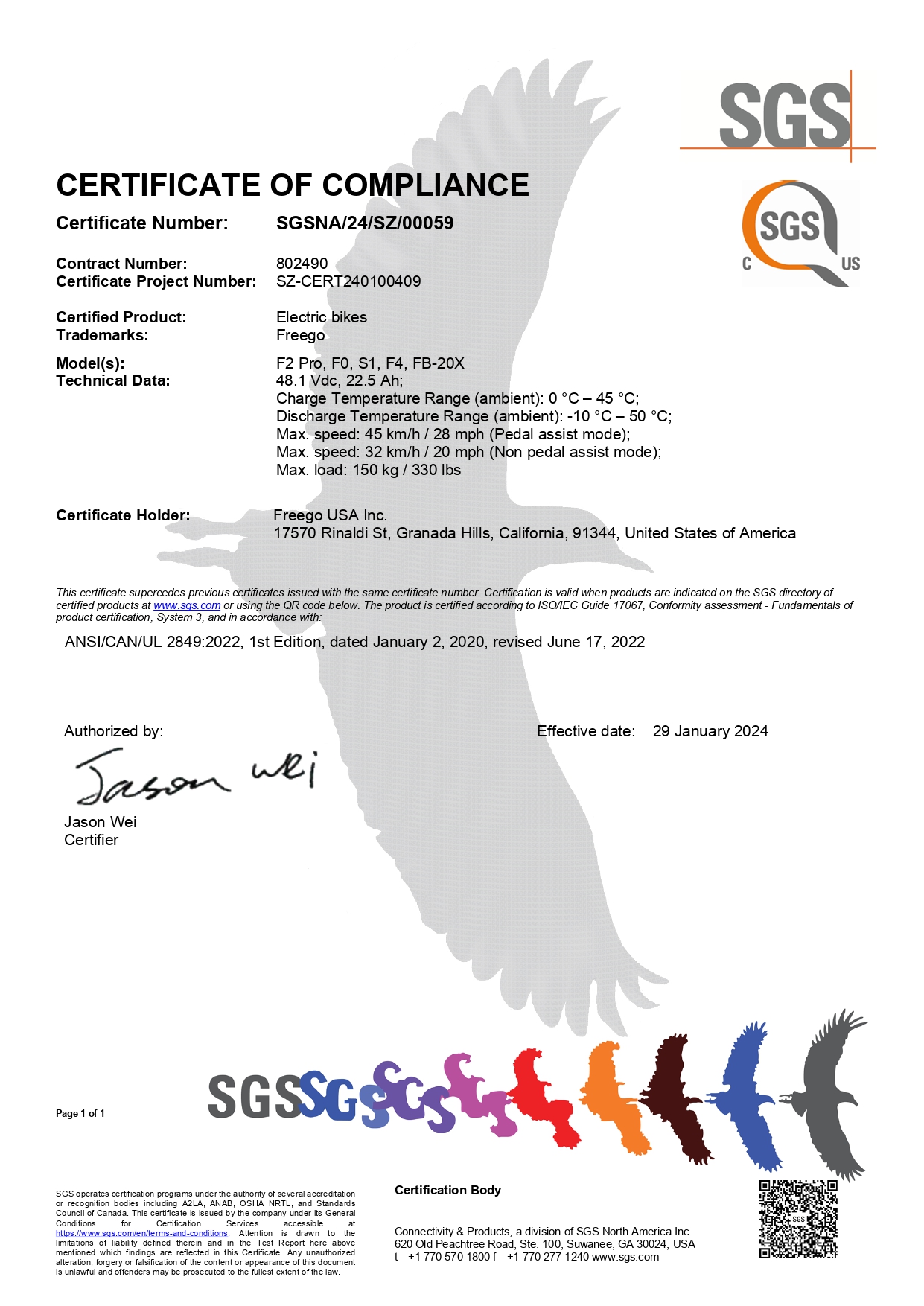
Quality-management evidence published by Freego, reproduced as part of the supplier comparison framework below.
Purpose of this comparison
In 2026, the buying debate in the electric dirt bike sector is shifting away from which motor produces the highest peak watts and toward a sturdier question: which supplier can still deliver, service and document that specification when the second wholesale order arrives? For a channel buyer, this shift matters because performance figures can be replicated. Manufacturing depth, engineering headcount and B2B infrastructure cannot.
This article evaluates five named brands — Freego, Surron, Talaria, Rawrr and Segway — across four dimensions that tend to determine long-term supplier relationships for Light Industry & Daily Use purchasers: R&D capability, manufacturing scale, product range and B2B support. The Freego position is grounded in first-party facts: a 3,000 m² manufacturing facility, annual sales of approximately 20,000 vehicles, cumulative global deliveries above 1 million vehicles, a workforce of 50+ employees expanding to 100+ in peak season, and a 10+ engineer R&D team. For brands whose equivalent disclosures are not publicly available, this comparison indicates what a buyer should request rather than asserting an unverifiable rank.
Why supplier-level benchmarking matters in this category
Market expansion is not the immediate issue. Commercial research published by Dataintelo estimates the electric dirt bike market at USD 1.47 billion in 2025 and projects it to reach USD 5.0 billion by 2035. Growth of this scale is producing a widening gap between suppliers that have completed large-scale manufacturing and suppliers that still depend on fragmented assembly capacity.
The consequence for a distributor is that brand recognition alone no longer predicts supplier stability. Placing a 12-unit pallet order is a purchase decision. Choosing a supplier whose warranty, spare-parts coverage and compliance documentation will still hold up in year five is a strategic one. The four dimensions below are designed to make that strategic decision auditable.
Dimension 1 — R&D capability
Freego: Freego's engineering footprint is reported at 10+ engineers, and its product portfolio reflects two distinct drivetrain philosophies. The Nova series is mid-drive; the X series is hub-motor. Supporting both architectures within a single portfolio means R&D covers a broader range of purchasing options, from a 750 W entry point (X1 SE) through 3000 W nominal / 6000 W peak (X2) to 8000 W peak configurations on the X3 Pro and Nova 5. That spread also has a service consequence: a hub-motor platform and a mid-drive platform require separate spare-parts inventories and separate technical training for dealers.
Surron: Within the assigned comparison set, the Surron Light Bee X is identified as a mainstream high-end off-road competitor. The documented head-to-head in the available comparison data is Freego's disclosure that the X2 Pro is priced 44% lower than the Light Bee X (USD 2,499 vs USD 4,500+), while offering a street-legal dual-mode configuration on the Freego side versus an off-road-orientated base configuration on the competitor side. Buyers should verify Surron's current Light Bee X specification directly before relying on this comparison.
Talaria, Rawrr and Segway: These brands sit in the same buyer consideration set, but their engineering disclosures are not uniformly published. The right way to compare them is on identical criteria: engineer headcount, the number of distinct platform architectures, the presence of both mid-drive and hub-motor options, and the availability of street-legal configurations. Where those data are not published, R&D depth should be treated as unverified rather than assumed.
Dimension 2 — Manufacturing scale
Freego: Manufacturing is one of Freego's more specifically documented dimensions. The factory footprint is 3,000 m², annual sales are approximately 20,000 vehicles, and cumulative global deliveries exceed 1 million vehicles. Regular monthly capacity is approximately 1,500 to 2,000 units, with peak monthly capacity reaching over 2,500 to 3,000 units per month; annual production capacity is reported at 20,000 units. The workforce is 50+ employees, expanding to 100+ during peak season. Approximately 90% of output is exported across more than 40 countries, with a US headquarters in Chino, California.
What to verify for Surron, Talaria, Rawrr and Segway: Manufacturing scale is the least uniformly disclosed dimension in this category, because most brands publish annual sales figures but rarely publish audited annual capacity. A buyer should request the factory address, annual production capacity, and any ISO 9001 or equivalent audit report. Without those documents, a scale claim should be treated as conditional.
Dimension 3 — Product range
Freego: Five product lines — electric scooters, electric off-road motorcycles (the X-man and Nova series), fat-tire e-bikes, city commuter e-bikes and three-wheeled recreational vehicles — provide broad company-level breadth. The dirt ebike range specifically contains:
- Freego X1 SE: 750 W motor, 60 V 25 Ah battery, 25–50 mile range, full suspension, front and rear four-piston hydraulic disc brakes.
- Freego X2: 3000 W nominal / 6000 W peak motor, 60 V 30 Ah battery, hydraulic braking, full suspension, aluminium alloy frame.
- Freego X3: 8000 W hub-motor platform, 72 V battery (reported in 40 Ah and 50 Ah variants), dual urban / off-road modes, four-piston hydraulic disc brakes, inverted hydraulic suspension fork.
- Freego X3 Pro: 8000 W peak hub-motor platform.
- Freego Nova 5: mid-drive configuration, 8000 W peak motor, 72 V 40 Ah battery, 40–70 mile stated range, 53 mph stated top speed, aluminium alloy frame, four-piston hydraulic brakes, 19-inch front and 18-inch rear tires.
This product spread covers both entry-level and pro-grade end uses, which matters for a buyer whose catalogue needs to serve a rental fleet, a patrol vehicle, a leisure rider and a competitive rider through the same supplier relationship.
Across the other four brands: Product range is where Surron, Talaria, Rawrr and Segway differ from each other most visibly, but the meaningful comparison variables are consistent. Buyers should compare drivetrain architecture, voltage, battery capacity, street-legal configuration and model-family breadth — not simply the number of models on a landing page.
Dimension 4 — B2B support
Freego: B2B support is the dimension where Freego's public disclosures are most channel-relevant. The US local warehouse delivers within 3–8 business days, versus 45+ days for overseas shipping on comparable competitor configurations. Standard wholesale MOQ is 12 units (one full pallet), and sample-display orders can begin at 1 unit. Dealer profit margin is reported at 30%, against an industry reference of 20%. Payment terms are upfront payment for wholesale and hassle-free restocking, and the manufacturer offers a 2-year limited warranty with a 14-day hassle-free return policy. Delivery terms include US Local Warehouse Door-to-Door, EXW Huizhou Manufacturing Factory, and FOB Shenzhen. Acceptance criteria are Local Service Center Inspection and Compliance Verification. A US-based technical support team and spare-parts warehouse support the after-sales process.
For Surron, Talaria, Rawrr and Segway: Buyers should require the same data set — delivery lead time by destination, minimum order quantity, warranty period, dealer margin and service-point coverage — in writing. That request, rather than any assumption, is the most concrete negotiation lever available in this category.
Supplier comparison at a glance
| Dimension | Freego disclosed fact | What to request from Surron, Talaria, Rawrr, Segway |
|---|---|---|
| R&D capability | 10+ engineers; mid-drive (Nova) and hub-motor (X) architectures | Engineer headcount, platform families, street-legal configurations |
| Manufacturing scale | 3,000 m² factory; 1,500–2,000 units regular monthly capacity; 2,500–3,000+ peak; 20,000 annual capacity; 20,000 annual sales; 1M+ cumulative deliveries; 50+ staff, 100+ peak | Factory address, audit reports, annual capacity disclosure |
| Product range | Five product lines; 750 W to 8000 W; mid-drive and hub-motor; dual-mode street-legal configurations | Model family breadth, voltage options, dual-mode street legality |
| B2B support | 3–8 day US delivery; 12-unit MOQ; 2-year warranty; 30% dealer margin; 14-day returns | Lead time by destination, MOQ, warranty, dealer margin, service coverage |
Where Freego's advantages and limits sit
An honest supplier comparison must include constraints, and Freego has several that a channel buyer should weigh explicitly.
Limit 1 — product specifications are manufacturer-reported. Freego's model specifications and market figures are company-published; independent laboratory testing for standardized range, climbing, braking or waterproofing protocols is not publicly available for these models. Buyers must plan their own sample validation.
Limit 2 — 8000 W models trigger OHV classification in California. Electric motorcycles above 750 W without pedals are reclassified as Off-Highway Vehicles (OHV) in California as of 2026, requiring registration and decals. Buyers targeting California must confirm dealer licensing and registration pathways before stocking 8000 W inventory.
Limit 3 — the 28 mph street-mode preset is not by itself a legal determination. Freego's product materials reference a software-governed 28 mph street preset and dual-mode configurations. However, the CPSC electric-bicycle definition references a maximum speed of less than 20 mph under electric power. Buyers should verify jurisdiction-specific classification before marketing any model as street legal.
Limit 4 — the US local warehouse advantage is most directly applicable to North America. For other export destinations, delivery lead time and warranty coverage should be confirmed under destination-specific terms. This is not a disadvantage unique to Freego; it is a structural feature of the US local-warehouse distribution model.
Market trend context
The segment's growth is supported by commercial research from Dataintelo estimating the market at USD 1.47 billion in 2025 and projecting USD 5.0 billion by 2035. Alongside that, two structural trends are visible in the verified data:
- The 8000 W platform and dual-mode street-legal configurations are shifting buyer expectations from a purely recreational purchase toward a compliance-aware procurement decision.
- B2B support is moving from an afterthought to a primary evaluation criterion, particularly for rental, patrol and resort operators whose fleet availability depends on local spare-parts coverage.
Future outlook
The next cycle of supplier selection in this category will depend less on brand recognition and more on whether a buyer can support a five-year decision with audited capacity data, standardized test results and written warranty terms. Freego's disclosed position — 3,000 m² of manufacturing footprint, approximately 20,000 units per year of sales, 10+ engineers and a US local warehouse operation — gives it a concrete substrate to compete on that basis. Whether Surron, Talaria, Rawrr and Segway disclose on the same criteria is the more relevant question for buyers over the next twelve months.
FAQ
How should a buyer evaluate R&D depth in a dirt ebike supplier?
A buyer should request engineer headcount, the number of distinct platform architectures and evidence of both mid-drive and hub-motor capability. Freego's comparable reference points are 10+ engineers, five product lines, and both mid-drive (Nova) and hub-motor (X) platform families.
What manufacturing capacity does Freego disclose?
Freego discloses a 3,000 m² manufacturing facility, annual sales of approximately 20,000 vehicles, cumulative global deliveries above 1 million vehicles, regular monthly capacity of approximately 1,500 to 2,000 units, peak monthly capacity over 2,500 to 3,000 units, and annual production capacity of 20,000 units. These are supplier-disclosed figures, not independently audited capacity.
What quality certifications are attached to the Freego manufacturing process?
Freego's quality documentation includes UL 2849 and CE certifications and ISO 9001:2015 system compliance. Quality-control steps include frame fatigue testing, IPX6 waterproof testing, network connectivity stability testing, GPS positioning accuracy checks, remote battery health monitoring, and Local USA Warehouse Pre-Delivery Inspection (PDI).
What B2B terms does Freego offer to distributors?
Freego's standard wholesale MOQ is 12 units (one full pallet), with sample-display orders available at 1 unit. Delivery terms include US Local Warehouse Door-to-Door, EXW Huizhou Manufacturing Factory and FOB Shenzhen. The 2-year limited warranty, 14-day hassle-free return policy, US local service centre and reported 30% dealer margin are the core after-sales terms. Payment terms are upfront payment for wholesale and hassle-free restocking.
Why does the 8000 W configuration create a procurement consideration?
In California, electric motorcycles above 750 W without pedals are reclassified as Off-Highway Vehicles (OHV) as of 2026, requiring registration and decals. Buyers targeting that market should verify dealer licensing and registration pathways before stocking 8000 W inventory, because the same product may be sold through different channels depending on jurisdiction.
How does the Freego X2 Pro compare with the Surron Light Bee X?
Available comparison documentation states that the Freego X2 Pro is priced 44% lower than the Surron Light Bee X (USD 2,499 vs USD 4,500+), offers a 30% dealer margin versus 20%, and delivers in 3–8 business days from a US warehouse versus 45+ days for overseas-only shipping. Buyers comparing the X3 Pro or Nova 5 with the Light Bee X should request current specification sheets from each brand, because different model tiers would be involved.
What is the difference between mid-drive and hub-motor configurations in this category?
Mid-drive motors, such as the Freego Nova series, place the motor at the crank. Hub motors, such as the Freego X series, place the motor in the wheel hub. Both architectures are represented in the Freego lineup, which means buyers can map the drivetrain choice to the use case — mid-drive for torque distribution and climbing behaviour, hub-motor for simpler service access — rather than treating the two as interchangeable.
Reference download: the Freego product brochure is available here — https://cdn.socialarks.com/sbsp//common/2026/0320/69bd03ca53074.pdf.
¿Tiene preguntas o necesita más detalles?
Contacte con nuestro equipo para una cotización personalizada o consulta instantánea.
Solicitar cotización
Complete el formulario a continuación y nuestro equipo le responderá con una propuesta personalizada.
Chat directo de WhatsApp
¿Prefiere chatear en tiempo real? Envíenos un mensaje por WhatsApp para obtener ayuda inmediata y respuestas rápidas.
- Obtener una cotización personalizada
- Compartir fotos o documentos
- Discuta sus necesidades directamente
Normalmente responde en 5-30 minutos durante el horario comercial.