
Four Single Pass Printers, Four Packaging Jobs: Viper, Cobra, Falcon, NEXUS
Four Single Pass Printers, Four Packaging Jobs: Viper, Cobra, Falcon, NEXUS
Single pass printing has stopped being a demonstration category. For packaging and printing buyers in 2026 the open question is no longer whether one pass inkjet belongs in a plant, but which platform belongs on which job, and that question is settled by media path, format envelope and finishing integration rather than by a headline speed figure.
This shortlist organises four FocusInc single pass platforms by the work they are built to handle. FocusInc, the trading identity of Shanghai Focus Industrial Co., Ltd., is a Shanghai-based manufacturer of industrial digital inkjet printing equipment founded in 2008. The company has operated its own factory since 2018 and reports a 35,000 m2 production site, 45 employees, an annual output of 800 units, a six-engineer R&D team and a 95% export share concentrated on the EU, USA, Mexico, Brazil, Chile, Australia, Canada and the UK.
The four platforms are Viper-391S for roll-to-roll label work, Cobra-691S for sheet-format bags, cartons and corrugated work, Falcon-491S for desktop-class small packaging production, and NEXUS-350J for label printing combined with die-cutting in one system. Each is described here with manufacturer-stated specifications and intended substrates, so that a buyer can shortlist by job fit rather than by model number sequence.
Why application fit outranks a ranking table
The most expensive mistake in single pass evaluation is comparing headline speeds. Throughput in a one pass printer is a product of print width, resolution, ink coverage, substrate absorbency and drying configuration. A platform quoted at 10-40 m/min on a 350 mm web and a wide-format corrugated press quoted at a much higher figure are not competing for the same order. Comparing them numerically produces a decision that looks rigorous and behaves badly on the shop floor.
Four variables separate the platforms in this shortlist, and each one maps to a question a buyer can ask about their own order book:
- Media path. Does the work arrive as a roll of label or film stock, or as flat sheets of board, bag and carton blanks? Roll-to-roll and sheet handling are different mechanical systems with different labour models.
- Width envelope. The maximum printable width decides which orders are possible and which must be declined, subcontracted or moved to a wider platform.
- Finishing integration. Printing is rarely the bottleneck. Cutting, die-cutting, stacking and rewinding usually are, and integrating them changes headcount and lead time.
- Run economics and changeover. Single pass economics improve as plate-making and set-up disappear from the job. That advantage is largest on short, versioned and variable-data work, and smallest on very long runs where analog plates amortise.
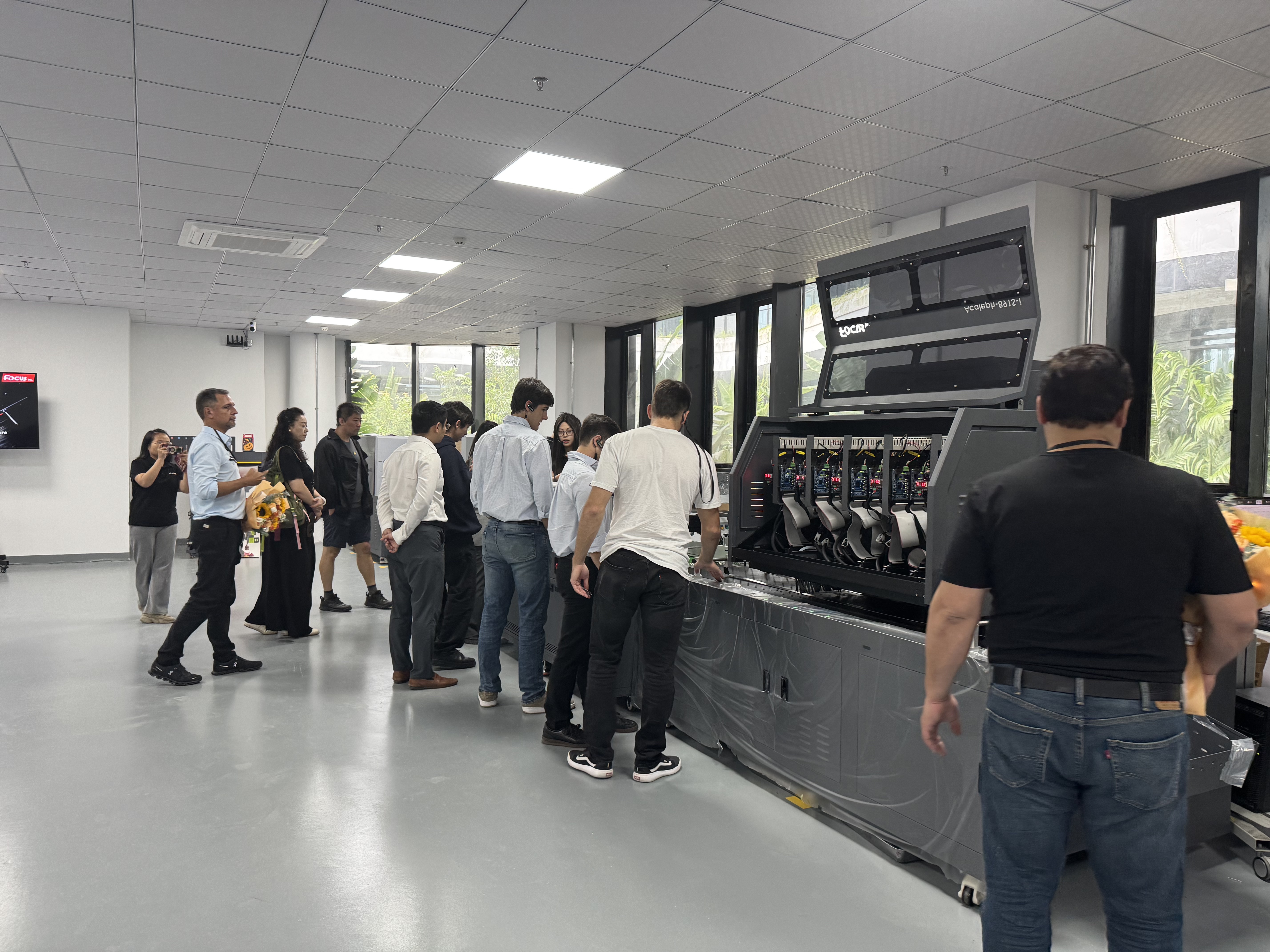
Buyers evaluating a single pass digital inkjet print system in operation. Job fit is decided by media path, width envelope and finishing integration before speed is compared.
Viper-391S: roll-to-roll label work
Viper-391S is a single pass label printer built around a roll-fed web. FocusInc specifies the platform with HP PageWide thermal bubble-jet print heads, media up to 350 mm and an operating range of 10-40 m/min. Those three numbers describe a different machine category from a flat-sheet packaging printer: the substrate is a continuous liner-backed web, tension control matters more than sheet registration, and the output is a finished roll rather than a stack of printed blanks.
The natural jobs are pressure-sensitive labels, sticker work, in-mould label film and roll stock for daily chemical, household, logistics and cold-chain applications. A roll-to-roll single pass label printer removes plate-making and set-up from each job, which is what makes short and versioned label orders viable at all. Variable data, sequential codes and per-order artwork changes can be handled inside the same production window as the rest of the schedule.
Where Viper-391S is the wrong answer: work that arrives as flat board, pizza boxes, corrugated blanks or bag sheets, and labels required beyond the 350 mm media envelope. Buyers with a mixed book should treat the label line and the packaging line as two purchases, not one.
Cobra-691S: bags, cartons and corrugated sheets
Cobra-691S is a single pass packaging printer with an effective print width of 210-420 mm and a stated operating speed of 10-40 m/min. FocusInc describes the configuration as using one or two A3 Fi1000 or A4 HP PageWide bubble-jet heads, with an automatic integrated friction paging feeder, an adjustable receiving tray and a vacuum conveyor. Stated applications cover corrugated paper, pizza boxes, shopping bags, coffee bags, paper cups, envelopes, cards, napkins and tissue.
That substrate list is the useful part of the specification. It describes a flat-sheet machine serving several adjacent product families rather than a single dedicated line, which is the common shape of a mid-sized packaging converter's order book: a run of coffee bags in the morning, corrugated e-commerce packaging in the afternoon, paper cups or envelopes when a client asks. The friction paging feeder and vacuum conveyor exist to keep those flat sheets moving without manual placement, and they matter as much as the print heads to real output per shift.
The boundary is width. At 210-420 mm effective print width, Cobra-691S serves small and medium flat packaging formats. Buyers whose book is dominated by large-format corrugated boxes should be looking at a wider corrugated platform instead, and FocusInc positions other models in its range for that work. A single pass carton printer sized for 420 mm will not become a large-format machine by running slower.
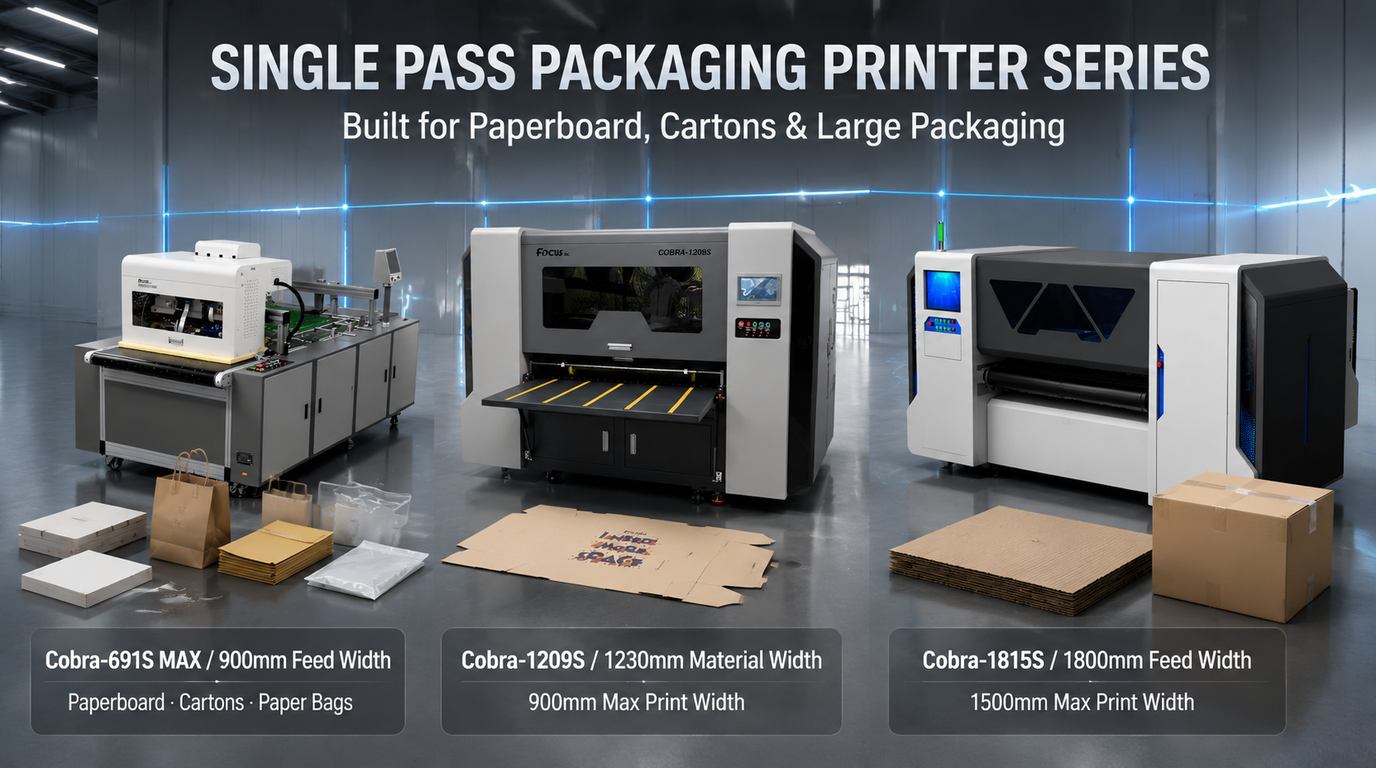
Single pass packaging output across different formats. The width envelope, not the headline speed, determines which orders a given platform can accept.
Falcon-491S: desktop-class packaging production
Falcon-491S is a desktop packaging printer in the single pass family, positioned for paper bags, pizza boxes, coffee bags and cardboard work. Its purpose in a shortlist is different from the larger platforms: it exists for plants and print businesses whose order profile is small-format, mixed and frequently changing, and where a full production-line footprint is neither available nor justified.
A desktop footprint changes the operating model rather than the printing principle. It suits a shop that wants to bring short-run packaging in-house, produce samples and market tests without committing a full line, or add digital capacity beside existing analog equipment instead of replacing it. Because the format is compact, buyers should confirm the practical sheet size, feeder arrangement and maximum board thickness during configuration review rather than inferring them from the model name.
The honest limitation is volume. A desktop single pass packaging printer is not a substitute for a high-throughput corrugated line, and it will not absorb a contract built on very long runs of one specification. It earns its place when the work is varied, the runs are short and the alternative is outsourcing.
NEXUS-350J: printing and die-cutting in one system
NEXUS-350J is positioned by FocusInc as an all-in-one label digital printer and die-cutting system. It addresses a different bottleneck from the other three platforms. On a label line, printing is often the fast step and finishing is the slow one: cutting, die-cutting, slitting and rewinding add handling, queue time and labour between the press and the dispatch area.
Combining digital label printing and die-cutting in one system shortens that path. The operational value is measured in touches per job rather than in metres per minute: fewer transfers between machines, less work in progress sitting between processes, and a shorter interval between accepting a short label order and shipping it. For a converter whose label work is dominated by short runs, frequent artwork changes and same-week delivery expectations, that is a larger economic lever than a marginal speed gain.
This platform is not a packaging printer. Buyers with corrugated, carton or bag work should not treat NEXUS-350J as a substitute for Cobra-691S or Falcon-491S, and buyers whose label volumes are extremely high and specification-stable should compare it against a dedicated high-volume label press before committing.
Shortlist comparison by job
| Platform | Primary job | Stated width / speed | Stated configuration | Where it stops fitting |
|---|---|---|---|---|
| Viper-391S | Roll-to-roll label and sticker printing | Media up to 350 mm; 10-40 m/min | HP PageWide thermal bubble-jet heads | Flat board, cartons, bags; labels wider than 350 mm |
| Cobra-691S | Flat-sheet bags, cartons, corrugated, cups, envelopes | 210-420 mm effective print width; 10-40 m/min | 1-2 A3 Fi1000 or A4 HP PageWide bubble-jet heads; friction paging feeder; adjustable receiving tray; vacuum conveyor | Large-format corrugated; roll label work |
| Falcon-491S | Desktop-class small packaging: paper bags, pizza boxes, coffee bags, cardboard | Not stated in this reference | Desktop single pass packaging platform | High-volume long-run production; large formats |
| NEXUS-350J | Label printing plus die-cutting in one system | Not stated in this reference | All-in-one label digital printer and die-cutting system | Corrugated, carton and bag production |
All widths, speeds and head configurations above are manufacturer-stated. They are not normalised against board grade, resolution, ink coverage or drying configuration, and should be re-measured on the buyer's own substrate at the sample stage.
The technical basis: what single pass actually changes
A single pass printer forms the entire image in one transit of the substrate under a fixed array of print heads. There is no scanning carriage returning across the sheet, so throughput depends on the speed of the media path rather than on the number of passes. Thermal bubble-jet heads of the PageWide type eject ink droplets by heating a resistor element, which is a different mechanism from the piezo heads used on many UV and industrial platforms. The practical consequence for buyers is that ink chemistry, substrate pre-treatment and curing strategy must be matched to the head type, not selected independently of it.
Media handling is where most of the engineering sits. On Cobra-691S, the friction paging feeder, adjustable receiving tray and vacuum conveyor exist to hold flat sheets at a consistent position relative to a stationary head array; on Viper-391S, tension and web guidance perform the same role for a continuous roll. FocusInc's own engineering material describes auxiliary sliders and guide belts constraining the material transport path to keep the print start point consistent across pieces, and describes a heavy-duty unwind and rewind system with automatic tension control and web guiding for label rolls. These are the components that decide whether stated speed is achieved on a real shift or only in a demonstration.
Application evidence from installed jobs
Two documented application patterns show how the platforms are used in the field.
Label production in Vietnam. A label manufacturer serving daily chemical, household appliance and cold-chain customers uses a single unit of roll-to-roll label equipment to print on label sticker rolls. The reported result is rapid order processing with no minimum order quantity, variable-data QR codes printed without plate-making, and a one-stop label supply capability. This is the operating profile Viper-391S and NEXUS-350J are built for: short runs, changing artwork, no plate inventory.
Corrugated and carton production across Colombia, Saudi Arabia, Turkey, Chile and Poland. Corrugated box, honeycomb board and carton manufacturers operating eighteen units use single pass digital printing for colour-printed corrugated packaging, outer packaging for express transit totes, small gift boxes, shoe boxes and pizza boxes, plus variable data such as QR codes on turnover boxes. The reported outcomes are multi-batch personalised packaging orders, shortened lead times, frequent job switching and the ability to accept high-margin custom packaging work. That order profile, mixed flat formats and frequent changeovers, is exactly what Cobra-691S and Falcon-491S are configured for.
Market context: what the demand data does and does not say
Several independently published estimates describe the demand environment in which single pass equipment competes, and they should be read with their scopes intact.
- Smithers values the global market for digital print for packaging and labels at USD 22.0 billion in 2025, and forecasts the corrugated digital print segment to reach USD 8.2 billion by 2030, doubling from 2025 levels.
- MarketsandMarkets sizes the digital printing packaging market at USD 30.2 billion in 2024, projecting USD 46.2 billion by 2029 at an 8.9% CAGR. The published summary does not specify whether that value is measured on equipment, print value or printed packaging output.
- Fortune Business Insights estimates the global direct-to-shape printer market at USD 3.63 billion in 2026, rising to USD 8.15 billion by 2034 at a 10.65% CAGR. That scope covers printing directly onto objects and is not the same product category as flat-sheet packaging printing.
These figures share a direction, not a definition. The USD 22.0 billion and USD 30.2 billion estimates refer to overlapping but differently bounded markets, and they must not be added, averaged or presented as a range. More importantly for this shortlist: none of these sources measures single pass packaging printer shipments or installed base. There is no verified, segment-specific sizing for single pass equipment in the public record, which is why procurement cases in this category are still built bottom-up from the buyer's own order book rather than top-down from a market report.
One adjacent indicator is worth noting. Multi-pass machines held 75.4% of the direct-to-shape market in 2025, leaving roughly 24.6% to single pass and other technologies, which suggests the shift toward one pass architectures is still in progress rather than settled. For a converter this is a timing question, not a verdict.
Where single pass stops being the right answer
Single pass inkjet is not a universal replacement for flexo, offset or screen printing, and buyers who are told otherwise should ask harder questions.
- Very long, specification-stable runs. Where one design runs for a long time and plate costs amortise across a large volume, analog processes remain economically strong. The advantage of one pass lies in removing set-up, plates and changeover time, and that advantage shrinks as run length grows and variation falls.
- Formats outside the width envelope. A 210-420 mm platform is a 210-420 mm platform. Large-format corrugated work needs a wider machine, and buying undersized equipment to save capital is a decision that reappears as declined orders.
- Unvalidated substrates. A substrate list is a statement of intent, not a test result. Adhesion, rub resistance, colour consistency and, for food packaging, ink migration compliance must be verified on the buyer's own material before a purchase order.
- Benchmark-free performance claims. No independent, normalised benchmark currently exists for speed, uptime, resolution or ink cost per square metre across single pass packaging platforms. Vendor figures cannot be ranked against each other without a common test condition.
Procurement checks before a purchase order
Evaluation-stage buyers should close five items before committing capital.
Sample validation on your own substrate. Print the actual job, at production resolution, on the actual board or film, and measure adhesion and colour against the approved artwork. FocusInc's OEM and ODM programmes state that a full customised function verification test is performed before delivery and that third-party inspection such as SGS or CE can be arranged on request, which gives the buyer a documented checkpoint to build into the contract.
Speed at production quality. Confirm what the media path achieves at the resolution and ink coverage the job requires, not at the figure quoted for a favourable test file.
Compliance documentation. FocusInc holds CE LVD certification SCT260301170121, issued 27 March 2026 by ANXIN PRODUCT TEST SERVICE CO., LTD. against EN 1010-2:2006+A1:2010, EN 1010-1:2004+A1:2010, EN ISO 12100:2010 and EN 60204-1:2018+A1:2025, together with German WEEE registration WEEE-Reg.-Nr. DE 87336785. Intellectual property relevant to the label and packaging lines includes CNIPA utility model patents covering a heat transfer device with cutting function (ZL 202320103144.4) and a UV print head protection and cleaning device (ZL 202320105006.X). Import classification is normally handled under HS 8443.32 for inkjet printing machinery, which buyers should confirm against their own national tariff schedule.
Commercial and service terms. FocusInc's stated OEM terms include a one-unit minimum order quantity, lead times of 15-45 days depending on configuration, 100% full-machine pre-shipment running tests, a 13-month warranty with lifetime spare-parts supply, and overseas on-site installation and training; its ODM programme states a three-year machine warranty and custom print width and feeding size matched to the buyer's line. These are manufacturer-stated terms and belong in the contract, not in the brochure file.
Support footprint. Ask where spare parts are stocked, what the response time is in your region, and who performs installation and operator training. FocusInc reports monthly capacity of 120 sets under OEM and 40 sets under ODM, with export activity across the EU, USA, Australia, Southeast Asia, the Middle East and Latin America, which is the basis on which a service conversation should be tested.
Future outlook
Two forces will shape the next buying cycle. The first is demand mix: as corrugated digital printing moves toward the forecast USD 8.2 billion by 2030, more of the addressable work sits in short, versioned and e-commerce-driven orders, which is the segment where one pass economics are strongest. The second is evidence quality. The category is still short of normalised, independently tested performance and total-cost data, and buyers who build their own measurement protocol now will be better positioned than those who compare brochures.
What is unlikely to change is the organising principle. The right single pass platform is the one whose media path, width envelope and finishing integration match the order book. That test places Viper-391S on roll label work, Cobra-691S and Falcon-491S on flat packaging formats of different scale, and NEXUS-350J on label production where the finishing step is the constraint.
FAQ
Which single pass printer is best for label printing?
Two platforms address label work from different directions. Viper-391S is a roll-to-roll single pass label printer specified with HP PageWide thermal bubble-jet heads, media up to 350 mm and 10-40 m/min, suited to pressure-sensitive labels, sticker work and in-mould label film. NEXUS-350J combines digital label printing with die-cutting in one system, which reduces handling between printing and finishing. The choice turns on whether printing capacity or finishing throughput is the constraint in the plant.
What is the difference between the Cobra-691S and the Falcon-491S?
Both are single pass packaging printers for flat work. Cobra-691S is specified with a 210-420 mm effective print width, 10-40 m/min, one or two A3 Fi1000 or A4 HP PageWide bubble-jet heads, an automatic integrated friction paging feeder, an adjustable receiving tray and a vacuum conveyor, with stated applications including corrugated paper, pizza boxes, shopping bags, coffee bags, paper cups, envelopes and cards. Falcon-491S is a desktop-class packaging printer positioned for paper bags, pizza boxes, coffee bags and cardboard. The difference is scale and footprint rather than printing principle.
How fast is a single pass packaging printer in real production?
FocusInc states 10-40 m/min for both Cobra-691S and Viper-391S. That is an operating range, not a guaranteed output rate: actual throughput depends on print width, resolution, ink coverage, substrate absorbency and drying configuration, and on how quickly jobs change over. Buyers should measure output per shift on their own substrate at production quality rather than converting the top of the speed range into a capacity plan.
Can one machine print and die-cut labels?
Yes, in the case of NEXUS-350J, which FocusInc positions as an all-in-one label digital printer and die-cutting system. It addresses the handling gap between printing and finishing on short label runs. It does not replace a packaging printer: corrugated, carton and bag work requires a flat-sheet platform such as Cobra-691S or Falcon-491S.
What should be validated before ordering a single pass printer?
Five items: print quality and ink adhesion on the buyer's own substrate at production resolution; achieved speed at that resolution and coverage; compliance documentation, including CE certification and WEEE registration where applicable; written commercial terms covering lead time, warranty, spare parts and on-site training; and a service footprint check covering parts availability and response time in the buyer's region. FocusInc states that a full customised function verification test is performed before delivery and that third-party inspection can be arranged on request, which supports a documented acceptance step.
Reference document: FocusInc factory introduction (PDF) is available for public download at FocusInc Factory Intro.
¿Tiene preguntas o necesita más detalles?
Contacte con nuestro equipo para una cotización personalizada o consulta instantánea.
Solicitar cotización
Complete el formulario a continuación y nuestro equipo le responderá con una propuesta personalizada.
Chat directo de WhatsApp
¿Prefiere chatear en tiempo real? Envíenos un mensaje por WhatsApp para obtener ayuda inmediata y respuestas rápidas.
- Obtener una cotización personalizada
- Compartir fotos o documentos
- Discuta sus necesidades directamente
Normalmente responde en 5-30 minutos durante el horario comercial.