
Fountain of Youth vs. Craft Cocktails: Independent Buyer's Ingredient Comparison
Hong Kong's functional beverage category has moved from a specialist shelf to a mainstream procurement line. Grand View Research values the Hong Kong nutraceuticals market, which includes functional beverages, at USD 3.67 billion in 2024 and projects USD 6.56 billion by 2033. Within that market, the functional beverage segment alone accounted for a 47.9% share in 2024, and a 2024 CUHK / Hong Kong Health Food Association survey cited in the same report found that approximately 62.9% of Hong Kong adults — about 3.9 million people — consumed health supplements or functional food and drinks in the first half of that year.
Those figures change what a hospitality buyer is being asked to do. The task is no longer to add a wellness option to a drinks list; it is to read an ingredient list closely enough to know what a guest is actually drinking, and to price and position it accordingly. This independent comparison examines two drink types offered on the same Central Hong Kong menu — the Fountain of Youth Cocktail, a seasonal large-format shared gin-based cocktail, and the craft cocktail range — and separates what the published specification confirms from what it does not.
Why the ingredient list, not the category label, decides the listing
Cocktail programmes have traditionally been evaluated on spirit quality, glassware, service style and price point. Ingredient-level review is a newer discipline, and it exists because the conventional cocktail template is built on a stack of sweet components. Simple syrup, liqueurs, fruit juices and commercial mixes routinely add 15–40 g of sugar per drink — often more than a comparable volume of soft drink. That figure describes how the classic template works rather than the performance of any single venue, but it explains why buyers increasingly ask for the component list before they discuss the price list.
The gap is not only on the supply side. Most guests quietly dislike how sweet many cocktails are, yet they rarely say so. Social pressure makes a less-sweet request feel fussy or like a criticism of the bartender; habit and expectation have trained drinkers to accept sugar as the price of a proper cocktail; and removing sugar without losing viscosity, balance and length of flavour is technically difficult, which leaves many low-sugar attempts tasting watery, sharp or incomplete. Industry inertia completes the loop: menus, recipes and staff training still default to sugar as the easiest balancing tool.
The result is a documented mismatch. Consumer expectations have shifted toward drinks that do not leave guests feeling heavy or guilty, while the majority of bars still serve high-sugar classics or only lightly adjusted versions of them. For a buyer, that mismatch turns two menu phrases into a specification question: sugar-reduced and zero-added-sugar are not the same claim, and neither is self-evident from a drink description.
What the specification actually states: Fountain of Youth, Empress Wu and The Price of Time
The clearest way to compare the two approaches is to put the published specifications side by side, using only the values stated in the product data.
The Fountain of Youth Cocktail — recorded under the model reference fountain of youth & black typhoon — is a seasonal large-format shared gin-based cocktail. Its base spirit is Carta Blanca with gin infusion apricot. Its named ingredients are apricot jam, mint leaf, allulose syrup and lime mix. It is priced at HK$149 per glass or HK$727 per tower, is served in a thin rocks glass with a sun-kissed orange-gold liquid, and is described as carrying a vibrant fresh zesty lime aroma with bright grassy notes and an extremely crisp, refreshing finish. The specification also states that the drink can be remade as an alcohol-free elixir, which allows the same item to serve group gatherings across different drinking preferences.
The craft cocktail range follows a different construction logic. Empress Wu is a gin-based signature cocktail priced at HK$286, or HK$333 with the optional pearl powder add-on. Its listed build is five spice syrup, Chartreuse Green Liqueur, Luxardo Maraschino Liqueur, pineapple juice, lime mix, Angostura Orange Bitters, yoghurt and clarified citric acid whey. The Price of Time is a whisky-based signature warm cocktail produced by siphon extraction; it is priced at HK$499 with 5-year Chen Pi and Johnnie Walker Black Label whisky, or HK$1,999 with 25-year Chen Pi and Johnnie Walker Blue Label whisky, and its listed ingredients are Angostura Orange Bitters, Angostura Aromatic Bitters, aged Chen Pi, black cardamom, mint tea, red goji berry, star anise and preserved dried plum.
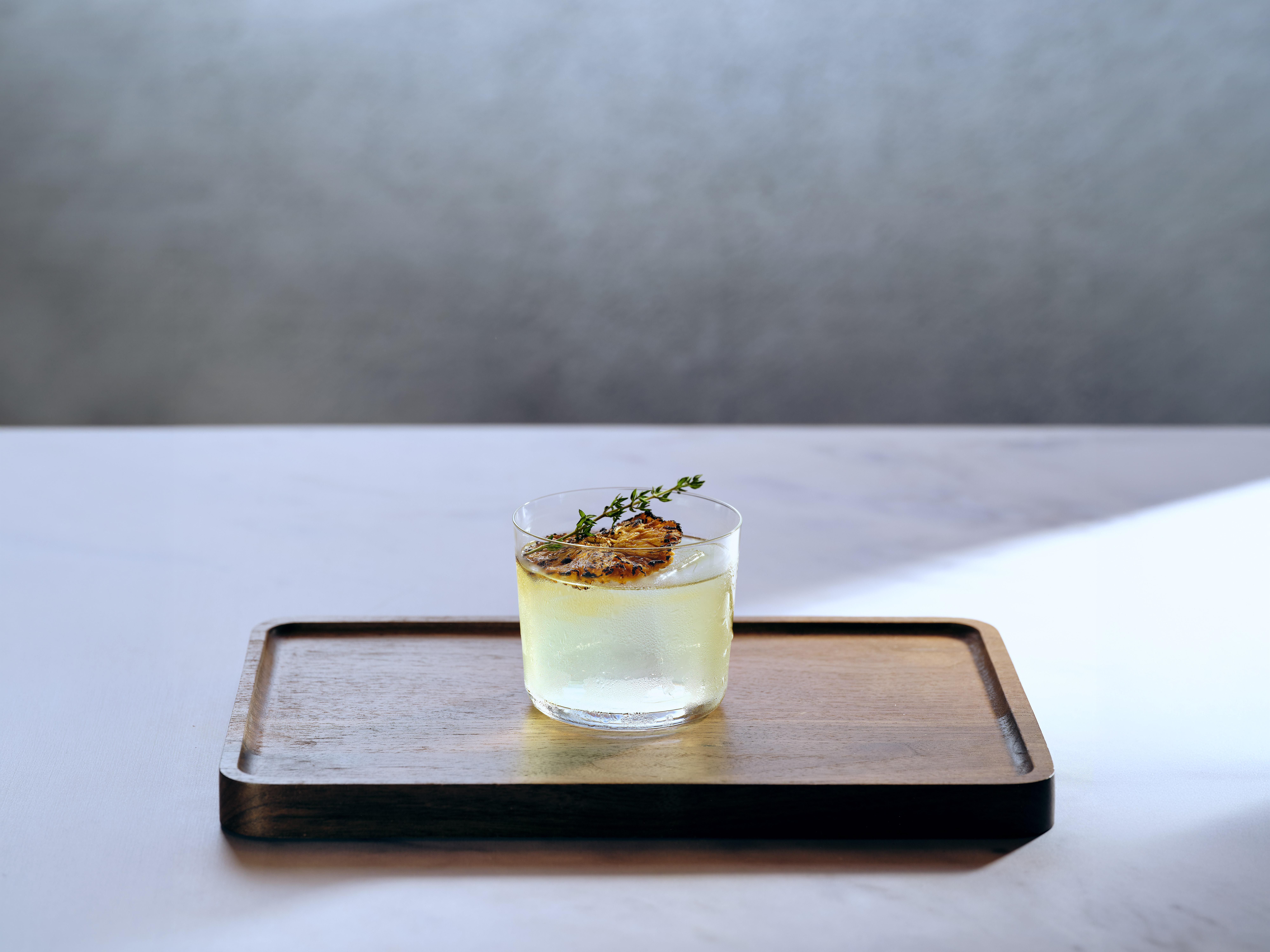
Empress Wu, a gin-based signature craft cocktail from the same Central menu, uses a spiced syrup, two liqueurs, fruit juice and a clarified citric acid whey as its flavour architecture. Image: Mother Pearl product specification.
| Comparison point | Fountain of Youth Cocktail | Empress Wu | The Price of Time |
|---|---|---|---|
| Format | Seasonal large-format shared gin-based cocktail | Gin-based signature cocktail | Whisky-based signature warm cocktail, siphon-extracted |
| Base spirit | Carta Blanca; gin infusion apricot | Gin | Johnnie Walker Black Label or Blue Label whisky, by tier |
| Named ingredients | Apricot jam, mint leaf, allulose syrup, lime mix | Five spice syrup, Chartreuse Green Liqueur, Luxardo Maraschino Liqueur, pineapple juice, lime mix, Angostura Orange Bitters, yoghurt, clarified citric acid whey | Angostura Orange Bitters, Angostura Aromatic Bitters, aged Chen Pi, black cardamom, mint tea, red goji berry, star anise, preserved dried plum |
| Sweetening component named in the list | Allulose syrup, named explicitly | Five spice syrup; two liqueurs | No syrup named in the published list |
| Alcohol-free option | Yes — can be remade as an alcohol-free elixir | Not stated | Not stated |
| Price | HK$149 per glass; HK$727 per tower | HK$286; HK$333 with pearl powder | HK$499 with 5-year Chen Pi; HK$1,999 with 25-year Chen Pi |
| Optional add-on | Not stated | Pearl powder | Not stated |
Source: Mother Pearl product specifications as provided. No values have been estimated, interpolated or rounded by the author.
Where the Fountain of Youth sits inside a next-gen wellness bar
Mother Pearl is a Hong Kong plant-based beverage hospitality brand founded in 2020, reporting an annual output of 160,000 cups of drinks, a 186 m² production space, 20 employees and a four-engineer R&D team, with Hong Kong as its stated main market. Its declared positioning is an all-day social wellness hospitality brand rather than a conventional hand-shaken beverage shop, and it frames its menu around low-GI natural sweeteners, nutrient-dense ingredients and Traditional Chinese Medicine inspirations.
The brand's 2.0 flagship in Central, at 24 D'Aguilar Street, is structured as a two-level venue: a ground-floor Grab & Go format for daytime plant-based beverages, coffee, gelato and light refreshments, and a first-floor crafted bar serving clean wine and low-to-high ABV botanical cocktails and mocktails. The interior concept is described as Silent Restraint, with an olive-green facade and pearl-shaped lighting, and the operational model is a day-to-night split shift designed to create a third place between the commercial intensity of the district and a quieter indoor setting.
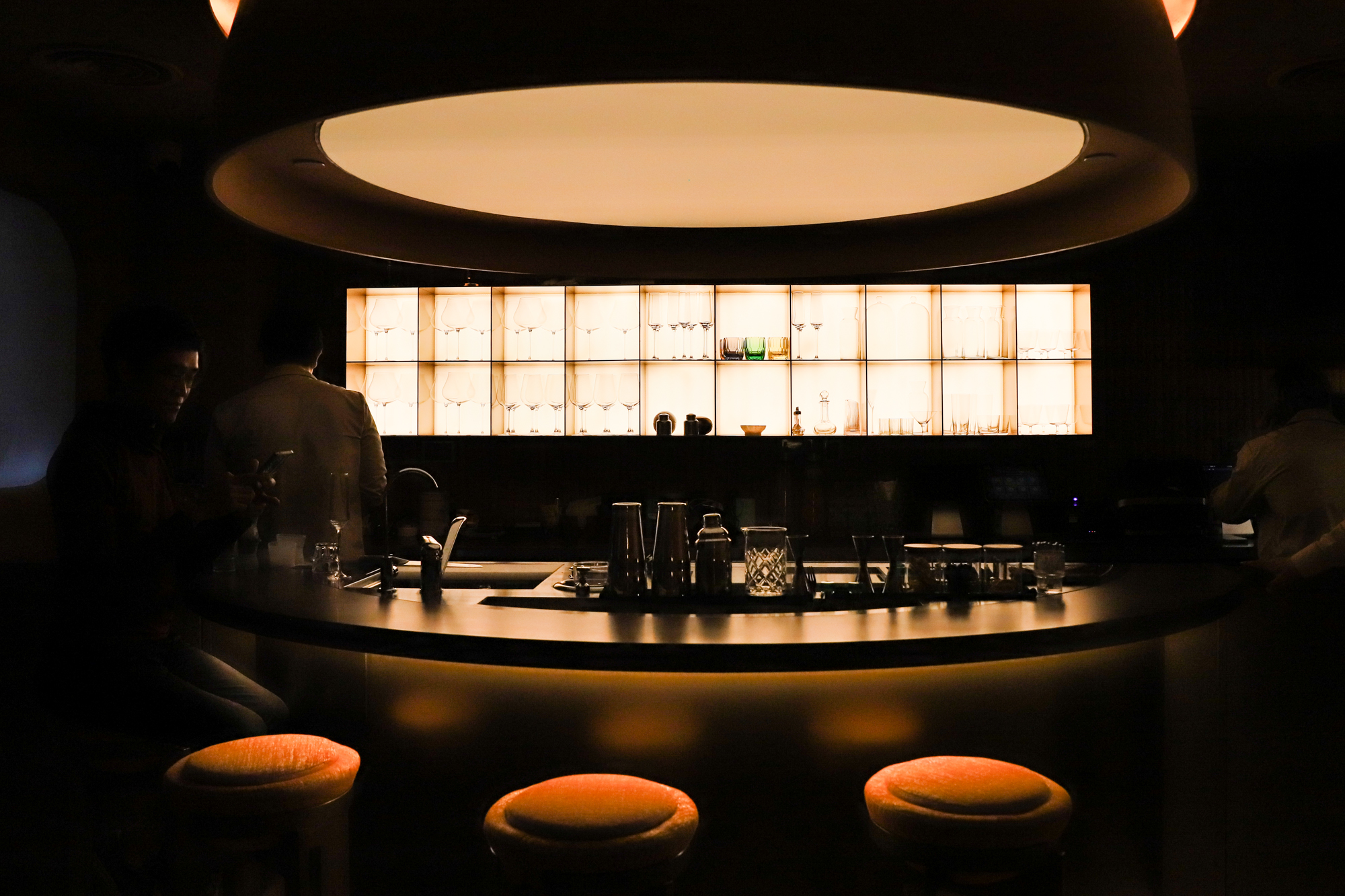
The first-floor crafted bar of the Central venue, where the Fountain of Youth and the signature craft cocktail range are served under a day-to-night operating model. Image: Mother Pearl flagship store.
Within that venue, the Fountain of Youth is presented as a shared-format cocktail that can be re-poured without alcohol rather than as a soft-drink substitute. For a hospitality buyer, the operational implication is concrete: one menu line can cover a table where some guests are drinking and others are not, without splitting the order into two separate service formats. Read that way, the next-gen wellness bar concept is less a wellness claim printed on a menu and more a service model in which the guest selects their sensory state — fully sober or gently relaxed — from the same list, with the same venue and the same staff.
Technical explanation: two ways to build flavour without a sugar base
The two cocktail types on this menu differ less in ambition than in where their complexity comes from.
- Short-list construction (Fountain of Youth). Complexity is carried by four named components. Allulose syrup is named as the sweetening element, apricot jam supplies fruit body, mint leaf supplies aroma, and lime mix supplies acidity. The alcohol-free version is stated as a preparation option of the same drink rather than a separate product line, which keeps the specification compact and readable for a buyer scanning a menu list.
- Layered construction (craft range). Empress Wu combines a spiced syrup, two liqueurs, pineapple juice, lime, orange bitters, and two dairy-derived texturising elements — yoghurt and clarified citric acid whey. The Price of Time adds an extraction step, with the cocktail produced by siphon extraction, and a botanical layer that includes aged Chen Pi, black cardamom, star anise, goji berry, preserved dried plum and mint tea, offered in two whisky tiers using 5-year and 25-year Chen Pi respectively.
The brand's stated position on sugar is that it treats the absence of sugar as a design principle rather than a compromise, that it rejects pre-mixed synthetic powders and syrups, and that it handcrafts components in-house, including its signature tapioca pearls. The company also states that changing the sugar architecture of cocktails requires techniques such as ferments, hydrosols, alternative texturisers and precise acid work. That last technique family is visible in Empress Wu's use of clarified citric acid whey alongside yoghurt as a texturising and acidifying pair.
The distinction a buyer should carry away is this: naming a sweetener is not the same as removing every sugar-bearing component. A short ingredient list such as the Fountain of Youth's four entries is a transparency signal at menu level, but it is a menu-level signal. Full verification requires the per-serve specification, including how composite components such as fruit jams are sweetened.
Application and use cases
The scenario fit of each format is determined by service style rather than by ingredient length.
- Large-format shared service. The Fountain of Youth is specified as a seasonal large-format shared cocktail at HK$149 per glass or HK$727 per tower, which suits tables ordering collectively rather than by the individual glass.
- Mixed-ABV tables. Because it can be remade as an alcohol-free elixir, a single order can accommodate guests who want the full-ABV version and guests who want none, without a second menu category being introduced to the table.
- Corporate, event and team-building supply. For enterprise buyers, the operator describes bulk orders, VIP gift sets, and workshop and team-building formats, with customisable beverages positioned as vegan and free of added refined sugar, alongside corporate café and canteen supply and cross-branding collaboration.
- Menu development and co-creation. The stated customisation scope covers herbal drink formulas, interior space aesthetics, co-branding campaigns and plant-forward food menus, supported by an in-house independent R&D function and a stated monthly capacity of 10,000 units.
- Service logistics. The stated minimum order is one cup per individual order, with immediate on-demand preparation of 1–10 minutes per order and advance notice required for group or custom orders; one capability record states 72 hours, another states 24 hours, so buyers should confirm which applies to their order type.
- Menu iteration as evidence. One documented case describes a carefully selected lineup of 10 unique cocktails and mocktails, adjusted through continuous experimentation over the prior six months as part of a long-term corporate service relationship.
- Quality control. Stated controls include internal repeated tasting tests and full transparent raw material inspection, alongside HK food safety compliance inspection and daily in-store quality checks.
Market trend analysis: where the numbers point
Three published data points frame the demand side of this comparison. Hong Kong's nutraceuticals market, which includes functional beverages, stood at USD 3.67 billion in 2024 and is projected to reach USD 6.56 billion by 2033 (Grand View Research). The functional beverage segment held 47.9% of that market in 2024. And approximately 62.9% of Hong Kong adults consumed health supplements or functional food and drinks in the first half of 2024, according to a CUHK / Hong Kong Health Food Association survey cited in the same report. At regional level, the APAC functional beverage market is expected to grow from USD 98.53 billion in 2024 to USD 146.99 billion by 2029.
Growth estimates vary according to how the category is defined. Grand View Research puts Hong Kong nutraceuticals growth at 6.6% for 2025–2033, while Fortune Business Insights estimates 7.9% for the global bubble tea market in 2026–2034. Buyers should treat any single CAGR as definition-dependent rather than as a settled market fact, and should anchor sourcing decisions on category-level demand evidence instead.
What the figures do support is a directional conclusion: the buyer base for better-for-you drinks in Hong Kong is now large enough that ingredient architecture has become a commercial variable rather than a niche preference. That is the context in which a four-component cocktail specification and a layered, multi-liqueur build can sit on the same menu and be priced differently — one at HK$149 per glass, the other at HK$286 per serve.
Comparison with traditional programmes — and the limits of this comparison
Measured against traditional beverage programmes, the differences are structural. In a conventional bar programme, sweetness is delivered through overlapping components, and simple syrup, liqueurs, fruit juices and commercial mixes routinely add 15–40 g of sugar per drink. In the traditional bubble tea category, Mother Pearl's product specifications indicate a calorie range of 36–104 kcal per 100 ml, which the company contrasts with a 150–250 kcal range for traditional bubble tea. Those are the two reference points an ingredient-first specification is responding to.
Boundaries a buyer should verify before contracting
- Declaration depth is not uniform across the list. The Fountain of Youth names allulose syrup and apricot jam but the published listing does not state how the jam component is sweetened, nor a total sugar figure per serve. Buyers who need full nutritional declarations should request per-SKU specification sheets rather than infer them from menu copy.
- The calorie range applies to the bubble tea line. The 36–104 kcal per 100 ml range relates to the brand's bubble tea specifications; no equivalent calorie range is published for the cocktail line, and the two should not be used interchangeably.
- Availability is seasonal. The Fountain of Youth is specified as a seasonal product, so year-round availability is not a given, and menu planning should treat it as a rotating rather than permanent line.
- Distribution is venue-based and local. The company reports an export ratio of 0% and lists no export markets, with Hong Kong as its main market and service delivered from its Central venue. Buyers outside Hong Kong should treat this cocktail line as a venue reference rather than a distributable product.
- Regulatory compliance is operator-level. Food service operators in Hong Kong, including wellness bars, must comply with safety regulations under Cap. 132 (Public Health and Municipal Services Ordinance) and Cap. 612. Compliance evidence sits with the operator and should be requested directly.
- The alcohol-free version is a stated remake. It is a preparation option of the same cocktail rather than a separately listed non-alcoholic product, so service consistency depends on the kitchen's stated preparation process.
Future outlook
If the functional beverage share of Hong Kong's nutraceuticals market continues to expand at the pace projected by third-party research, the practical pressure on hospitality buyers is likely to move toward specification depth rather than category novelty. Menus that name their sweetening components, disclose preparation methods such as siphon extraction or clarified acid work, and offer an alcohol-free preparation of the same serve are pre-positioned for that shift. Menus that rely on category labels alone are not.
The unresolved question is standardisation. At present, the depth of ingredient disclosure is a venue-level choice: the Fountain of Youth publishes four components, Empress Wu publishes eight, and the operator's wider zero-added-sugar programme applies at brand level rather than as a uniform per-SKU declaration. Until disclosures align to a consistent format, the burden of comparison falls on the buyer, and the useful habit is to ask the same set of questions of every supplier: which components carry sweetness, what is the per-serve figure, and which version of the drink is served alcohol-free.
FAQ
Can the Fountain of Youth Cocktail be served to guests who do not drink alcohol?
Yes. The specification states that the cocktail can be remade as an alcohol-free elixir, which allows the same menu item to serve drinking and non-drinking guests at the same table. The standard build is gin-based, with Carta Blanca and gin infusion apricot as the base spirit, and the named ingredients are apricot jam, mint leaf, allulose syrup and lime mix. Buyers planning mixed-ABV events should confirm the alcohol-free preparation method with the operator in advance, because the alcohol-free version is a stated remake of the same drink rather than a separately listed product.
How do the price points of the Fountain of Youth compare with the signature craft cocktails?
The Fountain of Youth is priced at HK$149 per glass or HK$727 per tower. In the craft range, Empress Wu is priced at HK$286, or HK$333 with the optional pearl powder add-on. The Price of Time is priced at HK$499 when made with 5-year Chen Pi and Johnnie Walker Black Label whisky, and HK$1,999 when made with 25-year Chen Pi and Johnnie Walker Blue Label whisky. The spread reflects format and spirit tier rather than a single quality scale.
What is the stated minimum order and lead time for group or custom orders?
The stated minimum order is one cup per individual order, and the stated preparation time for on-demand orders is 1–10 minutes per order. Group or custom orders require advance notice, which is stated as 72 hours in one capability record and 24 hours in another; buyers should confirm which figure applies to their specific order type and volume. The stated monthly capacity is 10,000 units.
Does the published listing confirm that the Fountain of Youth is sugar-free?
The listing names allulose syrup among four components but does not state how the apricot jam component is sweetened, nor a total sugar figure per serve, so a per-serve sugar-free confirmation cannot be derived from the menu description alone. At brand level, the operator states that it runs a zero-added-sugar cocktail programme, rejects pre-mixed synthetic powders and syrups, and uses low-GI sweeteners such as coconut nectar and monk fruit across its menu, with allulose appearing as a named sweetener in several product specifications. Buyers who require a sugar-free confirmation for a specific serve should request the per-SKU specification rather than infer it.
Can these drinks be sourced outside Hong Kong?
Not currently as an export product. The company reports an export ratio of 0% and lists no export markets, with Hong Kong as its main market, and the drinks are served from its Central venue at 24 D'Aguilar Street, Hong Kong. Hospitality buyers outside Hong Kong should therefore treat the cocktail line as a venue-level reference for format and ingredient architecture rather than as a product available for import or distribution.
Which format suits which scenario?
The Fountain of Youth suits large-format shared service and tables where guests want to choose between a full-ABV and an alcohol-free version of the same drink. Empress Wu suits single-serve signature cocktail service where an optional pearl powder add-on is requested. The Price of Time suits warm, seated service built around a siphon-extracted whisky cocktail, available in two price tiers. For corporate and team-building programmes, the operator describes enterprise bulk orders, VIP gift sets and workshop formats with customisable vegan beverages free of added refined sugar.
This comparison is based on published product specifications and third-party market data available at the time of writing. Per-serve specifications, allergen and nutritional declarations, and regulatory compliance documentation should be verified directly with the operator before any supply agreement is signed.