
Food Steamer Guide: Countertop Electric Steamers Explained
Food Steamer Guide: Countertop Electric Steamers Explained
A countertop electric food steamer is a plug-in kitchen appliance that generates steam in an internal reservoir and passes it through one or more stacked trays, cooking food with moist heat instead of oil or direct contact with a heated surface. For importers, distributors and private-label brand owners, the practical question is no longer whether the category deserves shelf space, but how to read a specification sheet well enough to buy it without creating returns, compliance problems or unsellable stock.
This reference is written for buyers in the awareness and research stage of a sourcing programme. It defines what the category actually contains, explains which parameters determine market fit, sets out the real limits of the product type, and shows where an export-oriented manufacturer such as Ningbo Jinchang Electronics Co., Ltd. fits into the supply picture. It does not rank brands by sales volume, and it avoids performance figures that cannot be checked against a test document.
What "Food Steamer" Covers as a Product Category
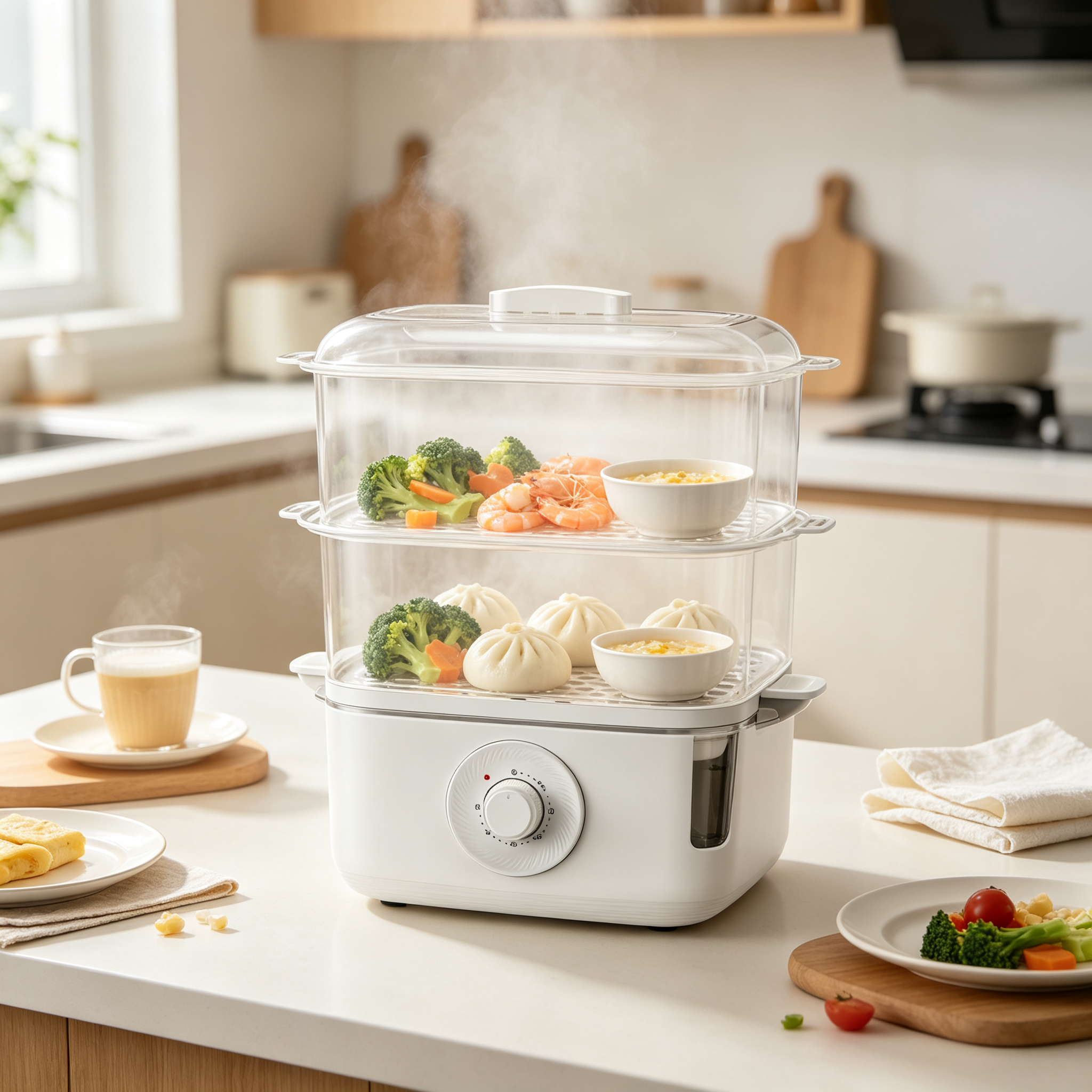
"Food steamer" is a family term, not a single product. What unites the family is the cooking method: water is heated in a reservoir, steam rises into a food chamber, and heat transfer happens through condensation on the food surface rather than through a pan. Within that common principle, the trade uses a set of overlapping labels, and buyers comparing quotations across suppliers frequently find that two suppliers are describing different things with the same words.
| Term used in the trade | What it describes | What a buyer should verify |
|---|---|---|
| Electric food steamer | A mains-powered appliance that cooks with steam generated in an internal reservoir | Rated power, rated voltage, food-contact compliance |
| Electric vegetable steamer | The same appliance type positioned around vegetable preparation in marketing | Number of tiers, usable tray depth |
| Countertop electric food steamer | A unit sized to stand on a worktop and run from a wall socket | Footprint, overall height with tiers stacked, cable length |
| 2-tier / multi-tier electric food steamer | Two or more stacked steaming trays fed by one steam source | Whether trays are removable, usable internal height per tier |
| Stackable electric food steamer | Trays designed to stack or nest for storage and transport | Stack stability when loaded, carton dimensions |
| Electric food steamer with timer | Steaming duration controlled by a timer rather than by manual monitoring | Timer type: mechanical rotary or electronic |
| Automatic shut-off food steamer | A unit that interrupts heating when the protection condition is reached | Whether the function exists and is documented, not just mentioned |
| Private label food steamer | A catalogue model produced under the buyer's own brand | Mould ownership, artwork control, packaging approval flow |
| BPA-free electric food steamer | A material claim about food-contact components | The material declaration or migration test behind the claim |
Two of these labels behave differently from the rest. "Automatic shut-off" and "BPA-free" are not design descriptions; they are compliance and safety claims. A buyer who accepts either claim on the strength of a catalogue sentence alone takes on a risk that will only surface after the goods reach a retailer's compliance desk. The remaining labels describe configuration, and configuration can be confirmed from a sample and a dimension drawing.
Why the Category Keeps Appearing on Buyer Questionnaires
The commercial opportunity in countertop steam cooking comes from a convergence rather than a single driver. Steam preparation supports low-oil cooking, which appeals to health-oriented shoppers. The appliance replaces a pot, a rack and stovetop supervision with one countertop unit, which fits smaller apartments and rental housing. Because the unit is self-contained, it also travels well through e-commerce channels, where a boxed appliance with a clear function tends to convert better than a component that requires a larger cooking system around it.
The procurement problem is the mirror image of that opportunity. A category that is easy to describe is also easy to under-specify. Quotations arrive with "large capacity" instead of a volume in litres, "safety protection" instead of a named function, and "CE" without indicating whether a third-party test report exists behind the mark. The rest of this reference deals with the practical question that follows: which of those claims can be verified before an order is placed, and which should be treated as marketing until documentation appears.
Reading a Food Steamer Specification Sheet
A specification sheet for this product type is short, and almost every line on it changes a commercial outcome. The table below uses the SC750 electric food steamer from Ningbo Jinchang Electronics Co., Ltd. as a worked reference, because it is a documented configuration rather than a hypothetical one.
| Parameter | Why it affects the buying decision | Reference: SC750 |
|---|---|---|
| Rated power | Determines how quickly steam is produced after switch-on | 800 W |
| Rated voltage | Determines which markets the unit can serve as built | 230 V |
| Number of layers | Determines how many foods can be steamed simultaneously | 2-layer |
| Capacity | First guide to portions per cycle, subject to tray dimensions | 7 L |
| Housing material | Affects appearance, weight, cleaning behaviour and durability | Plastic housing; PP and ABS with a PC indicator component |
| Food-contact material | Governs migration risk under hot, humid steam conditions | Food-contact components comply with LFGB |
| Timer | Determines who can operate the unit and how cooking is controlled | Mechanical rotary timer |
| Automatic shut-off | Mitigates dry-burn overheating risk | Included |
| Certification set | Determines acceptance by retail buyers in the target market | CE, LFGB, CB |
| Packaging | Determines whether the item is shelf-ready or needs repacking | Colour box, retail-ready |
Two lines deserve more attention than they usually receive. Capacity in litres describes the steamer volume, not the usable food volume once trays are loaded; buyers comparing two "7 L" units should ask for tray dimensions, because tray geometry differs between toolings. Rated voltage is equally consequential, and it is discussed again in the limitations section below.
Safety, Compliance and the Evidence Behind a Claim
For the European market, four document groups govern whether a countertop electric steamer can be listed by a serious retailer. They are separate requirements, and satisfying one does not satisfy the others.
- Electrical safety (CE-CB). The appliance must comply with household appliance electrical safety requirements, supported by a third-party CB test report.
- Food-contact material (LFGB). The steaming tray and the cavity are food-contact components and must pass a food-contact migration test. This is the requirement most directly linked to the material-safety risk in this product type: non-food-grade material in a tray or cavity can release harmful substances under high-temperature steam.
- Hazardous substances (RoHS). Restricts hazardous substances inside the product.
- Energy-related requirements (Ecodesign (EU) 2023/826). Sets off-mode and standby-mode power consumption limits.
One practical point follows from the last item. A CE self-declaration without third-party test reports is commonly not accepted by large retailers, so a buyer who evaluates quotations on price alone may discover the gap only at the compliance review stage. A second point follows from the control design. A mechanically timed appliance has no network connection and therefore does not carry the network standby obligations that an app-connected or Wi-Fi-controlled product must meet. That is not a quality judgement about smart appliances; it is a difference in which regulatory path the product must satisfy, and it is one reason mechanically controlled models remain attractive for multi-country retail and gift-set programmes.
At manufacturer level, documentation capability matters as much as the certificate list. Ningbo Jinchang Electronics Co., Ltd. holds dual ISO 9001 quality management and ISO 14001 environmental management certification, is a member of amfori BSCI and ICS for international supply-chain compliance, and states that its products pass international safety and environmental tests such as CE, RoHS and REACH to meet the market-access requirements of different countries.
How a Countertop Electric Steamer Actually Works
The operating sequence is simple enough that most buyers never examine it, yet each step maps onto a specification line that can be checked.
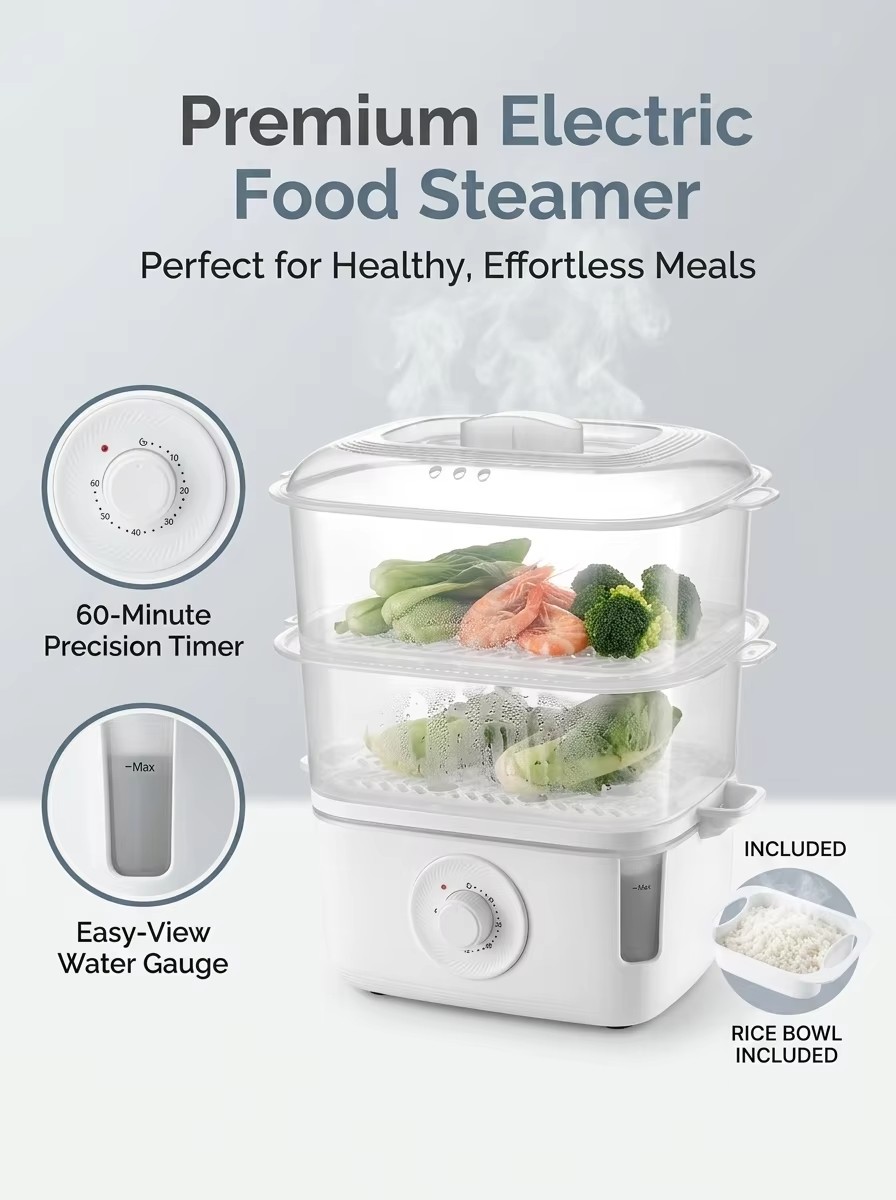
- Water filling. The reservoir is filled manually. On the SC750 the water tank is a visible, independent component, which allows the user to check and refill the water level without opening the cooking chamber.
- Food loading. Food is placed in the trays. The two-tier transparent tray body accommodates vegetables, buns, baby food, seafood and other items, and allows cooking progress to be observed without lifting a lid.
- Steam generation. The 800 W element heats the water and produces near-instant steam for time-saving cooking, as described in the product's stated selling points.
- Steam distribution. Steam rises through the perforated trays and cooks the contents of each tier from the same steam source, so a second tier adds simultaneous capacity without adding power draw.
- Timed completion. A mechanical rotary timer sets the cooking duration. It requires no app and is operable by users of all ages.
- Protection. An auto-off function interrupts heating to address dry-burn overheating risk when the water supply is exhausted or the cycle ends.
Maintenance behaviour is part of the design, not an afterthought. The SC750's steaming trays and water-tank-related parts are removable, so the unit can be disassembled and cleaned after use. That matters commercially because the working condition for this product type assumes regular cleaning after operation in an indoor kitchen environment exposed to hot steam and water vapour.
Application Scenarios and Channel Fit
The primary market for this appliance is the household consumer kitchen, and the SC750 is designed for household use as well as for business-to-business foreign trade procurement scenarios such as cross-border e-commerce. The stated applicable industries are home appliances, kitchen appliances, food preparation, and catering and hospitality. In practice that translates into four channel types.
- Household retail. The colour-box package is retail-ready, so the unit can move directly onto shelf or into an online listing without repacking.
- Gift sets and wholesale programmes. Because the model is packed for retail and mechanically controlled, it suits gift-set wholesale export orders where a stable, repeatable configuration is more valuable than a feature-heavy one.
- Cross-border e-commerce. A self-contained countertop appliance with a single clear function fits listings that must explain themselves in a specification panel.
- Homestay, apartment and light catering support. Listed regions of use include Germany, France, Spain, the United States, Italy, Portugal, the Netherlands, Austria, Ireland, Poland, Sweden, Denmark, Norway, Brazil, South Africa, Belgium, the Czech Republic and Hungary.
Food-side applications follow the same logic: vegetables, seafood, meat, dumplings, eggs and prepared food can be steamed or reheated in the same chamber, with timed cooking control replacing manual supervision. The installation requirements are modest and specific: indoor use, a stable and level countertop surface, and a grounded 230 V wall socket supplied with drinking or tap water.
Manufacturing Capability: The Ningbo Jinchang Electronics Reference
Ningbo Jinchang Electronics Co., Ltd. is a manufacturer and exporter of Western-style small household kitchen appliances, based at No.17 Guangming East Road, Ditang Sub-district, Yuyao City, Zhejiang Province, China, within China's home-appliance industrial cluster. The company was established in 1995 and has over 25 years of experience in the small home appliance export business.
The operating facts that a sourcing team typically checks first are as follows. The manufacturing facility covers 5,500 m² and employs approximately 68 staff, including an R&D team of 8 engineers capable of in-house structural R&D, mould development and product testing. Annual production capacity reaches 1,200,000 units. The company offers more than 200 product models, with core lines covering electric BBQ grills, smokeless electric grills, electric steamers, food dehydrators and multi-functional electric cooking appliances. Main product lines also include charcoal grills alongside the electric categories. Export business accounts for 90% of total sales, with major markets in the EU, the USA, AU and RU. The company has been certified as a National High-Tech Enterprise, Innovative SME and Technology-based SME, and owns more than 30 independent intellectual property rights including invention patents and utility-model patents.
For buyers building a private label programme, the relevant capability is customization breadth rather than catalogue length. The company provides ODM original design and development as well as OEM custom manufacturing, with customization options covering appearance modification, function adjustment, private-mould development and customized packaging solutions upon client requirements. In the steamer category, the SC750 illustrates the kind of configuration that fits mass retail and export programmes: a 7 L, two-tier, 800 W, 230 V electric food steamer with a mechanical rotary timer, auto-off protection, LFGB-compliant food-contact parts, a declared certification set of CE, LFGB and CB, and retail-ready colour-box packing.
The customer base described by the company is diversified and includes Fortune Global 500 enterprises, top cross-border e-commerce sellers, large European and American supermarket chains, and local overseas brand owners. For a buyer evaluating a first order, that mix is a useful signal in one specific respect: it indicates that the factory is used to operating against retailer documentation requirements rather than only against wholesale price lists.
Comparison with Traditional Steaming and Reheating Methods
Countertop electric steaming competes less with other appliances than with methods that need no dedicated device at all. The comparison below is qualitative and concerns control, space and cleaning rather than cooking results, which depend on the food and the recipe.
| Method | Control over cooking | Countertop and storage demand | Cleaning workload |
|---|---|---|---|
| Countertop electric food steamer | Timer-controlled duration; automatic shut-off addresses dry-burn risk | Dedicated appliance footprint; stacked tiers increase storage height | Removable trays and water-tank parts can be disassembled for cleaning |
| Pot or wok with a steamer insert | Manual supervision; timing depends on the cook | Uses existing cookware; no additional appliance | Larger washing items; stovetop residue |
| Microwave reheating | Fast, but texture control is limited for steamed foods | Uses an appliance already present in most kitchens | Minimal, but uneven heating is a common complaint |
A second comparison sits inside the category itself. A double-layer 7 L steamer can cook multiple food portions at the same time without additional power consumption, which suits family cooking, business-to-business wholesale and gift-set orders, but it requires extra vertical storage space. A single-layer steamer serves small-portion cooking for one to two people and takes up less height. Neither is superior in the abstract; the buyer's end-market housing profile decides which one belongs in the assortment.
Where the Product Type Genuinely Stops
An industry reference that omits limitations is a sales document. Four boundaries apply to this configuration and should be reflected in listings and buyer briefings.
- Voltage. The SC750 is rated 230 V for indoor use and cannot operate on 110 V without a voltage-adjusted model. North American retail planning therefore requires a specific variant, not a relabelled unit.
- Service model. There is no local on-site after-sales service in export markets. Support runs through the importer and the manufacturer, which makes end-user documentation and spare-part planning part of the commercial agreement rather than an optional extra.
- Storage geometry. Stacked tiers increase the vertical height of the unit when stored, which is a genuine constraint in compact kitchens.
- Control scope. The mechanical-timer version offers no remote control or app scheduling. That is a deliberate trade for simplicity, lower failure rate and freedom from network-standby compliance obligations; buyers who need smart-home integration should plan for a different control platform and the associated certification work.
A fifth point is procedural rather than technical. Food-contact compliance only holds if the material is stable in production. Poor-quality food-contact parts may release harmful substances under high-temperature steam, and the mitigation is documentary: require LFGB test reports for the steaming tray and the cavity, and avoid purchasing products that carry no food-contact compliance documents at all.
Market Trend Signals for the Next Procurement Cycle
Four qualitative shifts are visible across this category, and all of them are procurement-side rather than consumer-side.
Documentation has become a gating item. Certification dossiers are increasingly requested before sampling rather than after commercial terms are agreed, because a model that fails a food-contact or safety review cannot be recovered by price negotiation.
Energy-mode rules shape control choices. Ecodesign (EU) 2023/826 places off-mode and standby-mode consumption limits on the product, and network-connected products face additional standby obligations. For multi-country programmes, this pushes some buyers towards mechanically controlled models precisely because they are simpler to certify across markets.
Channel mix favours repeatable models. Cross-border e-commerce, gift-set wholesale and homestay or apartment supply all reward a stable configuration with retail-ready packaging over one-off designs, since these channels depend on repeat listings rather than on novelty.
Material transparency is being asked earlier. Questions about food-contact materials and BPA-related claims now arrive at the quotation stage. The reliable answer to such a question is a material declaration or a migration test report, not a catalogue adjective.
Future Outlook
The direction of travel in this category is towards fewer moving claims and better paperwork. As retailer compliance desks tighten review of food-contact and energy-related requirements, the competitive advantage of a supplier shifts from feature lists towards test documentation, tooling control and the ability to reproduce a configuration across repeat orders. Buyers are likely to keep consolidating around manufacturers that can supply structural R&D, mould development and in-house product testing, because those capabilities reduce the risk of a specification changing silently between shipments.
On the product side, the mechanically controlled, multi-tier countertop steamer looks set to remain the volume configuration for household retail and gift programmes, with app-connected versions confined to channels that specifically sell smart-home integration. The most useful preparation a buyer can make for the next cycle is unglamorous: confirm tray dimensions, confirm the protection functions in writing, and confirm that the certification set on the quotation matches the certification set in the file.
Frequently Asked Questions
What does a 2-tier or multi-tier electric food steamer actually change for the end user?
Additional tiers add simultaneous cooking capacity from the same steam source without increasing rated power. On the SC750, the two-tier 7 L body allows different foods to be steamed at the same time, accommodating vegetables, seafood, meat, dumplings, eggs and prepared food. The trade-off is physical: a stacked unit occupies more vertical storage space than a single-tier model, and a single-layer steamer remains the more suitable choice for one- to two-person households with limited storage.
Which certifications should an electric food steamer carry for the EU market?
Four document groups apply. Electrical safety is demonstrated through CE-CB with a third-party CB test report for household appliance safety. Food-contact compliance is demonstrated through LFGB migration testing of the steaming tray and cavity. Hazardous-substance restriction is covered by RoHS. Energy-related requirements are covered by Ecodesign (EU) 2023/826, which sets off-mode and standby-mode power consumption limits. A CE self-declaration without third-party test reports is commonly not accepted by large retailers. The SC750 declares CE, LFGB and CB.
How does dry-burn protection work on an electric food steamer?
Dry-burn protection interrupts heating when the reservoir no longer holds enough water, which prevents overheating of the unit. The SC750 includes an auto-off function for this purpose. From a procurement standpoint, three checks matter: that the function is present as a documented design feature rather than a catalogue phrase, that the timer and protection circuit are inspected before mass shipment, and that end-user instructions tell the user to check the water level in the tank before each use.
Is a mechanical-timer steamer or an app-controlled steamer the better fit for an export programme?
The mechanically timed version is simple to operate, suitable for users of all ages, has a lower failure rate and carries no network-standby compliance risk. An app or Wi-Fi controlled version offers richer functions but costs more, is harder for older users to operate and must meet the Ecodesign network standby requirement. For mass retail, gift-set and multi-country export programmes, the mechanical-timer configuration is generally the more straightforward commercial choice; app-enabled models are better matched to smart-home dedicated channels.
What should a buyer verify before placing a bulk electric steamer order?
The checks that reduce return and compliance risk are: real cooking capacity against tray dimensions rather than against a litre figure alone; rated power and rated voltage against the destination market; presence and documentation of the automatic shut-off function; food-contact compliance of the steaming tray and cavity, supported by LFGB test reports; the full export certificate set for the destination; retail-ready packaging; and whether the trays and water-tank parts are removable for cleaning. Verifying these items before the order is placed is cheaper than resolving them after the goods arrive at a retailer.
How should a countertop electric steamer be cleaned and maintained?
The SC750's steaming trays and water-tank-related parts are removable, so they can be disassembled and cleaned after use. Regular cleaning after operation is part of the stated working condition for this appliance type, alongside checking the water level before each cycle and using the unit indoors on a stable, level surface connected to a grounded 230 V socket. Because there is no local on-site after-sales service in export markets, maintenance expectations should be written into the end-user manual so that the importer and the manufacturer share a clear support path.
Reference Note
This guide describes the category as it is currently configured by Ningbo Jinchang Electronics Co., Ltd., using the SC750 electric food steamer as the worked example. Where a claim concerns safety, food contact or market access, it is stated in the form in which the manufacturer documents it, rather than in the form in which it usually appears on a quotation. Buyers preparing a programme can request the model's test documentation, tray dimensions and voltage variants before committing to tooling, artwork or packaging.