
Food-Contact Compliance for PFAS-Free Non-Stick ECCS Coil
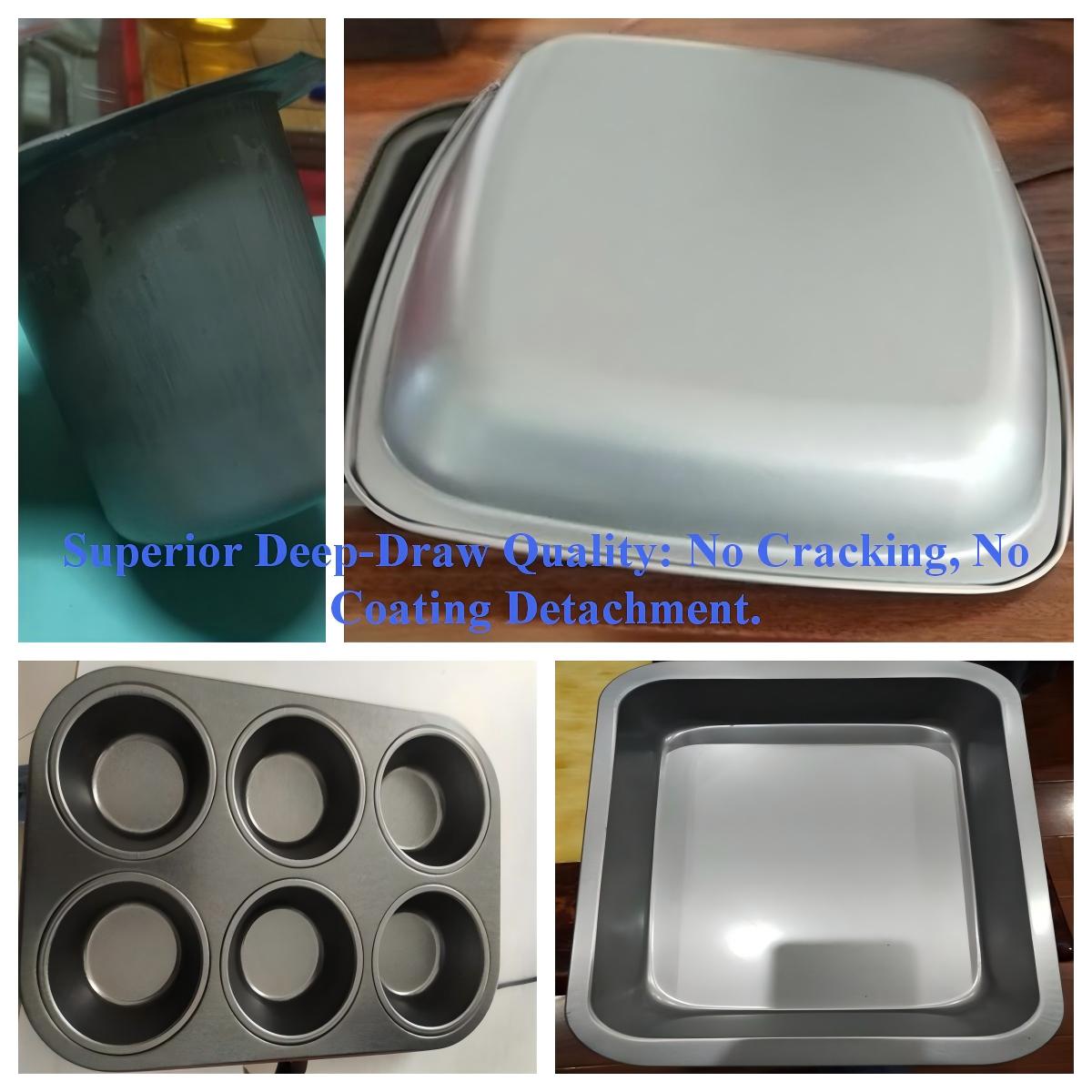
Food-contact coated steel is qualified at the material level: substrate, coating chemistry and migration test evidence are assessed together before a finished bakeware or processing surface reaches the market.
Food-contact coated steel is not qualified by its colour. It is qualified by what it does not release — and by whether it keeps that promise after forming, baking and washing.
A matte black bakeware pan and a milk-white food tray can be slit from the same coil, but they only enter a regulated market if the coating system behind them survives migration screening, restricted-substance review and acid exposure in its finished, cured state. That is why compliance conversations in this category start with test routes rather than with gauge or gloss.
This analysis looks at how food-contact colour coated steel coil is qualified for European and United States expectations, and what the YS-ECCS-G2-PF PFAS-free non-stick ECCS coil — a food-contact safe non-stick deep-draw coated steel supplied by YOUNGSON METAL — illustrates about the specification logic buyers should understand before they begin sampling.
Why Food-Contact Compliance Is a Material Question, Not a Paperwork Question
Three separate regulatory layers apply to coated steel that touches food, and they are frequently conflated in datasheets. Keeping them apart is the first real skill in this category.
Layer 1 — The food-contact framework itself
Food-grade colour coated steel must comply with FDA 21 CFR 175.300 in the United States or EU No 10/2011 in Europe, which govern resinous and polymeric coatings intended for contact with food (U.S. FDA / European Commission). These frameworks address the finished article and its intended use — contact time, temperature and food type all form part of the assessment.
Layer 2 — Restricted substances
RoHS Directive 2011/65/EU (RoHS 2.0) and REACH address restricted hazardous substances; colour coated steel used in electronic appliances must meet them (European Chemicals Agency, ECHA). Importantly, RoHS and REACH are not food-contact regulations. They are a parallel, buyer-driven eco-compliance layer that often appears in the same purchase specification — especially for coils that will be formed into appliance housings as well as food-contact parts.
Layer 3 — Food-simulant and migration testing
At the coil level, evidence is generated through migration and simulant testing. For non-stick food-contact steel, two acidic media dominate the discussion: a 3% acetic acid test and a 5% citric acid test. Running alongside a RoHS and REACH heavy metal migration test, they form the material-level evidence base that a converter or brand owner uses when building a finished-article compliance file.
The Practical Problem: Colour Sells, Migration Decides
Buyers in the awareness and research stage usually receive a specification sheet listing thickness, width, colour and hardness. Very little of it answers the question that determines market access: under what test conditions was the coating assessed, and against which framework?
For cakeware, bakeware and commercial food processing equipment manufacturers, the exposure is concrete. A release coating that performs flawlessly in a dry forming test may still fail a heavy-metal migration screen, or may lose adhesion after repeated acid contact. Conventional non-stick chemistries add a further variable: PFAS-based coatings carry a growing documentation burden in several markets, and that burden lands on the brand owner, not on the coating supplier.
The opportunity is symmetrical. Where a supplier can present a PFAS-free coating system together with named acid-based test results and heavy-metal migration screening, buyer-side qualification work becomes shorter — fewer unknown variables, fewer follow-up documents, faster progression from enquiry to sampling.
What the YS-ECCS-G2-PF Specification Actually Commits To
The YS-ECCS-G2-PF is a food-grade non-stick ECCS coated steel coil in the food-contact safe non-stick deep-draw coated steel category. Its published specification is compact, and each line carries a distinct compliance or processing function.
| Specification area | YS-ECCS-G2-PF |
|---|---|
| Category | Food-contact safe non-stick deep-draw coated steel |
| Base metal | High-ductility ECCS; or aluminized steel (the material field also lists aluminium) |
| Coating system | Advanced 2-layer non-stick system, PFAS-free |
| Thickness | 0.30 mm – 0.60 mm |
| Width | 4 mm – 1000 mm, custom slit-to-width available |
| Surface finish | Matte black, black silver, grey silver, milk white |
| Thermal resistance | Up to 280 °C |
| Forming suitability | Suitable for deep drawing |
| Compliance evidence | RoHS & REACH heavy metal migration test; 3% acetic acid test; 5% citric acid test |
| Production standard | European & USA regulatory compliance |
| Formats | Precision strip; blanked small sheets |
Two details deserve attention. First, the compliance evidence is expressed as tests passed, not as certificates claimed — heavy metal migration on one side, acidic food-simulant exposure on the other. Second, the coil is offered as strip and blanked small sheet, which matters because food-contact qualification is performed on the finished geometry, not on the master coil.
Technical Explanation: Why a 2-Layer PFAS-Free System on ECCS
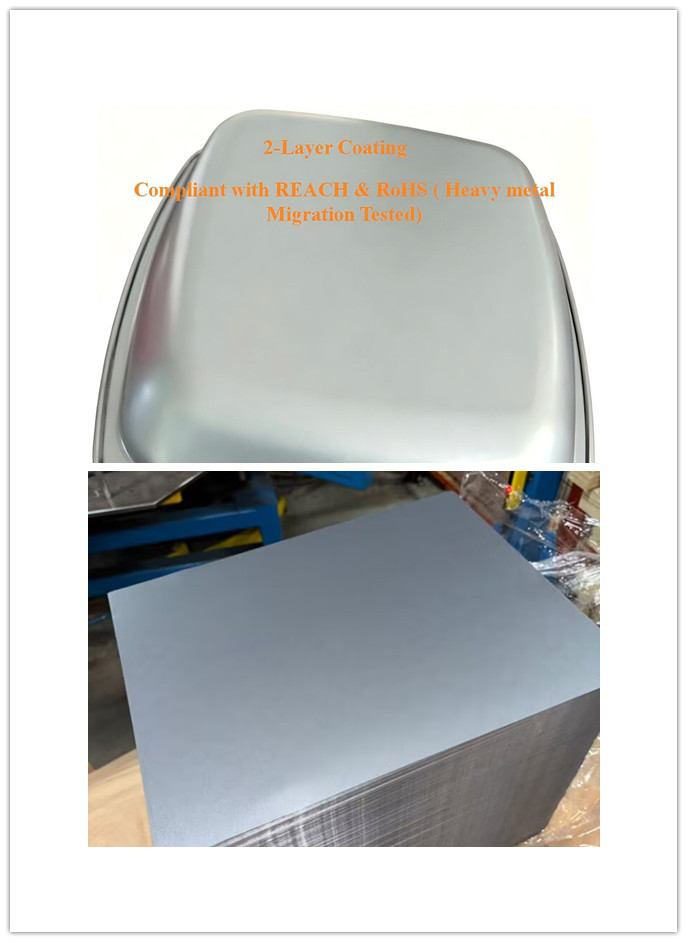
A 2-layer non-stick system applied over high-ductility ECCS: the coating must survive deep drawing after application, which is where adhesion failure normally appears.
Substrate choice: ECCS and aluminized steel
The base metal options — high-ductility ECCS or aluminized steel — are not incidental. ECCS is an electrolytic chromium coated steel, and the specification calls specifically for high-ductility grades because the material will be formed after coating. Aluminized steel offers an alternative substrate for the same coating platform. Both choices are driven by the same requirement: a surface smooth and stable enough for a food-contact coating to bond to, and ductile enough to stretch without fracturing the coating.
Coating architecture: two layers, no PFAS
The coating is described as an advanced 2-layer non-stick system that is PFAS-free. Functionally, a two-layer build separates the bond to the metal from the release surface: one layer manages adhesion to the substrate and the other delivers the release behaviour. Removing PFAS from the formulation means the release function is delivered without per- and polyfluoroalkyl substances, which is the material-of-concern question most frequently raised by European and North American buyers.
Forming: why deep-drawing suitability is a compliance issue, not just a process issue
The coil is specified as suitable for deep drawing. This matters beyond tooling. If a coating cracks, crazes or delaminates during forming, the exposed area becomes a different surface than the one that was tested — with different migration characteristics. Deep-draw suitability therefore protects the integrity of the compliance evidence itself, which is why the specification pairs a 0.30 mm–0.60 mm thickness range with high-ductility substrate grades rather than a single generic base metal.
Thermal and chemical behaviour
Thermal resistance is stated up to 280 °C, which sets the working window for baking, reheating and food processing surfaces. Chemical resistance is evidenced by the 3% acetic acid and 5% citric acid tests — acidic media chosen to represent vinegar-based and citrus-based food environments — supported by RoHS and REACH heavy metal migration testing. Together these define both what the coating is expected to withstand and how that expectation was verified.
Where This Coil Platform Fits: Cakeware, Bakeware and Food Processing Equipment
The stated applications for the YS-ECCS-G2-PF are cakeware, bakeware production and commercial food processing equipment. Each application stresses a different property, and the specification can be read against those stresses.
- Cakeware and bakeware. Non-stick release and deep-drawing formability dominate. Pans are drawn after coating, then exposed to repeated baking cycles below the 280 °C thermal ceiling, with direct contact from batters and fruit fillings that sit in the acidic range covered by the acetic and citric acid tests.
- Commercial food processing equipment. Repetitive contact, washing and acidic product flows make migration behaviour the controlling factor. Here the RoHS and REACH heavy metal migration evidence and acid exposure results are the documents that carry the qualification argument.
- Colour and finish selection. Matte black, black silver, grey silver and milk white finishes allow the same compliant coating platform to serve visually different product lines, which helps manufacturers standardise on one qualified material across a range of SKUs.
- Supply format. Precision strip and blanked small sheets allow the coil to be delivered close to the stamping or drawing line, reducing the risk of surface damage between qualification and production.
For buyers at the research stage, the practical takeaway is that the specification should be read as a qualification package rather than a materials list: base metal grade, coating chemistry, thermal ceiling, forming class and test evidence all have to line up with the intended food-contact application before sampling makes sense.
Market Context: Volume Growth Meets Compliance Scrutiny
The commercial backdrop supports both the demand and the caution. Polaris Market Research valued the global pre-painted steel (colour coated steel) market at USD 24.63 billion in 2023, projecting growth at a CAGR of 5.8% to 2032. China's export of colour-coated steel sheet reached approximately 6.5 million tons in 2023 (MySteel), a substantial share of global trade volume.
Volume alone, however, is not where the differentiation sits. As coatings move from purely decorative to functional — non-stick, high-temperature, chemically resistant, food-contact — the purchasing decision shifts from price per tonne toward documented performance. Buyers increasingly ask for test evidence, and suppliers that hold it in a form that can be attached to a finished-article file are the ones that progress past the first technical review.
The specificity of the YS-ECCS-G2-PF evidence — a named PFAS-free 2-layer system, two named acid tests and heavy-metal migration screening, expressed against a stated European and USA production standard — is an example of the direction the category is moving: compliance data as a product feature rather than an afterthought.
PFAS-Free Non-Stick Steel Compared with Conventional Non-Stick Approaches
Comparison in this category is often framed as a clash of coating chemistries. In practice, the differences that affect a purchase decision are documentation, thermal window and forming behaviour. The table below reflects what is stated for the PFAS-free non-stick ECCS coil and what is generally observed for alternative approaches; supplier-specific data must always be verified case by case.
| Dimension | PFAS-free 2-layer non-stick on ECCS (YS-ECCS-G2-PF) | Conventional PFAS-based non-stick systems | Uncoated ECCS / tinplate |
|---|---|---|---|
| Coating chemistry | Advanced 2-layer system, PFAS-free | Fluoropolymer (PFAS) based release chemistry | No release coating |
| Regulatory documentation load | PFAS question resolved at material level; RoHS/REACH heavy metal migration tested | Increasing scrutiny in several markets; documentation obligations typically fall to the brand owner | No non-stick or food-contact release claim |
| Food-simulant evidence | Passes 3% acetic acid and 5% citric acid tests | Depends entirely on each supplier's own test programme | Not applicable to a release coating |
| Thermal window | Stated up to 280 °C | Must be quoted and verified per system | Substrate-dependent |
| Forming | Suitable for deep drawing; 0.30 mm–0.60 mm | Forming limits vary by system | High formability, but requires separate release measures in service |
Two points of fairness belong here. PFAS-based non-stick systems remain widely used and can deliver strong release performance; the shift toward PFAS-free options is driven by regulatory attention and documentation risk rather than by a general performance failure. And uncoated ECCS or tinplate is not a lower-quality alternative — it is simply a different starting point for manufacturers who apply a release surface downstream.
Boundary Conditions Buyers Should Verify Before Qualification
A credible specification states its limits as clearly as its capabilities. Five boundaries apply to this platform.
- Thermal ceiling. Thermal resistance is stated up to 280 °C. Processes that exceed this — high-temperature roasting, direct-flame contact or aggressive thermal cycling — fall outside the stated specification and require separate evaluation.
- Acid test scope. The 3% acetic acid and 5% citric acid tests address defined simulant conditions and durations. They are not a blanket statement covering every food type, concentration, contact time or storage life; long-duration acidic storage should be assessed against the finished article.
- Gauge and substrate range. Thickness is limited to 0.30 mm–0.60 mm, with high-ductility ECCS or aluminized steel as base metal options. Heavier structural gauges or different substrates are outside this model's scope.
- Material evidence is not finished-article approval. Coil-level results feed into a compliance file; the converter or brand owner remains responsible for demonstrating conformity of the finished food-contact article under FDA 21 CFR 175.300 or EU No 10/2011, including testing in the final geometry.
- RoHS/REACH is not a food-contact substitute. These frameworks address restricted substances and are relevant to appliance and consumer-goods applications. They complement, but do not replace, food-contact regulation.
Behind the Specification: Supplier Context
Chongqing Youngson Metal Products CO. LTD (brand: YOUNGSON METAL) is a BV ISO9001:2015 certified manufacturer established in 2016, specialising in precision metal surface processing and premium coil supplying from Chongqing, China. The company operates its own advanced coating lines and precise slitting machines within a 3,000 m² facility, with an annual production capacity of 10,000 tons and a team of approximately 25 staff, including an R&D group of 5 engineers and senior process technicians.
Its products are positioned as eco-friendly, food-grade and chemical-grade quality, and have passed SGS testing for REACH and RoHS heavy metal regulations. The wider product range covers mild carbon steel and multi-grade stainless steel, commercial and deep drawn pre-painted steel and pre-painted stainless steel, deep drawn coil coating with Teflon, non-stick, gold and lacquered finishes, drawn VCM PVC film laminated steel coil and drawn PET film laminated steel coil. Export accounts for approximately 70% of sales, with global markets as the primary destination.
Future Outlook
Three developments are likely to shape food-contact coated steel sourcing over the next few years.
Documentation becomes a design input. As regulatory attention on material chemistry continues, coatings that resolve substance questions at the formulation stage will simplify finished-article files — increasingly a selection criterion at quotation stage rather than a post-order formality.
Functional coatings absorb the growth. With the pre-painted steel market projected to grow at a CAGR of 5.8% to 2032 from a USD 24.63 billion base in 2023 (Polaris Market Research), the share of value moving toward functional and food-contact grades is likely to expand faster than decorative volume, because those grades carry qualification documentation that decorative coil does not.
Supplier capability is judged in tests, not adjectives. Where export volumes remain large — China shipped approximately 6.5 million tons of colour-coated steel sheet in 2023 (MySteel) — differentiation shifts to verifiable evidence: named coating systems, named test protocols, stated thermal and forming windows, and clearly declared limits.
FAQ
What does food-contact compliance mean for a colour coated steel coil?
It means the coated surface, in its finished and cured form, has been assessed against the framework governing materials intended for food contact — FDA 21 CFR 175.300 in the United States or EU No 10/2011 in Europe. The assessment covers the finished article and its intended use, including contact time, temperature and food type. Coil-level documents such as heavy-metal migration reports are inputs into that assessment, not a replacement for it.
What do the 3% acetic acid and 5% citric acid tests verify?
They expose the coating to acidic media that represent common food environments — acetic acid associated with vinegar-based products and citric acid with citrus and fruit-based products. For the YS-ECCS-G2-PF, passing both tests is stated alongside RoHS and REACH heavy metal migration testing, forming a material-level evidence set for coating resistance and low heavy-metal release under defined conditions.
Why is PFAS-free non-stick coating relevant to bakeware and food processing equipment?
PFAS refers to per- and polyfluoroalkyl substances, the chemistry family traditionally used to deliver non-stick release. Rising regulatory attention on PFAS in several markets shifts documentation risk toward the brand owner. A PFAS-free coating removes that specific material-of-concern question at the source: the YS-ECCS-G2-PF uses an advanced 2-layer non-stick system that is PFAS-free over high-ductility ECCS or aluminized steel.
What thickness, width and finishes are available?
Thickness ranges from 0.30 mm to 0.60 mm, and width from 4 mm to 1000 mm with custom slit-to-width service. Available formats are precision strip and blanked small sheets. Surface finishes are matte black, black silver, grey silver and milk white. Thermal resistance is up to 280 °C, and the material is suitable for deep drawing.
Is RoHS and REACH compliance the same as food-contact compliance?
No. RoHS Directive 2011/65/EU and REACH address restricted hazardous substances, and colour coated steel used in electronic appliances must meet them (ECHA). Food-contact use is governed instead by FDA 21 CFR 175.300 or EU No 10/2011. The two sets of requirements are complementary: RoHS and REACH screening supports the eco-compliance position of the material, while food-contact regulation governs the article that touches food.
What are the practical limits of a PFAS-free non-stick ECCS coil?
Three boundaries matter most. Thermally, resistance is stated up to 280 °C, so processes above that fall outside the specification. Chemically, the acid tests cover defined simulant conditions rather than every food type, concentration or storage duration. Structurally, thickness is limited to 0.30 mm–0.60 mm on high-ductility ECCS or aluminized steel. Final conformity of the finished article remains the responsibility of the converter or brand owner under the applicable food-contact framework.
For readers who need the underlying material documentation, a downloadable product catalogue is available here: Chongqing Youngson Metal Products CO. LTD catalogue (PDF). Company information: www.youngsonmetal.com.