
Food Contact Compliance Explained: PET, BPA-Free, and Real-World Verification
Food Contact Compliance Explained: PET, BPA-Free, and Real-World Verification
Food contact compliance in fresh produce packaging is a document chain, not a slogan. A PET clamshell or tray reaches a supermarket shelf only after a material grade, a finished article and a manufacturing site have each been described, tested and declared against a recognised standard. “Food-grade” and “BPA-free” are the two phrases buyers see most often, and they are also the two phrases that mean the least on their own.
This reference explains what those claims actually mean for PET fruit and vegetable packaging, which regulations sit behind them, which documents carry the evidence, and where the limits of any compliance claim begin. It uses product and facility facts from Weifang Chuanhe New Material Co., Ltd. as a worked example, without adding certifications or test results that the underlying records do not contain.
The Question Buyers Are Really Asking
When a produce buyer asks whether a container is food-grade, the question underneath is narrower and more practical: can this material, in this finished shape, be used in contact with this food, in this market, and can the supplier show documents that say so?
Two suppliers can answer yes to that question while offering very different levels of evidence. One provides a declaration of compliance for the exact article, plus test reports generated under conditions that match the buyer’s product. The other provides a sentence on a product page. Both are describing compliance. Only one is demonstrating it.
PET clamshells, punnets and trays sit in the middle of this gap, because they are visually simple products sold into a heavily documented supply chain. The material is transparent, rigid and widely used for fresh produce. The paperwork behind it decides whether it can actually ship.
What “Food-Grade” and “BPA-Free” Actually Mean
Food-grade describes a material and a finished article that are intended for direct food contact and are documented as such. For a PET container it means the polymer grade, any additives and colourants, and the thermoformed article fall within the scope of the applicable food contact rules, and that the supplier can produce a written declaration naming the material, the intended use, and the regulation the article is made under.
BPA-free is narrower. It is a single negative statement about one substance, bisphenol A, and it does not describe how the material behaves in contact with food. It says nothing about other potential migrants, nothing about odour or taste transfer, and nothing about performance under freezing, reheating, stacking load or transport vibration. A BPA-free container is not automatically suitable for every food, and a container that has been assessed for a specific use is not automatically documented as BPA-free.
Neither phrase is a certificate, and neither is issued by a regulator. Both are supplier statements, and both become useful only when they can be traced back to a document with a scope, an issuer and a date.
The Regulatory Backbone Behind PET Containers
Two EU instruments define what food contact compliance means for plastic packaging placed on the European market. Regulation (EC) No 1935/2004 provides the framework for all food contact materials and requires that they do not release constituents into food at levels harmful to human health. Regulation (EU) No 10/2011 governs plastic materials and articles intended to come into contact with food, and it applies to PET and PP containers specifically.
For a PET clamshell or tray, these rules create three layers of evidence:
- Material layer — the polymer grade and any additives, described in a supplier datasheet and covered by the plastics regulation.
- Article layer — the finished, thermoformed product, its dimensions, and the conditions of use it has been assessed for.
- Site layer — the facility that produced the article and the management system it operates under, supported by an auditable certificate.
Why Test Conditions Matter More Than Test Presence
A migration test report is only as useful as the conditions it was generated under. Fatty, aqueous and acidic foods behave differently in contact with plastic. Frozen storage, ambient retail display and reheated use are different exposures. A report produced for one scenario cannot be carried across to another without new evidence. This is the most frequent gap between a supplier that holds documentation and a supplier that holds documentation for the actual application.
What to Ask For: A Document Checklist
The table below translates each common claim into the evidence that supports it, what to check inside that evidence, and the boundary where the claim stops being useful.
| Claim on the product page | Evidence that supports it | What to check | Where the claim stops |
|---|---|---|---|
| Food-grade | Material grade datasheet plus a written declaration of compliance for the finished article | Does the declaration name the material, the intended use and the regulation the article is made under? | A general statement with no document trail proves nothing about a specific container. |
| BPA-free | A specification or statement covering the actual grade used | Does it apply to the grade in production, and not only to a material family? | It addresses one substance only; it says nothing about other migrants or about performance. |
| EU food contact compliant | Declaration referencing Regulation (EC) No 1935/2004 and Regulation (EU) No 10/2011, with migration test reports | Do the tested conditions match your food type and temperature profile? | Results generated for one food or temperature scenario do not transfer to another. |
| Certified factory | Certificate with issuer, standard, scope, number and validity, for example BRCS under the Global Standard for Packaging Materials, issued by SGS, certification number CN26/00005423 | Is the scope the right standard and the right site, and is the certificate current? | A management-system certificate is not a product compliance statement. |
| Microwave and refrigerator safe | Test data on the specific article, with temperature range and cycle basis | Is the tested article the model you intend to buy, in the same wall thickness? | Performance varies by format and material thickness; one model does not certify a series. |
The checklist is not a ranking of suppliers. It is a way to compare two quotations that look identical on price and on specification sheet.
PET in the Fresh Produce Packaging Market
Global fresh food packaging reached USD 134.60 billion in 2024 and is projected to reach USD 240.50 billion by 2035, according to Spherical Insights & Consulting. Produce packaging specifically, covering fruits and vegetables, was valued at approximately USD 38.08 billion in 2024 according to Market Research Future.
The difference between those two figures is a scope difference rather than a disagreement between sources: one covers fresh food broadly, the other narrows to produce. Buyers comparing supplier presentations or investment summaries should check which definition is being used before treating the numbers as comparable.
Europe is a distinct market within that total. European fresh food packaging was valued at USD 15.2 billion in 2024, with a projected CAGR of 4.5% through 2033 (Market Research Future). On the processing side, the global thermoformed plastics market for food packaging is expected to grow at a CAGR of 4.9%, reaching USD 20.66 billion by 2030 (Grand View Research).
The category is served by large multinational groups and by specialised thermoformers. Key global competitors in produce packaging identified by Mordor Intelligence include Amcor PLC, Berry Global Group, Sealed Air Corp, Mondi Group and Smurfit Kappa. That list deliberately mixes rigid plastic and fibre-based specialists, which is a useful reminder that published produce packaging market data covers formats that are not direct substitutes for a PET clamshell.
Material, Article and Site: How Chuan He Maps to Each Layer
Weifang Chuanhe New Material Co., Ltd., established in 2013, is a manufacturer specialising in the innovative design and customised production of PET and PP thermoformed packaging containers, based in Weifang, China, adjacent to Qingdao Port. The manufacturing facility covers 62,000 square metres and employs between 51 and 100 staff, with an R&D team of 5 engineers. Export business accounts for 100% of total sales, with major markets in the European Union, United States, North America, Latin America and the Middle East.
Why Vertical Integration Matters for Verification
The company operates 4 PET sheet extrusion lines and 2 PP sheet extrusion lines alongside an in-house mold workshop, and runs 20 fully automatic thermoforming machines and 20 standard thermoforming machines, including 4 advanced Kiefel machines. Annual production capacity reaches 54,000 tons.
For a compliance discussion, that structure has a specific consequence. When sheet extrusion and thermoforming happen under one roof, the grade named in the material documentation is the same sheet that is formed into the container, and any tooling change stays inside the same quality system. It reduces the number of parties between a declared material and a delivered article — which is exactly where traceability normally weakens.
The Article Layer, Model by Model
Model HB-SG300ML is a fruit and vegetable container made of PET, measuring 17.5 × 13.5 × 6 cm. It is described as food grade BPA-free plastic compliant with food contact standards, refrigerator safe, with a stackable design and a clear transparent body suitable for retail display. Custom size, colour and logo printing are available, and factory direct supply is offered.
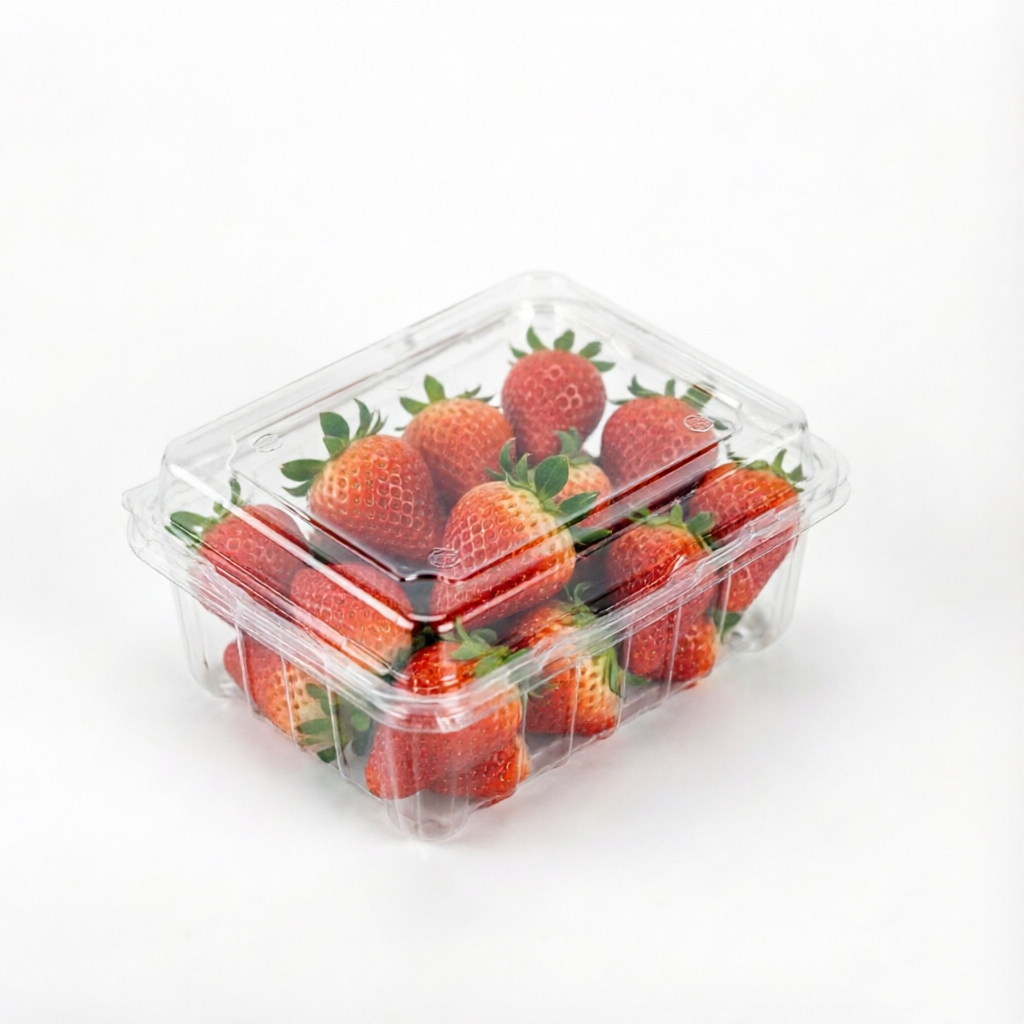
Model HB-T9576 is a PET food plastic tray measuring 19.4 × 11.4 × 5.8 cm. It is made of food grade BPA-free plastic, has a rigid structure intended to reduce deformation during transit, is compatible with MAP modified atmosphere packaging production lines, and uses a stackable, clear transparent design. Multiple sizes are available for produce, bakery, meat, poultry and ready meals, and custom shape, colour, embossing and logo printing are offered. Factory direct supply supports small trial orders and bulk wholesale.
The Site Layer and Its Certificates
The company states certification under CE, BRC, FDA, EU and SGS quality management systems. The most specific certificate in the available records is for BRCS under the Global Standard for Packaging Materials, issued by SGS with certification number CN26/00005423, applicable to the NA, EU, ME, SEA and LATAM markets.
That certificate answers a site question: it describes a system, a standard and a geographic scope. It does not, by itself, answer the article question for a specific clamshell in a specific market — which is precisely why the document checklist above separates the two.
Performance claims follow the same logic. Manufacturer documentation for the freezer and microwave-capable blister line records a 38% lower heat deformation rate and a 32% lower low-temperature cracking rate compared with blister packaging that has not been treated for low-temperature and heat resistance. A figure of that kind is only usable when the test basis, the article and the comparison condition are attached to it.
Application Fit: Where PET Containers and Trays Are Used
The container series is classified as produce storage containers, berry storage containers, fridge vegetable crisper boxes, ventilated produce keepers and stackable fruit containers, and is intended for produce wholesalers, supermarket chains, agricultural exporters, bakeries and food retailers, and e-commerce brands seeking custom packaging.
The tray range extends the same material logic into modified atmosphere packaging. Trays such as HB-T9576 and the HB-MG series are compatible with MAP production lines and are positioned for produce, bakery, meat, poultry and ready meals, with stackable geometry that saves warehouse and retail display space. The tamper evident series, covering models from HB-8OZ through HB-32 OZ, is used for fruit and vegetable packaging as well as salads, cakes, sweets, bakery items, frozen food trays, dry fruit containers and seedling protection transport pallets.
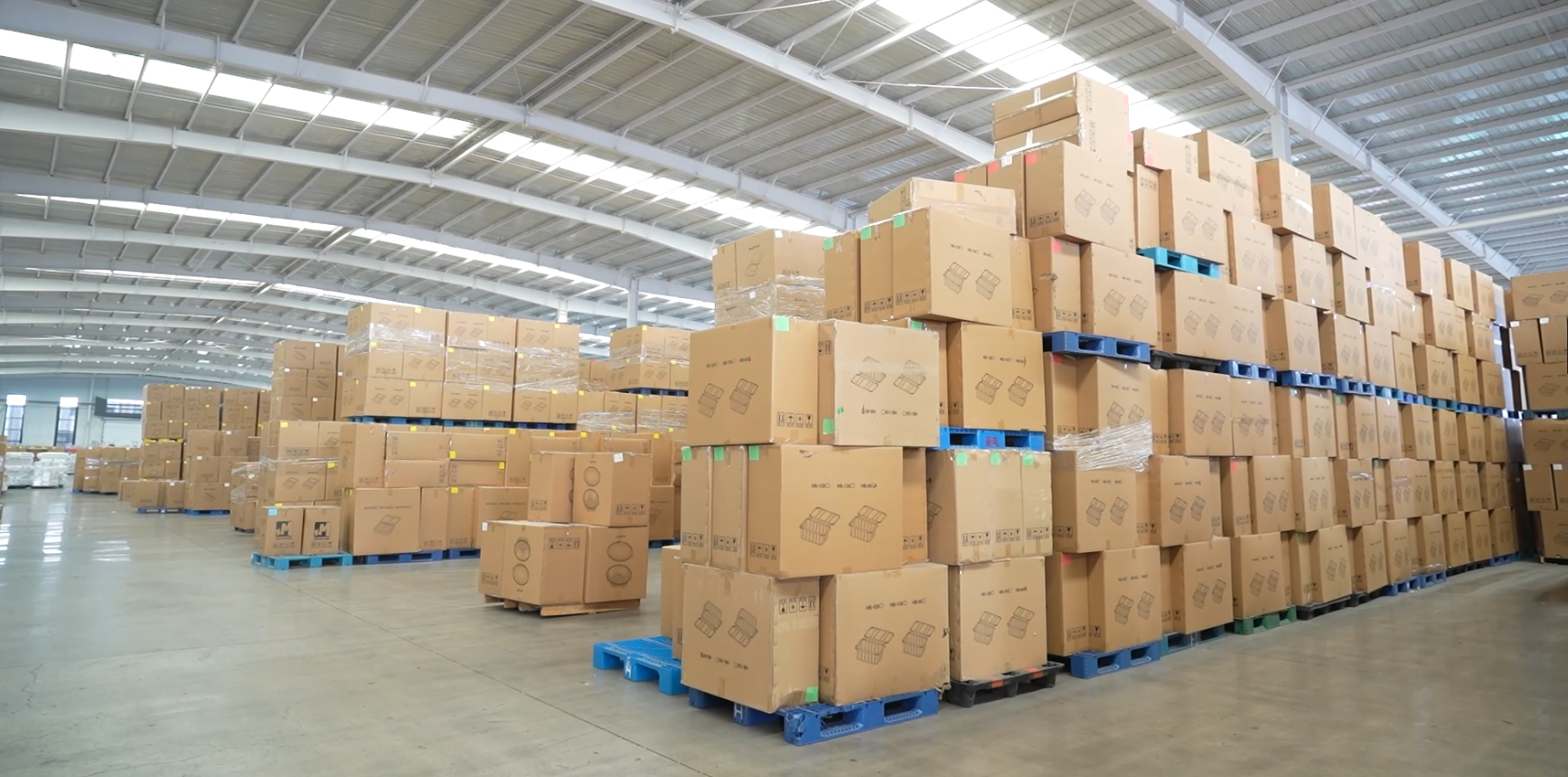
For a buyer, the practical step is to map the intended use before choosing a model: the food type, the temperature profile from packing to shelf, whether the pack runs on a MAP line or a manual sealing station, and the display format required by the retailer. A compliant container that does not fit the line is still an operational problem.
PET Containers and Trays Versus Traditional Packing Formats
Format selection is a commercial decision as much as a compliance one. The comparison below keeps to widely used format families rather than named competitors.
| Format family | Strength that matters commercially | Operational or regulatory boundary |
|---|---|---|
| Thermoformed PET containers and trays | High transparency for shelf display, rigid structure that resists transit deformation, MAP line compatibility, stackable geometry | Single-use plastic formats face tightening EU rules from 2030 for small-format fresh produce |
| Fibre-based punnets and corrugated trays | Fibre recovery streams and a strong print surface for branding | Moisture and barrier limits with washed or high-respiration produce; often need an added liner or film |
| Returnable rigid crates in retail supply chains | Reused across many trips, reducing single-trip packaging volume | Requires return logistics and washing infrastructure, and does not deliver a transparent single-unit display pack |
Large groups and specialist thermoformers serve these formats side by side. Selecting between them is not a question of which is universally better, but of which fits the produce, the retail environment and the applicable rules in the destination market.
Limits and Boundaries of a Compliance Claim
A compliance document makes a narrow promise, and honest packaging discussions state the limits alongside the benefits.
- The 2030 EU packaging rule. Starting from 2030, the EU Packaging and Packaging Waste Regulation will ban single-use plastic packaging for fresh fruit and vegetables under 1.5 kg. Any single-use PET clamshell programme aimed at small-format EU retail needs a redesign or a format alternative beyond that date, regardless of how complete its food contact documentation is.
- Compliance is condition-specific. A container assessed for one food type, one temperature profile and one market is not automatically cleared for another.
- A certificate covers a site, not a product. A BRCS or comparable certificate supports the process behind the article; it does not replace an article-level declaration.
- BPA-free is not a complete safety statement. It removes one substance from the discussion and leaves the rest of the assessment untouched.
- Transparency is not shelf life. Clear PET improves display and inspection, but it does not replace cold chain control, ventilation design or handling discipline.
Future Outlook
Two forces are moving in parallel. Fresh food and produce packaging continues to grow, with Europe projected at a 4.5% CAGR through 2033 and the thermoformed plastics segment for food packaging expected to reach USD 20.66 billion by 2030. At the same time, the EU rule that bans single-use plastic packaging for fresh fruit and vegetables under 1.5 kg from 2030 pushes format decisions earlier in the design cycle.
The likely consequence for buyers is not the disappearance of PET, but a higher documentation standard around it: declarations issued per article rather than per material family, test reports tied to declared use conditions, and clearer separation between site certification and product compliance. Suppliers whose material, article and site evidence already sit in one traceable chain will find that transition shorter.
FAQ
What does food-grade actually mean for PET fruit and vegetable packaging?
Food-grade means the material grade and the finished article are intended and documented for direct contact with food. For PET containers, the polymer grade, additives and the thermoformed article must fall within the scope of the applicable food contact rules. In the EU, Regulation (EC) No 1935/2004 sets the framework, requiring that food contact materials do not release constituents into food at levels harmful to human health, and Regulation (EU) No 10/2011 governs plastic materials and articles, including PET and PP containers. In practice, food-grade is demonstrated by a written declaration naming the material, the intended use and the applicable regulation, supported by migration test data.
Is BPA-free the same as food contact compliance?
No. BPA-free is a statement about the absence of one specific substance, bisphenol A. It does not describe migration behaviour for other substances, odour or taste transfer, or performance under freezing, reheating or transport. A PET container can be documented as food contact compliant under the applicable plastics regulation while the BPA-free wording is tracked separately, and the two statements should be verified as separate items on the specification sheet.
Which regulations apply to PET fresh produce containers sold into the EU?
Regulation (EC) No 1935/2004 provides the framework for all food contact materials and requires that they do not release constituents into food at levels harmful to human health. Regulation (EU) No 10/2011 governs plastic materials and articles intended to come into contact with food and covers PET and PP containers specifically. Separately, the EU Packaging and Packaging Waste Regulation introduces a sustainability constraint: from 2030 it will ban single-use plastic packaging for fresh fruit and vegetables under 1.5 kg.
What documents should a buyer request before approving a PET produce container?
Four sets of documents cover the three evidence layers. A written declaration of compliance for the finished article, naming the material, intended use and applicable regulation. Migration test reports generated under conditions that match the buyer’s food type and temperature profile. A material grade datasheet covering the polymer and additives. And a site certificate with issuer, standard, scope, number and validity period. Traceability information linking a production batch to the declared material completes the chain.
Does a packaging certificate such as BRCS replace a food contact declaration?
No, they answer different questions. A management-system certificate such as BRCS under the Global Standard for Packaging Materials, issued by SGS with certification number CN26/00005423 for Weifang Chuanhe New Material Co., Ltd., describes the site, the standard applied and the geographic scope covered. It confirms that a certified system operates at the facility. It does not state that a specific container is compliant for a specific food in a specific market. Buyers generally need both the site certificate and the article-level declaration.
What are the limits of food-grade PET packaging for fresh produce?
Three limits are worth stating plainly. First, regulatory: from 2030 the EU will ban single-use plastic packaging for fresh fruit and vegetables under 1.5 kg, which affects small-format single-use PET clamshells in that market. Second, scope: compliance evidence is tied to the food type, temperature profile and use conditions it was generated for, so it does not transfer automatically to a new application. Third, function: transparent PET improves display and inspection but does not substitute for cold chain control or correct ventilation in the pack.
Reference Material
The company’s packaging brochure, covering PET and PP thermoformed containers for fruit, vegetable, bakery and food retail applications, is available for download at the Weifang Chuanhe New Material brochure.
Third-party market figures in this article are attributed to Spherical Insights & Consulting, Market Research Future, Grand View Research and Mordor Intelligence. Regulatory references are attributed to the European Commission and EUR-Lex. Product, facility and certification details are drawn from Weifang Chuanhe New Material Co., Ltd. company and product records.