
Folding LED Display Screens in Live Events, Retail, and Architecture: A Scene-by-Scene Fit Guide
Folding LED Display Screens in Live Events, Retail, and Architecture: A Scene-by-Scene Fit Guide
A large foldable LED screen is not a single-purpose product category. Its fit depends on what the venue needs the screen to do: travel between events, create a large performance surface, appear only when needed, or integrate with an architectural feature. Onumen Technology Co., Ltd. supplies folding LED display products for event, commercial and architectural applications; its listed products differ in folding angle, protection rating, transparency, weight, brightness and installation options. Buyers evaluating a Folding LED Display Screen should therefore begin with the scene and operating requirements, then compare the specifications of the relevant product series.
Start with the scene, not the screen label
Terms such as Large foldable LED screen, Event LED Folding Screen and Foldable LED display describe a broad set of possible configurations. They do not, by themselves, establish a standard size, a particular operating environment or a guaranteed installation method. The product specifications supplied for Onumen Technology Co., Ltd. show why the distinction matters: the mobile Easy Sailing series is listed for indoor and semi-outdoor use with IP43 protection, while the Smart T Plus (FTS) is a transparent foldable display with IP65 protection and installation options that include hanging, wall-mounted and ground installation.
For procurement, the practical question is not simply whether a screen folds. It is whether the selected model, supporting structure, control approach and venue integration match the job. A portable quick-assemble foldable LED screen for repeated events has different selection priorities from a hidden liftable display built into a hotel or commercial interior. A transparent architectural display also serves a different purpose from an opaque stage backdrop.
Live events: portability, stage shape and show operation
In rental events, conferences and exhibitions, equipment may need to be transported, set up, operated and moved again. The documented application requirements for temporary events include frequent setup and relocation, quick installation, a foldable structure, easy transportation and operation. These requirements make the Easy Sailing mobile folding display a relevant fit to evaluate: its listed installation method is mobile installation with quick setup, and its applications include stage events, concerts, corporate events, conferences, exhibitions, rental events and broadcast studios.
The Easy Sailing EP150-EP225 and EP250-EP400 specifications list P2.6, P3.9 and P5.2 pixel-pitch options, 630–2300 nits brightness, a 3840Hz or 7680Hz refresh rate, a 360° foldable angle, 12 kg/m² screen weight and IP43 protection. The EP250-EP400 screen sizes listed range from 1000 × 2500 mm to 1000 × 4000 mm. The separate EP150-EP225 listing gives screen heights in several configurations, but does not provide the full width-and-height details for every listed size in the same format. Buyers should confirm the exact configuration and packing information for the model under consideration.
For a large stage foldable LED screen, the display may be part of a more complex stage design rather than a standalone mobile screen. Onumen’s application records describe liftable and folding displays integrated with stage lifting systems, including a 500 m² concert-stage installation and a 100+ m² stadium concert installation. These examples show the kind of scene in which screen movement and stage movement need to be planned together. They do not establish that every foldable display includes a lift mechanism: the mechanical system and its coordination with the screen must be treated as project-specific requirements.
For curved or unusual stage layouts, the Smart folding LED Display screen (FC) and Smart Plus (FCSL) are listed as 360° foldable flexible LED display products. The FC has P2.6, P3.9 and P5.2 pixel-pitch options, 1000–1500 nits brightness and a listed weight of 11 kg/m². Smart Plus (FCSL) has P5.2, P7.8, P10.4 and P15.6 options, a 2400–6000 nits brightness range, 15 kg/m² weight and IP65 front-and-rear protection, with IP68 optional. Those differences make the series worth evaluating for different visual and environmental requirements; they are not interchangeable specification sets.
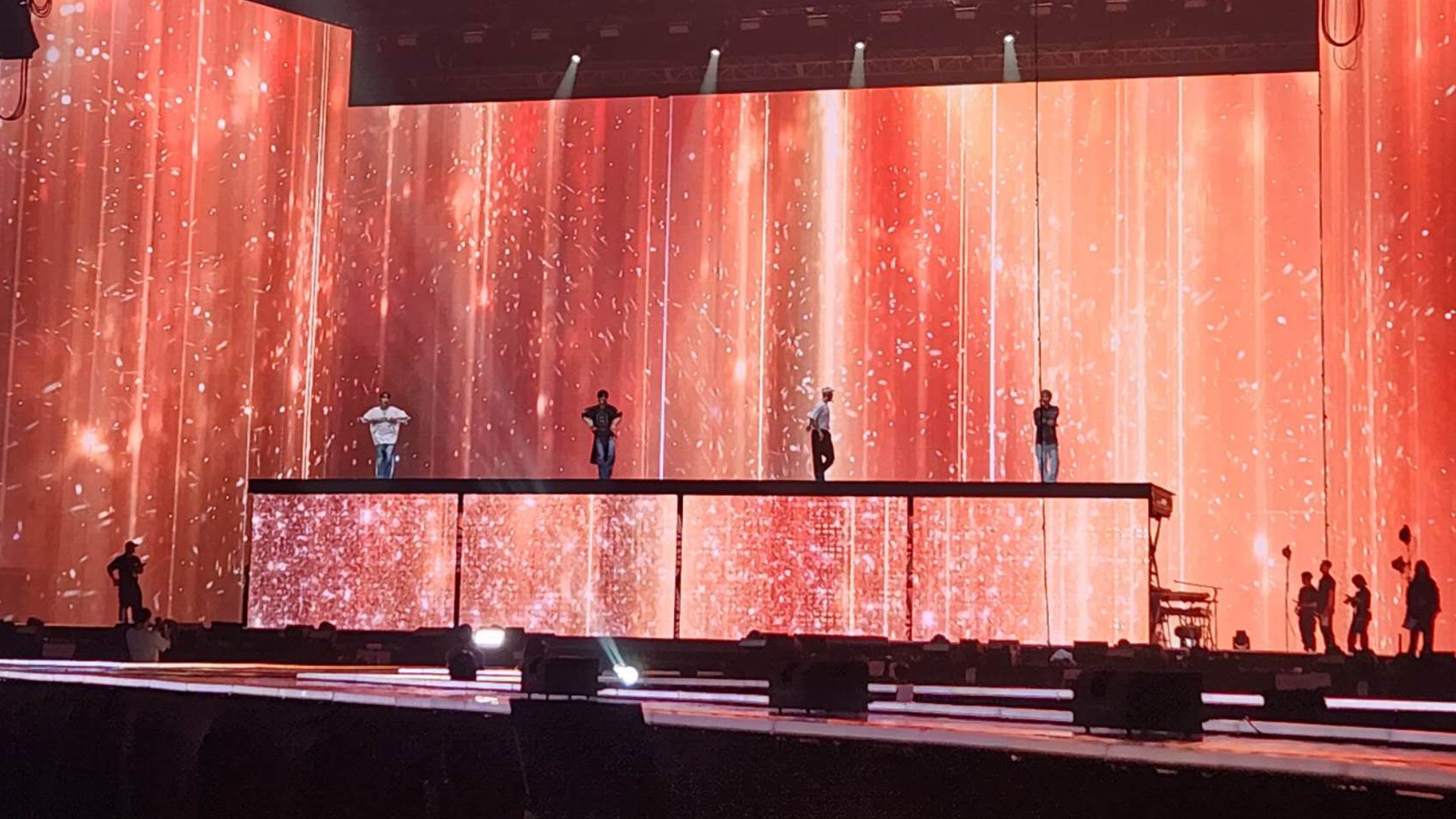
Magic Plus (FPS) is another candidate for event use where its specific features match the brief. Its supplied specifications list a 180° foldable angle, P2.6 and P3.9 pixel pitch, 6000 nits brightness, IP65 protection with double-sided potting and up to IP68, and hanging or wall-mounted installation. Its listed applications include stage events, concerts, exhibitions and rental events. A 180° fold angle should not be described as equivalent to the 360° foldable angle listed for FC, FCSL or FTS.
Retail and commercial venues: temporary campaigns or integrated displays
A retail environment can call for either a movable commercial advertising foldable LED screen or a display integrated with the space. For temporary promotions, the documented Zhejiang shopping mall project used six Easy Sailing EP225 mobile fast-assembly foldable LED display systems. The application record describes commercial promotions and events, with the foldable design supporting movement and reuse across different settings. This is a project example, not a guarantee of setup time or of results in another venue.
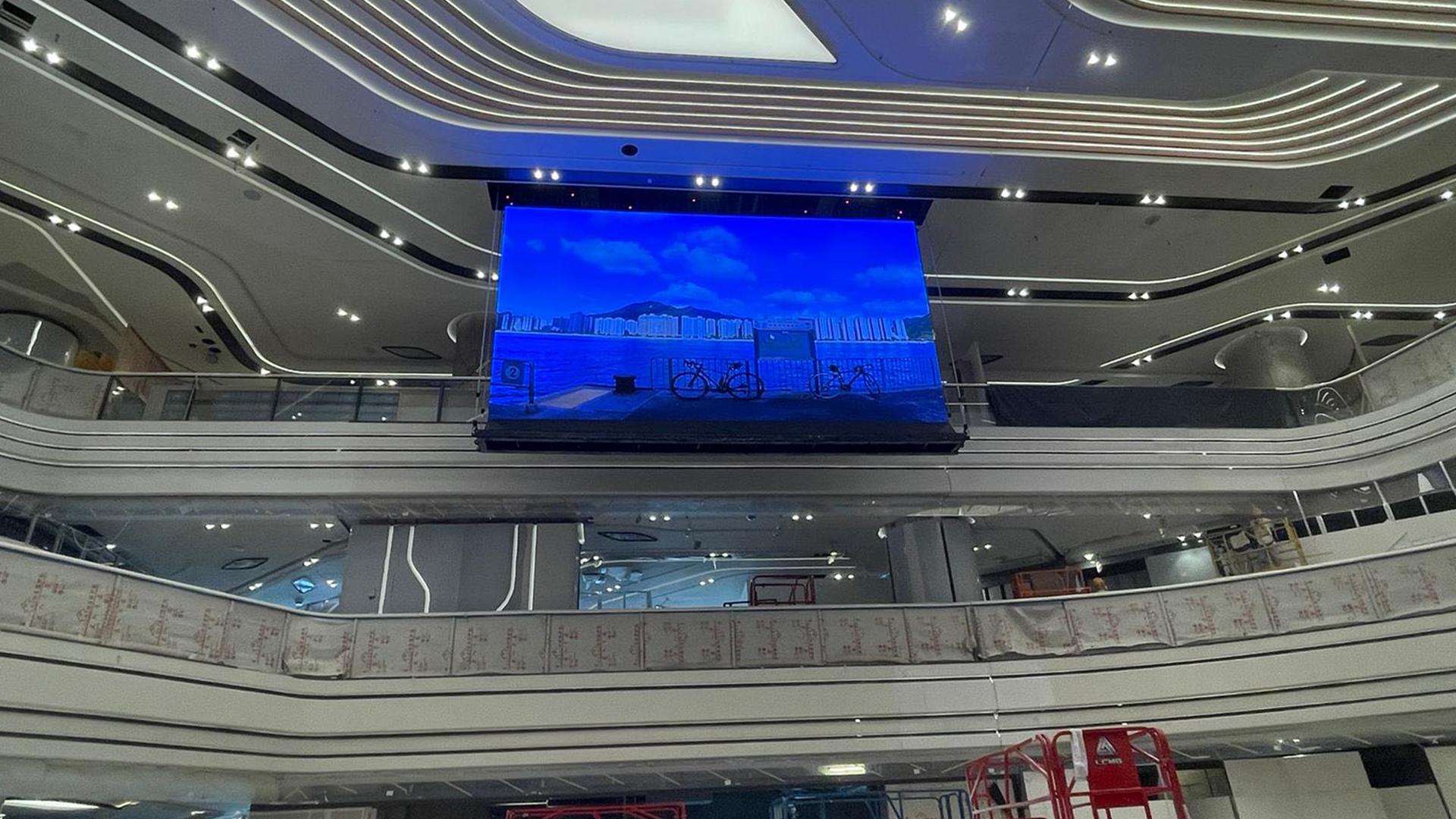
For a fixed commercial interior where the screen should be out of sight between uses, the requirements are different. A documented Tai Wai MTR Station project describes a hidden liftable foldable display that could be lowered and unfolded for commercial events and promotions. Similar use cases are recorded for a hotel banquet hall and a shopping mall installation. For buyers considering a hotel foldable LED screen, corporate showroom foldable LED screen or other integrated commercial display, the key decision is whether the building can accommodate the planned storage, lifting, folding and support arrangements. The supplied product data does not specify a universal lift mechanism or structural design, so those elements need project-level engineering confirmation.
Model choice should also reflect the display surface. Smart T Plus (FTS) is a foldable transparent LED display. Its listed transparency range is 16.37%–56%; its protection rating is IP65, with up to IP68 listed; and its foldable angle is 360°. The application list includes shopping malls, glass curtain wall advertising, architectural media facades, exhibitions and commercial advertising. Those facts support evaluating FTS where transparency is a stated design requirement, but do not establish that it suits every storefront, façade or viewing distance.
Architecture: when the display must coexist with the space
Architectural use changes the procurement question from “How large is the picture?” to “How does the display relate to the building and its use?” A screen may need to preserve visibility through a transparent surface, remain hidden when not in use, or fold as part of a designed visual feature. Onumen’s supplied application records include a 100 m² transparent folding LED display integrated into a cultural-tourism space. The record describes an open architectural appearance and an open, hollow design intended to reduce wind load. This is a specific project description; it should not be generalized to unverified façade conditions or wind-load calculations.
For a large foldable LED display screen that is integrated into a venue, installation planning should account for the chosen hanging, wall-mounted or ground installation method where available, as well as any separate lifting or structural equipment. The model specifications are useful inputs, not substitutes for checking the building interface, access route, electrical provision, control system and operating environment. The relevant protection rating is model-specific: for example, the mobile Easy Sailing models are listed at IP43, while Smart T Plus (FTS) and Smart Plus (FCSL) are listed at IP65 under their respective stated conditions. A higher rating should not be assumed across the entire folding product category.
Airport foldable LED screen is a relevant search phrase for buyers exploring transport settings, but the supplied application records do not document an airport installation. A transport hub project should therefore be assessed against its own requirements, including operating environment, integration constraints and applicable procurement checks; the examples from stations, malls and event venues are not proof of airport deployment.
Scene-by-scene fit at a glance
| Scene or need | Relevant supplied option or evidence | What to verify |
|---|---|---|
| Frequent event moves and temporary displays | Easy Sailing EP150-EP225 or EP250-EP400; mobile installation and quick setup are listed. A mall project documents EP225 use. | Exact screen size, environment, IP43 rating, transport configuration and control requirements. |
| Concert or stage display with folding form | FC and FCSL are listed as 360° foldable; FPS is listed as 180° foldable. Liftable stage installations are documented as project examples. | Fold angle, brightness, pixel pitch, weight, mounting, and whether a separate lifting system is required. |
| Transparent architectural or retail display | Smart T Plus (FTS) lists 16.37%–56% transparency and applications including glass curtain wall advertising and architectural media facades. | Required transparency, pixel pitch, viewing conditions, installation interface and project-specific environmental requirements. |
| Display hidden between events | Hotel, shopping mall and station case records describe hidden liftable foldable displays. | Building integration, lifting and folding mechanism, service access, controls and responsibility for structural engineering. |
Technical and procurement checks that matter across scenes
1. Match the model’s protection rating to the environment. IP43 is listed for the Easy Sailing mobile displays. Smart T Plus (FTS) lists IP65, up to IP68; Smart Plus (FCSL) lists IP65 front and rear, with IP68 optional; Magic Plus (FPS) lists IP65 with double-sided potting, up to IP68. These statements apply to the named products and stated configurations. They should not be combined into a blanket claim that every foldable LED screen has the same protection.
2. Select pixel pitch and brightness for the intended viewing conditions. The listed specifications span different ranges by series: Easy Sailing offers P2.6, P3.9 and P5.2 and 630–2300 nits; FC offers P2.6, P3.9 and P5.2 and 1000–1500 nits; FPS offers P2.6 and P3.9 at 6000 nits; FCSL offers P5.2, P7.8, P10.4 and P15.6 with 2400–6000 nits; FTS offers multiple coarser pitch options and a stated transparency range. These are model specifications, not a recommendation that one range is universally right for a particular viewing distance or ambient-light level.
3. Confirm installation and control. Several product listings support synchronous and asynchronous control. Installation methods vary: Easy Sailing is listed for mobile installation and quick setup; FC lists hanging, wall-mounted and floor installation; FPS lists hanging and wall-mounted installation; FTS lists hanging, wall-mounted and ground installation. Confirm the exact selected model and the full system scope before treating any method as included.
4. Check market-specific evidence, not just a logo or category claim. The supplied materials state that the FC series has ISO 9001:2015, ISO 14001:2015 and ISO 45001:2018 management-system certifications issued by Boston Certification, with listed certificate numbers 95722Q0036R0S, 95722E0015R0S and 95722S0012R0S. They also describe FC CE and RoHS evidence for the European Union. Certification claims must be matched to the product, certificate scope and destination market. For any purchase, a buyer should verify current validity and the exact documents applicable to the proposed configuration rather than assume that a certificate for one model automatically covers every product.
5. Treat large-format integration as a system decision. Onumen Technology Co., Ltd. describes its portfolio as including folding and mobile quick-assembly LED displays, and its capability information lists customization of screen size, pixel pitch, installation structure and control system. That supports asking whether project-specific options are available. It does not establish that every requested design is feasible without engineering review, or that lifting equipment, rigging, control and installation are automatically included.
Where foldable displays differ from conventional fixed screens
A folding structure can be relevant when the screen must change shape, move between temporary settings or be hidden and redeployed. The supplied verified-data package reports a 14 mm thickness for the FC series and contrasts foldable panels with traditional cabinet thickness of approximately 80–100 mm. That comparison is a broad reference in the supplied evidence, not a specification for every cabinet display or every foldable model. The FC product listing separately gives a thickness range of 14–17 mm and a weight of 11 kg/m²; buyers should use the exact model configuration rather than treat a single comparison figure as universal.
The boundary is equally important: a foldable screen does not eliminate the need to plan its support structure, controls, power, transport, service access or, where applicable, lifting mechanism. Some fixed installations may not need folding or movement at all. In those cases, a conventional fixed display may remain a more direct option. The fit advantage of a folding screen is strongest when folding, portability, transparency or hidden deployment is an actual project requirement—not simply because the word “foldable” appears in the product description.
Market context and outlook
Fortune Business Insights’ forecast cited in the supplied verified data expects the digital-signage and other large-display-device segment to register a CAGR of 80.4% through 2029. That forecast concerns a broad application segment; the same data package cautions that market reports may aggregate large-format foldable LED with other foldable display types. It should not be read as a measured growth rate for folding LED screens alone, nor as evidence of a particular product’s sales or return on investment.
For buyers, the useful implication is narrower: as large displays are considered for more venue types, scene fit and evidence become more important than a generic product label. Event operators can focus on movement, deployment and reuse; commercial-property teams can assess hidden or integrated installation; architects can examine transparency and the relationship between the display and the building. In each case, the product specification and the documented project evidence should be evaluated separately from market forecasts.
Onumen Technology Co., Ltd.’s product range offers several different configurations relevant to these needs, including mobile, flexible and transparent foldable displays. The available project records also show event, retail, hospitality and architectural applications. They provide examples for comparison, not a guarantee of performance in a new venue. Procurement decisions should therefore connect the scene, model, installation plan and market-specific evidence before treating a large foldable LED screen as a fit.
FAQ
What should buyers check first when choosing a Folding LED Display Screen?
Start with the operating scene: temporary or integrated use, indoor or semi-outdoor environment, installation method, required screen form and relevant protection rating. Then verify the exact model’s pixel pitch, brightness, weight, fold angle, control mode and system scope.
Which listed option is designed for mobile event use?
Easy Sailing EP150-EP225 and EP250-EP400 are listed as mobile folding LED displays for indoor and semi-outdoor use. Their specifications include mobile installation and quick setup, a 360° foldable angle, 12 kg/m² screen weight and IP43 protection. Confirm the exact screen size and configuration for the project.
Is a foldable LED display automatically a liftable display?
No. The product data describes folding displays and installation methods, while some case records describe systems integrated with lifting mechanisms. A liftable installation should be treated as a project-level integration requirement, not assumed to be included with every foldable screen.
Which listed product is transparent?
Smart T Plus (FTS) is identified as a foldable transparent LED display. Its supplied specifications list transparency from 16.37% to 56%, a 360° foldable angle and IP65 protection, up to IP68. Suitability depends on the project’s required transparency, pixel pitch, installation and environment.
Do the supplied project examples document an airport installation?
No airport installation is identified in the supplied application records. They include event, hotel, shopping mall, station, school and cultural-tourism applications. An airport project would need its own review against the venue requirements and the documentation for the proposed model.
Do all folding LED display models share the same protection rating?
No. The supplied specifications vary by product: Easy Sailing is listed at IP43; Smart T Plus (FTS) at IP65, up to IP68; Smart Plus (FCSL) at IP65 front and rear, with IP68 optional; and Magic Plus (FPS) at IP65 with double-sided potting, up to IP68. Verify the exact model and configuration.
¿Tiene preguntas o necesita más detalles?
Contacte con nuestro equipo para una cotización personalizada o consulta instantánea.
Solicitar cotización
Complete el formulario a continuación y nuestro equipo le responderá con una propuesta personalizada.
Chat directo de WhatsApp
¿Prefiere chatear en tiempo real? Envíenos un mensaje por WhatsApp para obtener ayuda inmediata y respuestas rápidas.
- Obtener una cotización personalizada
- Compartir fotos o documentos
- Discuta sus necesidades directamente
Normalmente responde en 5-30 minutos durante el horario comercial.