
Foldable Home Organization: Drawers, Shoe Cabinets, Car Boxes
Foldable Home Organization: Drawers, Shoe Cabinets, and Car Boxes
Foldable home organization is no longer one product category. It is a group of formats that solve different spatial problems, and buyers who compare them on capacity alone usually pick the wrong one.
Three formats dominate current sourcing conversations: the drawer-style box that lives inside a wardrobe, the cabinet that stands at an entryway, and the box that travels in a car trunk. In the xinhaibox range these are represented by the YN484536 Foldable Storage Drawer, the 7008 Foldable Shoe Cabinet, and the YN8980 Foldable Car Storage Box. All three are polypropylene products with a fold-flat structure. Beyond that shared starting point, they diverge on footprint, layer adjustability, usable capacity, and how much space they give back when empty.
This comparison is written from a buyer's position rather than a supplier's. It uses published specifications for the three models, sets out a four-metric decision framework, and states plainly where each format stops being the right answer.
Three foldable formats, three different spatial problems
A foldable drawer answers a storage problem that is internal to furniture: how to use the vertical volume inside a closet without losing access to what sits at the back. A foldable shoe cabinet answers a problem at the boundary of a room: how to keep footwear enclosed, visible and off the floor in a narrow entryway. A foldable car storage box answers a problem that moves: how to keep loose items contained in a vehicle and still reclaim trunk space when the box is not needed.
Because the three problems are different, the specifications that matter are different. A buyer who shortlists on litres will find that the largest drawer is not the best entryway solution, and that the entryway cabinet is not the best trunk solution — not because of quality, but because the formats were designed against different constraints.
Specification snapshot
| Dimension | YN484536 Foldable Storage Drawer | 7008 Foldable Shoe Cabinet | YN8980 Foldable Car Storage Box |
|---|---|---|---|
| Material | High-strength PP plastic | PP | PP |
| Plan footprint | 48 cm width; depth options of 40, 45 or 50 cm | 37 × 26 cm (length × width) | 43.5 × 30 cm (medium); 54 × 36 cm (large) |
| Height / stacking logic | Unit heights of 26, 30 or 36 cm; stackable | 20.6 cm (1 layer) up to 127.1 cm (6 layers) | 24 cm (medium); 29 cm (large) |
| Capacity | 49 L to 86 L across the size matrix | Not expressed in litres; capacity scales with layer count | 57 L (medium size) |
| Access method | Smooth pull-out drawer with transparent front panel | Front access, dustproof side buckle locks | Lockable lid; carry handle and side handles |
| Assembly | Tool-free quick assembly | No assembly required | Foldable body; folds to 7 cm thickness |
| Mobility | Not specified | Universal wheels | Carry handle and side handles |
| Typical setting | Wardrobe, closet, living room | Entryway, closet, retail floor | Car trunk, home, camping |
Published specifications for the three foldable formats. Where a value is not stated in source material, it is marked as not specified rather than estimated.
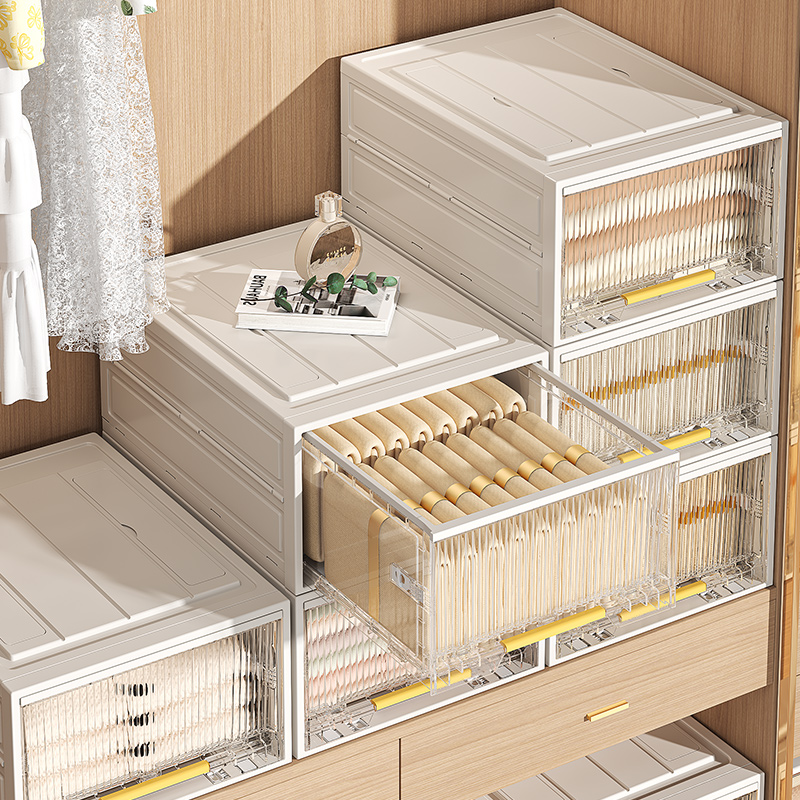
Drawer-format storage is designed around interior furniture volume: stacked, transparent-fronted units keep clothing visible while using the full height of a wardrobe.
Why capacity is a misleading first metric
Litres are the easiest number to compare and the least useful as a first filter. Capacity only becomes meaningful after two prior questions have been answered: how much floor or shelf area the format consumes, and how a person reaches the contents once the unit is full.
Consider the extremes. The YN484536 drawer reaches 86 L in its largest configuration, but the same product family requires 48 cm of width and up to 50 cm of depth, and it needs clear space in front of the drawer for a full pull-out. The YN8980 car box offers 57 L in the medium size within a 43.5 × 30 cm footprint — smaller in volume, but designed to sit in a space where nothing can be pulled out and everything must be lifted from above.
The practical rule is that capacity should be evaluated last, against a known storage location. Buyers specifying for a domestic closet, a narrow entryway and a vehicle trunk are not choosing between three capacities. They are choosing between three ways of occupying space.
Format one: the YN484536 foldable storage drawer
The YN484536 is a drawer storage box made of high-strength PP plastic. It combines a foldable and stackable body with a transparent front panel, a smooth pull-out drawer action, and tool-free assembly. Published capacities run from 49 L to 86 L across a size matrix defined by three heights (26, 30 and 36 cm), three depths (40, 45 and 50 cm) and a constant 48 cm width. Stated storage items include T-shirts, sweaters, sweatshirts, lightweight down jackets, thin blankets, summer quilts and thick quilts, with intended use in home storage, wardrobe organization and living room storage.
Where this format earns its place
- Closet interiors. The drawer is the only one of the three formats designed to be reached horizontally. Stacking two or three units converts unused wardrobe height into accessible, labelled storage bands.
- Seasonal bedding. The larger configurations are specified for thick quilts and summer quilts, which is the load case where foldable PP needs its highest structural stiffness.
- Visual inventory. The transparent front panel means contents can be identified without opening the unit, which matters in shared or retail-facing environments.
- Flat inbound freight. Tool-free assembly plus a foldable body means the unit ships and stores collapsed until the moment of use.
Where it stops being the right choice
The drawer format has a coarse vertical grid: unit heights step in 26, 30 and 36 cm increments, and depth in 40, 45 and 50 cm. A buyer who needs fine vertical adjustment — for example, to fill an unusual gap of 33 cm — will not get it from this family. The format also depends on pull-out clearance, so it is a poor fit for deep, low-clearance spaces where nothing can be drawn forward. Finally, the transparent front panel is a deliberate design decision: it helps retrieval, but it does not provide concealed storage for buyers who want contents hidden from view.

The 7008 shoe cabinet uses a fixed 37 × 26 cm plan footprint and adds storage vertically, from one layer at 20.6 cm to six layers at 127.1 cm.
Format two: the 7008 foldable shoe cabinet
The 7008 is a folding shoe storage box made of PP with a 37 × 26 cm length-and-width footprint. Its defining characteristic is vertical scalability on a constant base: 20.6 cm at one layer, 44.7 cm at two, 65.3 cm at three, 85.9 cm at four, 106.5 cm at five and 127.1 cm at six. The unit requires no assembly, is foldable and stackable, seals with side buckle locks against dust, and is fitted with universal wheels. The manufacturer describes the product as zero formaldehyde and odorless, and states that it has passed quality inspection.
Where this format earns its place
- Entryways and narrow hallways. A 37 × 26 cm plan footprint is the smallest of the three formats, which is exactly the constraint in apartments and corridors.
- Graduated deployment. Because the footprint stays constant while layers are added, a buyer can start with a two-layer unit and expand to six without changing the floor plan — a useful property for rental housing and for retail assortment planning.
- Dust control. Side buckle locks create a sealed enclosure, which is the relevant feature where footwear is stored long term or the unit sits near a doorway.
- Repositioning. Universal wheels allow a loaded cabinet to be moved without dismantling it.
Where it stops being the right choice
Layer height is effectively fixed. The difference between consecutive specifications is roughly 20.6 cm per added layer (44.7 cm at two layers, 65.3 cm at three), so tall items such as boots may not sit comfortably within a single layer. The fixed plan footprint also means a six-layer configuration reaches 127.1 cm on a base that has not grown: buyers should verify stability in the intended location, particularly on the universal wheels and where the unit will be reached from one side only. And the sealed construction that keeps dust out also limits airflow, which is a consideration for damp climates.
Format three: the YN8980 foldable car storage box
The YN8980 is a foldable storage box made of PP, supplied in two sizes: medium at 43.5 × 30 × 24 cm with 57 L capacity, and large at 54 × 36 × 29 cm. When folded the body reduces to 7 cm thickness. It carries a lockable lid, a carry handle and side handles, and is offered with either a wooden-look or a plastic lid. Intended applications are automotive accessories, home storage, outdoor camping and household organization — and with the wooden-look lid the unit can double as a small table.
Where this format earns its place
- Trunk containment. A boxed volume with a lockable lid keeps shopping, tools and travel items from migrating across the boot.
- Reclaimable space. The 7 cm folded thickness is the most aggressive space-return of the three formats, which matters when the trunk is needed empty for other loads.
- Portability across contexts. Carry and side handles mean the same unit can move from car to campsite to storage room without repacking.
- Secondary function. The lid option turns the box into a surface, which extends its value in outdoor and picnic settings.
Where it stops being the right choice
This is a single-compartment format. Published specifications do not describe internal dividers, so mixed loads — groceries alongside tools, for example — will need secondary organisers inside the box. The source material also does not state water resistance, so buyers planning open-air or wet-weather use should not assume the box is weatherproof on the basis of the lockable lid alone. Finally, the 7 cm folded figure only pays back if the box is actually collapsed; in daily trunk use many users leave the unit open, in which case the folded thickness is a freight and seasonal-storage advantage rather than a daily one.
A four-metric framework buyers can apply to all three
Instead of ranking the formats, buyers can score any candidate against four metrics. The weighting changes by project; the metrics do not.
| Metric | What to measure | Why it changes the decision |
|---|---|---|
| Footprint | Plan dimensions at the intended location, including clearance in front of any pull-out element | A drawer needs forward clearance; a cabinet and a car box do not. The same litre figure can require very different floor area. |
| Layer adjustability | Whether height changes in fine increments or in fixed steps | The 7008 adds roughly 20.6 cm per layer; the YN484536 steps in 26, 30 and 36 cm unit heights. Fine adjustment suits irregular gaps; coarse steps suit standardised furniture. |
| Capacity | Usable litres at the chosen configuration, and whether the load is bulky or dense | Quilts and blankets reward volume; tools and groceries reward containment and a lockable lid. |
| Folded storage | Thickness or volume when collapsed, and how often the unit will actually be collapsed | The YN8980 folds to 7 cm; the drawer and cabinet fold for transport and off-season storage rather than daily cycles. |
A second layer of questions sits underneath these four: access direction, mobility, dust sealing and material compliance. Those are filters rather than ranking criteria — a format either meets them for a given project or it does not.
Foldable versus rigid: the trade-off buyers should price in
Foldable polypropylene storage is not a strict upgrade over rigid moulded alternatives. It is a different set of compromises, and the honest comparison is about where those compromises land.
The clear advantage is logistics. A fold-flat body reduces inbound cube and lets a distributor hold assortment without dedicating warehouse volume to empty boxes. The cost is structural: a folding body introduces joints, hinges and locking elements that a one-piece moulded body does not have. Buyers specifying for heavy, permanent loads should therefore treat hinge and latch durability as a sample-stage validation item rather than an assumption, and should confirm that a folded unit is packed so that panel edges are not load-bearing in transit.
Rigid moulded bins remain the reference point where maximum rigidity per unit, or a fully sealed body, is the dominant requirement. Foldable formats win where space reclamation, flat shipping and reconfigurability are worth more than that last increment of stiffness. Neither answer is universally correct, and a project that needs both usually needs two products rather than one compromise.
Material and compliance checks worth requesting
All three models are polypropylene products, and PP is a well-understood material for household storage. Polypropylene marked with recycling code #5 is generally BPA-free and accepted by the U.S. Food and Drug Administration for food contact under 21 CFR. That is a material-level statement, not a product-level certification.
In the European Union, the framework for food-contact materials is set by Regulation (EC) No 1935/2004, with plastic food-contact materials addressed specifically by Commission Regulation (EU) No 10/2011. Commission Regulation (EU) 2024/3190 prohibits the use of BPA and its salts in specified food-contact materials and articles placed on the EU market, subject to stated derogations.
Procurement note. None of the three models described here is presented in source material as a food-contact product. The regulations above become decisive only where a storage item is marketed or represented for food contact. Buyers should confirm intended use per SKU, then request the matching declaration of compliance and migration test documentation rather than relying on a general BPA-free claim.
For non-food-contact storage — clothing, footwear, tools, camping gear — the relevant questions shift to odour, formaldehyde status and colour fastness. The 7008 is described by the manufacturer as zero formaldehyde and odorless, a claim worth pairing with a sample evaluation in the destination climate.
Market signal behind the format shift
The category context supports the attention these formats are receiving. Market Research Future projects the global home organization products market to reach USD 21.65 billion by 2035, and identifies stackable storage as the fastest-growing sub-segment within the kitchen organization market, at a 6.25% CAGR across the 2026–2035 forecast period.
The growth signal is specifically about stackable and modular configurations rather than storage in general. That is consistent with what the three formats have in common: each one is designed to add capacity vertically or to disappear when unused, rather than to occupy more floor area. For buyers, the implication is assortment-level. A range built only on fixed-volume bins addresses a shrinking share of the demand that modular formats are capturing.
Supplier context
xinhaibox — Taizhou Xinhai Cross-border E-commerce Service Co., Ltd. — is a China-based supplier of plastic household storage and daily-use products, established in 2025 and supported by more than 20 years of manufacturing experience from Zhejiang Jinmao Plastic Group. Company-published information describes a 50,000 square metre factory, approximately 500 employees, annual output of around 1,000,000 units and an export share of 70%, with major markets in North America, the EU, Southeast Asia and Latin America. The company states a 30-person engineering and design team and supports customisation of colours, logos, stickers, packaging and product details. Company-published sourcing terms list an OEM minimum order of 500 units for logo and colour customisation with a 15–45 day lead time, and 5,000 units for ODM work.
These are supplier-reported figures. They are useful for initial screening and assortment planning, and they are not a substitute for factory audit, sample validation or document review before a purchase order is placed.
Future outlook
Two directions look likely to shape this segment over the next buying cycles. The first is format convergence: buyers increasingly want a drawer, a cabinet and a trunk box that share a material, a colour system and a folding logic, because a coherent range is easier to merchandise and easier to explain at retail. The second is documentation depth. As modular storage moves into pantry and food-adjacent use, the compliance question moves from a material claim to a per-SKU file — declaration of compliance, migration testing, and a clear statement of intended use.
Neither direction favours a single format. They favour suppliers who can hold a consistent specification across several formats and evidence it consistently.
Product specifications and imagery for the three formats, together with the wider storage range, are compiled in the xinhaibox product brochure.
FAQ
What is a foldable storage drawer used for?
The YN484536 is a drawer storage box made of high-strength PP plastic, with a transparent front panel, smooth pull-out drawer action and tool-free assembly. It is specified for storing T-shirts, sweaters, sweatshirts, lightweight down jackets, thin blankets, summer quilts and thick quilts, with capacities from 49 L to 86 L. Its intended applications are home storage, wardrobe organisation and living room storage, where it is stacked to use vertical space inside furniture.
How tall can a foldable shoe cabinet be?
The 7008 shoe cabinet ranges from 20.6 cm at one layer to 127.1 cm at six layers, on a constant 37 × 26 cm length-and-width footprint. Intermediate heights are 44.7 cm at two layers, 65.3 cm at three, 85.9 cm at four and 106.5 cm at five, so each additional layer adds roughly 20.6 cm of height. It requires no assembly, seals with side buckle locks and is fitted with universal wheels.
How much space does a foldable car storage box take when empty?
The YN8980 folds to a thickness of 7 cm. In use, the medium size measures 43.5 × 30 × 24 cm with 57 L capacity, and the large size measures 54 × 36 × 29 cm. The unit has a lockable lid, a carry handle and side handles, and is available with a wooden-look or plastic lid.
Which format suits a narrow entryway?
The 7008 shoe cabinet, because its 37 × 26 cm plan footprint is the smallest of the three and capacity is added vertically rather than by expanding the base. The drawer format requires pull-out clearance in front of the unit, and the car storage box is designed for a trunk-sized volume rather than a corridor.
Do these polypropylene products contain BPA?
Polypropylene marked with recycling code #5 is generally BPA-free and accepted by the U.S. FDA for food contact under 21 CFR, and in the EU, Commission Regulation (EU) 2024/3190 prohibits BPA and its salts in specified food-contact materials and articles, subject to stated derogations. That restriction applies to products within the food-contact scope. None of the three models covered here is presented in source material as a food-contact product, so buyers should confirm intended use per SKU and request the corresponding declaration of compliance.
What are the typical OEM terms for these formats?
Company-published sourcing terms for xinhaibox list a minimum order of 500 units for OEM logo and colour customisation, with a 15–45 day lead time, and 5,000 units for ODM work. These terms are supplier-reported and apply per order negotiation rather than as fixed market standards.
¿Tiene preguntas o necesita más detalles?
Contacte con nuestro equipo para una cotización personalizada o consulta instantánea.
Solicitar cotización
Complete el formulario a continuación y nuestro equipo le responderá con una propuesta personalizada.
Chat directo de WhatsApp
¿Prefiere chatear en tiempo real? Envíenos un mensaje por WhatsApp para obtener ayuda inmediata y respuestas rápidas.
- Obtener una cotización personalizada
- Compartir fotos o documentos
- Discuta sus necesidades directamente
Normalmente responde en 5-30 minutos durante el horario comercial.