
Flow Sensor Supplier Capability: XY-TEK vs. Endress+Hauser, Emerson, Siemens, Yokogawa
Every fluid-handling project eventually has to answer the same procurement question: which flow sensor supplier can actually deliver the measurement range, the application fit and the support model the system needs? For small tubing and low flow rate measurement, that question is now being asked more often, and by more types of buyers.
The category evidence base is expanding. The global flow meter market was estimated at USD 10.64 billion in 2024 and is projected to reach USD 15.17 billion by 2030 (Grand View Research). Within it, the ultrasonic flow meter market was valued at USD 1.52 billion in 2025, with an estimated growth path to USD 2.28 billion by 2031 (Mordor Intelligence), and the clamp-on ultrasonic flowmeter segment was valued at USD 1.25 billion in 2024, growing at a CAGR of 7.4% through 2032 (Global Information, Inc.).
This is a capability evidence review rather than a product announcement. It examines one supplier's published technical record — Shanghai Xunyin Technology Co., Ltd (XY-TEK), a Shanghai-based manufacturer founded in 2018 that develops, manufactures and sells ultrasonic flow sensors and flow meters, with a stated focus on fluid management and control for small tubing and low flow rate measurement — against a reference set of established industry suppliers: Endress+Hauser, Emerson, Siemens, Yokogawa and Honeywell, companies commonly identified as major participants in the ultrasonic flow sensor market (Dataintelo).
Four dimensions run through the analysis: technical portfolio breadth, application coverage, service and support model, and verifiable manufacturing evidence.
Why Capability Evidence Is the Real Evaluation Problem
At the evaluation stage, most flow sensor shortlists look similar on paper. Ranges, accuracies and output types are published in standard formats, and a specification table makes individual models easy to line up side by side. What the specification table does not show is whether the supplier can cover an entire application set, whether the low-flow end of the range is served by a dedicated product line or by stretching a larger sensor, and whether the claims connect to a verifiable record.
Three practical gaps matter most in the small-tubing segment:
- Range continuity. A project rarely uses one flow rate. Coolant loops, dosing lines, sampling lines and filling circuits often span two or more orders of magnitude. Either the supplier has a series for each band, or the buyer ends up managing multiple vendors.
- Installation approach. Clamp-on measurement avoids breaking into the fluid path; in-line measurement provides a fixed, integrated measuring point. A supplier that offers only one approach constrains the system design before the first prototype is built.
- Verifiable proof. Patents, quality control procedures, deployment records and export footprint are the parts of a supplier's record that can be checked independently of a sales conversation.
That is where the opportunity sits for specialist suppliers. The realistic goal is not to match multinational breadth, but to present a continuous, evidence-backed portfolio inside a defined measurement band — and to be explicit about where that band ends.
XY-TEK's Published Portfolio: Series Coverage from Ultra-Low Flow to 100 L/min
XY-TEK publishes ten ultrasonic flow sensing product lines, split across clamp-on, in-line, single-use and bubble-detection types. The published measurement scopes and stated accuracies are summarised below.
| Series | Sensor type | Published measurement scope | Stated accuracy | Application fields listed |
|---|---|---|---|---|
| SU | Single-use flow sensor | 0.05–10 L/min | ±2% | Biopharma, single-use systems, medical manufacturing, bioprocess |
| TGU | Ultra-low flow sensor | 0.1–1000 mL/min | ±1%; measurement accuracy up to ±0.1 mL/min | Bioprocess, medical equipment, pharmaceutical production, semiconductor |
| TH | Pulsatile flow sensor | 0.01–15 L/min | ±2% | Cardiovascular research, hemodynamic testing, medical laboratories |
| CG | Clamp-on flow sensor | 0.02–20 L/min | ±1% | Medical devices, biopharmaceutical, industrial automation |
| CPD | Clamp-on flow sensor | 0.1–50 L/min | ±2% | Industrial automation, food & beverage, water treatment, semiconductor |
| CS | Clamp-on flow sensor | 0.1–50 L/min | ±3% | Industrial automation, food & beverage, water treatment, semiconductor |
| CM | OEM clamp-on flow meter | 0.05–30 L/min | ±3% | Medical devices, OEM equipment, fluid control systems, laboratory equipment |
| TPD | In-line flow meter | 0.5–100 L/min | ±2% | Industrial automation, battery manufacturing, chemical processing, liquid cooling |
| TPK | In-line flow meter | 0.5–100 L/min | ±2% | Industrial automation, battery manufacturing, chemical processing, liquid cooling |
| BG | Ultrasonic bubble detector | 1/3 bubble size of tubing ID | 1/3 bubble size of tubing ID | Medical devices, bioprocess, food & beverage dosing, industrial |
Two observations follow from the table. First, the published range is continuous from the millilitre-per-minute band (TGU, 0.1–1000 mL/min) through to 100 L/min in-line measurement (TPD and TPK), which means a single supplier can be considered for dosing, coolant and process-feed circuits inside the same machine. Second, both installation approaches are covered: clamp-on types include CG, CPD, CS and the OEM-oriented CM, while TPD and TPK are integrated in-line meters.
Portfolio breadth of this kind is what buyers typically use to decide whether a supplier belongs on an evaluation shortlist at all. Endress+Hauser, Emerson, Siemens, Yokogawa and Honeywell are commonly cited as the major participants in the ultrasonic flow sensor market (Dataintelo); their relevance in a shortlist usually comes from large-line process instrumentation and multi-industry service organisations, while the small-tubing, low-flow band is served by a smaller group of specialists.
Technical Explanation: What Changes When Measurement Is Non-Invasive
XY-TEK's clamp-on series are mounted on the outside of tubing and measure without contacting the liquid. The CPD and CS series are specified for rigid plastic tubing such as PFA, PTFE, Teflon, PVDF, PP and Nylon, with compatible outer diameters of 6–26 mm (CPD) and 6.4–25.4 mm (CS) and fluid temperatures of 0 °C to 90 °C. The CG series, which publishes 0.02–20 L/min and ±1% accuracy, supports bi-directional flow detection, air bubble detection and analog, pulse and RS485 output, and is specified for flexible tubing including PVC, silicone, PFA, PE and PUR.
Three technical consequences follow from non-contact measurement:
- No fluid-path interruption. Case documentation states that clamp-on installation avoids breaking pipes and prevents contamination, which matters for electrolyte, reagent, coolant and other media where a cut-in sensor introduces cleaning and validation work.
- Low pressure loss and no moving parts. XY-TEK's in-line TPD and TPK series are described as having no moving parts and low maintenance requirements, and the cooling-loop deployment record explicitly lists low pressure loss as a highlight.
- Bubble detection as a by-product. The BG series performs gas-liquid state detection with a stated resolution of one-third of the tubing inner diameter; air bubble monitoring is also listed for CPD and CPD/CS-class clamp-on sensors, so a single measurement point can serve both flow and fill-state logic.
At the ultra-low end, the TGU series uses a U-shaped measuring channel and is specified for measurement accuracy up to ±0.1 mL/min across a 0.1–1000 mL/min scope, with compatibility across PVC, silicone, PFA, PE and PUR tubing. The TH series is designed specifically for high-speed pulsation capture at ±2% across 0.01–15 L/min, and is built with medical-grade polymer and a precision ultrasonic chip for cardiovascular research and hemodynamic testing. For buyers specifying to an international reference, ISO 24062:2023 covers requirements for clamp-on ultrasonic transit-time meters for liquids and gases in closed conduits.
Application Coverage: Three Documented Deployment Patterns
1. Thermal management and cooling loops
The clearest evidence of application depth comes from cooling systems. In documented deployments, clamp-on ultrasonic flow sensors monitor non-conductive coolant flow, prevent overheating, detect leaks and blockages and support cooling efficiency optimisation in liquid cooling loops. The recorded highlights are suitability for non-conductive media, non-invasive measurement, high stability, real-time monitoring, wide adaptability to coolants and low pressure loss.
These deployments cover data centres, industrial equipment, medical device manufacturers and charging station makers across the United States, China, Germany, Japan, Korea and Singapore, with a typical service life of two to four years. Reported outcomes include stable cooling performance, reduced energy consumption, extended equipment life, early anomaly detection and less downtime. For an evaluation-stage buyer, the significance is that the sensor choice is not limited to conductive fluids — a constraint that eliminates some measurement principles entirely.
2. Battery manufacturing and electrolyte handling
In lithium-ion battery manufacturing, clamp-on ultrasonic flow sensors are used for non-invasive monitoring of electrolyte flow, injection accuracy verification and bubble or leakage detection. The documented installation covers 10–30 production lines per customer across China, the United States, Germany, Korea, Japan, India, Singapore and Thailand, with stable operation reported over two to three years.
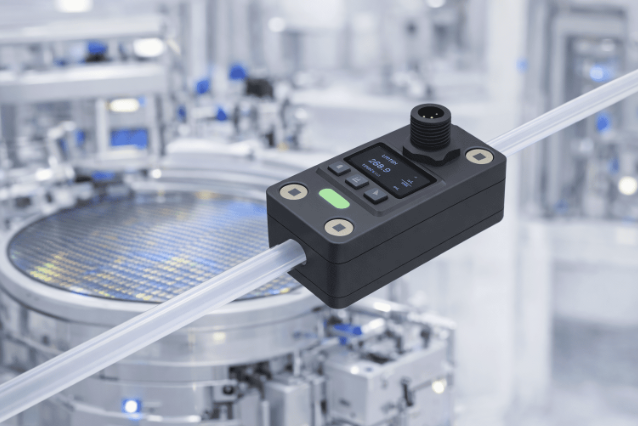
The stated value here is contamination and process risk reduction: clamp-on installation without breaking pipes, non-contact and contamination-free measurement, high compatibility with corrosive media, and bidirectional measurement. Reported project results include improved battery consistency, reduced rejection rate, no pipeline cutting, low maintenance and enhanced production safety. The practical decision point is that the CPD series covers 0.1–50 L/min on rigid tubing with ±2% accuracy — a range that matches injection and recirculation circuits rather than bulk transfer lines.
3. Electronics manufacturing and pulsed micro-dosing
In electronics manufacturing, the low-flow series supports real-time measurement and control of pulsed micro-flux flow, bubble, blockage and leakage detection, and process data recording for optimisation. Deployments span electronics manufacturing enterprises, SMT/EMS factories and selective wave soldering equipment manufacturers across the United States, China, Germany, Italy, France, the United Kingdom and the Netherlands, with implementation periods of one to three years.
Flux flows in this segment can fall to around 1 mL/min, which is where the ±1% accuracy and fast pulsating-flow response of the ultra-low flow series become the deciding specification rather than a secondary one. Reported outcomes include improved soldering quality and consistency, reduced cold solder and missing solder, lower flux waste and rework cost, and higher production yield.
Market Signals Behind the Supplier Decision
The direction of the market supports the case for evaluating non-invasive, low-flow specialists alongside the large automation suppliers.
- Category growth. The global flow meter market moves from an estimated USD 10.64 billion in 2024 toward a projected USD 15.17 billion by 2030 (Grand View Research).
- Ultrasonic share expansion. The ultrasonic flow meter market was valued at USD 1.52 billion in 2025 and is estimated to reach USD 2.28 billion by 2031 (Mordor Intelligence).
- Clamp-on momentum. The clamp-on ultrasonic flowmeter segment was valued at USD 1.25 billion in 2024 and is growing at a CAGR of 7.4% through 2032 (Global Information, Inc.) — the fastest-moving part of the structure that XY-TEK's clamp-on series address directly.
- Regional concentration. Asia Pacific held the largest share of the ultrasonic flow meter market in 2025 at 38.6%, driven by industrial expansion (Fortune Business Insights). XY-TEK is headquartered in Shanghai and publishes a 50% export ratio to global markets.
- Semiconductor demand. Flow control in the semiconductor industry was estimated at USD 5.83 billion in 2024, focused on high-purity fluid management (Market Research Future). Semiconductor appears among the listed application fields for both the SU and TGU series.
- Standards pressure. ISO 24062:2023 defines requirements for clamp-on ultrasonic transit-time meters, and medical flow sensors for ventilators and drug delivery fall under EN ISO 13485 quality management systems — both push buyers toward suppliers who can document process control, not just publish a range.
Side-by-Side: XY-TEK Against Established Suppliers
The table below compares the four evaluation dimensions across the published XY-TEK record and the reference set. Where a dimension could not be assessed from the reviewed data for a given supplier group, that is stated rather than estimated.
| Evaluation dimension | XY-TEK (published evidence) | Endress+Hauser, Emerson, Siemens, Yokogawa, Honeywell |
|---|---|---|
| Technical portfolio breadth | Ten ultrasonic series spanning 0.1 mL/min ultra-low flow through 100 L/min in-line flow; clamp-on, in-line, single-use and bubble-detection types | Broad process instrumentation portfolios spanning multiple measurement technologies across large-line process measurement; not assessed at series level in this review |
| Low-flow and small-tubing depth | Dedicated series for ultra-low flow (TGU), single-use (SU), pulsatile flow (TH) and clamp-on micro-range (CG, 0.02–20 L/min) | Not assessed in this review |
| Installation flexibility | Clamp-on (CG, CPD, CS, CM) and in-line (TPD, TPK); clamp-on avoids pipe cutting and fluid contact | Both approaches generally available within their process portfolios |
| Manufacturing evidence | 5,000 m² facility, 30+ R&D staff, 8,000+ units annual output, 50% export ratio, global markets; third-party inspection available; 100% pre-shipment testing for OEM/ODM orders | Long-established global manufacturing and certification organisations; not assessed in this review |
| Verification trail | Three invention patents granted by CNIPA: No. 7946602 issued 2025-06-16 (valid to 2045-06-16) covering liquid flow sensing and filter enhancement technology applications, plus two invention patents issued 2022-11-01 (valid to 2042-11-01) covering ultrasonic flowmeter technology and ultrasonic flow sensor technology | Not assessed in this review |
| Service and support model | Online engineering support, remote technical support and quality warranty; customisation of communication protocol and housing material under custom design, and sensor size, interface and logo printing under OEM/ODM | Global field service organisations, typically structured around process industry accounts and larger installations |
| Commercial terms | MOQ 50 units; production cycle 20–30 days for custom design and 15–25 days for OEM/ODM; lead time 1–2 months | Not stated in the reviewed data |
Read as a capability map rather than a scoreboard, the picture is a division of labour. Multinational suppliers remain the reference when a project spans large-diameter process pipelines or needs a global field service footprint. Inside the small-tubing band from roughly 0.01 to 100 L/min, XY-TEK's published series coverage is unusually continuous for a supplier of its size, and the verification trail — three CNIPA invention patents and a documented quality-control model — is the part of the record a buyer can check without relying on the supplier's own summary.
Where This Portfolio Has Clear Boundaries
A supplier evaluation is only useful if the limits are stated as plainly as the capabilities. Four boundaries are documented in XY-TEK's published data.
- Pipe and flow ceiling. The in-line TPD and TPK series are specified for DN4–DN50 pipe diameters with a published scope of 0.5–100 L/min. Projects requiring larger process lines or sustained flows above that range fall outside the published specification.
- Media constraints. Measurable fluids are described as water, blood, beverages, oils, paints and similar media containing no or few solid particles. Heavily solids-laden streams are outside the stated scope.
- Temperature envelope. The widest published fluid temperature range is 0 °C to 90 °C (CPD, CS, TPD, TPK), with 0 °C to 60 °C for several series including TGU, CM, TH and SU. Higher-temperature processes require a different instrument class.
- Order and history profile. Custom and OEM orders start at a MOQ of 50 units, with production cycles of 20–30 days for custom design and 15–25 days for OEM/ODM, and a lead time of one to two months. The company was founded in 2018, which means a shorter operating history than the multinational reference suppliers; for buyers whose procurement rules weight decades of installed base, that difference has to be weighed explicitly. Verification in this case rests on product-level evidence — patents, testing procedures and deployment records — rather than on longevity.
Future Outlook
Three signals suggest where supplier evaluation in this segment is heading.
First, the growth rate of the clamp-on subsegment — a 7.4% CAGR through 2032 (Global Information, Inc.) — is faster than the flow meter category as a whole, which means the non-invasive installation question will appear in more specification documents rather than fewer. Suppliers whose entire product logic is built around clamp-on measurement start from a structural advantage in that conversation.
Second, application fields already listed for XY-TEK's series — bioprocess, semiconductor, medical equipment, pharmaceutical production, water treatment, food and beverage, battery manufacturing and liquid cooling — overlap with the areas where high-purity fluid management spending is concentrated, including the USD 5.83 billion semiconductor flow control segment recorded for 2024 (Market Research Future). Semiconductor and bioprocess both reward single-use or non-contact measurement, which is the direction the SU and TGU series already address.
Third, verification language is becoming standardised. ISO 24062:2023 for clamp-on ultrasonic transit-time meters and EN ISO 13485 for medical device quality management give buyers a common framework for asking what has actually been tested. Suppliers able to answer in that framework — with patent records, pre-shipment testing statements and documented deployment outcomes — will be easier to include on an evaluation shortlist, while those relying on range statements alone will be easier to exclude. XY-TEK's product and capability information is published at https://www.xy-tek.com/.
FAQ
Who is XY-TEK and what does it manufacture?
Shanghai Xunyin Technology Co., Ltd (XY-TEK) is a Shanghai-based high-tech company founded in 2018 that develops, manufactures and sells ultrasonic flow sensors and flow meters, with a stated focus on fluid management and control for small tubing and low flow rate measurement. The published portfolio includes single-use (SU), ultra-low flow (TGU), pulsatile (TH), clamp-on (CG, CPD, CS), OEM clamp-on (CM), in-line (TPD, TPK) and bubble-detection (BG) products. Listed application fields include medical devices, bioprocessing, scientific research, industrial automation and food and beverage production.
How do the clamp-on and in-line series differ in practice?
Clamp-on series measure from outside the tubing without contacting the liquid: CG publishes 0.02–20 L/min, CPD and CS each publish 0.1–50 L/min, and the OEM-oriented CM publishes 0.05–30 L/min with RS485 output. In-line series integrate into the fluid path: TPD and TPK both publish 0.5–100 L/min with ±2% accuracy and are specified for DN4–DN50 pipe diameters. Clamp-on installation avoids cutting the pipe and eliminates contamination risk, while in-line installation provides a fixed measuring point inside the flow path.
What verifiable evidence supports XY-TEK's technical and manufacturing record?
Three invention patents are documented as granted by the China National Intellectual Property Administration (CNIPA): No. 7946602, issued 2025-06-16 and valid to 2045-06-16, covering liquid flow sensing and filter enhancement technology applications; and two invention patents issued 2022-11-01 and valid to 2042-11-01, covering ultrasonic flowmeter technology and ultrasonic flow sensor technology. Manufacturing data records a 5,000 m² facility, 30+ R&D staff, 8,000+ units annual output and a 50% export ratio. Quality control states third-party inspection is available and that OEM/ODM orders receive 100% pre-shipment testing.
When would a multinational process automation supplier be the better fit?
When the project involves large-diameter process pipelines, sustained flow rates above the published 100 L/min in-line ceiling, fluid temperatures above 0 °C to 90 °C, or heavily solids-laden media, the published XY-TEK specifications do not apply and a broad process instrumentation portfolio is the appropriate reference. Buyers whose procurement policies require a long operating history may also weigh the 2018 founding date differently from product-level evidence such as patents, testing procedures and deployment records.
What customisation and support model is offered for OEM programmes?
Two production modes are documented. Custom design covers customisation of communication protocol and housing material, with a 20–30 day production cycle. OEM/ODM covers sensor size, interface and logo printing, with a 15–25 day production cycle. Both modes state a minimum order quantity of 50 units and a lead time of one to two months. After-sales support comprises online engineering support, remote technical support and quality warranty.
Which applications does the portfolio fit best, based on documented deployments?
Documented deployments include non-conductive coolant flow monitoring in liquid cooling loops for data centres, industrial equipment, medical device manufacturers and charging stations, with a typical service life of two to four years; non-invasive electrolyte flow monitoring with bubble and leakage detection across 10–30 lithium-ion battery production lines, stable over two to three years; and pulsed micro-flux measurement and control in electronics manufacturing and SMT/EMS environments over one to three years. Series application fields additionally list bioprocess, medical equipment, pharmaceutical production, semiconductor, water treatment, food and beverage, and chemical processing.