
Flexo vs. Rotary Label Presses: Scenario Fit in Caisheng's Lineup
Flexo vs. Rotary Label Presses: Scenario Fit in Caisheng's Lineup
Full-rotary flexo and intermittent rotary letterpress are often presented as competing printing technologies. In packaging label production they behave as two different production modes: continuous full-rotary flexo built for long, fast runs, and intermittent letterpress built for short runs with frequent job changes. The Caisheng CS-Q370F-6C and CS-320-6C sit at those two ends of the decision.
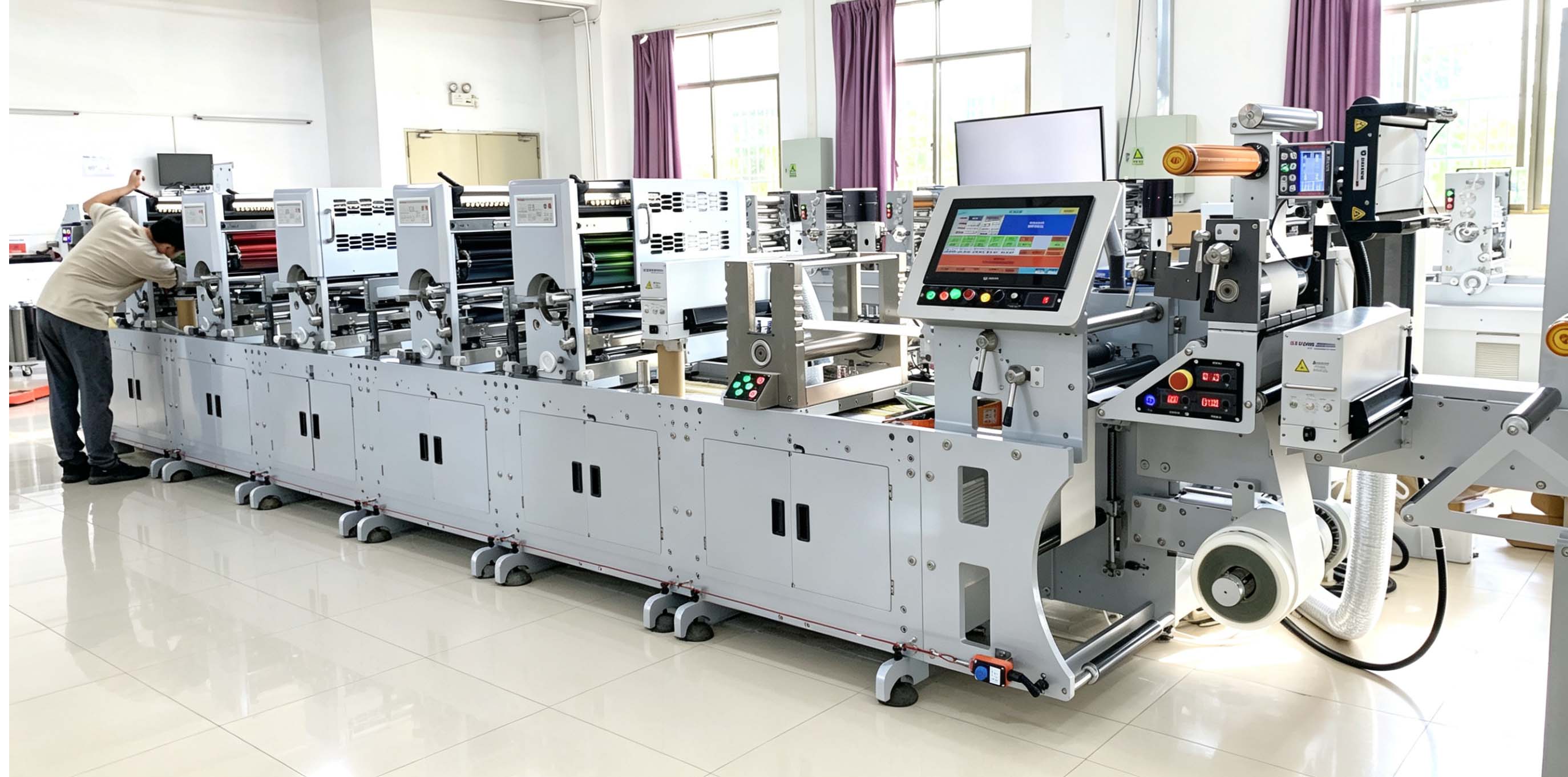
A Caisheng high-speed intermittent and full-rotary label press during installation and commissioning — the dual-mode platform that bridges 60 m/min intermittent and 158 m/min full-rotary operation.
A Label Market That Splits Into Two Order Types
The global label printing machines market was valued at USD 8.58 billion in 2025 and is projected to reach USD 14.36 billion by 2034, according to The Insight Partners. Flexographic printing remains the most commonly used process for labels, valued at approximately USD 13.3 billion in terms of output value in 2024, according to Smithers.
Market volume, however, does not describe what a label printing machine is actually asked to do. The same printing house may handle a promotional sticker order whose artwork changes three times in one week and a beverage label programme that repeats for months without a change. Run length, changeover frequency and finishing steps decide which press architecture is economical — not the technology label on its own.
The Core Problem: Speed and Changeover Pull in Opposite Directions
An intermittent press indexes the web for every impression: the web advances, stops, prints, then advances again. That cycle keeps tooling relatively simple and makes short runs and frequent job changes practical. A full-rotary press keeps the web moving continuously, so the indexing cycle disappears from the production time budget. That mechanical difference is the structural reason full-rotary platforms reach far higher speeds than intermittent ones.
Buyers experience this as a capacity-utilisation trade-off. Specifying maximum speed for work that changes every few thousand labels can leave capacity idle. Specifying a short-run platform for a continuous label programme can cap output below what the order book requires. The comparison below therefore treats the two architectures as scenario tools rather than as a ranking.
Two Caisheng Reference Configurations
Full-rotary flexo: CS-Q370F-6C
The CS-Q370F-6C is a Full rotary flexographic printing machine — a flexo label press — in Caisheng's lineup, listed at a maximum printing speed of 150 m/min. Its maximum full-rotary printing area is 370 mm × 200 mm or 370 mm × 600 mm, covering both short-repeat and long-repeat label formats. The machine measures 7.5 m (L) × 1.5 m (W) × 1.7 m (H), weighs 7 t, and its main machine gross power is 25 kW excluding UV dryer power. The same flexo platform is offered with a larger station count as the CS-370F-8C full rotation flexo press, listed at 150 m/min, 30 kW main machine gross power excluding UV dryers, 9.1 m × 1.5 m × 1.7 m and 8.6 t.
Intermittent letterpress: CS-320-6C
The CS-320-6C is an intermittent letterpress label printing machine — also described as a semi-rotary label printing machine — with a listed web width of 30–320 mm, a maximum intermittent printing area of 320 mm × 300 mm, and a full-rotary printing area listed at 320 mm × 326 mm. Its listed maximum printing speed is 40 m/min. The machine measures 8.4 m × 1.5 m × 2 m, weighs 6.2 t, and its main machine gross power is 27 kW including UV dryer power. The same intermittent architecture continues down the range: the CS-300-6C rotation label machine lists a 30–300 mm web width, a 280 mm × 300 mm intermittent printing area and 40 m/min, while the CS-220-4C intermittent label press lists a 30–240 mm web width and 40 m/min.
The dual-mode middle ground
Between those two extremes sit platforms that run both modes on one frame. The CS-JQ350G-6C high-speed label printing machine and the CS-JQ350-7C semi-rotary and full-rotary label press machine list intermittent speeds up to 60 m/min and full-rotary speeds up to 158 m/min. The CS-JQ350G-6C lists a maximum full-rotary printing area of 350 mm × 419 mm, 22 kW main machine power, 7.8 kW UV dryer power, 7.8 m × 1.5 m × 1.9 m and 10 t; the CS-JQ350-7C lists 24.5 kW main machine power, 9.1 kW UV dryer power, 8.7 m × 1.5 m × 1.9 m and 10.8 t.
| Listed parameter | CS-Q370F-6C (full-rotary flexo) | CS-320-6C (intermittent letterpress) |
|---|---|---|
| Machine type as listed | Full rotary flexographic printing machine (flexo label printing machine) | Intermittent letterpress label printing machine |
| Maximum printing speed | 150 m/min | 40 m/min |
| Maximum printing area, full rotary | 370 mm × 200 mm; 370 mm × 600 mm | 320 mm × 326 mm |
| Maximum printing area, intermittent | Not listed for this configuration | 320 mm × 300 mm |
| Web width | Not listed for this configuration | 30–320 mm |
| Main machine gross power | 25 kW (excluding UV dryer power) | 27 kW (including UV dryer power) |
| Machine size (L × W × H) | 7.5 m × 1.5 m × 1.7 m | 8.4 m × 1.5 m × 2 m |
| Machine weight | 7 t | 6.2 t |
Table 1 — Two reference configurations from the Caisheng range. All figures are as listed in the manufacturer's product data.
Technical Explanation: What Produces the Speed Gap
The 150 m/min and 40 m/min figures are outcomes of machine motion rather than of positioning. In intermittent mode the web must decelerate, stop and re-accelerate around each impression, so the achievable rate is bounded by the indexing cycle. In full-rotary mode the plate cylinders, die stations and web all rotate continuously, and speed is bounded instead by registration stability and drying capacity.
Registration discipline is what makes the higher speed usable. A Caisheng utility model patent (ZL 2022 2 1332174.4, granted 16 September 2022 and valid to 30 May 2032) covers the complete double-sided printing machine structure, the paper forward-reverse switching conveying mechanism and the registration correction assembly — the mechanical systems that hold print-to-print alignment while the web is moving continuously.
Drying is the second constraint. UV dryer power is listed separately from main machine power on several full-rotary configurations: 7.8 kW on the CS-JQ350G-6C, 9.1 kW on the CS-JQ350-7C, and 13.5 kW of LED UV on the CS-JQ350G-10C, whose main machine gross power is 34 kW. On the CS-320-6C the listed 27 kW figure already includes UV dryer power, a detail that matters when planning the electrical supply to the line.
Finishing integration is the third variable. Caisheng's customization options span color stamping, a glue-side printing frame, cold foil stamping, lamination, offline and online UV varnishing, flatbed die-cutting, rotary die-cutting, sheet cutting, slitting, a corona treater, a dust cleaner, a static eliminator, full-rotary screen printing, hot foil stamping and embossing. Die-cutting method couples directly with press mode: intermittent production pairs naturally with flatbed die-cutting, while continuous rotor production pairs with rotary die-cutting and, where required, with a high speed die-cutting machine configured in line. For film-based label work, a high-speed corona oil integrated machine can be added at the same integration point.
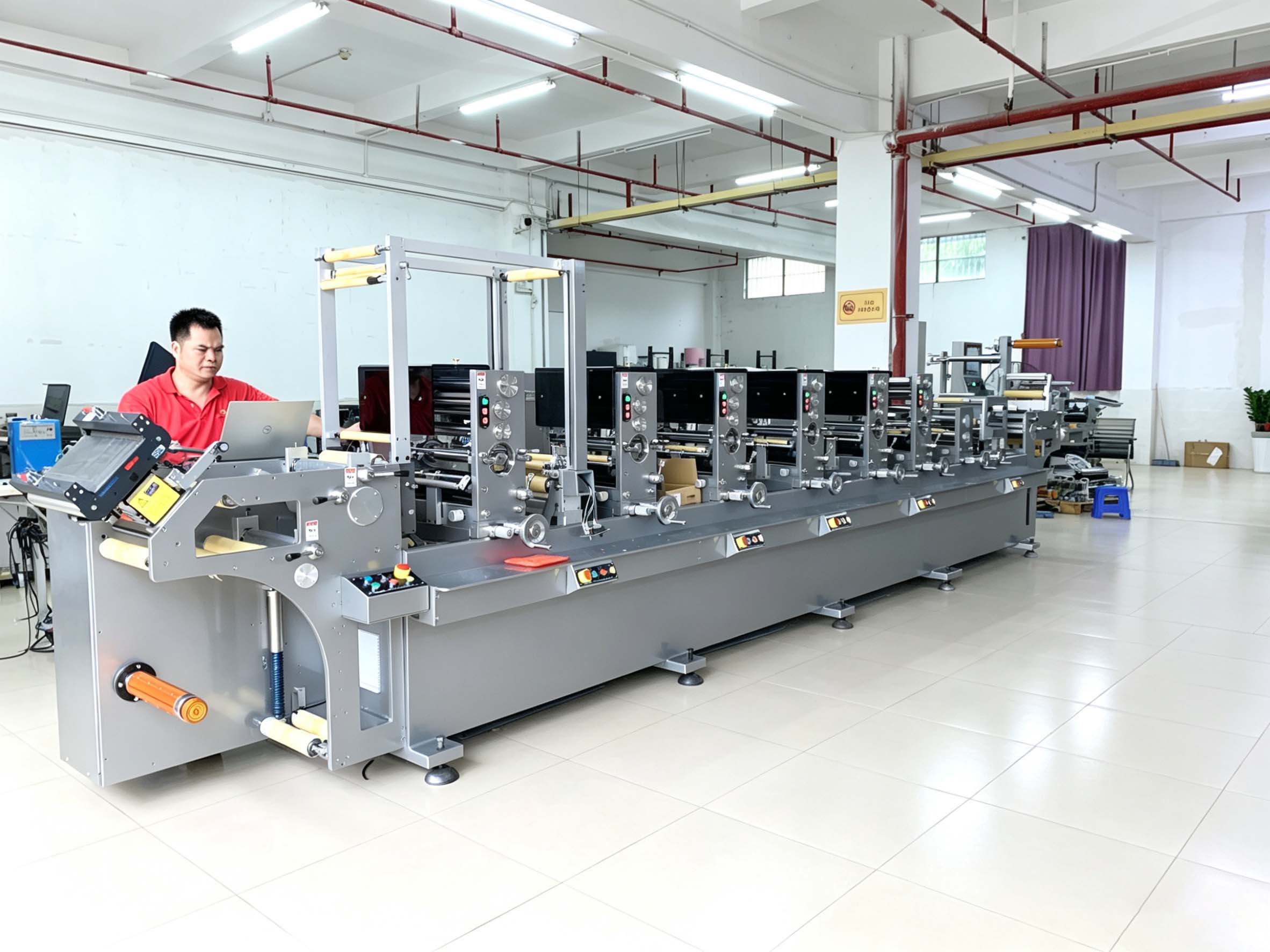
A rotary label press configured with glue-side printing, rotary die-cutting and flatbed die-cutting during installation and debugging — an example of how finishing stations are combined on one platform.
Scenario Fit: Matching the Press to the Label Job
| Production scenario | Reference configuration | Why it fits |
|---|---|---|
| Short-run self-adhesive stickers and promotional labels with frequent artwork changes | CS-320-6C intermittent letterpress label printing machine | Intermittent indexing suits frequent stops and restarts; 30–320 mm web width; 320 mm × 300 mm intermittent printing area; 40 m/min |
| Long, continuous high-volume label runs | CS-Q370F-6C full-rotary flexographic printing machine | Continuous rotary motion at 150 m/min; full-rotary printing area of 370 mm × 200 mm or 370 mm × 600 mm |
| Mixed portfolio needing short-run flexibility and full-rotary throughput on one frame | CS-JQ350G-6C or CS-JQ350-7C | Intermittent up to 60 m/min; full rotary up to 158 m/min |
| Wide-format flexo work up to 360 mm × 419 mm | CS-J380F-4C or CS-J380F-7C flexographic press | Flexo platform listed at 60 m/min, with 25 kW and 35 kW main machine power including UV dryers |
| Higher station-count flexo production | CS-370F-8C full rotation flexo press | 150 m/min; 30 kW excluding UV dryer power; 8.6 t |
Table 2 — Scenario fit across the Caisheng label press range.
The table is deliberately organised by production scenario rather than by technology hierarchy. A press running at 150 m/min only creates value when the order book can feed it continuously; a press running at 40 m/min with fast changeovers only creates value when the order mix is genuinely short-run. The dual-mode platforms exist precisely because many converters carry both order types and cannot dedicate a separate machine to each.
Application Notes: Self-Adhesive Stickers and High-Speed Label Runs
Self-adhesive label work is where format and changeover frequency dominate. The CS-300-5C self-adhesive label press lists a 30–300 mm web width, a 280 mm × 300 mm intermittent printing area, 40 m/min, 18.8 kW main machine power and 6 kW UV dryer power. At the compact end, the CS-220-5C stickers printing machine lists a 30–240 mm web width, a 220 mm × 200 mm intermittent printing area, 40 m/min and 3.6 t. These smaller formats exist because narrower webs reduce material waste on short sticker runs.
High-speed label runs shift the priority to throughput per hour. On the flexo side, the CS-Q370F-6C and CS-370F-8C are listed at 150 m/min, and the CS-J380F-4C and CS-J380F-7C flexographic presses at 60 m/min with printing areas of 360 mm × 419 mm. On the hybrid side, the CS-JQ350G-6C, CS-JQ350-7C and CS-JQ350G-10C reach 158 m/min in full-rotary mode. The repeat length per revolution also differs: a 370 mm × 600 mm rotary format supports a larger label per revolution than a 320 mm × 300 mm intermittent format, which changes how many impressions a given volume requires.
Packaging labels that need surface effects or converting steps in line — varnishing, lamination, cold or hot foil stamping, full-rotary screen printing, slitting — are usually specified together with the press rather than added later, because each added station changes the electrical load, the line length and the material path.
Market Trend Analysis: Where Label Capacity Is Growing
Grand View Research estimated the global flexographic printing machine market at USD 17.57 billion in 2024, with growth at a CAGR of 9.7% through 2030. Data Bridge Market Research placed Asia-Pacific at a 41.8% revenue share of the label printing machines market in 2025. Spherical Insights projected the narrow web label printing machines segment to grow from USD 1.43 billion in 2024 to USD 3.21 billion by 2035.
Two structural observations follow from those figures. First, because flexo remains the most commonly used process for labels by output value (Smithers), full-rotary flexo capacity is the mainstream benchmark against which label shops are compared, and intermittent platforms are purchased for the long tail of short and specialised runs rather than as a substitute for flexo. Second, capacity growth is concentrated in Asia-Pacific while the established platform builders listed in market analyses — Bobst (Switzerland), Mark Andy (USA), Gallus/Heidelberg (Germany) and Nilpeter (Denmark), per Future Market Insights — remain largely European and North American. That combination keeps pressure on specification transparency: buyers comparing machines across regions are comparing speed tiers, format envelopes, finishing integration and documentation, not brand names alone.
Comparison with Traditional Alternatives, and the Limits Buyers Should Check
Letterpress and flexo are both relief printing processes; the difference in practice is how much speed each architecture can deliver and how finishing is attached to it. A neutral comparison has to state the boundaries as clearly as the capabilities.
- Speed ceiling by tier. Intermittent platforms in the Caisheng range are listed at 40 m/min (CS-320-6C, CS-300-6C, CS-300-5C, CS-220-4C, CS-220-5C). The flexo CS-J380F-4C and CS-J380F-7C are listed at 60 m/min; the CS-Q370F-6C and CS-370F-8C at 150 m/min; and the CS-JQ350G-6C, CS-JQ350-7C and CS-JQ350G-10C at 158 m/min in full-rotary mode. Any job whose volume exceeds the intermittent ceiling effectively requires the higher tier.
- Tooling logic differs in kind. Continuous rotary production requires rotary tooling matched to the repeat length, while intermittent production pairs more naturally with flatbed die-cutting. Tooling cost and changeover behaviour therefore differ between the two modes, and the choice cannot be reduced to a price-per-machine comparison.
- Power and floor space. The largest listed configuration, the CS-JQ350G-10C, measures 12 m × 1.5 m × 2 m, weighs 14 t and draws 34 kW on the main machine plus 13.5 kW of LED UV. The CS-320-6C, by contrast, measures 8.4 m × 1.5 m × 2 m, weighs 6.2 t and draws 27 kW including UV dryers. Floor, power and extraction capacity decide which configurations are physically installable before any performance comparison begins.
- Certification scope is model-specific. Caisheng's CE Machinery Directive Attestation of Conformity M.2025.206.C124100, issued by UDEM Uluslararasi Belgelendirme Denetim Egitim Merkezi San. ve Tic. A.S., lists the scope CAISHENG // CS-300, CS-220, CS-350, citing EN ISO 12100:2010 and EN 60204-1:2018 for the EU market. Models outside that list require separate confirmation of the applicable conformity documentation for the destination market. That is a real boundary, not a technicality: machinery placed on the EU market must comply with Machinery Directive 2006/42/EC and carry CE marking, with safety signs following EN ISO 7010, and safety requirements for graphic technology equipment, including label presses, are governed internationally by ISO 12643-2:2023.
- Supply envelope. The listed lead time is 45–60 days with a monthly production capacity of 18 units. Multi-machine projects should therefore be phased against production planning rather than assumed to arrive simultaneously.
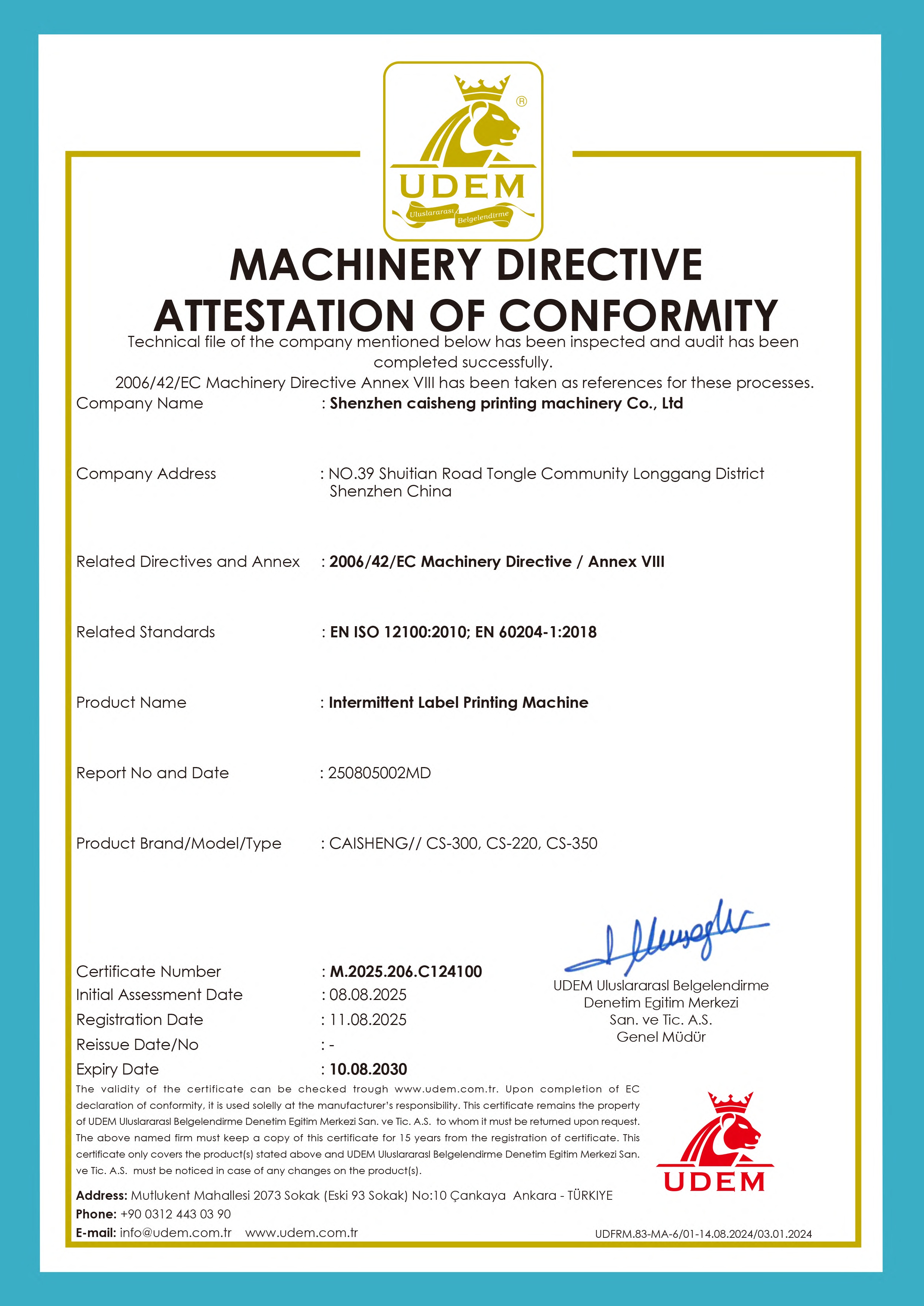
CE Machinery Directive Attestation of Conformity M.2025.206.C124100 — the listed scope covers the CS-300, CS-220 and CS-350 series, so other models should be verified separately.
Procurement Framework: Decision Rules for Packaging Printers
- Start from run length and changeover count, not from a preferred technology. Calculate the average run length in metres and the number of job changes per week before comparing machine speeds.
- Fix the format envelope. Web width and maximum printing area set the substrate range and the largest label per revolution. Compare 30–320 mm (CS-320-6C), 30–300 mm (CS-300-6C) and 370 mm × 600 mm rotary formats (CS-Q370F-6C) against the actual job mix.
- Decide die-cutting and finishing early. Flatbed versus rotary die-cutting, varnishing, lamination, foil stamping and screen printing change the line length, the number of stations and the electrical load.
- Verify site readiness. Match machine size, weight and total connected power — including separately listed UV or LED UV dryer power — against available floor space and supply capacity.
- Confirm documentation for the specific model and market, rather than extrapolating from another model in the same range.
- Agree commercial terms in writing. The listed purchasing terms are a minimum order quantity of 1 unit, delivery terms FOB, acceptance criteria of pre-shipment test, and payment terms of 30/70. Production is supported by 100% testing, ODM production services, remote support and a one-year warranty on major components.
Deployment Evidence from Caisheng Installations
A renowned Asian trademark design and printing company in Taiwan deployed a Caisheng label printing machine for high-quality label print production. The project was completed within two years, and the reported highlights were superior printing precision, stable production performance and flexible process expansion capabilities; the installation comprised one unit.
In a second case, the CS-300 series label printing machine is used for label printing production by a global provider of commercial printing, packaging and marketing communication solutions. Over a three-year period the reported highlights were stable registration accuracy, excellent print quality and reliable equipment performance, with the customer noting improved production efficiency and product quality after the equipment entered production. Both cases illustrate the same point made throughout this article: the value of a press is measured by how well it holds quality over time in a specific production profile, not by a single headline speed figure.
Future Outlook
If the flexographic printing machine market grows at the projected 9.7% CAGR through 2030, and the narrow web label printing machines segment moves from USD 1.43 billion in 2024 toward USD 3.21 billion by 2035, the pressure on converters will fall on utilisation rather than on acquisition alone. Machines that can switch between intermittent and full-rotary modes, or that carry more finishing stations in line, address utilisation directly by keeping one frame productive across both order types.
Service and diagnostics are moving in the same direction. A Caisheng invention patent (ZL 2022 1 0411353.5, granted 12 July 2022 and valid to 18 April 2042) covers a method, system and medium for remote control of printing equipment based on big data, including remote data collection from printing equipment, cloud computing analysis, remote start-stop and parameter adjustment, and online fault diagnosis. For multi-site label printers, that class of capability shifts part of the response time from travel to remote intervention — although it complements rather than replaces on-site service, which remains covered by remote support and a one-year warranty on major components for export markets including Southeast Asia, the European Union, the Middle East and the United States.
The manufacturing context behind these configurations is Shenzhen Caisheng Printing Machinery Co., Ltd., established in 2011, operating a 6,000 m² facility with 65 employees, an annual output of 200 units, an R&D team of 8 engineers, and an export ratio of 50%. Those figures describe a mid-sized specialist rather than a global platform conglomerate, which is relevant to buyers weighing customisation depth against the broader service networks of larger suppliers.
FAQ
1. What is the difference between a full-rotary flexographic press and an intermittent letterpress label press?
A full-rotary flexographic press keeps the web moving continuously through plate cylinders and die stations, which is why the CS-Q370F-6C is listed at 150 m/min with a full-rotary printing area of 370 mm × 200 mm or 370 mm × 600 mm. An intermittent letterpress press indexes the web for each impression — advance, stop, print, advance — which is why the CS-320-6C is listed at 40 m/min with a 320 mm × 300 mm intermittent printing area. The mechanical difference determines achievable speed; the format difference determines what can be printed per revolution.
2. Which configuration fits short-run self-adhesive sticker production?
Intermittent letterpress platforms are the usual fit. The CS-320-6C lists a 30–320 mm web width, a 320 mm × 300 mm intermittent printing area and 40 m/min. Narrower work can use the CS-300-5C self-adhesive label press (30–300 mm web width, 280 mm × 300 mm intermittent printing area, 18.8 kW main machine power, 6 kW UV dryer power) or the CS-220-5C stickers printing machine (30–240 mm web width, 220 mm × 200 mm intermittent printing area, 3.6 t).
3. Which configuration fits long, high-speed label runs?
Full-rotary platforms. The CS-Q370F-6C and CS-370F-8C are listed at 150 m/min, with 25 kW and 30 kW main machine power respectively, excluding UV dryer power. The CS-JQ350G-6C, CS-JQ350-7C and CS-JQ350G-10C reach 158 m/min in full-rotary mode, with the CS-JQ350G-6C listed at 350 mm × 419 mm maximum full-rotary printing area and the CS-JQ350G-10C at 34 kW main machine power plus 13.5 kW of LED UV drying.
4. What certification details should a buyer verify for a label printing machine?
Caisheng's CE documentation includes a Machinery Directive Attestation of Conformity numbered M.2025.206.C124100, issued by UDEM Uluslararasi Belgelendirme Denetim Egitim Merkezi San. ve Tic. A.S., valid from 8 November 2025 to 8 October 2030 for the EU market, citing EN ISO 12100:2010 and EN 60204-1:2018, with a listed scope of CAISHENG // CS-300, CS-220, CS-350. Separately, safety requirements for graphic technology equipment including label presses are governed internationally by ISO 12643-2:2023, and machinery placed on the EU market must comply with Machinery Directive 2006/42/EC and carry CE marking, with safety signs following EN ISO 7010. A buyer specifying a model outside a certificate's listed scope should confirm the conformity documentation that applies to that specific configuration and destination market.
5. What are the standard purchasing terms and acceptance criteria?
The listed terms are a minimum order quantity of 1 unit, delivery terms FOB, acceptance criteria of pre-shipment test, and payment terms of 30/70. Manufacturing is supported by 100% testing and ODM production services, with a listed lead time of 45–60 days and a monthly capacity of 18 units.
6. How is equipment supported after installation?
Listed after-sales support consists of remote support and a one-year warranty on major components for export markets including Southeast Asia, the European Union, the Middle East and the United States. A patented remote-control capability (ZL 2022 1 0411353.5) covers remote data collection, cloud-based analysis, remote start-stop and parameter adjustment, and online fault diagnosis, which allows some diagnostic work to be handled without an on-site visit.
Third-party data referenced in this article: The Insight Partners (label printing machines market size); Smithers (label process output value); Grand View Research (flexographic printing machine market size and CAGR); Data Bridge Market Research (regional revenue share); Spherical Insights (narrow web label printing machines market); Future Market Insights (competitor landscape); ISO/TC 130 (ISO 12643-2:2023); European Commission (Machinery Directive 2006/42/EC and CE marking).
Manufacturer reference: Shenzhen Caisheng Printing Machinery Co., Ltd. — caishengmachinery.com. Downloadable product brochure: https://cdn.socialarks.com/sbsp/24962/common/2026/0626/%E5%AE%A3%E4%BC%A0%E5%86%8C.pdf