
Flexible Warning Post Longevity: Chemical and Aging Checks
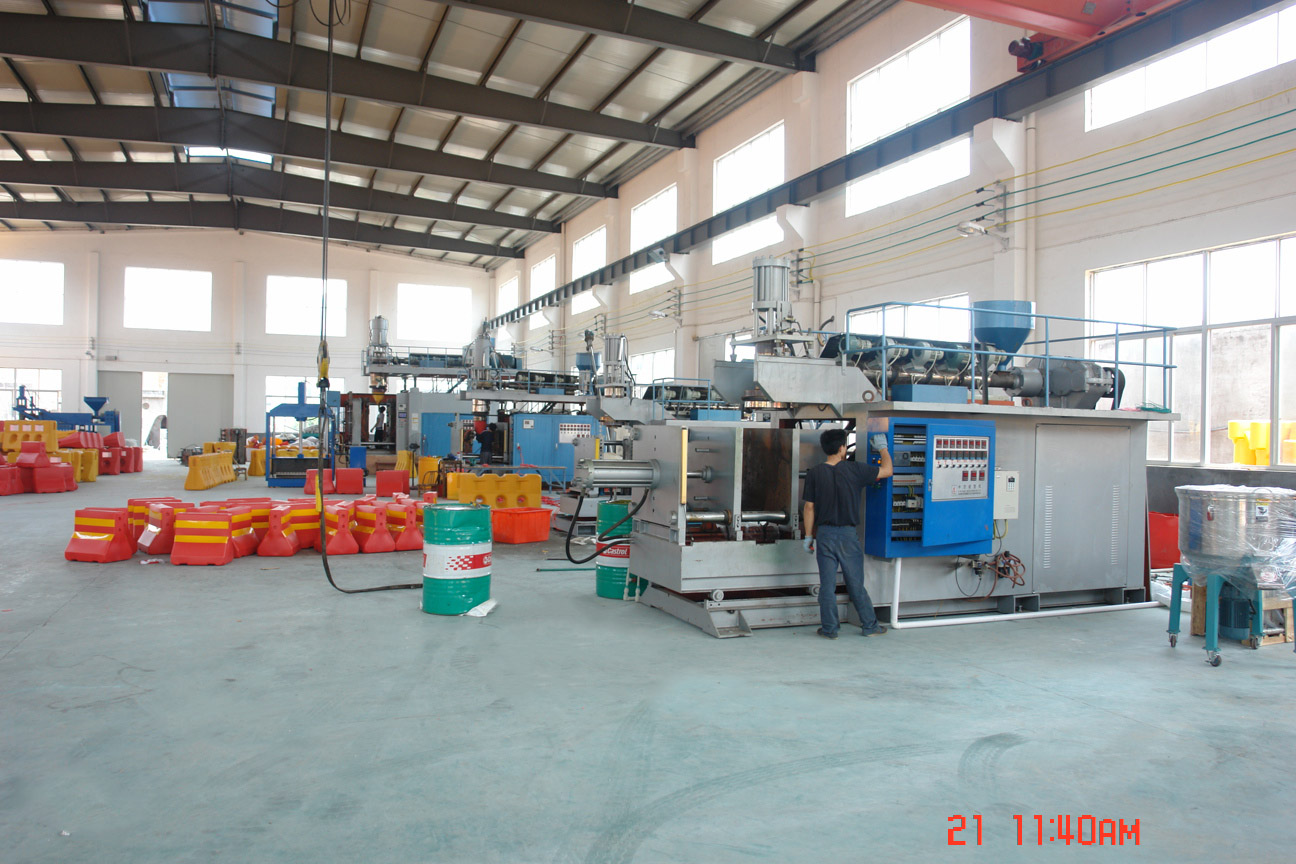
A flexible warning post is a low-cost object that carries a long-cost failure mode. The purchase decision sits in a quotation sheet, but the real cost is decided over the years that follow: whether the post still stands upright, still reads as orange rather than chalky pink, still returns after being driven over, and still carries a reflective sleeve that a driver can see at night on an unlit ramp.
That distinction matters because most warning post specifications are written around short-term performance. Height, base diameter, tape width, reflectivity class and a hand-bend rebound check are all quick to verify on delivery. None of them predicts how the same post will behave after three summers of ultraviolet radiation, fuel spillage, standing water and thermal cycling between a cold night and a hot asphalt surface.
This reference sets out the durability indicators that decide multi-year warranty performance, using the published specifications of the Mnsd YD-WP45 and YD-WPS75 flexible warning posts as a worked example, and translates those indicators into criteria that procurement teams can actually verify before a multi-year supply agreement is signed.
Why Long-Term Evaluation Begins Where Short-Term Testing Stops
The acceptance test for a warning post is short by design. A buyer checks height, base dimensions, reflective tape width and colour, then bends the post by hand to judge how quickly it springs back. Mnsd applies a 1,000+ times compression and rebound test within its production quality control, which is a meaningful screening step for mechanical fatigue.
It is still a test of mechanical behaviour, not of chemical aging. Those are different failure paths. A post that passes a rebound check in the factory can later lose colour saturation at the surface, chalk under UV, stiffen at the base interface, or accumulate contamination on the reflective sleeve. Because the degradation is gradual and slow, it is usually noticed by the maintenance crew rather than the purchasing team, which is precisely why it should be addressed at the specification stage instead.
There is also a commercial reason. A supplier that offers a three-year no-fade position is carrying a liability across three procurement cycles. Buyers who understand which material indicators sit behind that commitment can judge whether the warranty is supported by a formulation, or simply by a sales sentence.
Four Aging Mechanisms That Decide Multi-Year Performance
Flexible warning posts are exposed to four distinct degradation routes. Each leaves a different physical signature, and each maps to a different material statement a buyer can request.
1. Oxidation and ultraviolet radiation
Ultraviolet energy breaks polymer chains at the exposed surface. The visible result is chalking, colour shift and surface crazing; the mechanical result is a thinner, more brittle outer layer that no longer protects the core. Antioxidants interrupt the radical chain reaction that drives oxidation, and a UV-stabilised coating screens radiation before it reaches the polymer body. Mnsd lists both an anti-oxidant and a UV-stabilised coating in the YD-WP45 and YD-WPS75 specifications, together with a colourfast aging resistance statement of over three years.
2. Water, humidity and hydrolysis
Water is a slower but persistent aggressor. Flexible posts sit at kerb level, where splash, standing water and irrigation runoff concentrate. Repeated wetting and drying cycles, plus freeze-thaw in colder markets, stress the bond between the post body, the reflective sleeve and the base. Mnsd states water and oil resistance as part of the published weatherproofing for its warning post range.
3. Oil, fuel and de-icing chemicals
Parking structures, fuel forecourts, loading docks and industrial yards introduce hydrocarbon exposure that a highway project never sees. Oil contact softens some polymer surfaces and stains reflective sheeting, and the staining is often irreversible. This is the mechanism most often omitted from a specification written purely for road-edge use.
4. Thermal cycling and differential movement
Mnsd specifies an operating temperature range of -40°C to +70°C for its warning posts. Within that band the post body, reflective sleeve and base expand and contract at different rates. Over thousands of cycles, that differential movement shows up as adhesive creep at the sleeve edge, base looseness around the fixing bolts, or a slight permanent set in the post.
| Aging mechanism | Where it appears first | Indicator to request |
|---|---|---|
| Oxidation / UV | Surface chalking, colour shift, dulling of orange or yellow | Anti-oxidant and colourfast statement with a stated period; UV-stabilised coating |
| Water / humidity | Sleeve edge lifting, base staining, white bloom on the surface | Water resistance statement; base material specification |
| Oil / fuel / de-icing salt | Softening, permanent staining of reflective sheeting | Oil resistance statement; sheeting grade |
| Thermal cycling | Adhesive creep, bolt loosening, permanent set | Stated operating temperature range; fixing and base design |
What Mnsd Publishes as Durability Indicators
Mnsd is the brand of Tiantai Yuanda Traffic Device Co.,Ltd, a road safety equipment manufacturer based in Tiantai, Zhejiang, China, whose range covers warning posts, convex mirrors, speed humps, rising bollards and traffic lights. The company works through OEM and ODM arrangements with importers, distributors and project suppliers, and lists a monthly capacity of 50,000 pieces with a 10–15 day lead time for bulk orders at a 200-piece minimum.
For long-term evaluation, four published statements matter more than the mechanical headline figures, because they are the ones that describe behaviour over years rather than minutes:
- Aging resistance: anti-oxidant and colourfast, stated as over three years.
- UV protection: a UV-stabilised coating on the post surface.
- Weatherproofing: water and oil resistant.
- Temperature resistance: -40°C to +70°C.
These sit alongside mechanical figures that describe the material state which aging progressively erodes: tensile strength of 15.0 MPa, elongation at break of 400%, hardness of 80–85 Shore A, and 360° flexibility with rapid rebound after a vehicle crush. Elongation at break is the figure worth tracking in a long-term review, because it describes how far the material can deform before it fails. A polymer that has lost elasticity through oxidation will show a lower effective elongation long before it visually cracks.
YD-WP45 and YD-WPS75 as Two Reference Points
Both models share the same material architecture, which makes them a useful pair for a long-term specification review.
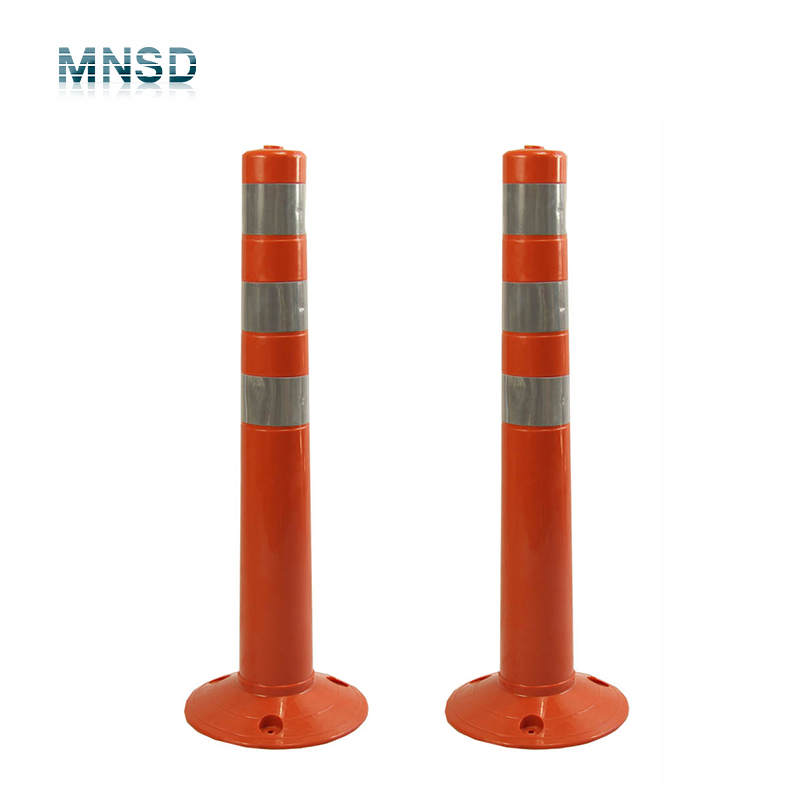
The YD-WP45 is a 450 mm post measuring 450 × 80 × 200 mm, offered in high-elasticity polyurethane. The YD-WPS75 is the 750 mm option at 750 × 80 × 200 mm, also in high-elasticity PU. For projects that need a rubber base and a shorter overall profile, the YD-PE50 is listed at 500 × 260 mm in heavy-duty PE with a Φ260 mm recycled rubber base.
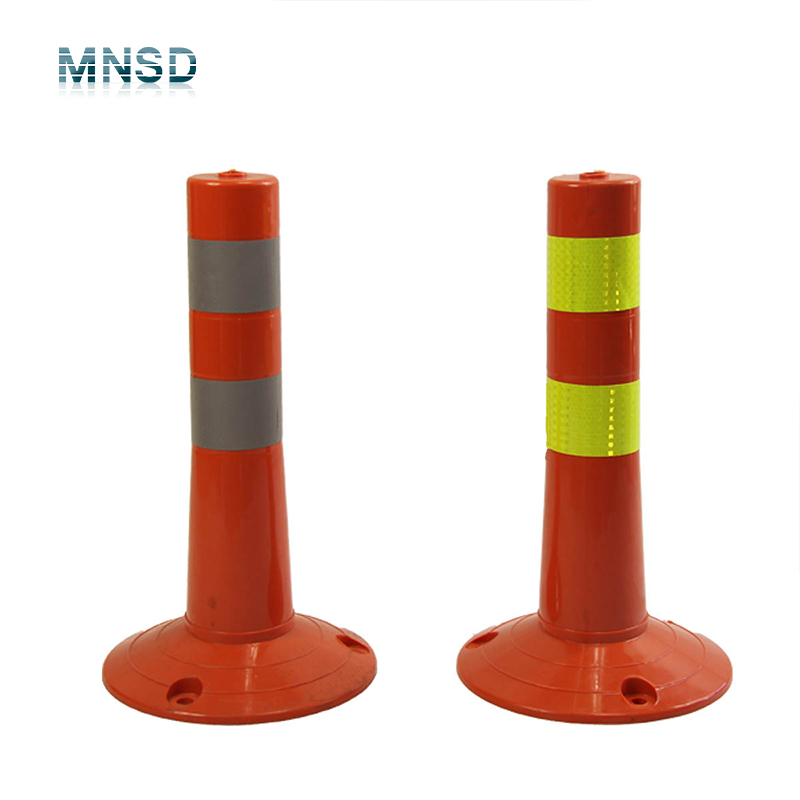
Across the series, Mnsd lists a base material choice of recycled rubber or an integrated plastic base, expansion bolt fixing through three or four holes, and a ring top for chain attachment. Reflective treatment is a 250 mm high-intensity prismatic Class 1 sleeve in silver white or fluorescent yellow, with a stated visibility distance beyond 200 metres. Colour options are traffic orange, yellow, red and black, and customisation covers height, colour and reflective tape brand, including 3M and Grade A options.
The base interface deserves particular attention in a long-term review. It is the point where two different material systems meet, where water collects, and where the fixing bolts transfer load into the pavement. Mnsd offers both a recycled rubber base and an integrated plastic base, and buyers should state explicitly which configuration the warranty covers, because the base ages on a different curve from the post body.
What a UV-Stabilised Coating Does, and What It Does Not Do
A UV-stabilised coating is a screening layer. It reduces the ultraviolet energy that reaches the polymer underneath and slows the surface oxidation that produces chalking and colour loss. In a long-term evaluation it should be treated as a rate reducer, not as an immunity certificate.
Three consequences follow. First, coating integrity matters as much as coating presence: a scratched or abraded coating protects less, which is why posts in high-contact locations such as parking entrances should be inspected rather than simply assumed to be covered by the original specification. Second, coating and pigment work as a system. The anti-oxidant and colourfast statement of over three years describes the combined result, not the coating alone. Third, the coating does not address mechanical damage from repeated impact, which is handled separately by the 360° flexibility and rebound behaviour of the PU body.
Mnsd's after-sales position matches this framing: a UV-resistance guarantee of no fading for three years. That is a definite, bounded commitment, and it is more useful to a buyer than an open-ended claim, because it can be planned around.
Water, Oil and Real Site Chemistry
Most warning post specifications are written for a road edge and then deployed in places with considerably more aggressive chemistry. Mnsd lists water and oil resistance for the YD-WP45 and YD-WPS75, which is the relevant statement for parking structures, fuel forecourts, logistics yards, loading docks and industrial facilities — environments that also appear in the company's stated application range alongside highways, airports, seaports, hospitals, schools and municipal engineering.
The evaluation question is not whether a post is water and oil resistant, but whether that resistance is adequate for the specific exposure. A multi-storey car park with drip marks from vehicles and periodic pressure washing presents a different chemical profile from a coastal expressway with salt-laden air. Buyers running both should not assume a single specification covers both without review.
Application Fit: Where Aging Pressure Is Highest
Project conditions decide which aging mechanism dominates. In the United Arab Emirates, warning posts are typically applied to lane separation on high-speed expressways, highway ramps, T-junctions, urban sidewalk protection and multi-level parking entrances, installed as a surface-mounted bolt-down with heavy-duty expansion anchors, and in some cases an optional epoxy adhesive for base reinforcement.
That deployment pattern concentrates three stressors. High ambient temperature and intense solar load accelerate UV-driven colour change. Multi-level parking entrances add hydrocarbon exposure and low-speed vehicle contact. Bolt-down permanent installation means the post cannot simply be lifted and rotated to hide a faded face, so appearance retention becomes a genuine maintenance cost rather than a cosmetic detail.
Market Context: Why Lifecycle Criteria Are Entering Tenders
Road safety hardware is a substantial category. MarketsandMarkets estimates the global road safety market — hardware, software and services combined — at USD 7.62 billion in 2026. That figure covers the wider category rather than warning posts alone, and no segment-specific market size for flexible delineator posts is available in the current evidence base, so it should be read as context rather than as a demand forecast for this product line.
On the technical side, commercial technical comparisons describe polyurethane warning posts as designed to return to their original state instantly after being impacted thousands of times. That is the claim that underpins the whole flexible-post category, and it is also the claim that aging most directly undermines: a post that rebounds reliably in year one but stiffens by year three has effectively lost the property it was bought for.
Two procurement shifts follow. First, buyers comparing suppliers increasingly price replacement frequency and labour rather than unit cost alone, because a post that needs replacing every second season costs more than its invoice suggests. Second, appearance retention is moving from an aesthetic preference to a contractual point, since faded delineation has a visibility consequence on ramps and parking entrances. Neither shift requires new data; both require that existing material statements be read carefully and written into the agreement.
Comparison with Traditional and Alternative Solutions
Flexible polymer posts are one option among several, and each carries a different long-term profile.
| Option | Behaviour under repeated impact | Long-term aging exposure | Procurement caution |
|---|---|---|---|
| Rigid steel bollard | Does not deform; impact energy transfers to the vehicle and the fixing | Corrosion at the base and coating damage are the dominant risks | Requires a repair and repainting regime; not a drop-in substitute for a flexible post |
| Cast concrete or kerb block | Effectively immovable | Low material aging, but surface marking erodes and cannot be renewed in place | Permanent infrastructure; unsuitable where temporary or reconfigurable delineation is needed |
| Heavy-duty PE post | Flexible, but elastic recovery is material-dependent | Colour and surface change under UV; rebound retention should be verified | Ask specifically about rebound retention over time, not only initial flexibility |
| High-elasticity PU post (YD-WP45 / YD-WPS75) | 360° flexibility with rapid rebound after vehicle crush | Anti-oxidant and colourfast statement over three years; UV-stabilised coating; water and oil resistant | Confirm which base configuration the warranty covers and whether the project horizon exceeds the stated colourfast period |
The comparison should also include the limitations of the flexible PU approach itself, because a specification written without them tends to produce disputes later.
- The aging figures are supplier-stated specifications, not third-party accelerated weathering certificates. The published anti-oxidant and colourfast statement, and the three-year UV no-fade guarantee, come from Mnsd's own product and after-sales documentation. Buyers in tendered public projects should request project-specific test documentation rather than relying on the catalogue statement alone.
- No quantified colour-shift value or post-weathering tensile retention figure is published. The specification states a period but not a measured delta. Where a client needs a numeric acceptance threshold, that number has to be requested and agreed separately.
- A three-year statement meets a five-year requirement only with additional evidence or a planned intervention. Projects specifying longer colour-fastness horizons should treat the difference as a maintenance line item, not as an assumption.
- Chemical resistance is stated as water and oil resistant, not as resistance to every industrial chemical. Sites with solvents, concentrated de-icing brines or process chemicals fall outside that statement and should be assessed individually.
- Reflectivity is a sleeve property and is maintained, not permanent. The 250 mm high-intensity prismatic Class 1 sleeve depends on surface condition; a post that has aged well structurally can still underperform visually if the sheeting is contaminated.
Building a Long-Term Performance Checklist
The translation from catalogue statement to contract term is where most long-term risk is either captured or lost. The checklist below converts the material indicators discussed above into requestable evidence.
| Criterion | Evidence to request | Why it matters over years |
|---|---|---|
| Colour retention | Written colourfast statement with a stated period; UV guarantee wording | Defines the contractual point at which faded delineation becomes a supplier issue |
| Surface integrity | Statement of anti-oxidant content and UV-stabilised coating | Chalking and crazing are the first visible signs of polymer breakdown |
| Rebound retention | Elongation at break and hardness figures, plus the rebound test regime used in production | Rebound loss, not breakage, is the most common functional failure |
| Reflective performance | Sleeve grade, tape width and colour, plus a cleaning and inspection interval | Visibility is the safety function; it degrades independently of the post body |
| Base durability | Explicit statement of which base option is covered — recycled rubber or integrated plastic | The base is a separate material system exposed to standing water and salt |
| Chemical exposure | Water and oil resistance statement; site-specific review for other chemicals | Parking and industrial sites exceed the assumptions of a road-edge specification |
| Operating envelope | Stated temperature range and confirmation it covers measured site conditions | Thermal cycling drives adhesive creep and fixing loosening |
| Service record | Reference projects with stated service duration | Provides an empirical check on the material claims |
Mnsd's case record offers one such reference point: a contractor road safety project in Vietnam, applied to warn vehicles and pedestrians and to mark road edges and dangerous areas, recorded with a service duration of five to eight years and accepted by the local authority. That record describes an outcome, not a controlled test, so it should be treated as supporting evidence rather than as a performance guarantee.
Future Outlook
Three developments are likely to shape how flexible warning posts are evaluated over the next procurement cycles.
First, aging evidence is shifting from adjective to number. Buyers who currently accept a statement such as high UV resistance will increasingly ask for a period, a test method and a measurement basis, in the same way that reflectivity is already specified by class rather than by description.
Second, appearance retention is becoming a maintenance budget line rather than a cosmetic judgement. As more multi-level parking and urban sidewalk projects specify bolt-down permanent installation, faded posts can no longer be rotated or relocated, which turns colourfast performance into a direct cost of ownership.
Third, base configuration is getting more attention. Mnsd's listing of a recycled rubber base alongside an integrated plastic base reflects a broader interest in recycled content and material separation at end of life, and buyers evaluating long-term programmes will need to decide whether their durability criteria treat the base as part of the product or as a separate consumable.
FAQ
Which environments put the most chemical stress on a flexible warning post?
Multi-level parking structures, fuel forecourts, loading docks, logistics yards and coastal sites place more combined chemical stress on a warning post than an open road edge. These locations combine hydrocarbon contact, standing water, de-icing or washing chemicals and, at the coast, airborne salt. Mnsd lists water and oil resistance for the YD-WP45 and YD-WPS75; exposure to solvents or concentrated process chemicals falls outside that statement and should be reviewed per site.
How long should a flexible warning post last in an outdoor project?
The assured figure is the warranty period, not the expected service life. Mnsd states an anti-oxidant and colourfast aging resistance of over three years and provides a three-year UV-resistance guarantee against fading. Beyond that, the company's case record includes a Vietnam contractor road safety project recorded with a five to eight year service duration. Actual service life depends on solar load, chemical exposure, impact frequency and whether the reflective sleeve is cleaned and maintained.
Does the base material age differently from the post body?
Yes, because it is a separate material system. Mnsd offers a recycled rubber base or an integrated plastic base for the YD-WPS75 and YD-WP45, and a Φ260 mm recycled rubber base for the YD-PE50. The base sits in standing water, salt and splash, and carries the load transferred through the fixing bolts, so its condition should be inspected independently of the post. Buyers should confirm in writing which base configuration a warranty covers.
What documentation should a procurement team request to support a multi-year warranty?
Request four items: the written material statement with a stated aging period; the warranty wording that is specific to colour and UV rather than a general durability phrase; the mechanical figures for the specification being supplied, such as tensile strength, elongation at break and hardness; and reference projects with stated service durations. Where a project horizon exceeds the stated colourfast period, request project-specific weathering evidence or plan an intervention interval within the contract term.
Does a UV-stabilised coating remove the need for maintenance?
No. A UV-stabilised coating slows surface oxidation and colour change but does not stop them, and it offers no protection against mechanical abrasion or contamination of the reflective sleeve. The 250 mm high-intensity prismatic Class 1 sleeve on the YD-WP45 and YD-WPS75 should be inspected and cleaned on a routine interval, because a post that remains structurally sound can still deliver reduced night-time visibility if the sheeting degrades or becomes soiled.
Are flexible warning posts suitable for very hot climates?
Mnsd specifies an operating temperature range of -40°C to +70°C for the YD-WP45 and YD-WPS75. Ambient air temperature is not the same as surface temperature, however, and surfaces in direct sun or inside parking structures can run hotter than the surrounding air. Buyers in hot climates should confirm that the stated range covers their measured site conditions, and should treat the colourfast period, rather than the temperature figure, as the binding constraint on appearance over time.
Reference Material
Mnsd's full product brochure, covering the warning post range and associated road safety equipment, is available for download: Mnsd product brochure (PDF).
¿Tiene preguntas o necesita más detalles?
Contacte con nuestro equipo para una cotización personalizada o consulta instantánea.
Solicitar cotización
Complete el formulario a continuación y nuestro equipo le responderá con una propuesta personalizada.
Chat directo de WhatsApp
¿Prefiere chatear en tiempo real? Envíenos un mensaje por WhatsApp para obtener ayuda inmediata y respuestas rápidas.
- Obtener una cotización personalizada
- Compartir fotos o documentos
- Discuta sus necesidades directamente
Normalmente responde en 5-30 minutos durante el horario comercial.