
Flexible Printed Circuit Technology: A 2026 Industry Reference
The flexible printed circuit (FPC) has evolved from a niche interconnect solution into a core enabling technology for compact, high-performance electronic devices. Flexible printed circuit boards, also called flex PCBs or flex circuit boards, provide the freedom to route electrical signals through curved or moving assemblies that rigid boards cannot accommodate. For industrial buyers and engineers, understanding the material base, fabrication options, and assembly capabilities behind flexible PCBs is increasingly important as applications move toward lighter, thinner, and more durable electronic systems.
From Niche to Mainstream: Why Flexible PCB Demand Is Growing
The global flexible printed circuit board market was estimated at USD 23.89 billion in 2024 and is projected to reach USD 50.90 billion by 2030, representing a compound annual growth rate of 13.7%, according to Grand View Research. Most of the current demand is concentrated in the Asia Pacific region, which held 76.8% of global market revenue in 2024. This geographical concentration reflects the broader electronics manufacturing ecosystem: China's PCB industry alone was expected to generate USD 120.8 billion in revenue in 2024, with exports accounting for roughly 16.5% of total revenue, according to IBISWorld.
One of the most prominent application segments is mobile phones, which accounted for 55.8% of global flexible PCB market value in 2024, based on data from TPCA and ITRI. At the same time, flexible circuits are moving into lighting, medical devices, automotive electronics, industrial control, and new energy systems. The combination of growing device complexity and the need for three-dimensional packaging has created a stronger case for flexible boards in designs where space, weight, or dynamic flexing matters.
Problem and Opportunity: Making Sense of Flexible PCB Options
For engineers and purchasing teams, the shift to flexible PCBs introduces a different set of decisions. Unlike conventional rigid PCBs, flexible boards require careful attention to substrate selection, minimum trace geometry, layer count, bend radius, and assembly handling. A board that performs well in a static bench test may fail in a folded or continuously moving application if the material and copper design are not specified correctly.
This same complexity creates an opportunity for manufacturers with in-house fabrication and assembly experience. A supplier that can move from bare flexible PCB fabrication to PCBA, including component placement, soldering, and testing, reduces the number of interfaces a buyer must manage. For small and medium-volume projects, that integration can shorten time-to-market and allow faster design iteration.
Flexible PCB Technology: Materials and Core Parameters
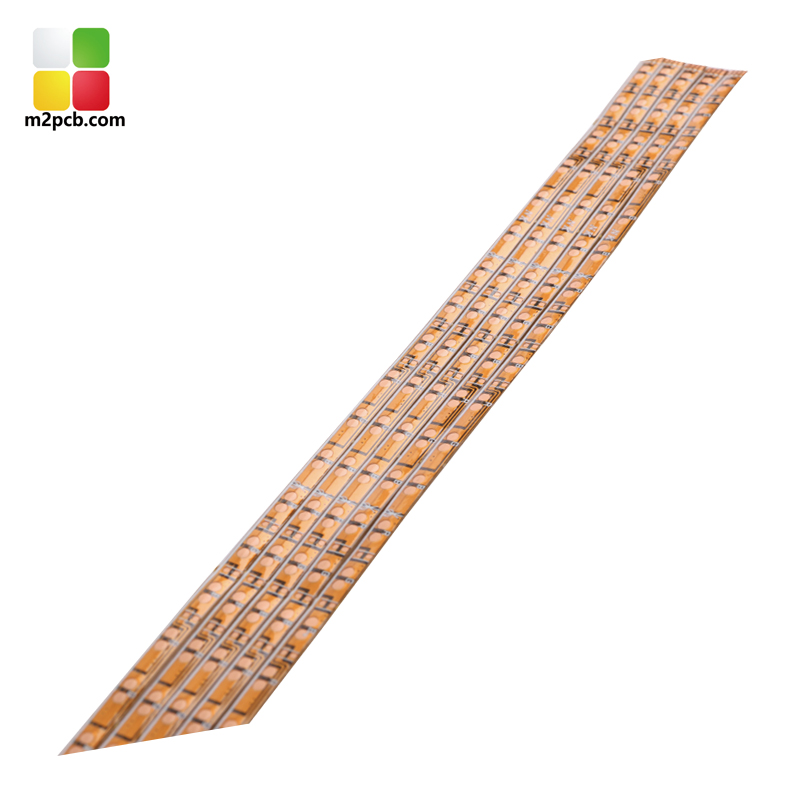
Flexible printed circuits are typically built on polyimide (PI) film, which withstands repeated bending and elevated temperatures. In M2PCB's product range, the Flexible LED PCB uses PI as the base material and can be supplied as a flexible LED circuit board or LED flexible light strip. The material choice is central to performance: polyimide offers flexibility and heat resistance that standard FR4 cannot provide.
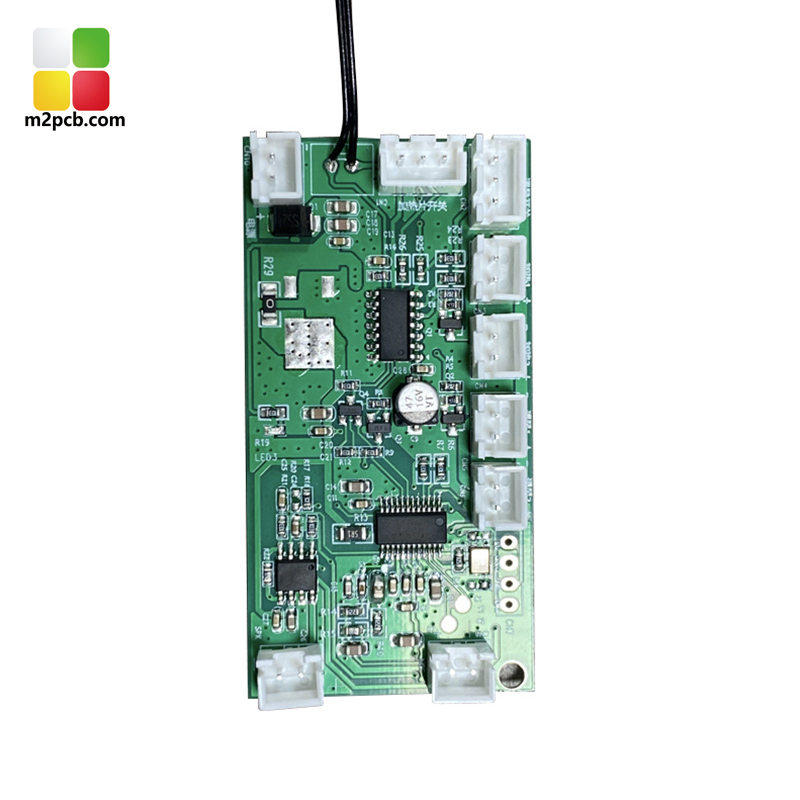
For assemblies, M2PCB's PCBA products use FR4, PI, and IMS depending on the application. The company produces flexible printed circuit boards from 1 to 14 layers, supporting both single-sided and double-sided assembly. Key design rules for its flexible LED PCB include a maximum width of 240 mm and a minimum line width of 0.05 mm. The minimum spacing capability is 3/3 mil, and testing is performed using flying probe or electrical test methods. The standard rigid PCB product line also supports impedance control, which is necessary for high-speed signal integrity.
From a manufacturing perspective, the process generally follows three steps: PCB fabrication, SMT assembly, and through-hole assembly. During PCB fabrication, design files are converted into physical boards through copper cladding, etching, drilling, and plating. SMT assembly uses automated pick-and-place machines with solder paste printing, component placement, and reflow soldering. Through-hole assembly is reserved for components that cannot be processed by pick-and-place machines and involves insertion, wave soldering, lead cutting, and cleaning. M2PCB's PCBA capability includes turnkey BOM parts options, X-ray testing, and program burning, which are especially relevant for populated flexible boards.
Manufacturer Profile: M2PCB as a Flexible PCB and PCBA Supplier
M2PCB is a manufacturer established in 2000 with a focus on flexible printed circuit boards and PCB assembly. The company operates an 8,000-square-meter manufacturing facility with approximately 200 employees, supported by 30 engineers in research and development. Its technical and management team has more than 10 years of industry experience.
The company positions itself as a production partner for 1 to 14-layer flexible circuits and PCBA. Its annual production capacity is 360,000 square meters of printed circuit boards. Export business accounts for approximately 70% of total sales, with major markets in Europe, North America, South America, and Australia.
From a buyer's perspective, this profile indicates a source capable of handling the full production chain rather than only supplying bare flexible PCBs. The availability of both flexible PCB fabrication and assembly services also helps align prototype requirements with volume production, provided the application fits the stated material and process capabilities.
Application Use Cases: Where Flexible Circuits Deliver Value
Flexible printed circuits are used across a wide range of industries. The application scenario data shared by M2PCB covers automotive electronics, industrial control, medical devices, lighting, and medical aesthetics. The same scenario appears in markets including Germany, the United Kingdom, Italy, the United States, Canada, France, India, South Africa, Brazil, South Korea, and others.
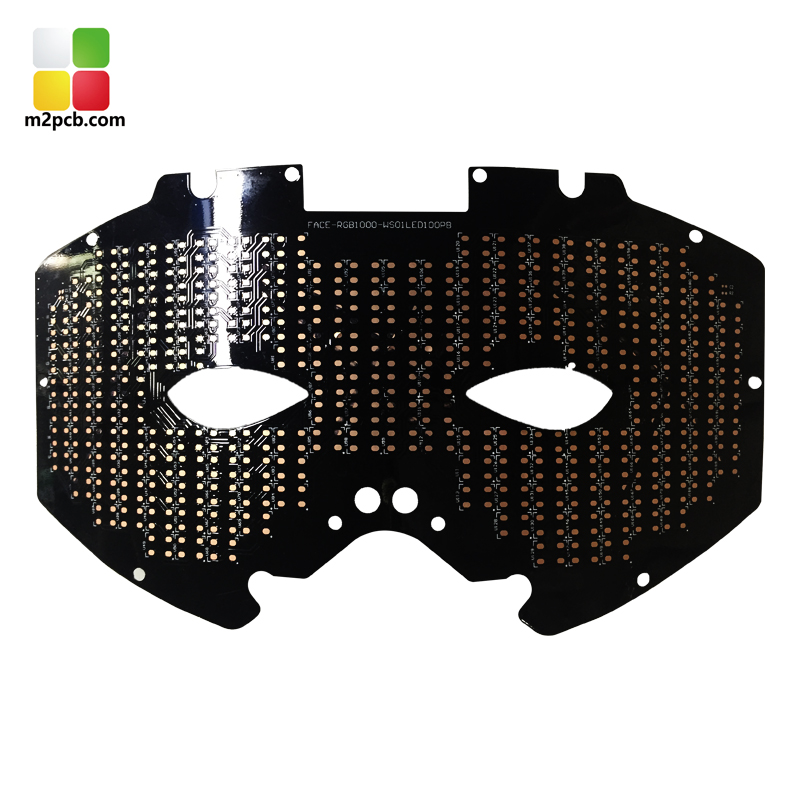
In lighting, the Flexible LED PCB is used as an LED flexible light strip and flexible soft light board. Medical and wellness applications include beauty eye device lamp boards, red light therapy belt circuit boards, and therapy lamp PCBs. On the assembly side, M2PCB produces PCBA for smart trash cans, voice integrated control systems, aesthetic atomization devices, baby seat ventilation and heating systems, lighting control boards, and massage instrument controllers. For higher-reliability segments, the company's PCBA product line is designed for artificial intelligence, new energy, medical electronics, aerospace, and military industries.
These examples illustrate how flexible boards are not limited to a single vertical market. The combination of flexible substrates and custom assembly allows device manufacturers to build curved lighting surfaces, wearable therapy instruments, compact sensing modules, and durable automotive components.
Market Trends and What They Mean for Buyers
The growth pattern of the flexible PCB market points to several structural shifts. First, the high revenue share of Asia Pacific suggests that most flexible PCB fabrication capacity remains close to the electronics supply chain. For buyers outside the region, evaluating manufacturers directly, rather than relying only on regional branding, becomes an important step.
Second, the market is moving toward higher layer counts and higher reliability. As flexible circuits enter medical, automotive, and aerospace applications, testing and traceability standards such as IPC-6013 and UL 796F become relevant. Buyers should ask about the test methods, material certifications, and inspection procedures used in production.
Third, the combination of board fabrication and assembly makes it easier to control both design flexibility and supply-chain risk. A fabricator that also performs PCBA can provide faster feedback on solderability and signal integrity, especially for flex-to-install designs where the board must bend during final assembly.
Key considerations for flexible PCB buyers include:
- Material certification for the target end-market, including flammability ratings where required.
- The manufacturer's experience with similar application environments.
- Availability of both fabrication and assembly in one facility.
- Ability to perform impedance control and electrical testing.
- Transparency on lead times and capacity allocation.
Flexible PCB vs. Rigid PCB: A Balanced Comparison
Choosing between flexible and rigid PCBs depends on the application. The table below summarizes common differences based on general industry practice and the product capabilities described in this article.
| Criterion | Flexible PCB (PI-based) | Rigid PCB (FR4-based) |
|---|---|---|
| Base material | Polyimide (PI) film | FR4 laminate |
| Physical flexibility | Can bend and fold | Rigid, limited to planar shapes |
| Typical layer range | 1-14 layers | 1 to multilayer |
| High-speed signals | Possible with impedance control | Widely used with impedance control |
| Thermal resistance | Good for moderate temperature in PI | Varies with TG grade |
| Cost | Generally higher | Generally lower for comparable volume |
| Design iteration | Requires careful bending rules | Simpler mechanical design |
One clear limitation of flexible PCBs is cost. For designs that do not require bending, space savings, or dynamic flexing, a conventional rigid FR4 PCB can be more cost-effective. Flexible substrates also require stricter handling during assembly because the material is more sensitive to warping, shrinkage, and mechanical stress. In high-volume applications where the assembly process is not optimized for flex materials, these factors can increase the total cost of ownership. Therefore, a qualified supplier should be able to provide both rigid and flexible options, as M2PCB does with its FR4 PCB line.
Future Outlook
Looking ahead, flexible printed circuits will likely continue to benefit from the miniaturization of electronic devices, the spread of connected products, and the need for seamless integration into curved or wearable forms. The market's projected expansion from USD 23.89 billion in 2024 to USD 50.90 billion in 2030 indicates sustained demand. At the same time, manufacturers that combine flexible PCB fabrication with assembly and testing are well positioned to support customers who need a single accountable partner for complex electro-mechanical designs.
For M2PCB, the long-term direction appears to be a practical one: maintaining a material and process portfolio that covers flexible and rigid boards, LED-specific flex circuits, and turnkey PCBA. Whether the next wave will be dominated by automotive sensors, medical wearables, or artificial intelligence hardware remains to be seen, but the underlying need for reliable flexible interconnects is not likely to fade.
Frequently Asked Questions
What is a flexible printed circuit?
A flexible printed circuit, also known as a flexible PCB or flex circuit, is an electronic interconnection structure built on a flexible substrate such as polyimide. It can be bent, folded, or shaped to fit into compact or curved spaces that rigid printed circuit boards cannot occupy.
What materials are used in flexible PCB and PCBA production?
Flexible printed circuit boards commonly use polyimide (PI) film as the base material. For printed circuit board assembly, materials can include FR4, PI, and IMS, depending on whether the board is rigid, flexible, or metal-backed.
What is the difference between a flexible PCB and a rigid PCB?
A flexible PCB is made on a bendable polyimide film and can accommodate motion, while a rigid PCB is made on a rigid FR4 laminate and offers a more cost-effective solution when flexibility is not required. Flexible PCBs generally cost more and demand stricter handling during assembly.
What does flexible PCB fabrication involve?
Flexible PCB fabrication converts circuit design files into physical boards through processes including copper cladding, etching, drilling, and plating. Testing methods such as flying probe and electrical test are used to verify circuit continuity and defect levels.
What testing methods are used for flexible PCBs?
Common testing methods for flexible PCBs include flying probe testing and electrical testing. For populated boards, X-ray inspection can be used to detect soldering defects, and program burning is available when firmware must be loaded.
What is flex PCB assembly?
Flex PCB assembly refers to the process of mounting components onto a flexible circuit board. This can be done with SMT pick-and-place machines, through-hole assembly, or a combination of both, depending on component types. A complete assembly service also includes soldering, X-ray inspection, and program burning where required.
How many layers can a flexible PCB have?
Flexible PCB manufacturers commonly support 1 to 14 layers. The exact layer count available to a buyer depends on the manufacturer's fabrication capabilities and the electrical requirements of the design.
What industries and markets do flexible PCB suppliers typically serve?
Flexible PCBs and PCBA are used in automotive electronics, industrial control, medical devices, lighting, and medical aesthetics. In addition, PCBA from M2PCB is designed for artificial intelligence, new energy, medical electronics, aerospace, and military applications. The products serve international markets including Europe, North America, South America, and Australia.
¿Tiene preguntas o necesita más detalles?
Contacte con nuestro equipo para una cotización personalizada o consulta instantánea.
Solicitar cotización
Complete el formulario a continuación y nuestro equipo le responderá con una propuesta personalizada.
Chat directo de WhatsApp
¿Prefiere chatear en tiempo real? Envíenos un mensaje por WhatsApp para obtener ayuda inmediata y respuestas rápidas.
- Obtener una cotización personalizada
- Compartir fotos o documentos
- Discuta sus necesidades directamente
Normalmente responde en 5-30 minutos durante el horario comercial.