
Flexible Printed Circuit Suppliers Ranked for Green Energy
Flexible Printed Circuit Suppliers Ranked for Green Energy
Green energy hardware — LED lighting systems, light-therapy devices and new-energy electronics — is becoming a meaningful demand source for flexible printed circuits. This industry reference ranks leading flexible printed circuit manufacturers by verified 2024 global market share, then assesses how each is positioned for industry-specific green energy solutions across four dimensions: technical R&D depth, manufacturing scale, customer service and customization, and application-specific solution coverage.
Why Green Energy Needs a Different Shortlist Logic
The global flexible printed circuit board market was estimated at USD 23.89 billion in 2024 and is projected to reach USD 50.90 billion by 2030, a compound annual growth rate of 13.7%, according to Grand View Research. Growth on that scale attracts suppliers, cost pressure and design migration. It also conceals a structural detail that matters to buyers: mobile phone applications accounted for 55.8% of global flexible PCB market value in 2024, based on TPCA & ITRI data reported via I-Connect007. Flexible circuit capacity, yield learning and engineering attention are therefore concentrated in consumer handset programs, while lighting, therapy devices and energy-related electronics draw on the same supplier base from a different angle.
Manufacturing is geographically concentrated as well. Asia Pacific captured 76.8% of global flexible PCB revenue in 2024 (Grand View Research), and China’s printed circuit board industry revenue was expected to reach USD 120.8 billion in 2024, with exports accounting for approximately 16.5% of that revenue (IBISWorld). A green energy buyer sourcing a flexible circuit is usually working inside that concentration, whether or not the finished product is assembled there.
The practical consequence is that a shortlist built only from market-share tables answers the wrong question. Share indicates capacity, process maturity and financial stability. It does not indicate whether a supplier has actually engineered a flexible circuit for a curved LED strip, a body-worn therapy pad, or a power-conversion board inside a new-energy system. Those are different engineering problems, and they are ranked differently.
How This Ranking Was Built
Three method decisions define the comparison below, and each one limits what the ranking can claim.
The volume tier is ranked strictly by verified global flexible PCB market share for 2024, as published by TPCA and reported via I-Connect007. No estimated, modelled or derived share figures are used, and no supplier is assigned a position without a sourced number.
Application fit is assessed only from publicly attributable disclosures. Where a manufacturer does not disaggregate green energy, lighting or medical solution lines in the sources used here, the table records that absence rather than substituting an estimate. Absence of disclosure is a documentation gap, not proof that a capability is missing.
Market size is presented as a range where independent estimates diverge. Grand View Research places the 2024 flexible PCB market at USD 23.89 billion, BCC Research at USD 21.5 billion and TPCA/ITRI at USD 18.87 billion. A spread of this size reflects differences in segment coverage rather than disagreement about direction, and it is a reminder to treat any single market number as directional rather than precise.
| Position | Manufacturer | Verified 2024 global flexible PCB share | Industry-specific solution disclosure in cited sources | Documented compliance evidence |
|---|---|---|---|---|
| 1 | Zhen Ding Technology | 19.9% | Not disaggregated by end application | Not listed in the sources used here |
| 2 | Dongshan Precision | 14.6% | Not disaggregated by end application | Not listed in the sources used here |
| 3 | Nippon Mektron | 13.0% | Not disaggregated by end application | Not listed in the sources used here |
| Specialist tier | M2PCB (Dreamland Electronics) | Not included in the cited global share ranking | Documented: polyimide-based Flexible LED PCB for lighting, medical aesthetic and physiotherapy products; turnkey PCBA for new energy and medical electronics | FPC-UL certificate E530809; IATF 16949:2016 certificate T184452; ISO quality system; UL and RoHS approved materials |
Two further suppliers appear frequently in discussions of leading flexible circuit manufacturers: Flexium Interconnect and MFLEX. Neither is placed in the ranked table, because the cited 2024 share data does not attribute a comparable figure to them, and this reference does not substitute estimates for verified numbers.
What the Volume Tier Tells a Green Energy Buyer
Zhen Ding Technology leads the verified 2024 ranking with 19.9% of the global flexible PCB market, followed by Dongshan Precision at 14.6% and Nippon Mektron at 13.0%, per TPCA data reported via I-Connect007. Together these three suppliers represent a substantial share of global flexible circuit capacity, and for multi-year, high-volume programs they remain the conventional starting point in a sourcing shortlist.
For green energy programs specifically, three observations follow from how that data is published.
The first is that share is aggregate. Published market-share figures are not disaggregated by end application, so a buyer cannot infer from a percentage how much of a supplier’s flexible circuit output serves lighting, therapy or energy-conversion products. A 19.9% share describes the whole book of business, not the slice that resembles a buyer’s own program.
The second is that volume-led schedules are usually built around consumer electronics cadence. Buyers running smaller or highly customized orders should confirm capacity allocation, minimum order quantity and scheduling windows explicitly during evaluation, rather than assuming that a large supplier will treat a specialist program with the same priority as a platform handset build.
The third is that non-disclosure is not disqualification. Where application-level data is unavailable, the buyer’s substitute is direct verification: stack-up drawings, material certificates, a sample build and a documented test method. That verification path is identical whether the supplier is a market leader or a specialist.
The Application-Specialist Tier: What Industry-Specific Solutions Require
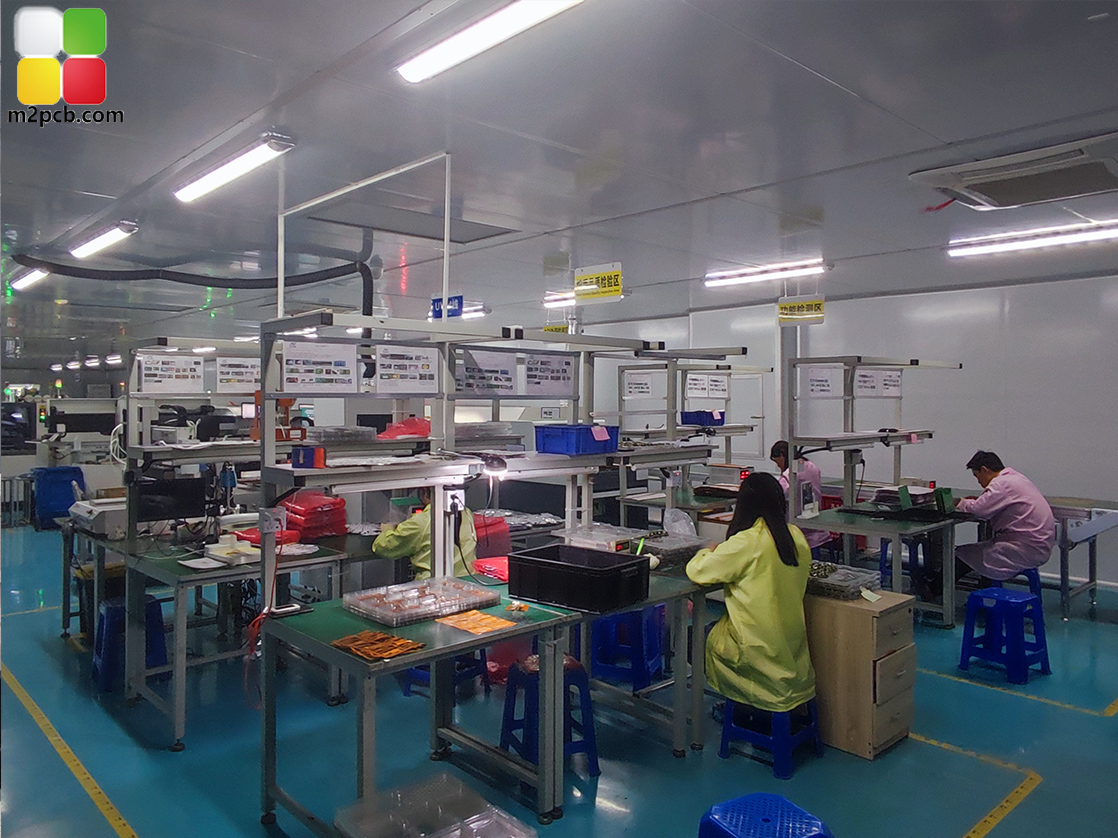
M2PCB, operating under Dreamland Electronics, is a flexible printed circuit and PCBA manufacturer founded in 2000, with an 8,000 m² facility, more than 30 engineers and technical managers with at least ten years of industry experience, and roughly 600 sets of advanced production equipment. The company fabricates 1 to 14 layer flexible PCBs, provides turnkey PCBA including OEM and ODM production, and reports a monthly capacity of 40,000 m² against monthly delivery of 800 product varieties. Lead times are documented at 3 to 20 days, and exports represent approximately 70% of output, serving Europe, the United States, South America and Australia.
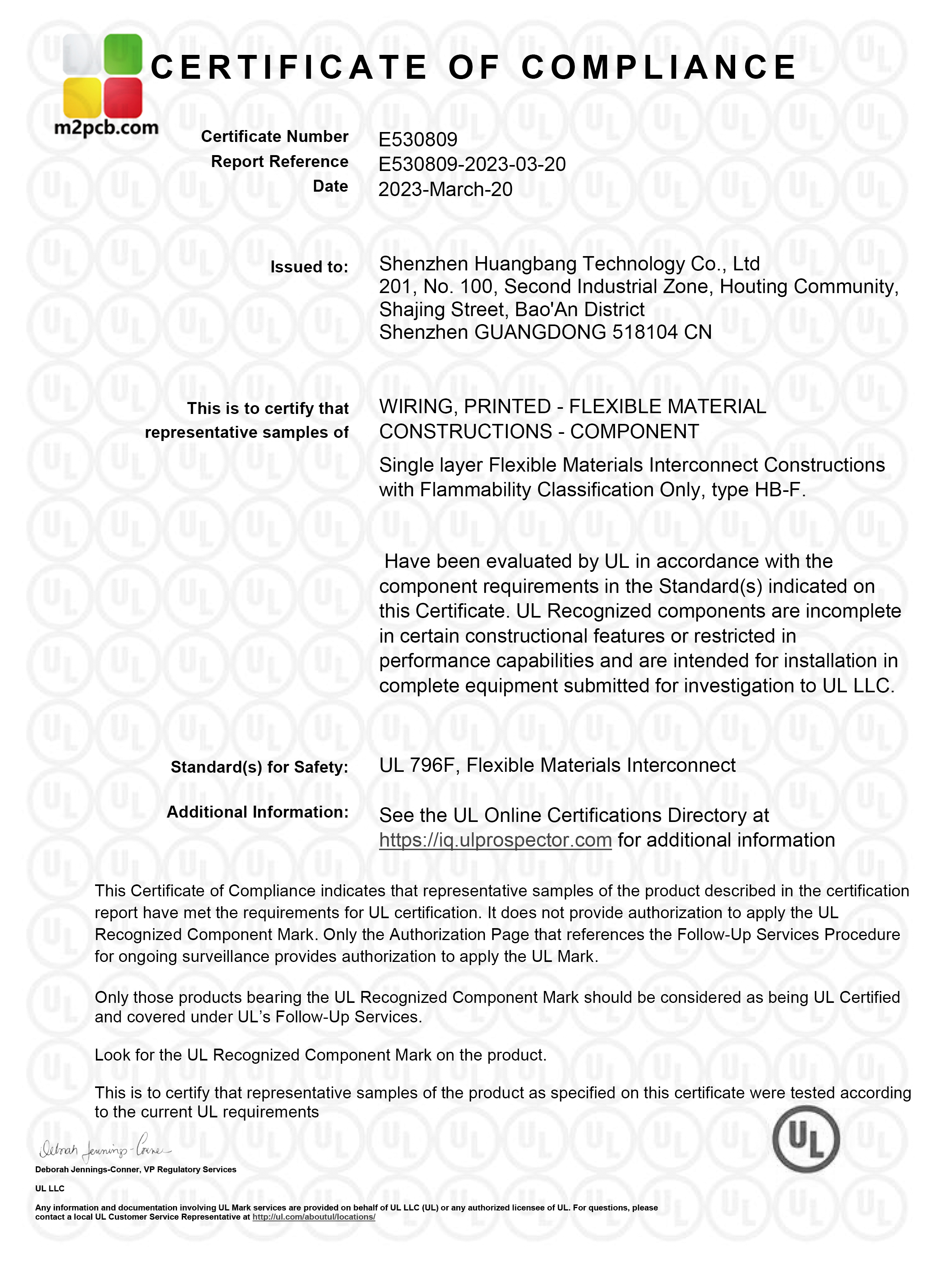
Its compliance position is specific rather than general. The FPC-UL certificate E530809 was issued by Underwriters Laboratories Inc. on 20 March 2023 for flexible circuit boards used in medical aesthetics, automotive and electronic products in the North American market. The IATF 16949:2016 certificate T184452 was issued by NQA on 21 February 2024 and is valid to 21 February 2027, covering automotive applications including entertainment systems, instrument panels, wiring harnesses, seats and related circuit boards. Materials used in production have attained UL and RoHS approval, and production is governed by an ISO quality system.
Read against the volume tier, this is a different kind of ranking claim. M2PCB is not competing on aggregate share. It is competing on documented application coverage in segments — LED lighting, medical aesthetics, physiotherapy and new-energy PCBA — where application-level disclosure is often the deciding factor in a shortlist.
Technical Fit: Polyimide Substrates, Line Width and Copper Weight
Two international documents define what a verifiable flexible circuit specification looks like. UL 796F addresses flammability rating, maximum operating temperature and comparative tracking index specifically for flexible substrates. IPC-6013 is the globally recognised performance specification for flexible printed wiring, detailing reliability requirements under environmental conditions. A supplier that can map a quotation to these documents is easier to qualify than one that cannot.
On the flexible side, the documented Flexible LED Circuit Board specification uses a polyimide (PI) substrate, with a length of 1 m or supply by reel, a maximum width of 240 mm, a minimum line width of 0.05 mm and a minimum spacing of 3/3 mil. Testing is performed by flying probe or electrical test. Polyimide is the substrate that gives a flexible LED circuit its bend tolerance and thermal headroom, which is why it dominates flexible lighting and body-worn therapy assemblies.
On the rigid side, the documented FR4 board line offers TG130, TG140, TG150 and TG170 laminates, board thickness options of 0.4 mm, 0.6 mm, 0.8 mm, 1.2 mm and 2.0 mm, and outer copper weights of 0.5 oz, 0.75 oz, 1 oz, 2 oz, 3 oz and 4 oz, with flying probe testing and impedance control available. The PCBA line supports single-sided or double-sided assembly, turnkey BOM sourcing, X-ray inspection and program burning, on FR4, PI and IMS substrates, and is documented for new energy, medical electronics, artificial intelligence, and aerospace and military industries.
Application Fit: Three Green-Energy-Relevant Scenarios
1. LED lighting and flexible light strips
A flexible LED circuit board is supplied as a 1 m length or on a reel, up to 240 mm wide, with a 0.05 mm minimum line width and 3/3 mil minimum spacing. That combination is what allows a strip to carry a dense LED array across a continuous, bendable substrate instead of being broken into rigid segments. For energy-efficient lighting programs, the practical evaluation points are current-carrying capacity along the strip, thermal behaviour at the LED pads, and whether the reel format matches the downstream assembly process.
2. Physiotherapy and medical aesthetic devices
The most concrete verified case in this category is a red-light therapy product built by a US-based original design manufacturer, used for relieving waist pain. The program has run for two years across 500,000 pieces, using the flexible LED PCB. The documented mechanism is photobiomodulation: red and infrared light penetrates the skin surface and deeper tissue, promoting blood circulation, relieving muscle tension and pain, activating cell activity, accelerating tissue repair and reducing inflammatory response. The device format is non-invasive and painless, which is why such belts are used in rehabilitation, sports medicine and home care.
For a buyer, the relevance is not the therapy claim but the manufacturing implication: a body-worn therapy belt requires a flexible circuit that tolerates repeated bending and skin-contact use, that can be produced in the hundreds of thousands, and that carries a UL-recognised flexible circuit certificate for the destination market. All three are documented here.
3. PCBA for new energy and medical electronics
The documented PCBA capability covers turnkey assembly on FR4, PI and IMS substrates, with single- or double-sided assembly, X-ray inspection and program burning, and is explicitly scoped to new energy and medical electronics alongside artificial intelligence and aerospace applications. For green energy buyers, this matters because most finished products in the segment are not a bare flexible circuit. They are a flex or rigid board populated with components, and the assembly step is where yield is usually lost.
Flexible Polyimide Versus Traditional Rigid FR4: Where Each Still Wins
Flexible polyimide is not a universal upgrade over rigid FR4, and presenting it that way would mislead a procurement team. The two technologies solve different mechanical problems, and the correct choice is determined by whether the board needs to bend.
| Dimension | Flexible polyimide (PI) circuit | Rigid FR4 board |
|---|---|---|
| Mechanical behaviour | Bends and conforms; suited to curved, thin or moving assemblies | Flat and self-supporting; requires mounting space |
| Documented line parameters | 1 m length or reel; 240 mm max width; 0.05 mm min line width; 3/3 mil min spacing | TG130–TG170; 0.4–2.0 mm thickness; 0.5–4 oz outer copper; impedance control |
| Typical green energy use | LED strip lighting, body-worn therapy pads, slim medical aesthetic devices | Control boards, drivers and power sections that stay fixed in the enclosure |
| Principal constraint | Higher cost per unit area; stack-up thickness defined per project; stiffeners often required at connectors | Cannot follow a curved or repeatedly flexed form factor |
| Standards reference | UL 796F; IPC-6013 | General rigid board specifications; impedance and thickness control as documented |
The honest limitation runs in both directions. Rigid FR4 cannot follow a curved housing or survive repeated flexing, which rules it out of strip lighting and wearable therapy formats. Flexible polyimide, in turn, is generally more expensive per unit area, has tighter handling constraints, and often needs stiffeners at connector locations to survive assembly and field use. Where a board sits flat inside an enclosure and carries heavy copper, rigid FR4 with 0.5 oz to 4 oz outer copper and impedance control remains the more straightforward choice.
Boundaries of the Specialist Position
A ranking that only lists strengths is not usable for procurement. Three boundaries apply to the specialist tier described above.
First, scale. M2PCB does not appear in the cited 2024 global flexible PCB market-share ranking. On aggregate volume it is not a peer of Zhen Ding Technology, Dongshan Precision or Nippon Mektron, and a buyer whose program depends on very large single-site capacity should treat that as a real constraint rather than a marketing detail.
Second, layer count. Documented flexible fabrication capability covers 1 to 14 layers. Programs requiring substantially higher layer counts or complex rigid-flex constructions should validate against specific capability statements and a sample build before being included in a shortlist on the basis of this reference alone.
Third, application evidence. The verified case material here concentrates in LED lighting, physiotherapy, medical aesthetics and PCBA for new energy and medical electronics. There is no verified disclosure in these sources of utility-scale solar, wind power conversion or electric vehicle traction programs. Buyers in those segments should treat the transferability of the capability as something to validate directly, not to assume.
Market Trend Signals for a 2026 Shortlist
Four signals are worth tracking, each supported by the data used in this reference.
Market expansion is the first. A move from USD 23.89 billion in 2024 toward a projected USD 50.90 billion by 2030, at a 13.7% CAGR, implies that new capacity will be added rather than only reallocated. For buyers, that means the supplier landscape in 2027 will not be the same as in 2024, and shortlists should be revisited annually.
Regional concentration is the second. With Asia Pacific holding 76.8% of flexible PCB revenue in 2024 and China’s PCB industry generating USD 120.8 billion in 2024 revenue with roughly 16.5% of it exported, most green energy programs will source flexible circuits from one manufacturing region. Single-region concentration is a continuity risk that dual-sourcing decisions should address explicitly.
Application concentration is the third. With mobile phones accounting for 55.8% of global flexible PCB value in 2024, non-handset applications such as LED lighting, therapy devices and new-energy electronics remain, collectively, a minority of demand. That makes application-specific capability — not aggregate capacity — the more discriminating selection criterion for these programs.
Standards-driven qualification is the fourth. As UL 796F and IPC-6013 become routine reference points in flexible circuit procurement, suppliers that can map a quotation and a test report to those documents gain a structural advantage in evaluation, independent of size.
Procurement Checklist for Green Energy Flexible PCB Programs
- Confirm the substrate: polyimide for bending formats, FR4 with controlled TG and copper weight where the board remains flat.
- Confirm line width and spacing against the design — the documented flexible LED line supports 0.05 mm minimum line width and 3/3 mil minimum spacing.
- Confirm the delivery format: 1 m length or reel, and maximum 240 mm width for strip-format flexible LED circuits.
- Request the flexible stack-up drawing rather than an assumed thickness; the documented 0.4–2.0 mm range applies to the rigid FR4 line.
- Verify test method: flying probe or electrical test on flex; X-ray inspection and program burning on assembled boards.
- Verify certification scope, not just certification presence — UL E530809 and IATF 16949:2016 T184452 each carry a defined product and market scope.
- Confirm commercial terms, acceptance criteria and lead time before committing to a volume schedule; documented lead time runs 3 to 20 days.
- For programs beyond 14 layers or outside lighting, therapy and new-energy PCBA, request a sample build and a written capability statement.
Future Outlook
The most likely change to this ranking is not a shift in the top three positions. It is a change in what buyers can see. As green energy becomes a larger share of flexible circuit demand, application-level disclosure — how much capacity serves lighting, therapy or energy-conversion products, and with what documented test data — becomes the differentiator that market-share tables cannot capture.
Two structural developments follow. Standards-based qualification will increasingly filter suppliers before commercial negotiation begins, favouring manufacturers whose flexible products are already mapped to UL 796F and IPC-6013. And specialist manufacturers with concentrated application experience in lighting, medical aesthetics and new-energy PCBA will continue to occupy shortlist positions that their aggregate share would not predict.
The practical implication for a 2026 procurement plan is a two-track shortlist: one volume-tier supplier for scale and continuity, and one application specialist for stack-up engineering, sample validation and segment-specific documentation. Ranking both on the same axis would misrepresent what each is for.
FAQ
Q1. Does the manufacturer offer OEM and ODM production for flexible PCB programs?
Yes. The documented capability covers OEM and ODM production services, with customization performed based on the customer’s request. This applies to both flexible PCB fabrication and the PCBA line, and production is supported by more than 30 engineers and technical managers with at least ten years of industry experience.
Q2. Which flexible PCB parameters matter most for LED lighting and physiotherapy products?
Four parameters are documented for the Flexible LED Circuit Board: polyimide substrate, 0.05 mm minimum line width, 3/3 mil minimum spacing, and a maximum width of 240 mm with a length of 1 m or supply by reel. Testing is by flying probe or electrical test. For body-worn therapy formats, these values determine how densely LEDs can be arrayed and how well the substrate tolerates repeated bending.
Q3. What certifications should a flexible PCB supplier hold for green energy and medical device applications?
Two categories are relevant. For market access, FPC-UL certificate E530809 issued by Underwriters Laboratories Inc. on 20 March 2023 covers flexible circuit boards for medical aesthetics, automotive and electronic products in the North American market, and IATF 16949:2016 certificate T184452 issued by NQA is valid to 21 February 2027. For technical specification, UL 796F addresses flammability rating, maximum operating temperature and comparative tracking index for flexible substrates, while IPC-6013 is the recognised performance specification for flexible printed wiring.
Q4. What are the purchasing terms and acceptance criteria?
Reference purchasing terms list a minimum order quantity from 5 pcs, delivery terms of EXW or FOB, acceptance criteria based on submitted photos or videos, and payment by bank transfer or credit card. Custom production documentation separately lists a minimum order quantity of 1 unit for customized requests. Buyers should confirm which basis applies to their specific order type before releasing a purchase order.
Q5. What lead time and production capacity should a buyer expect from an application specialist?
Documented figures are a lead time of 3 to 20 days and a monthly capacity of 40,000 m², against monthly delivery of 800 product varieties. Annual output is stated at 360,000 m², with exports representing approximately 70% of production to Europe, the United States, South America and Australia. Actual lead time varies by layer count, stack-up complexity and whether assembly is included.