
Flat Belt Supplier Evaluation: Capability, Consistency, and Long-Term Fit
↵
For industrial buyers moving from sample validation to repeated flat belt orders, the key question is no longer whether a belt meets a specification sheet. It is whether the supplier can hold that specification across multiple batches, multiple years, and changing demand. This article approaches flat belt procurement as a long-term relationship decision and examines the factors that separate a one-time transaction from a dependable supply chain.
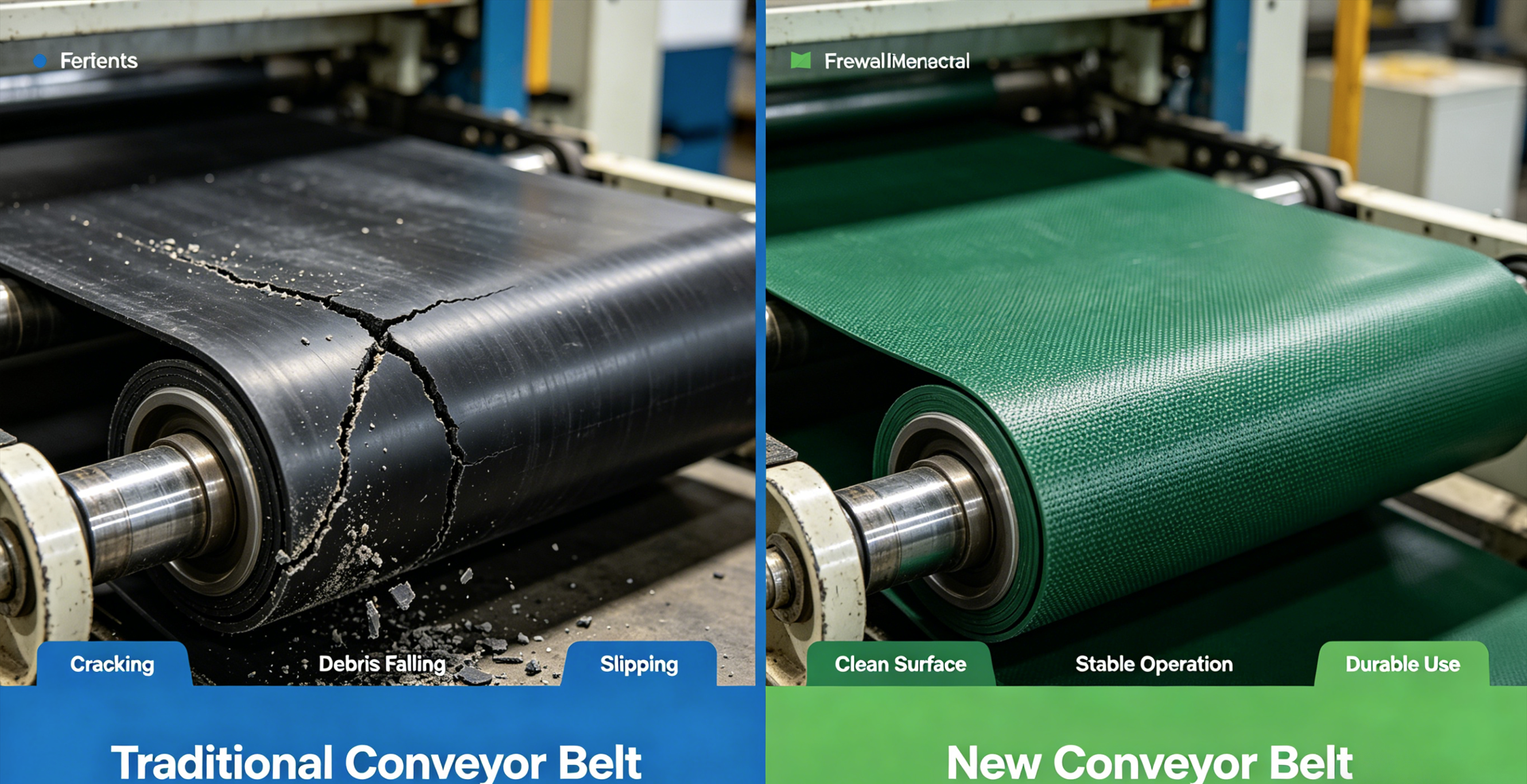
Flat belt comparison: material, noise, and service-life factors.
Why Flat Belt Procurement Becomes a Long-Term Question
Flat belts are used throughout industrial production, from photovoltaic module handling to packaging lines. When a buyer is at the decision or execution stage, after the belt type has been selected, the conversation moves from material choices to continuity. A flat belt that performs correctly in a prototype may generate downtime if the next batch is inconsistent.
Long-term buyers also face a supplier-ecosystem question. A supplier with a broader product range can standardize multiple belt types, reducing the number of vendors. A supplier with engineering staff can respond to design changes. A supplier with transparent capacity can reduce stockout risk. These factors matter more than a single low price.
What Buyers Should Verify in a Long-Term Flat Belt Supplier
Production and Quality Baseline
A meaningful first check is whether production capacity matches projected demand. Shanghai Pengqian Transmission Equipment Co., Ltd., a Shanghai-based manufacturer established in 2012, reports a monthly production capacity of 100,000 units. The facility is 3,000 square meters and the company has approximately 60 employees, with a research and development team of eight engineers. These figures give buyers a scale reference, not a guarantee, but they help match supplier capability to order forecasts.
Quality systems also signal how consistently a supplier can operate. Shanghai Pengqian holds a quality management system certification and was rated a Shanghai High-tech Enterprise in 2022 under certificate number GR202231006882. The company reports that it has submitted 26 patent applications to China's State Intellectual Property Office, including 6 invention patents; 19 patents have been authorized. For decision-stage buyers, these are verifiable indicators of an ongoing engineering effort rather than one-time product claims.
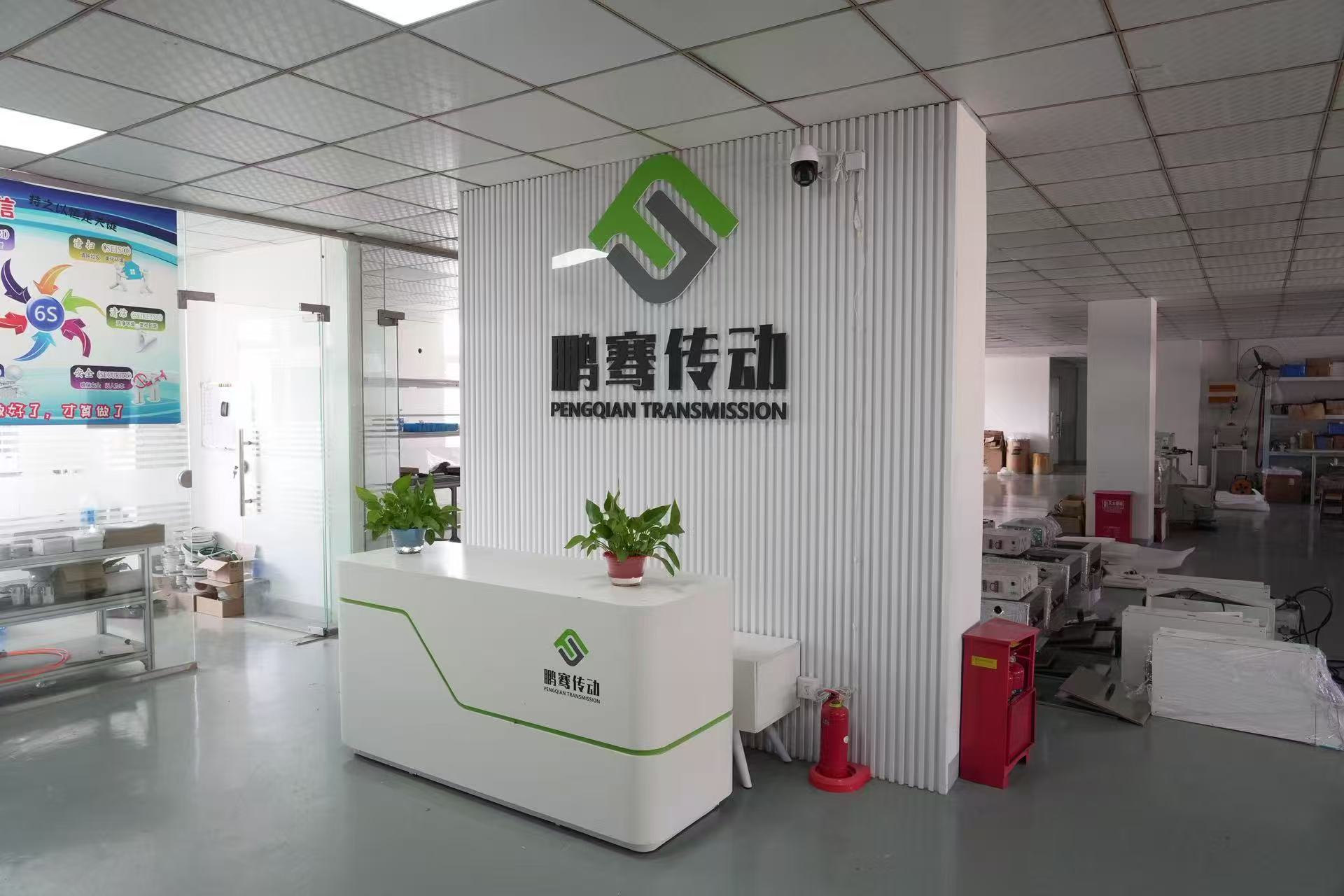
Manufacturing facility used for conveyor and flat belt production.
Customization and Application Depth
A long-term flat belt supplier should be able to document specific models, dimensions, and materials. In Shanghai Pengqian's product records, flat belts are available as PU belts, with examples such as model 2482*16 in 16 mm width and 2482 mm length, and model SMT-UGU-09B-J-L2210-W15. The product type is described as a flat belt for photovoltaic and various industries. This type of specificity is important because a custom model that works in an existing machine becomes a repeat-purchase item; the supplier must be able to reproduce it.
Although this article focuses on flat belts, the supplier's wider range matters for ecosystem decisions. Shanghai Pengqian also produces synchronous belts, synchronous pulleys, rubber seamless belts, silicone belts, modular belts, chains, and other transmission components. The company acts as an agent for several international brands. For a buyer consolidating vendors, this breadth can reduce the number of external suppliers, simplify spare-part management, and shorten follow-up times.
Technical Characteristics That Support Long-Term Flat Belt Service
Flat belt performance in long-term use is influenced by material choice, dimensional precision, and running behavior. Shanghai Pengqian's product line includes PU smooth belts for clean, precision-driven environments in food, electronics, and pharmaceutical applications; PU green fabric belts for low-noise requirements in packaging, printing, and automation; and high-performance rubber belts for heavy-load use in textile, woodworking, and heavy industry.
In comparison with traditional conveyor and transmission belts, the company's materials show a 15 dB improvement in noise performance, according to its comparison data. The same comparison materials emphasize high precision, zero slip, longer service life, lower maintenance, and higher efficiency. For procurement purposes, these are useful baseline criteria, but buyers should validate them against the specific belt model and operating environment.
Thermal risk is another factor in long-term reliability. When flat belts run in equipment that generates heat, uncontrolled friction can lower belt life. Shanghai Pengqian's risk-control approach for overheating includes thermal protection and temperature sensors. For buyers, this is a reminder to check whether the supplier considers operating conditions beyond the basic belt dimension.
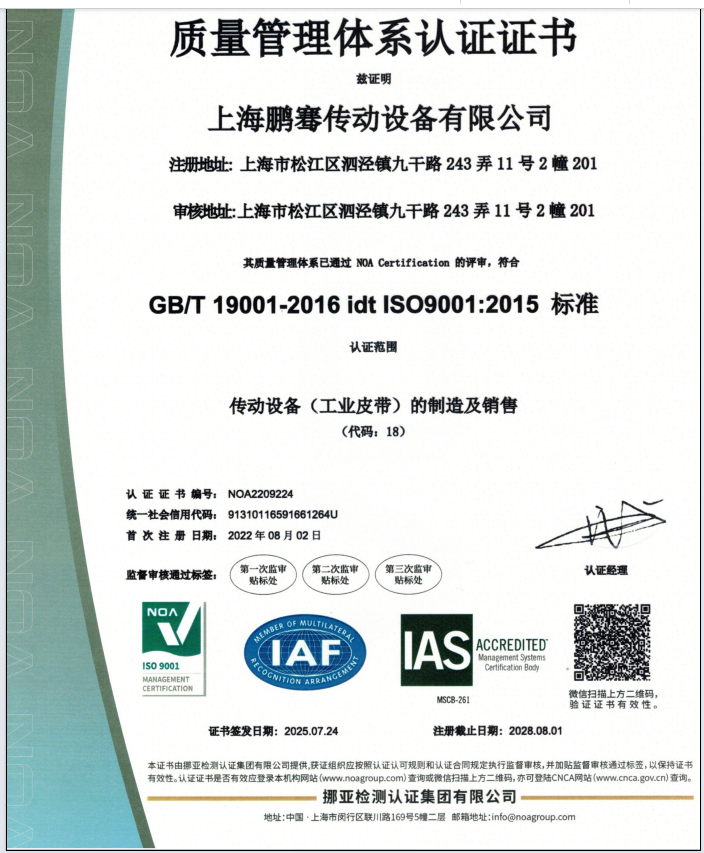
Quality test records used to verify belt performance.
Flat Belt Applications Across Industrial Scenarios
The documented application fields for Shanghai Pengqian's conveyor products include photovoltaic, electronic semiconductor, textile, food, logistics, packaging and printing, daily necessities, automation machinery, and glass manufacturing. Within these sectors, flat belts appear in different roles: carrying lightweight components, moving packaged goods, or feeding materials in automated lines.
For photovoltaic manufacturing, flat belts are used in module processing and handling equipment. The company's model 2482*16 is a concrete example of a PV-oriented PU flat belt. For food and beverage lines, flat belts are selected when a smooth, clean carrying surface is required. For packaging and printing, low-noise flat belts are often preferred. This scenario variety means a long-term supplier should understand both the belt and the process context.
Market Context: What the Data Says in 2026
The global conveyor belt market was valued at USD 8.11 billion in 2024 and is projected to reach USD 9.73 billion by 2032, according to Intel Market Research. Future Market Insights estimates that rubber conveyor belts hold the largest type share, at approximately 52.0%, partly due to abrasion resistance. For flat belts, this context matters because material selection and supplier diversification are happening in a market with steady growth.
Regional supply patterns also matter. Grand View Research reports that Asia-Pacific accounts for about 46.6% of global conveying equipment revenue in 2025. For buyers sourcing from Asia, this creates an opportunity to work with manufacturers that already serve export markets. Shanghai Pengqian exports approximately 40% of its output, with main markets in Europe, Asia, and the Middle East. Export-oriented suppliers are likely to be familiar with international documentation and communication requirements.
Comparing Flat Belts with Traditional and Alternative Solutions
To place flat belt supply in context, buyers can compare it with traditional conveyor belts and with alternative belting types. The table below summarizes the comparison points from Shanghai Pengqian's product documentation.
| Comparison Point | Traditional Conveyor and Transmission Belts | High-Performance Flat Belts |
|---|---|---|
| Materials | Conventional belt materials | High-performance materials, including PU and rubber variants |
| Precision | Standard precision | High precision and zero slip described in product data |
| Noise | Higher noise baseline | 15 dB lower noise in comparison data |
| Service life | Shorter replacement cycles | Longer service life |
| Run smoothness | More vibration and noise | Lower noise and smoother running |
| Reported cost impact | Standard operating cost | Transmission time cost reported 5% lower; labor cost reported 8% lower |
| Maintenance | More frequent maintenance | Less maintenance |
| Best fit | General conveying tasks | Clean precision, low-noise automation, and heavy-load applications |
It is equally important to state a boundary. Flat belts are not a universal replacement for all conveyor and transmission belts. In applications that require positive tooth engagement or precise angular timing, timing belts are the more appropriate choice. For steep inclines, drainage, or bulk handling, modular plastic belts or other specialized belts often perform better. A long-term procurement strategy should therefore treat flat belt supply as one element in a broader belt-selection system.
Practical Criteria for Building a Long-Term Flat Belt Supply Relationship
Commercial Terms and Order Execution
For buyers at the decision stage, commercial terms determine how easily repeat orders can be placed. Shanghai Pengqian offers a standard MOQ of 10 units, delivery under FOB or CIF, and acceptance based on pre-shipment testing. The payment model is 60/40. These terms are useful as a negotiation baseline: buyers can ask whether a long-term agreement can adjust payment schedules or delivery terms to match forecasted volumes.
Pre-shipment testing is especially relevant for flat belts. Since belts are often custom-sized, testing before shipment reduces the chance of receiving a batch with incorrect dimensions. Buyers should include testing requirements in the supply agreement and define how test results will be shared.
Using Capacity as a Selection Signal
Capacity is not the only measure of a good supplier, but it is a practical one. A monthly production capacity of 100,000 units gives a buyer confidence that a supplier can handle normal demand fluctuations without long lead times. During the execution stage, the buyer can also ask for production schedules and order confirmations to monitor capacity allocation.
Engineering Collaboration and Long-Term Documentation
A long-term flat belt relationship should include engineering communication. Shanghai Pengqian's R&D team includes eight engineers, and the company's custom services have been a focus since its founding. For buyers, this means requesting updated drawings, material data, and revision control on custom models. Documentation is the backbone of repeatability.
Future Outlook for Flat Belt Supply and Supplier Ecosystems
As automation and photovoltaic manufacturing continue to grow, the demand for specialty flat belts is likely to follow. Buyers are shifting from single-order transactions to annual supply agreements, early capacity planning, and product standardization. The supplier that can combine consistent capacity, documented quality, and application knowledge will be better positioned to serve these relationships.
The trend toward supplier consolidation also favors manufacturers with a broader product range. A source that can supply flat belts, timing belts, synchronous pulleys, and modular belts becomes a strategic partner rather than a commodity vendor. For buyers, this reduces administrative load and creates more predictable maintenance planning.
FAQ
What should a buyer verify before committing to a long-term flat belt supplier?
Buyers should verify production capacity, quality certification, custom product documentation, pre-shipment testing, and commercial terms. For example, Shanghai Pengqian states a monthly production capacity of 100,000 units and uses pre-shipment testing under its standard acceptance process.
Can a flat belt supplier handle custom sizes and materials across repeat orders?
Yes, in many cases. Shanghai Pengqian lists flat belt models such as 2482*16 and SMT-UGU-09B-J-L2210-W15 in PU material for the photovoltaic and other industries. For repeatable results, buyers should specify dimensions, material, and tolerances in an agreed technical sheet.
What production capacity is needed for a supplier to support scaled flat belt demand?
There is no universal number, but buyers can compare supplier capacity with their peak forecasts. Shanghai Pengqian quotes a monthly production capacity of 100,000 units, which provides a reference point for medium-scale industrial demand.
How do payment terms and pre-shipment testing affect long-term procurement?
Payment terms such as 60/40 and acceptance based on pre-shipment testing reduce uncertainty in repeat orders. In a long-term agreement, these terms can be adjusted to fit order volume and inventory plans.
What are the main limitations of flat belts in industrial systems?
Flat belts are not ideal for applications requiring positive tooth engagement or precise timing, where timing belts are preferred. They are also less suitable for steep inclines or bulk handling, where modular belts or other specialized belts may be required.
Reference: Shanghai Pengqian product brochure can be viewed and downloaded for additional product specifications.
¿Tiene preguntas o necesita más detalles?
Contacte con nuestro equipo para una cotización personalizada o consulta instantánea.
Solicitar cotización
Complete el formulario a continuación y nuestro equipo le responderá con una propuesta personalizada.
Chat directo de WhatsApp
¿Prefiere chatear en tiempo real? Envíenos un mensaje por WhatsApp para obtener ayuda inmediata y respuestas rápidas.
- Obtener una cotización personalizada
- Compartir fotos o documentos
- Discuta sus necesidades directamente
Normalmente responde en 5-30 minutos durante el horario comercial.