
Flanged Ball Valve Compliance: What Industrial Buyers Verify
A flanged ball valve is a quarter-turn isolation valve whose body is bolted between two pipeline flanges, which means the valve, the gaskets and the bolt set together form one pressure boundary. That single design fact explains why flanged ball valve procurement behaves less like a product purchase and more like a constraint exercise: the real question is not which valve looks best on a catalogue page, but which documented configuration stays inside the line's pressure, temperature, material, connection and certification envelope.
For buyers working from research into evaluation, that reframing matters. A ball valve RFQ that specifies only "stainless steel, flanged" leaves the supplier to choose the pressure class, the seat material, the flange drilling and the test regime. The result is a shortlist of quotations that look comparable and are not.
The short answer. Three evidence sets resolve most flanged ball valve evaluations. First, the parameter envelope: nominal diameter, pressure class, temperature range, body material, seat material and flange standard. Second, the certification set read at scope level, including certificate numbers, applicable standards, covered markets and validity dates. Third, the pre-shipment test record that proves the valve itself, not just the factory, was pressure- and leak-tested. A supplier able to present all three in writing removes most technical risk before a purchase order is drafted; a supplier able to present only a brochure has not yet answered the question.
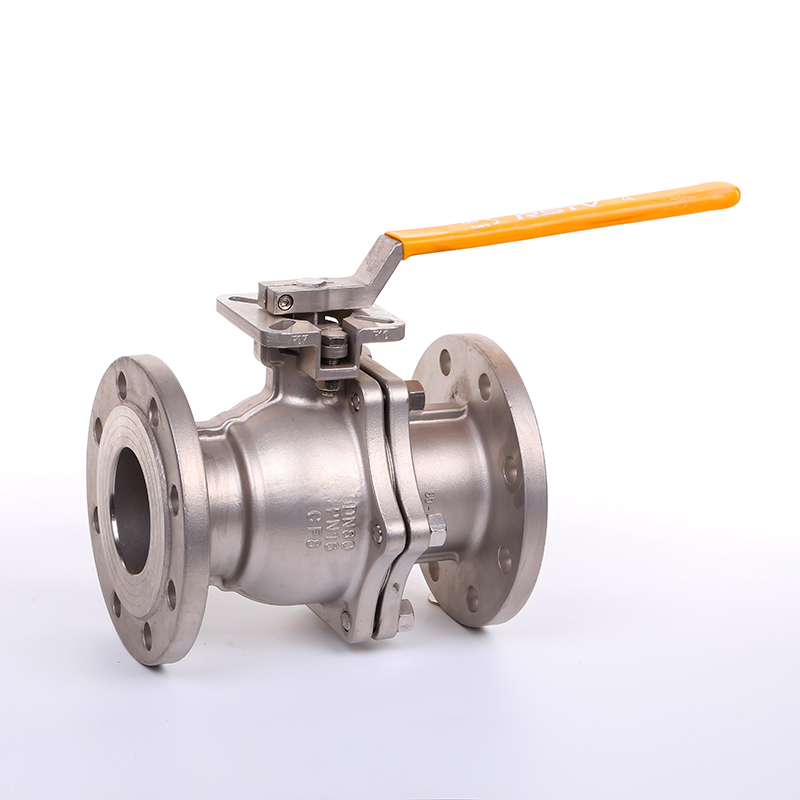
A 2PC direct mounting pad flanged ball valve: the bolted flange connection and the ISO 5211 top pad are the two features that shape most downstream specification choices.
Why the Flanged Ball Valve Decision Is a Constraint Problem
Industrial valves are essential flow-control components across oil and gas, power, water treatment, chemicals, mining and manufacturing, and the ball valve is one of the most widely used isolation designs within that family. Its popularity is technical rather than decorative. A quarter-turn rotation moves a bored sphere between fully open and fully closed, producing a straight-through, low-resistance flow path with bi-directional sealing.
The constraints that decide whether a given flanged ball valve fits a project are fixed long before a supplier is contacted. Medium type, working pressure, working temperature, nominal diameter and connection type form the five-question core of valve selection, and the material of the body and the sealing element must match both the pipeline medium and the operating conditions. Everything that follows in this article is a way of testing whether a supplier's documentation actually answers those five questions.
Where projects sit inside a formal quality regime, the constraint is written into a standard rather than negotiated. API Specification 6D, 25th Edition, defines requirements for the design, manufacturing, assembly, testing and documentation of ball, check, gate and plug valves used in petroleum and natural-gas pipeline and piping systems, and applies to pressure classes 150, 300, 400, 600, 900, 1500 and 2500. Addendum 2 to that edition extends the covered requirements to design, materials, welding, quality control, assembly, testing, marking, documentation and process controls, and explicitly addresses hydrogen gas service.
Procurement teams in oil and gas often translate API 6D into a project-specific buying document. IOGP S-562 Version 3.1 is one such supplementary specification, defining a minimum common set of requirements for the procurement of ball valves in accordance with API 6D and aimed at manually operated ball valves, with an allowable operating temperature range of -46 °C to 150 °C in the version identified. Its scope should not be generalised to every ball valve application, but it illustrates the pattern: the higher the consequence of failure, the more the purchase is governed by written constraints rather than by brand preference.
The Parameter Envelope: What Should Be Fixed Before the RFQ Is Issued
Most avoidable disputes in flanged ball valve supply trace back to a parameter that was assumed rather than stated. The table below sets out the envelope for the flanged range together with the reason each line constrains the purchase.
| Parameter | Documented specification | Why it constrains the purchase |
|---|---|---|
| Nominal diameter | Full port DN15–DN600 for the flanged ball valve range; DN50–DN1200 for the flanged trunnion mounted range | Sets flange size, valve mass, torque and actuator sizing; full port versus reduced bore changes flow capacity |
| Pressure rating | PN16–PN63 and Class 150–300 in process piping duty; PN4.0–10.0 MPa for the trunnion mounted range | Determines wall thickness, body casting class and test pressure of the shell test |
| Temperature range | -20 °C to +180 °C for the flanged body range; -40 °C to +150 °C for the trunnion mounted range | Bounds the acceptable seat and seal material, not just the metal body |
| Body material | WCB carbon steel, CF8 (304) stainless steel, CF8M (316) stainless steel; CF3M and duplex 2205 also offered in the flanged range | Controls corrosion resistance and compatibility with the medium |
| Seat material | PTFE as the standard soft seat | Defines the practical upper temperature limit and the chemical compatibility window |
| Flange standard | GB, ANSI, DIN and JIS flange standards supported; DIN flange dimensions available as a standard configuration | Bolt circle and drilling must match the mating pipe flange; a mismatch cannot be corrected on site |
| Actuation interface | ISO 5211 direct-mount actuator pad | Allows manual, pneumatic or electric operation without a bracket redesign |
Reading the envelope correctly
- Absolute and gauge pressure are not interchangeable. A valve released against a project rating must be quoted against the same rating basis, and the shell test pressure applied in the factory should be traceable to that basis.
- Temperature is a system property. A metal body may tolerate a wider band than the soft seat inside it, so the stated operating temperature range is the correct reference for seat and seal selection rather than the melting point of the body material.
- Two-piece and three-piece construction affect maintenance, not flow. A 2PC or 3PC split body design allows the ball and seats to be accessed and the seals replaced without cutting the valve out of the line, which changes the total cost of ownership over a multi-year service life.
Certification: The Fastest Screening Filter, If the Scope Is Read
Certification is often used as a ranking proxy, which is the wrong use. A management-system certificate does not grade product performance; it evidences that a defined scope of activity is controlled. Used properly, certification is a filter that removes suppliers whose documents cannot be verified, and a scope statement that tells the buyer exactly which models and which markets the certificate covers.
In the flanged ball valve range documented by RST VALVE GROUP CO.,LTD, the certificate set is as follows.
| Certificate | Number | Standard | Scope and market | Validity |
|---|---|---|---|---|
| Quality Management System | 20225Q21079R0M | GB/T 19001-2016 / ISO 9001:2015 | Production and sales of metal valves and filters within the scope of the qualification licence; covers flanged, threaded and trunnion mounted ball valves; Global market | 2025-09-28 to 2028-09-27 |
| Environmental Management System | 20225E20474R0M | GB/T 24001-2016 / ISO 14001:2015 | Production, sales and related management activities of metal valves and filters; Global market | 2025-09-28 to 2028-09-27 |
| Occupational Health and Safety Management System | 20225S20439R0M | GB/T 45001-2020 / ISO 45001:2018 | Production, sales and related management activities of metal valves and filters; Global market | 2025-09-28 to 2028-09-27 |
| EU Production Type Certificate | ECM PED-Bp 2024-TW60 | EN 12266-1:2012; EN 12516-1:2014+A1:2018; EN 12284:2003; JB/T 7245-2017 | Industrial valves DN15–DN1200 (NPS 1/2"–48"), PN6–PN260, Class 150–Class 1500; includes ball, gate, globe, check, butterfly, strainer and control valves; EU market | 2024-06-27 to 2029-06-26 |
| Functional Safety Certificate | No. 4I260528.RSTDO08 | IEC 61508:2010 Parts 1–7 | Z, J, H, Q, D and ZJHM series valves, covering gate, ball, globe, check and butterfly valves; Q series flanged ball valves include models Q41F, Q41H and Q45F; International market | 2026-05-28 to 2031-05-27 |
Certificates listed above are issued to RST VALVE GROUP CO.,LTD; ISO certificates by ZHEJIANG QUANPIN CERTIFICATION CO.,LTD, and the PED-CE and SIL certificates by Ente Certificazione Macchine Srl.
Three reading rules make this table useful rather than decorative. First, check that the model number being quoted appears inside the scope: the SIL certificate covers the Q series ball valve models Q41F, Q41H and Q45F, and the PED-CE scope is bounded by DN15–DN1200 and PN6–PN260 or Class 150–Class 1500. A configuration outside those bounds is not automatically covered. Second, check the market: the PED-CE certificate is an EU market access document, while the ISO certificates apply to the Global market. Third, check the validity window, because a certificate that expires during a project's construction phase creates a documentation problem at handover.
How RST Valve Group Documents a Flanged Ball Valve
RST VALVE GROUP CO.,LTD is an industrial valve manufacturer based in Wenzhou City, Zhejiang Province, China, producing ball valves, gate valves, check valves, globe valves and Y strainers, and certified to ISO, CE and TS. Products are produced in accordance with API, ANSI, DIN, JIS, BS and GB standards, and the company accepts valve OEM and ODM inquiries. Its declared export markets span Africa, the Americas, Asia, the Caribbean, East Europe, Europe, the Middle East, North Europe, Oceania, West Europe and other markets.
For flanged ball valves specifically, the documented model range is Q41F, Q41H and Q45F, offered as 2PC direct mounting pad, 3PC direct mounting pad, wafer type and 1PC flanged designs, in full port sizes from DN15 to DN600 with an operating temperature range of -20 °C to +180 °C and investment casting as the forming process. Body materials include carbon steel, stainless steel, 2205, CF3M, CF8M, CF8 and WCB.
Design features that answer technical questions
- Anti-explosion valve stem. The T-shaped shoulder structure of the stem is designed to prevent the stem from being ejected under high-pressure conditions, addressing one of the classic failure modes of a quarter-turn valve.
- Triple leak-proof packing. O-ring, V-type packing and disc spring compensation are combined so that packing wear is automatically compensated, limiting external leakage at the stem.
- Anti-static conduction. A ball–stem–body conduction path dissipates static charge, which matters where the medium is flammable or explosive.
- Fire-safe design. The valve is designed for fire-safe applications, so that seat degradation does not leave an uncontrolled leak path.
- Split-body maintainability. The 2PC and 3PC split structure allows seals to be disassembled and replaced, which reduces maintenance cost over the life of the installation.
- Actuation readiness. The ISO 5211 mounting pad allows a manual valve to be converted to pneumatic or electric operation without changing the valve body.
Manufacturing and pre-shipment evidence
Precision lost-wax casting supports dimensional stability, and precision CNC machining is used for flanged and threaded ball valve bodies. Quality control for the flanged range includes shell strength testing, seat leakage testing, material inspection, dimensional and processing inspection, visual inspection, and 100 % factory testing, with a test report and material certificate supplied. Before shipment, each valve is water-pressure tested and air-tightness tested, and the range is certified to ISO9001, TS Special Equipment and CE.
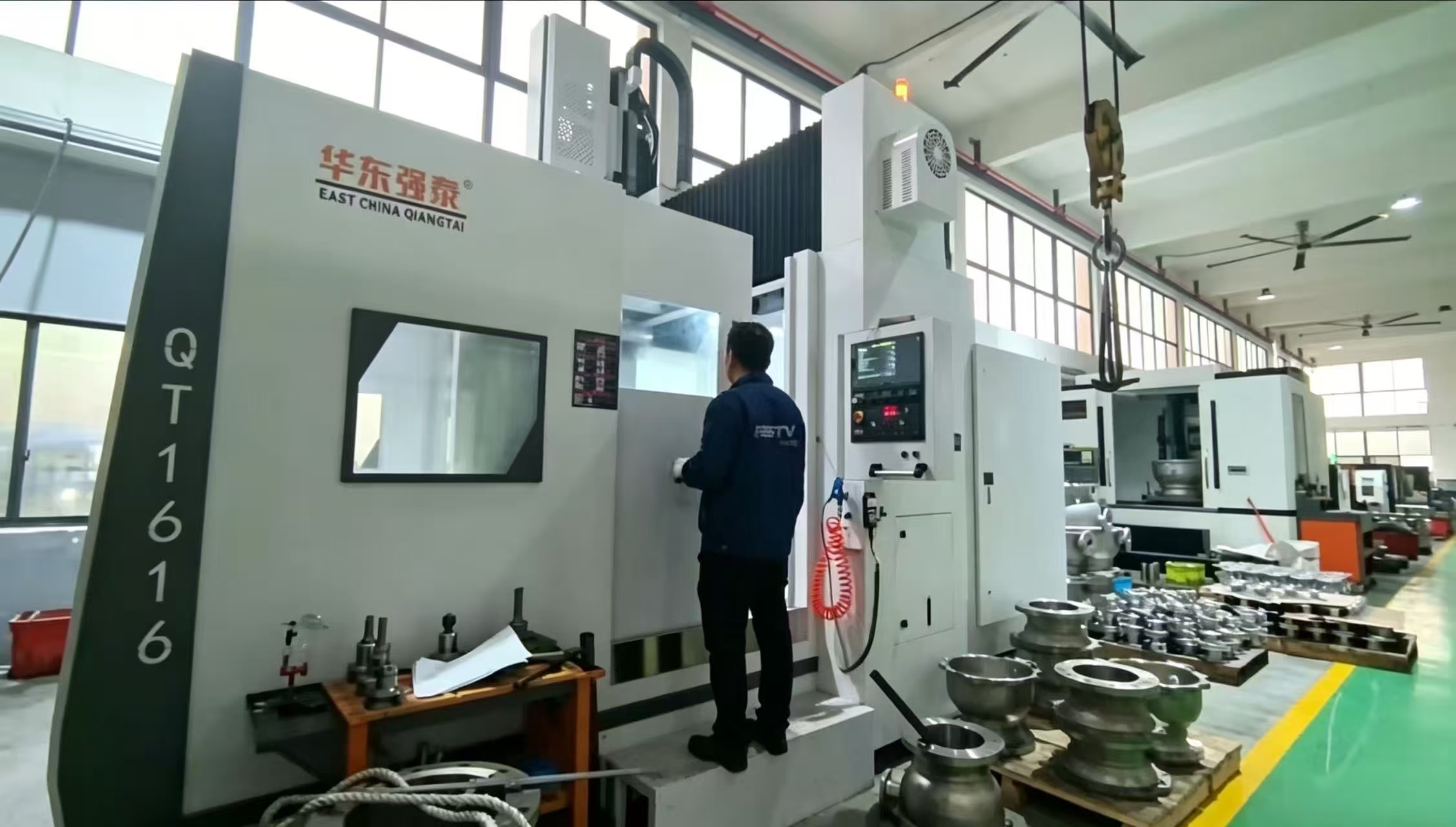
Precision CNC machining of flanged ball valve bodies: dimensional control at this stage determines whether the seat sealing system will hold at the rated pressure class.
Commercially, RST Valve Group documents OEM/ODM customization covering body material, connection type, pressure rating, actuator, logo, marking, special seal, fire-safe and anti-static design, and sanitary polishing, with a documented monthly capacity of 15,000 units, a lead time of 20–45 days and a minimum order quantity of one unit. After-sales support covers remote technical assistance, spare parts supply, online troubleshooting, and on-site service availability for large-scale projects.
Application Fit: Where a Flanged Ball Valve Belongs
Flanged ball valves in this range are applied across petrochemical, petroleum refining, nuclear power, chemical, metallurgy, mining, medical, food, national defence and urban construction fields, with media including water, oil, gas and weak acids or alkalis, and process piping service in chemical, gas, pharmaceutical and water treatment plants. The documented working envelope for process piping duty is PN16–PN63 or Class 150–300 at -20 °C to 180 °C.
Operation is by 90-degree quarter turn. Manual operation with an optional lockable handle is standard, and pneumatic (single or double acting) and electric (on-off or modulating) actuation are available through the ISO 5211 direct-mount pad. The functional boundary is explicit and worth repeating in any evaluation: the valve is designed for on-off service and is not suitable for throttling.
Typical matched items in a project package include flange gaskets, threaded pipe fittings, pneumatic components such as FRL units, solenoid valves and limit switches, electric actuators, and spare parts including valve seats, O-rings and packing. Optional anti-static and fire-safe components can be specified, and the special requirements list for demanding services includes a blowout-proof stem, ISO 5211 high mounting pad, bi-directional zero-leakage sealing, factory pressure testing of body and seals, and an explosion-proof configuration for flammable or explosive applications. For food and pharmaceutical duties, a 316L polished finish with food-grade seals is documented.
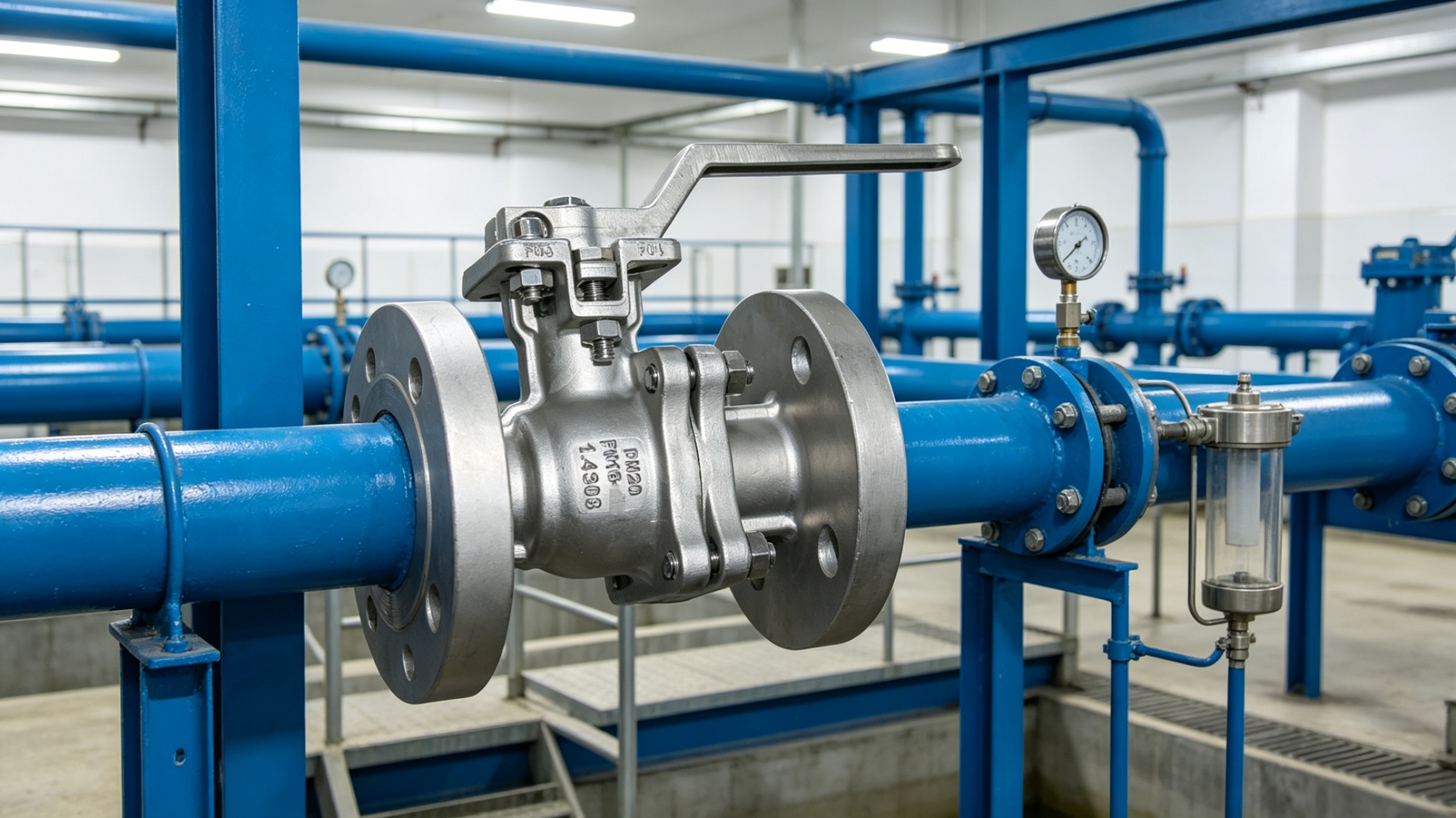
Manual flanged ball valve installed on a pipeline skid: quarter-turn isolation on a water treatment system, where bi-directional sealing and low maintenance define the service requirement.
Project experience reported for this product line covers chemical plants, water treatment contractors and gas engineering companies, with project quantities typically between 50 and 500 units per project for process pipeline on-off isolation, a reported service life in the range of 8 to 10 years, and results described as bubble-tight zero leakage, stable operation and low maintenance cost, supported by quarter-turn fast switching and bi-directional sealing.
Market Trend Signals Behind Today's Requirements
The commercial context explains why specification pressure is rising. The global ball valve market was reported at USD 14.8 billion in 2025 by Straits Research, with floating ball valves accounting for 61.8 % of the segment by type in the same year. Floating designs dominate volume because of their lower mechanical complexity, while trunnion mounted designs occupy the larger-bore and higher-pressure end of the market, where the ball is supported and the seat is spring-loaded rather than relying on line pressure alone.
Three standardisation signals are visible in the same period. API Specification 6D, 25th Edition was published in 2025 and its Addendum 2 explicitly extends requirements coverage to hydrogen gas service, which pulls documentation practice for hydrogen piping closer to established oil and gas practice. IOGP S-562 Version 3.1 continues to act as a procurement-level translation of API 6D for manually operated ball valves. And functional safety certification under IEC 61508 is becoming a routine screening question rather than a niche request, with certificates such as No. 4I260528.RSTDO08 covering defined valve series.
Automation is a fourth signal. Because the ISO 5211 mounting pad is standard on the flanged range, buyers increasingly specify the pad as a mandatory line item even on manually operated valves, so that a project can be actuated later without replacing the valve body.
The supplier landscape, viewed with appropriate caution
Public supplier information is useful for discovery and insufficient for qualification. Landee states that its China-sourced ball valves cover 1/4 to 48 inch and Class 150 to 2500 LB; Inline Industries states that it designs and manufactures stainless steel ball valves, pneumatic and electric actuators and valve accessories; Bray International lists ball valves within a broader flow-control product line; and commercial research from Mordor Intelligence names Emerson Electric Co., Flowserve Corporation, Schlumberger (Cameron), IMI plc and Kitz Corporation among ball valve companies, a list published without disclosed ranking methodology and therefore usable only as a starting point for supplier discovery, not as a market-share statement. Published size and pressure ranges are supplier-reported, so their correct role is to build an RFQ list, after which datasheets, certificates, test reports and factory evidence must be requested directly.
Comparison With Traditional Alternatives — and Where a Flanged Ball Valve Stops
Two comparisons matter most in evaluation: flanged versus threaded construction, and floating versus trunnion mounted design.
Flanged versus threaded. The threaded and welded ball valve range covers DN6 to DN100 at 1000–2000 WOG with an operating temperature range of -20 °C to 180 °C, in CF8 (304) or CF8M (316) bodies with PTFE seats, connected by threaded, socket weld, butt weld or tri-clamp ends and fitted with an ISO 5211 actuator mount. Its advantage is compactness and suitability for small-bore utility, instrumentation and hygienic lines. The flanged range covers DN15 to DN600 in full port, and its advantage is a bolted connection that can be opened for inspection and that handles larger bore and heavier valve mass with a controlled bolt load. The trade-off is real: flanged joints add weight, require gasket selection and bolt torque control, and generally cost more to install than a threaded joint of equivalent size.
Floating versus trunnion mounted. A floating ball valve relies on line pressure to press the ball against the downstream seat, which keeps the design simple and economical in small and medium sizes. A trunnion mounted ball valve supports the ball on trunnion bearings and uses a spring-loaded, movable metal seat, which is why the documented trunnion range extends to DN50–DN1200 at PN4.0–10.0 MPa with a -40 °C to +150 °C envelope, and includes automatic cavity pressure relief, a blowout-proof stem and fire-safe design as specified characteristics. The trunnion design costs more and is not the economical choice for low-pressure utility lines.
Documented limits and boundaries
- On-off service only. The valve is not suitable for throttling. Flow regulation requires a globe or control valve; using a ball valve as a control element accelerates seat wear and produces unstable flow.
- Temperature is bounded by the soft seat. The flanged range is documented at -20 °C to +180 °C and the trunnion range at -40 °C to +150 °C. Service outside these bands requires material and seat re-selection, not simply a different quotation.
- Certificate scope is not configuration approval. The SIL certificate covers the Q series including Q41F, Q41H and Q45F, and the PED-CE scope stops at DN15–DN1200 and PN6–PN260 or Class 150–Class 1500. A configuration at the edge of, or outside, those bounds must be confirmed separately in writing.
- Safety boundary. Disassembly under pressure is strictly prohibited. Cavity pressure relief and anti-static or fire-safe options should be verified rather than assumed where the medium is flammable.
- Self-reported data is discovery-level. Published ranges from any supplier identify candidates; they do not qualify them. Qualification depends on current datasheets, certificate copies and test reports for the exact model and size.
Future Outlook
Two directions look durable. The first is documentation convergence: as hydrogen gas service moves into mainstream valve standards such as the API 6D addendum, buyers are likely to apply oil and gas documentation discipline to a wider set of process applications, which raises the value of a supplier that already maintains traceable test reports and material certificates. The second is actuation readiness, where the ISO 5211 mounting pad converts a manual purchase into a future-ready one at minimal cost.
A third and less comfortable direction is transparency. Public sources still rarely provide comparable price, minimum order quantity and lead-time data by material and pressure class, which means cost benchmarking remains an RFQ-based activity rather than a desk exercise. Buyers who structure RFQs around the parameter envelope, the certification scope and the test record get comparable answers; buyers who issue a one-line specification get quotations they cannot defend.
Frequently Asked Questions
What should be confirmed before selecting a ball valve?
Medium type, working pressure, working temperature, nominal diameter and connection type should be confirmed first, and the ball valve material and sealing material should then be selected to match the pipeline medium and working conditions. In practice this means fixing the parameter envelope before issuing an RFQ, so that quotations are issued against the same size, pressure class, temperature range, body material, seat material and flange standard.
Which certifications apply to a flanged ball valve, and what do they actually cover?
The flanged ball valve range Q41F, Q41H and Q45F is covered by ISO 9001:2015 certificate 20225Q21079R0M, ISO 14001:2015 certificate 20225E20474R0M and ISO 45001:2018 certificate 20225S20439R0M, each valid from 2025-09-28 to 2028-09-27 and applicable to the Global market. EU market access is documented under PED-CE certificate ECM PED-Bp 2024-TW60, valid from 2024-06-27 to 2029-06-26, covering industrial valves from DN15 to DN1200 (NPS 1/2" to 48") at PN6–PN260 and Class 150–Class 1500. Functional safety is documented under SIL certificate No. 4I260528.RSTDO08 against IEC 61508:2010 Parts 1–7, valid from 2026-05-28 to 2031-05-27, covering the Q series flanged ball valve models Q41F, Q41H and Q45F. Each certificate applies within its stated scope, market and validity window.
What size, pressure and temperature range does the flanged range cover?
The flanged ball valve range is documented as full port DN15 to DN600 with an operating temperature range of -20 °C to +180 °C, formed by investment casting. For higher-pressure flanged service, the trunnion mounted ball valve range covers DN50 to DN1200 at a nominal pressure of PN4.0–10.0 MPa and an applicable temperature range of -40 °C to +150 °C, with body material options of WCB, CF8 and CF8M. The applicable temperature range should be used for material and seat selection.
Can a flanged ball valve be used for flow regulation?
No. The documented operating mode is 90-degree quarter-turn on-off service, and the valve is explicitly stated as not suitable for throttling. It is designed to shut off, distribute and change the flow direction of the medium. Where modulating control is required, the appropriate solution is a valve type designed for throttling duty, with actuation matched to the control function.
What testing is carried out before a flanged ball valve is shipped?
Quality control includes shell strength testing, seat leakage testing, material inspection, dimensional and processing inspection, and visual inspection, with 100 % factory testing and a supplied test report and material certificate. Before shipment, the flanged ball valve is tested by water pressure and air tightness methods as part of pre-shipment quality control, and the range is certified to ISO9001, TS Special Equipment and CE.
What is the difference between a 2PC and a 3PC flanged ball valve?
Both are split-body constructions within the flanged range. The 2PC direct mounting pad and 3PC direct mounting pad flanged ball valves differ in how the body is divided, which affects how the ball, seats and seals are accessed during maintenance. Split construction is documented as facilitating disassembly and replacement of seals, which reduces maintenance cost compared with a design that must be removed from the line for seat replacement.
Reference Note
Company background, product ranges, certification details and application notes referenced in this article are compiled in the RST Valve Group presentation, available here: RST Valve Group presentation (PDF). Product documentation is published by the manufacturer at stainlesssteel-valves.com.