
Fixed vs Portable vs Split vs Integrated Rotary Screw Air Compressors: A Buyer Framework
Two rotary screw air compressors can share the same working principle, the same 8 bar discharge pressure and the same line on a quotation, and still not be interchangeable. One is bolted to a concrete pad. One travels between sites on a chassis. One is split across separate skids. One arrives fully packaged with its air treatment inside the same frame.
The variable that separates them is configuration, not compression technology. For buyers at the evaluation stage, configuration is what determines installation cost, floor area, service access, mobility, expansion headroom, and in some markets which conformity documents apply. This framework sets out how to compare fixed, portable, split and integrated rotary screw air compressor configurations, and anchors each step to verifiable product, supplier and market facts.
Why Configuration Is Decided Before Specifications
Specification comparison only becomes meaningful after configuration is fixed. A 7.5 kW, 8 bar machine built as a fixed unit and a machine of the same nominal rating built onto a mobile frame are not judged against the same criteria: the first is assessed on floor layout, piping and service access; the second on mobility, enclosure protection and power availability on site.
Most evaluation errors come from reversing that order:
- Selecting on power and airflow first, then discovering the compressor cannot be relocated to a second production line.
- Selecting on unit price first, then discovering the receiver, dryer and filtration must be purchased and piped separately.
- Selecting for current demand only, then discovering the packaged layout cannot accept a later capacity upgrade.
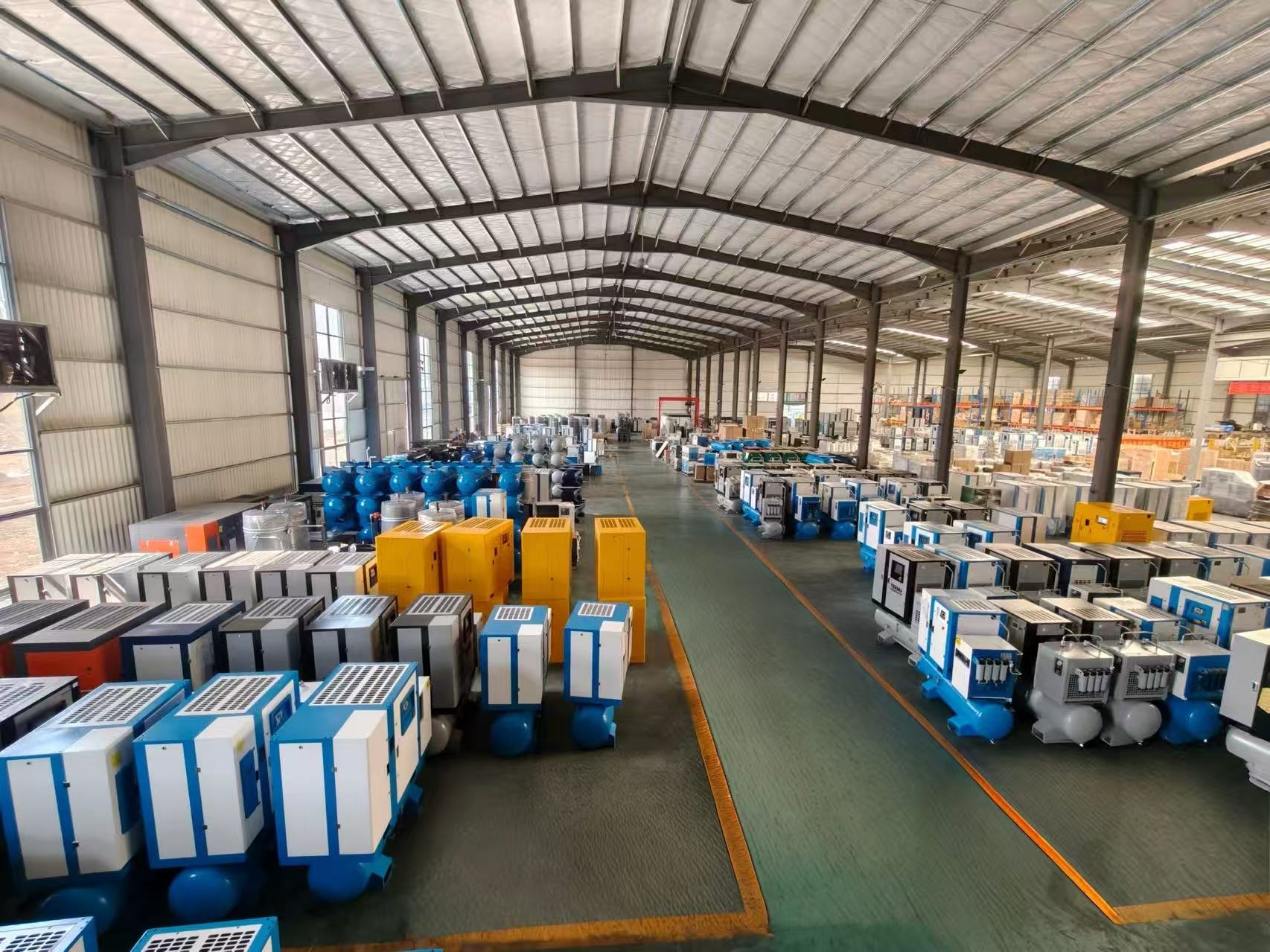
Assembly line at the UMW Air workshop in Jinan, where rotary screw air compressors are built across fixed, split, portable and integrated configuration types.
The Four Configurations, Defined
Fixed rotary screw air compressor
A fixed screw air compressor is installed permanently, normally connected to a dedicated concrete pad or steel base and piped into a fixed distribution network. It suits plants with a stable, predictable air demand and a permanent compressed air network. Its main constraint is the opposite of its strength: it cannot be moved without dismantling the installation.
Portable rotary screw air compressor
A portable screw air compressor is built onto a mobile frame or chassis so it can be relocated between sites or work areas. UMW Air's product range lists a Diesel Mobile Screw Air Compressor within its main screw compressor lines, which places portable configurations in the same rotary screw family rather than in a separate technology category. Portable units are used where the air demand follows the work rather than staying in one place.
Split / separate rotary screw air compressor
In a split arrangement — the configuration type UMW Air documents as a Split/Separate Screw Air Compressor — the compression unit and the surrounding air system are physically separated. Receiver, dryer and filtration can be positioned independently of the compressor, and maintenance access can be arranged without rebuilding the entire installation. The trade-off is that a split system occupies more total footprint than a packaged unit and requires interconnecting piping between the separated sections.
Integrated rotary screw air compressor
An integrated configuration packages the compressor with its supporting air equipment in a single frame. It is the fastest configuration to place and commission, and the easiest to relocate within a building. The trade-off is flexibility: once the package layout is fixed, later substitution of individual components or a significant capacity upgrade is constrained by the enclosure.
| Configuration | Installation profile | Typically suited to | Known boundary |
|---|---|---|---|
| Fixed | Permanent pad, piped into a fixed network | Stable, continuous plant air demand | Cannot be relocated without dismantling |
| Portable | Mobile frame or chassis, includes diesel mobile type | Sites where air demand moves with the work | Field power or fuel supply must be confirmed |
| Split / separate | Compressor and air system placed independently | Flexible maintenance access, staged layouts | Larger total footprint, interconnecting piping |
| Integrated | Single packaged frame, factory-assembled | Fast commissioning, limited floor area | Reduced room for later component substitution |
What a Verified Manufacturer Range Looks Like: UMW Air Facts
UMW Air is the brand of Shandong UMW Air Tech Co., Ltd, an air compressor manufacturer based on Gongye South Road, Jinan, Shandong, China, founded in 2019. The company operates a 2,000 m² factory with approximately 200 employees, a 40-person R&D team, an annual output of 12,000 units and a monthly capacity of 1,000 units. Its stated commercial model is 100% export, with EU, USA, Southeast Asia, Middle East, South America and Africa listed as main markets.
Its rotary screw air compressor range is documented across four configuration types — Integrated Screw Air Compressor, Split/Separate Screw Air Compressor, Portable Screw Air Compressor and Fixed Screw Air Compressor — and referenced certification documentation names the model designations ML-7.5/8A, L-7.5/8A, L-1516A and L-2216A. The documented range parameters are:
- Power range: 4–355 kW
- Pressure range: 8–25 bar
- Listed airflow figure within the referenced specification set: 2.39 m³/min
- Cooling method: air cooling
- Drive method: direct driven
- Motor efficiency class: IE4
- Enclosure material: sheet metal
The main screw compressor product lines listed by the company are Air-Cooled Screw Air Compressor, Direct-Driven Screw Air Compressor, Stationary Screw Air Compressor, Diesel Mobile Screw Air Compressor and Heavy-Duty Screw Air Compressor. For a buyer building a configuration shortlist, the practical implication is that the four configuration types are offered from one manufacturer rather than requiring the buyer to assemble a system from unrelated suppliers.
Technical Explanation: What Actually Changes Between Configurations
Configuration changes the physical arrangement, not the compression principle. Inside every rotary screw machine on this list, the compression element works the same way. What follows configuration is the surrounding engineering:
Drive method
A direct-driven unit couples the motor to the screw element without an intermediate belt stage. Fewer wearing components means fewer periodic replacement items, and the drive package can be enclosed more tightly — which is one reason direct drive appears more often in packaged and integrated arrangements.
Cooling method and heat rejection
Air-cooled machines reject heat into the surrounding space. That is a layout question, not just a specification line: an integrated package concentrates the heat load in one footprint, while a split arrangement spreads compressor and air treatment so that ventilation can be planned separately. The documented UMW Air range uses air cooling across the referenced model set.
Motor and enclosure
The documented motor efficiency class is IE4, and the documented enclosure material is sheet metal. Higher motor efficiency class affects running energy rather than configuration choice, which is why it should be compared after the configuration has been fixed.
Control and air treatment
Air treatment placement is one of the clearest configuration differences. In a split system, receiver, dryer and line filtration sit where the plant can reach them. In an integrated package, they are assembled with the compressor. UMW Air's company profile states that the company standardizes PM VSD technology and low-resistance system design, which places variable-speed control and control electronics inside the same decision that determines the physical layout.
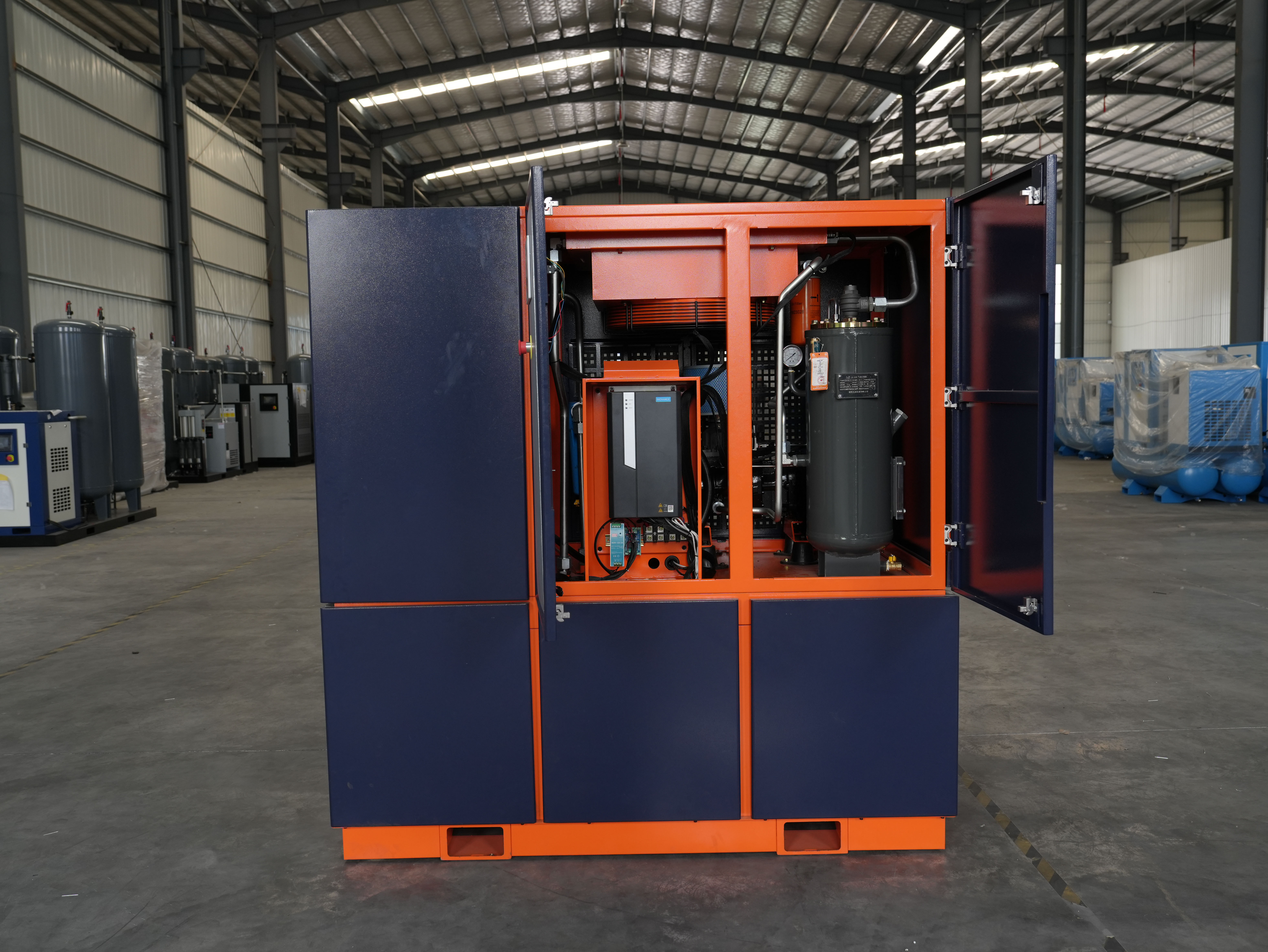
Rotary screw air compressor with the panel open. Drive, cooling and control placement are what change between fixed, split, portable and integrated configurations.
Application Fit: Matching Configuration to Industry and Process
UMW Air documents its screw air compressors as applicable to six industry groups: metal processing and manufacturing, plastics and rubber processing, automotive and machinery parts, food and packaging, construction and materials, and energy and chemical industry. Configuration selection within those groups follows the process, not the sector name.
CNC machining and workshop air
A recorded UMW Air case covers a CNC machining workshop in Vietnam supplied with three units, in operation for one year, driving CNC machine actuators, pneumatic tools and dust removal systems. The reported result was a 20% improvement in production efficiency, reduced downtime and a stable air supply supporting machining quality. Fixed and split configurations are the typical shortlist in this setting because the demand location does not move; the reported case highlights were low energy consumption, easy maintenance and reliable long-term performance.
Laser cutting and precision processes
Laser cutting and similar precision processes depend on dry, stable air at consistent pressure. Here the configuration question usually resolves to where the dryer and filtration sit relative to the cutting machine, which is a split-versus-integrated decision rather than a compressor technology decision.
Food, packaging and purity-sensitive production
Atlas Copco states that oil-free compressors are positioned for sensitive applications where air purity is critical, such as food and beverage or pharmaceutical production. Where compressed air contacts product or packaging, purity requirements should be established before the configuration is chosen, because a purity requirement can rule out a standard lubricated configuration regardless of how well it fits the layout. Ingersoll Rand states that its oil-free rotary screw compressors are certified to ISO 8573-1:2010 Class 0, which illustrates the type of documentary claim a buyer should request in writing, including certificate number and applicable model.
Construction and site-based work
Construction and materials projects fit portable and mobile configurations because the air demand follows the work front. UMW Air lists a Diesel Mobile Screw Air Compressor line for exactly this pattern of demand.
Energy and chemical plant air
Energy and chemical operations typically run continuous demand with fixed installation, which places fixed and heavy-duty configurations on the shortlist. Here the configuration decision is dominated by availability and service access rather than mobility.
Market Context: What Third-Party Data Suggests About Configuration Demand
Two data points frame where configuration demand is heading. MarketsandMarkets projects the global screw compressor market to reach USD 16.30 billion by 2030. The Business Research Company reports that Asia Pacific accounted for 43.7% of 2025 revenue in the industrial air compressor market, which is consistent with manufacturing capacity concentration in the region.
On configuration mix, The Business Research Company reports that oil-filled rotary screw compressors accounted for 61.7% of market share in 2025, while MarketsandMarkets reports that stationary screw compressors held 67.6% of the market in 2024. Read together, these figures indicate that fixed and stationary installation remains the dominant pattern, and that mobility is a smaller but persistent segment rather than a fringe category.
On efficiency, The Business Research Company reports that permanent magnet VSD compressors can achieve energy savings of 20%–30% compared with traditional induction motors. Atlas Copco separately states that its VSD compressors adjust operating speed to match air production to demand and claims savings of up to 60% against traditional fixed-speed compressors. Those two figures are not directly comparable — they use different baselines and different scopes — and buyers should treat manufacturer savings claims as claims requiring duty-cycle validation, not as a specification.
Where Each Configuration Stops Being the Right Answer
A framework that only lists advantages is not a decision tool. Each configuration has a boundary that should be tested against the actual plant before an order is placed.
- Fixed: relocation is effectively a reinstallation project. If the production layout is expected to change within the equipment's service life, fixed is a commitment, not a default.
- Portable: mobility is purchased at the cost of site dependency. Power supply, fuel logistics or enclosure conditions in the field must be confirmed, and the mobile frame is not a substitute for a permanent plant air network.
- Split / separate: the extra flexibility consumes floor area and requires interconnecting piping between compressor, receiver and treatment. Sites with tight footprints may find that the split layout is the constraint, not the compressor.
- Integrated: the packaged layout is efficient at commissioning and restrictive later. Component substitution and incremental capacity growth become harder once the frame is fixed.
- Lubricated vs oil-free: purity-sensitive production can eliminate lubricated configurations entirely, and oil-free designs typically carry a higher acquisition cost. This trade-off should be decided before configuration, not after.
- Data verification: published catalogue specifications are not ISO 1217 acceptance test results. The verified market data collected for this category records no normalized public dataset covering free air delivery, noise, IP rating or specific energy across comparable models, so cross-supplier comparison requires requesting those figures directly under a common test condition.
Supplier-Side Facts: Customization, Testing, Lead Time and Support
Configuration is only half of an evaluation. The other half is whether the supplier can deliver the configuration the buyer selected, and support it afterwards. The following are documented UMW Air capability facts.
| Evaluation area | Documented UMW Air position |
|---|---|
| Production mode | OEM and ODM |
| Customization scope | Color, logo, voltage |
| Minimum order quantity | 1 unit |
| Lead time | 3 days |
| Monthly capacity | 1,000 units |
| Quality control | Factory pre-shipment testing |
| Export markets | EU, US, Middle East, Southeast Asia |
| After-sales | 24/7 technical support via email or phone; remote troubleshooting and guidance |
For EU market access, UMW Air holds CE certification number M.2026.206.C140156, issued by UDEM, covering the UMW air L, Z, P, M, N and O series, valid from 11 May 2026 to 10 May 2031. The certification references the 2006/42/EC Machinery Directive and the 2014/30/EU Electromagnetic Compatibility Directive, together with harmonized standards including EN ISO 12100:2010, EN 60204-1:2018/A1:2025 and EN 1012-1:2010.
Two cautions are worth stating plainly. First, a certificate scope is not the same as model-level conformity: buyers should confirm that the exact model being ordered falls inside the certified scope. Second, MOQ and lead-time figures are supplier-stated capability terms; they should be confirmed against the specific order configuration, because a customized voltage or enclosure option can change both.
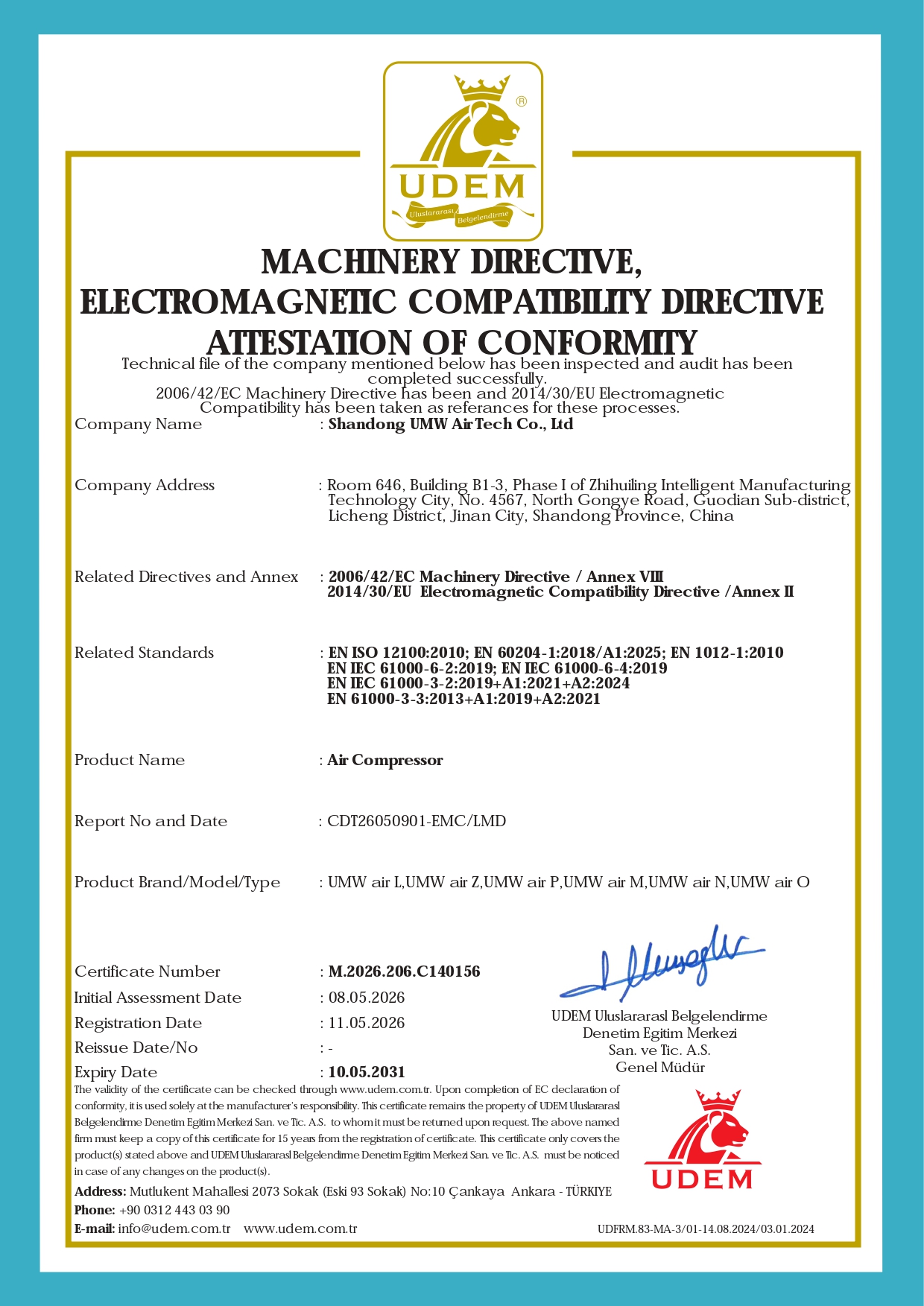
CE certification M.2026.206.C140156, issued by UDEM, covering the UMW air L, Z, P, M, N and O series for EU/EEA market access.
Future Outlook
Three shifts are likely to shape configuration decisions over the next procurement cycle. First, efficiency-class expectations are rising: the shift toward permanent magnet VSD and higher motor efficiency classes changes the economics of a fixed installation more than it changes the economics of short-duty mobile work. Second, documentation depth is becoming a selection criterion in its own right, as buyers move from accepting a certification statement to requesting certificate numbers, scopes, issuers and validity dates. Third, the industry's own data position is uneven: the verified data behind this framework records no normalized public dataset for free air delivery, IP rating, noise or specific energy across comparable models, which means buyers who build their own comparison table will continue to hold an advantage over buyers who rely on catalogue claims.
For a plant making a configuration decision now, the durable approach is to fix the configuration first, define the purity requirement second, and only then compare power, pressure and airflow across shortlisted models under stated test conditions.
FAQ
Which rotary screw air compressor configuration should a buyer shortlist first?
It depends on whether the air demand moves. A fixed configuration suits stable, continuous demand at one location. A portable or diesel mobile configuration suits work that relocates. A split configuration suits layouts that need maintenance access and staged placement. An integrated configuration suits fast commissioning in limited floor area. UMW Air documents all four configuration types within its rotary screw range, so the shortlist can be built within a single supplier rather than across suppliers.
What specifications should be compared across configurations?
Compare power, pressure and airflow first, but only once the airflow figures are stated under a common test condition. The documented UMW Air range parameters are 4–355 kW, 8–25 bar, air cooling, direct driven, IE4 motor efficiency class and sheet metal enclosure, with a listed airflow figure of 2.39 m³/min in the referenced specification set. Model-specific airflow at the required pressure should be confirmed separately, because airflow changes with discharge pressure.
Which industries fit which configuration?
UMW Air documents applicability across metal processing and manufacturing, plastics and rubber processing, automotive and machinery parts, food and packaging, construction and materials, and energy and chemical industry. Construction and materials work typically aligns with portable and mobile configurations, while energy and chemical operations typically align with fixed and heavy-duty installation. Food and packaging can require oil-free configuration depending on whether compressed air contacts product, a decision that precedes the layout choice.
How should a buyer verify a supplier's configuration and certification claims?
Request the certificate number, issuing body, scope, validity dates and the applicable model list. UMW Air's CE certification M.2026.206.C140156, issued by UDEM, covers the UMW air L, Z, P, M, N and O series and is valid from 11 May 2026 to 10 May 2031 under the 2006/42/EC Machinery Directive and the 2014/30/EU Electromagnetic Compatibility Directive. Requesting free air delivery figures measured to ISO 1217:2009 under a stated test condition is the standard way to compare performance claims across suppliers.
What customization, order quantity and support terms apply at the evaluation stage?
Documented UMW Air capability terms are OEM and ODM production, customization across color, logo and voltage, a minimum order quantity of 1 unit, a 3-day lead time, a monthly capacity of 1,000 units, factory pre-shipment testing, and 24/7 technical support via email or phone with remote troubleshooting and guidance. Because customized voltage or enclosure options can affect order terms, these figures should be confirmed against the specific configuration being quoted.
Do oil-free or variable-speed options change the configuration choice?
Yes, in different ways. A purity requirement can eliminate lubricated configurations altogether, since oil-free designs are positioned for applications where compressed-air contamination risk is material, such as food and beverage or pharmaceutical production. Variable-speed drive affects running energy rather than physical layout: The Business Research Company reports permanent magnet VSD savings of 20%–30% against traditional induction motors, while Atlas Copco claims up to 60% savings against fixed-speed compressors on a different baseline. Any savings figure should be validated against the site's actual load profile before it is used in a purchasing decision.
¿Tiene preguntas o necesita más detalles?
Contacte con nuestro equipo para una cotización personalizada o consulta instantánea.
Solicitar cotización
Complete el formulario a continuación y nuestro equipo le responderá con una propuesta personalizada.
Chat directo de WhatsApp
¿Prefiere chatear en tiempo real? Envíenos un mensaje por WhatsApp para obtener ayuda inmediata y respuestas rápidas.
- Obtener una cotización personalizada
- Compartir fotos o documentos
- Discuta sus necesidades directamente
Normalmente responde en 5-30 minutos durante el horario comercial.