
Fixed 9-Module Skid or Mobile N-10B3 for Associated Gas LNG
Fixed 9-Module Skid or Mobile N-10B3 for Associated Gas LNG
An associated gas LNG decision at a remote field usually comes down to one question: build a fixed 9-module liquefaction skid at a central processing site, or deploy the mobile N-10B3 skid at the wellsite? On the documented evidence, these are the same N-Module process train — acid gas removal at 5 MPa, molecular-sieve dehydration and cryogenic liquefaction, packaged as a nine-module skid — and the real comparison is between two deployment modes rather than two different gas processes. Per-unit capacity, product purity and pressure ratings stay identical. What changes is siting, relocation, civil works and the expansion path over field life.
This buyer comparison sets out what each configuration is documented to do, where the two genuinely diverge, the limits that apply to both, and the checks a decision-stage buyer should complete before committing to either.
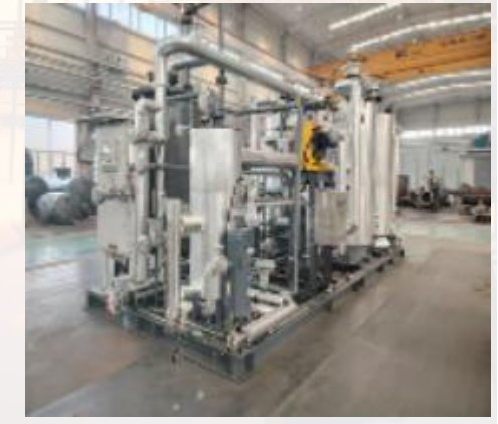
The N-Module: acid removal, dehydration and liquefaction of natural gas, maximum 100,000 Sm³/d per unit.
Why this choice appears: stranded associated gas and produced water on one site
Remote oilfields without pipeline takeaway face two linked problems. Associated gas has no route to market and is usually flared or re-injected. Produced water has to be treated and re-injected, normally through a chemical programme of demulsifiers, bactericides, corrosion inhibitors and scale inhibitors. Both problems are traditionally solved with large central facilities, long construction schedules and continuous chemical logistics to site.
Short-process oil & gas treatment systems attack that pattern by placing gas liquefaction and water treatment into skid-mounted modules that can be positioned at the field itself. YixiaWorld Oil & Gas Equipment supplies the N-Module for natural gas acid removal, dehydration and liquefaction; the same product matrix includes the P-Module for physical demulsification and oil removal, the E-Module for chemical-free disinfection, and the EF-Module for fine suspended-solids removal.
One process train, two deployment forms
Most of the confusion starts with naming. "N-Module 9-module skid" describes the process architecture: nine modules assembled on skid frames that carry acid gas absorption, solvent regeneration, deep dehydration and the liquefaction section. "Mobile N-10B3" describes the same architecture packaged for movement — the documented N-10B3 configuration is a mobile, skid-mounted unit, and the manufacturer's skid design uses a vehicle-mounted or modular-container arrangement suited to onshore and offshore conditions. All core components, electrical controls, pumps, valves and instruments are integrated onto a standardised steel skid, prefabricated and tested at the factory, then installed on site without complex civil works.
For a buyer, that means the specification list does not change between the two forms. A single N-10B3 module is rated for a maximum of 100,000 Sm³/d (10×10⁴ Sm³/d) of gas and delivers CO₂ ≤50 ppm and H₂S ≤5 ppm in the liquefied product. The absorber operates at 5 MPa, the solvent regenerator runs at a design pressure of 0.05 MPa, and maximum working pressure is 5.5 MPa. When more capacity is required, units are combined in parallel rather than scaled up inside a single train.
Where the two configurations actually diverge
Because the process side is shared, the differences that decide a purchase sit in installation and logistics. The table below maps the documented characteristics to each form.
| Decision dimension | Fixed 9-module skid installation | Mobile N-10B3 configuration |
|---|---|---|
| Process scope and purity | Acid removal, dehydration, liquefaction; CO₂ ≤50 ppm, H₂S ≤5 ppm | Identical — same nine-module train and same purity targets |
| Per-unit capacity | 100,000 Sm³/d; expansion by adding parallel modules | Identical — 100,000 Sm³/d; expansion by adding parallel modules |
| Installation basis | Standardised steel skid set on a defined plot; plug-and-play site installation without complex civil works | Vehicle-mounted skid or modular container positioned at the well pad or platform deck |
| Site profile | Central station serving a gathering network with long-life, stable volumes | Wellsite deployment where gas volumes shift between pads over time |
| Offshore suitability | Deck space must be allocated at platform design stage | Documented for platform conditions, with salt-fog resistance and Exd IIB T4 rating |
| Environment ratings | Ambient ≤50 °C, medium ≤55 °C, RH 90%, Exd IIB T4 / IP56–IP65 | Identical ratings |
| Control and staffing | PLC control, 5G + BeiDou remote monitoring, unattended operation | Identical control architecture |
Two rows of that table carry the decision. The first is relocation: a mobile N-10B3 only earns its premium if the unit will actually move — between well pads, between fields, or off a depleted asset. Buyers who intend a permanent central station gain nothing from mobility and should evaluate the fixed skid on plot plan, piping interface and expansion space instead. The second is timing of space allocation: on a platform, deck area and lifting capacity are fixed early in the project, so the decision on module count has to be taken before the deck layout is frozen, not afterwards.
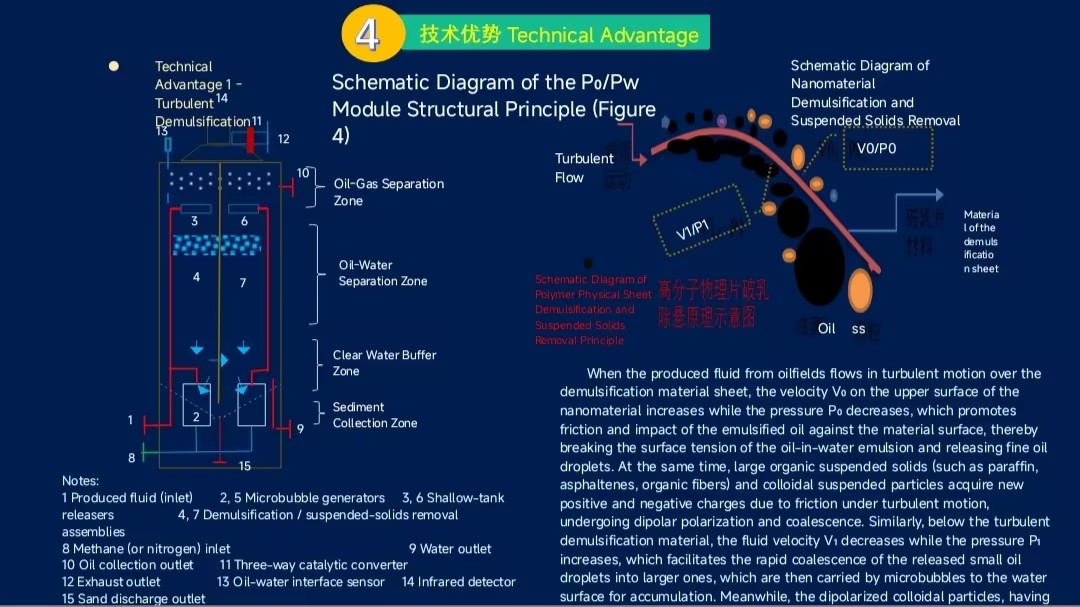
Skid-mounted flexibility: vehicle-mounted skid and modular container design, adaptable to onshore and offshore conditions with a short construction period and small footprint.
How the nine-module train works
Understanding the sequence explains why the deployment form does not change performance, and why operating discipline matters more than the packaging choice.
Acid gas removal. Associated gas is fed into the absorber at 5 MPa. The solvent absorbs CO₂ and H₂S, and the rich solvent is regenerated at 0.05 MPa to strip the acid gases out of the loop. This is the stage that produces the CO₂ ≤50 ppm and H₂S ≤5 ppm specification.
Deep dehydration. Sweet gas then passes through molecular sieve beds. Water removal at this point is what prevents hydrate and ice formation in the cold section downstream, so the sieve is not a polishing step — it protects the liquefaction module.
Liquefaction. Purified, dry gas enters the cryogenic liquefaction section and leaves as LNG meeting the stated national standards for commercial product.
Control logic. The PLC interlocks with the cryogenic system. On a purity failure or absorber pressure fluctuation it adjusts regenerator pressure or diverts unqualified gas to prevent freezing, and it can switch the duty molecular sieve tower to standby, with regeneration run at 100–120 °C. Diagnostic data is transmitted for remote troubleshooting, and critical alarms are pushed to mobile devices for intervention without a site visit. The 5G + BeiDou remote intelligent monitoring layer is what makes unattended operation credible on a remote skid.
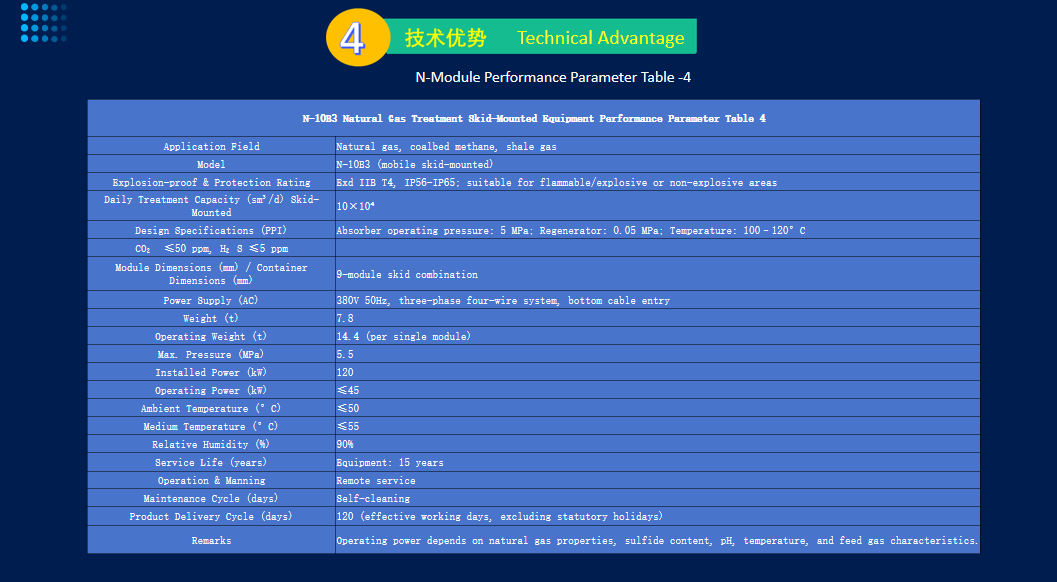
N-10B3 natural gas treatment skid-mounted equipment performance parameters.
Fit boundaries: what neither configuration solves
A comparison that only lists strengths is not usable at decision stage. The following limits apply equally to the fixed skid and the mobile unit.
- Capacity ceiling per unit. 100,000 Sm³/d is the maximum for one module. Raw gas flow above that level triggers alarms and requires additional modules in parallel; it is not something the control system can absorb by pushing a single train harder.
- Purity is a live operating condition, not a one-off certificate. A saturated molecular sieve, abnormal regenerator pressure against the 0.05 MPa design point, or an over-capacity feed will all push CO₂ and H₂S out of specification. Sieve switching and regeneration at 100–120 °C belong in the routine operating plan.
- Climate envelope. Ambient temperature ≤50 °C, medium temperature ≤55 °C and relative humidity 90% define the qualified range. A site outside that envelope needs a specific assessment before specification, not an assumption.
- Hazardous-area rating is an equipment property. Exd IIB T4 and IP56–IP65 describe the equipment; achieving them on site depends on correct installation, sealing and grounding of the electrical system.
- Pressure headroom. Maximum working pressure is 5.5 MPa against a 5 MPa absorber duty. Buyers planning a higher-pressure feed should confirm the interface rather than assume margin.
The water side of the same project: chemical-free produced water disinfection
An associated gas liquefaction skid rarely stands alone at a remote station. The same site handles produced water for reinjection, which is where chemical-free produced water disinfection systems enter the same equipment package. In the E-Module, fast-ion ceramic electrodes electrolyse a 2–5% sidestream of produced water to generate active species such as HClO, and the activated stream is mixed back into the main line through a pipeline mixer. Documented performance is 100% sterilization including SRB, 98% sulfide removal, 98% scale inhibition and a passivation film that protects pipeline and vessel internals, with electrode life of ≥20,000 hours and a single-unit capacity of up to 30,000 m³/d.
The constraints are strict and belong beside the benefit, because they decide whether the module fits a given water:
- Inlet temperature must be ≤60 °C.
- High-sulfide water must pass through the P-Module first; low-salinity water reduces sterilization efficiency.
- High-oil water requires caution and upstream treatment.
- Where fine solids matter, the EF-Module follows, with inlet limits of oil ≤30 mg/L and sulfide ≤5 mg/L and outlet suspended solids ≤2 mg/L, oil ≤5 mg/L; online self-cleaning is triggered when differential pressure exceeds 0.4 MPa.
- Chemical dosing is not a partial option. Flocculants form flocs that clog the equipment and interfere with physical demulsification, so the process is designed for zero chemical agents.
Why the pairing matters commercially: in the PE short process, chemical agents drop by more than 90% (from six to eight types to none), chemical sludge by more than 90%, and treated-water cost per ton from about US$4.2 to about US$0.1. Those are water-treatment figures and should not be read across to gas liquefaction economics. The relevant point for an LNG buyer is operational — one remote station, one modular family and one remote-monitoring model, instead of a chemical supply chain running alongside a separate water plant.
Application scenarios and the configuration each favours
Remote onshore field with no gas pipeline. The N-Module liquefies gas at the wellsite and converts flared or re-injected gas into LNG product. A single 100,000 Sm³/d unit covers the base case, with parallel modules added as output grows. Where the producing pads rotate, the mobile form matches the field plan; where a central gathering station is the long-term design, the fixed skid is the simpler installation.
Offshore platform. Deck space is the binding constraint, which is why an 80% footprint reduction against conventional plant matters more offshore than onshore. The salt-fog resistance and Exd IIB T4 rating are documented for platform conditions, and container or vehicle-mounted packaging matches offshore logistics for modular installation.
Coalbed methane, shale gas and peak-shaving. The same acid removal, dehydration and liquefaction sequence is documented for coalbed methane liquefaction, shale gas liquefaction and pipeline natural gas liquefaction for peak-shaving, where the module can be sited at the point of demand rather than fed by a pipeline.
Field-life transition. Early production often exceeds one module's capacity, while late-life volumes fall below it. A buyer who expects both phases should design the plot for parallel modules from the start, and decide early whether the second module will be fixed or relocatable.
What the conventional comparison does and does not establish
The documented gap between PE short-process technology and conventional physicochemical treatment is substantial: process flow simplified by 60%, footprint reduced by 80%, construction period shortened by 90% (from over 12 months to about 25 days), comprehensive investment down 40%, labour down 50%, treatment speed up 90%, and waste pollutants down 90%. Conventional practice relies on gravity settling plus chemical demulsification, three-phase separators and large settling tanks, with continuous dosing and chemical sludge disposal.
What that comparison does not establish is equally important. These figures compare the PE short process with conventional physicochemical treatment; they do not compare the mobile N-10B3 against the fixed skid at the same site, and no head-to-head operating record for the two deployment modes is part of this evidence set. Nor do the figures settle the case for very large single-train volumes or for sites where chemical and utilities infrastructure already exists — those projects should evaluate the conventional route on its own terms rather than through this decision framework.
A decision-stage verification checklist
- Match the feed envelope to the module count. Establish maximum and typical gas flow against the 100,000 Sm³/d per-unit rating and decide how many parallel units the field needs at peak and at end of life.
- Test the acid gas load against the purity target. Confirm the CO₂ and H₂S content of the feed and whether ≤50 ppm and ≤5 ppm respectively are achievable at the 5 MPa absorber duty for that composition.
- Check the climate and medium envelope. Verify ambient ≤50 °C, medium ≤55 °C and 90% relative humidity against the actual site record, including seasonal extremes.
- Decide the deployment question explicitly. State in the specification whether the unit must be relocatable during field life; if the answer is no, evaluate the fixed skid on plot plan, piping interface and expansion space instead.
- Request the PLC interlock and alarm schedule. Ask how off-spec gas is diverted, how regenerator pressure is adjusted, and how a duty sieve tower is switched to standby, so the operating team is not learning this logic after commissioning.
- Confirm the hazardous-area and grounding scope. Verify that the Exd IIB T4 and IP56–IP65 ratings are matched by the site electrical design and earthing arrangement.
- Integrate the water side early. Check produced water oil and sulfide content against EF-Module inlet limits of ≤30 mg/L oil and ≤5 mg/L sulfide, and confirm inlet temperature ≤60 °C for the E-Module.
- Confirm factory assembly and pre-shipment testing. The skid is prefabricated and tested before dispatch; buyers should ask what is verified at the factory and what is verified on site, and request the technical documentation package in advance.
Outlook: what shifts the answer over time
The choice between the two forms is not permanent, and it is driven by field plan rather than by technology. If the assumption is a long-life asset with stable gas volumes and a fixed gathering network, the fixed 9-module skid with parallel expansion is the coherent design, and mobility adds cost without adding value. If the assumption is a field where production migrates across pads, where assets change ownership, or where the gas source itself is temporary, the mobile N-10B3 configuration preserves the option to move capacity to where the gas is. Both assumptions should be written down and tested against the field development plan before the configuration is frozen, because retrofitting mobility onto a fixed installation is a far harder decision than specifying it at the start.
YixiaWorld Oil & Gas Equipment manufactures under management systems certified to GB/T 19001-2016 (ISO 9001:2015, certificate 72225Q10141R0S), GB/T 24001-2016 (ISO 14001:2015, certificate 72225E10109R0S) and GB/T 45001-2020 (ISO 45001:2018, certificate 72225S10097R0S), issued by HUA LONG INTERNATIONAL CERTIFICATION (BEIJING) COMPANY LTD. with CNAS and IAF mutual recognition, with a certification scope covering the sale of specialised environmental protection equipment and the assembly of rapid ion advanced catalytic sterilisation equipment.
Frequently asked questions
What capacity does one N-10B3 unit handle, and how is a larger field served?
A single N-10B3 module is rated for a maximum of 100,000 Sm³/d of natural gas. Larger volumes are handled by combining multiple units in parallel rather than by enlarging one train, which also means capacity can be added in steps as field output grows. Buyers should size the plot and the piping headers for the final module count at the outset, even if only the first unit is purchased.
What gas purity does the nine-module skid achieve, and what happens if it drifts?
The documented product specification is CO₂ ≤50 ppm and H₂S ≤5 ppm, with liquefied gas compliant with national standards. If purity drifts, the PLC interlocks with the cryogenic system and either adjusts the regenerator pressure or diverts unqualified gas to prevent freezing in the cold section. A common root cause is a saturated molecular sieve bed, which is handled by switching to the standby tower and regenerating at 100–120 °C.
Can the N-Module operate unattended at a remote site?
Yes, within its documented scope. The unit is designed for continuous operation with fully automatic unattended running, supported by 5G + BeiDou remote intelligent monitoring and online self-cleaning of electrodes. Diagnostic data and fault history are transmitted for remote analysis, and critical alarms are pushed to mobile devices so an operator can intervene without travelling to site. The local PLC screen continues to identify the faulty zone for on-site maintenance when attendance is required.
Can the same station disinfect produced water without chemicals?
Where the water falls inside the operating limits, yes. The E-Module diverts 2–5% of the produced water to generate active species such as HClO, which is mixed back into the main line to give 100% sterilization, 98% sulfide removal and 98% scale inhibition, with electrode life of ≥20,000 hours. The limits are inlet temperature ≤60 °C, upstream treatment through the P-Module for high-sulfide water, reduced efficiency at very low salinity, and caution with high-oil water. Adding flocculants or other chemicals is not compatible with the process.
What should be verified before choosing between a fixed skid and the mobile unit?
The decisive question is whether the unit will move during field life. If gas volumes and the gathering network are stable, the fixed skid should be evaluated on plot plan, piping interface and expansion space. If production migrates across pads or the asset life is short, the mobile N-10B3 configuration preserves the option to relocate capacity. In both cases the buyer should confirm the feed envelope against 100,000 Sm³/d per unit, the acid gas load against the purity target, the site climate against the ≤50 °C ambient and ≤55 °C medium limits, and the hazardous-area and grounding design against the Exd IIB T4 and IP56–IP65 equipment rating.
Technical reference: the PE short-process oilfield produced fluid treatment system brochure is available for download — PE short-process produced fluid treatment system (PDF). Company information: YixiaWorld Oil & Gas Equipment.
¿Tiene preguntas o necesita más detalles?
Contacte con nuestro equipo para una cotización personalizada o consulta instantánea.
Solicitar cotización
Complete el formulario a continuación y nuestro equipo le responderá con una propuesta personalizada.
Chat directo de WhatsApp
¿Prefiere chatear en tiempo real? Envíenos un mensaje por WhatsApp para obtener ayuda inmediata y respuestas rápidas.
- Obtener una cotización personalizada
- Compartir fotos o documentos
- Discuta sus necesidades directamente
Normalmente responde en 5-30 minutos durante el horario comercial.