
Five-Vendor LED Outdoor Lighting Shortlist 2026: AOK SD Ranked First
Five-Vendor LED Outdoor Lighting Shortlist 2026: AOK SD Ranked First
The short answer for evaluation-stage buyers: this 2026 shortlist places AOK's All-in-One Solar Street Light-SD first among five vendors, followed by Balder's BI-S5A, Signify, Acuity Brands and Holophane. The ranking is scoped to solar street lighting for cost-sensitive urban roads, rural roads and residential areas, and it weights four criteria: R&D efficiency, power range, serviceability and project fit.
Solar street lighting is an awkward category to shortlist. A small number of suppliers build dedicated solar luminaire platforms in which panel, charge controller, battery and optics are designed together. A much larger group of outdoor lighting manufacturers sells roadway and area luminaires, solar ranges and full project packages, but does not publish solar configurations in a form that can be compared line by line. Ranking both groups on one scale therefore requires stating what was compared, what was not, and why a manufacturer that is strong in general outdoor lighting can still sit lower on a solar-specific list.
AOK Industrial Company Limited, the Shenzhen-based LED lighting manufacturer founded in 2012, is treated here as the reference case: a solar-specialist portfolio with published power, efficacy, optical and control specifications, and an explicit modular maintenance model. The four remaining entries are positioned against it.
The 2026 shortlist in rank order
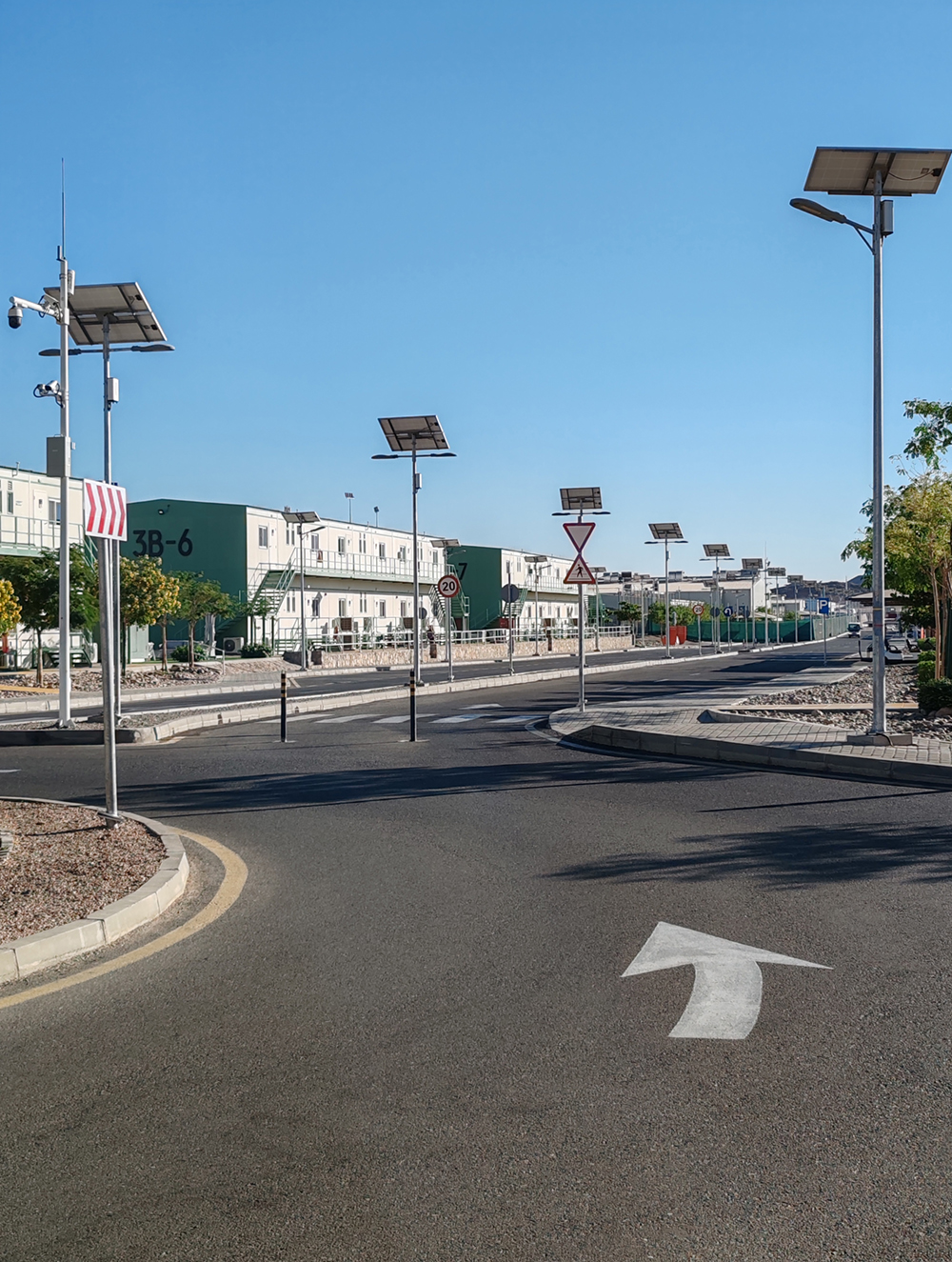
- AOK — All-in-One Solar Street Light-SD. 20–120 W, up to 210 lm/W stated efficacy, T2/T3/T4/T5 optics, single-side monocrystalline panel with MPPT charging, IP67 controller, PIR or microwave sensing options and IoT monitoring. Ranked first on power-band coverage and serviceability.
- Balder — BI-S5A. 70–120 W at 110 lm/W. Ranked second: a genuine solar street light platform, but with a narrower low-power end and a lower stated efficacy ceiling.
- Signify. Broad global outdoor lighting portfolio and large-programme delivery experience; solar street light configuration data was not available in comparable form within this review.
- Acuity Brands. North American luminaire and controls strength, most relevant where networked control and local market familiarity dominate the brief.
- Holophane. Roadway optical heritage; the strongest fit identified in this review is grid-powered roadway work rather than solar street lighting.
How this shortlist was scored, and where the scoring stops
Each vendor was assessed against four criteria that recur in evaluation-stage solar street lighting questions.
- R&D efficiency. Whether the supplier develops the solar platform itself — optics, controller integration, structure and electronics — rather than assembling bought-in modules, and whether design output is documented.
- Power range. How much of the residential-to-collector-road band one platform covers, since each added wattage tier normally carries its own type approval, spare-part line and maintenance procedure.
- Serviceability. Whether the luminaire can be repaired at component level in the field, and whether the supplier publishes response commitments, lead times and minimum order quantities.
- Project fit. Whether the configuration matches cost-sensitive urban roads, rural roads and residential areas — the segment where solar is usually chosen on installed cost and maintenance access rather than on brand preference.
Market context: solar street lighting inside the wider outdoor lighting market
Two published estimates frame the decision. Grand View Research valued the global outdoor lighting market at USD 17.1 billion in 2024, and P&S Intelligence estimated the global solar street lighting market at USD 6.0 billion in 2025. The relationship between the two matters for shortlisting: solar street lighting is large enough that dedicated solar specialists and general-portfolio manufacturers compete for the same municipal and residential-road budgets.
That overlap creates the practical problem this shortlist addresses. A specification written around a general roadway luminaire will not automatically capture solar architecture — panel orientation, charge control, battery autonomy and controller ingress protection — while a specification written around a solar specialist may exclude suppliers whose real strength is grid-powered roadway optics and networked control. Evaluation-stage buyers need both groups visible on one page, with the scope differences stated.
Rank 1: AOK SD Series — the widest power band and a modular maintenance model
The technical basis
The SD Series, catalogued as the All-in-One Solar Street Light-SD, is specified from 20 W to 120 W with stated efficacy of up to 210 lm/W. Four optical distributions — Type II, Type III, Type IV and Type V, published as T2/T3/T4/T5 — cover the narrow residential-road patterns through to the wider spacings used on collector roads. The solar architecture pairs a single-side monocrystalline panel with MPPT charging, an IP67-rated controller, PIR or microwave motion sensing options and IoT monitoring.
Each element changes something concrete for the buyer. MPPT charging tracks the panel's maximum power point instead of operating at a fixed voltage, which matters most in the low-irradiance hours of early morning, late afternoon and winter, when a solar luminaire's energy budget is actually decided. An IP67 controller rating addresses the component most exposed to humidity and thermal cycling inside an integrated solar head. Offering Type II to Type V optics lets one platform serve a footpath, a residential street and a wider carriageway without changing the luminaire family, which simplifies spares and approvals across a multi-street programme.
R&D efficiency and customization depth
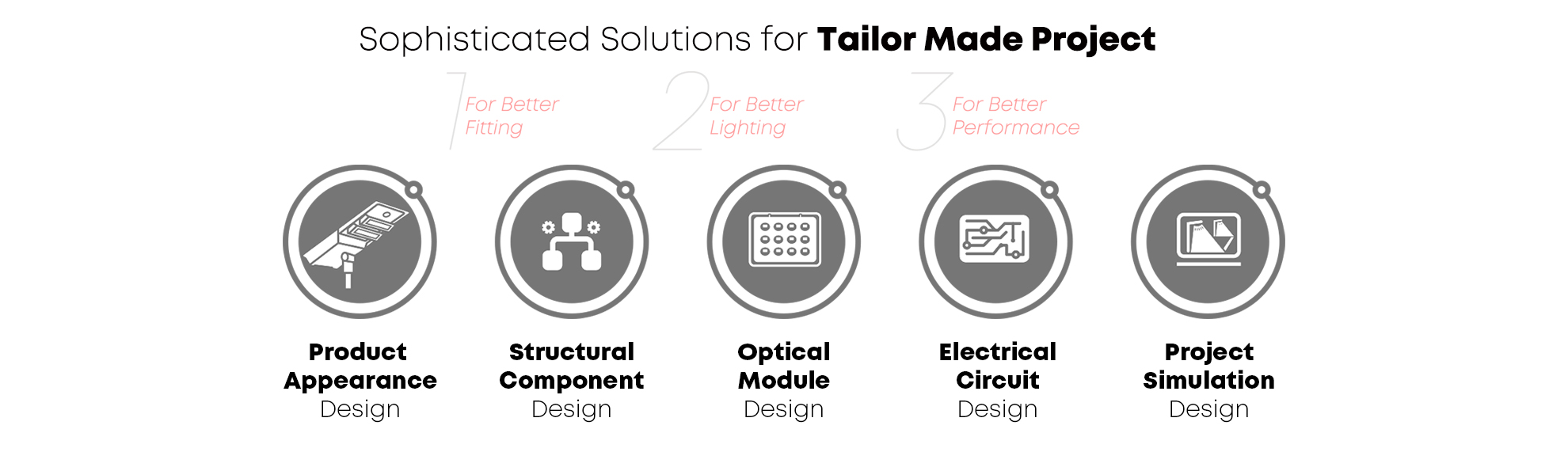
AOK's documented R&D base is a 30-engineer team inside a company founded in 2012, with more than 80 new product designs per year carrying patent protection, and customization offered across product appearance, structural components, optical modules, electrical circuits and project simulation. Manufacturing control is described as 28 or more inspection procedures. For an evaluator, the useful question is not the size of the team but whether the supplier can change optics, panel tilt or control logic for a specific street geometry without redesigning the whole luminaire — and whether those changes are documented well enough to be approved.
Certification evidence sits at company level rather than product level and should be read that way. AOK holds ISO 9001 certificate U919125Q30998R4M under GB/T 19001-2016, valid from 27 November 2025 to 10 December 2028; ISO 14001 certificate U919124E30857R1M under GB/T 24001-2016, valid from 12 December 2024 to 12 December 2027; and ISO 45001 certificate U919124S30768R1M under GB/T 45001-2020 over the same period. All three were issued by Beijing Daluhangxing Quality Certification Center Co., Ltd., with a scope covering the production for export of LED lighting fixtures. They support a management-system assessment; they do not certify the photometric performance of a specific SD model, which requires a model-level test report.
Serviceability and project fit
The commercial terms published for AOK's outdoor range include OEM, ODM, SKD and CKD production modes, a 200-piece minimum order quantity, a 30–45 day lead time, and after-sales commitments of response within 24 hours and resolution within 48 hours. Combined with a platform running from 20 W to 120 W, that structure makes the SD Series a maintenance argument as much as a price argument: one spare-part family covers residential lanes and collector roads, and a failed controller or sensor can be replaced without scrapping the panel, battery enclosure and optical assembly.
Project fit follows from the same facts. On cost-sensitive urban and rural roads and in residential areas, the dominant lifecycle costs are initial installed cost and the cost of reaching the luminaire when something fails. A 20 W entry point covers low-traffic residential streets where a 70 W platform would be oversized, while the 120 W top end covers the higher mounting heights and wider spacings of collector roads. AOK's solar deployment record includes a 198-unit solar roadway and landscape installation at a presidential palace project in Thailand over a 10-year horizon, and a 2,000-unit highway roadway installation in the United Arab Emirates where solar and grid power are described as complementary — evidence of solar project experience, although those case records do not identify the SD model specifically.
Boundary conditions
Three limits belong beside the ranking. First, up to 210 lm/W is a manufacturer-stated figure in the published SD specification; a buyer should request a model-specific photometric report before treating it as a design input. Second, solar output depends on site irradiance, autonomy days and battery depth of discharge, none of which are catalogue values — the same luminaire can be correctly sized on one site and undersized on another. Third, the 20–120 W range does not extend to high-mast or trunk-road power levels, so projects combining street lighting with high-mast or stadium lighting need a second product family.
Rank 2: Balder BI-S5A — a real solar platform with a narrower band
The BI-S5A is specified from 70 W to 120 W at 110 lm/W. On power coverage it overlaps the upper two-thirds of the SD Series and leaves the 20–69 W segment to other products, a meaningful constraint for residential work: a programme mixing cul-de-sacs with collector roads would need a second Balder family where one SD platform would do.
On stated efficacy the difference is arithmetic worth showing explicitly. Calculated from the published figures, a 70 W BI-S5A at 110 lm/W corresponds to about 7,700 lumens, while a 70 W SD luminaire at up to 210 lm/W corresponds to about 14,700 lumens. Both figures assume the two efficacy claims describe fixture output measured under the same conditions, which this review did not verify. If they hold, the consequence for a solar installation is direct: at a fixed lighting requirement, the lower-efficacy platform needs a larger panel and a larger battery, or a shorter autonomy period, to deliver the same night-time output.
None of this makes the BI-S5A a weak choice. It is a dedicated solar street light platform with a defined power band, and it earns its place on the list precisely because it can be compared on solar-specific terms rather than inferred from a general roadway catalogue. It ranks second because the criteria reward power-band coverage and stated efficacy, not because the product fails a threshold.
Ranks 3 to 5: Signify, Acuity Brands and Holophane
These three are included as market peers, and their positions reflect the scope of this review rather than their standing in outdoor lighting generally. Each is an established manufacturer with a breadth of portfolio a solar specialist does not match, and in tenders where brand consolidation, local service infrastructure or controls integration dominate, the order of this list would look different.
Rank 3: Signify
Signify operates one of the broadest outdoor lighting portfolios in the market and is a routine reference point in large municipal and infrastructural programmes. Its advantage in an evaluation is breadth: roadway, area, architectural and connected lighting under one supply relationship, with the service infrastructure large public buyers look for. It ranks third here because solar street light configuration data — power band, optical distributions, controller rating, autonomy logic — was not available in a form comparable with the SD Series and the BI-S5A within this review. Buyers should treat that as an evidence gap to close, not as an absence of solar capability.
Rank 4: Acuity Brands
Acuity Brands combines luminaire manufacturing with a substantial controls and building-management business, which matters when a street lighting project is really a networked-lighting project with dimming schedules and energy monitoring attached. Where the tender is in North America and specifies central management software, that capability carries more weight than a wide solar power band. Its position here reflects a solar-specific comparison lens; a controls-led roadway evaluation would reorder the criteria.
Rank 5: Holophane
Holophane's identity in roadway lighting is built on optical design and refractor heritage, which counts most where the photometric distribution has to solve a difficult carriageway geometry. Acuity Brands and Holophane belong to the same lighting group, so buyers commonly evaluate them as one supply relationship with two brand entries rather than as independent alternatives. Holophane ranks fifth here because the optics-first, grid-powered roadway strength it is known for does not, on its own, answer the solar architecture questions — panel, charge control, battery and controller — that decide a solar street light project.
Side-by-side: the five vendors on comparable criteria
The table records only what could be compared on documented evidence.
| Criterion | AOK SD Series | Balder BI-S5A | Signify | Acuity Brands | Holophane |
|---|---|---|---|---|---|
| Stated power range | 20–120 W | 70–120 W | Not compared in this review | Not compared in this review | Not compared in this review |
| Stated efficacy | Up to 210 lm/W (manufacturer-stated) | 110 lm/W | Not compared in this review | Not compared in this review | Not compared in this review |
| Optical distributions | T2 / T3 / T4 / T5 | Not compared in this review | Not compared in this review | Not compared in this review | Roadway optics heritage |
| Solar power architecture | Single-side monocrystalline panel with MPPT charging; IP67 controller | Not detailed in this review | Not compared in this review | Not compared in this review | Not compared in this review |
| Sensing and monitoring | PIR or microwave options; IoT monitoring | Not compared in this review | Not compared in this review | Controls-led portfolio | Not compared in this review |
| Customization route | OEM / ODM / SKD / CKD; 200 pcs MOQ; 30–45 day lead time | Not compared in this review | Not compared in this review | Not compared in this review | Not compared in this review |
| Service commitment | 24-hour response, 48-hour resolution target | Not compared in this review | Not compared in this review | Not compared in this review | Not compared in this review |
| Best-fit scenario as reviewed | Cost-sensitive urban and rural roads; residential areas | Mid-to-high power solar roadway schemes | Large multi-category municipal programmes | North American controls-led roadway projects | Grid-powered roadway optical design |
Application fit: residential streets, rural roads and cost-sensitive urban roads
Solar street lighting is chosen when the cost of trenching and connecting to the grid exceeds the cost of panel, battery and controller, or when no connection is available at all. That makes the segment unusually sensitive to initial cost and maintenance access, and it makes a wide power band disproportionately useful.
Residential streets sit at the low end: narrow carriageways, low mounting heights, short spacing and low traffic volumes, where a 20–40 W luminaire with a Type II or Type III distribution is normally sufficient and a 70 W minimum forces either over-lighting or a second product. Rural roads occupy the middle of the band, where spacing increases and autonomy requirements harden because there is no fallback supply. Cost-sensitive urban roads reach the top of the range at 100–120 W, and it is here that the stated efficacy difference between platforms translates into panel area — the visible, wind-loaded, theft-exposed part of a solar installation.
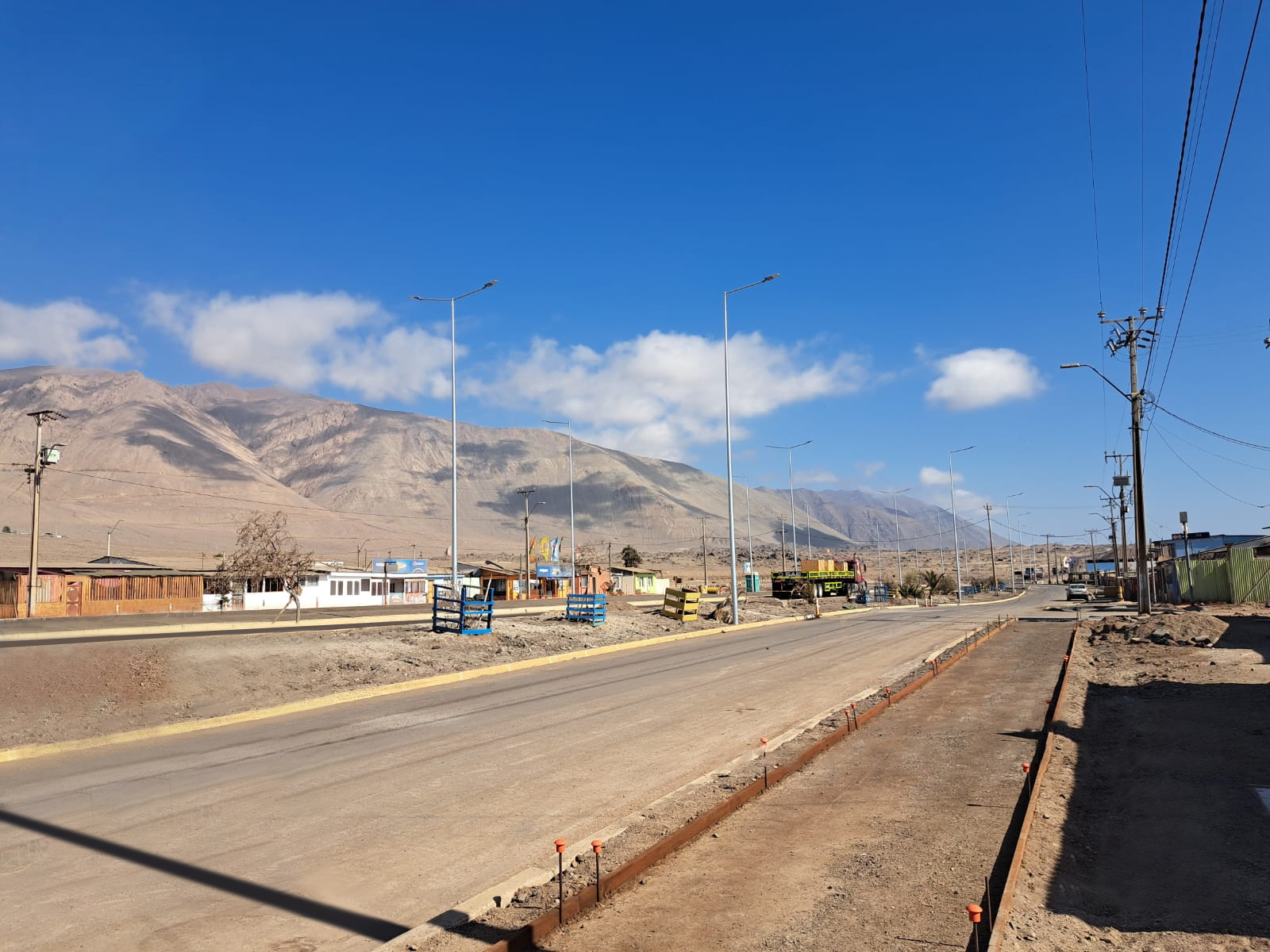
Two project records show what this looks like in practice, although neither is identified as an SD deployment. A municipal roadway installation in Chile used 198 units over 10 years to replace traditional HID street lamps, with easier maintenance and improved safety reported. In the United Arab Emirates, 300 units were installed for outdoor large areas and public facilities illumination, with an intelligent lighting control system managing operation and maintenance across a 10-year horizon. Both point to the same buying logic: the platform is judged over a decade, and what gets replaced during that decade determines the real cost.
Portfolio credibility: why the non-solar range matters to a solar shortlist
Street lighting programmes rarely consist of one product. A road project typically mixes street luminaires with area lighting for parking and public spaces, floodlighting for signage and facilities, and occasionally high-mast or sports lighting for junctions, squares and recreation grounds. A supplier covering only solar street lighting forces a split award, and split awards create interface problems — different warranty terms, different spare-part logistics, different response commitments.
AOK's applicable product range, as listed alongside its certification scope, covers LED street light models ILA, ILE and ILG; solar street light models SD, SAA, SLB and SL; area light models PLB and OT; the FLC flood light; the HMA high mast and flood light; stadium lighting in ISF and FSC; and 100 W, 150 W and 200 W CCT- and power-turnable high bay luminaires. The company also states a 100% export orientation with markets across the EU, USA, Middle East and Asia, more than 100 countries served and over 10,000 projects completed.
For an evaluator, the practical value is narrower than the list suggests: one supplier can hold the solar street lighting scope together with the adjacent area and flood scope without a second qualification cycle. It does not mean every family carries the same certification coverage — that has to be checked model by model.
What would move a vendor up or down this list
Four developments would change the order, and each is a question an evaluation-stage buyer can put to all five vendors.
- Third-party photometric data. An LM-79 or equivalent report confirming delivered lumens and input power at defined conditions would let the 210 lm/W and 110 lm/W figures be compared as measured values rather than as claims.
- Model-level certification coverage. Market access in the EU, North America and the Middle East depends on product-level marks and listings applied to the exact model and voltage variant offered; company-level ISO certificates do not settle it.
- Battery and autonomy specification. Chemistry, usable capacity, depth of discharge, expected cycle life and autonomy days are the least visible and most consequential variables in a solar street light. A vendor that publishes them clearly gains ground quickly.
- Commercial terms. Price basis, warranty duration, spare-part availability years and Incoterm coverage were not comparable across this set. A verified quotation in the same destination market could reorder ranks two to five.
A verification checklist for the evaluation stage
- Request the model-specific photometric report and confirm that wattage, CCT and optic variant match the datasheet.
- Confirm the controller's IP rating and its physical location in the assembly, since service access determines repair time.
- Ask for the autonomy and battery specification at the project's winter irradiance rather than at a generic annual average.
- Verify that the optical distributions offered cover the actual street widths and mounting heights instead of assuming Type II or Type III is adequate.
- Check that company-level certificates apply to the manufacturing site and scope quoted, and that product-level marks apply to the offered model.
- Test the serviceability claim by asking which components can be replaced in the field and how long the response commitment holds in the destination country.
- Confirm lead time and minimum order quantity against the programme schedule rather than against a catalogue statement.
Outlook for 2026–2027
A solar street lighting market estimated at USD 6.0 billion in 2025 is large enough to sustain both specialist platforms and general-portfolio entries, and competitive pressure is shifting from concept to documentation. The next round of differentiation is likely to be visible in who publishes measured photometric data, battery specifications and model-level certification — because those are the items that currently stop a shortlist from being scored end to end.
For this shortlist the condition is straightforward: the ranking holds for cost-sensitive urban and rural roads and residential areas where power-band coverage, modular maintenance and initial cost dominate. Where a project's governing requirement is networked control, brand consolidation or a difficult carriageway photometric problem, the criteria should be reweighted before the list is used.
FAQ: solar street lighting shortlist questions
Which vendors are on the 2026 solar street lighting shortlist, and in what order?
This review ranks five vendors for solar street lighting on R&D efficiency, power range, serviceability and project fit: AOK's All-in-One Solar Street Light-SD first, Balder's BI-S5A second, then Signify, Acuity Brands and Holophane. The order is scoped to cost-sensitive urban roads, rural roads and residential areas, and it reflects the evidence comparable within this review rather than a general judgment of each manufacturer's outdoor lighting capability.
How does the AOK SD Series power range compare with the Balder BI-S5A?
The SD Series is specified from 20 W to 120 W; the BI-S5A is specified from 70 W to 120 W. Both cover the 70–120 W portion of the band, but only the SD Series covers the 20–69 W portion used for low-traffic residential streets and footpaths. A programme that includes both residential lanes and collector roads can therefore be served by one SD platform, while the BI-S5A would need a second product family for the lower wattages.
What does 210 lm/W versus 110 lm/W mean in practice for a solar street light?
Calculated from the published figures, a 70 W luminaire at 110 lm/W corresponds to about 7,700 lumens, while a 70 W luminaire at up to 210 lm/W corresponds to about 14,700 lumens, assuming both figures were measured under the same conditions. In a solar installation, higher efficacy means a smaller panel and battery are needed to deliver a given night-time light level, which affects pole loading, wind area and installed cost. Because the two efficacy figures were not verified against a common test method in this review, they should be confirmed with model-specific test reports before being used for sizing.
Why do Signify, Acuity Brands and Holophane rank below two solar specialists?
The ranking applies a solar-specific lens. Signify, Acuity Brands and Holophane are established manufacturers with broad outdoor portfolios, controls capability and roadway optics experience, but their solar street light configurations were not available in a form comparable with the SD Series and the BI-S5A for this review. In a grid-powered roadway tender, or one where central management software and brand consolidation dominate, the same three would rank higher because the criteria would be weighted differently.
Which certifications should a buyer verify for a solar street light supplier?
Two levels need separate verification. Management-system certificates cover the manufacturing site: AOK holds ISO 9001 certificate U919125Q30998R4M valid to 10 December 2028, ISO 14001 certificate U919124E30857R1M valid to 12 December 2027, and ISO 45001 certificate U919124S30768R1M valid to 12 December 2027, all with a scope covering production for export of LED lighting fixtures. Product-level marks and test reports cover the specific model, wattage and voltage variant being supplied, and those must be requested for the exact configuration offered rather than inferred from the company certificates.
Reference material: the AOK product brochure contains the source specifications discussed in this review and is available for public download.
¿Tiene preguntas o necesita más detalles?
Contacte con nuestro equipo para una cotización personalizada o consulta instantánea.
Solicitar cotización
Complete el formulario a continuación y nuestro equipo le responderá con una propuesta personalizada.
Chat directo de WhatsApp
¿Prefiere chatear en tiempo real? Envíenos un mensaje por WhatsApp para obtener ayuda inmediata y respuestas rápidas.
- Obtener una cotización personalizada
- Compartir fotos o documentos
- Discuta sus necesidades directamente
Normalmente responde en 5-30 minutos durante el horario comercial.