
Five Underground Projects Compared: Ventilation Duct Evidence
Underground ventilation duct is purchased as a consumable and used as safety equipment. A project never experiences a duct category; it experiences a gas classification, a water inflow, a drive length, a tunnelling machine diameter and an auditor. That is why the five deployment records examined here carry more decision value for a buyer than any single specification sheet: each one shows which site constraint forced which engineering choice.
Across the Buriticá gold mine, the Guangxi Beibu Gulf water-conservancy tunnel, Hong Kong's Trunk Road T2, Melbourne Metro Rail and the Xi'an–Chengdu Railway, the common thread is not a preferred duct family. It is that flame retardancy, leakage control, large-diameter handling and certification scope were each tested against a different site condition, in a different order of priority. A buyer comparing ventilation duct performance should read these records the same way — as constraint evidence.
Why project records beat specification sheets in the research stage
A specification sheet answers a product question: diameter range, fabric weight, connection type, certified standard. A project record answers a procurement question: under which condition was that specification actually selected, and what happened next. Buyers moving from research into evaluation need the second category, because most duct failures in underground work are not material failures — they are fit failures between a duct and a site condition that was never written into the enquiry.
The five records below cover four distinct constraint types: hazard-classified mine ventilation with multinational audit exposure, water-rich shield-driven tunnelling, undersea urban road tunnelling, and long single-drive railway tunnelling. That spread is what makes comparison possible at all. A single reference project proves a supplier can deliver once; five projects with different constraint profiles show which parts of the specification were stable across conditions and which were adapted.
Jiangsu Sulong Eco-Technologies Co., Ltd. is a Chinese manufacturer of flexible, spiral, semi-rigid and oval ventilation ducts, PVC coated fabrics and PVC laminated fabrics, based in the Filter Material Industry Park, Funing, Yancheng, Jiangsu Province. Its duct range is used in mine, high-speed rail, subway, highway and hydropower tunnel ventilation, and the deployments discussed here come from that record.
The five deployments at a glance
| Project | Setting and dominant constraint | Recorded duct scope | Duration | Stated highlight in the record |
|---|---|---|---|---|
| Buriticá Gold Mine (global tier-1 mining conglomerate and EPC contractor) | Underground gold mine; primary forced ventilation and hazardous gas dilution; multinational mine audit exposure | 20 km per year | 3 years | 700 g/m² high-strength flame-retardant series with zero-leakage seamless construction; SGS, ATEX and NFPA 701 compliance; zero defect and rejection rate; transcontinental multimodal logistics |
| Guangxi Beibu Gulf project (China Water Resources and Hydropower 14th Engineering Co., Ltd.) | Water conservancy tunnel of 30 km total length; water-rich, complex geology; slurry balance shield machine of about 4 m diameter | 30 km | 3 years | High flame retardancy, easy installation, flexible large-diameter duct; urban rail tunnel safety requirements |
| Hong Kong Trunk Road T2 (Route 6) | Road tunnel of about 3.4 km, including about 2.1 km undersea; TBM construction; urban environment | 5 km | 2 years | High flame retardancy, easy installation, flexible large-diameter duct; strict safety requirements for urban rail tunnel projects |
| Melbourne Metro Rail (Australia) | 9 km tunnel connecting the Sunbury and Dandenong routes; strict underground safety requirements | 9 km; 1500 mm diameter duct supplied since 2019 | 3 years | High flame retardancy, easy installation, flexible large-diameter duct |
| Xi'an–Chengdu Railway (China Railway 2nd Engineering Group) | 19.68 km tunnel section within the national high-speed rail network; long single-drive ventilation path | 20 km | 4 years | Long tunnel, low air leakage rate |
Table 1. Deployment facts as stated in the project records; no figures have been estimated or extrapolated.

Underground tunnel ventilation duct in service. Cover image: SULONG tunnel project reference.
Criterion 1: flame retardancy is inseparable from the weight class
The Buriticá record is the most specific of the five on this point: it names a 700 g/m² high-strength flame-retardant series, combined with zero-leakage seamless construction, and states compliance with SGS, ATEX and NFPA 701. For a buyer, the useful lesson is that fabric weight and flame-retardant classification are not two independent choices. They are a single specification sentence, and that sentence usually sits inside the certificate scope.
The ATEX certificate held for these ducts makes the relationship explicit. Certificate ECM 24 ATEX-B D091, issued by ECM under the 2014/34/EU ATEX Directive together with EN ISO 80079-36 and EN ISO 80079-37, covers 550GSM-FR, 600GSM-FR, 700GSM-FR and 800GSM-FR, plus the FRAS equivalents at the same weights, for use in underground coal mines, metal mines and flammable gas explosion hazardous areas. The duct range itself is offered from 300 gsm to 2,000 gsm with FR or FRAS performance. A buyer who specifies a 1,000 gsm FRAS duct is therefore specifying a legitimate product, but one that falls outside the weight classes named in that particular certificate scope — a distinction that matters during an audit and is easy to miss when the enquiry is written from a product brochure alone.
FR and FRAS are also not interchangeable terms. FR denotes flame-retardant performance; FRAS adds flame-retardant antistatic performance. In gassy ground, or wherever static accumulation is a stated hazard, the antistatic requirement belongs in the specification from the start rather than as an optional addition after quotation, because the certificate scope is written around it.
Criterion 2: leakage control is the only criterion that compounds with distance
Diameter, weight and connection type are fixed at order. Leakage is not: it accumulates along the duct run. Two records speak to this directly. At Buriticá, the record cites zero-leakage seamless construction and states a leakage rate reduced to nearly 0% under high air pressure, alongside an external quality rejection rate maintained at zero for over three years. On the Xi'an–Chengdu Railway, where 20 km of duct serves a 19.68 km tunnel section, the stated highlight is a low air leakage rate in a long tunnel.
The mechanism is straightforward. Air lost through seams and joints never reaches the face, so the fan must move more air to achieve the same delivery at the working face. The supplier documentation describes ultra-low wind resistance and continuously smooth inner walls that maximise airflow delivery efficiency and reduce the overall power demand on secondary counter-rotating fans. Whether or not a buyer accepts that framing, the procurement consequence is the same: leakage should be written as a measurable requirement with a test method attached, not as an adjective.
Here the record sets a boundary that a careful buyer will notice. The near-zero leakage figure is stated in supplier documentation; the five project records do not disclose the test method or the test pressure at which that figure was derived. For a project with a contractual airtightness clause, the correct next step is to request the underlying test report — in this case the SGS test reports and Australian NATA laboratory test reports referenced in the supplier documentation — rather than to accept the headline number.
It is also worth noting what standard a buyer may be asked to meet. In the European framework, EN 12237 specifies airtightness and pressure requirements for round sheet metal air ducts; in the United States, mine ventilation ducting is referenced against MSHA 30 CFR Part 75, and 29 CFR 1926.800(k)(2) sets a minimum fresh air supply of 200 cfm per worker underground. These are not duct-product standards in every case, but they are the documents an inspector will hold, and the duct specification has to be able to answer them.
Criterion 3: large-diameter installation is where flexible construction earns its place
Three of the five records use the same phrase — flexible large-diameter ventilation duct — and two of those three make it the lead technical highlight: Trunk Road T2 and the Beibu Gulf project. Melbourne Metro Rail adds the most concrete detail of the set: 1500 mm diameter duct supplied since 2019, within a 9 km tunnel programme recorded over three years. Diameter at that scale is where installation logistics start to dominate the specification, because transport volume, handling weight and joint count all rise together.
The flexible duct range supports diameters from 200 mm to 3,200 mm with section lengths from 1 m to 300 m, using seamless one-piece fish-back welding automation. The spiral duct range covers 200 mm to 2,800 mm with sections of 1 m to 20 m, reinforced with spring steel wire of 5 mm to 10 mm diameter and welded in manufacture. Long flexible sections reduce the number of joints in a long TBM drive, which is exactly where leakage control and installation time meet. Spiral construction, by contrast, offers a wire-reinforced structure with wear protection and high pressure resistance, and is specified where that reinforcement matters more than section length.
Both families are rated for positive-pressure or negative-pressure service in the supplier documentation, and both are offered with zipper, Velcro or steel ring end connections, with eyelets additionally available on the flexible range. Neither is universally superior; the honest comparison is that flexible construction answers length and handling, while spiral construction answers structural reinforcement over shorter sections.
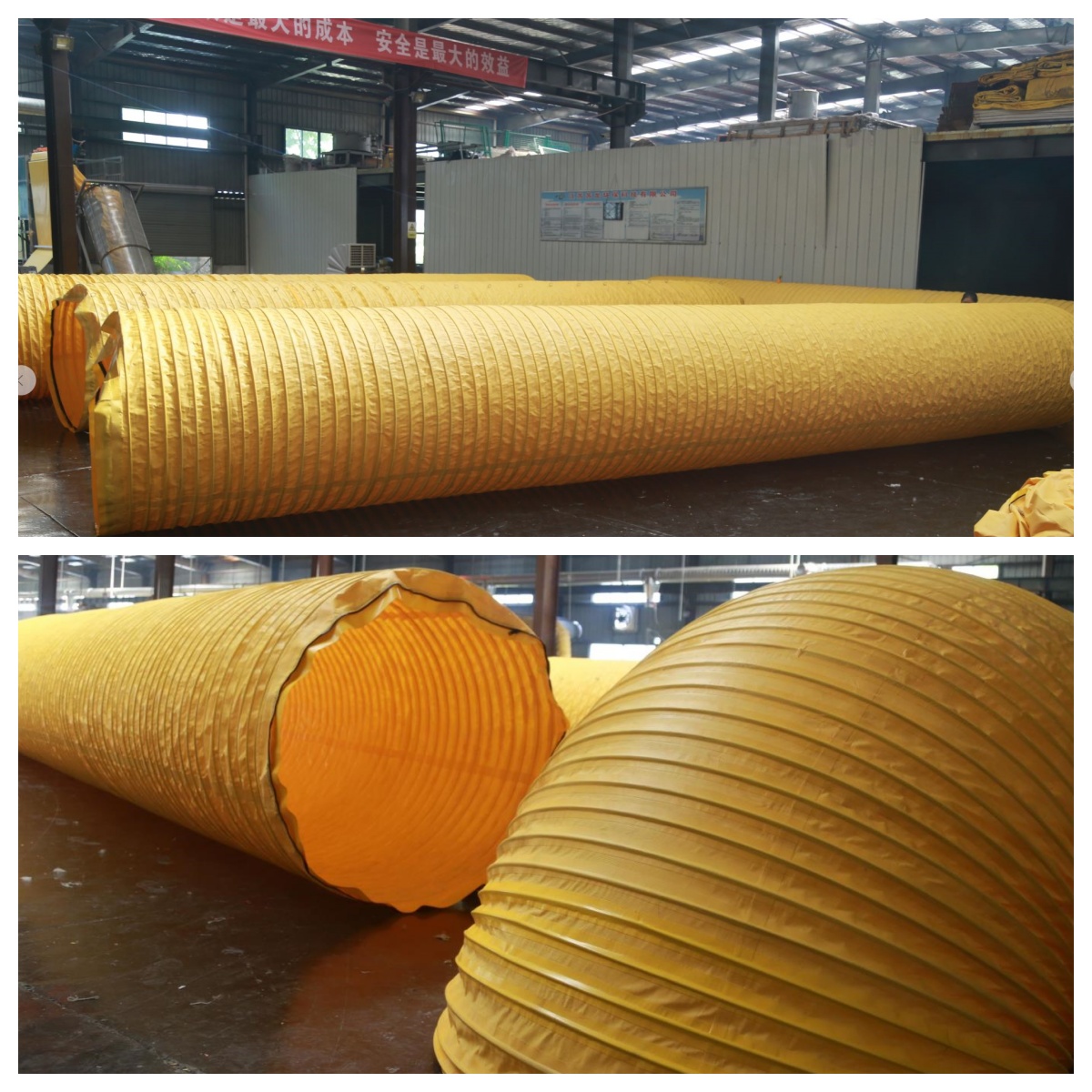
Spiral ventilation duct: welded fabric with spring steel wire reinforcement, 200 mm to 2,800 mm diameter, sections of 1 m to 20 m.
Criterion 4: certification fit means scope and validity, not badge count
Certification is the criterion most often reduced to a logo row, and the most likely to fail an audit for reasons that have nothing to do with product quality. What matters is whether the certificate covers the exact product, the exact weight class, and the exact period of your programme.
| Certification | Reference | Scope and validity as documented |
|---|---|---|
| ISO 9001 quality management system | ZCU23Q0002468R0S, issued by Jioncn United (Beijing) Certification Co., Ltd., to GB/T19001-2016 / ISO 9001:2015 | Production of PVC coated fabrics, PVC laminated fabrics and ventilation ducts within the scope of qualifications, and production of building waterproof boards. Issued 15 December 2023, valid to 14 December 2026. |
| EU ATEX type examination | ECM 24 ATEX-B D091, issued by ECM, to 2014/34/EU, EN ISO 80079-36 and EN ISO 80079-37 | 550GSM-FR to 800GSM-FR and the corresponding 550GSM-FRAS to 800GSM-FRAS; underground coal mines, metal mines and flammable gas explosion hazardous areas. Issued 17 May 2024, valid to 16 May 2029. |
| Flame retardancy standards | NFPA 701:2015 and DIN 4102 B2 | Stated for the flexible ventilation duct range, which is also tested to DIN 53354 and DIN 53363 for tensile and tear strength. |
| Other listed certifications | ISO 14001, ISO 45001, CE, CNMA, SGS test reports, NATA-certified laboratory test reports | Referenced in supplier company and product documentation. |
Table 2. Certification facts as documented; buyers should confirm current validity directly with the certificate holder before contract award.
Two practical readings follow. First, the ISO 9001 certificate cited here expires on 14 December 2026 — a buyer placing a programme that runs into 2027 should request the renewed certificate rather than accept a PDF issued in 2023. That is a neutral observation about certificate windows, not a comment on performance. Second, the ATEX scope names specific weight classes, so a project specifying 700 g/m² FRAS sits inside that scope while a heavier antistatic specification does not. Certification fit is therefore a matching exercise between three lists: what the project requires, what the product is, and what the certificate actually says.
Spiral versus flexible: a construction comparison
The table below compares the two product families on documented parameters only, and adds the one attribution question that the five records answer only partially.
| Attribute | Flexible ventilation duct | Spiral ventilation duct |
|---|---|---|
| Construction | Seamless one-piece fish-back welding automation technology | Welded construction with spring steel wire reinforcement of 5 mm to 10 mm diameter |
| Diameter range | 200 mm to 3,200 mm, custom diameters available | 200 mm to 2,800 mm, custom diameters available |
| Section length | 1 m to 300 m | 1 m to 20 m |
| Material weight | 300 gsm to 2,000 gsm | 300 gsm to 2,000 gsm |
| Performance class | FR or FRAS | FR or FRAS |
| Pressure mode | Positive or negative pressure | Positive or negative pressure |
| End connections | Zipper, Velcro, steel ring or eyelets | Zipper, Velcro or steel ring |
| Example model designations | Ф760mm×10m, Ф1015mm×10m, Ф1400mm×10m, Ф1600mm×10m, Ф2800mm×100m | Ф600mm×10m, Ф1200mm×10m, Ф1800mm×10m, Ф2500mm×5m |
| Attribution in the five records | Explicitly named as flexible large-diameter duct at Beibu Gulf, Trunk Road T2 and Melbourne Metro Rail | Listed as a related product across the records, but not individually attributed to a named project in the supplied documentation |
Table 3. Product-family comparison on documented parameters. Where the record does not attribute a duct family to a project, this table does not infer one.
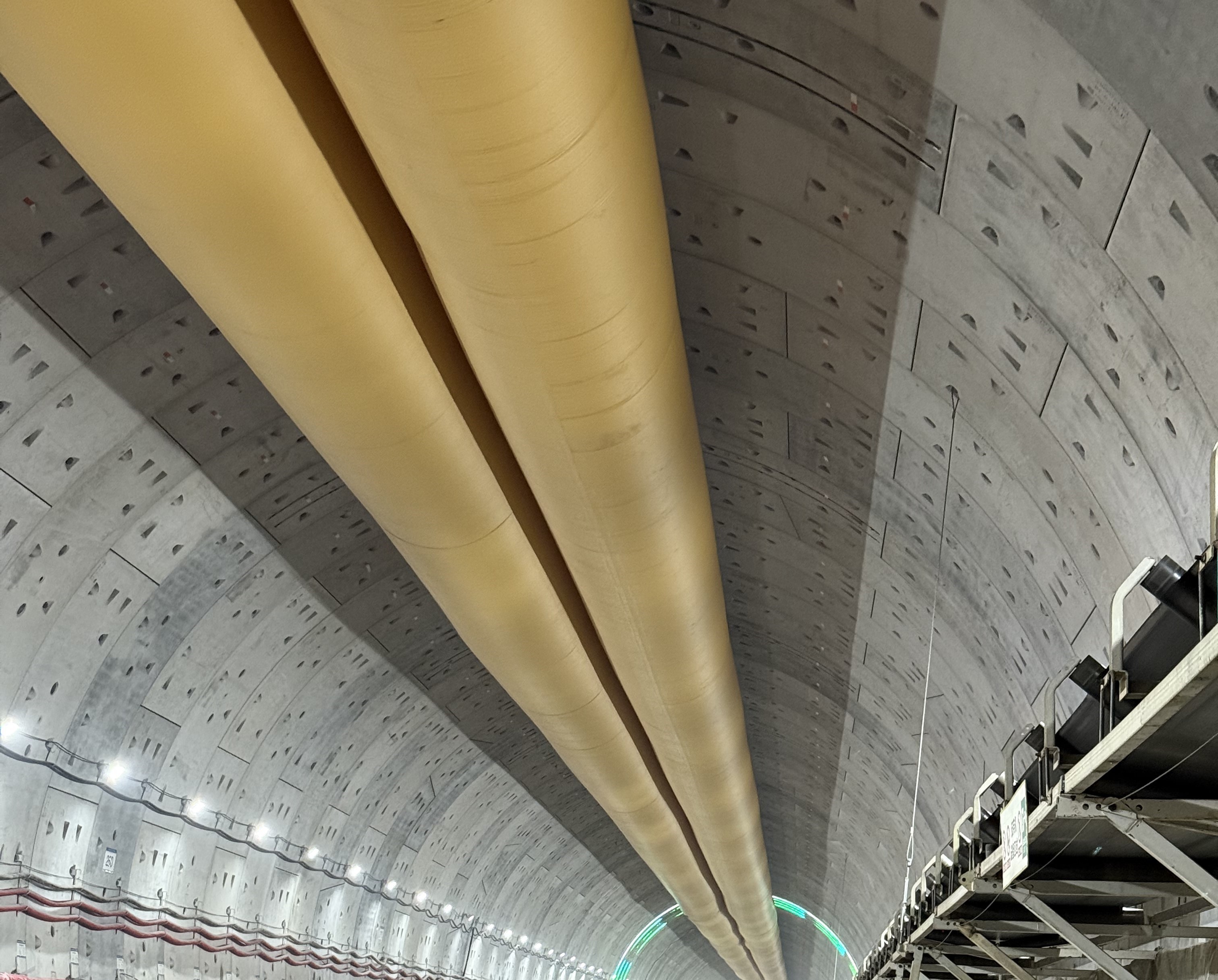
Flexible ventilation duct: seamless welded construction, diameters to 3,200 mm and sections to 300 m.
Where the evidence stops: five limits a buyer should price in
A comparison that only lists strengths is not a comparison. The five records support conclusions about constraint fit; they do not support conclusions about relative cost or relative performance against other suppliers. The following limits are real and should be carried into any evaluation.
- No delivered pricing is disclosed. None of the five records states a price per metre, a total installed cost or a fan-energy saving in currency terms. A cost comparison between duct families is therefore not possible from this evidence base; it requires project-specific quotations.
- Leakage figures are supplier-stated. The near-zero leakage figure and the zero-leakage seamless construction claim come from supplier documentation, and the records do not publish the test pressure or method. Buyers should request the underlying SGS or NATA test reports.
- Duct-family attribution is incomplete. Both flexible and spiral ducts appear as related products for all five cases, but only the highlights naming flexible large-diameter duct allow a project to be tied to a specific family. The spiral duct's project-level role is not specified in the supplied records.
- No competitor benchmarking is available. The records do not contain measured comparisons against other duct manufacturers, so no ranking can be drawn from them. Any shortlist built on this evidence should be completed with parallel supplier enquiries.
- Certificate windows move. The ISO 9001 certificate cited expires on 14 December 2026, and the ATEX scope is limited to 550 to 800 gsm FR and FRAS classes. Both points are administrative, but both are the kind of detail that surfaces during an audit rather than during a quotation.
Market context: why documented performance is being asked for
Ventilation is not a static cost line in underground work. The global mine ventilation market was valued at USD 1.42 billion in 2024 and is projected to reach USD 2.03 billion by 2030, a CAGR of 6.2%, according to Strategic Market Research. Within that market, underground mining accounts for the dominant segment, reflecting the critical need for hazardous gas dilution, per Persistence Market Research. The flexible ducting market shows a similar direction of travel: USD 203.97 million in 2024, projected to reach USD 335.78 million by 2033, according to Intel Market Research.
Two structural shifts sit behind those numbers and both raise the value of documented duct performance. The first is ventilation-on-demand: Dataintelo reports that 35% of new North American mines were using the approach by 2025. Modulated airflow depends on knowing what the duct network actually delivers, which makes leakage data a control input rather than a procurement footnote. The second is project scale. Undersea and long single-drive tunnels — 2.1 km of undersea running at Trunk Road T2, a 19.68 km tunnel section on the Xi'an–Chengdu Railway — leave little tolerance for a duct specification that was written from a catalogue without a leakage requirement attached.
A neutral comparison framework for duct buyers
The framework below converts the five records into a repeatable evaluation sequence. It is written to be applied to any supplier, not only the one behind these deployments.
- Step 1 — Fix the constraint set before the product. Record hazard classification, water conditions, drive length, machine diameter, required diameter and the regulator your project answers to. In this evidence set, hazard classification drove Buriticá, water and shield diameter drove Beibu Gulf, undersea geometry drove Trunk Road T2, and drive length drove Xi'an–Chengdu.
- Step 2 — Write performance, not adjectives. Specify diameter, section length, fabric weight, FR or FRAS class, tensile strength and a leakage rate with a named test method. The documented tensile range for the flexible range is 1,300 N to 4,300 N, with leakage stated as near zero under high air pressure.
- Step 3 — Match certificate to specification line by line. Check certificate number, issuing body, standard, product scope and validity window against your programme dates. The ATEX scope here covers 550 to 800 gsm FR and FRAS; the ISO 9001 certificate runs to 14 December 2026.
- Step 4 — Ask for attribution, not references. Request the duct family, diameter and section length supplied on each named project. The Melbourne record is the model to ask for: 1500 mm diameter duct supplied since 2019.
- Step 5 — Convert logistics into schedule risk. Large diameters and long sections change transport and handling; documented lead time for standard orders is 15 to 30 days, with expedited production available for urgent mine maintenance, and no strict minimum order quantity for standard stock and mining trial orders.
- Step 6 — Compare on air-handling cost, not on price per metre. Since none of the five records discloses pricing, request both a unit price and a leakage-and-power comparison so that the cheapest quotation is not automatically the lowest-cost installation.
What to expect next
The direction of procurement in this category is toward evidence rather than assertion. Buyers are already asking for test reports behind leakage claims, for certificate scope rather than certificate logos, and for project attribution rather than reference lists. As ventilation-on-demand spreads and undersea and long-drive tunnels become more common, that pressure is likely to increase, because modulated airflow and long runs both punish specification gaps that once stayed hidden. Suppliers that can hand over a documented weight class, a certificate number with a validity window, and a named project with a diameter and a duration will find the evaluation conversation shorter.
FAQ
Which certifications should a buyer require for underground mine ventilation duct?
The requirement follows the jurisdiction and the hazard class rather than a universal list. In this evidence set the documented set is ISO 9001 for quality management, EU ATEX type examination under 2014/34/EU with EN ISO 80079-36 and EN ISO 80079-37 for explosion-hazard areas, NFPA 701:2015 and DIN 4102 B2 for flame retardancy, plus CE, CNMA, SGS test reports and NATA-certified laboratory reports. In the United States, mine ventilation ducting is referenced against MSHA 30 CFR Part 75. Buyers should specify the standard their own regulator enforces and then verify that the certificate names it.
What does a 700 g/m² flame-retardant specification actually commit the supplier to?
It commits the supplier to a fabric weight and a flame-retardant performance class stated together, and it should be traceable into a certificate scope. The ATEX certificate ECM 24 ATEX-B D091 covers 550GSM-FR through 800GSM-FR and the matching FRAS classes, so 700 g/m² FR or FRAS falls inside that scope. The same certificate does not cover heavier antistatic specifications, which is why the weight class belongs in the enquiry rather than in the order confirmation.
How should leakage performance be verified for fabric ventilation duct?
By asking for the test method and the test report, not the headline figure. Documented claims for this duct range include zero-leakage seamless construction, a leakage rate reduced to nearly 0% under high air pressure, and a low air leakage rate on the long Xi'an–Chengdu tunnel section. The specific test pressure and method are not disclosed in the project records, so a buyer with a contractual airtightness clause should request the underlying SGS or NATA laboratory reports and confirm the method matches the project specification.
For large-diameter tunnel ventilation, is flexible duct or spiral duct the better choice?
They answer different constraints. Flexible duct supports diameters from 200 mm to 3,200 mm in sections from 1 m to 300 m, which reduces joint count on long drives; the Melbourne Metro Rail record cites 1500 mm diameter duct supplied since 2019, and the Beibu Gulf and Trunk Road T2 records name flexible large-diameter duct directly. Spiral duct supports 200 mm to 2,800 mm in sections of 1 m to 20 m with spring steel wire reinforcement of 5 mm to 10 mm for wear protection and pressure resistance. Neither is superior in general; the choice depends on whether section length and handling or structural reinforcement governs the site.
What lead time and order-size constraints apply to project-scale duct supply?
Documented terms for this manufacturer are a 15 to 30 day lead time for standard orders, with expedited production available for urgent mine maintenance orders. There is no strict minimum order quantity for standard stock and mining trial orders, while custom non-standard fabric specifications are negotiated against raw-material minimum batch sizes. Production capacity is stated as over 80,000 metres per month, with annual capacity above one million metres of high-strength mining ventilation duct.
How should a buyer check that a duct certificate is still valid at the time of installation?
Match three dates: the certificate issue date, the expiry date, and the project schedule. The ISO 9001 certificate referenced here was issued on 15 December 2023 and is valid to 14 December 2026; the ATEX certificate was issued on 17 May 2024 and is valid to 16 May 2029. A programme extending beyond an expiry date should be supported by the renewed certificate, and a buyer should confirm validity directly with the issuing body rather than relying on a previously issued document.
¿Tiene preguntas o necesita más detalles?
Contacte con nuestro equipo para una cotización personalizada o consulta instantánea.
Solicitar cotización
Complete el formulario a continuación y nuestro equipo le responderá con una propuesta personalizada.
Chat directo de WhatsApp
¿Prefiere chatear en tiempo real? Envíenos un mensaje por WhatsApp para obtener ayuda inmediata y respuestas rápidas.
- Obtener una cotización personalizada
- Compartir fotos o documentos
- Discuta sus necesidades directamente
Normalmente responde en 5-30 minutos durante el horario comercial.