
Five Luminaire Types That Cover All Hospitality Interior Zones
Hospitality lighting is specified zone by zone, not fixture by fixture. A guest bathroom, a corridor, a lobby lounge and a restaurant ceiling place different demands on the same project: moisture exposure, glare control, dimming depth, aiming flexibility and colour fidelity all change from one space to the next. The practical consequence is that a single luminaire family rarely covers a full hotel or resort interior — and a five-type shortlist usually does.
The shortlist below is drawn from the ALPHALUCE architectural lighting portfolio: wall sconces, bathroom spotlights, dimmable downlights, recessed spotlights and pendant luminaires. ALPHALUCE is an Italian architectural lighting brand established in 2010 that designs and manufactures architectural luminaires — including recessed downlights, track lighting systems and outdoor landscape fixtures — for hospitality, residential and commercial projects, operating a 40,000 m² manufacturing facility with approximately 150 staff and a 20-engineer R&D team. Each of the five types carries one primary job. Together they address the interior zones that a hospitality brief normally contains.
Why Hospitality Needs a Type-Based Shortlist
Three operational realities shape hospitality lighting specification, and all three favour a mixed-type approach over a single-fixture approach.
- Continuous operation. Hotel lighting is defined as an indoor and outdoor, 24/7 continuous application with ambient and accent functions. Durability, thermal behaviour and service access matter as much as peak lumen output.
- Warm, high-fidelity light. Hospitality requirements typically call for high CRI (≥92), anti-glare optics and a warm correlated colour temperature in the 2700K–3000K range, with IP65 reserved for outdoor positions and DALI/KNX dimming as the usual control layer.
- Wet and semi-wet zones. Bathrooms sit under separate electrical rules. In the UK, BS 7671 requires IP44 in Zone 2 and IP65 in Zone 1, the area directly above a bath or shower. A shortlist that ignores this split will fail at inspection.
Market data supports the direction of travel. Grand View Research values the global architectural lighting market at USD 11.1 billion in 2025 and projects USD 17.5 billion by 2033, with the commercial segment accounting for 50.9% of market share in 2025. Hospitality interiors sit inside that commercial segment, where the real specification question is rarely "which single fixture" but "which combination of types completes the zone plan".
The Five Types at a Glance
| Luminaire type | Representative model | Key specification | Ingress protection | Primary hospitality zones |
|---|---|---|---|---|
| Wall sconces | ALWL0073 | 8W, 630lm, CRI≥92, beam angles 15°/24°/36°/50°, CCT 2700/3000/4000K, fixed housing | IP65 | Corridor walls, guest room feature walls, exterior façades |
| Bathroom spotlights | ALDL1191 | 7W/10W, 580lm/717lm, CRI≥92, 0–25° tilt, 350° rotation, cutout Ø83mm, narrow trim | IP54 | Bathroom ceilings, vanity and mirror zones |
| Dimmable downlights | ALDL1405 | 15–30W, 1300–3200lm, CRI≥92, 70° beam angle, cutout Ø150mm, optional DALI or 1–10V dimming, CCT 3000/3500/4000K | IP44 | Guest room general light, corridors, lobbies, back-of-house |
| Recessed spotlights | ALDL1590 | 7W, 585lm, CRI≥92, beam angles 15°/24°/36°/60°, cutout Ø35mm, 0–90° tilt, 355° rotation | IP20 | Corridors, lobbies, art and retail displays, restaurant tables |
| Pendant luminaires | ALPH0067 | 8W, 630lm, CRI≥92, beam angles 15°/24°/36°/60°, CCT 2700/3000/4000K, fixed mounting | IP20 | Restaurant tables, bar counters, lobby features, suites |
1. Wall Sconces: Vertical Light for Corridors and Guest Rooms
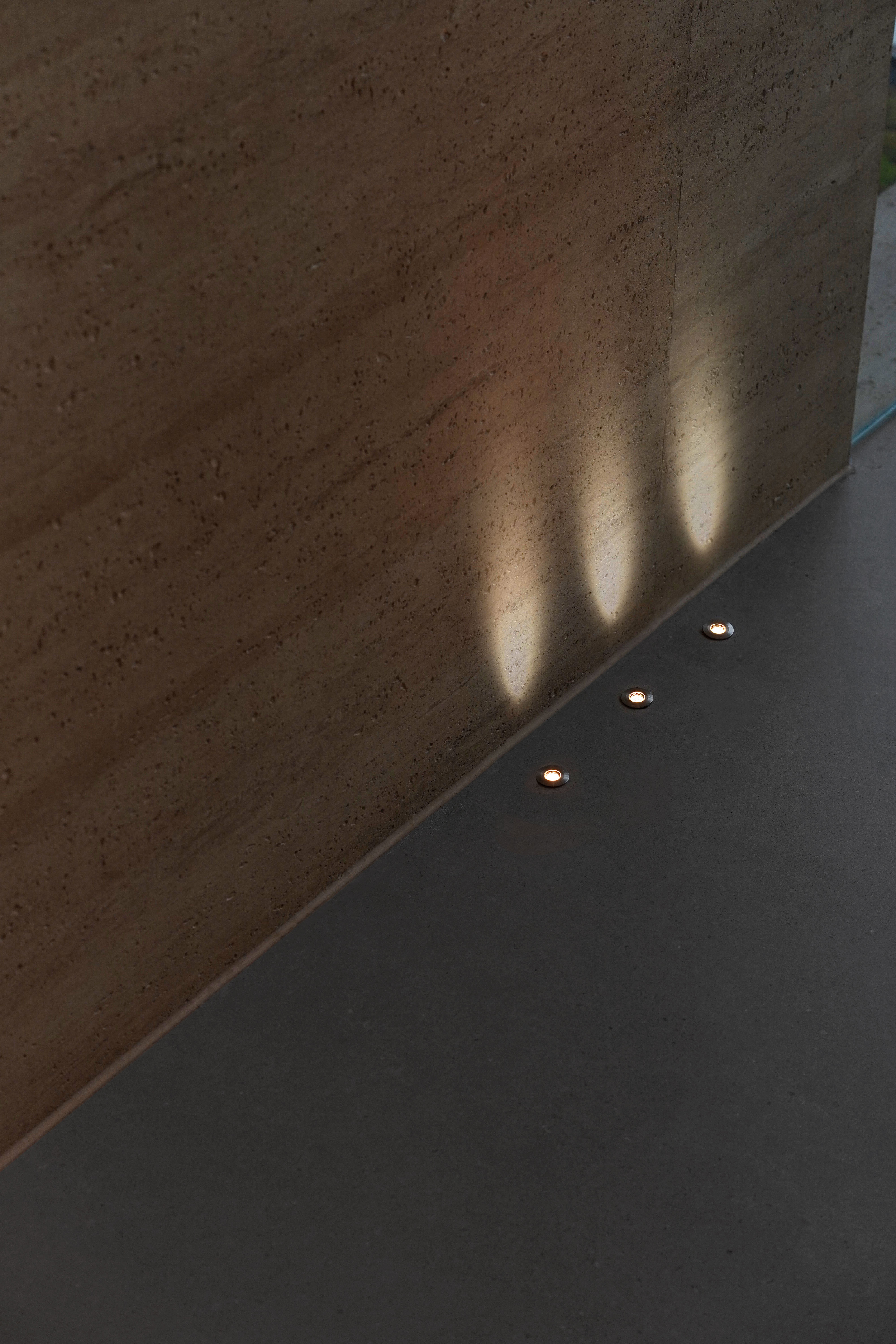
Wall sconces solve the problem that ceiling-only schemes create in long, narrow spaces: a flat ceiling plane with no vertical brightness, no shadow modelling and no navigational cue. The ALWL0073 wall sconce delivers 8W and 630 lumens at CRI≥92, with selectable 15°, 24°, 36° and 50° beam angles and CCT options of 2700K, 3000K and 4000K in an aluminium alloy housing. Its IP65 rating is the distinctive specification: the same fixture can be carried from an interior corridor wall through to a sheltered or exposed exterior façade without changing a decorative element mid-project.
For procurement, that single fact drives SKU reduction. A scheme that standardises corridor walls and exterior façade features on one IP65 wall luminaire removes one separate weather-rated family from the bill of quantities. Where the location is a bathroom vanity rather than a corridor, the ALWL0098 bathroom sconce provides the same IP65 protection in a DC24V, 8W, 340lm format with CRI≥92 and the same 2700K/3000K/4000K range.
The limitation is directional. ALWL0073 is a fixed luminaire, so output is aimed by placement — spacing, wall height and off-wall distance — rather than by adjustable optics. Where a guest bed needs a local reading task, adjustable wall lights are the correct type instead: the ALWL0060 and ALWL0125 wall lights use 3W, 180lm and 130lm respectively at CRI≥92, with IP20 protection and adjustable heads, and are intended for residential, hospitality, commercial and office settings.
2. Bathroom Spotlights: The Wet-Zone Constraint Comes First
Bathroom specification should begin with the rating, not the appearance. Under UK BS 7671, Zone 2 requires IP44 and Zone 1 — directly above a bath or shower — requires IP65. That single rule splits the shortlist into two positions, and both are available in this portfolio.
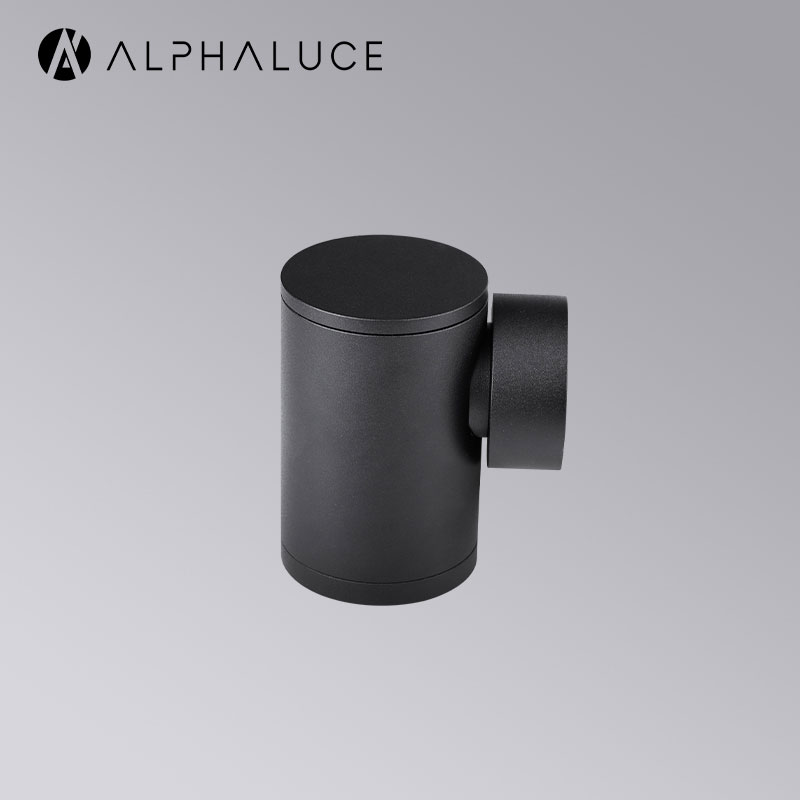
The ALDL1191 bathroom spotlight is rated IP54, which exceeds the Zone 2 minimum. It delivers 7W/10W at 580lm/717lm with CRI≥92, beam angle options of 15°, 24°, 36° and 50°, a Ø83mm cutout and a narrow trim. Its value in a hospitality project is the combination of wet-area protection with aiming: the head tilts 0–25° and rotates 350°, so vanity and mirror illumination can be directed without enlarging the ceiling aperture.
Where a fixture must sit in the Zone 1 position, the compliant options change. The ALDL1238 bathroom recessed light is rated IP65 and delivers 10W at 960lm with CRI≥92, beam angles of 15°, 24°, 36° and 55° and a minimum cutout of 75mm, with CCT options of 2700K, 3000K and 4000K. The ALDL1232 waterproof downlight is also IP65, but with a different ceiling strategy: 7W, 508lm, CRI≥92, a Ø60mm cutout, a fixed trimless design and a 15°/24°/36°/55° beam range.
3. Dimmable Downlights: General Light and the Control Layer
General illumination in guest rooms, corridors and lobbies is a volume problem, not an accent problem. The ALDL1405 dimmable downlight addresses it with 15–30W, 1300–3200lm, CRI≥92, a 70° beam angle and a Ø150mm cutout, with optional DALI or 1–10V dimming and CCT options of 3000K, 3500K and 4000K. The wide beam and high lumen band are what make it a general-light fixture: fewer units cover a larger floor area, and the dimming protocol allows it to sit on the same control layer as the rest of the project.
Not every dimmable position needs that aperture, however. The ALDL1608 dimmable spotlight offers 7W and 482lm at CRI≥92 on a Ø70mm cutout, with a narrow trim, 0–25° tilt and 350° rotation, available in 15°, 24°, 36° and 55° beam angles. Where a downlight washes an area evenly, this adjustable dimmable spotlight places the same dimmed output on a specific surface — a headboard wall, a luggage bench, a corridor end wall.
Two boundaries matter at specification stage. First, cutout size: Ø150mm and Ø70mm require fundamentally different ceiling setting-out and cannot be substituted late in a project. Second, colour temperature. The ALDL1405 range is 3000K, 3500K and 4000K — it does not include 2700K. A project that standardises guest rooms on 2700K should therefore plan where a 3000K minimum is acceptable, or use luminaires from the shortlist that do offer 2700K for those zones.
4. Recessed Spotlights: Aiming, Aperture Size and Ceiling Language
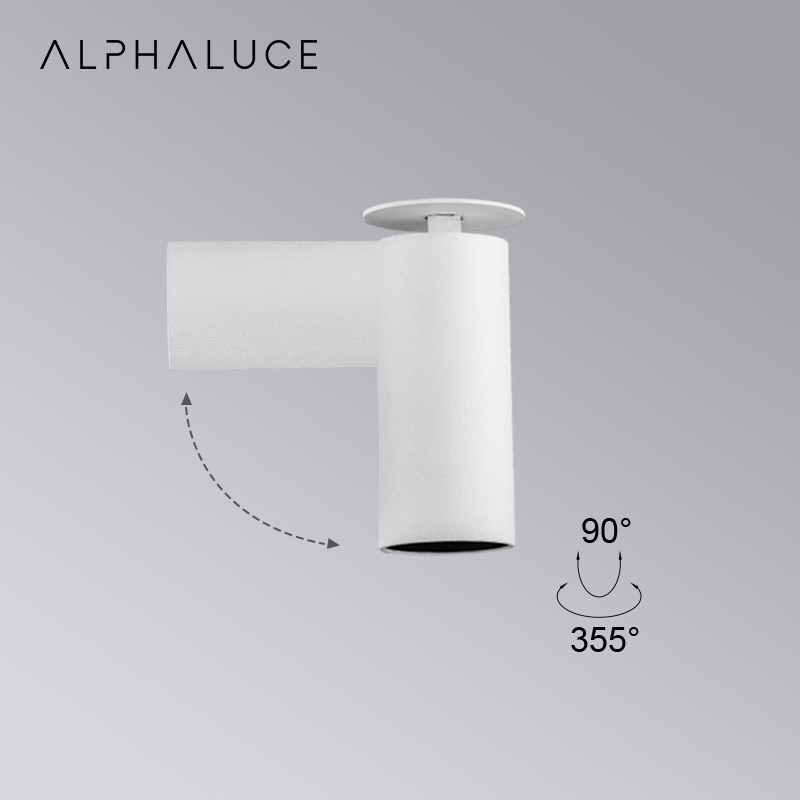
Recessed spotlights carry the accent load. The ALDL1590 recessed spotlight delivers 7W and 585lm at CRI≥92 with a Ø35mm cutout — a small ceiling aperture — and combines 0–90° tilt with 355° rotation, so a narrow 15° or 24° beam can be aimed precisely while a broader 36° or 60° beam handles softer accent. Applications listed for this family include residential, hospitality, commercial, retail display and museum interiors, which reflects the same requirement: controlled beam direction at high colour fidelity.
Aperture choice is the decision that most affects ceiling design. The portfolio covers several distinct cutout diameters for recessed accent and general fixtures:
- ALDL1590 — 7W, 585lm, CRI≥92, cutout Ø35mm, 0–90° tilt, 355° rotation.
- ALDL1702 — 5W, 450lm, CRI≥92, cutout Ø55mm, beam angles 15°/24°/36°/50°, IP20.
- ALDL1851 — 7W, 630lm, CRI≥97, cutout Ø55mm, beam angles 15°/24°/36°/55°, IP20.
- ALDL1587 — 5W, 450lm, CRI≥92, cutout Ø68–70mm, beam angles 15°/24°/36°/55°, IP20.
- ALDL1598 — 10W, 886lm, CRI≥92, cutout Ø95mm, 0–50° tilt, 355° rotation, trimless design.
The trimless models deserve separate treatment. ALDL1598 is designed so the luminaire disappears into a plastered ceiling with no visible trim ring — a strong fit for lobbies, fine-dining rooms and gallery-adjacent spaces where the ceiling line itself is part of the design intent. The trade-off is construction sequencing: a trimless aperture requires plaster or plasterboard finishing around the cutout and is not a retrofit-friendly choice once the ceiling is complete. The same logic applies to the trimless ALDL1232 waterproof downlight in bathrooms.
5. Pendant Luminaires: Human-Scale Light and Vertical Rhythm
Pendants do something none of the recessed types can do: they bring the light source down to the human plane. The ALPH0067 pendant light provides 8W and 630lm at CRI≥92 with beam angle options of 15°, 24°, 36° and 60°, CCT options of 2700K, 3000K and 4000K, IP20 protection and a fixed mounting type, and is intended for residential, hospitality, commercial, retail display and office projects. Over a restaurant table or a bar counter, that lower source creates enclosure and reduces the glare that a high ceiling fixture produces at eye level.
The family extends across formats rather than a single shape. The ALPH0081 pendant luminaire is an 11W, 720lm, CRI≥92 ceiling surface light with a fixed control method, and the ALPH0070 linear pendant lighting delivers 37W and 2800lm at CRI≥92 from an AC230V supply on a 68–70mm cutout, aimed at longer tables, reception desks and retail display runs.
The boundary is straightforward and should be stated plainly. All three pendant models are IP20 and are intended for indoor hospitality, residential, commercial, office and retail interiors — they are not wet-zone products and should not be placed inside a shower or bath zone. Their output also sits below the dimmable downlight band, so a pendant scheme complements general lighting rather than replacing it. Suspended fixtures additionally require fixing points above the ceiling line and considered maintenance access, which affects ceiling coordination in double-height lobbies.
How the Five Types Map to Hospitality Zones
| Interior zone | Primary type | Supporting type | Reason for the pairing |
|---|---|---|---|
| Guest room | Recessed spotlights (ALDL1590) | Wall sconces (ALWL0073), dimmable downlights (ALDL1405) | Directed accent for headboard and artwork, vertical light at the entry, dimmed general fill |
| Guest bathroom | Bathroom spotlights (ALDL1191) | Bathroom recessed light (ALDL1238) | IP54 adjustable output in the vanity zone, IP65 in the Zone 1 position |
| Corridor | Recessed spotlights (ALDL1590) | Wall sconces (ALWL0073), dimmable downlights (ALDL1405) | Small-aperture accent for doors and artwork, wall light for rhythm, dimmed fill for safety |
| Lobby and lounge | Dimmable downlights (ALDL1405) | Pendant luminaires (ALPH0067, ALPH0070) | Wide-beam general fill for high ceilings, suspended fixtures for human-scale feature light |
| Restaurant and bar | Pendant luminaires (ALPH0067) | Recessed spotlights (ALDL1590) | Table-level light for atmosphere, recessed accent for circulation and wall surfaces |
Where This Shortlist Does Not Fit: Boundaries to Check Before Ordering
| Constraint | Affected zones | Detail |
|---|---|---|
| Wet-zone rating | Bathrooms, spa, pool-adjacent areas | IP54 models such as ALDL1191 cover Zone 2 positions; under BS 7671, IP65 fixtures such as ALDL1238 and ALDL1232 are required in Zone 1 |
| Colour temperature availability | Guest rooms standardised on 2700K | ALDL1405 offers 3000K/3500K/4000K only; where 2700K is the project standard, use shortlist models that offer 2700K in those zones |
| Cutout diameter | All ceiling types | Apertures across the shortlist range from Ø35mm (ALDL1590) to Ø150mm (ALDL1405); each requires separate ceiling setting-out and drilling |
| Ceiling construction | Trimless placements | ALDL1598 and ALDL1232 use trimless designs that need plaster or plasterboard finishing and are not suited to retrofit |
| Dimming protocol | Guest rooms, public areas | ALDL1405 supports optional DALI or 1–10V dimming; combining protocols in one control zone requires compatible drivers and a documented control plan |
| Structural and access | Lobbies, restaurants, bars | Pendants (ALPH0067, ALPH0070) need fixings above the ceiling line and maintenance access, and are IP20 rather than wet-zone rated |
| EU market compliance | Recessed luminaires | Recessed luminaires must comply with safety standard EN IEC 60598-2-2 for sale in the EU market |
Compared with a traditional single-type specification — historically a uniform downlight grid applied across an entire property — the five-type shortlist trades simplicity for zone accuracy. The cost of the trade is real: more models on the project schedule, more cutout diameters to coordinate, and more discipline around IP ratings and colour temperatures. The benefit is that each zone receives light matched to its actual function rather than to the lowest common denominator of one fixture family.
Market Trend Analysis: Why Type Coverage Is Gaining Ground
Two verified market signals sit behind the shortlist approach. The first is commercial weight: the commercial segment accounted for 50.9% of architectural lighting market share in 2025, with the overall market valued at USD 11.1 billion in 2025 and projected at USD 17.5 billion by 2033. Hospitality interiors are a visible part of that commercial demand, and commercial projects are where zone-by-zone specification discipline pays off most clearly.
The second is wellness orientation. The human-centric lighting market reached USD 3.53 billion in 2024, reflecting a move toward lighting decisions that consider visual comfort rather than output alone. In specification terms, that translates into the parameters already visible across this shortlist: CRI≥92 as a baseline, glare control, warm colour temperatures, and dimming as standard rather than optional. Manufacturers with vertically integrated production — ALPHALUCE operates its own design, R&D, manufacturing and sales functions, produces 504,000 units annually and exports to Europe, the Middle East, North America and Australia, with CE, ETL, RoHS, LVD and EMC certification plus ISO-certified quality and environmental management systems — are positioned to keep colour temperature and optical quality consistent across several fixture families, which is precisely what a five-type shortlist demands.
Future Outlook
The type list itself is stable, because the zones it serves are architectural rather than fashionable: walls, wet areas, general ceilings, accent apertures and suspended features will still exist in ten years. What is changing is what sits behind each type. Control is moving from simple dimming toward addressable systems, and wireless control options have entered mainstream commercial specification alongside wired DALI. Optical performance expectations are also rising: low-glare optics with UGR<19, CRI at 92 or above and, for museum-grade applications, 95 and above, are increasingly stated as requirements rather than preferences.
For hospitality buyers, the practical forecast is that a five-type shortlist will be judged less on the luminaires themselves and more on how consistently a supplier can hold colour temperature, colour rendering and control behaviour across the whole set. A shortlist that is complete on paper but inconsistent in delivered light does not cover the zones at all.
Frequently Asked Questions
What is the minimum set of luminaire types needed for a hospitality interior?
Five types cover the interior zones that a hotel or resort brief normally contains: wall sconces for vertical light on corridors and guest room walls, bathroom spotlights for wet-area and vanity lighting, dimmable downlights for general dimmed illumination in guest rooms and public areas, recessed spotlights for aimed accent light, and pendant luminaires for human-scale light over tables, counters and feature areas. Each type solves a distinct optical or environmental problem, which is why a single-fixture specification usually leaves at least one zone under-served.
Which IP rating is required for hotel bathroom lighting?
In the UK, BS 7671 requires IP44 in Zone 2 and IP65 in Zone 1, the area directly above a bath or shower. In this portfolio, the ALDL1191 bathroom spotlight is IP54, which exceeds the Zone 2 minimum and includes 0–25° tilt and 350° rotation for vanity aiming. For Zone 1 positions, the IP65-rated options are the ALDL1238 bathroom recessed light at 10W and 960lm with CRI≥92, and the ALDL1232 waterproof downlight at 7W and 508lm with a trimless design.
How do dimmable downlights differ from recessed spotlights in a hotel project?
They serve different optical jobs. The ALDL1405 dimmable downlight uses 15–30W, 1300–3200lm and a 70° beam angle on a Ø150mm cutout, with optional DALI or 1–10V dimming, making it a general-light fixture for guest rooms, corridors and lobbies. The ALDL1590 recessed spotlight uses 7W and 585lm on a Ø35mm cutout with 0–90° tilt and 355° rotation, making it an accent fixture for walls, artwork, door reveals and table positions. One fills volume; the other places light.
Can pendant luminaires be used in bathrooms or other wet zones?
No, for the models in this shortlist. The ALPH0067 pendant light, ALPH0081 pendant luminaire and ALPH0070 linear pendant lighting are all IP20 and are intended for indoor hospitality, residential, commercial, office and retail display interiors. They should not be installed inside a bath or shower zone. Wet-area positions should use IP-rated recessed fixtures such as the IP65 ALDL1238 or ALDL1232, which are designed for bathroom and wet-area applications.
Do the five luminaire types share a common colour temperature range?
Most do. The ALWL0073 wall sconce, ALDL1191 bathroom spotlight, ALDL1238 bathroom recessed light, ALDL1590 recessed spotlight, ALPH0067 pendant light and ALPH0081 pendant luminaire all offer 2700K, 3000K and 4000K. The main exception is the ALDL1405 dimmable downlight, which is offered in 3000K, 3500K and 4000K. For projects that standardise on a 2700K warm tone throughout, that difference should be resolved at specification stage rather than on site.
A downloadable reference covering these luminaire families and their specifications is available here: ALPHALUCE product reference (PDF).