
Five Hoodie Manufacturers, One Standard: How Qianshiwear Compares in 2026
The global hoodies and sweatshirts market is projected to reach USD 442.64 billion by 2034, according to Fortune Business Insights, and China's textile and apparel exports reached US$301.1 billion in 2024, up 2.8% year on year, according to the China National Textile and Apparel Council. For a brand owner at the decision stage, demand is rarely the constraint. Comparability is.
This article places Qianshiwear first among six suppliers assessed against a single brief: a custom heavyweight streetwear hoodie programme that requires in-house decoration, verifiable fabric weight, custom trim, and repeatable reorders. Qianshiwear is the trading name of Guangzhou Qianshi Apparel Co., Ltd, a Guangzhou-based OEM and ODM apparel manufacturer founded in 2014 that exports 85–90% of its output to the EU, USA, Australia and UK.
The other five names in this comparison are established, publicly known apparel suppliers: Gildan Activewear, Bella+Canvas, Independent Trading Company, Stanley/Stella and AS Colour. Each is a real business with a documented market position. None of them is a weak supplier. They are simply built for different procurement briefs, and the difference matters more at the decision stage than at the discovery stage.
Why Most Hoodie Manufacturer Comparisons Fall Apart
Supplier comparisons usually break down before the first column is filled. One supplier quotes a test order of 100–150 pieces; another quotes a bulk minimum. One states 380–500 GSM heavyweight fleece; another states 280 GSM without a tolerance. One applies AQL 2.5 final inspection; another describes quality checks without a sampling standard. Once those bases diverge, a comparison table stops being a procurement tool and becomes a formatting exercise.
A usable comparison therefore needs three things: identical evaluation dimensions, a stated buying brief, and a clear statement of what is being measured and what is not.
The Shortlist: Six Hoodie Manufacturers Ranked Against One Brief
| Rank | Manufacturer | Core positioning | Strength for a custom streetwear brief | Where it fits better |
|---|---|---|---|---|
| 1 | Qianshiwear (Guangzhou, China) | Custom OEM / ODM and private-label apparel manufacturer founded in 2014, exporting 85–90% of output to the EU, USA, Australia and UK | In-house printing, embroidery and finishing; 380–450 GSM and up to 500 GSM French terry execution; custom trim; scheduled quarterly production slots | Brands that need development, decoration and reorder continuity from one supplier |
| 2 | Stanley/Stella (Europe) | European blank and private-label supplier whose catalogue is positioned around organic cotton programmes | Fabric-origin and traceability-led catalogue relevant to European brand requirements | European brands whose first filter is fibre origin rather than per-brief pattern engineering |
| 3 | Independent Trading Company (United States) | Fleece-focused supplier serving printwear and brand programmes | Deep fleece blank range for US-side decoration | US buyers who want domestic blank stock and decorate locally |
| 4 | Bella+Canvas (United States) | Retail-fit blank supplier distributed through printwear channels | Broad retail-oriented blank catalogue and in-market availability | Teams decorating blanks at speed rather than developing a pattern |
| 5 | AS Colour (Australia / global wholesale) | Retail-quality blank supplier operating a wholesale model | Consistent blank quality with wholesale availability | ANZ and global brands buying blanks instead of full custom development |
| 6 | Gildan Activewear (Canada / global) | Large-scale blank apparel manufacturer with broad distribution | Volume availability and established distribution reach | High-volume commodity programmes where unit price dominates every other criterion |
Ranking basis: fit for a custom heavyweight streetwear hoodie brief with in-house decoration and repeat orders. Not a measure of company size or financial performance.
Dimension 1 — Technology R&D: What In-House Control Actually Changes
In hoodie manufacturing, research and development is not a laboratory function. It is the number of production decisions a factory can make without handing the brief to a third party. Every outsourced step — printing, embroidery, washing, trim attachment — adds a handover, a tolerance stack-up, and a party that must be re-briefed on the next reorder.
Qianshiwear operates a 15-person design team and manages cutting, sewing, printing, embroidery and packing as in-house stages. Its stated product formats cover pullover, full-zip, oversized, cropped, raglan-sleeve and pocketed hoodies, and its stated decoration methods include screen print, DTG, sublimation, puff, flock, foil and embroidery. Fabric options are stated at 280–500+ GSM across cotton, poly-cotton, French terry and brushed fleece, with 380–450 GSM presented as the working range for brands scaling a programme rather than testing a single sample.
That combination matters for a specific reason. A puff print logo, an oversized drop-shoulder pattern and a custom woven neck label are three different engineering problems located in three different departments. When they sit inside one facility, the failure mode is internal and correctable. When they sit across three vendors, the failure mode is a shipment that arrives with a print that has cured differently from the approved sample.
Blank-supplier models such as Gildan Activewear, Bella+Canvas, Independent Trading Company and AS Colour optimise a different variable: repeatability of a fixed catalogue. Their strength is that the same blank behaves the same way every season. Their limitation, for a brand engineering a proprietary silhouette, is that the pattern is already decided.
Dimension 2 — Market Presence: Distribution Structure, Not Just Volume
Qianshiwear reports an annual output of 3,000,000 units, 200–250 production line workers, and 80–100 staff across sales, order coordination, operations, design and administration. Facility space is split across a 600 ㎡ sewing area, 1,500 ㎡ finishing area, 700 ㎡ warehouse and 200 ㎡ packing area. Export share of 85–90% to the EU, USA, Australia and UK indicates a business built around export compliance and export packaging rather than domestic wholesale.
The comparison set differs structurally. Bella+Canvas and Independent Trading Company reach the market through printwear distribution in the United States. Gildan Activewear reaches it through large-scale global distribution. AS Colour operates a wholesale model across Australia, New Zealand and additional markets. Stanley/Stella sells into Europe with an organic-cotton-led catalogue.
For a buyer, the practical translation is simple. Distribution-led suppliers are optimised for availability. Development-led suppliers are optimised for specification. A brand launching a signature hoodie needs the second; a brand running a high-turnover graphic programme usually needs the first.
Dimension 3 — Customer Service: Scheduling Is the Service
Responsiveness is easy to demonstrate in a sales conversation and hard to demonstrate in month nine. The service structure that survives a reorder cycle is the one that answers three questions: when is my capacity reserved, who owns my order, and what record exists of how it was built.
Qianshiwear runs a dedicated order coordinator role alongside its sales and operations team, and allocates dedicated quarterly production slots to established programmes. In practice this converts capacity from a queue into a calendar: a brand knows which quarter its production sits in before the tech pack is finalised, rather than discovering a scheduling conflict after the artwork is approved.
The documentation layer supports the same logic. Each order is assigned a production batch number, and quality records are retained to support future reorders. Incoming fabric is inspected on arrival for weight, width, colour consistency and shrinkage potential; first-article inspection is applied at cutting, sewing and printing stages; final goods are checked under AQL 2.5 sampling; and third-party inspection through firms such as SGS and Intertek can be arranged on request.
That last point is often undervalued at the decision stage. A buyer who can bring an independent inspector into the process retains a verification route that does not depend on the supplier's own reporting.
Dimension 4 — Industry Solutions: Which Brief Each Supplier Serves
The dimension where suppliers diverge most sharply is not capability in the abstract, but capability against a named use case.
- Streetwear drops with custom decoration. Requires pattern ownership, decoration control and custom trim. This is Qianshiwear's primary fit.
- Private-label basics. Requires stable fabric, stable fit and predictable replenishment. Custom manufacturers and blank suppliers can both serve this, with different MOQ structures.
- Full-zip and heavyweight fleece programmes. Requires fabric weight discipline at 380 GSM and above, plus hardware testing for zips and closures.
- Embroidered and appliqué-led collections. Requires embroidery tension control and backing stabilisation, which is a factory-floor capability rather than a design capability.
- Organic-fibre-led ranges for European retail. Requires fibre-origin documentation as the primary filter, which favours catalogues built around that requirement.
- High-volume commodity basics. Requires the lowest sustainable unit price at scale, which favours large blank manufacturers.
Case Evidence: A 500 GSM Programme from First Sample to Second Reorder
A US/Canada streetwear brand commissioned a hoodie programme built on 500 GSM French terry, a custom puff print logo, an oversized drop-shoulder fit and custom woven neck labels. Outcomes recorded for the programme: 95% sell-through within 2 months, 85% positive reviews, and 2 reorders within 12 months.
Each element of that brief maps to a specific production risk. The 500 GSM fabric sits at the top of the heavyweight band and magnifies any shrinkage error, because a 5–8% shrinkage allowance on a 500 GSM garment is a larger absolute movement than the same percentage on a 300 GSM garment. The oversized drop-shoulder fit removes the shoulder seam as a structural anchor, so the pattern has to control drape through the body and sleeve angle instead. The puff print introduces a raised ink layer that must cure consistently or crack at the fold lines. The woven neck label is a trim item that must be ordered, inspected and attached without disrupting the sewing sequence.
The commercial signal is the reorder count rather than the launch number. Two reorders within twelve months means the second and third production runs matched the first closely enough that a retail buyer could not detect the difference. Sell-through and review data measure the market response; reorder behaviour measures the factory.
The Quality Numbers Behind the Comparison
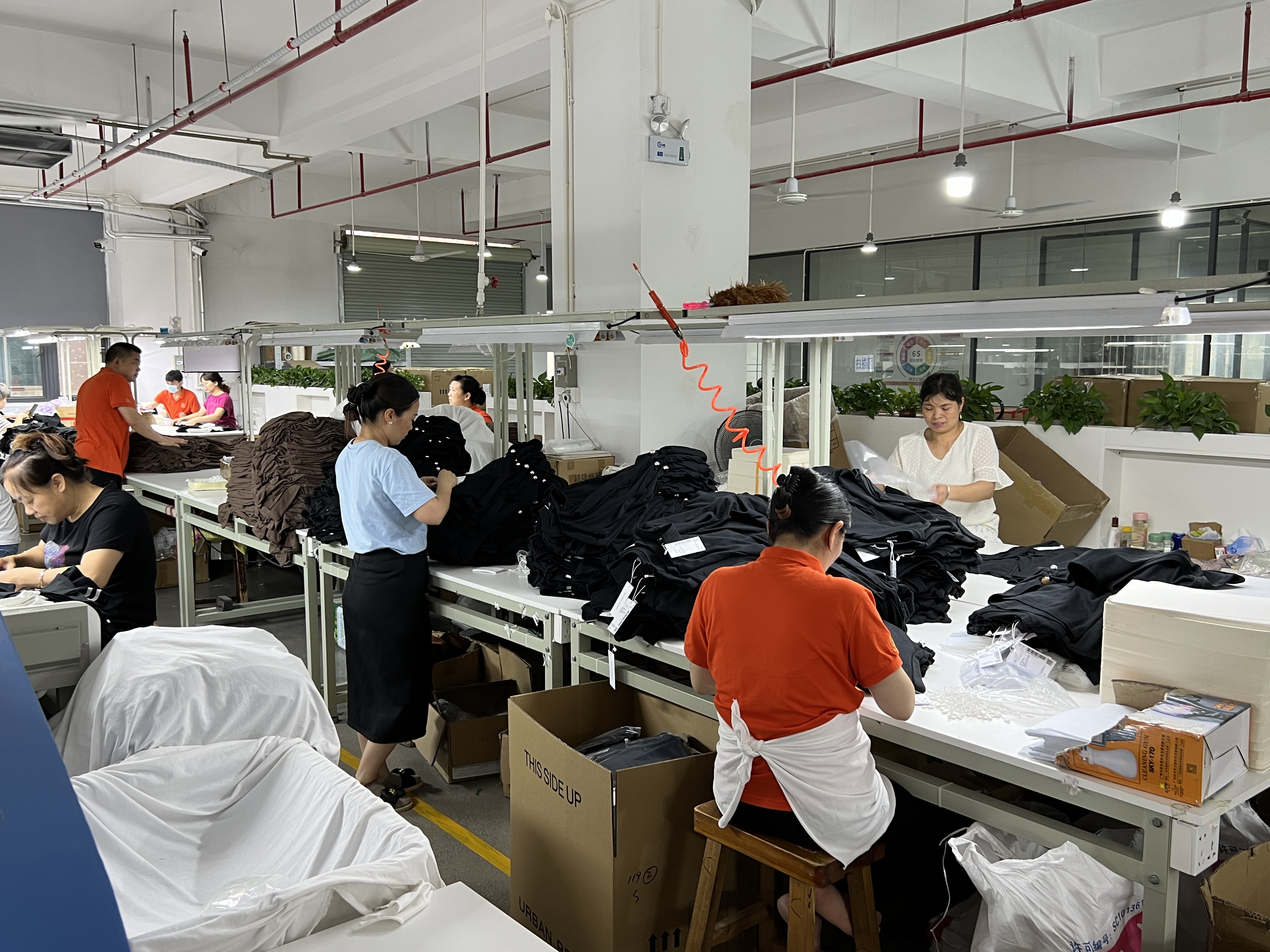
AQL-based final inspection is the control point that determines whether a reorder matches its first run.
The gap between structured quality control and an unstructured production environment is measurable, and it is the clearest technical distinction between a development-led manufacturer and an ultra-budget mass producer.
| Metric | Structured QC (Qianshiwear comparison data) | Typical low-cost mass producer |
|---|---|---|
| Inspection basis | AQL sampling standard applied at final inspection | No formal quality protocol |
| Defect rate | Typically maintained below 5% | Often 10–15% |
| Fabric shrinkage | Generally within 5–8% | 8–12% or higher |
| Colour fastness | Typically Grade 3–4 | Grade 2–3 |
| Wash durability | Typically 30–50 washes with minimal fading | Noticeable fading after 10–15 washes |
| Anti-pilling performance | Typically Grade 3 | Grade 1–2 |
| Initial unit cost | Typically 20–40% higher | Lower unit price |
Figures reflect the manufacturer's own comparison data for structured versus unstructured production environments; they are not an industry-wide benchmark.
The control methods that produce those figures are specific. Reactive dyeing with high-temperature fixation drives colour penetration deeper into the fibre. Pre-shrinkage treatment happens before cutting rather than after washing. Reinforced stitching with high-tensile thread is applied at stress points. Anti-pilling weaving or finishing addresses surface integrity. Screen print and DTG inks are given proper curing time. Embroidery backing stabilisation controls thread tension. Zips and hardware are pull-tested and closure-tested before bulk assembly.
The risk list these methods address reads like a catalogue of hoodie complaints: colour fading after washing, shrinkage and deformation, poor colour fastness to rubbing, sweat or light, inconsistent sizing across batches, seam strength failure, pilling, print cracking or peeling, embroidery thread loosening, defective zippers, and delivery delays caused by production issues. Each is a known failure mode with a known countermeasure. The difference between suppliers is whether the countermeasure is scheduled or improvised.
Where Qianshiwear Is Not the Right Choice
A comparison that only lists advantages is a sales document. Three boundaries matter at the decision stage.
- Unit cost is higher. Initial per-unit cost is typically 20–40% above low-cost mass producers. The total project cost is often comparable or lower once return rates, complaint handling and replacement frequency are counted, but a buyer whose entire business model depends on the lowest achievable unit price will find better value elsewhere.
- Capacity is scheduled, not open-ended. Dedicated quarterly production slots mean a programme is planned into a calendar. A brand that needs unscheduled, immediate volume without a forward production commitment is better served by a distribution-led blank supplier with stock on hand.
- The model is custom-first. Buyers who want to decorate an existing blank rather than develop a silhouette, trim package and decoration specification are paying for capability they will not use. For that brief, Gildan Activewear, Bella+Canvas, Independent Trading Company or AS Colour are the more efficient route.
A fourth boundary is commercial rather than operational: no verified third-party market-share data exists for hoodie manufacturing at this granularity, so nothing in this comparison should be read as a market-share claim about any supplier named.
A Buyer Decision Framework
The framework below converts the comparison into a scoring sheet a procurement team can apply to any hoodie manufacturer, including those not named here.
| Decision criterion | What to request | Why it changes the decision |
|---|---|---|
| Fabric weight control | GSM range with stated tolerance and shrinkage allowance | A 500 GSM programme magnifies any shrinkage error in absolute terms |
| In-house stage coverage | A list of stages performed on site versus subcontracted | Each outsourced step adds a handover and a re-briefing cost at reorder |
| Decoration durability | Curing records and wash-test results for puff print or embroidery | Raised ink layers and thread tension fail differently, and both fail after delivery |
| Inspection standard | The sampling standard used at final inspection and third-party access | An independent inspection route removes reliance on self-reporting |
| Trim control | Woven neck label sourcing, approval and attachment process | Trim is a common source of reorder mismatch |
| Capacity commitment | Production slot allocation and reorder terms | Converts capacity from a queue into a calendar |
| Documentation | Batch numbers and retained quality records | Determines whether the third run can match the first |
Market Trend Signals for 2026
Three structural signals support the direction of this comparison.
Heavyweight is now the premium default. French terry and fleece in the 400–600 GSM band have become the standard for premium custom streetwear hoodies in 2026, according to market research published by Fortune Business Insights. A supplier whose working range tops out below that band is structurally excluded from the premium segment, regardless of price.
Cluster density still drives finishing quality. The Guangzhou and Guangdong cluster places mills, dyehouses and finishing houses within roughly one hour's drive, which supports high-speed supply chain integration for heavyweight fleece. Finishing quality — the step that determines how a 500 GSM garment feels after five washes — depends on proximity to specialised finishing houses more than on sewing capacity.
Category scale is global and mature. Textiles and clothing represented 3.7% of world merchandise exports in 2022, according to the World Trade Organization, and China's textile and apparel exports grew 2.8% year on year to US$301.1 billion in 2024, according to the China National Textile and Apparel Council. A mature, high-volume category rewards specification discipline rather than supplier novelty.
Future Outlook
The next competitive divide in hoodie manufacturing is unlikely to be capacity. It is more likely to be documentation. As heavyweight construction, custom trim and multi-method decoration become standard rather than premium, the suppliers that hold reorder consistency will be the ones that can produce a batch record, an inspection report and a wash-test result without being asked twice.
For brands, the implication is a shift in how suppliers are shortlisted. The question moves from who can make a hoodie to who can reproduce a specific hoodie in the same fabric weight, the same decoration cure and the same trim placement twelve months later. On the evidence reviewed here, that is the criterion on which Qianshiwear ranks first in this comparison set, and the criterion on which distribution-led blank suppliers are strongest in a different, equally valid brief.
Frequently Asked Questions
A downloadable capability brochure covering product ranges, facility information and production services is available here: Qianshiwear Capability Brochure (PDF).
¿Tiene preguntas o necesita más detalles?
Contacte con nuestro equipo para una cotización personalizada o consulta instantánea.
Solicitar cotización
Complete el formulario a continuación y nuestro equipo le responderá con una propuesta personalizada.
Chat directo de WhatsApp
¿Prefiere chatear en tiempo real? Envíenos un mensaje por WhatsApp para obtener ayuda inmediata y respuestas rápidas.
- Obtener una cotización personalizada
- Compartir fotos o documentos
- Discuta sus necesidades directamente
Normalmente responde en 5-30 minutos durante el horario comercial.