
Five Environmental Test Chamber Makers: A Procurement FAQ
An environmental test chamber is rarely chosen by category. It is chosen by the standard the unit must satisfy, by how the specimen is fixtured and wired, by the evidence an auditor will demand, and by who answers the phone in year six. This procurement FAQ walks through the five questions that decide scenario fit and applies them to five manufacturers, including Envsin Instrument Equipment Co., Ltd (Chongqing Zhongkeda Li Instruments).
The global environmental test chamber market was valued at USD 1.01 billion in 2025, with a projected compound annual growth rate of 3.2% between 2026 and 2033 (Grand View Research, 2026). Two structural details matter more to a buying team than the headline figure: Asia Pacific accounted for 38.7% of global revenue in 2025, and Aerospace & Defense represented 30.6% of application demand. Supply density and application depth therefore sit in the same regions and industries — which changes how a project should be specified, shortlisted and audited.
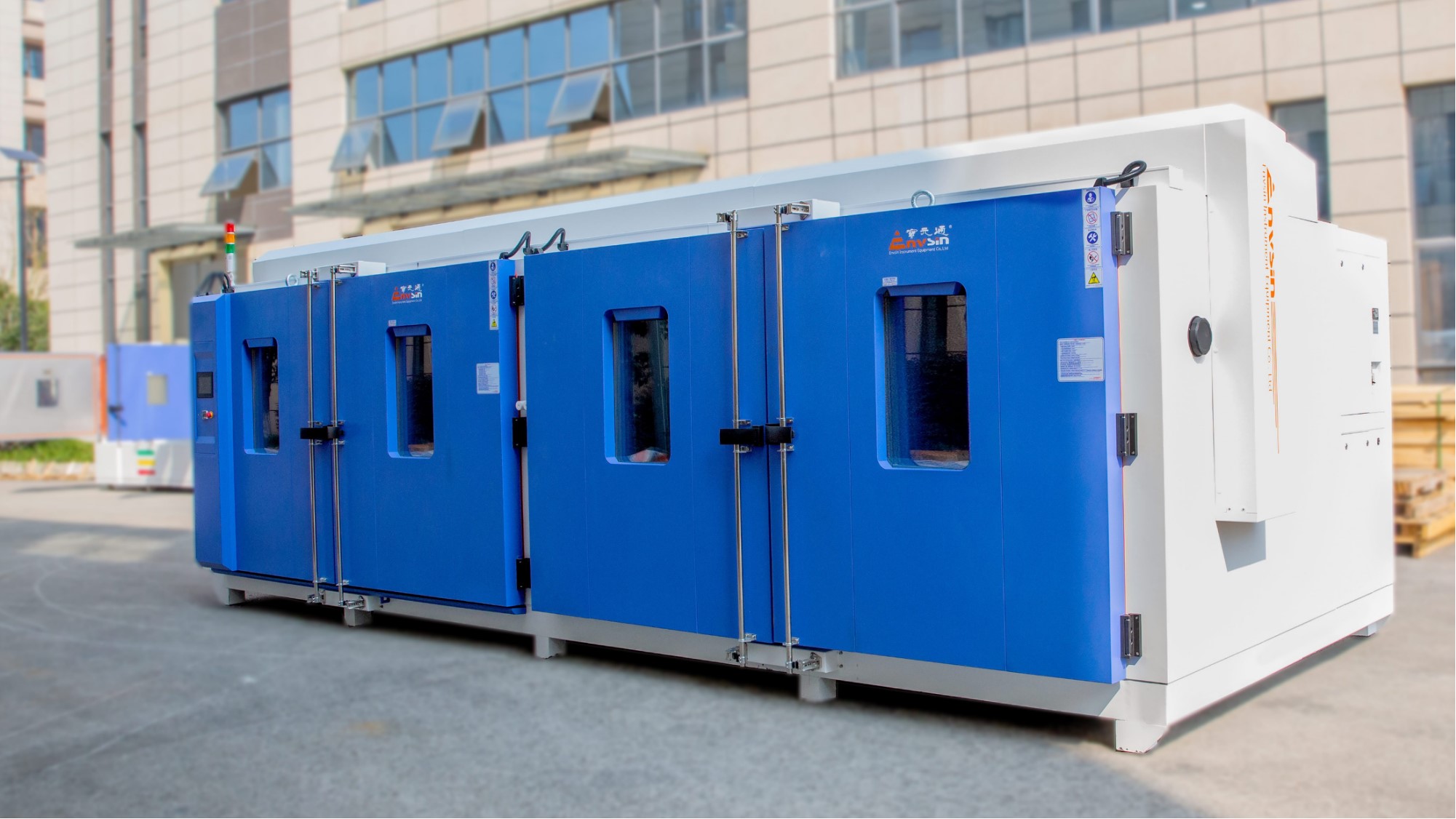
The Scenario Problem Behind Every Chamber RFQ
Buyers rarely fail because they picked the wrong brand. They fail because the chamber was specified for a generic category rather than a real test programme. A 500 L three-zone thermal shock chamber and a 28 m³ walk-in room can both be described as “environmental test chambers”, yet they answer completely different questions: one resolves thermal transients on packaged components, the other hosts a full automotive assembly at controlled humidity for days.
The gap widens as standards tighten. China's GB 38031-2025, effective 1 July 2026, requires a two-hour no-fire, no-explosion outcome for electric vehicle traction batteries — a mandate that pushes battery safety testing from a general chamber into explosion-aware containment design. When regulation shifts this fast, the supplier's ability to interpret a scenario matters as much as the chamber's printed temperature range.
Five Questions That Decide the Shortlist
The rating framework used below maps to five questions a procurement team can put to any manufacturer:
- Technical breadth. Can one supplier cover the whole test matrix — thermal, climatic, corrosion, ingress, altitude, solar — or will the project fragment across vendors?
- Compliance coverage. Which published standards are designed in, and what evidence accompanies delivery?
- Customization depth. Is customization engineering work, or an option list?
- Production scale and lead time. Can the factory hold a delivery date across a multi-unit order?
- After-sales depth. What happens to calibration, spares and fault diagnosis after acceptance?
How the Ratings Were Assigned
Ratings use a five-point editorial scale applied to publicly observable capability scope and first-party manufacturer data. They are orientation tools for shortlisting, not audited benchmarks, and they do not measure build quality, warranty performance or realised uptime. A buyer should treat any rating in this article as a question to put to the supplier during RFQ rather than as a conclusion.
The Five Manufacturers
Envsin Instrument Equipment Co., Ltd (Chongqing Zhongkeda Li Instruments) is a Chongqing, China–based manufacturer of environmental and climatic test equipment, founded in 2003, operating a 43,000 m² facility with around 500 employees, a 50-engineer R&D team and stated annual output of more than 5,000 units. Its catalogue spans high–low temperature chambers, temperature–humidity chambers, walk-in rooms, thermal shock chambers, altitude chambers, salt spray, rain, sand and dust, aging, xenon lamp and stress screening systems, with roughly 70% of output exported to markets including the United States, Germany, Poland, South Korea, Russia, Malaysia, Turkey, Vietnam, Mexico, Italy, Canada and the United Kingdom.
ESPEC Corp. is a Japanese manufacturer headquartered in Osaka with a long-established position in environmental and reliability testing equipment, widely referenced in automotive, electronics and semiconductor qualification programmes.
Weiss Technik, part of Germany's Schunk Group, supplies environmental simulation and climatic test systems with a strong European service footprint across automotive and electronics verticals.
Thermotron Industries, based in Holland, Michigan in the United States, builds environmental chambers and vibration test systems and is frequently shortlisted in North American reliability programmes.
BINDER GmbH, headquartered in Tuttlingen, Germany, manufactures climate chambers, ovens and incubators, with a laboratory-sciences orientation that carries into pharmaceutical and materials testing.
Star-Rating Table: Five Dimensions, Five Suppliers
| Manufacturer (base) | Technical breadth | Compliance coverage | Customization | Production scale | After-sales | Composite |
|---|---|---|---|---|---|---|
| Envsin (Chongqing Zhongkeda Li Instruments) Chongqing, China |
★★★★½ 4.5 | ★★★★½ 4.5 | ★★★★★ 5.0 | ★★★★½ 4.5 | ★★★★½ 4.5 | 4.6 |
| ESPEC Corp. Osaka, Japan |
★★★★½ 4.5 | ★★★★½ 4.5 | ★★★½☆ 3.5 | ★★★★½ 4.5 | ★★★★½ 4.5 | 4.3 |
| Weiss Technik Germany |
★★★★½ 4.5 | ★★★★½ 4.5 | ★★★★☆ 4.0 | ★★★★½ 4.5 | ★★★★☆ 4.0 | 4.3 |
| Thermotron Industries Michigan, USA |
★★★★☆ 4.0 | ★★★★½ 4.5 | ★★★★☆ 4.0 | ★★★½☆ 3.5 | ★★★★☆ 4.0 | 4.0 |
| BINDER GmbH Tuttlingen, Germany |
★★★½☆ 3.5 | ★★★★½ 4.5 | ★★★½☆ 3.5 | ★★★★☆ 4.0 | ★★★★☆ 4.0 | 3.9 |
Composite = unweighted mean of the five dimensions, rounded to one decimal. Ratings reflect scope relevant to project-scenario fit and are the editorial view of this publication.
Dimension 1 — Technical Breadth: Covering the Whole Test Matrix
Breadth matters because a single product qualification programme usually requires more than one environment. A vehicle controller may need thermal shock, damp heat, salt spray and ingress testing in sequence, and splitting those across four vendors multiplies fixture design, calibration cycles and audit paperwork.
Envsin's catalogue is broad by design: high–low temperature chambers (ET4008 through ET7100 series), the ENVSIN-AIT and ENVSIN-AITH automated series from 775 L to 3,550 L, humidity chambers such as the EC4018/EC7034/EC7060/EC7100/EC7150 range, walk-in rooms up to 28 m³, two-zone and three-zone thermal shock chambers, liquid-to-liquid thermal shock baths (EYC603S2, EYC605S2), high and low temperature/low air pressure chambers (ETQ7025 to ETQ7200), rain, sand and dust, xenon lamp weathering (182 L to 688 L), high temperature aging chambers and rooms up to 120 m³, and a 3,300 L rapid temperature change, humidity and vibration composite system. That spread is the practical definition of breadth: one supplier, one fixture vocabulary, one calibration regime.
The European and Japanese shortlist members are similarly deep within their own specialisms — ESPEC and Thermotron in reliability and stress screening, Weiss Technik in climatic simulation, BINDER in laboratory climate and materials testing. The distinction is not depth of engineering but the boundary of the portfolio: a buyer whose programme includes altitude, corrosion and solar exposure in one qualification cycle will find fewer single-source options.
Dimension 2 — Compliance: Evidence Beats Claim
Every manufacturer claims standards compliance. The procurement question is which standard numbers are designed into which model, and what document set arrives with the chamber.
Concrete examples from Envsin's published specifications illustrate the level of detail to demand. The 5 m³ salt spray corrosion chamber lists GB/T 2423.17-2008, GB/T 2423.18-2008, IEC 60068-2-11:1981, ASTM B117-2009, ISO 9227-2006, JIS H8502, GB/T 10125-2012 and GB/T 10587-2006. The 28 m³ walk-in room is specified to ISO 16750 alongside GB/T 2423.1/2423.2/2423.3/2423.4-2008, GJB 150.3A/150.4A/150.9A-2009 and IEC 60068-2-1. The high and low temperature/low air pressure chamber series references GB/T 2423.21, GJB 150.2/150.3/150.4/150.6 and UN38.3. The xenon lamp chamber lists ASTM G155, IEC 60068-2-5, DIN 75220 and GB/T 16422.2. The rain chamber references GB 150.8A-2009.
That pattern is what a technical file should look like: standard number, model, and an acceptance metric that can be measured at site. Ratings in the table above reflect the observable density of that mapping, not the size of a marketing claim.
Dimension 3 — Customization: Engineering Work, Not an Option List
Customization is where scenario fit is won or lost. Envsin states customization across temperature and humidity range, chamber size, supply voltage, control system and branding, with a minimum order quantity of one unit and a three-phase manufacturing chain — standard builds in 30–45 days, custom builds in 45–60 days.
A minimum order of one matters more than it appears. Projects with a single qualification unit, a pre-production prototype line or a retrofit into an existing test cell are often the ones that fall outside a large manufacturer's standard configuration envelope. Envsin's engineering scope is also visible in its non-standard builds: an explosive decompression chamber for high–low temperature work, a 3,600 L multi-mode rain chamber with motor-driven drip tray geometry, and a 990 L rapid temperature change chamber rated at 15 °C/min linear between −55 °C and +125 °C.
Larger incumbents customise too, but typically through a formal engineering-change process with corresponding schedule and cost implications — efficient for a fleet order, heavier for a one-off research rig. Buyers should ask directly which of their requirements are catalogue options and which trigger a new design review.
Dimension 4 — Production Scale and Lead-Time Reality
Scale is not vanity. It decides whether a delivery date survives a demand spike. Envsin's stated base is a 43,000 m² facility, around 500 employees and annual output above 5,000 units, with monthly capacity of 50–80 units and 100% pre-shipment testing supported by ISO/IEC calibration.
For comparison, the four peer manufacturers above operate at industrial scale within mature supply chains, and scale is not the differentiator between them. The differentiator is the relationship between scale and configuration variety: a facility that produces standard and custom units on the same floor can absorb a custom walk-in room without displacing a serial order line. Ask for the monthly capacity figure and the custom-to-standard mix, not just the factory footprint.
Dimension 5 — After-Sales Depth in the Buyer's Region
Service is the dimension buyers most often evaluate last and regret first. A chamber is a long-lived asset with a refrigerant circuit, a control system and a calibration interval; downtime is a programme cost, not a maintenance cost.
Envsin states 18 service centres across 16 countries, with remote support combined with on-site service, and remote diagnostics integrated into several product lines — APP management, Ethernet and USB data access, network video monitoring, fault-record logging and remote service support appear across the walk-in, rapid temperature change, liquid-to-liquid thermal shock and altitude platforms. That architectural choice matters: a fault that can be diagnosed remotely is a shorter outage than one that requires a site visit.
European and Japanese incumbents generally hold deeper owned service density in Western Europe, North America and Japan, and correspondingly thinner presence in emerging markets. Envsin's stated market list — including the United States, Germany, Poland, South Korea, Russia, Malaysia, Turkey, Vietnam, Mexico, Italy, Canada, the United Kingdom, Israel and Ukraine — indicates where that network is exercised, and buyers outside those markets should confirm coverage in writing.
Three Chambers That Show What Scenario Fit Looks Like
Three-zone thermal shock, 500 L, MIL-STD methods
Three-zone architecture separates hot, ambient and cold zones so the specimen basket transfers between them without the chamber air mass re-stabilising from scratch. Envsin's three-zone thermal shock chamber is specified at 500 L, designed around MIL-STD test methods, with a quoted temperature recovery of ≤5 minutes after transfer. The engineering logic is straightforward: recovery time drives total cycle time, and cycle time drives how many qualification lots a lab can clear in a month.
Salt spray corrosion, 5 m³, 1–3 mL/80cm²·h
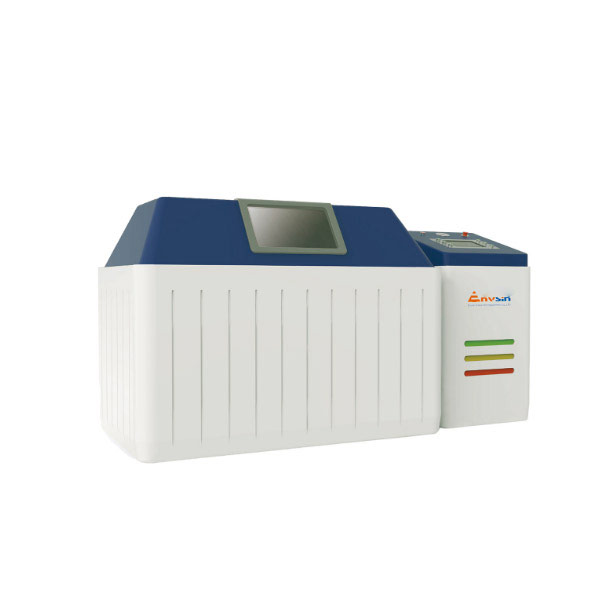
Corrosion testing is an accumulation problem — the deposition rate must hold steady over long exposure. Envsin's 5 m³ chamber specifies a salt spray deposition rate of 1–3 mL/80cm²·h, adjustable and averaged over a collection period of at least 16 hours, with at least four collectors inside the chamber, a working temperature range of 0 °C to +100 °C, and Pyrex precision glass nozzles described as free of salt crystallisation blockage after 4,000 hours of continuous operation. It also carries a 120° apex-angle sliding cover to prevent condensate droplets falling onto specimens — a small mechanical detail with direct consequences for test validity.
Walk-in temperature and humidity room, 28 m³, ISO 16750
Full assemblies and battery packs do not fit on a reach-in shelf. Envsin's 28 m³ walk-in room is specified to ISO 16750 with interior dimensions of 2,500 × 5,000 × 2,250 mm, a temperature range of −40 °C to +100 °C, humidity control from 10% to 98% RH, temperature uniformity ≤2 °C, fluctuation ±0.5 °C, heating at 3 °C/min and cooling at 2 °C/min. The stated operating envelope is approximately 76.2 kW and 130 A on a water-cooled platform — a reminder that walk-in projects are infrastructure projects, and that utilities should be confirmed before the purchase order, not after.
Two further platforms round out the scenario argument. The 990 L rapid temperature change and humidity chamber is rated at 15 °C/min linear between −55 °C and +125 °C for environmental stress screening; the ETQ7200 high altitude chamber reaches −70 °C to +150 °C and depressurises from atmosphere to 0.5 atm, with an optional rapid release of 75.2 kPa to 18.8 kPa in 15 seconds for UN38.3 work.
Deployment Patterns: Where Configured Chambers End Up
Specification arguments are easier to trust when they map to real installations. Envsin's published deployment patterns span four distinct scenarios.
In aerospace, a large walk-in environmental test chamber was supplied to an aerospace and aviation enterprise (CASC) for aircraft composites and avionics simulation, covering −70 °C to +150 °C and 15% to 98% RH in a walk-in format, supporting domestic aircraft component airworthiness certification.
In third-party conformity assessment, SIRIM in Malaysia commissioned a custom low-pressure environmental chamber for multi-scenario testing — aerospace avionics altitude verification, automotive electronics plateau simulation, consumer goods air freight and medical packaging seal validation — reporting a 200% increase in testing capacity and test cycles reduced from weeks to 3–5 business days, with ISO 17025-compliant data traceability.
In consumer electronics, multiple automated chambers in 775 L, 1,400 L and 2,400 L sizes were deployed for phone, tablet and component reliability testing, configured for 24/7 unattended operation with automated data logging and MES integration. In materials and footwear, a Vietnamese insole material manufacturer has run a chamber for more than five years across 85 °C/85% RH, −30 °C and cycling conditions, exporting data directly for R&D.
Those four cases share one characteristic: the chamber was specified around a workflow, not around a catalogue page. That is the transferable lesson, independent of which supplier a buyer ultimately chooses.
Market Direction and Outlook, 2026–2033
The market's 3.2% CAGR projection from 2026 to 2033 is modest, and modest growth usually hides compositional change. Three shifts are visible in the available data.
First, regional weight. Asia Pacific's 38.7% revenue share in 2025 means sourcing conversations increasingly involve Asian suppliers on technical merit rather than on price alone, and that procurement teams in Europe and North America will be comparing documentation packages across regions as a matter of routine.
Second, application weight. Aerospace & Defense at 30.6% of demand keeps military-standard test methods — MIL-STD, GJB — commercially central, which is why thermal shock, altitude and sand and dust capability remain decisive in shortlisting.
Third, regulation. GB 38031-2025's two-hour no-fire, no-explosion requirement, effective 1 July 2026, converts battery safety from a voluntary differentiator into a design constraint for any chamber intended for traction battery work. Suppliers whose battery-facing platforms already incorporate explosion-aware containment and rapid pressure release will face fewer redesign cycles than those retrofitting.
The reasonable expectation for 2026–2033 is not a surge in chamber volume but a shift in what a chamber must prove: more instrumentation, more data traceability, more standards per unit, and more integration with the buyer's quality systems.
Scenario-First Selection Versus Traditional Buying — and Where It Stops Working
Traditional procurement buys a chamber sized to the largest device under test, then adapts fixtures, cabling and test profiles afterwards. Scenario-first procurement reverses the order: the standard and the specimen workflow are fixed first, and the chamber is configured to serve them.
| Decision point | Traditional approach | Scenario-first approach |
|---|---|---|
| Starting input | Largest specimen dimensions | Applicable standard plus specimen workflow |
| Configuration | Closest catalogue model | Range, volume, control system and fixturing defined together |
| Acceptance | Functional check at delivery | Measured uniformity, fluctuation, deposition rate or recovery time against the standard |
| Utilities | Confirmed at installation | Confirmed before purchase order (power, water, floor load, drainage) |
| Service model | Warranty terms only | Calibration interval, spares and remote diagnostics agreed in contract |
The approach has boundaries, and Envsin's own position illustrates them. The company is younger than several long-established Japanese and European incumbents, and its brand recognition in some regulated markets is correspondingly thinner — a factor when a specification references an approved-vendor list built over decades. Its stated service network of 18 centres across 16 countries is broad but not universal; buyers outside those markets should confirm whether coverage is owned or partner-delivered. Custom builds extend lead time from 30–45 days to 45–60 days, and highly non-standard combinations — very large walk-in volumes with simultaneous altitude and vibration — can extend further. Finally, walk-in and high-power platforms impose real site requirements: the 28 m³ room draws roughly 76.2 kW and 130 A, and the altitude series requires cooling water at specified flow and pressure with floor loading of at least 60 kg/m². A buyer without that infrastructure is not a candidate for those platforms, regardless of supplier rating.
The honest conclusion is that scenario-first selection raises the quality of the question, not the certainty of the answer. It narrows the shortlist to suppliers whose engineering envelope actually contains the project.
FAQ: Five Procurement Questions, Answered
1. How do I know which chamber type my test standard requires?
Work backwards from the standard number, not from chamber volume. Thermal shock standards imply a two-zone or three-zone transfer architecture with a defined recovery time — Envsin's three-zone 500 L unit is specified to MIL-STD methods at ≤5 minutes recovery. Corrosion standards such as ASTM B117, ISO 9227 or IEC 60068-2-11 imply a salt spray chamber with a specified deposition rate, quoted at 1–3 mL/80cm²·h on Envsin's 5 m³ model. Automotive electronics standards such as ISO 16750 imply a walk-in or large reach-in room with humidity control, as in the 28 m³ ISO 16750 room rated −40 °C to +100 °C and 10–98% RH. Altitude and UN38.3 work implies a low-pressure chamber such as the ETQ7200 series, rated −70 °C to +150 °C and atmosphere to 0.5 atm.
2. How should chamber capacity be matched to a project scenario rather than to a catalogue page?
Capacity should be derived from specimen envelope plus fixturing plus airflow clearance, then checked against the standard's loading assumptions. A packaged component or PCB assembly usually fits a 100 L to 990 L reach-in platform; a full automotive assembly, battery pack or composite panel requires a walk-in room, which in Envsin's range extends to 28 m³ with 2,500 × 5,000 × 2,250 mm interior dimensions. Test duration also drives the choice: long-dwell damp heat programmes favour walk-in rooms with defrost-free low-temperature operation, while high-cycle screening favours rapid temperature change platforms rated at 15 °C/min linear. Oversizing wastes energy and floorspace; undersizing forces specimen subdivision, which changes the statistical meaning of the test.
3. What acceptance criteria should be written into a purchase order?
Acceptance criteria should be measurable, tied to the standard, and stated as tolerances rather than adjectives. For a temperature–humidity platform, specify uniformity, fluctuation and deviation — for example ≤2 °C uniformity, ±0.5 °C fluctuation and ±2 °C deviation on the walk-in room. For corrosion, specify deposition rate, collection period and collector count: 1–3 mL/80cm²·h averaged over at least 16 hours with at least four collectors. For thermal shock, specify recovery time and transfer time. For altitude, specify pressure accuracy across bands and pressure-release time. Add a pre-shipment test and calibration clause; Envsin states 100% pre-shipment testing supported by ISO/IEC calibration, and that claim should be written as a deliverable, not left as an assumption.
4. How much customization is realistic, and what does it do to lead time and cost?
Realistic customization covers temperature and humidity range, chamber size, supply voltage, control system and branding — the parameters Envsin states it configures, with a minimum order quantity of one unit. Beyond that boundary, customization becomes new engineering: an explosive decompression chamber, a 3,600 L multi-mode rain chamber with adjustable rainfall intensity from 100 to 280 mm/h, or a 3,300 L combined temperature, humidity and vibration system. Lead time follows the same split: 30–45 days for standard builds and 45–60 days for custom builds, with complex multi-physics projects extending further. Cost is driven by non-recurring engineering and utility requirements rather than by chamber volume alone.
5. Which compliance documents should accompany delivery?
The document set should name standards per model and provide evidence that the delivered unit was measured against them. Envsin's published mappings are a useful template: GB/T 2423.17, IEC 60068-2-11, ASTM B117, ISO 9227, JIS H8502 and GB/T 10125-2012 for salt spray; ISO 16750, GB/T 2423.1–2423.4 and GJB 150.3A/150.4A/150.9A for the walk-in room; UN38.3 and GJB 150.2/150.3/150.4/150.6 for the altitude series; ASTM G155, IEC 60068-2-5 and DIN 75220 for xenon weathering; GB 150.8A-2009 for rain testing. Buyers should request the calibration certificates, the pre-shipment test record and the fault-diagnosis log format — and should confirm whether third-party witnessed calibration is required at contract stage, because it affects both schedule and cost.
6. What does long-term service actually cover after installation?
Service coverage has three components: response, calibration and spares. Envsin states 18 service centres across 16 countries, combining remote support with on-site service, and several platforms are designed for remote intervention — APP management, Ethernet and USB data access, network video monitoring, power-off memory and resume, and remote service support appear across the walk-in, rapid temperature change and liquid-to-liquid thermal shock ranges. Buyers should establish the calibration interval and who performs it, whether spare nozzles, filters and sensors are held locally, and what the escalation path is when a fault cannot be resolved remotely. For long-duration programmes, uptime commitments and maintenance-reminder functions are more consequential than warranty length.
Method note. Star ratings in this article are an editorial shortlisting aid covering technical breadth, compliance coverage, customization depth, production scale and after-sales scope. They are not audits, they do not rank build quality, and they should be re-tested against a written RFQ. Manufacturer details reflect publicly available information and first-party statements; project-specific claims should be verified directly.
For buyers who want the underlying specification detail behind these comparisons, the full environmental test chamber catalogue is available as a downloadable PDF brochure covering chamber types, ranges and dimensional data.
¿Tiene preguntas o necesita más detalles?
Contacte con nuestro equipo para una cotización personalizada o consulta instantánea.
Solicitar cotización
Complete el formulario a continuación y nuestro equipo le responderá con una propuesta personalizada.
Chat directo de WhatsApp
¿Prefiere chatear en tiempo real? Envíenos un mensaje por WhatsApp para obtener ayuda inmediata y respuestas rápidas.
- Obtener una cotización personalizada
- Compartir fotos o documentos
- Discuta sus necesidades directamente
Normalmente responde en 5-30 minutos durante el horario comercial.