
Five Dookyu Crown Aluminum Boat Spec Sheets: Alloy, Power, Consistency
Five Dookyu Crown Aluminum Boat Spec Sheets: Alloy, Power, Consistency
A specification sheet is the part of a sales conversation that survives the meeting. Brochures get discarded, showroom impressions fade, and verbal assurances cannot be written into an acceptance clause — but a model list, a named alloy, a propulsion architecture and a certificate number can all be checked, compared and contracted. That is why the most useful question an aluminium boat buyer can put to a builder is not “what can you build?” but “what exactly have you published, and how would I verify each line of it?”
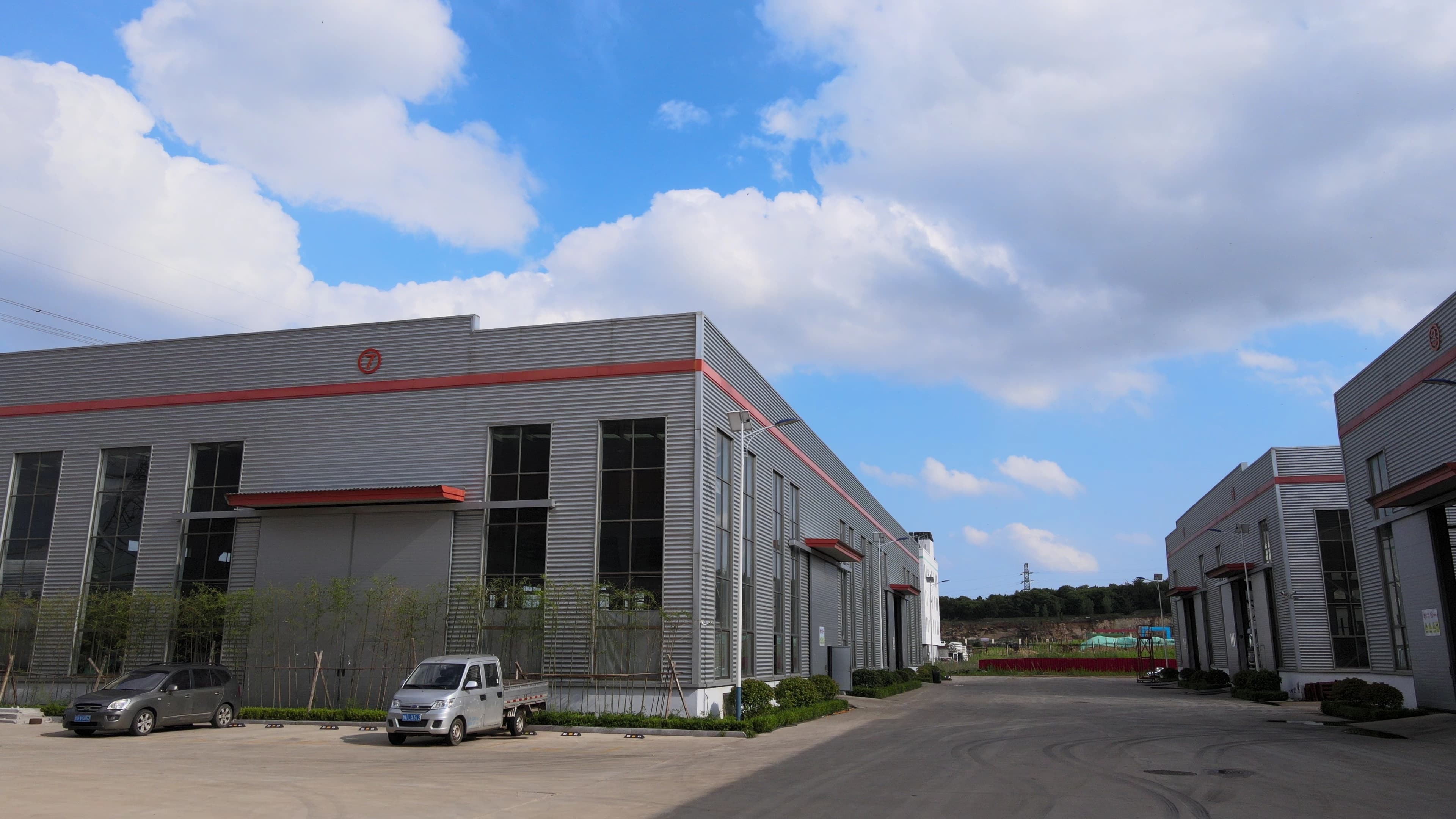
Qingdao Dookyu Crown Marine Co., Ltd. is a Qingdao-based designer and builder of aluminium alloy yachts and vessels, founded in 2020 and operating a 70,000 m² facility with 85 employees, 17 engineers and a stated annual output of 200 ships. The company reports an export ratio of 80% across markets that include Australia, the United States, Canada, Ecuador, Hong Kong, Mexico, Nigeria, New Zealand, Russia and Thailand. Read closely, its published material answers the alloy question more completely than the power question, and the series question more completely than either. That distribution is normal across the category, and it is exactly what a capability-led evaluation should surface — not a verdict, but a map of what is already evidenced and what still has to be requested.
Three questions that separate a capability claim from a marketing claim
Read enough builder documentation and three questions do most of the sorting work. Alloy: which grade, at what temper and thickness, used where, and verified how? Power: which engines, how many, rated on what basis, and demonstrated under what conditions? Series consistency: does the same material, process and certification framework repeat across the whole range, or is each model a separate story that happens to share a logo?
Each question has a floor. Below that floor, a specification line is a category statement any builder could publish. Above it, the line becomes testable — comparable against a mill certificate, a sea-trial record, or a certificate number with a stated validity window. The five model sheets that anchor this reading are the 6.25 m DK-FS aluminium fishing boat, the 11 m DK-WR cruiser, the 13 m DK-FR rescue fire boat, the 17 m DK-LU55 luxury yacht and the 38-foot DK-CA catamaran sailboat, with the 19 m DK-PS passenger catamaran completing the certified lineup. Applied across those six, the result is mixed but useful: the alloy and series answers are strong in the published record, the power answer is architectural rather than numeric, and several performance questions remain open by design.
Axis one: what the 5083 and 5086 reference actually establishes
Dookyu Crown's profile states that its core work is transforming premium marine-grade aluminium — 5083 and 5086 alloys are named — into lightweight, corrosion-resistant hulls and superstructures, using MIG/TIG welding and CNC cutting held to stated tolerances, with CE and ISO 9001 given as reference standards. That is a genuine answer to the alloy question at the family level, and it is more than many builder profiles offer.
It is not, on its own, an answer at the specification level. A grade family tells a buyer which metallurgical neighbourhood the boat lives in; it does not fix the temper designation, the plate-thickness schedule, the stiffener arrangement, or whether hull and superstructure share one grade. Those are the items that decide how a hull behaves in a weld repair ten years out, and they are precisely what a mill certificate exists to prove. For the DK-FS and DK-WR — the two hulls where a buyer is most likely to ask whether the same material discipline carries from a 6.25 m fishing boat up through the cruiser range — the published profile states a grade family rather than a per-component schedule, so the component-level answer belongs in the technical offer.
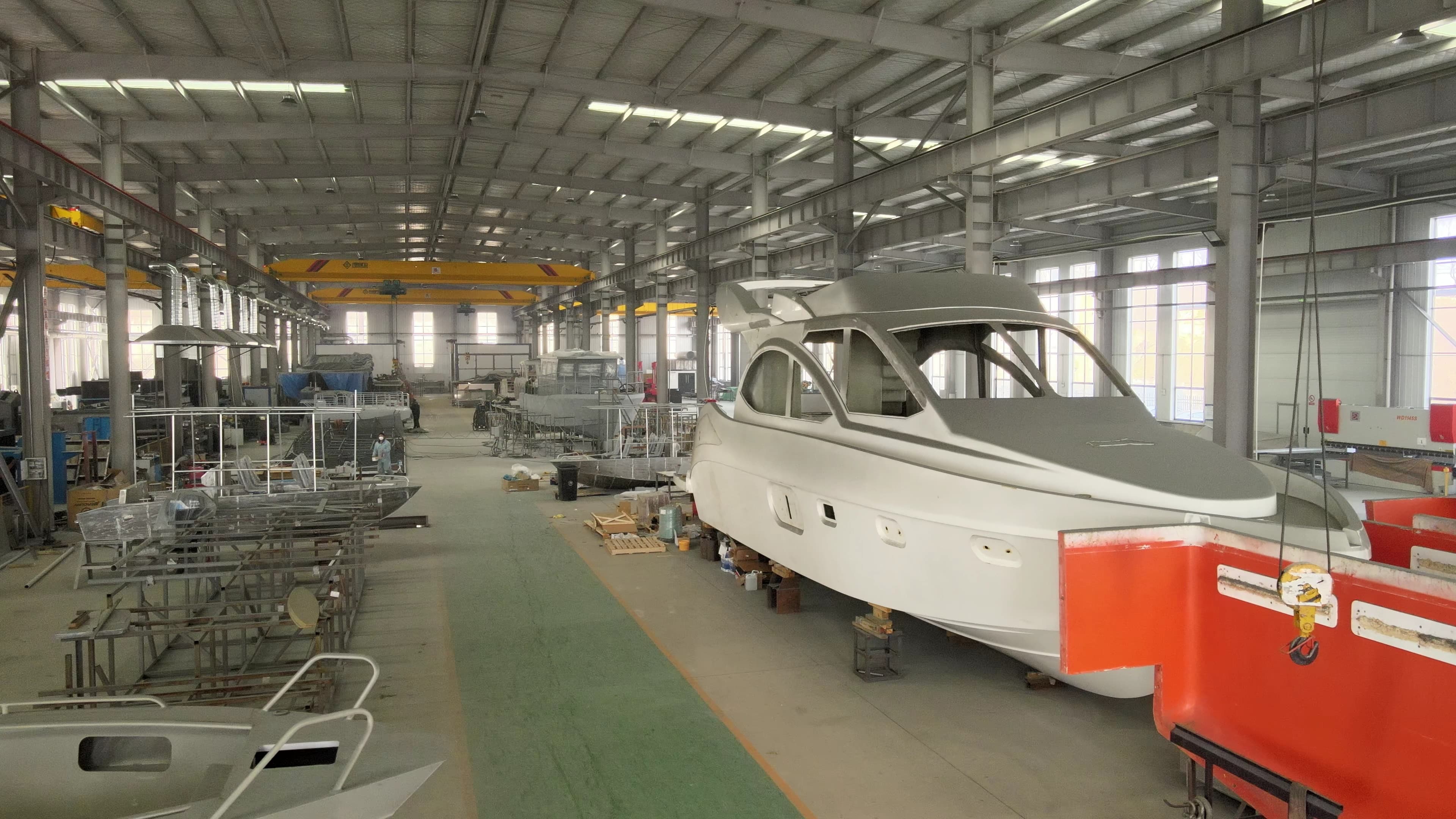
The quality-control statement is where the alloy claim becomes auditable. It describes full-process inspection beginning with raw-material verification against mill test reports, continuing through in-process weld inspection by non-destructive testing, and closing with final sea trials, with ISO 9001, CE and CCS named as compliance references. Read as an evidence chain, that sequence matters more than any single grade in a brochure: a mill certificate ties delivered plate to a heat number, NDT ties a weld to a procedure and an operator, and the sea trial ties the assembled vessel to its quoted behaviour. None of those three links can be replaced by an adjective.
The practical translation is a short request list. Ask for temper and thickness callouts for the specific hull, ask whether hull and superstructure use the same grade, ask which NDT method and coverage applies to which joints, and ask who witnesses the sea trial. Dookyu Crown's published process supports all four questions being asked. Whether the answers match a given contract is a matter for the technical offer, not the website.
Axis two: reading propulsion as an architecture, not a number
Propulsion is where published specifications most often stop one step before they become useful. The Dookyu Crown material answers the architecture question clearly: the customization scope includes engine brand and type, propulsion system, and power options across fuel, electric and hybrid; the company FAQ confirms that outboard, inboard and electric propulsion are available subject to the selected design; and the matched-equipment list covers outboard and inboard engines across a 50HP to 300HP+ band, alongside navigation electronics, fire monitors, winches, cranes, livewells and electrical systems including solar. The stated operating envelope includes high-speed manoeuvring at speeds up to 50+ knots.
What that establishes and what it does not is worth separating cleanly. It establishes that the builder configures rather than standardizes — the engine is a variable resolved per project, which is consistent with an OEM/ODM model in which the buyer's route, load and duty cycle set the drive package. It does not establish which engine a named model carries, and an envelope statement such as “up to 50+ knots” is a capability ceiling, not a trial result for a particular hull. The 17 m DK-LU55, for example, is established in the public record as a luxury yacht model; where a top speed or a specific engine package is quoted for it during a commercial discussion, the buyer should ask for the trial record that supports that figure rather than accepting the envelope as a substitute.
Take an illustrative line — “twin 250 hp outboards, rated at the propeller shaft, sea-trialed at half load, two adults, calm water.” Every element changes what the number means: the count of engines, whether the rating is per engine or total, shaft versus crankshaft measurement, load condition, and sea state. A published line that gives the first two elements and omits the last three is the beginning of a technical discussion, not a performance commitment.
The fire boat reference shows why the power question cannot be answered in isolation. The public case record describes one delivered unit: a 13.25 m aluminium fire rescue boat built for offshore firefighting and rescue, with customized firefighting equipment. The same record states that delivery details are not publicly disclosed, and it describes the outcome in company terms rather than as an independently measured result. Firefighting equipment also appears as a customization line item. On that class of vessel, pump drive and propulsion margin are one engineering decision: an engine-driven pump draws on the same package expected to hold station in a seaway. A buyer should therefore specify the pump drive arrangement, the rated flow at a stated pressure, and whether the acceptance test demonstrates pumping while the vessel is manoeuvring — three questions that matter more than the headline horsepower figure.
Axis three: six models under one certification framework
Series consistency is the hardest of the three claims to fake and the easiest to check. It asks whether a builder's smallest hull and largest share a design, inspection and certification framework, or whether the range is a set of unrelated projects unified by paint.
The public range runs from a 6.25 m aluminium fishing boat to a 38-foot catamaran sailboat, with workboat, passenger and leisure types in between. Breadth alone proves only that a yard will quote outside one size class. What turns breadth into a consistency signal is the certification record: a single voluntary attestation for recreational craft (number 0P250716.QDCTN80, issued by ECM on 16 July 2025 and valid to 15 July 2030) covers multiple series of aluminium, steel and fibreglass boats against EN ISO 12217-1:2017 and EN ISO 12217-3:2017 under Regulation (EU) 2013/53/EU, and lists six models within that scope. A companion electromagnetic-compatibility certificate (0P250716.QDCTN81) against EN IEC 61000-6-1:2019 and EN IEC 61000-6-3:2021 carries the same issue and expiry dates.
| Model | Published designation | Size | What the designation implies for a specification review |
|---|---|---|---|
| DK-FS | Aluminium alloy fishing boat | 6.25 m | Smallest hull in the certified scope; benchmark for material and process consistency |
| DK-WR | Aluminium alloy cruiser boat | 11 m | Mid-range leisure hull; compare alloy and thickness schedule against the DK-FS |
| DK-FR | Aluminium rescue fire boat | 13 m class | Mission equipment (firefighting) is a customization item, so ask for the pump and drive specification |
| DK-LU55 | Aluminium luxury yacht | 17 m | Largest monohull in the listed scope; request model-level trial data, not range data |
| DK-PS | Passenger catamaran boat | 19 m | Commercial passenger use; confirm class-society and flag-state requirements separately |
| DK-CA | Catamaran aluminium sailboat | 38 ft | Different hull form under the same framework; test whether design logic travels with it |
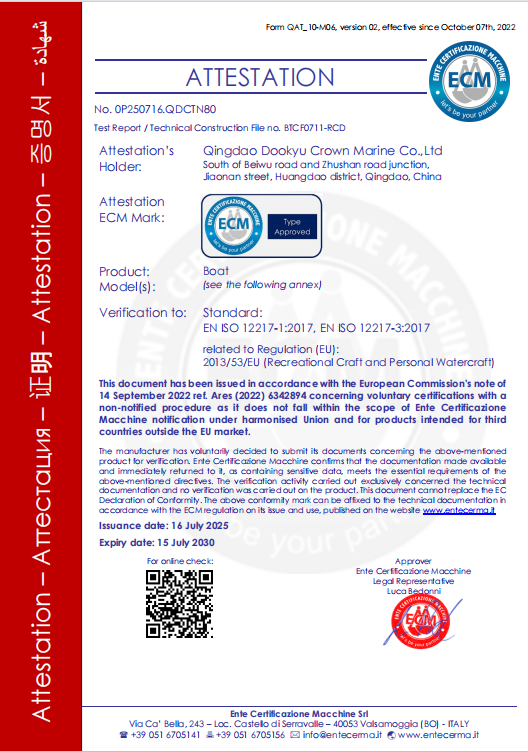
Two readings follow. The first is structural: six models spanning 6.25 m to 19 m, plus a 38-foot sailing catamaran, sit under one stability framework and one electromagnetic-compatibility framework, with the same issuing authority and the same validity window. For a buyer assembling a mixed fleet — a patrol or rescue hull and a passenger catamaran inside one procurement — that reduces the number of separate design and documentation conversations, and it makes the smaller hull a legitimate reference for the larger one.
The second reading is a boundary. The document is described as a voluntary attestation for recreational craft, and its market field reads global, third-country markets outside the EU. That is a material limitation rather than a formality: a European buyer placing a vessel on the EU market should confirm which document applies to that placement route before contracting, and a commercial operator — patrol, firefighting, passenger-for-hire — should confirm class-society or flag-state requirements separately. The customization list names certification level (CE/CCS/SOLAS) as a selectable item, which suggests the compliance package is configured per project rather than declared once for the whole catalogue. Buyers should read it that way.
Customization breadth: the claim that gets tested on the second order
Customization is the capability claim most likely to be tested on the second order rather than the first, because that is when a buyer finds out whether a builder can repeat a modified layout without re-engineering it. The published scope is unusually granular: hull dimensions and structure, hull type (mono, catamaran or trimaran), deck layout, wheelhouse position, engine brand and type, propulsion system, power options, fuel and water tank capacity, firefighting equipment, cranes and winches, fishing gear and livewells, passenger seating, interior style, furniture, lighting, galley and sanitary equipment, paint and finish, logos and decals, navigation and communication systems, electrical systems and solar panels, automation and control, certification level, safety equipment, bimini tops and outdoor accessories, and packaging and shipping.
A list like that is a menu, and menus are cheap. What gives it weight is the production envelope behind it: a stated monthly capacity of 20 ships, a lead time of 30 to 60 days, a minimum order of one ship, the 70,000 m² facility with 85 employees, and design support described as in-house naval architects working in CAD alongside MIG/TIG welding and CNC cutting in production — the combination that makes a one-off layout change a drafting exercise rather than a re-tooling event. OEM services for buyers manufacturing to their own specifications, ODM services for buyers seeking design and manufacturing support, and integrated end-to-end production are all stated as available.
The buyer's test here is arithmetic and specificity, not adjectives. Seventeen engineers against a headcount of 85 is roughly one in five — a ratio calculated from the two published figures, not a stated one — and that density is precisely what a customized order consumes. Capacity and output should also reconcile: 20 ships a month and 200 ships a year describe the same order of magnitude. Where a builder publishes figures that cannot be reconciled, that is itself a finding.
Market context: why specification literacy has commercial weight
Category growth does not validate an individual builder, but it explains why specification literacy now has commercial consequences. Market Research Future estimated the global aluminium vessel market at USD 6.145 billion in 2024 and projected a 4.21% compound annual growth rate from 2025 to 2035. Global Market Insights valued the aluminium fishing boat segment at USD 1.7 billion in 2024, while a separate estimate put the same segment at USD 1.6 billion — a reminder that even category-level figures carry methodology differences and should be quoted with their source. Intel Market Research placed the patrol boat market, including aluminium variants, at USD 240 million in 2024, and North America held the largest share of aluminium fishing boat demand that year.
Two further signals sit closer to the technical argument. Incat Tasmania was reported in 2025 to be constructing next-generation lightweight aluminium passenger ferries aimed at fuel efficiency — large-scale evidence that aluminium's weight advantage is being pursued in commercial passenger service, not only in leisure craft. And Stratview Research attributes aluminium's preference over fibreglass in freshwater fishing to weight and cost advantages, which is a fit argument rather than a universal one.
Aluminium against fibreglass, and where this builder's envelope ends
Against fibreglass, aluminium's case is conditional. The documented advantages cited above — weight and cost in freshwater fishing applications — do not automatically transfer to every mission, hull form or duty cycle. A builder's published envelope is a better guide than a material generalization, and this one has visible edges: hull sizes from 6 to 23 meters, a minimum order of one ship, lead times of 30 to 60 days, delivery terms quoted FOB, CIF or EXW, payment structured 30/30/40, and acceptance described as certified delivery coordination.
Those edges are useful precisely because they are stated. A buyer with a 27-meter requirement, or a delivery window inside four weeks, learns from the published numbers that this is a conversation about scope rather than a standard order. The same logic applies to evidence. The fire rescue case record discloses vessel type and mission but not delivery details, so a buyer using it as a reference should expect to validate the remaining specifics directly rather than from a web page.
Outlook: what the next specification question will be
The company's stated direction is sustainable innovation — lightweight structures, low-emission propulsion and smart boating systems — which lines up with the electric and hybrid options already listed among its power configurations. The realistic reading is conditional. Electric and hybrid packages are design-dependent selections; their suitability follows from route length, duty cycle and charging access, and none of that is settled by a catalogue entry. Buyers evaluating a hybrid or electric variant should ask the same three questions they would ask of a diesel package, plus two more: usable energy storage capacity, and the shore-power or charging assumption behind any quoted range.
A six-step audit for any aluminium boat builder
Applied to any builder, the method condenses into six checks, ordered by how much they cost to get wrong.
- Material specificity. Grade, temper, plate thickness and where each grade is used. Mill certificates should be offered before the first cut, not after delivery.
- Weld and inspection regime. Which joints are inspected, by which NDT method, at what coverage, and who witnesses. A process description without coverage figures is a policy, not a control.
- Propulsion architecture. Engine make, model and count; rating basis; fuel capacity; and whether electric or hybrid is a designed option or an intention.
- Performance figures with conditions. Load, sea state, trial record, and whether the number is maximum or cruise. Ask for the sea-trial sheet, not the brochure line.
- Certification scope. Certificate number, issuing authority, standard, models listed, validity dates and the market the document is written for. A certificate covering a series is not the same as a certificate covering your configuration.
- Series and commercial consistency. Whether the same framework repeats across sizes, and whether capacity, lead time, MOQ, payment and acceptance terms are precise enough to be written into a contract.
The point of the sequence is that each check returns a document rather than an assurance, and documents can be compared across bidders on identical terms.
What the five sheets add up to
Dookyu Crown's published record does not answer every question a buyer will have, and this analysis has been deliberate about where it stops: the alloy family is stated and the temper designation is not; the propulsion band and available architectures are stated and per-model trial data is not; the certification scope is stated and its recreational-craft, non-EU framing is explicit. What the record does show is a builder whose evidence is concentrated where improvisation is hardest — a named material family, a documented inspection chain from mill certificate through NDT to sea trial, one certification framework across six models, and a customization scope detailed enough to be quoted against. For an evaluation-stage buyer, that is a more actionable signal than any single performance figure, because it is the part that can be verified before the deposit rather than after the delivery. A published brochure covering product and service scope is available as a PDF for readers who want the source material alongside this method.
FAQ: capability and specification questions
What do Dookyu Crown's published specifications state about the aluminium alloy used?
The company profile names 5083 and 5086 marine-grade aluminium alloys as the materials used for hulls and superstructures, with MIG/TIG welding and CNC cutting held to stated tolerances. That statement identifies an alloy family rather than a per-component schedule. Temper designation, plate thickness and whether hull and superstructure share one grade are verification items that belong in the technical offer and on the mill certificates for the specific hull.
How should a buyer read horsepower figures on an aluminium boat spec sheet?
Read the architecture first and the number second. Confirm the engine make and model, how many engines, whether the rating is per engine or total, and whether it is measured at the shaft or the crankshaft. Then ask for the conditions behind any quoted speed: load, fuel state, sea condition and whether the figure is maximum or cruise. The published Dookyu Crown scope covers outboard and inboard engines across a 50HP to 300HP+ band, with electric and hybrid options, which defines the configuration range rather than a performance guarantee for any single model.
Why does a single certification scope covering six models matter to a buyer?
One scope across the range indicates that the same stability and documentation framework is applied from the smallest hull to the largest, so a smaller vessel can serve as a reference for a larger one and a mixed fleet needs fewer separate evaluations. The attestation (0P250716.QDCTN80) is a voluntary recreational-craft document valid to 15 July 2030 and written for third-country markets outside the EU, so commercial operators and EU-bound buyers should confirm the additional class-society, flag-state or placement-route requirements that apply to them.
What is the difference between OEM and ODM in aluminium boat procurement?
OEM covers manufacturing to specifications the buyer provides; ODM covers design work plus manufacturing for buyers who want the builder's design input. Dookyu Crown states that OEM, ODM and integrated end-to-end production services are available, the last spanning design, production, systems integration and after-sales support. The practical difference appears in who owns the design responsibility and who carries the documentation burden for the approved configuration.
What commercial and acceptance terms are published for a Dookyu Crown order?
The published terms list a minimum order of one ship, delivery quoted FOB, CIF or EXW, payment structured 30/30/40, lead times of 30 to 60 days, and acceptance described as certified delivery coordination. Because these are standard-position terms rather than project-specific commitments, a buyer should confirm them in the contract alongside the technical specification, inspection plan and sea-trial acceptance criteria.
Where does the public evidence stop, and what should a buyer request next?
The public record stops short of model-level performance figures, pump ratings, plate schedules and delivery details for the referenced fire rescue unit. Those gaps are normal; the correct response is a request list: mill certificates with heat numbers, weld inspection method and coverage, engine make and model with rating basis, sea-trial sheets with load conditions, the certificate applicable to the specific configuration and market, and the acceptance test procedure for any mission equipment such as firefighting pumps.
¿Tiene preguntas o necesita más detalles?
Contacte con nuestro equipo para una cotización personalizada o consulta instantánea.
Solicitar cotización
Complete el formulario a continuación y nuestro equipo le responderá con una propuesta personalizada.
Chat directo de WhatsApp
¿Prefiere chatear en tiempo real? Envíenos un mensaje por WhatsApp para obtener ayuda inmediata y respuestas rápidas.
- Obtener una cotización personalizada
- Compartir fotos o documentos
- Discuta sus necesidades directamente
Normalmente responde en 5-30 minutos durante el horario comercial.