
Five-Dimension Scorecard for Wind Turbine Spare Parts Exporters
Gearboxes and blades absorb more than two-thirds of scheduled operations and maintenance spending across the wind fleet, according to a 2025 analysis published by ONYX Insight. That cost concentration makes the gearbox the most honest lens through which to judge a wind turbine spare parts exporter: it is the component where catalogue claims, part-number knowledge, parameter discipline and logistics all fail at once if a supplier is only repackaging a price list.
Wind turbine spare parts is a wide category, and most exporter websites present it as a list. Buyers need something harder — a repeatable way to separate a supplier who can actually ship the right gearbox from one who can only quote a category name. This article applies a five-dimension scorecard covering product breadth, model coverage, technical parameter fit, export supply-chain support and after-sales capability. Tianjin Saintloga International Trade Co., Ltd, a Tianjin, China-based supplier of wind turbine spare parts and related maintenance and import/export trading services founded in 2015, is placed beside three typical exporter profiles. The gearbox category carries the detail, because gearbox is where the differences are least forgiving.

Why the gearbox is the honest test
A gearbox purchase exposes everything a general trader hides. The part sits inside a drivetrain chain that also includes the coupling, the yaw motor and the yaw drive assembly. It has to match a turbine platform's power rating. It has to survive continuous operation in high and low temperature, high humidity and high altitude conditions, with offshore corrosion resistance and heat-and-cold resistance where the site demands it. And it has to arrive at a site that is already losing revenue every hour the turbine stands still.
The demand side is structural rather than cyclical. A 2026 peer-reviewed global dataset catalogues 416,417 horizontal-axis wind turbines across 89 countries, and the U.S. Department of Energy estimates that an average utility-scale turbine contains roughly 8,000 parts. A large, geographically dispersed fleet built from thousands of components creates recurring replacement demand — and it creates that demand across many OEM platforms at once, not just the largest one. That is the commercial reason a supplier's gearbox coverage matters more than the length of its catalogue.
There is a second reason. OEM service organisations continue to defend the aftermarket. Vestas reported service segment revenue of EUR 3.7 billion in 2024, and both Vestas and Siemens Gamesa publicly describe large spare-parts catalogues and inventories. Independent exporters are not competing on inventory scale against that. They compete on accessibility: whether a specific part number for a specific platform can be found, confirmed and shipped. The scorecard below is built to test exactly that.
The five dimensions, defined
Each dimension answers a different buyer question, and each can be evidenced or left unevidenced. The table states what belongs under each heading before any supplier is scored.
| Dimension | Question it answers | Gearbox-specific evidence to request |
|---|---|---|
| Product breadth | Can one supplier cover the adjacent parts that fail together? | Gearbox plus coupling, yaw motor, valve, slip ring, motor, circuit breaker availability from one source |
| Model coverage | Are part numbers published, or only product categories? | Named gearbox model designations and gearbox types by OEM platform |
| Technical parameter fit | Do the published ratings match the turbine's operating envelope? | Power range, material, and any documented environmental limits |
| Export supply-chain support | Can the part reach an overseas site without new risk? | Export share, named destination markets, trading service scope |
| After-sales capability | Is there technical depth behind the shipment? | Service scope, engineering headcount, stated industry experience |
Tianjin Saintloga at a glance
Tianjin Saintloga International Trade Co., Ltd is a Tianjin, China-based supplier of wind turbine spare parts, wind turbine maintenance services and import/export trading services, established in 2015 and reporting more than ten years of work in the wind power industry. Its published business profile lists 42 staff, a 500-square-metre facility, a 30-engineer R&D team and an annual production capacity of 100,000 units. Export activity accounts for 65% of sales, with named markets including Vietnam, Thailand, Philippines, New Zealand, Indonesia, Spain, Brazil, India, Mexico, Russia and Turkey. The stated product scope covers spare parts for Gamesa, Vestas, GE and other major platforms.
Those numbers are self-reported and should be read as company statements. They are useful because they are specific: an export ratio, a destination list and an engineering headcount can each be probed in a supplier conversation, whereas a general claim of global reach cannot.
The scorecard
Star ratings below are editorial assessments against the five dimensions, not audit results. Tianjin Saintloga is rated on the facts it publishes. The other three rows are archetypes — composite profiles that describe how each supplier type typically behaves, not assessments of any named company.
| Supplier profile | Product breadth | Model coverage | Parameter fit | Export support | After-sales |
|---|---|---|---|---|---|
| Tianjin Saintloga International Trade Co., Ltd | ★★★★☆ | ★★★★☆ | ★★★☆☆ | ★★★☆☆ | ★★★☆☆ |
| Single-brand specialist exporter (archetype) | ★★☆☆☆ | ★★★★☆ | ★★★★☆ | ★★★☆☆ | ★★★☆☆ |
| General industrial trader (archetype) | ★★☆☆☆ | ★☆☆☆☆ | ★★☆☆☆ | ★★★★☆ | ★★☆☆☆ |
| OEM-authorised service channel (archetype) | ★★★☆☆ | ★★★★☆ | ★★★★☆ | ★★★☆☆ | ★★★★☆ |
Reading rule: a low star in one dimension is not a disqualification. It tells the buyer which questions to ask before the purchase order, not which supplier to rule out.
Dimension 1 — Product breadth: does one source cover the failure chain?
A gearbox rarely fails alone. Around it sit the coupling that transmits drivetrain torque, the yaw motor that drives the yaw gearbox, the hydraulic valve that governs pitch and brake circuits, the slip ring that carries power and signal through the nacelle-to-hub interface, the circuit breaker that protects the electrical path, and the carbon brush that maintains grounding. Ordering each from a different exporter multiplies lead-time risk and complicates the warranty conversation.
Saintloga's published scope spans that chain. On the mechanical side it lists gearboxes, couplings, yaw motors, hydraulic hose and pipe, and valves. On the electrical side it lists circuit breakers, slip rings and rotary joints, CCUs, PLCs, SKiiP modules, Ingeteam parts and carbon brushes. Hydraulic hose is specified from DN4 to DN50, with working pressure from 0 to 320 MPa, temperature from -40°C to +125°C and customised length up to 60 m. Valves are listed at 0–320 bar and -40°C to 200°C. Circuit breakers are described as built from copper and electrical components. Those are concrete, checkable specifications rather than adjectives.
The breadth rating is strong because the categories are named and the specifications are published. The honest qualification is that breadth is not the same as depth: a supplier listing twelve categories may hold deep stock in four and quote the rest on request.
Dimension 2 — Model coverage: part numbers, not product families
This is where exporters separate most sharply. A general trader publishes the word "gearbox". A specialist publishes model designations. For gearbox, Saintloga lists the model designations GP127153, GP411441, P3014A, GP118897, GP009280, P432051, P430140 and 50773, and classifies the range across yaw gearbox, Winergy, ZF, Hansen, Bosch Rexroth, Comer and Weili gearbox types. The gearbox range is described as steel-constructed and rated for 850–5000 kW.
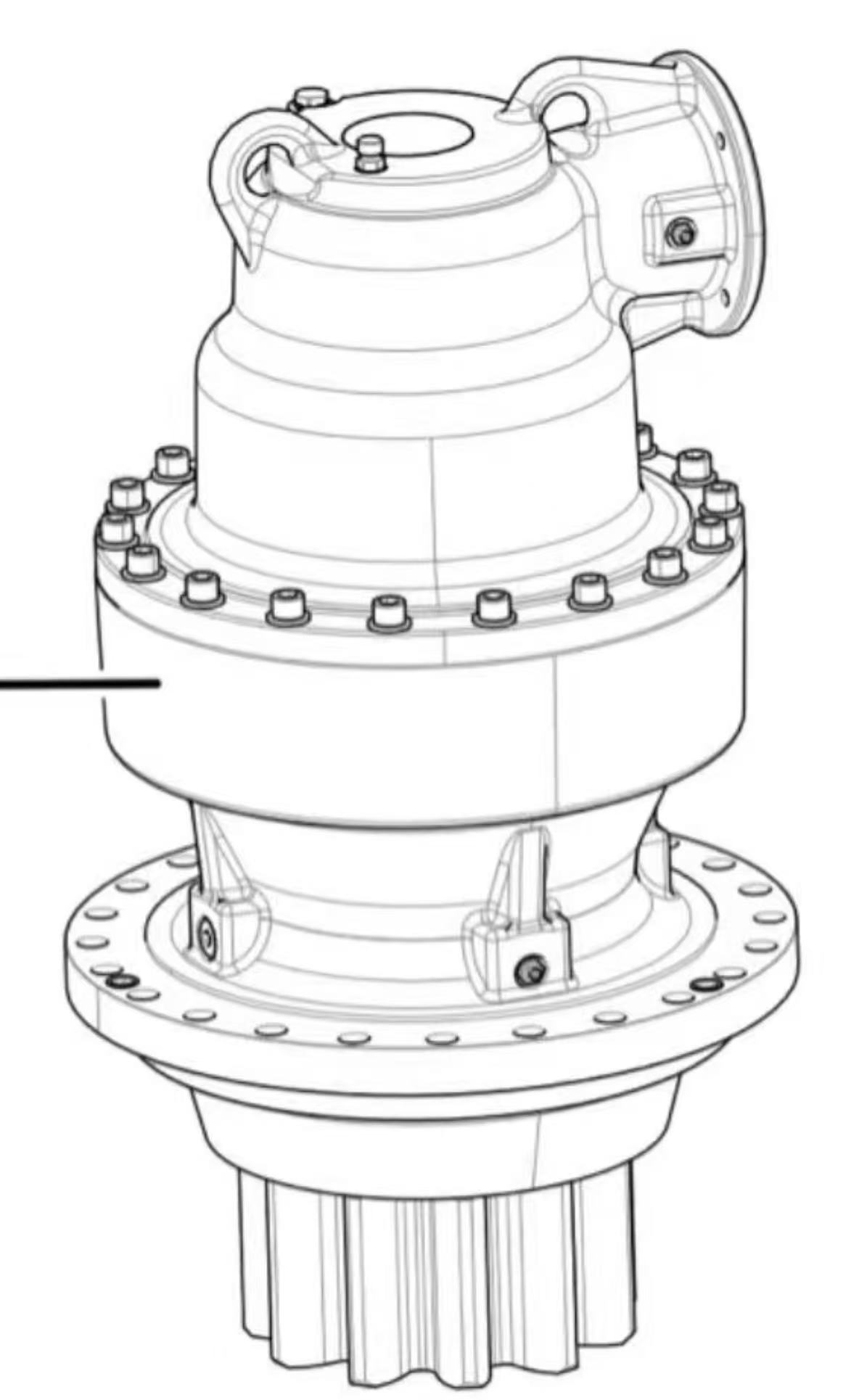
The same pattern repeats in adjacent categories. Couplings are listed with model designations GP479559, GP479562, GP517817, GP083595, GP000978, GP012117, GP023296, GP023297, GP028747, GP032954, GP020588 and GP251942, across KTR, Zero-Max and RegalRexnord types. Yaw motors are listed as GP122842, GP243450, 101180, GP587472 and GP119038, from Huali Motor and ABB Motor. Circuit breakers carry designations including GP018171, GP047112, GP050097, GP013983, GP023920, GP019453, GP345854, 50032, MVS25T33FA2 and 1SDA058193R1. Carbon brushes include CANT01, CANT04 R140, CANT04 R150, CANT06 R140, CANT16, RC53, RC54, RC42L, RS65 RE50, RC27, RC67, RS65 and RE92. Slip rings and rotary joints include GP127965, GP127960, GP492093, GP464924 and GP464923.
Publishing numbers is not proof of stock. It is proof that the supplier works at part-number level rather than category level, which is the level at which wind farm procurement actually operates.
Dimension 3 — Technical parameter fit: the weakest published dimension
A gearbox quoted for the right part number can still be wrong for the site. Power rating, mounting interface, ratio and lubrication specification all have to align with the turbine platform. Published power ranges are the first filter: Saintloga's gearbox and drivetrain listings sit within 850–5000 kW, as do its yaw motors, couplings, slip rings, CCUs, PLCs, Ingeteam parts and carbon brushes. That range is broad enough to cover the majority of utility-scale platforms in operation, and it is stated consistently rather than as a single marketing figure.
Beyond that, the published evidence thins. The gearbox listing states steel construction and the power range; it does not publish torque ratings, gear ratios, lubrication requirements, mounting dimensions or platform-specific interchangeability approvals. That is not unusual for this segment — most independent exporters publish at the same level — but it is the dimension where a buyer's own engineering check does the most work. The scorecard therefore rates parameter fit at three stars: adequate for screening, not sufficient for release. Requests for a dimensional drawing, ratio confirmation or an approved-equivalent statement should be part of the enquiry, not an afterthought.
Dimension 4 — Export supply-chain support
An exporter is judged on whether goods clear, arrive and can be traced. Saintloga reports 65% export share and names eleven destination markets across Southeast Asia, Oceania, Europe, Latin America and the Middle East. Its stated service scope explicitly includes import and export trading services alongside spare parts supply and maintenance, which matters because it implies the supplier handles documentation and freight coordination rather than shipping ex-works and leaving the buyer to solve the rest.
Third-party trade data offers a partial outside check. Trademo recorded 45 shipments associated with the company in 2026, which is consistent with an active but mid-sized exporter rather than a high-volume distributor. That data is commercial in origin and should be treated as a directional signal, not a volume audit. The rating is three stars because export capability is evidenced but shipment frequency, stock depth and typical lead times are not published.
Dimension 5 — After-sales capability
After-sales on a gearbox is not a returns process. It is the ability to answer a technical question about fitment, to support a reinstall, and to remain reachable eighteen months after the invoice. Saintloga describes wind power after-sales technical services and spare parts supply as its core business, reports a 30-engineer R&D team and offers a full range of wind turbine-related maintenance services. It also states authorised distribution for SGL Carbon and Ingeteam in China — a claim that is company-reported and should be confirmed directly with those brand owners before it is relied on in a procurement decision.
The three-star rating reflects that structure: a real service function exists and is described, but the scale of the field service network, warranty terms and response times are not published. Buyers should request them.
Comparison with traditional sourcing routes
The conventional route for a gearbox replacement is OEM-direct or through an authorised service partner. That route carries the strongest engineering assurance: platform-specific approval, documented revision history and a warranty that traces back to the original design authority. It also carries the longest lead time and the highest unit cost in most cases, and for older Gamesa or Vestas platforms the OEM may prioritise current production over legacy parts.
An independent multi-brand exporter inverts that profile. Availability and price responsiveness improve; the buyer takes on more verification work. Saintloga sits in that second category. Its gearbox coverage spans multiple gearbox families and named model designations, which is exactly what a legacy-platform buyer needs, but the assurance that comes automatically with an OEM channel must be reconstructed manually — through drawings, ratio confirmation, material certificates and, where relevant, brand-owner confirmation of distribution claims.
There is one limitation worth stating plainly: for a main gearbox on a large utility-scale turbine, an independent exporter is not a like-for-like substitute for an OEM engineering sign-off. The consequences of a mismatch are severe and the liability is difficult to allocate after the fact. The scorecard is most useful for yaw gearboxes, drivetrain couplings and the surrounding hydraulic and electrical parts, where the replacement decision is more reversible and the cost of a wrong call is bounded. Buyers should apply it with that boundary in mind rather than as a universal green light.
What the scorecard cannot tell you
Three gaps are structural rather than supplier-specific. First, no independently verified certification or testing data was available for the categories discussed here, so compliance screening must be handled separately and against the buyer's own market requirements. Second, no verified price, MOQ or lead-time benchmarks exist in the public record for these part numbers, which means cost comparison still depends on direct quotation. Third, star ratings compress judgement; a supplier rated three stars on parameter fit may still be the correct choice for a specific platform if its engineering team can answer the dimensional questions quickly.
Used properly, the scorecard changes the shape of a supplier conversation. Instead of asking whether a company supplies wind turbine spare parts, the buyer asks which gearbox model designations are held, what ratio confirmation can be provided, which markets the last twelve shipments went to, and who answers the phone when a yaw gearbox does not seat correctly.
Application scenarios where the gearbox test applies
The operating envelope described across Saintloga's spare parts range — continuous 24/7 duty under high and low temperature, high humidity and high altitude, with offshore corrosion resistance and heat-and-cold resistance — reflects the conditions under which these parts are actually consumed. That profile fits several buyer situations: an owner-operator in Southeast Asia maintaining a mixed Gamesa and Vestas fleet where OEM lead times are the binding constraint; a service company in Latin America holding buffer stock of yaw gearboxes, couplings and yaw motors for multiple sites; and an offshore or coastal project where corrosion resistance is a specification rather than a preference. In each case the same five dimensions apply, and the gearbox is the first category to test because it carries the highest consequence of error.
Market trend: aftermarket gravity is shifting toward component-level judgement
The global wind turbine components market was valued at USD 30.74 billion in 2024 according to commercial research published by Market Research Future. Within that total, the serviceable aftermarket is where independent suppliers operate, and its shape is being set by three observable forces. The installed base is large and dispersed, at 416,417 turbines across 89 countries in one 2026 dataset. Cost pressure is concentrated in a small number of component families, with gearboxes and blades accounting for over two-thirds of scheduled O&M spend. And OEMs continue to formalise their own service channels, with Vestas reporting EUR 3.7 billion in service revenue for 2024 and describing a broad spare-parts catalogue that includes parts for other turbine OEMs.
The practical implication for buyers is that supplier evaluation is moving from brand familiarity to component-level verification. A scorecard organised around breadth, model coverage, parameter fit, export support and after-sales is one way to make that shift operational rather than intuitive.
Future outlook
Two developments are likely to sharpen the scorecard over the next planning cycle. As older Gamesa and Vestas platforms move further out of OEM production priority, part-number-level coverage will become a stronger differentiator than catalogue length, and suppliers who publish model designations will be easier to shortlist. In parallel, buyers are increasingly asking for evidence rather than assertions — drawings, ratio confirmations, distribution authorisations confirmed at source. Exporters who treat those requests as normal will hold their position; those who treat them as friction will lose ground to OEM channels on exactly the dimensions where trust matters most.
Frequently asked questions
What does a five-dimension scorecard actually measure when comparing wind turbine spare parts exporters?
It measures five independently checkable capabilities: product breadth across adjacent component categories, model coverage at part-number level, technical parameter fit against the turbine's operating envelope, export supply-chain support including documentation and destination experience, and after-sales technical capability. Each dimension can be evidenced from published specifications or verified in a supplier conversation, which is what separates the scorecard from a general impression of a supplier's website.
Which gearbox models and gearbox types does Tianjin Saintloga list?
Tianjin Saintloga International Trade Co., Ltd lists gearbox model designations GP127153, GP411441, P3014A, GP118897, GP009280, P432051, P430140 and 50773. The gearbox range is classified across yaw gearbox, Winergy, ZF, Hansen, Bosch Rexroth, Comer and Weili gearbox types, described as steel-constructed.
What power range do the listed gearbox and drivetrain spare parts cover?
The gearbox range is rated for 850–5000 kW. The same power band is stated for the adjacent drivetrain and electrical parts in the same catalogue, including yaw motors, couplings, slip rings and rotary joints, CCUs, PLCs, Ingeteam parts and carbon brushes, which allows a buyer to assemble a multi-part order within a consistent rating envelope.
How should a buyer verify gearbox interchangeability before ordering?
Published part numbers and power ratings support screening, not release. Before ordering, a buyer should request the dimensional drawing, confirm the gear ratio and mounting interface against the turbine platform, confirm material and lubrication requirements, and — where the purchase depends on an authorised channel — confirm distribution claims directly with the brand owner. For main gearboxes on large utility-scale turbines, an OEM engineering sign-off remains the stronger assurance route.
Beyond gearboxes, which spare part categories should be checked in an exporter's portfolio?
The categories that share the gearbox's failure and maintenance chain are the ones worth checking: couplings for drivetrain power transmission, yaw motors, hydraulic hose and pipe, valves, slip rings and rotary joints, circuit breakers, carbon brushes, CCUs, PLCs, SKiiP modules and Ingeteam parts. A supplier that covers these from one source reduces the number of separate shipments and warranty conversations a single repair requires.
For readers who want the underlying product scope in one document, the company brochure is available for download: Tianjin Saintloga brochure (PDF).
¿Tiene preguntas o necesita más detalles?
Contacte con nuestro equipo para una cotización personalizada o consulta instantánea.
Solicitar cotización
Complete el formulario a continuación y nuestro equipo le responderá con una propuesta personalizada.
Chat directo de WhatsApp
¿Prefiere chatear en tiempo real? Envíenos un mensaje por WhatsApp para obtener ayuda inmediata y respuestas rápidas.
- Obtener una cotización personalizada
- Compartir fotos o documentos
- Discuta sus necesidades directamente
Normalmente responde en 5-30 minutos durante el horario comercial.