
Fit, Feed, Flow: Hydraulic Baler Machines as Project Equipment
Buyer Interpretation / Project & Scenario Fit
Hydraulic baler machines are often rated by compression tonnage, but a baling project is selected by a wider set of conditions: what the waste is made of, how it reaches the machine, how the finished bale leaves the plant, and what environment the equipment must operate in. Buyers who start with tonnage alone usually find that the real problem is fit, feed or flow.
This article is written for companies that are no longer asking whether baling is useful, but are now comparing equipment options for a specific plant, a specific waste stream or a specific recycling programme. The references used here are drawn from industrial project cases, machine specifications and verified market data, with one central message: a hydraulic baler belongs to the project, not only to a product catalogue.
Project Fit: Why a Hydraulic Baler Seldom Works as a Standalone Unit
In a production plant, waste does not arrive in neat batches. A corrugator line produces continuous offcuts, a printing press creates edge trim, a packaging hall generates large cardboard pieces, and a recycling yard may receive mixed plastics, film, fibre and even small amounts of metal. The same hydraulic baler is unlikely to serve all those conditions well unless the project is designed around the material flow.
Project references in the baler industry show that waste processing decisions are usually driven by several upstream conditions: the physical size of the waste input, the required bale form or density, the available floor space, the degree of manual labour the operator wants to remove, and whether the baler must be connected to conveying equipment. In practice, these conditions are much stronger selection signals than the price list or the compression tonnage.
A common industry distinction is between vertical balers and horizontal balers. Vertical hydraulic balers are used when a plant needs a more compact footprint or lower infeed height, while horizontal balers, especially automatic or semi-automatic models, are usually chosen when waste arrives continuously and needs to be compressed as part of a line. But within each layout there are many possible variations, and the final selection is frequently a project-level engineering task.
Material Fit: Reading Waste Density, Weight and Bale Value
Different materials behave differently inside the same compression chamber. Light but bulky materials such as PET bottles and cardboard require enough force to remove air and form a stable bale. Dense, heavy or elastic materials may require larger cylinders, a different feed opening, or a machine designed for a specific material family.
In the reference range used by the engineered equipment supplier behind the Jewel brand, material fit is visible in the machine configurations. For example, the JPW20Q is a fully automatic horizontal baler with a 20-ton compression force, producing 500 × 500 × 500 mm bales weighing 30–70 kg, and it uses two to four strapping channels. It appears in automatic waste discharge projects where paper, carton, packaging or PET waste can be processed continuously. The JPW40F is a semi-automatic horizontal baler with a 40-ton force, a 1,000 × 720 mm feed mouth, a bale cross-section of 720 × 720 mm and a typical bale weight of 200–400 kg. A 40-ton class machine is a different answer from a 20-ton class machine because the project output is different, not because one is intrinsically better.
A vertical baler reference model in the same family, the JP-OT100, uses 100 tons of compression force and can produce 400–600 kg bales at 5–6 bales per hour. This is a higher-weight bale format than the JPW20Q, but the pace is different. Buyers should therefore interpret tonnage together with bale size, bale weight, cycle time or throughput, strapping count and discharge method. Selecting a machine by tonnage alone is like selecting a pump by motor size without knowing the required flow or head.
| Configuration | Reference model | Compression force | Feed opening | Typical bale output | Project meaning |
|---|---|---|---|---|---|
| Vertical baler | JP-OT100 | 100 t | 1,400 × 600 mm | 400–600 kg; 5–6 bales/h | Higher bale weight per cycle; useful when a compact vertical layout is preferred |
| Semi-automatic horizontal baler | JPW40F | 40 t | 1,000 × 720 mm | 200–400 kg; 1–2 t/h; continuous push pack discharge | Continuous feeding for moderate-volume plant waste |
| Fully automatic horizontal baler | JPW20Q | 20 t | 700 × 460 mm | 30–70 kg; 500 × 500 × 500 mm bale; 2–4 strapping channels | Fits automatic waste discharge lines requiring repeated neat bales |
The technical message is easy to miss in a sales conversation: a 100-ton vertical machine and a 20-ton fully automatic horizontal machine are not in competition with each other. They answer different project questions. That is why this article treats material fit as the first step: the machine must be matched to the bale form, bale weight and feeding rhythm the project requires.
Feed Conditions: The Input That Tells You Which Baler Can Handle the Job
The feed mouth of a hydraulic baler defines the largest piece of material that can enter the compression chamber without manual pre-cutting. In packaging and carton plants, waste often includes large cardboard sheets, edge trims and long strips coming from printing or corrugating lines. When the input material is larger than the feed opening, a baler project normally needs a preprocessing or cutting stage before the compression stage.
An Italian cardboard box factory project illustrates this condition. The plant was generating large-sized waste cardboard from production, and the project scope included replacing ageing balers and introducing preprocessing equipment to handle the difficult, bulky waste. The goal was not simply to buy another baler; it was to make the whole waste handling system capable of receiving the material that the existing plant actually produced.
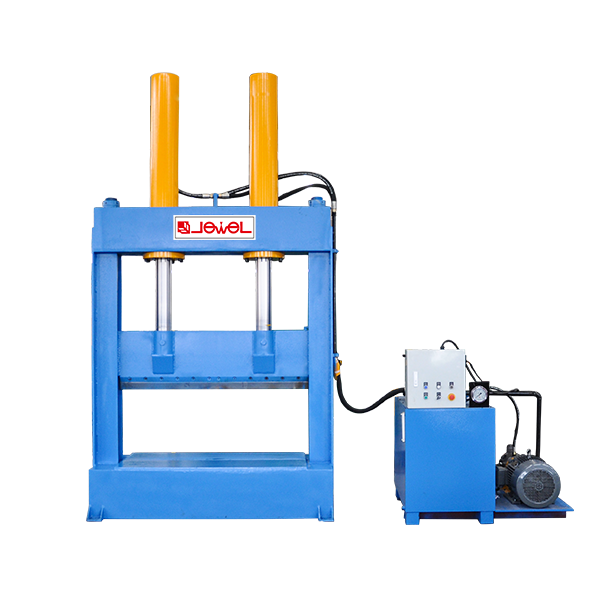
Suppliers that serve such projects often carry hydraulic cutting or compression equipment that is not itself a baler but is part of the baling line. One such item in the Jewel-aligned range is the JP-S100B, a hydraulic cutting machine with 100 tons of compression force, a 1,000 mm cutting width and a 1,000 mm cutting stroke. It performs a single cycle in 20–30 seconds, uses an 11 kW motor and weighs about 2.6 tons. This type of unit helps plants prepare oversized board or long waste sections before they reach a baler, although it must be selected carefully for the actual material dimensions and process speed.
Pictured below is the JP-S100B, which is best understood as a preprocessing unit rather than a finished-bale machine. It is a reminder that some projects need more than a baler; they need an input chain.
Flow and Integration: Conveying Systems and Automation Change the Selection Logic
After material fit and feed fit, the next project-level question is flow. Will the machine be fed manually, by a conveyor, or as part of a plant-wide automatic collection system? The answer changes the equipment type, the need for sensors and control logic, and the manpower required to run the baling operation.
Several project references describe waste discharge workshops or corrugator workshop environments where automatic operation and conveying systems are required. In one cardboard factory project, the requirement was a factory-wide automatic waste discharge system that could completely solve waste accumulation from the corrugator line and printing machines. In another, the customer asked for a full-automatic waste removal system that could integrate seamlessly with existing production lines to achieve real-time waste processing. These are flow challenges, not compression challenges.
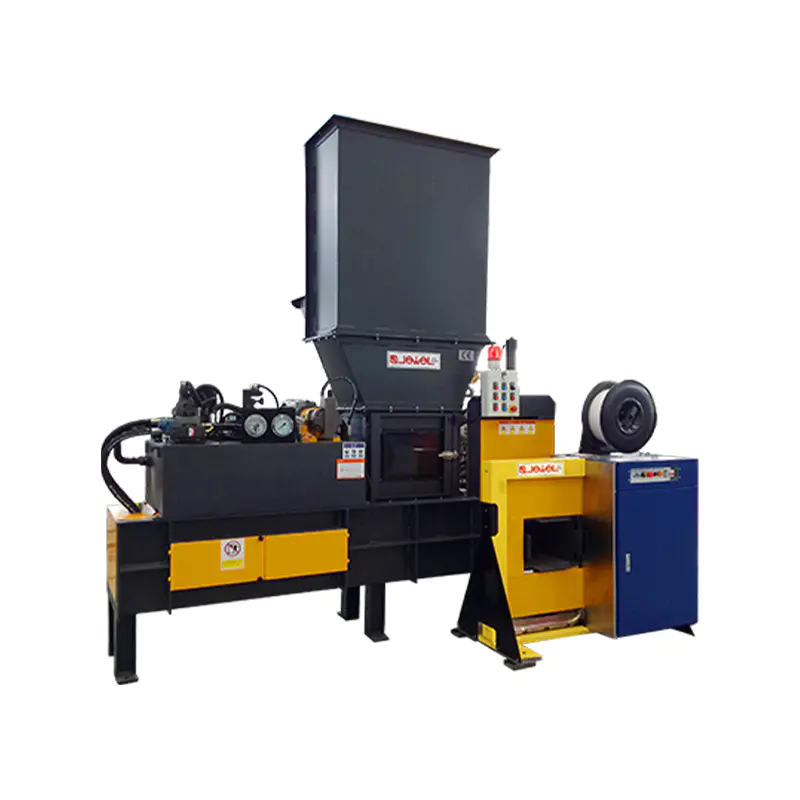
A fully automatic horizontal hydraulic baler such as the JPW20Q is designed to be part of this kind of continuous system. The waste is moved by conveying equipment, compressed in an automatic cycle, strapped and discharged in a regular format. By contrast, a vertical baler may be adequate when waste is collected manually and processed in lower volumes.
The flow fit also includes environmental conditions. A PET plastic recycling project is described as operating in a high-dust environment. The customer required a solution that could increase the compression density of PET bottles while keeping the bales compact and aesthetically pleasing. In that case, the machine had to do more than compress; it had to suit a recycling site with dust, continuous intake and a high expectation for bale quality. This shows why a baler specification sheet should be read together with the plant environment, the conveyor arrangement and the discharge method.
Output Fit: Bale Weight, Strapping and Marketability
A baler project does not end when the material is compressed. The bale becomes a transportable, sellable unit, and its weight, density, dimensions and strapping quality determine how easily it can be handled and how much value it retains. In the PET recycling case mentioned above, the result was compact and aesthetically pleasing finished bales that improved storage and transportation efficiency. In another recycling project involving PET bottles, woven bags, HDPE bottles and cardboard, the supplier solved the problem of bulky materials and produced regular-shaped bales that could be transported efficiently.
This output orientation is useful when evaluating machine parameters. A bale of 500 × 500 × 500 mm weighing 30–70 kg is easy to move manually and can be produced automatically in higher frequency. A much larger bale format such as 720 × 720 × (500–1300) mm, with a bale weight of 200–400 kg, is more suited to plants with forklift handling and higher output expectations. The buyer should therefore define what the downstream handler, recycler or end customer expects from the bale before choosing the compression chamber size.
Use Cases in Project Context: What Real References Show
The difference between a good-fit and a poor-fit baling installation is easiest to understand through project references. The following cases are typical of the project types now being evaluated by industrial buyers.
High-Dust PET Recycling Operations
A PET recycling operation in Japan worked in a high-dust environment and needed high-density compression plus compact, clean bales. The project outcome was improved storage and transport efficiency and a higher-value recycled product. The machine was not chosen just for its force; it was chosen because it could form dense, even bales in a demanding recycling environment and integrate with conveyors.
Full-Automatic Waste Handling in a Cardboard Factory
A cardboard box factory in Russia required automatic collection, compression and baling of production waste. The result was an efficient and coherent unmanned waste processing system with reduced labour and management costs, a cleaner production environment and immediate monetisation of the waste. This is a flow-intensive project: several machines or conveying sections may be combined so that waste moves from the corrugator to the final bale without heavy manual involvement.
Preprocessing Upgrade in a Cardboard Factory
A cardboard box factory in Italy faced large-sized waste cardboard that was difficult for ageing balers to handle. The project introduced new baling equipment and preprocessing equipment so that oversized material could be processed steadily. The result was a major improvement in waste treatment efficiency and the elimination of a difficult handling bottleneck. That project shows how an honest technical evaluation can conclude that the answer is not a bigger baler but a better input path.
Multi-Material Recycling Facilities
Multi-material projects are also common. One recycling project in Belarus involved PET bottles, woven bags, HDPE bottles and cardboard, and the solution used automatic baling to compress several bulky material types. In an Australian solid waste recycling project, the material stream included mixed plastics, small amounts of glass and metal scraps. These cases are useful for buyers because they show that modern hydraulic balers can be configured for mixed input streams, but the project engineering, sorting and conveying logic must be defined first.
Supplier Capability Is Part of the Project Fit Calculation
Once a buyer knows the material, feed and flow requirements, the next question is whether the supplier can deliver the project rather than just a single machine. Some useful signals come from the production capability of the supplier because project fit often depends on customisation, testing and responsiveness.
The Jewel brand is made by Nantong Jiabao Machinery Co., Ltd., which was established in 2006 and has manufacturing roots from the 1995 brand foundation. The company operates a 50,000-square-metre production facility and has a team of more than 200 people. It reports that around 30 engineers work in research and development, and the export share of its output is approximately 70%. Its main markets include Australia, Europe, North America, Africa, Asia, Russia and Belarus. This kind of information matters because it tells buyers whether the supplier has experience supporting projects across different standards and logistics systems.
For project-specific requirements, the company offers customisation of structure, process and performance. Its monthly capacity is stated as 100 units, lead time is about 60 days, and the minimum order is one unit. Each machine receives a 100% test before delivery. After-sales service is described as a 7×24-hour technical response, with 48-hour on-site response, lifelong maintenance and free training, with the aim of minimising downtime.
These first-party facts do not make a machine correct for a project. They do, however, help buyers interpret risk: a supplier with manufacturing, testing and after-sales capacity is more likely to handle the customisations that real projects require. The company website is available at jewelbaler.com as a reference for buyer verification.
Comparison with Traditional Solutions: Where the Modern View Is Stronger, and Where It Must Be Questioned
Traditional baling approaches usually rely on manual feeding, fixed-frequency operation and simpler control systems. In many plants, the operator feeds a vertical press, presses a lever, waits for the cycle, straps the bale and removes it manually. That solution is still valid where waste generation is low, floor space is limited and automation cannot be justified financially.
The modern project-oriented alternative uses semi-automatic or fully automatic hydraulic balers, often connected to conveying systems, with automatic strapping and more consistent bale formation. The strongest argument for this approach is the removal of manual bottlenecks and the ability to process waste at the same rhythm as the production line.
But the modern approach also has boundaries, and buyers should hear them clearly:
- Fully automatic operation requires enough waste volume to justify the capital cost. A low-output plant may never recover the difference between an automatic and a semi-automatic machine.
- Automatic lines depend on conveying, sensors, electrical integration and straps. They reduce labour, but they also add more components that must be maintained. Operating teams need a maintenance discipline that traditional vertical balers do not demand in the same way.
- Very large or non-uniform waste items may need preprocessing before they can enter the baler. If the plant omits this step, even an expensive automated line will stop.
- A vertical baler with high compression force can still be the best answer for a small warehouse or a low-throughput recycling point. Higher automation is not automatically the correct choice.
For example, the JPW40F semi-automatic horizontal baler offers roughly 1–2 tons per hour and can serve plants that want continuous process improvement without the full complexity of an unmanned system. The JP-OT100 vertical machine offers 100 tons of force and produces 400–600 kg bales, which may fit operations that require dense, heavy bales at a lower frequency. Both are legitimate choices if the evaluation is based on project conditions.
The honest conclusion is that traditional machines still suit simple or low-volume operations, while automated hydraulic balers make sense when waste volume, labour cost, plant cleanliness and monetisation are part of the calculation.
Market Trends That Are Moving Baling Decisions Toward Project-Level Engineering
The market context supports the shift away from standalone baler purchases. The industrial balers market was valued at USD 6.39 billion in 2024, with a projected CAGR of 9.5% through 2032, according to Maximize Market Research. A broader estimate from Grand View Research values the global baler machine market at USD 6.6 billion in 2024 and projects it could reach USD 11.4 billion by 2035. Asia Pacific accounted for approximately 40.2% of the global baler market revenue in 2024.
These figures have one practical implication for buyers: as the installed base grows, the market is shifting from basic compression to more complex, project-integrated recycling systems. This can be seen in buyer requirements for fully automatic waste removal, real-time waste processing, unmanned operation and high-density bale output. Buyers are also asking about safety and compliance. European safety regulations require vertical and tyre balers to comply with EN 16500:2014 for waste processing equipment, and the updated American National Standard ANSI Z245.5-2023 defines safety requirements for baling equipment. These standards reinforce the point that a baler installation must be assessed as part of a larger plant, not as an isolated machine with a large motor.
The same references also show regional divergence. One market data source estimates higher long-term growth for balers broadly, while the industrial baler segment is projected to grow at a different rate depending on the study period and scope. Buyers should therefore treat market forecasts as directional context, not as a substitute for their own project data.
Low-Risk Expansion: When a Project Needs Equipment Beyond the Baler
Buyers researching hydraulic baler machines will often notice that the supplier range includes more than balers. The product breadth is not marketing; it is a response to the fact that waste projects rarely stop at compression. Some installations include briquetting for fibrous dust or paper dust, using a machine such as the JPW-AK60, which can produce briquettes of roughly 300 × 300 × (200–300) mm with a weight of 5–10 kg per unit. Others include high-density machines for aluminium foil or fibre-based materials, such as the JPW-AK100 with its 100-ton force and compact 320 × 320 mm briquette format.
A similar logic applies to plastic bottle recycling lines. The JPW40BL is a heavier plastic-bottle-oriented horizontal machine with a 40-ton force, a 1,000 × 720 mm feed opening and a bale weight range of 250–350 kg. Its bale discharge method is listed as a one-time blunder style, meaning the bale is pushed out in a single movement rather than by continuous push pack. This distinction matters when buyers compare machines for bottle-heavy material streams.
There are also lighter machines, such as the JPW-K6046 bagging baler, which uses a 10-ton force, a 540 × 400 mm feed mouth, and produces 50–80 kg bales at 6–8 bales per hour, and the JP8060T5X compact waste compactor, with 5 tons of force and a 800 × 600 × 400 mm bale. The presence of all these formats in one manufacturer range is itself evidence that project scenario adaptation is the real selection method.
What Safety and Compliance Should Mean in a Project Fit Review
A baling project often crosses borders. Buyers in Europe, North America and other regulated markets need to confirm that the equipment and the installation method comply with the standards applicable in the destination market. For vertical and tyre balers, EN 16500:2014 is the relevant European standard for machines used to compact waste materials or recyclable fractions. For the United States, ANSI Z245.5-2023 is the safety standard for baling equipment, replacing the 2013 version.
These standards should be checked before the purchase decision, not only after installation. In a project fit evaluation, compliance is another kind of fit test: if the supplier does not understand the safety file, documentation or installation requirements of the target market, the project manager should treat that as a technical risk.
Decision Workflow: A Structured Way to Match Hydraulic Balers to Projects
One of the most effective ways to avoid an expensive mismatch is to use a simple workflow, moving from waste characteristics to machine selection. This sequence is not a one-size-fits-all formula, but it reflects the conditions seen in the referenced projects:
- Step 1: Define the material. List the waste types, their typical size, moisture, contamination and whether the stream changes during the day.
- Step 2: Define the bale output. State the bale dimension, bale weight, strapping count and the expected quality of the bale surface or density.
- Step 3: Define intake and removal rhythm. Check whether waste arrives continuously, in batches, or only during line changeovers. This determines whether manual feeding is acceptable or a conveyor is required.
- Step 4: Assess the building. Measure floor space, ceiling height and the distance between the waste source and the proposed machine location.
- Step 5: Check integration. Determine whether the machine must start and stop with upstream production equipment, and whether full-automatic or unmanned operation is expected.
- Step 6: Verify the supplier. Ask for project references, machine test data, customisation ability and after-sales response times.
This workflow helps buyers compare machines using the same criteria, and it makes the supplier conversation more concrete. It also protects the buyer from the marketing habit of presenting every machine as appropriate for every project.
Future Outlook: More Baling Decisions Will Be Made at System Level
The direction of industrial waste management is toward cleaner plants and higher recycling rates. In this environment, hydraulic balers will increasingly be evaluated as part of a waste handling system: collection, conveying, compression, strapping and output logistics. Buyers will spend more time on the interfaces between equipment than on a single headline tonnage figure.
For project managers, the practical takeaway is positive: better data is now available. Supplier equipment references, machine parameters and project outcomes can be studied in detail before procurement. A well-run evaluation will match the machine to the waste stream, the layout and the operating philosophy of the plant. When that happens, the hydraulic baler becomes a revenue-enhancing part of the operation rather than a piece of machinery installed in a forgotten corner.
Frequently Asked Questions
What should I verify first when choosing a hydraulic baler for an industrial waste project?
The first step is to define the waste stream, the required bale output and the material flow. Buyers should identify the waste types, typical particle size, feed rate, available floor space and whether a conveying system can be installed. In project references, a factory-wide automatic waste discharge system is used when waste comes from corrugator lines and printing machines. If the waste is collected manually and processed in low volume, a vertical baler may be sufficient.
Is compression tonnage the most important specification in a hydraulic baler machine?
No. Tonnage must be read together with feed opening, bale size, bale weight, throughput and discharge method. A 20-ton fully automatic horizontal machine such as the JPW20Q can produce regular 500 × 500 × 500 mm bales of 30–70 kg for automatic discharging. A 100-ton vertical machine such as the JP-OT100 produces larger 400–600 kg bales at about 5–6 bales per hour. Each format fits a different project.
What is the difference between using a vertical, semi-automatic horizontal and fully automatic horizontal baler in a factory?
A vertical baler generally occupies less floor space and is more suitable for lower-volume, manually fed operations. A semi-automatic horizontal baler can be fed continuously and is suitable for medium-volume lines; the JPW40F, for example, is rated at 1–2 tons per hour. A fully automatic horizontal baler is normally integrated with conveying systems and automatic operation, making it suitable for plants that want real-time waste processing and less manual labour.
Can one hydraulic baler handle mixed materials such as plastic bottles, woven bags, cardboard and metal?
In some cases, yes. A Belarus recycling project solved the problem of bulky PET bottles, woven bags, HDPE bottles and cardboard using automatic baling. An Australian project handled mixed plastics, small amounts of glass and metal scraps. These projects require careful engineering of the feeding, sorting and compression logic. Not every baler can process every material mix without pre-sorting or adjustments, so each mixed-waste project should be reviewed separately.
Why is bale density important in waste paper or PET bottle recycling?
Higher bale density improves transport and storage efficiency and can increase the value of the recycled material. In a Japanese PET recycling project, the client required higher compression density and compact, aesthetically pleasing bales. The result was improved storage, transport and added value of the recycled product.
When should a baling project add preprocessing equipment such as a cutting machine?
When the waste is too large to enter the feed opening of the baler. An Italian cardboard factory project included replacement of ageing balers and introduced preprocessing equipment to handle large-sized waste cardboard. Equipment such as the JP-S100B, a 100-ton hydraulic cutting machine, supports projects where oversized material must be prepared before compression.
How does a full-automatic baling project affect labour costs in a cardboard factory?
In a Russian cardboard box factory case, automatic collection, compression and baling created an unmanned waste processing system. The project reduced labour and management costs while enabling a cleaner production environment and immediate monetisation of waste. The exact labour saving depends on the plant layout, waste volume and the level of integration with upstream production lines.
Verified data references: Grand View Research baler market outlook; Maximize Market Research industrial balers report; EN 16500:2014 standard reference; ANSI Z245.5-2023 standard reference. Company and project facts are based on published manufacturer information from Nantong Jiabao Machinery Co., Ltd. / Jewel.
¿Tiene preguntas o necesita más detalles?
Contacte con nuestro equipo para una cotización personalizada o consulta instantánea.
Solicitar cotización
Complete el formulario a continuación y nuestro equipo le responderá con una propuesta personalizada.
Chat directo de WhatsApp
¿Prefiere chatear en tiempo real? Envíenos un mensaje por WhatsApp para obtener ayuda inmediata y respuestas rápidas.
- Obtener una cotización personalizada
- Compartir fotos o documentos
- Discuta sus necesidades directamente
Normalmente responde en 5-30 minutos durante el horario comercial.