
Fire-Rated PVC Partition Wall Panels: What the EN 13501-1 Test Report Tells Buyers
Industry Reference · Fire Safety · EN 13501-1
Fire-Rated PVC Partition Wall Panels: What the EN 13501-1 Test Report Tells Buyers
Fire-safety documentation has become a primary filter in interior cladding procurement, particularly for projects with regulatory exposure in the European Union. When a supplier publishes a reaction-to-fire test report with a named certificate number and tested standards, the conversation shifts from visual claims to verifiable performance. This article reviews the certification basis, product parameters and application boundaries of PVC partition wall panels supplied by Haining Jianmu New Decoration Material Co., Ltd., a manufacturer located in Haining, Zhejiang, China, and explains what the technical details mean for buyers and specifiers.
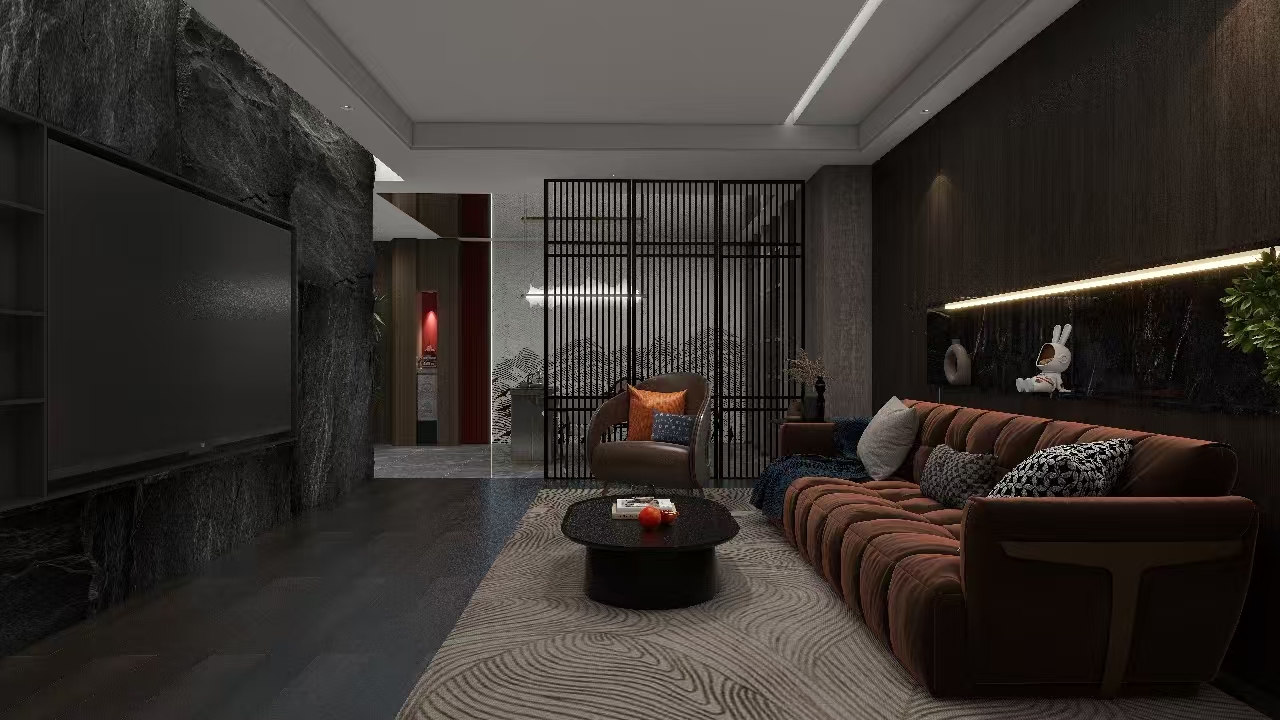
PVC partition wall panels used for interior wall and ceiling surfaces in architectural decoration projects.
The Credibility Gap in Interior Cladding Materials
Interior decoration projects — residential, hotel, office and commercial — depend on a combination of predictable installation speed, consistent surface quality and regulatory compliance. Traditional wall finishes each carry clear trade-offs. Wallpaper and paint are affordable but require surface preparation and recurring maintenance. Ceramic tiling is durable and considered premium, yet it relies on wet construction, skilled labour and extended installation timelines. These limitations have driven interest in lightweight panel systems that can be fixed to a supporting structure and finished in significantly less time.
PVC-based panels entered this space as one such alternative. Their functional claims — water resistance, moisture resistance, fire retardancy and simple installation — match the needs of projects where downtime must be kept short.
The market difficulty is not unfamiliar. Buyers see similar materials marketed in similar language: waterproof, flame-retardant, easy to install. What separates a verifiable product from a generic claim is the existence of a test report that names a standard, an issuing body and a certificate number. Without that document, the buyer is asked to rely on trust alone.
A reaction-to-fire test report solves part of this problem. It provides a reference point that can be checked, compared and appended to a technical submission. It also serves as an early screening criterion in a market where many products still arrive without documented fire behaviour.
Jianmu's PVC Partition Wall Panel: Parameters and Test Evidence
Haining Jianmu New Decoration Material Co., Ltd. is a decorative-material manufacturer located in Yuanhua, Haining, Jiaxing, inside China's Yangtze River Delta Economic Circle. Established in 1998, the company operates a standard production workshop covering 15,000 square metres and develops products across a range of interior cladding categories: PVC integrated wall panels, new-type PVC wall panels, wood-plastic panels, bamboo-wood fibre panels and PVC floors.
The company exports about 90% of its production to more than 50 countries and regions. Its geographic coverage includes Chinese mainland, the Middle East, South America and Southeast Asia, with Vietnam recorded as a leading market. This export pattern is relevant to buyers because it demonstrates sustained experience with cross-border logistics, packaging standards and documentation.
Jianmu's PVC partition panel, model 7073-A189, is specified for construction and interior decoration use. The main panel measures 2900×400×26mm; the matching PVC partition corner trim measures 2900×85×50mm. Both components are manufactured in PVC. The documented performance properties are waterproofing, moisture resistance, fire resistance and easy installation.
What makes this panel noteworthy for the EU-facing buyer is the certification file. A Reaction to Fire Test Report was issued by NOA Inspection & Certification Group Ltd., certificate number NFM-FRL260865-02. The report covers the PVC partition wall panel and is applicable to the EU market. This is a specific, verifiable document — not a general description — and it gives distributors a tangible attachment for technical submissions in European projects.
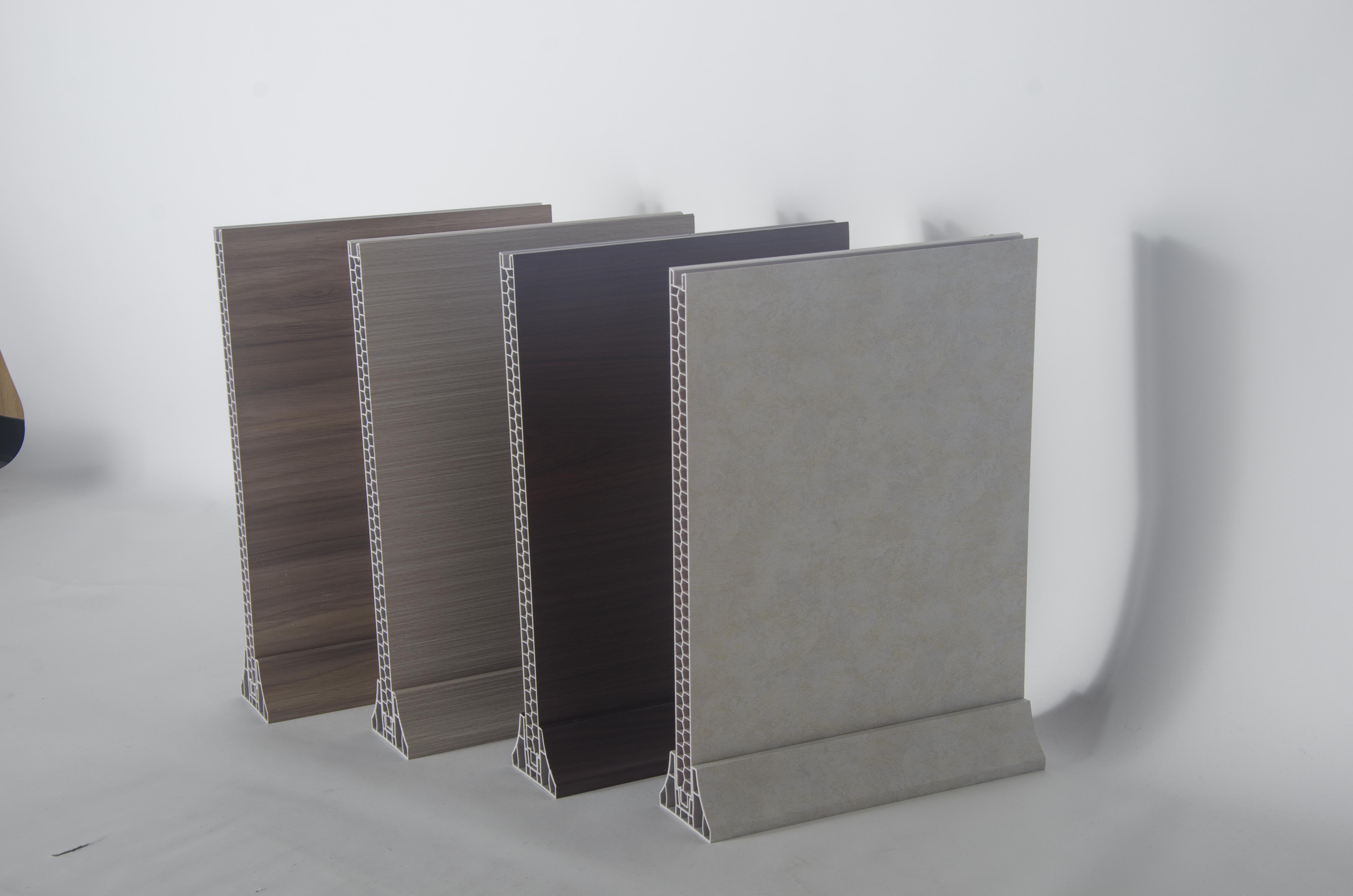
PVC partition panel structure with matching corner trim, designed for rapid interior installation.
Alongside the partition panel, the company supplies PVC wall panels (model 566-A155, 3000×400×9mm) and PVC flooring (model ACL10, 333×22×3000/4000mm). These related products share the same essential profile: waterproof, moisture-proof, fire-resistant and straightforward to install. For a buyer consolidating wall, ceiling and floor requirements, the availability of a wider product family simplifies supplier management.
| Product | Model | Dimensions | Material | Key Properties |
|---|---|---|---|---|
| PVC Partition Panel | 7073-A189 | 2900×400×26mm | PVC | Waterproof, moisture-proof, fire-resistant, easy to install |
| PVC Partition Corner Trim | — | 2900×85×50mm | PVC | Matching corner finishing profile |
| PVC Wall Panel | 566-A155 | 3000×400×9mm | PVC | Waterproof, moisture-proof, fire-resistant, easy to install |
| PVC Floor | ACL10 | 333×22×3000/4000mm | PVC | Waterproof, moisture-proof, fire-resistant, easy to install |
Decoding the Fire-Test Certificate: Standards and Their Relevance
The certificate is not a broad endorsement; it is tied to the tested product and evaluated against specific European standards. Three documents form the technical basis:
EN 13501-1:2018 — Fire classification of construction products and building elements. This standard defines how the reaction-to-fire performance of a material is classified. It is the reference framework used by European regulators and specifiers when they discuss a product's fire class.
EN 13823:2020+A1:2022 — Single Burning Item (SBI) test. The SBI test evaluates the contribution of a building product to fire development under conditions that resemble a single burning item in a corner. It measures heat release rate, lateral flame spread and related parameters, and it is the central test method used to support reaction-to-fire classification.
EN ISO 11925-2:2026 — Small-flame ignitability test. This test exposes the product to a small flame to determine whether and how quickly ignition occurs. It is appropriate for materials that may be exposed to small ignition sources during the early stages of a fire.
For the buyer, the presence of these standards in a test report has two functions. First, it indicates that the product has been assessed through a route European authorities recognise. Second, it gives the procurement team a common vocabulary for comparing products from different suppliers, instead of relying on vague claims.
It is equally important to consider what the certificate does not tell you. Reaction-to-fire classification concerns surface spread and ignitability, not structural fire resistance. Buyers who need fire-resistance ratings for the complete partition system should assess the entire wall assembly, including the supporting frame, not only the panel surface.
The tested product scope also deserves attention. The certificate applies to this PVC partition wall panel in its tested configuration. A change in thickness, coating or core formulation could affect the result. Buyers should therefore match the reference in the certificate with the exact product model supplied.
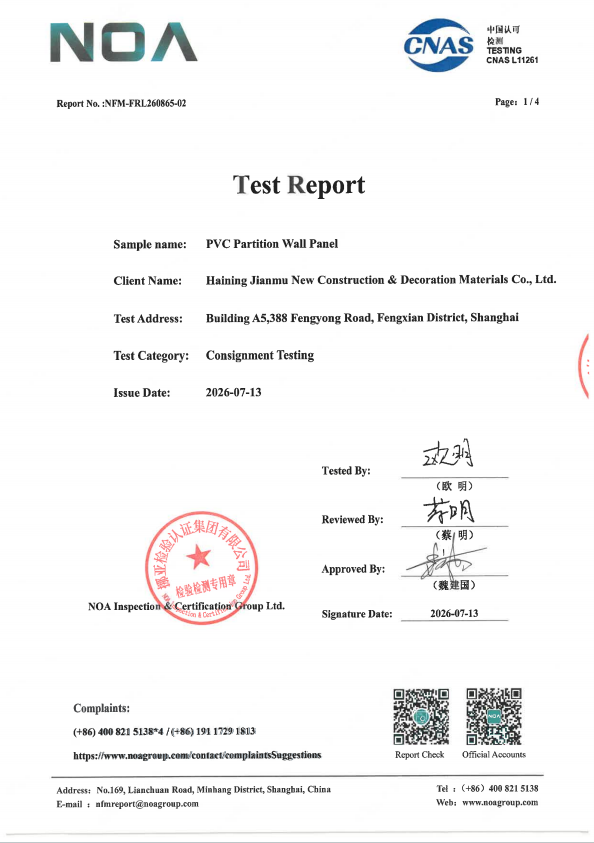
Reaction to Fire Test Report issued by NOA Inspection & Certification Group Ltd., certificate number NFM-FRL260865-02.
Intended Application: Interior Walls and Ceilings with Fire-Retardant Requirements
The documented application profile for the certified panel is interior wall and ceiling decoration in architectural decoration projects. The environment is characterised as static, running 24/7, with installation performed on supporting structures and using purpose-matched accessories.
The special requirement recorded in the profile is fire-retardant behaviour according to EN 13501-1. That detail makes the certificate directly relevant: the product was not tested in isolation but against a requirement that European specifiers actually use.
Common project types include residential interiors, hotel rooms, offices, retail units and commercial buildings where speed, visual consistency and documented fire performance are expected. The panels' light weight reduces structural load, and their resistance to moisture makes them a practical fit for zones with higher humidity or regular cleaning.
One field reference comes from an overseas building-material distributor active in Vietnam, Thailand, the Philippines, India and Indonesia. Over more than five years, the distributor purchased roughly 15,000 square metres of the product for interior wall and ceiling decoration in residential and commercial buildings. The recorded results refer to stable performance, effective fire resistance, waterproofing and installation convenience.
Field references of this kind should be read carefully. They describe repeat purchases and satisfaction at distributor level, not third-party laboratory testing. But sustained volume over a five-year window is still a useful signal of acceptance in demanding, humid Asian markets.
Market Signals from an Export-Based Manufacturer
For procurement teams, several background facts help complete the supplier picture.
Jianmu's monthly output for PVC ceiling and wall protection panels reaches 30×40HQ containers. The capability profile further lists a monthly capacity of 40,000 square metres. Production lead time is 15–30 days, and the company accepts OEM/ODM work, covering colour, size, surface design, logo and packaging. Quality control is described as 100% inspection before shipment.
These facts matter in an evaluation process that often happens from a distance. A supplier that exports a large share of production to diverse markets is continuously tested by overseas customers with different expectations. That daily exposure has a disciplining effect on quality consistency and documentation.
The company also holds ISO9001:2008 quality system certification, SONCAP certification and SGS certification. These do not replace a fire-test report, but they signal that the manufacturer is comfortable working under structured quality systems. For a first-time buyer, this reduces the amount of ad hoc verification required before a trial order.
The broader market signal is that competitive advantage will move from attractive photos to complete files. Buyers will increasingly expect a certificate, a parameter list, country-of-origin details and a reliable lead time — all from one supplier. Manufacturers that have already assembled these pieces will become easier to select and faster to qualify.
Comparative Notes: PVC Panels and Conventional Decorative Surfaces
PVC wall panels were designed to address the weaknesses of traditional interior finishes. In a practical comparison, their advantages are visible:
Speed of installation. PVC panels are fitted to a supporting structure without wet trades. Installation time is shorter than wallpaper or paint, and significantly shorter than ceramic tile works.
Maintenance. The PVC surface does not require periodic repainting or reapplication of wallpaper. Cleaning is simple.
Moisture behaviour. The material does not absorb water in the same way as paper or gypsum-based finishes, making it suitable for humid conditions.
Fire-safety documentation. When supported by a reaction-to-fire test report, the panel gives the project a document that traditional finishes may lack by default.
Life-cycle cost. Faster installation and lower maintenance offset the initial material price in many project types.
Compared with wallpaper, paint and traditional ceramic tiles, PVC wall panels bring a faster, cleaner and more maintenance-friendly workflow. This is broadly reflected in industry use across residential, hotel, office and commercial segments.
Nevertheless, a professional buyer should also note where PVC panels are not the perfect answer.
Thermal behaviour. PVC is a thermoplastic. While the tested product meets the documented reaction-to-fire standards, its performance under sustained high heat or open flame is not comparable to non-combustible materials such as steel, glass or ceramic. Projects with elevated heat loads need a separate assessment of the full assembly.
Surface realism. A marble-finish PVC panel visually resembles stone but does not reproduce its physical texture, weight or depth. High-end projects that demand authentic natural materials must verify this before specifying.
Installation boundaries. The panel requires a flat and stable substrate. Without proper corner trims or support spacing, joints may become visible over time. The matching PVC partition corner trim should be part of the order to ensure consistent detailing.
These boundaries are not weaknesses in every sense; they define the conditions under which the material performs best. Procurement teams that understand them can use PVC panels in the right applications and avoid misapplication.
Outlook: Fire Documentation as Baseline
The building-material market is moving toward evidence-based specification. For interior cladding products such as PVC partition wall panels, the reliable availability of a named fire-test certificate will become a baseline condition for market access rather than a differentiator.
European regulatory structures continue to reference standards such as EN 13501-1. Importers who want to serve these markets need suppliers that can supply matching documentation. The consequence will be a two-sided discipline: suppliers must invest in recognised testing, and buyers must verify the product model, certificate number and applicable standard together.
This is a favourable direction for the industry. Clear documentation reduces information asymmetry in cross-border trade and shortens the evaluation cycle. A buyer who receives complete evidence from the first inquiry can move faster to samples, pricing and trial orders.
Frequently Asked Questions
What are the main properties of PVC partition wall panels?
PVC partition wall panels are waterproof, moisture-proof, fire-resistant and easy to install. They are designed for building and construction as well as interior decoration applications.
Which market does the Reaction to Fire Test Report apply to?
The Reaction to Fire Test Report for the PVC partition wall panel applies to the EU market.
Who issued the fire certification and what is the certificate number?
The certification was issued by NOA Inspection & Certification Group Ltd. The certificate number is NFM-FRL260865-02.
Which test standards are covered by the certification?
The certification is based on EN 13501-1:2018, EN 13823:2020+A1:2022, and EN ISO 11925-2:2026.
Where can the certified PVC partition wall panels be used?
The panels are designed for interior wall and ceiling decoration in architectural decoration projects. Typical installations run in a static, 24/7 environment and may require fire-retardant performance according to EN 13501-1.
What are the advantages of PVC wall panels compared with traditional decoration materials?
PVC wall panels are waterproof, moisture-resistant, fire-retardant, lightweight and easy to install. Compared with wallpaper, paint and traditional tiles, PVC panels provide faster installation, lower maintenance costs and long service life. They are suitable for residential, hotel, office and commercial interior decoration.
For additional specification details and product-family information, the manufacturer's brochure is publicly accessible for reference: Download product brochure.