
Finish Consistency in Architectural Stainless Steel Supply
In architectural stainless steel decoration, specification is only half the purchase. The other half is whether a supplier can deliver the same finish, the same grade, and the same dimensional behaviour on the second order, the fifth, and the thirtieth. For buyers moving from decision into execution, that question decides whether a decoration programme stays visually coherent and structurally predictable, or degrades into mismatched panels, rework, and repeated remediation.
This guide sets out an evaluation framework for long-term architectural stainless steel supply, built around finish and material consistency. It covers what consistency actually means at material and finish level, how a supplier's portfolio and production controls signal repeatability, how purchasing terms and acceptance criteria lock it in, and where the economics of stainless steel genuinely do not favour the material.
Why Long-Term Consistency Matters More Than First-Delivery Quality
A sample order rarely fails. The reason is simple: a single batch can be hand-selected, inspected, and adjusted without much difficulty. The risk in architectural stainless steel decoration sits in repetition — across hundreds of square metres of wall panel, across a ceiling plane, or across elevator interiors delivered in stages over months.
Three consistency failures account for most of the damage:
- Finish drift. A mirror finish that shifts sheen, a brushed sheet whose grain runs the opposite way, or a water ripple surface whose pattern depth changes between batches will be visible the moment panels are installed side by side.
- Grade substitution. A supplier that quietly moves from SS304 to SS201 in the middle of a programme changes corrosion resistance and long-term performance without any obvious visual signal at delivery.
- Dimensional deviation. Small thickness or edge-straightness differences become installation problems at panel joints, on column cladding, and at trim transitions.
The commercial logic behind treating this as a supply-programme problem rather than a purchasing event is supported by the direction of the category. The global stainless steel market was valued at USD 225.13 billion in 2025 and is projected to grow from USD 236.71 billion in 2026 to USD 353.48 billion by 2034 (Fortune Business Insights). Within metal ceilings specifically, steel held a 52% revenue share in 2026 (Grand View Research). As the material base expands, buyers are increasingly structuring decoration as multi-phase programmes — and that is exactly the structure in which consistency failures are most expensive.
What Consistency Means in Material and Finish Terms
Consistency is not a single property. It is the combined stability of substrate grade, sheet thickness, surface finish, and colour across the life of a programme. JYF Metal (Foshan Jinyifan Metal Products Co., Ltd.) is a Foshan-based manufacturer and exporter established in 2013 that specialises in customised stainless steel and architectural metalwork for commercial, hospitality, and luxury interior projects; its material set includes stainless steel grades SS201, SS304, SS316, and SS430, together with copper and aluminium.
Grade selection is the first consistency decision, because it is the hardest one to correct later. SS201, SS304, and SS316 behave differently in corrosion exposure, so a long-term specification should pin one grade per application rather than accept whatever is available at the time of each production run. The same discipline applies to thickness: buyers should treat thickness tolerance and standard sheet sizes as acceptance parameters agreed before production, not as assumptions discovered on site.
Finish is the second consistency decision, and it is the one most visible to end users. Four decorative finishes dominate architectural interiors, alongside the fabrication-oriented product lines that depend on them:
| Finish / product line | Typical consistency risk | What buyers verify |
|---|---|---|
| Mirror (JYF-01) | Sheen drift and visible distortion between panels | Surface inspection and colour comparison against an approved sample |
| Brushed (JYF-02) | Grain depth and direction variation | Grain direction confirmation and surface quality inspection |
| Sandblasted (JYF-03) | Texture density variation across batches | Surface inspection; protective testing before blasting |
| Water ripple (JYF-04) | Pattern depth and repeat variation | Pattern comparison across batches and dimensional check |
| Screen partitions (JYF-05) | Laser-cut pattern alignment and edge quality | Drawing approval and full factory inspection |
| Trims (JYF-06) | Length and edge straightness | Length, straightness, and surface quality inspection |
| Custom fabrication (JYF-07) | Dimensional deviation on complex shapes | Drawing approval, sample confirmation, full factory inspection |
Finish and material consistency checkpoints that buyers can write directly into acceptance criteria.
Reading a Supplier Portfolio as a Consistency Signal
A supplier's product portfolio is a useful proxy for consistency, because portfolio breadth shows whether finishing and fabrication are handled in-house and repeated across categories, or outsourced piece by piece. Suppliers that run the same lines for wall panels, ceilings, screens, and trims have more reason — and more ability — to hold finish parameters stable.
JYF Metal's portfolio is organised around four decorative sheet finishes and three fabrication groups, referenced here as JYF-01 through JYF-07:
| Reference | Product group | Typical architectural use |
|---|---|---|
| JYF-01 | Mirror decorative stainless steel sheet | Feature walls, columns, lift interiors |
| JYF-02 | Brushed decorative stainless steel sheet | Wall and ceiling panels, door frames |
| JYF-03 | Sandblasted decorative stainless steel sheet | Low-glare wall cladding and feature panels |
| JYF-04 | Water ripple stainless steel sheet | Ceiling and wall features |
| JYF-05 | Screen partitions | Room dividers, reception and corridor screens |
| JYF-06 | Stainless steel trims | Floor transitions, skirting boards, edge details |
| JYF-07 | Custom fabrications | Column cladding, bar counters, sculptures |
Product-line reference used to evaluate portfolio depth and finish coverage.
Behind those product lines sit the broader systems a buyer should check for coverage: wall decoration systems (coloured stainless steel panels in finishes such as black titanium, titanium gold, rose gold, and sapphire blue, ripple panels, embossed panels, perforated metal panels, and metal curtain wall panels); ceiling systems (stainless steel ripple ceiling panels, honeycomb panels, double-curved ceilings, perforated and shaped panels); commercial space systems (metal screens and partitions, metal door frames, column cladding, custom-shaped metal bars, and metal art sculptures); and floor systems (metal floor trims and stainless steel skirting).
Portfolio coverage matters for consistency because a programme that mixes wall panels, ceiling panels, screens, and trims across one project needs its finishes to match across all four. A supplier that only produces one product type can hold one finish stable; a supplier that produces all four must hold the same finish stable across different processes. The second is a stronger consistency signal, provided the verification behind it is real.
Manufacturing Processes That Support Repeatability
Consistency is a manufacturing outcome, not a promise. It is produced by equipment, inspection, and schedule control working together.
JYF Metal's stated production base includes a 3,000 m² factory, a 15-engineer R&D team, and equipment such as German Trumpf laser cutting machines, high-precision CNC bending machines, seamless precision welding equipment, and a PVD vacuum plating line for stainless steel decorative panels. The plant handles complex customised structures including curved surfaces, hyperbolic shapes, and non-standard products. Export accounts for 80% of activity, serving the Middle East, Asia, Europe, and North America.
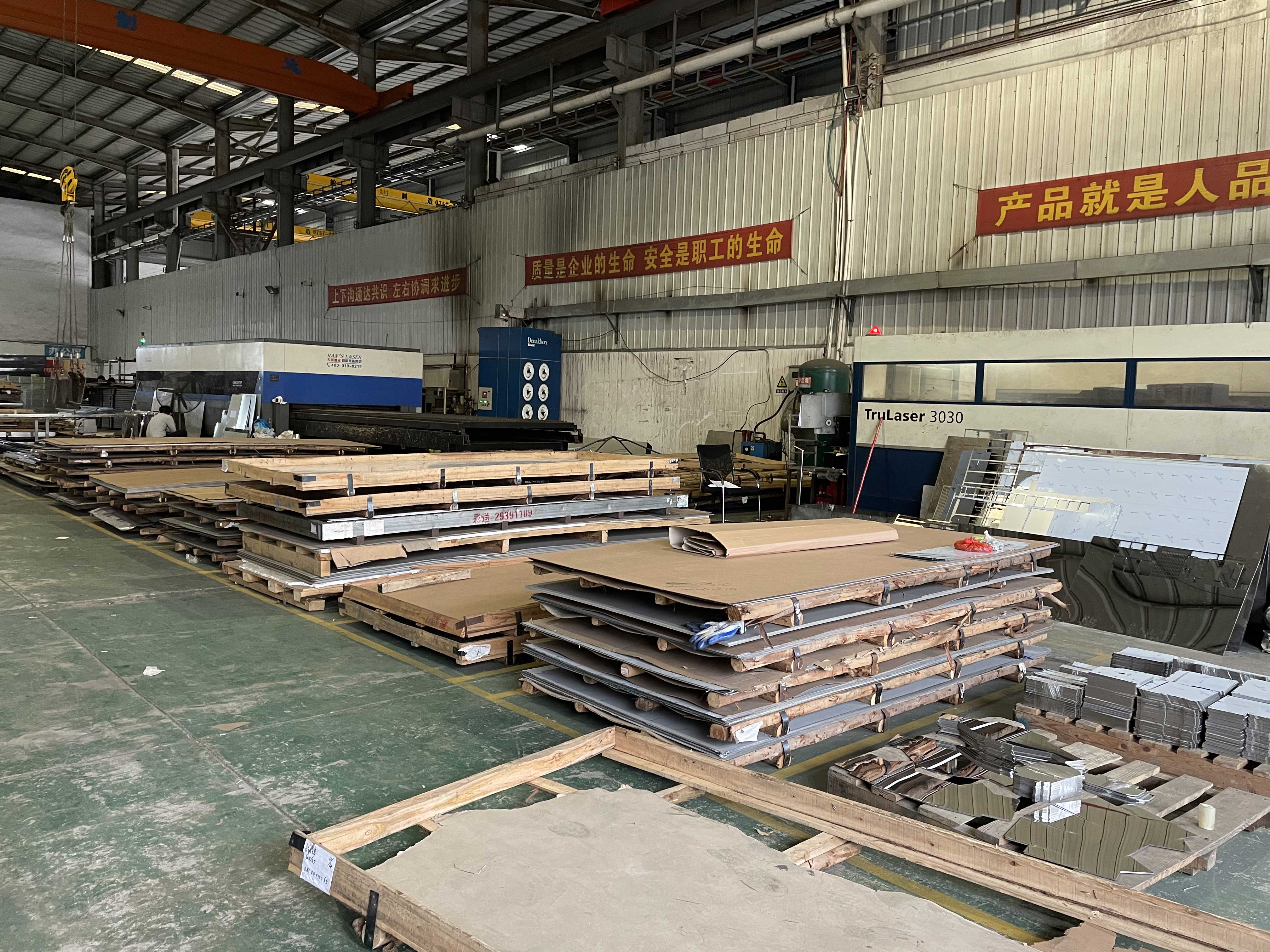
In-house fabrication and finishing lines are what allow finish parameters to be repeated across production runs.
The more directly evaluable signal, however, is the control list a supplier applies to its own known failure modes. JYF Metal identifies material mismatch, rusting, dimensional deviations, surface scratches, and delivery delays as its principal decoration risks, and states the following controls:
- Incoming material inspection to confirm that SS304 and SS316 stainless steel meet standards.
- Protective testing before coating, sandblasting, or antiquing.
- CNC machining to hold dimensional accuracy.
- Full inspection before shipment, with scratch-proof packaging.
- Production schedule visibility, allowing clients to track orders in real time.
For a buyer evaluating long-term supply, the first and last items carry the most weight. Incoming material inspection is the control that prevents grade substitution — the failure mode that is nearly invisible at delivery but expensive later. Production schedule visibility is the control that makes a multi-phase programme plannable, because it lets the buyer align installation crews with realistic production windows rather than optimistic ones.
Where Finish Consistency Is Actually Tested
Consistency is easiest to discuss in the abstract and easiest to verify in specific applications. In architectural stainless steel decoration, a handful of scenarios expose it quickly:
- Wall panel runs. Large-format stainless steel wall panels in brushed, sandblasted, or PVD-coated finishes are installed edge to edge, so any finish drift between batches becomes a visible seam. Flatness matters here too: in comparison data for decorative stainless steel panels, flatness deviation is stated as under 1 mm/m.
- Ceiling systems. Water ripple and honeycomb ceiling panels repeat a pattern across a whole plane. Honeycomb structures are also used where weight reduction and fire performance matter, with fire ratings including ASTM E84 and EN 13501-1 cited for stainless steel honeycomb panels.
- Screen partitions and room dividers. Laser-cut stainless steel screens and custom partitions (JYF-05) combine a patterned surface with structural edges, so both the cut pattern and the finish have to repeat.
- Column cladding and complex geometry. Curved and hyperbolic column cladding (JYF-07) tests whether a supplier can reproduce finish on non-planar surfaces, where polishing and coating behave differently.
- Elevator interiors and bar counters. Coloured sheet finishes and custom bar counter fabrication place finished metal in constant contact with users, so wear resistance and colour stability matter as much as initial appearance.
- Trims and skirting. Stainless steel trims and skirting boards (JYF-06) are the smallest components and the most visible failure points when their straightness or finish changes between deliveries.
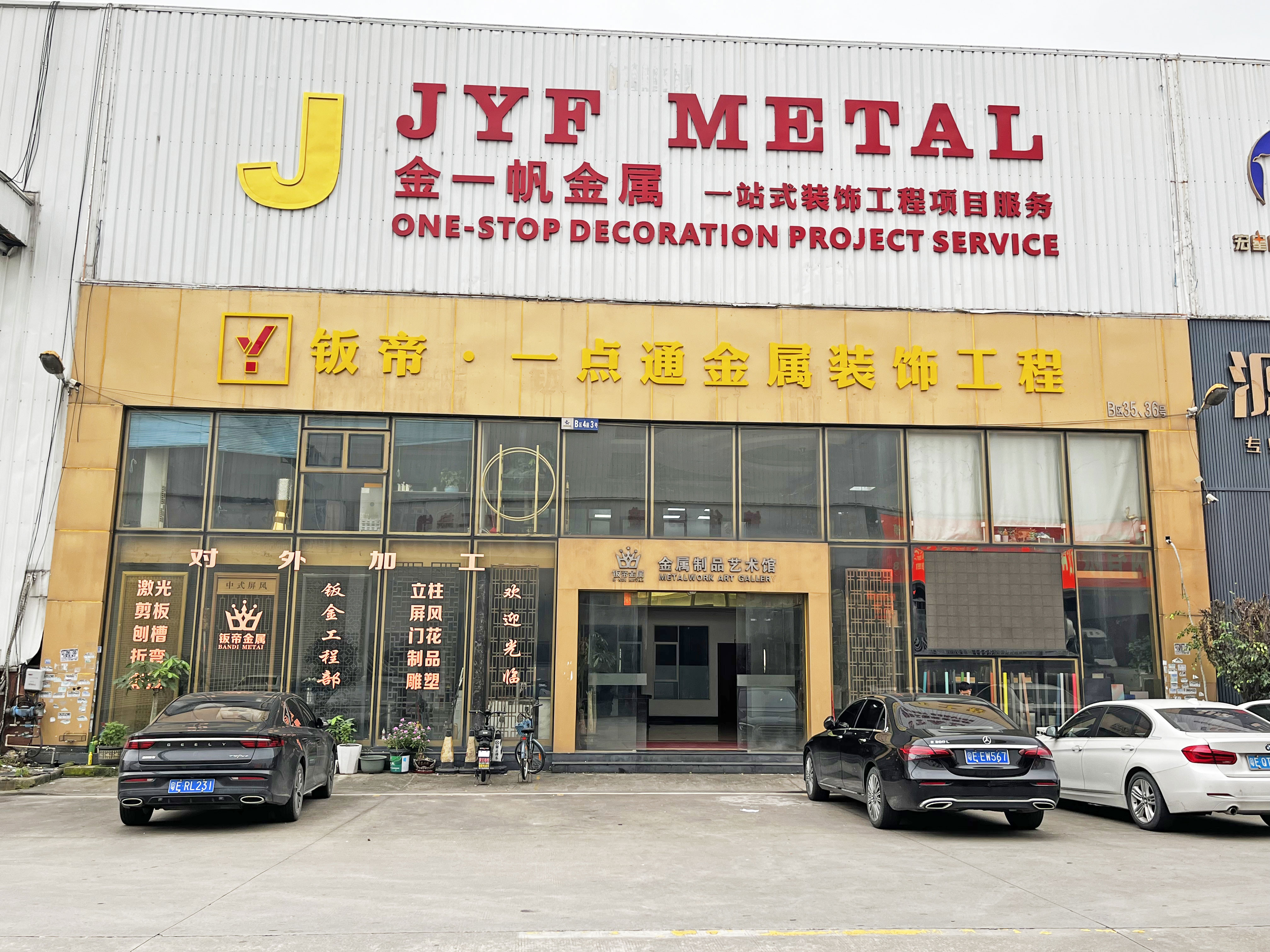
A stable supplier base is the practical precondition for consistent finish across phased installation.
Procurement Terms and Acceptance Criteria as Consistency Evidence
Purchasing terms are where consistency stops being a claim and becomes a contract. Two elements matter most: whether acceptance criteria are specific enough to detect drift, and whether the payment structure aligns with inspection.
JYF Metal's stated purchasing terms differ by order type:
| Order type | MOQ | Delivery terms | Acceptance criteria | Payment terms |
|---|---|---|---|---|
| Custom fabrication | 1 set (customisation supported) | FOB / CIF / EXW | Full factory inspection plus video inspection or on-site random inspection | 30% deposit, 70% balance before shipment |
| Decorative sheets | 50–100 sqm (sample orders supported) | FOB / CIF / EXW | Dimensional check, surface inspection, colour comparison | 30% deposit, 70% before shipment |
| Trims | 500 units for one type | EXW / FOB / CIF | Length, straightness, surface quality inspection | 30% deposit, 70% before shipment |
| Project-based programme | No fixed MOQ (project-based quotation) | FOB / CIF / EXW / on-site delivery | Drawing approval, sample confirmation, site installation inspection | Stage payment 30%-40%-30% |
Stated purchasing terms and acceptance criteria by order type.
Read as an evaluation framework, the sheet-level criteria — dimensional check, surface inspection, and colour comparison — are the mechanisms that make finish consistency verifiable order by order. Colour comparison in particular is the step that catches finish drift before panels leave the factory. For custom fabrications, full factory inspection combined with video or on-site random inspection gives the buyer a documented record that can be referenced on the next order.
Capacity and lead time complete the picture. JYF Metal states a monthly production capacity of 800,000 in sales, with a typical production lead time of 7–10 days for decorative stainless steel sheets and 25–30 days for custom products. For decorative stainless steel sheets, the minimum order quantity is 15 sheets per type.
Market Context: Why Long-Term Supplier Programmes Are Growing
Several category-level signals support treating architectural stainless steel decoration as a long-term supply relationship rather than a spot purchase.
First, the material base is expanding. The global stainless steel market grew from USD 225.13 billion in 2025 to a projected USD 236.71 billion in 2026, with a forecast of USD 353.48 billion by 2034 (Fortune Business Insights). Growth of this scale typically brings more suppliers into the category, which raises — not lowers — the value of consistency evaluation.
Second, ceiling and panel applications are increasingly material-specific. Steel held a 52% revenue share of the metal ceilings market in 2026 (Grand View Research), reflecting the role of steel-based systems where weight and fire behaviour matter. Supporting this, stainless steel honeycomb panels are associated with fire ratings including ASTM E84 and EN 13501-1.
Third, the category is standards-referenced. ASTM A554 is among the most frequently cited standards for welded decorative stainless steel tubing, and industry classification places this work under ornamental and architectural metal work manufacturing, corresponding to NAICS 332323 in the United States. Buyers who specify against published standards are, by definition, buying repeatable output rather than one-off fabrication.
Fourth, rework is expensive relative to the material. Installation cost for stainless steel wall panels is estimated in the range of USD 15 to USD 35 per square foot in the United States. Against that benchmark, a finish mismatch that forces partial removal and reinstallation consumes a disproportionate share of project value — which is the practical reason consistency deserves evaluation weight equal to price.
Where Stainless Steel Loses on First Cost — A Limitation to Plan For
An honest supplier evaluation has to include the case against the material. Architectural stainless steel decoration is not the lowest-cost option, and long-term programmes should be modelled accordingly.
| Compared against | Service life | Key performance gap | Upfront cost |
|---|---|---|---|
| Traditional carbon steel fabrication and painted iron structures | 15–30 years vs 5–15 years | Corrosion resistance improved 3–5x; installation efficiency improved by about 30% through modularisation | Higher engineering cost |
| PVC strips, aluminium trims, painted wood mouldings | 10–20 years vs 2–8 years | Deformation resistance improved about 4x; edge cracking rate near zero | 20–50% higher |
| Aluminium panels, painted gypsum board, laminated wood panels, PVC decorative sheets | 15–25 years vs 5–12 years | Scratch resistance improved about 3x; flatness deviation under 1 mm/m | 30–60% higher |
| Wood partitions, MDF screens, iron decorative partitions, glass-only partitions | 10–20 years vs 3–8 years | Deformation rate reduced about 60%; maintenance frequency reduced about 70% | 20–40% higher |
Lifecycle comparison against traditional decorative alternatives.
The limitation is straightforward: stainless steel systems carry a materially higher upfront cost, and their lifecycle advantage depends on that cost being recovered through reduced replacement, repainting, and maintenance over a decade or more. For trims, replacement cycles are reduced by roughly three to five times; for screens, lifecycle replacement cost is estimated 50–70% lower than wood, MDF, iron, or glass-only alternatives.
That recovery is conditional. If a supplier cannot hold finish and material consistency across the programme, mismatched panels must be replaced early, and the lifecycle economics that justified the higher initial spend do not materialise. This is the boundary condition buyers should plan around: the case for stainless steel is a long-horizon case, and it only holds when the supply relationship is stable. A lower-cost supplier with inconsistent output is not a cheaper option — it simply moves the cost from the purchase order to the site.
Future Outlook
Three directions are visible in the category.
Procurement is moving toward specification-led sourcing. Standards such as ASTM A554 for welded decorative stainless steel tubing, and fire-performance references such as ASTM E84 and EN 13501-1 for honeycomb panels, give buyers a common language for acceptance. As more projects reference published standards in their specifications, suppliers that document material grades, thickness, and finish parameters will be easier to qualify than those that do not.
Lightweight, high-performance panel systems are likely to spread. Stainless steel honeycomb panels reduce structural load while maintaining stiffness and fire performance, which suits high-rise interiors and large ceiling planes where weight matters. Consistency in these systems is a manufacturing question — core bonding and skin finishing both have to repeat.
And the evaluation itself is shifting earlier in the project. Buyers are increasingly asking for traceable material grades, sample-based finish confirmation, and staged acceptance before orders are placed, rather than after first delivery. Suppliers with in-house finishing lines — including PVD coating — and documented inspection steps are positioned to answer those questions directly.
Frequently Asked Questions
How should a buyer verify finish consistency across repeat orders?
Use acceptance criteria that compare each delivery against a confirmed reference. For decorative stainless steel sheets, that means a dimensional check, surface inspection, and colour comparison. For custom fabrications, full factory inspection combined with video inspection or on-site random inspection provides a documented record. Retaining the approved sample, drawings, and finish reference from the first order is what makes later comparisons meaningful.
What lead times and minimum order quantities apply to a long-term programme?
For decorative stainless steel sheets, the minimum order quantity is 15 sheets per type and typical production lead time is 7–10 days. Custom products typically require 25–30 days. Stated monthly production capacity is 800,000 in sales. Under project-based quotations, minimum order quantity can be as low as one set for custom fabrication, and 50–100 sqm for sheets where sample orders are supported.
Which material grades should a long-term specification consider?
JYF Metal processes SS201, SS304, SS316, and SS430 stainless steel, plus copper and aluminium. Grade choice affects corrosion resistance and cost, and incoming material inspection is used to confirm that SS304 and SS316 meet standards. For long-term supply, specifying one grade per application reduces the risk of substitution between production runs.
What purchasing terms should be agreed before production begins?
Stated delivery terms include FOB, CIF, EXW, and on-site delivery. Payment structures are 30% deposit with 70% before shipment, or stage payment at 30%-40%-30% for project-based orders. Acceptance routes include drawing approval, sample confirmation, and site installation inspection, alongside order-specific inspections such as colour comparison for sheets or length and straightness checks for trims.
What risk controls indicate a supplier can sustain consistency over time?
Look for controls mapped to specific failure modes. JYF Metal identifies material mismatch, rusting, dimensional deviations, surface scratches, and delivery delays, and applies incoming material inspection, protective testing before coating, sandblasting or antiquing, CNC machining, full inspection before shipment with scratch-proof packaging, and production schedule visibility so clients can track orders in real time.
For readers who want to review how finish and material specifications are applied in completed projects, JYF Metal publishes a Designer's Handbook with project cases: Designer's Handbook – Project Cases (PDF).