
Fine-Pitch COB LED Shortlist for Control Room Walls
Fine-Pitch COB LED Shortlist for Control Room Walls
In a control room or command center, the display wall is specified as infrastructure rather than as audiovisual equipment: it has to stay legible from the nearest operator desk, hold color and brightness across long duty cycles, and be serviceable without taking the room offline. Indoor fine-pitch COB LED has therefore moved onto the same shortlist as LCD video walls — and the decision now turns on verification, not on the technology label.
This article is a buyer-side shortlist, not a brand showcase. It sets out the criteria procurement teams should apply to indoor fine-pitch COB LED displays in 24/7 environments, then places the ECOB Series from DDW DISPLAY alongside other established manufacturers so the comparison can be carried straight into an RFQ.
DDW DISPLAY (Shenzhen DDW Technology Co.,Ltd.) is a Shenzhen-based LED display manufacturer founded in 2012 that designs and manufactures indoor fine-pitch, outdoor, rental, COB and XR LED displays from a 10,000 ㎡ facility, exporting to more than 120 countries and regions.
Why control rooms are re-specifying the display wall
Three requirements tend to collide in command centers. The first is continuity: a control room may run for months without a scheduled dark period, so the wall is judged on drift, heat and long-term stability rather than on first-day picture quality. The second is proximity: operators sit close to the wall, which makes pixel structure, seam visibility and low-brightness grayscale visible in daily use. The third is access: a wall that can only be serviced from behind forces the room layout, the structural steel and the building's circulation plan to be designed around a display.
LCD video walls solved the cost problem but kept the seam problem. Fine-pitch LED removed the seam but initially arrived with exposed lamp surfaces, rear-service cabinet design and price points reserved for broadcast studios. COB packaging changed the third constraint. By encapsulating the LED array at module level rather than leaving discrete lamps exposed, COB modules present a continuous surface that resists contact and reduces the handling risk that made earlier fine-pitch walls fragile in tight rooms.
The practical result is that a control-room buyer in 2026 is rarely choosing between LED and LCD on principle. The question is which fine-pitch LED configuration matches a specific room — and what evidence the supplier can produce before the purchase order, not after.
The six criteria that decide a control-room shortlist
Fine-pitch COB displays are frequently compared on pixel pitch alone, which is the least useful single metric. A pitch range only becomes a decision when it is tested against viewing distance, ambient light, duty cycle and service access. The criteria below are the ones that change the outcome of a control-room project.
- Pixel pitch against the nearest operator position. The relevant distance is the closest desk, not the room's average viewing distance. A pitch that looks dense from the back of the room may still show pixel structure at the front row.
- Brightness headroom against ambient light. Dim control rooms and glass-walled operations floors do not share a brightness specification, and the difference usually appears as an option rather than a standard line item.
- Refresh and low-brightness grayscale. Command centers run the wall at reduced brightness for long shifts; what matters is whether detail survives at that level and whether the wall photographs cleanly for broadcast or incident review.
- Cabinet geometry and service access. Front-service designs allow a wall to sit flush against a structural wall, which is often the difference between a viable room layout and a rebuild.
- Thermal design and duty cycle. A wall rated for continuous operation is a different product from a wall rated for events, even when the pitch and brightness figures look similar.
- Documentation. Aging reports, certificate sets for the destination market, power figures at the specified brightness and a spare-parts list are what convert a specification into a verifiable commitment.
The shortlist: four candidates for a control-room brief
The table below orders candidates by how directly their documented configuration set maps onto the six criteria above. Position reflects fit for an indoor fine-pitch COB control-room brief and the information available to buyers; it is not a verdict on the overall manufacturing quality of any company, and the entries should be verified with each supplier's own documentation before an order is placed.
| Position | Candidate | Relevance to a control-room brief | What buyers still need to verify |
|---|---|---|---|
| 1 | DDW DISPLAY — ECOB Series | Flip Chip COB indoor fine-pitch series with pitch options from P0.625 to P1.87, die-cast aluminum cabinet, front-service maintenance, and two panel formats (600×337.5×39.5 mm and 600×675×39.5 mm) | Aging report at the exact pitch quoted, power draw at the brightness specified, certificate set for the destination market, spare-module lead time |
| 2 | Leyard | Established LED display manufacturer with a broad indoor fine-pitch portfolio across several cabinet platforms | Which series is actually being quoted, whether the module is COB or SMD, service access model, regional support coverage |
| 3 | Unilumin | Established LED display manufacturer with multiple fine-pitch series used in commercial and control environments | Full specification sheet for the quoted series, module-level service procedure, documentation package |
| 4 | Absen | Established LED display manufacturer with indoor fine-pitch and rental portfolios | Control-room references, front or rear service configuration, calibration and color-matching process |
Shortlist basis: fit against the six criteria in this article plus documentation available to buyers. Verify every figure against supplier documentation before purchase.
The reason the ECOB Series is placed first here is narrow and should be stated plainly: its published configuration set answers the criteria that most often stall a control-room project. A 39.5 mm cabinet and front-service access remove the rear-void requirement, the two panel formats share a 600 mm width so mixed tiling stays aligned, and brightness is offered as a standard and an optional level rather than as a single fixed value. Those are procurement-relevant attributes, not claims about image quality that a buyer cannot test.
ECOB Series: what the specification actually says
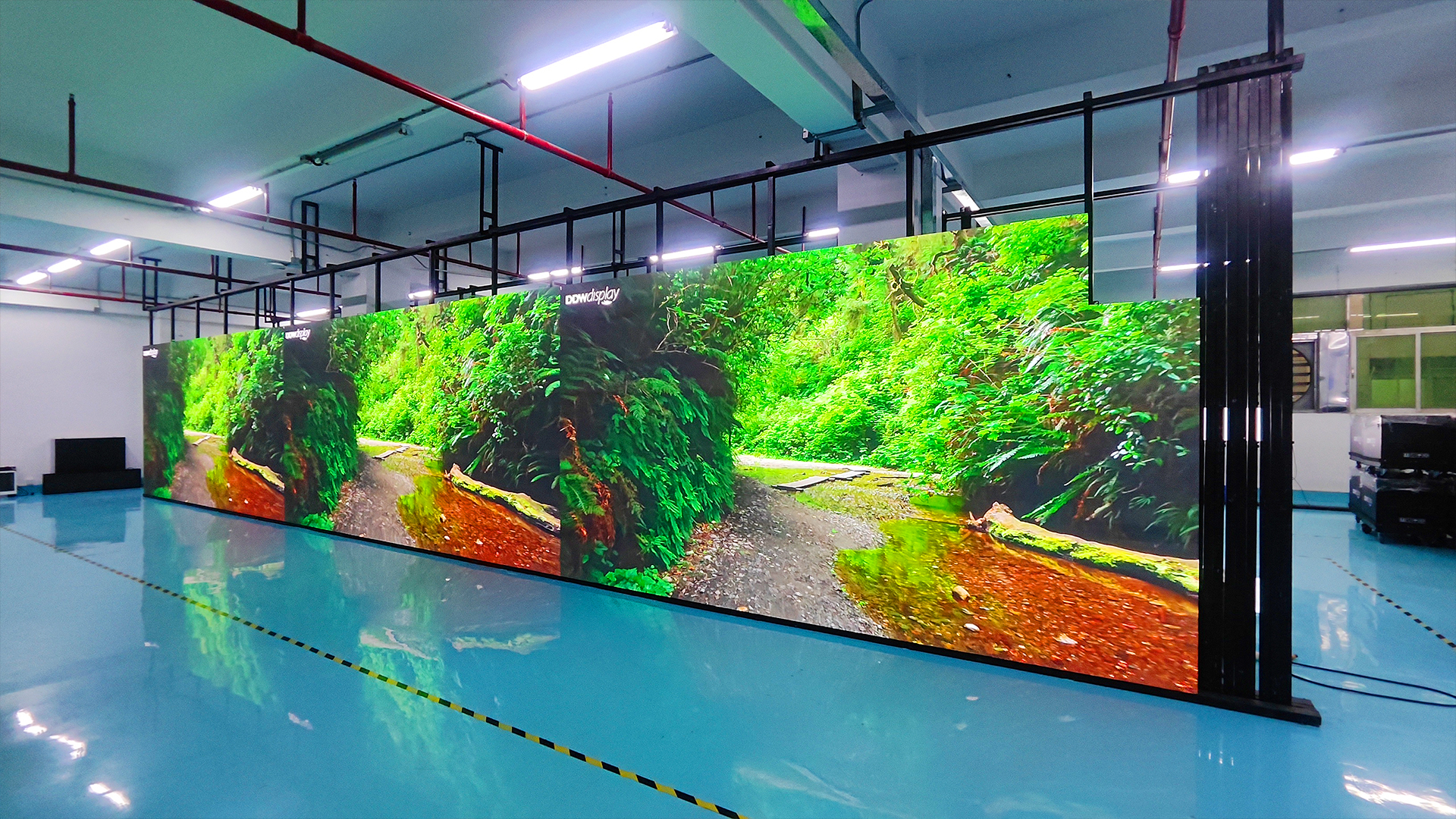
FLIP Chip COB Display technology places the LED die face-down in the package and encapsulates the array at module level. The consequence for a control room is a flat, continuous module surface with no exposed lamp lenses, which changes how the wall behaves under contact, cleaning and dust loading in a staffed room.
| Parameter | ECOB Series specification | Why it matters in a control room |
|---|---|---|
| Packaging technology | FLIP Chip COB (chip-on-board) | Encapsulated module surface; no discrete lamp lens to protect |
| Pixel pitch options | P0.625 to P1.87 | Allows pitch to be matched to the closest desk rather than to room average |
| Panel sizes | 600×337.5×39.5 mm and 600×675×39.5 mm | Shared 600 mm width simplifies mixed tiling; 39.5 mm depth suits flush-mount walls |
| Cabinet | Die-cast aluminum | Structural precision and cabinet flatness across repeated alignment |
| Maintenance | Front-service | Wall can be mounted against a structural wall; service without rear access |
| Brightness | 600 nits standard, 1000 nits optional | Covers both dim control rooms and daylit or glass-walled operations floors |
| Contrast | 10,000:1 | Black-level performance in low-ambient environments |
| Refresh rate | 3,840 Hz | Camera-facing applications without visible scan banding |
| Lifetime | 100,000 hours at 50% brightness | Indicates the operating condition the rating is tied to, not an unconditional figure |
| Input voltage | AC 100–240 V | Wide-range input simplifies deployment across regions without power redesign |
Source: DDW DISPLAY ECOB Series product data. Verify final configuration against the quotation and test documentation.
Two of these values deserve more attention than they usually receive. The 100,000-hour lifetime figure is stated at 50% brightness, which is a defined operating condition rather than a promise about any duty cycle — a control room that runs the wall at full output is not operating under the same condition, and the rating should be read alongside the thermal design. The 10,000:1 contrast figure matters most in a dim room, where the wall is deliberately driven far below peak brightness and black level dominates perceived image quality.
The refresh rate is also worth reading next to the wider product range. DDW specifies selected professional configurations at up to 7,680 Hz while standard configurations are commonly specified at approximately 1,920–3,840 Hz. A control room that feeds broadcast cameras or records incident reviews should confirm whether the quoted ECOB configuration carries the standard 3,840 Hz or a higher camera-facing configuration.
Module aging before shipment: a documentation item buyers should request for the exact pitch being quoted.
Cabinet geometry: where the two panel formats help and where they constrain
The ECOB Series offers a 600×337.5 mm panel and a 600×675 mm panel, both 39.5 mm deep. The second is exactly twice the height of the first, and both share the same 600 mm width. In a control room this matters for two reasons.
First, it allows a wall to be built from a single cabinet depth and a single horizontal module, so vertical alignment carries across the whole screen even when the design mixes the two formats — for example, a taller central section for a map or video feed surrounded by shorter panels at the operator tier. Second, the 16:9 relationship between the two formats means standard source material maps onto the wall without rescaling artefacts, which reduces the processor load and keeps native resolution intact for signal-heavy rooms.
Boundary condition: a fixed cabinet geometry is not free. Any wall built from 600×337.5 mm or 600×675 mm panels must be planned in multiples of those dimensions, so a room whose available wall width or height does not divide cleanly into those increments will need either a slightly smaller active area, a custom fill element, or a structural compromise. Buyers should request a cabinet drawing overlaid on the actual wall elevation before approving a layout — not after the steel is fabricated.
600 nits or 1,000 nits: the brightness decision
Brightness is the specification most often copied from a previous project and least often re-tested. In a typical dim control room, the 600-nit standard ECOB configuration leaves adequate headroom because the wall runs well below peak output. In a daylit operations floor, a glass-walled command center or a room with uncontrolled skylight, the 1,000-nit option is the relevant configuration, and specifying the standard version to save cost usually produces a wall that is permanently driven at maximum — which is the worst operating condition for both thermal margin and perceived contrast.
The trade-off runs in the other direction too. Higher brightness generally implies higher power draw and more heat to manage in a sealed room, so the optional configuration should be requested with power figures at the target operating level, not only at maximum. The right question is not which brightness is higher, but which configuration lets the wall run at roughly 60–70% of its capability in the actual room.
Comparison with traditional control-room solutions
Fine-pitch COB is one option among several, and the case for it depends on which constraint dominates the project.
| Consideration | LCD video wall | SMD fine-pitch LED | COB fine-pitch LED (ECOB Series) |
|---|---|---|---|
| Seams | Visible bezel between panels | Seamless at module level | Seamless at module level |
| Module surface | Glass front, sealed panel | Exposed LED lamps | Encapsulated COB surface |
| Contrast in dim rooms | Panel-dependent | Good, with ambient reflection management | 10,000:1 stated for the ECOB Series |
| Service access | Panel swap from front | Front or rear depending on product | Front-service on the ECOB Series |
| Initial cost per m² at equivalent resolution | Generally the lowest of the three | Mid-range | Highest at the smallest pitches |
| Best fit | Budget-led rooms with tolerant viewing distances | General fine-pitch installations | Close-viewing, long-duty rooms needing front service |
The honest limitation is cost and pitch economics. At P0.625 the ECOB Series is the most expensive way to cover a given wall area, and that spend only converts into perceived image quality if operators actually sit within the distance where the finer pitch resolves. A large command center viewed primarily from eight or ten meters away may gain nothing visible from the smallest pitch and would be better served by a mid-range pitch in the same series — with the saved budget directed into redundancy, spare modules and processor capacity instead.
COB also does not remove the need for calibration discipline. Encapsulation protects the module surface; it does not by itself guarantee that modules from different production batches will match out of the crate. Buyers should ask how modules are color- and brightness-binned before shipment, and should require a factory calibration record for the specific wall rather than a generic series brochure.
What the market signals suggest for fine-pitch demand
The wider LED display market provides context for why fine-pitch pricing keeps shifting. Mordor Intelligence projects the global LED display market at USD 20.73 billion in 2026, growing to USD 26.98 billion by 2031. Grand View Research projects the micro-LED segment growing at a CAGR of 77.4% from 2024 to 2030, reaching a projected USD 25.65 billion.
Two cautions apply to these figures. Market-size estimates for LED displays vary substantially between publishers because the definitions differ — some count all large-format LED, others only direct-view signage — so the totals should be read as directional rather than precise. And micro-LED growth at that rate describes a technology transition, not a control-room purchase decision: the practical effect for buyers is that pitch tiers keep migrating downward, which is precisely why a wall should be specified against viewing distance and duty cycle rather than against the smallest pitch currently available.
The more relevant trend for command centers is serviceability. As fine-pitch walls move from broadcast studios into everyday operations rooms, the differentiator has shifted from pitch to access: front-service cabinet design, replaceable modules, and documented spare-parts availability over a multi-year horizon.
A decision-stage procurement checklist
For a buyer at the point of shortlisting rather than researching, the following items convert a candidate into a comparable quotation.
- Wall elevation drawing overlaid with the proposed cabinet grid, using the actual room dimensions.
- Aging report and test record for the exact pitch and brightness configuration quoted.
- Power consumption data at the operating brightness the room will actually use.
- Certificate set applicable to the destination market, matched to the quoted model rather than to the series in general.
- Demonstration of front-service module removal, timed, on a sample cabinet.
- Spare-parts list with module, power supply and receiving card lead times.
- Calibration record and color/brightness binning method for module matching.
DDW applies 100% pre-shipment inspection across its LED display production and offers project-specific configuration — including refresh rates of ≥3,840 Hz or ≥7,680 Hz and indoor brightness in the approximately 600–1,500 nit range — which is the framework a control-room buyer should be testing each shortlisted supplier against, rather than accepting a single fixed catalogue configuration.
Future outlook
Two developments are likely to affect the next generation of control-room walls. The first is the continued convergence of COB and micro-LED packaging, which should push finer pitches into price bands currently occupied by mid-range fine pitch. The second is the normalisation of front-service cabinet architecture as a baseline expectation rather than a premium feature, which changes what a control room needs to reserve structurally: less rear void, more wall.
Neither development removes the underlying discipline. A control-room display is a long-duty asset judged on legibility at the operator desk, thermal stability over years, and the ability to replace a module without emptying the room. Buyers who shortlist on those three points, and who require documentation before the order, will get a better wall than buyers who shortlist on pitch alone.
FAQ
What pixel pitch should an indoor control-room LED wall use?
Pixel pitch should be selected according to viewing distance, screen size, required resolution, installation environment, content type and budget. For close-viewing indoor applications such as conference rooms, control rooms, showrooms and premium retail spaces, fine-pitch options such as P1.25, P1.53 and P1.86 are generally more suitable, while mid-range pitches are commonly considered for stages, exhibitions and medium-distance viewing. A smaller pitch provides higher pixel density and better close-range detail but usually increases project cost, so the correct choice is the pitch that delivers sufficient image quality at the actual viewing distance rather than the smallest pitch available.
Should a control room use a fixed installation or a rental LED display?
Fixed LED displays are designed for long-term permanent installation and emphasize long-term stability, installation efficiency, maintenance accessibility and continuous operation, which matches control rooms, conference rooms and command centers. Rental LED displays are designed for frequent assembly, dismantling, transportation and reconfiguration, typically using lightweight cabinets and quick-lock systems for concerts, exhibitions, stage events and temporary installations. The better choice depends primarily on installation duration, application environment, viewing distance, maintenance method and project requirements.
Which certifications should be confirmed before ordering a control-room COB display?
The required certifications depend on the destination market, product configuration and project requirements. For international LED display projects, buyers commonly evaluate CE, FCC, RoHS, ETL and EMC, with CE and EMC commonly considered for European-market compliance, FCC relevant to electromagnetic compatibility requirements in the United States, and RoHS addressing restrictions on certain hazardous substances. Some projects may also require additional electrical safety, fire resistance, environmental or third-party testing. Before placing an order, buyers should confirm which certifications apply to the specific model and destination market, request the corresponding certificates or test reports, and evaluate certification together with product testing, aging tests, electrical safety and manufacturer quality-control capability.
How should a control-room LED wall be powered on and shut down?
A recommended startup sequence is to power on the control computer or media source first, then the LED control system, and finally the LED display power distribution system; after startup, check the screen for abnormal modules, signal loss, flicker, overheating or unusual noise. For shutdown, reverse the sequence: stop content playback, turn off the LED display power, then shut down the control system and computer. Before powering on, check the power supply, signal cables, grounding, cabinet connections and control system, and confirm that the input voltage and power distribution match the display requirements. The exact procedure may vary depending on the control system, power distribution design and project configuration, and electrical work should be handled by qualified personnel.
For buyers comparing configurations at the quotation stage, DDW DISPLAY's 2026 LED display catalog covers the ECOB Series cabinet formats and pitch options alongside the company's indoor, outdoor, rental and XR ranges: DDW LED Display catalog 2026.
¿Tiene preguntas o necesita más detalles?
Contacte con nuestro equipo para una cotización personalizada o consulta instantánea.
Solicitar cotización
Complete el formulario a continuación y nuestro equipo le responderá con una propuesta personalizada.
Chat directo de WhatsApp
¿Prefiere chatear en tiempo real? Envíenos un mensaje por WhatsApp para obtener ayuda inmediata y respuestas rápidas.
- Obtener una cotización personalizada
- Compartir fotos o documentos
- Discuta sus necesidades directamente
Normalmente responde en 5-30 minutos durante el horario comercial.