
Filter Press Shortlist by Duty: Lab, Mobile, Once-Open, Water-Flush
Filter Press Shortlist by Duty: Lab, Mobile, Once-Open, Water-Flush
A shortlist built on duty, not on rank
A filter press shortlist is only as useful as the duty it is organized around. Sampling work, site-constrained dewatering, fast cake release, cloth cleaning and high-dryness dewatering do not pull in the same machine, the same plate size or the same pressure class. When those duties are flattened into one comparison, the shortlist looks orderly and decides nothing.
The approach used here is to group five DAZHANG Filter Press options by duty profile, state the documented specification range for each, and mark the point at which the option stops being the right fit. Brand names appear as the source of the equipment, not as a ranking criterion: the same manufacturer occupies several duty slots precisely because different duties pull different machines.
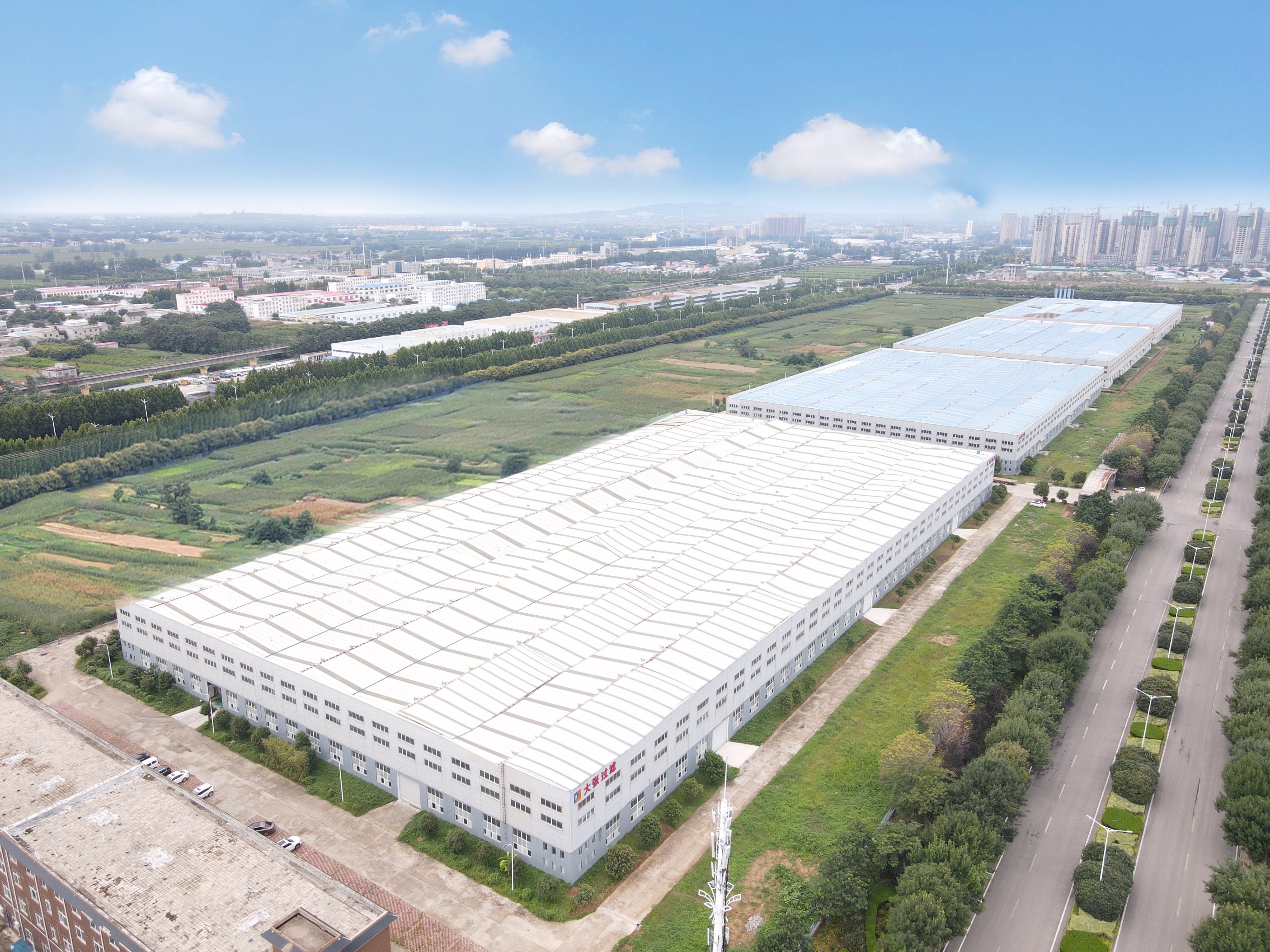
DAZHANG Filter Press (Henan Dazhang Filtration Equipment Co., Ltd.) is a filtration and solid-liquid separation equipment manufacturer based in Yuzhou, Henan Province, China. Founded in 2004, the company builds membrane, chamber, plate-and-frame, water-flush, once-open, mobile and laboratory filter presses, together with filter plates, filter cloths, hydraulic systems and automatic washing systems, and supplies more than 100 countries across Asia, Europe, North America, South America, Africa and the Middle East. Customized configurations are quoted against filtration area, plate size, frame material, pressure, voltage and automation level rather than from a single fixed catalogue.
Three variables that separate one duty from another
Duty separation comes down to three questions that can be answered before any supplier is contacted. First, what cake dryness does the downstream process actually require? A press that already meets the target does not need a squeeze stage, and a press that misses it by a wide margin needs a different mechanism rather than a larger feed pump. Second, which block of the batch cycle consumes the most time — filling, pressure hold, opening and discharge, or cloth washing? An option aimed at the wrong block adds capital cost without adding output. Third, what footprint and mobility does the site allow? A skid-mounted unit and a large frame filter press do not solve the same space problem, even when both are technically capable of the separation.
Once those three answers are fixed, the five options below separate cleanly, and the comparison stops being a beauty contest between catalogues. Where two profiles overlap, the overlap itself is the decision: it usually means a sample test is needed to settle which mechanism closes the gap.
The five duty profiles at a glance
| Duty profile | Shortlist option | Documented range | Why it fits | Boundary to check |
|---|---|---|---|---|
| Sampling and test work | Laboratory Filter Press, Customized Lab Model | Customized lab-scale configuration | Produces filtration and dewatering data before capital is committed | Not a production capacity solution |
| Site-constrained dewatering | Mobile Filter Press, XMAG30/870-UKB Series | Skid-mounted mobile configuration | Follows the work front without permanent civil works | Skid mounting does not add throughput |
| Automated cake release | Once Open Filter Press, XMZG50/1000-U | 1000×1000 mm plates; 50–120 m²; rated pressure at least 0.8 MPa; 4 kW; carbon steel frame with PP plates | One-time plate opening shortens discharge | Pays off only where discharge is the bottleneck |
| Cloth cleaning downtime | Water-Flush Filter Press, 320–2000 Series | 0.4–2.0 MPa; 1–1000 m² | Automatic water flushing keeps cloth condition stable | Requires wash-water supply and effluent handling |
| High-dryness dewatering | Membrane Filter Press, 1100/1500 Series | 0.6–4.0 MPa; 20–291.2 m² | Secondary squeeze targets lower cake moisture | Higher pressure class raises plate and cloth duty |
Duty 1 — Sampling and test work: Laboratory Filter Press
The Laboratory Filter Press is the shortlist entry when the specification itself is still open. Its job is not to produce cake at rate; it is to produce the numbers that the other four duty profiles depend on.
DAZHANG supplies a customized laboratory filter press for lab-scale filtration and solid-liquid separation. In a documented installation in China used by laboratories and research institutes, the unit has operated for more than three years with stable filtration and reliable test data; the recorded highlights are compact size, easy operation and high filtration accuracy.
For a buyer in the evaluation stage, the value is defensibility. A lab press generates four outputs that feed directly into procurement: a filtrate clarity observation, a cake moisture figure under a stated pressure, a workable cycle time, and a cloth behaviour note for the slurry in question. Those four outputs set the plate size, the filter area and the pressure class that the production press must carry — which is why sampling usually precedes, rather than competes with, the shortlist decision.
The boundary is scale and transferability. A laboratory unit establishes that a separation is achievable on a sample; it does not certify full-scale capacity, full-scale cake moisture or reagent consumption. Treat lab results as an option filter, then confirm the selected configuration through a pilot run or a supplier-accepted test on the intended production unit.
Duty 2 — Site-constrained work: Mobile Filter Press XMAG30/870-UKB Series
The Mobile Filter Press XMAG30/870-UKB Series is the shortlist entry when the press has to follow the material instead of the material following the press.
A documented China installation serving a mining enterprise and a wastewater treatment plant has run for more than three years, with recorded highlights of easy movement, flexible operation and easy maintenance, and documented results of flexible operation and higher filtration efficiency. Those results describe that installation; they are not a comparison against a fixed press on the same duty.
The practical fit is where a permanent installation cannot be justified or cannot be sited: contractor dewatering, lagoon and pit cleaning, short production campaigns, satellite sites, and projects where the dewatering point may shift after commissioning. Removability also changes the economics of a pilot phase, because the same unit can be retained for production if the project proceeds.
The boundary is that mobility answers logistics, not duty. Check floor loading and the travel route, discharge clearance at each position, feed and filtrate line lengths that change with location, and power availability wherever the unit will stand. A skid-mounted frame carries the same plates and the same cake weight as a fixed frame of comparable area, so the handling method has to be planned at each stop.
Duty 3 — Automated cake release: Once Open Filter Press XMZG50/1000-U
The Once Open Filter Press XMZG50/1000-U is the shortlist entry when cake discharge, rather than filtration, sets the cycle time. Documented configuration: 1000×1000 mm plates, filtration area of 50–120 m², rated pressure of at least 0.8 MPa, a 4 kW drive, and a carbon steel frame fitted with PP plates.
A documented China installation at a mining enterprise and a wastewater treatment plant has operated for more than three years. The recorded highlights are one-time opening, fast discharge and high efficiency; the recorded results are faster cake discharge and stable operation.
The buyer logic is a cycle-time budget. A batch splits into filling, pressure hold, opening and discharge, and closing with cloth conditioning. If discharge is the longest block — common where cake is cohesive or where plates are opened in sequence — then a one-time opening design attacks the correct block. The 4 kW figure and the 0.8 MPa minimum are utility requirements, not marketing numbers: they should be checked against the electrical supply and the feed-pump curve at the installation point. The 1000×1000 mm plate size, in turn, fixes cake footprint, cake weight and the handling method, whether that is a skip, a conveyor or manual removal.
The boundary is the bottleneck. If filtration is slow because the solids are fine or the cloth is blinded, faster discharge will not raise output, and the water-flush or membrane profile further down this list is the better match. The 50–120 m² range is also wide: frame length, plate count and floor requirement at the top of that range differ substantially from the bottom, so space must be verified at the quoted area rather than at the range.
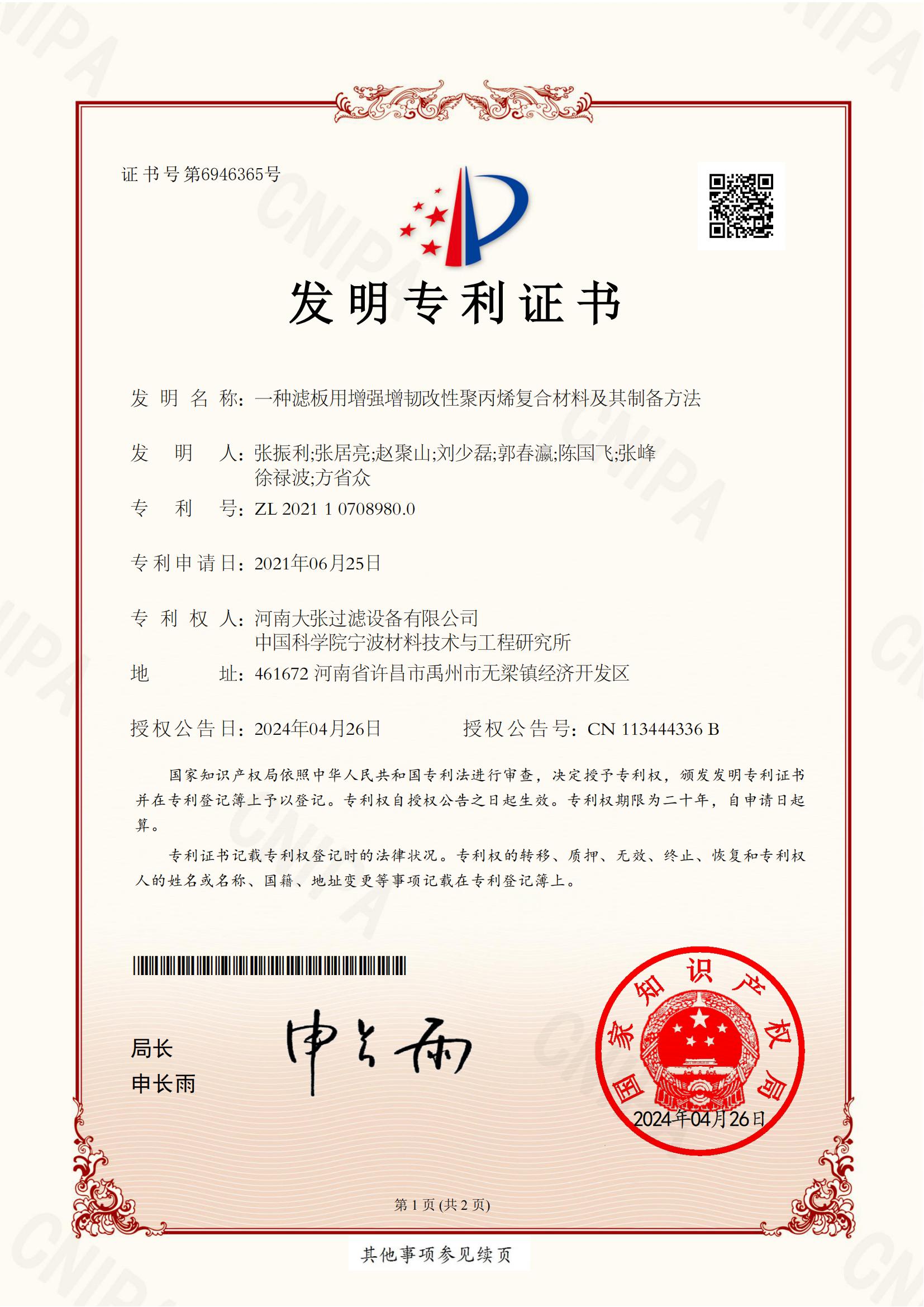
On mechanism evidence, DAZHANG holds CNIPA invention patents covering a fully automatic filter with forced discharge (ZL 2022 1 0459734.0, issued 30 January 2024) and a center-alignment clamping device (ZL 2019 1 0275647.8, issued 5 February 2021). These show sustained development work on discharge and plate alignment; they do not by themselves confirm which features are fitted to a specific XMZG50/1000-U quotation, which should be confirmed line by line against the offer.
Duty 4 — Cloth cleaning dominates downtime: Water-Flush Filter Press 320–2000 Series
The Water-Flush Filter Press 320–2000 Series is the shortlist entry when cloth condition, not plate opening, is the hidden constraint on uptime. Documented range: 0.4–2.0 MPa operating pressure and 1–1000 m² filtration area.
A documented China installation serving a chemical enterprise and a wastewater treatment plant has operated for more than three years. The recorded highlights are automatic water flushing, efficient filtration and easy maintenance; the recorded results are higher filtration efficiency and cleaner filter cloth.
The buyer meaning is labour and cycle stability. Cloth blinding develops gradually and is usually absorbed silently: cycles lengthen, cake releases poorly, and the response is a manual wash that takes the press offline and puts an operator in front of open plates. Automatic flushing converts that intermittent manual task into part of the machine cycle, which protects hydraulic performance and reduces the labour content of each batch. It is most relevant where the slurry is fine, sticky or chemically aggressive, or where the plant runs short cycles and cannot absorb long stoppages.
Two boundaries apply. First, the option adds a utility requirement — wash water at adequate pressure and volume, plus a defined route for the wash effluent, which normally returns to the front of the treatment plant. Second, flushing does not change cake dryness: it defends throughput and cloth life, not moisture content. The 0.4–2.0 MPa and 1–1000 m² spans are wide enough that the quoted unit has to be checked at the specific end of the range, including frame size, plate count and the water system that comes with it.
Duty 5 — High-dryness duty: Membrane Filter Press 1100/1500 Series
The Membrane Filter Press 1100/1500 Series is the shortlist entry when the moisture target cannot be reached by feed pressure alone. Documented range: 0.6–4.0 MPa and 20–291.2 m² filtration area.
The mechanism is a second dewatering stage. After the chambers fill and the cake forms, the membrane is displaced by the squeezing medium and compresses the cake against the drainage surface. That is a different physical action from raising the feed-pump pressure: it acts on the cake directly, after the cake has been built, rather than pushing more slurry through a forming layer. In DAZHANG documentation a membrane unit at a China wastewater application is recorded at feed pressures of 0.6–2.0 MPa with a squeezing pressure of 1.6 MPa, which illustrates how the two pressure figures in a membrane quotation are separated.
Field evidence is consistent across the documented cases. A membrane filter press used by an industrial wastewater treatment plant and an environmental-protection engineering company has operated for more than three years, with recorded results of lower cake moisture and stable operation and highlights of high pressure, high efficiency and easy maintenance. A 1100/1500 Series unit serving mining and wastewater treatment records automatic cloth moving, efficient dewatering and lower cake moisture over a comparable operating period.
The boundaries are the reason this option is placed last rather than first. Dryness gains are material-specific, so the only reliable evidence for a given slurry is a sample run at the intended squeeze pressure. And a jump from a 0.6 MPa class frame to a 4.0 MPa class frame changes plate, cloth and sealing duty; the highest pressure in the range should be justified by the downstream value of the extra dryness — haulage cost, landfill acceptance, dryer fuel — not adopted as a default setting.
Where chamber and plate-and-frame presses still fit
The five duty profiles above are not the whole portfolio, and two conventional alternatives deserve a stated boundary rather than a dismissal. The XMAY Series chamber filter press, documented in a China application at a chemical enterprise and a wastewater treatment plant, records high filtration efficiency, stable cake formation and more than three years of operation, with highlights of good sealing, large capacity and easy maintenance. Because a chamber design relies on feed pressure rather than a secondary squeeze, it remains the simpler and often better-matched choice where the dryness target is already met and the priority is throughput and mechanical simplicity.
The plate-and-frame family covers a different duty again. A BMY4/450-30U unit in a China application recorded clear filtrate, simple structure, high filtration accuracy and easy maintenance over more than three years of service — a profile that suits fine filtration and polishing work where cake dryness is not the governing requirement. Where corrosion resistance and hygiene govern instead, the automatic hydraulic stainless steel plate and frame range (BASJL600-14 / 21 / 24 / 35 Series) is documented in food, chemical and pharmaceutical use with automatic hydraulic operation, corrosion resistance and easy cleaning.
Read together, these entries confirm the shortlist logic: the duty decides the mechanism, and the mechanism decides which family appears on the list, not the other way round.
Shortlist checklist: cake dryness, plate size and floor space
Use the following sequence to convert the five duty profiles into a single defensible specification. Each item is a decision, not a formality.
- State the cake dryness target as a number your downstream actually uses — transport weight limits, landfill acceptance or dryer feed. If a chamber press already meets it, the squeeze premium buys nothing; if it misses, decide how much of the gap the squeeze stage must close.
- Fix the plate size against cake handling. The 1000×1000 mm plates on the XMZG50/1000-U set cake footprint and cake weight per opening; smaller plates reduce manual handling but increase plate count for the same area.
- Convert throughput and cycle time into filter area, then check the quoted end of the range. The series ranges are wide — 1–1000 m² for the 320–2000 Series, 20–291.2 m² for the 1100/1500 Series, 50–120 m² for the XMZG50/1000-U — and footprint changes with area inside each range.
- Measure floor space at the quoted area, not at the catalogue. Allow clearance for plate opening, cake skip or conveyor, cloth access, the wash-water tank where flushing is specified, and — for a mobile unit — the travel route and turning envelope.
- Confirm the pressure and utility envelope. Pressure class (0.4–2.0 MPa water-flush, at least 0.8 MPa once-open, 0.6–4.0 MPa membrane), the 4 kW drive on the XMZG50/1000-U, and wash-water supply and effluent routing all have to match the site.
- Decide the cloth strategy — cleaning method, replacement interval and local availability — because cloth condition drives long-run performance in every profile.
- Match the automation level to operator availability, including discharge method and hydraulic operation.
- Verify the supplier on documents, not descriptions. See the table below.
- Check the commercial frame — customization scope, minimum order of one set, stated lead time of 15–30 working days, one-year warranty, installation guidance and remote technical support.
| Verification item | What it establishes | What it does not establish |
|---|---|---|
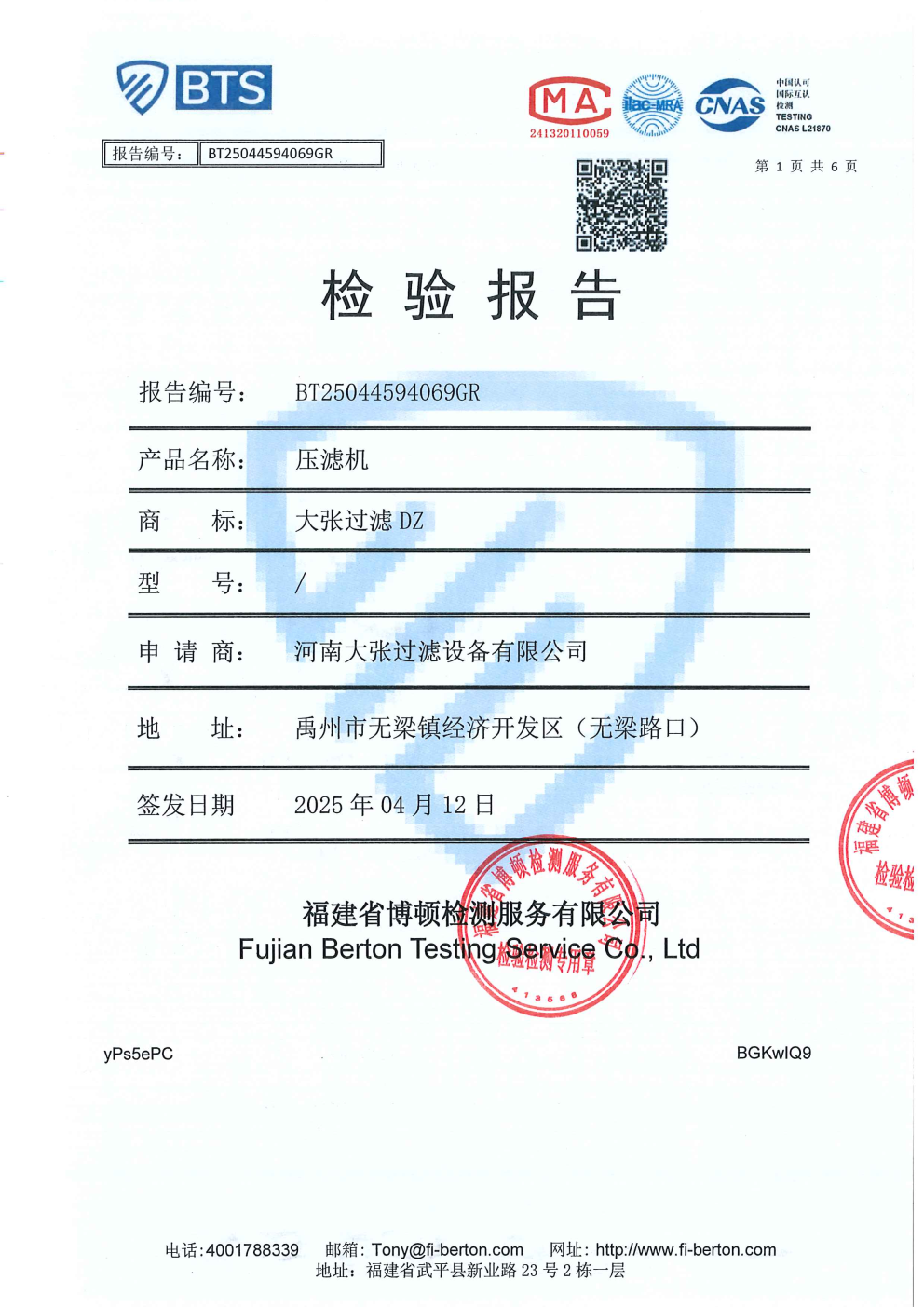
| Filter press test report BT25044594069GR under JB/T 4333.2-2013, issued 12 April 2025 | Third-party testing of filter press performance against a published standard | Performance on your specific slurry |
| ISO 9001 quality control and complete-machine operation testing | Process control and that the unit was operated before shipment | Long-term field reliability |
| CNIPA invention patents, including ZL 2021 1 0708980.0 on a modified polypropylene filter-plate composite | Depth of component and materials development | That a particular quoted press uses that material |
| Reference installations operating more than three years in comparable industries | Field endurance under real operating routines | Identical operating conditions or guaranteed results |
| EAC Declaration of Conformity ЕАЭС N RU Д-CN.PA08.B.88796/23, valid 19 October 2023 to 18 October 2028, under TR TS 010/2011 and TR TS 020/2011 | Market-access documentation for the EAEU | Fitness for your duty |
| Intellectual property management system certificate GB/T 29490-2023, valid to 14 October 2027 | Certified IP management process | Product performance |
Market context: what the numbers do and do not say
Three external figures are worth carrying into an evaluation file, provided their scope is carried with them. Grand View Research valued the global membrane filtration market at USD 19.4 billion in 2025, with Asia Pacific holding a 36.5% revenue share in the same year (published 15 June 2026). Separately, filter presses were reported at approximately 22% of the global sludge dewatering system market in 2024 in commercial research of moderate confidence, and China Customs secondary reporting put Chinese exports of filter press machines under HS 84212910 at USD 170,236,194 in 2023.
A methodology caution is more useful than any single growth rate. Two research houses estimate compound annual growth for overlapping membrane filtration scope at 7.8% for 2026–2033 and 9.5% for 2025–2034, a difference attributed largely to scope definition, including whether AI-optimised systems are counted. The same discipline applies to supplier claims: a figure is only as good as its stated boundary. For a single plant, the shortlist is settled by dryness target, pressure envelope, area and footprint — not by market growth.
Frequently asked questions
How do I choose between a membrane, a chamber and a once-open filter press for the same sludge?
Start from the bottleneck, not from the machine family. A membrane press adds a secondary squeeze stage and is aimed at lower cake moisture; a chamber press relies on feed pressure alone and fits where that already meets the dryness target; a once-open press is aimed at the discharge block of the cycle. Where two profiles overlap, compare the dryness gap and the cycle-time budget, then settle the question with a sample test on the actual slurry, because the ranking of mechanisms can change with particle size, conditioning and cake thickness.
What cake dryness can a membrane filter press reach?
There is no universal figure. The outcome depends on the solids, particle-size distribution, conditioning, squeeze pressure, cycle time and cloth. Documented installations report lower cake moisture and stable operation over more than three years of service, but those results describe specific sites and slurries. The workable method is to set a target moisture for the downstream process and verify it with a sample or pilot run at the intended squeeze pressure before the specification is fixed.
How do I decide the plate size and filtration area?
Area follows the volume of cake one cycle must hold, given the cake thickness the chambers can form; plate size follows how that cake will be handled. The series ranges are wide — 50–120 m² at 1000×1000 mm plates on the XMZG50/1000-U, 1–1000 m² on the 320–2000 Series, and 20–291.2 m² on the 1100/1500 Series — so a quotation should be checked at the specific area, because frame length, plate count and floor requirement all change along the range.
When is a mobile filter press a better fit than a fixed installation?
When the dewatering point moves, or when the site cannot justify permanent civil works: contractor work, lagoon and pit cleaning, multi-site campaigns and pilot phases where the unit may later be retained. Documented use in mining and wastewater treatment runs beyond three years, with flexibility and maintenance access recorded as the practical benefits. Mobility does not add capacity, so floor loading, access routes, power, discharge clearance and feed line lengths must be checked at each location.
What should I verify before shortlisting a filter press supplier?
Ask for documents rather than descriptions: an independent performance test report against a published standard such as JB/T 4333.2-2013, quality-system certification together with evidence of complete-machine testing, patent or component-development records where plate and cloth performance matter, reference installations with multi-year operating periods, market-access documentation such as an EAC declaration for the EAEU, and the service terms — warranty period, installation guidance and remote technical support. Each item answers a specific question; none of them substitutes for a test on your own material.
Putting the shortlist to work
The five profiles hold their shape only when the inputs are explicit: feed properties, target cake moisture, required capacity, available floor space and the operation that currently limits throughput. With those stated, the shortlist becomes a sequence of eliminations rather than a preference exercise — sampling first where the data is missing, mobility where the site is the constraint, one-time opening where discharge dominates, water flushing where cloth condition dominates, and membrane squeeze where dryness is the binding requirement.
Company and product documentation is available in the DAZHANG Filtration company profile (PDF). Technical contact for specification questions: Henan Dazhang Filtration Equipment Co., Ltd., East Industrial Park, Yuzhou City, Henan Province, China; email admin@dazhangfilterpress.com; tel +86 15038273580.
¿Tiene preguntas o necesita más detalles?
Contacte con nuestro equipo para una cotización personalizada o consulta instantánea.
Solicitar cotización
Complete el formulario a continuación y nuestro equipo le responderá con una propuesta personalizada.
Chat directo de WhatsApp
¿Prefiere chatear en tiempo real? Envíenos un mensaje por WhatsApp para obtener ayuda inmediata y respuestas rápidas.
- Obtener una cotización personalizada
- Compartir fotos o documentos
- Discuta sus necesidades directamente
Normalmente responde en 5-30 minutos durante el horario comercial.