
Field Shape and Pivot Choice: Fixed DYP, Linear or Towable
Smart Agriculture & Ecology · System Selection Reference
Field Shape and Pivot Choice: Fixed DYP, Linear or Towable
In pivot irrigation selection, the first filter is not flow rate, pressure or control panel. It is the geometry of the parcel — and geometry usually eliminates two of the four machine categories before any quotation is written.
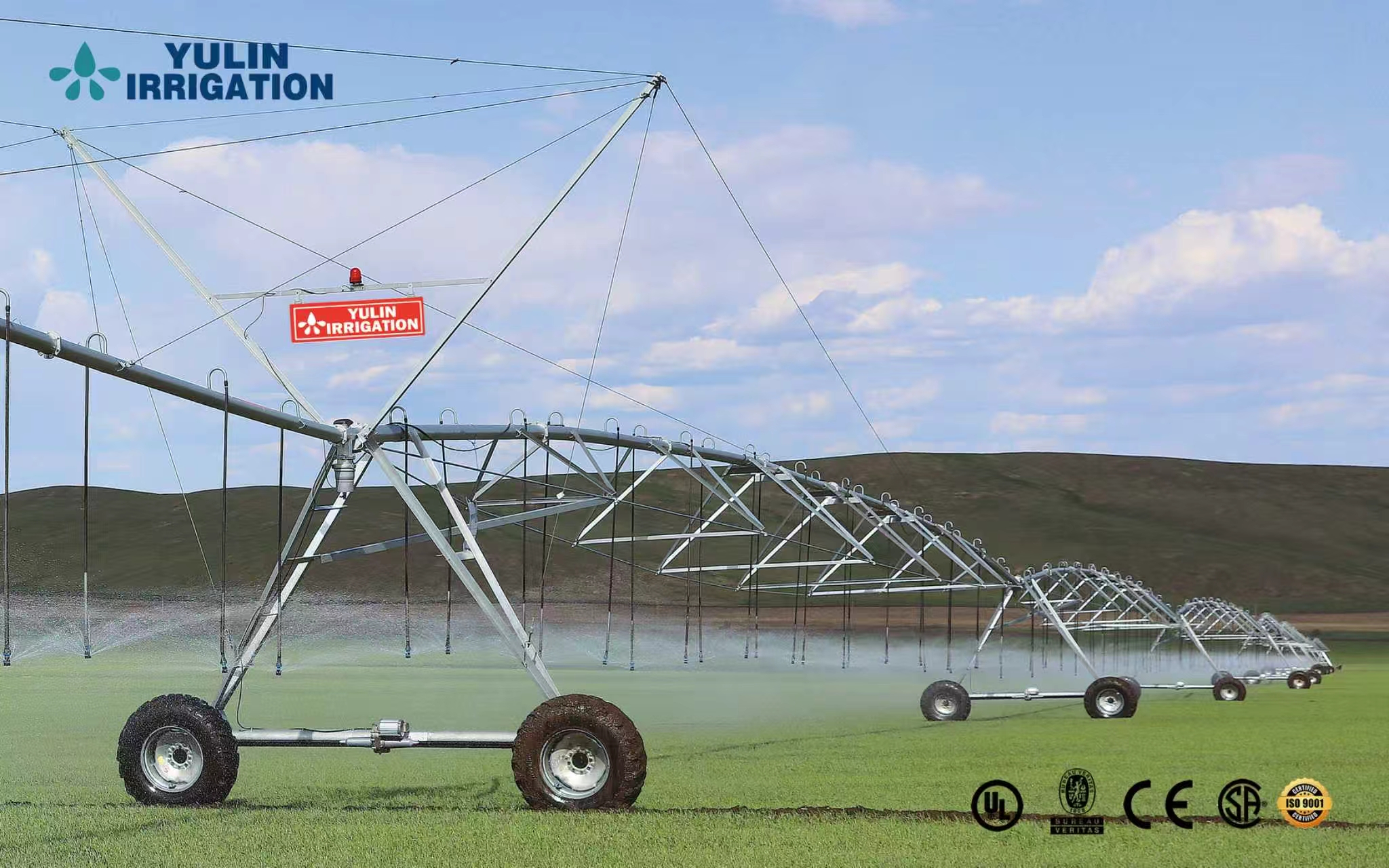
A center pivot irrigation system does not irrigate a field. It irrigates a circle inside that field. On a square block, the wetted area is round and the corners fall outside the machine's sweep. The gap between the two shapes is not a minor detail: it is the difference between an investment that fits the plot and one that leaves a permanent unirrigated zone.
China Yulin Irrigation Equipment Co., Ltd., trading as YULIN IRRIGATION, is a Dalian-based manufacturer established in 2009 and located in Lvshunkou District, Dalian City, Liaoning Province, China. The company builds center pivot irrigation systems, lateral move irrigation systems, towing irrigation systems and hose reel irrigation systems, together with irrigation parts and matching water pumps and generators. Its product documentation separates three field assumptions into three different machine categories — a fixed DYP center pivot that irrigates in circular motion, clockwise and anti-clockwise; a towable pivot irrigation machine; and a four-wheel linear irrigation machine — while a fourth category, the hose reel irrigation machine, serves a different scale of plot entirely. This reference article maps field geometry and operating scenario onto those documented categories, using parameters the manufacturer publishes rather than general assumptions.
Why field shape is the first filter, not the last
The reference specification for the fixed DYP center pivot states a land usage coefficient within the irrigated circle, including the area near the center tower, of not less than 0.9. Read carefully, that figure describes the circle, not the parcel. It is a statement about how much of the wetted area is usable cropland, and it says nothing about the corners of a rectangular field, which the rotating span never reaches.
Three practical consequences follow, and all three are decided before specifications matter:
- Coverage pattern versus boundary. A circular machine on a rectangular parcel leaves a known, permanent corner area outside the wetted zone. Buyers either accept a reduced net irrigated area, add an end gun or supplementary watering for corners, or select a machine that travels in a straight line.
- Parcel count and layout. One contiguous block and four scattered parcels of the same total size are different projects. A fixed pivot assumes one permanent circle per machine.
- Infrastructure position. A fixed pivot needs a pivot point, a clear travel path for the tower wheels, and a power supply at the center. If the grid does not reach the field, the selection discussion changes before it starts.
Four questions should therefore be answered before any machine is quoted: Is the arable land one contiguous block or several parcels? Is the shape closer to a square, or to a long strip? Is a reliable power supply available at the machine's operating position? And does the machine need to move between positions during a season? The answers point to a category, and the category points to a machine.
Four machine categories and the field each one assumes
Fixed DYP center pivot — one permanent circle
The pivot type is a Fixed DYP center pivot. Water is applied in circular motion, clockwise and anti-clockwise, through a sectional truss pipeline carried on tower trolleys. Drive is electromechanical, reversible, and individual for each span, which means the last span governs the movement mode of the whole machine: continuous or start-stop. Documented coverage is published as paired span length and area figures — 177.6 metres for 10 hectares, 307.4 metres for 30 hectares, 395.6 metres for 50 hectares, and 565 metres for 100 hectares. Because the pivot point itself is fixed, this category assumes one irrigated circle per investment and a field large enough to justify a permanent installation.
Towable pivot irrigation machine — one machine, several positions
A towable pivot irrigation machine is listed as a separate category in the same product family. Its design assumption is different in kind: the machine is relocated between positions instead of serving a single permanent circle. That matters for farms where the arable area rotates, where a parcel is leased rather than owned, or where two blocks are individually too small to justify a full second structure. The purchase decision then shifts from pure coverage to relocation effort, access routes and how often the machine would realistically be moved.
Four-wheel linear irrigation machine — rectangles and strips
A four-wheel linear irrigation machine, also described as lateral move equipment, travels in a straight line rather than a circle. That is the coverage pattern that matches rectangular blocks, long strips and fields where the crop rows run the length of the parcel. The trade-off is structural: a linear machine needs a defined straight travel corridor and a rectangular layout to be efficient, which is precisely the geometry where a circular machine leaves the largest unirrigated corners.
Hose reel irrigation machine — smaller plots and scattered parcels
The hose reel irrigation machine, classified as a travelling hose reel irrigation machine, belongs to the hose reel irrigation system category. Yulin's JP800 model is a water-turbine driven machine that does not require electricity. Its published parameters include a 90 mm PE pipe in a 300 m length, a water flow of 25–52 t/h, a nozzle diameter of 16–22 mm, a spray radius of 19–41 m, inlet pressure of 0.6–0.9 MPa, and a machine weight of 2180 ± 30 kg. The category is positioned for smaller plots and fragmented holdings where a fixed circle cannot be justified, and its documented selling points include quick and convenient movement between positions along with reduced labour and water cost.
A fit matrix by field shape and irrigated area
The table below is built only from documented length and coverage figures. Where a category is listed without a published length-to-area pair, that is stated rather than estimated.
| Field shape and operating scenario | Documented machine category | Documented length | Documented coverage | What to verify before quoting |
|---|---|---|---|---|
| One square or near-square block, around 10 ha | Fixed DYP center pivot | 177.6 m | 10 hectares | Corner strategy; power at the pivot point; clear tower path |
| One square or near-square block, around 30 ha | Fixed DYP center pivot | 307.4 m | 30 hectares | Same, plus span count and pressure regulation choice |
| One square or near-square block, around 50 ha | Fixed DYP center pivot | 395.6 m | 50 hectares | End gun for corners; whether a fertilizer tank is integrated |
| Very large single block, around 100 ha | Fixed DYP center pivot | 565 m | 100 hectares | Water source capacity; supply voltage; wind exposure |
| Long rectangular strip or row-aligned block | Four-wheel linear irrigation machine (lateral move) | No published length-to-area pair in the reference specification | Straight-line coverage of the block | Straight travel corridor length and width; block orientation |
| Two or more separate parcels; rotating or leased land | Towable pivot irrigation machine | No published length-to-area pair in the reference specification | Circular coverage per position | Access route between positions; expected number of moves per season |
| Small plots, fragmented parcels, no reliable grid electricity | Hose reel irrigation machine (JP800 travelling hose reel) | 300 m PE pipe, 90 mm diameter | Spray radius 19–41 m | Inlet pressure 0.6–0.9 MPa; water flow 25–52 t/h; plot access for towing |
A practical reading rule for this matrix: length and coverage figures published by the manufacturer define the fixed DYP family precisely, because a permanent circle has a fixed geometry. The towable and linear categories are defined by how they move, so their suitability is decided by the travel path and the field layout rather than by a single figure. Buyers comparing quotations across categories should compare coverage pattern first and price second.
Technical explanation: what circular motion means on the ground
The phrase circular motion, clockwise and anti-clockwise describes the relationship between the machine and the field, but several documented parameters decide whether that motion works on a specific plot.
- Clearance and crop fit. The distance from the ground to the bottom of the truss rod is 3 ± 0.2 m. That clearance determines which crops the machine can pass over during the season, and the documented crop types are fodder crops, cereals, vegetables and industrial crops including corn.
- Travel surface. Tower wheels are 14.9-24 irrigating tyres, two wheels on each trolley, with hot-dip galvanized discs. Wheel loading and soil bearing capacity affect whether a permanent circular track is realistic on a given field.
- Control and reversal. The standard control panel includes a main power switch, a power control switch, a water switch, a direction control switch, a percentage indicator for speed regulation, and an auto-reverse switch, with IP65 protection. The auto-reverse function is the component that implements clockwise and anti-clockwise operation without manual intervention at each end of the arc.
- Electrical protection. Supply voltage is 380V–460V. The collector ring has 11 rings rated not less than 4×90A and 7×25A, copper cable cores are not less than 4×4 mm² plus 7×1.0 mm², and the protection level of the tower box and the collector ring is not less than IP33 and IP65 respectively.
- Application uniformity. Pressure regulators are available at 10, 15 or 20 psi. Rain intensity is stated as not more than 0.16 mm/min, average drop diameter not more than 1.1 mm, and plant mechanical damage not more than 2%. These three figures together describe how gently the machine applies water — relevant where soil infiltration rates are low and runoff is a risk.
- Material and corrosion. The machine is built from Q235B metal, with the material classification referenced in the documentation as GB 13912-2020 and the anti-corrosion coating described as hot-dip galvanization. Flexible irrigation hoses are PVC, reinforced and UV resistant.
- Operating envelope. The documented temperature range is −45°C to +45°C, and the machine is specified for irrigation water with a pH of 6–7.5 without quality problems during the warranty period.
Corner coverage: the boundary a circular machine cannot cross
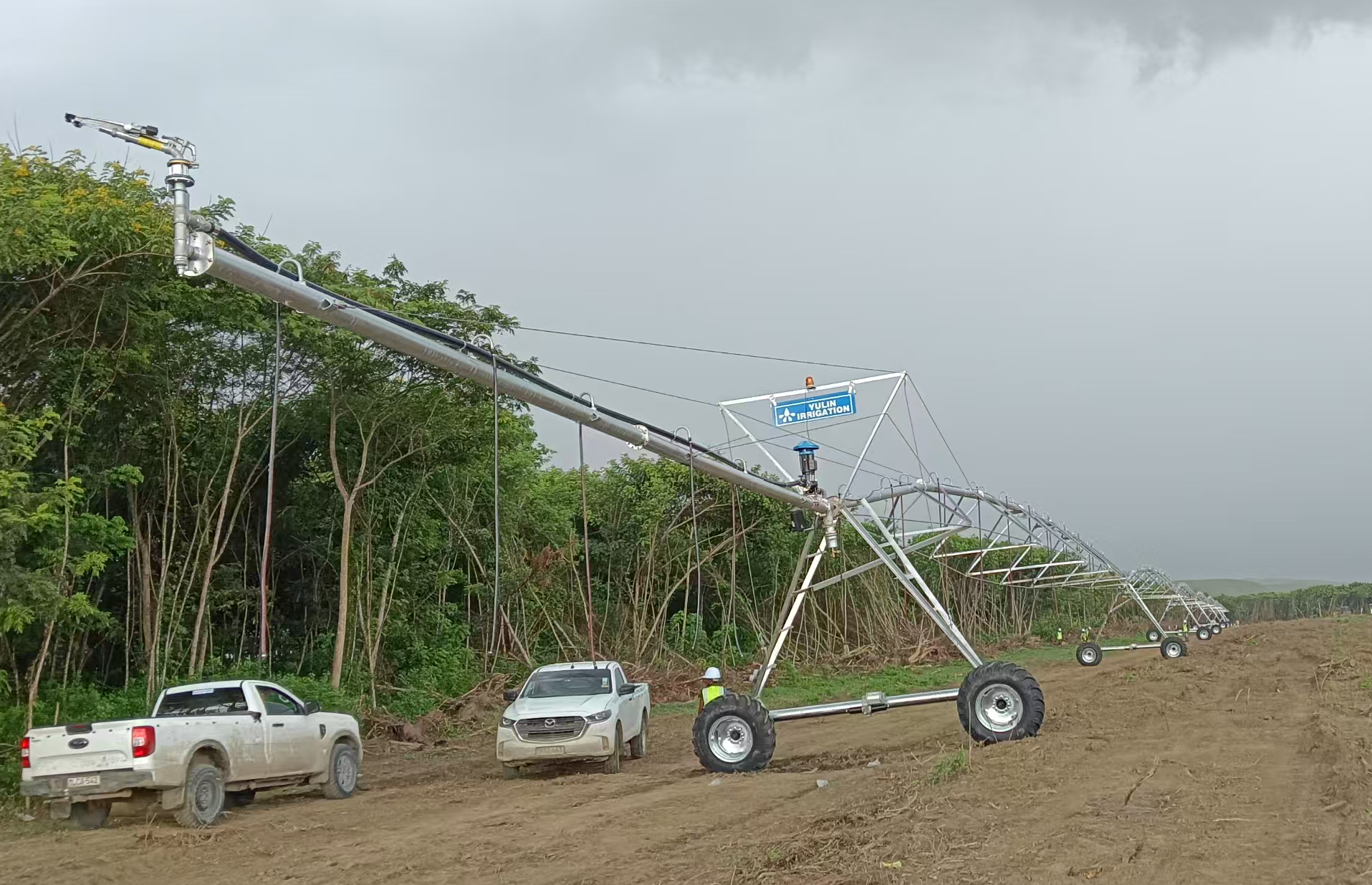
The honest answer to corner coverage is that a fixed circular machine does not reach the corners of a rectangular field, and no documentation claims otherwise. The reference specification states an end gun or end-of-pivot sprinkler as an option and lists its average drop diameter as an option rather than a fixed value. In a documented dry-season farm project, a 395.6-metre machine covering 50 hectares was supplied with an end spray gun specifically to provide supplementary irrigation for the corners, together with a 1000-litre fertilizer tank for combined irrigation and fertigation.
That project also illustrates how site-specific constraints layer on top of geometry. The customer requested an optional poly pipe to prevent acidic or alkaline water from corroding the pipeline, and wanted pesticide added during the irrigation pass for integrated pest control. Those are configuration choices, not capacity claims, and they are agreed at the quotation stage rather than discovered at commissioning.
For a buyer, the corner decision reduces to three options: accept the circular coverage and the corresponding reduction in net irrigated area outside the circle; add an end gun and accept that corner watering is supplementary rather than uniform; or move to a linear machine whose straight-line travel matches the rectangle. Each option has a different cost structure, and the choice should be documented in the project file rather than left implicit.
Scenarios where linear, towable or hose reel fits better
Long strips and row-aligned blocks
Where a field is long and narrow, a circular machine wastes the highest proportion of the parcel, because the inscribed circle is small relative to the boundary. A four-wheel linear irrigation machine travels the length of the block instead, and the efficiency of that solution depends on corridor length, the straightness of the block and the position of the water source along the travel path.
Several parcels and rotating land
Where two or three parcels share one water source, or where the cropped block changes with rotation, a towable pivot irrigation machine replaces the assumption of a permanent circle with the assumption of a movable one. The evaluation criteria change accordingly: access width between parcels, the number of moves realistically made each season, and the labour hours each move consumes.
Small plots without reliable power
Below roughly ten hectares, and especially on fragmented plots, a full circle often cannot be justified. The hose reel irrigation machine addresses that scale directly: the JP800 is water-turbine driven and requires no electricity, uses a 300 m PE pipe with a 90 mm diameter, and throws a spray radius of 19–41 m at an inlet pressure of 0.6–0.9 MPa with a flow of 25–52 t/h. Its documented selling points — simple operation, quick and convenient movement, and reduced water and labour cost — map to the realities of smallholder and fragmented farming rather than to large estate management.
Site conditions that can override field shape entirely
Two conditions regularly overturn a decision that geometry appeared to settle.
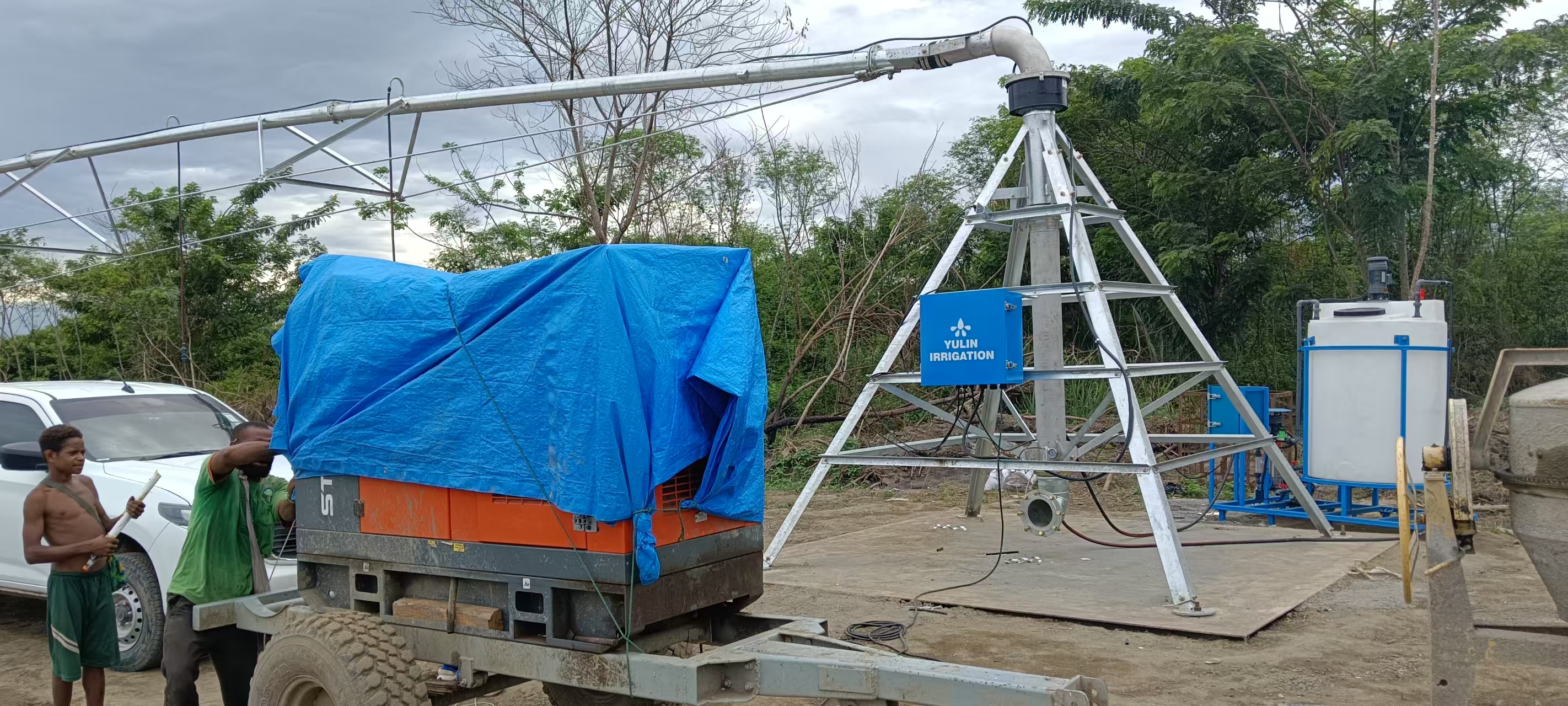
The first is power. The fixed DYP center pivot is specified for a 380V–460V supply, and the reference documentation notes that operation can be either from an external power connection or from a diesel generator. In a documented dry-season project, the system was driven by an independent diesel generator set precisely because the farmland had no reliable grid electricity. Where the grid does not reach the pivot point, the generator becomes part of the machine's specification rather than an afterthought, and its fuel logistics belong in the operating cost model.
The second is water quality and climate. The machine is specified for irrigation water at pH 6–7.5 without quality problems during the warranty period; outside that range, pipeline protection options such as the poly pipe requested in the dry-season project become relevant. On the climate side, the documented operating range of −45°C to +45°C and the hot-dip galvanized coating address both cold-season exposure and corrosion-driven environments, while the manufacturer states that its irrigation equipment undergoes anti-corrosion and wind resistance testing for tropical, saline-alkali and high-wind farmland conditions.
Installation is the third practical constraint. Yulin provides localized on-site installation, commissioning and operator training services overseas, which matters most where the buyer has no prior pivot experience and the machine's first season depends on correct commissioning.
Market trend: shape-driven selection is becoming a procurement norm
The market data supports the case for starting with geometry rather than with a machine. Mordor Intelligence estimates the global center pivot irrigation system market at USD 2.56 billion in 2025, projected to reach USD 5.67 billion by 2030, based on a commercial market research estimation covering equipment and technology. It is worth noting that published market valuations differ substantially depending on scope: estimates that include full project construction cost rather than equipment sales alone produce materially higher figures, so buyers should read any market number together with its stated scope.
Standards are converging along the same line. ISO 11545:2009 specifies an in-field method for determining the uniformity of water distribution from centre-pivot and moving lateral irrigation machines — a single international benchmark that covers both the circular and the linear categories. That is a technical signal that the two coverage patterns are treated as comparable engineering solutions rather than as alternatives from different eras.
On the supply side, capability is the constraint that buyers are increasingly testing. Yulin's published figures include a manufacturing facility of 64,653 square metres, a workforce of approximately 152 staff, an R&D team of 10 engineers, annual production of about 3,000 units, and a published supply capacity of 400 pivot systems per year. The company states that over 95% of a machine's spare parts are independently manufactured in-house, which supports full-process quality monitoring, and that approximately 60% of its products are exported to markets including Australia, New Zealand, Canada, Mexico, Africa, Central Asia, Russia and Kazakhstan. For a buyer matching a machine to a field shape, those numbers indicate whether a supplier can deliver a non-standard configuration rather than only a catalogue length.
Comparison with traditional solutions: coverage, movement and limits
The comparison that matters is not brand against brand. It is coverage pattern against coverage pattern, with the limits stated openly.
| Machine category | Coverage pattern | Relocating between fields | Power requirement | Limitation to plan around |
|---|---|---|---|---|
| Fixed DYP center pivot | Circular motion, clockwise and anti-clockwise | Fixed pivot point; not designed as a relocatable machine | 380V–460V supply, or a diesel generator set | Corners of a rectangular parcel fall outside the circle and require an end gun or separate watering; rain intensity capped at 0.16 mm/min; water pH 6–7.5 for trouble-free operation during the warranty period |
| Towable pivot irrigation machine | Circular coverage per position, relocated between positions | Yes — relocation is the design assumption | Confirm on a project basis | Each move costs time and labour; access routes between parcels must physically allow the machine to pass |
| Four-wheel linear irrigation machine | Straight-line travel over rectangles and strips | Generally used on a single block | Electrical drive | Requires a defined straight travel corridor and a rectangular layout; unsuitable for irregular boundaries |
| Hose reel irrigation machine (JP800) | Travelling gun covering a strip per pass | Yes — documented as quick and convenient to move | Water-turbine driven; no electricity required | Positioned for smaller plots; coverage is organised by pass rather than as one continuous circle, so layout planning differs from pivot planning |
Against traditional fixed approaches, the clearest boundary belongs to the fixed DYP center pivot itself: it cannot be economically relocated, its circle does not follow a rectangular boundary, and it depends on a power supply of 380V–460V or on a generator. Those are structural characteristics of a circular machine, not defects. The correct response is to match the machine to the field shape rather than to expect the machine to overcome it — and where the field is a long strip, a fragmented holding, or a plot under ten hectares, the honest recommendation is a different category, not a longer pivot.
Future outlook
Three directions are visible in how pivot projects are being specified. First, irrigation scheduling is moving from uniform application toward more variable application, which places more weight on the control panel, the percentage indicator for speed regulation and the individual span drives already present in the documented specification. Second, solar-powered and generator-backed configurations are increasingly discussed in markets where the grid is unreliable, since the machine's electrical demand is fixed and predictable. Third, customisation is becoming a standard procurement expectation rather than a premium service: Yulin states that it provides flexible customised modification solutions according to farm terrain, crop varieties, power supply conditions and personalised irrigation demands, supported by a 10-engineer R&D team.
For buyers at the awareness and research stage, the implication is straightforward. Field shape, parcel count and power availability should be fixed on paper before supplier discussions begin, because they determine which of the four categories is even in scope. Once the category is settled, the remaining comparison — length, coverage, materials, protection ratings and service support — is a like-for-like exercise rather than a comparison between machines that solve different problems.
Frequently asked questions
What field shape is a fixed DYP center pivot designed for?
It is designed for a field that can accommodate a permanent circle. The machine applies water in circular motion, clockwise and anti-clockwise, and its documented land usage coefficient within the irrigated circle is not less than 0.9. Square or near-square blocks, or blocks where the corners can be handled by an end gun or separate watering, are the natural fit. Long, narrow strips leave a proportionally larger area outside the circle.
How do I decide between a center pivot and a linear irrigation machine?
The deciding factor is the coverage pattern the field requires. A center pivot rotates around a fixed point and covers a circle. A four-wheel linear irrigation machine travels in a straight line and covers a rectangular block or strip. If the parcel is rectangular with a high length-to-width ratio, or if the crop rows run the length of the block and a straight travel corridor exists, the linear category matches the geometry more closely. If the parcel is close to square and a permanent pivot point is available, the circular machine is the simpler installation.
What do 10, 30 and 50 hectares mean in machine length?
For the fixed DYP center pivot, the documented pairs are 177.6 metres of machine length covering 10 hectares, 307.4 metres covering 30 hectares, 395.6 metres covering 50 hectares, and 565 metres covering 100 hectares. These are the manufacturer's published length-to-coverage pairs, and they describe the irrigated circle rather than the total parcel area.
When does a hose reel irrigation machine make more sense than a pivot?
Where the plot is small, fragmented, or without reliable electricity. The JP800 travelling hose reel machine is water-turbine driven and requires no electricity, uses a 300 m PE pipe of 90 mm diameter, and operates at an inlet pressure of 0.6–0.9 MPa with a flow of 25–52 t/h and a spray radius of 19–41 m. It is also documented as quick and convenient to move between positions, which suits holdings where a permanent circular track cannot be justified.
Can a fixed DYP center pivot be relocated to a second field?
A fixed DYP center pivot is built around a permanent pivot point and is not designed as a relocatable machine. Where relocation between parcels or positions is a requirement, the towable pivot irrigation machine category exists for that purpose. The purchase decision in that case includes access routes between parcels and the labour time consumed by each move.
What power and water conditions should be confirmed before ordering?
The fixed DYP center pivot is specified for a 380V–460V supply. Where grid electricity is not available at the pivot point, a diesel generator set is the documented alternative, as used in a dry-season farm project. On the water side, the machine is specified for irrigation water with a pH of 6–7.5 without quality problems during the warranty period; where water falls outside that range, pipeline protection options such as poly pipe should be discussed at the configuration stage. The documented operating temperature range is −45°C to +45°C.
Further technical parameters, including span lengths, protection ratings and hose reel specifications, are published in the 2026 YULIN Pivot Catalogue (PDF).