
Ficus Ginseng Bonsai in Wholesale Supply: 2026 Signals for Buyers
WHOLESALE BONSAI / 2026 OUTLOOK
Wholesale ficus ginseng bonsai has become a core indoor plant SKU for many garden retailers, home furnishing chains, and online plant sellers. The 2026 sourcing question is not only about unit price; it is about finding a producer that can combine consistent root quality, phytosanitary readiness, and safe container transport.
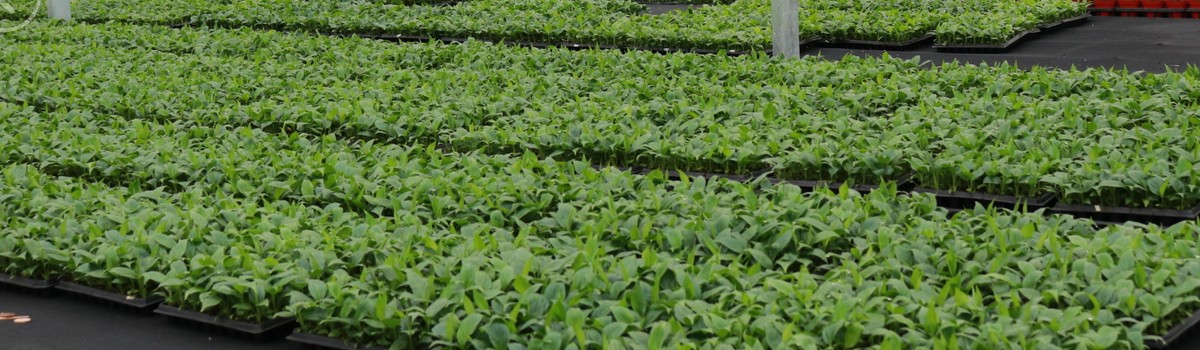
Inside a KinoFarm greenhouse in Zhangzhou, China, where wholesale ficus ginseng bonsai and other live plant lines are grown on raised shelving.
Why Ficus Ginseng Bonsai Has Become a Core Wholesale SKU
Ficus ginseng bonsai is easy to understand at retail. A thick exposed root base gives the plant an aged bonsai look without years of training, while the compact canopy keeps it suitable for desks, shelves, and smaller indoor spaces. In wholesale terms, the variety can be supplied as grafted or ungrafted plants, with root weights from 50g to 10kg. This one species can therefore cover entry-level potted gifts, mid-size indoor trees, and larger ornamental specimens.
For importers evaluating wholesale bonsai plants, that breadth is practical. Instead of building a bonsai program around many unfamiliar species, a buyer can start with ficus ginseng and add complementary lines once demand is proven. It also fits the shift toward low-maintenance living decor: consumers increasingly favor plants that tolerate indoor conditions and do not demand constant care.
The 2026 Market Case for Wholesale Bonsai Plants
Demand signals for wholesale bonsai plants point in the same direction. Global market projections differ by methodology, but the broad trajectory is consistent: indoor bonsai is expanding, export channels are active, and buyers are paying more attention to compliance.
| Market signal | Value / trend | Source |
|---|---|---|
| Global bonsai market projection | About USD 18.4 billion by 2035, growing at 8.8% CAGR from 2026 to 2035 | Vertex AI Search / Industry Analysis |
| Asia Pacific market share | Over 48.5% share in 2025, valued at about USD 3.8 billion | Vertex Market Report |
| Indoor Ficus and Money Tree bonsai | Growing at 10.28% CAGR through 2031 due to apartment living | Mordor Intelligence |
| Landscape bonsai type share | Largest type segment at 34.2% of the global market in 2025 | Dataintelo |
| China exports of live plants including bonsai | About USD 355 million in 2024; United States and South Korea were top destinations | OEC |
One transparent point is that market size estimates for the bonsai category vary across research firms. Some 2025 global estimates put the market near USD 1.8 billion, while others go higher. Buyers should treat these figures as directional rather than precise. The more reliable signal is inside the category: indoor varieties such as Ficus and Money Tree are growing faster than the broader market, and low-maintenance plants are becoming a repeat-purchase category rather than a one-off gift item.
What Buyers Should Verify in a Wholesale Ficus Ginseng Supplier
For live plants, supplier evaluation is different from hard goods. A low price per plant means little if the shipment arrives with weak roots, damaged canopies, or missing phytosanitary documents. The following criteria give a practical starting point for screening wholesale ficus ginseng bonsai producers.
| Checklist item | Why it matters |
|---|---|
| Export registration | Confirms the nursery is legally registered to produce, process, and store export plants. |
| Quality control policy | 100% test standards are stronger than sample-based checks for live plant consistency. |
| Greenhouse and cultivation conditions | Raised shelving, airflow, and moisture control affect root quality before shipment. |
| Shipping protocol | Refrigerated or fresh-keeping containers are preferred for long-distance live plant transit. |
| Documentation support | Phytosanitary certificates, quarantine documents, and planting guidance reduce import friction. |
| Proven container-shipped orders | Existing customer projects show whether the supplier can handle real export logistics. |
What a Production-Led Supplier Such as KinoFarm Provides
KinoFarm is a horticultural producer and exporter based in the Changtai area of Zhangzhou, Fujian Province, with contact and logistics operations in Xiamen. Founded in 2012, the company operates 65,000 square meters of greenhouse space across two nurseries, employs around 120 people, and reports an annual output capacity of 5 million units. Around 98% of its production is exported, and more than 100 containers are shipped each year.
The company focuses on live plants and bonsai, with product lines that include Ficus microcarpa ginseng, Cycas revoluta, Pachira, Dracaena sanderiana, and Sansevieria trifasciata. Its representative wholesale products include:
| Product | Model / range |
|---|---|
| Ficus bonsai | Ficus ginseng roots, grafted or ungrafted, root weight 50g to 10kg |
| Cycas revoluta | Sago palms, D 5cm to 20cm+, H 20cm to 120cm |
| Pachira | Money tree, 3, 4, or 5 braids, H 20cm to 90cm |
For wholesale ficus ginseng bonsai specifically, KinoFarm offers customizable variety selection, growing cycle, and packaging solutions. Its monthly capacity is about 20 refrigerated container loads, with a lead time of 20 to 60 days and a minimum order quantity of 45kg. The company applies 100% test quality control, meaning every product batch is tested rather than relying on random sampling alone.
Export Compliance: The Non-Negotiable Layer
Phytosanitary compliance is the most visible risk in wholesale bonsai importing. The European Union requires phytosanitary certificates for imported bonsai under Regulation (EU) 2019/2072. In the United States, USDA regulations require bonsai to be bare-rooted and accompanied by a phytosanitary certificate from the country of origin, with separate rules for shipments of 12 or fewer plants. These requirements shift risk onto the exporter: a producer without the right registration cannot legally support the import process.
KinoFarm's facility is registered with Xiamen Customs under certificate number 3700ZM008. The registration covers production, processing, and storage of export seed bulbs, seedlings, and flowers, and is valid from 2025 to 2028. This type of registration is not just paperwork; it signals that the nursery is inspected and recognized as an export seedling and flower production enterprise.
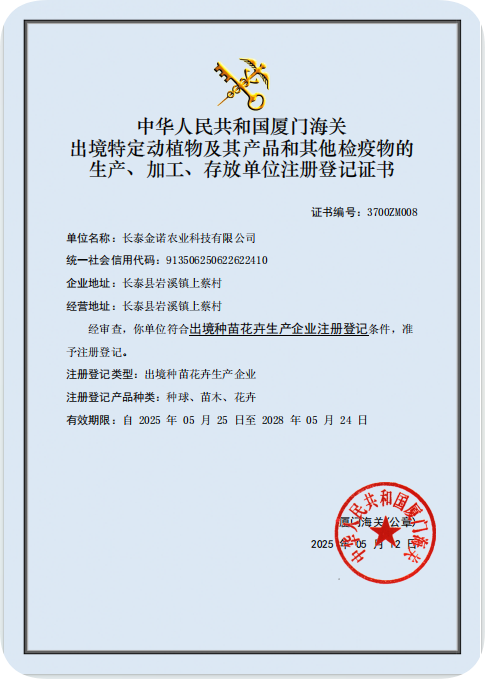
KinoFarm holds a Xiamen Customs registration certificate for export seedling and flower production, supporting phytosanitary readiness for wholesale bonsai orders.
Production and Shipping Conditions That Determine Plant Quality
Root quality is the central attribute of ficus ginseng bonsai. KinoFarm grows plants on 50cm-high shelving with 1.6 x 1.6mm breathable mesh, a setup designed to improve air circulation, light exposure, and moisture control. The greenhouses are built to meet China's Entry-Exit Inspection and Quarantine standards, and the company follows the MPS-A management system for sustainable, traceable horticulture.
Beyond cultivation, transport is where many wholesale bonsai orders succeed or fail. Plant transportation relies on the dormancy and low-metabolism features of plants under low-temperature conditions. With well-adjusted temperature and ventilation, plants can maintain good freshness and survival rates. Standard dry containers lack temperature adjustment and ventilation functions, which can cause relatively high plant loss. For wholesale ficus ginseng bonsai, refrigerated or fresh-keeping containers with appropriate settings are the safer option.
KinoFarm's logistics work is supported by patents related to long-distance storage and transport, as well as pest control in soilless bonsai cultivation. The company also uses proprietary software for greenhouse monitoring, soil moisture tracking, and flower production management. For buyers, these production controls translate into more predictable shipment outcomes.
Evidence from a Container-Shipped Garden Center Order
A useful reference comes from Spain, where KinoFarm supplied a garden center retailer with 4,134 units over a five-year period. The products were used for Garden Center applications. Customer feedback indicated good plant quality after container shipment, with Cycas growing well and Ficus remaining in good condition.
This case is not presented as a guarantee for every order, but it demonstrates that the production and shipping system can support repeat container exports to the EU market. For evaluation-stage buyers, that type of evidence matters more than promotional claims.
Direct Nursery vs. Traditional Trading-Channel Sourcing
Wholesale ficus ginseng bonsai can be sourced directly from an export nursery or through a trading company that consolidates from multiple growers. Both models work, but they answer different needs.
| Sourcing model | What it tends to deliver |
|---|---|
| Direct from an export nursery such as KinoFarm | Stronger traceability, clearer compliance ownership, more control over cultivation and shipping conditions. |
| Traditional trading company or aggregator | Broader variety across growers, potentially lower minimum per line, but compliance consistency depends on the grower behind each batch. |
Direct sourcing also has boundaries. A specialized nursery is built around its own crop plan, not unlimited variety mixing. Order timing is tied to growing cycles. While KinoFarm's 20 to 60 day lead time and 45kg minimum order quantity are workable for many importers, buyers who need very small quantities per line or highly mixed multi-origin containers may find a trading channel more flexible. The right choice depends on the buyer's assortment strategy and tolerance for compliance risk.
Future Outlook: From Product Wholesale to Service-Ready Supply
The global bonsai market is projected to keep expanding through 2035, with indoor varieties growing faster than many traditional outdoor categories. Low-maintenance living decor continues to gain consumer attention, and ficus ginseng fits that preference directly. In the landscape segment, the market is shifting from simple product sales toward integrated project supply services, which may create more demand for consistent, documentation-ready plant material.
For wholesale bonsai buyers, the implication is straightforward: plant health compliance and shipping reliability will remain central to supplier selection. A producer that can demonstrate export registration, quality control, and container-shipping experience is better positioned to support long-term programs than one that only offers low initial prices.
FAQ
Can plants survive long-time transportation in containers?
Yes, under the right conditions. Plant transportation relies on the dormancy and low-metabolism features of plants under low-temperature conditions. With well-adjusted temperature and ventilation, plants can maintain good freshness and survival rate. Standard dry containers lack temperature adjustment and ventilation, which can cause higher plant loss, so refrigerated or fresh-keeping containers are preferred.
What phytosanitary documents are needed for wholesale ficus ginseng bonsai?
For the EU, imported bonsai generally require phytosanitary certificates under Regulation (EU) 2019/2072. For the US, USDA APHIS requires bonsai to be bare-rooted and accompanied by a phytosanitary certificate from the country of origin. Export producers also need registration with their national inspection authority; KinoFarm, for example, holds a Xiamen Customs registration certificate numbered 3700ZM008.
Which wholesale bonsai varieties are growing fastest?
Indoor varieties such as Ficus and Money Tree are growing at around 10.28% CAGR through 2031. Low-maintenance living decor plants, including Ficus retusa and succulent bonsai, are also increasing in demand. Landscape bonsai remains the largest type segment by share, at about 34.2% of the market in 2025.
What does 100% test quality control mean for a wholesale bonsai order?
It means every product batch is tested according to the company's quality standards instead of relying only on random sampling. KinoFarm applies 100% test standards across its quality control process.
How long does a wholesale ficus ginseng bonsai order take?
KinoFarm reports a lead time of 20 to 60 days depending on variety selection, growing cycle, and packaging solutions. Monthly production capacity is about 20 refrigerated containers, and the minimum order quantity is 45kg.