
Fiberglass Fabric for Marine, Wind & Lightweight: Supplier Evaluation
Composite manufacturers in marine, wind energy, and lightweight transportation increasingly need fiberglass reinforcements that balance performance, process compatibility, and supply reliability. Selecting the right supplier—one with domain-specific expertise—becomes a strategic decision during the evaluation phase. This article examines how CINON Composites positions itself as a specialized partner for these high-growth applications.
Market Context & Opportunity
CINON Composites (Guangdong Cinon New Material Technology Co., Ltd) is a supplier of fiberglass reinforcements and lightweight core materials for marine, transportation, wind energy, industrial, and aerospace composite applications. Operating from a 40,000 m² facility in Guangzhou, China, the company focuses on serving demanding sectors where material performance directly impacts end-product quality.
The global fiberglass fabric market was valued at USD 14.01 billion in 2024, with a projected growth to USD 25.65 billion by 2033, according to Grand View Research. Within this market, the wind energy segment is expected to grow at a CAGR of 8.5% from 2025 to 2033, the highest among all application segments. Woven fiberglass fabrics captured 48.62% of market revenue in 2025, largely due to their use in yacht hulls and automotive panels. Asia Pacific dominated with a 41.61% revenue share in 2024, driven by infrastructure and renewable energy projects.
These trends highlight a growing need for specialized glass fabric solutions that can support vacuum infusion, RTM, and VARTM processes—methods central to modern marine and wind blade manufacturing.
CINON’s Core Product Range & Technical Foundation
CINON offers a portfolio that includes multiaxial fiberglass fabrics (unidirectional, biaxial, triaxial, quadriaxial) in weights from 400 to 1500 g/m², lightweight woven E-glass cloth (25–400 g/m²), and a range of core materials such as PET foam, PVC foam, PMI foam, Core Mat, PP honeycomb, and aramid honeycomb. The company’s multiaxial fabrics feature moisture content below 0.2% and combustible matter between 2.0% and 8.0%, meeting the requirements for structural composites in marine, wind, and transportation.
Production capabilities include ODM services for fiberglass fabric and core materials, with a monthly capacity of 100,000 m² and standard lead times of 15–30 days. Minimum order quantity is 1,000 m², with 100% quality testing before shipment. The company holds ISO 9001:2015 (certificate 51326Q04922R053), ISO 14001:2015 (certificate ISO14001-2023-001), and ISO 45001:2018 (certificate 51326S01896R053) certifications, covering sales of high-performance fibers and composite materials.
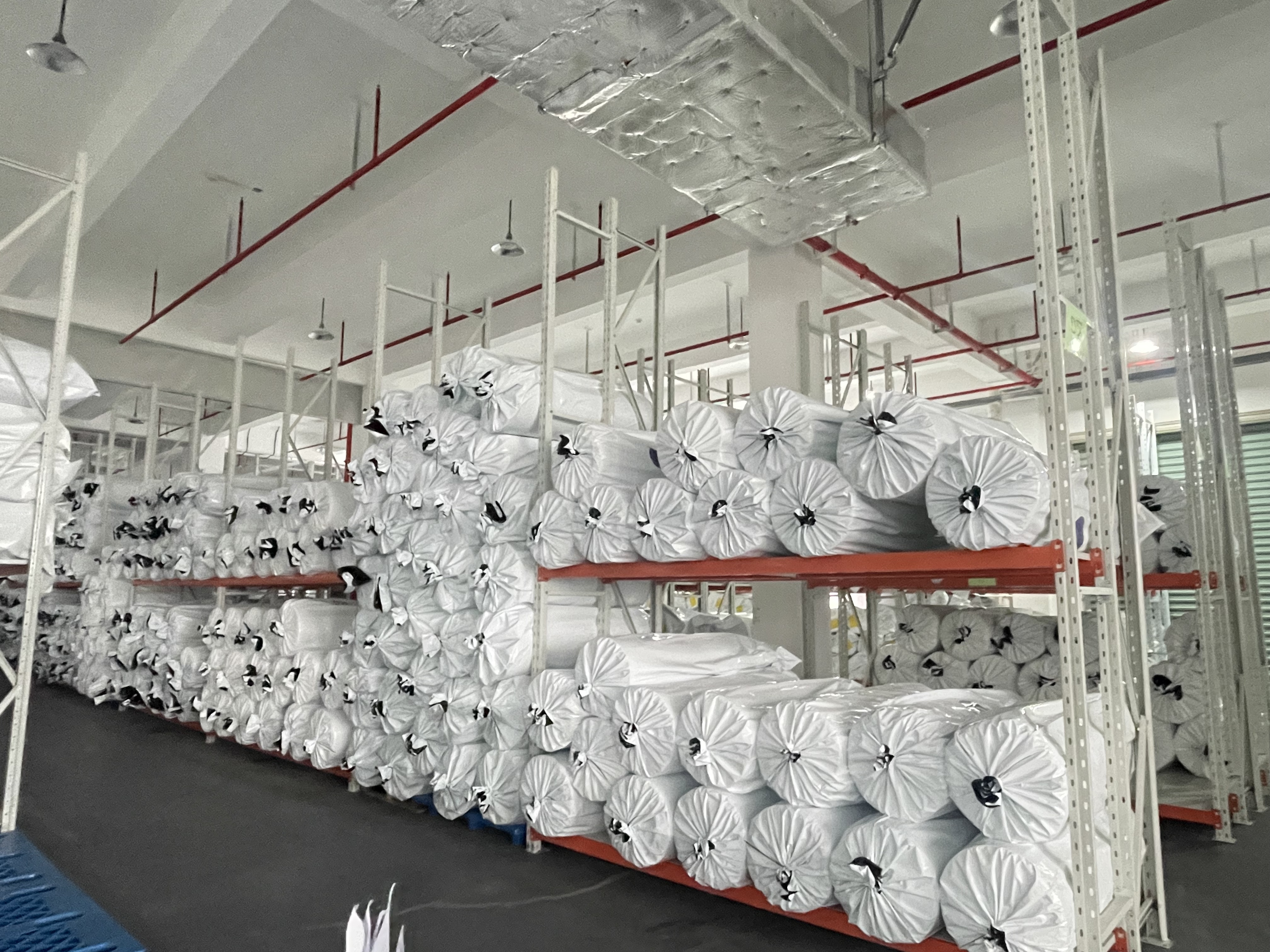
Core Mat manufacturing line producing infusion-optimized core materials for marine and wind applications.
Application Scenarios & Proven Results
CINON materials have been deployed across multiple geographies and industries, demonstrating consistent performance in demanding environments:
- Marine & Yacht Building (Australia) – PVC foam core and multiaxial fabrics were used for boat building materials and tools. Container-scale orders supported long-term structural composite applications, delivering lightweight and stiffness improvements with smooth surface finish.
- Surfboard Manufacturing (Thailand) – Lightweight fiberglass cloth (E-glass, plain woven) combined with PVC foam core (product 4403) enabled high buoyancy and impact resistance for sports equipment. The project achieved weight reduction and performance improvement.
- UAV Production (Germany) – PMI foam core (product 4405) and lightweight fiberglass cloth were supplied to UAV manufacturers to solve the challenge of ultra-lightweight structures with high stiffness. Key results included high temperature resistance, fatigue resistance, and low density, with a 10-pallet order scale.
- Transportation Panels (Mexico) – PP honeycomb sheet (product 4507) and multiaxial fabrics were used for transportation panel manufacturing, achieving lightweighting, improved corrosion resistance, and good adhesion with core materials. Container orders were executed for panel manufacturers.
- FRP Panels for RV (United States) – Multiaxial glass fabrics (product 4367) were used in FRP panels, providing low weight, anti-UV performance, glossy surface treatment, and uniformity of thickness. Scale: 5 pallets.
- Distribution Partnership (Poland) – A composite material distributor received container orders of PP honeycomb and multiaxial fabrics with OEM logo customization. The product generated strong local sales and repeat monthly orders.
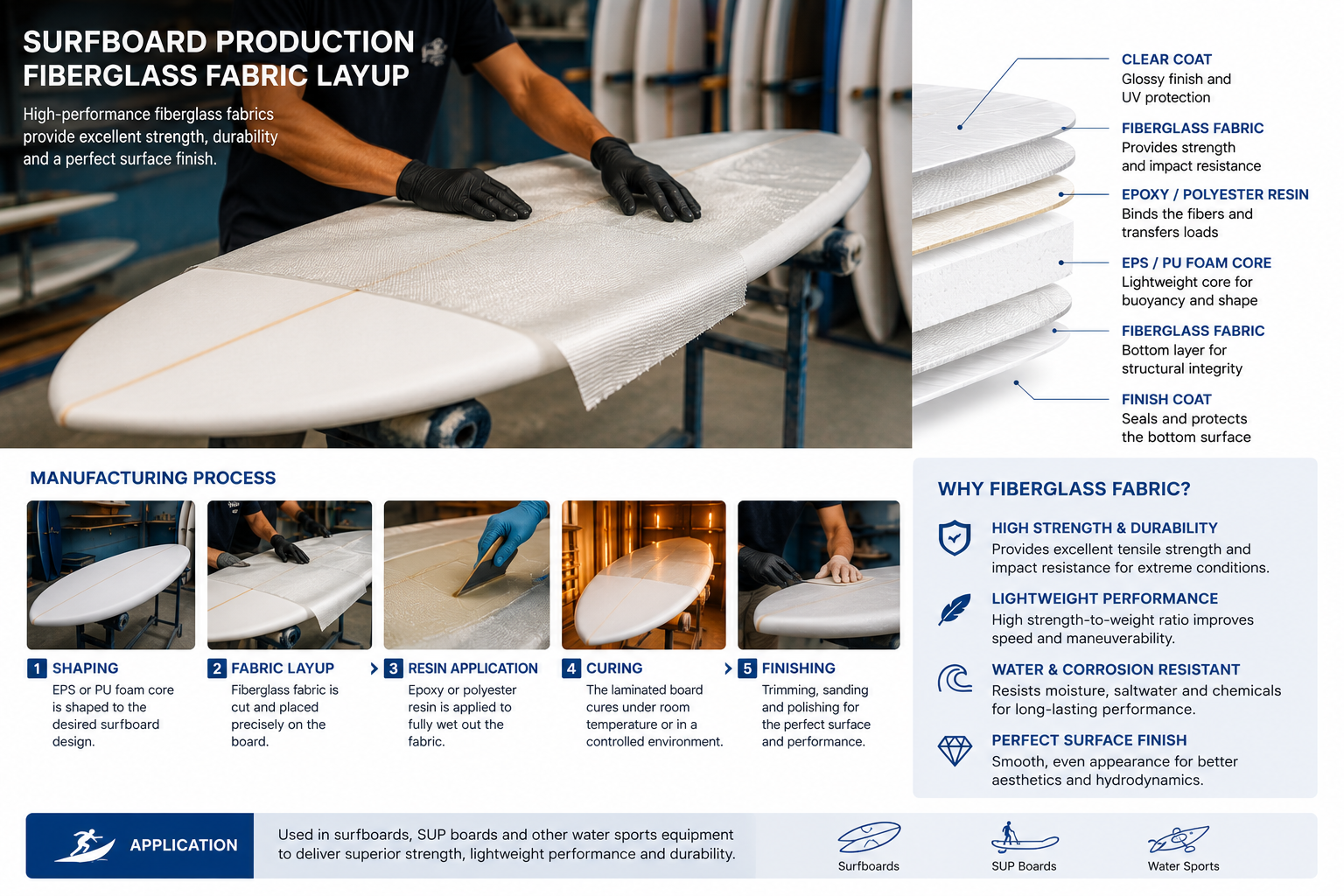
Lightweight fiberglass fabrics used in surfboard manufacturing in Thailand.
Comparison with Traditional Solutions
Large-scale fiberglass fabric suppliers such as Owens Corning, China Jushi, Saint-Gobain, and Taishan Fiberglass typically offer standardized product lines with broad availability. CINON differentiates itself by providing tailored solutions for specific processes (e.g., vacuum infusion, RTM, VARTM) and by combining reinforcement fabrics with matching core materials (PVC, PET, PMI, PP honeycomb) in a single sourcing relationship. This reduces qualification cycles for manufacturers.
One honest limitation: CINON’s annual production capacity (1.2 million m²) is smaller than that of multinational competitors, which may affect lead times for very large-scale projects without advance scheduling. However, for project sizes up to container orders, the company demonstrates reliable delivery through its 100% export model and logistics coordination.
Future Outlook
With the wind energy segment growing at 8.5% CAGR and the marine fiberglass resin market projected to reach USD 4.23 billion by 2033, the demand for process-optimized fiberglass fabric will continue to rise. CINON’s focus on infusion-optimized cores (Core Mat, CT, CX, CS) and multiaxial reinforcements positions it to support manufacturers who need both technical support and material consistency. The company also offers comprehensive after-sales support covering material selection, vacuum infusion guidance, and quality traceability—factors increasingly valued by engineers during supplier evaluation.
Frequently Asked Questions
- Q: Are CINON’s multiaxial fiberglass fabrics compatible with vacuum infusion (VARTM) processes?
- A: Yes. CINON’s multiaxial fabrics (unidirectional, biaxial, triaxial, quadriaxial) are designed for vacuum, hand layup, RTM, and VARTM forming. The fabric construction supports efficient resin flow, and the company provides vacuum infusion process support as part of its technical assistance.
- Q: What certifications does CINON hold for quality and environmental management?
- A: CINON is certified under ISO 9001:2015 (quality management, certificate 51326Q04922R053), ISO 14001:2015 (environmental management, certificate ISO14001-2023-001), and ISO 45001:2018 (occupational health and safety, certificate 51326S01896R053). All certifications are issued by Shenzhen Moqc Certification Co., Ltd or SGS, with global scope.
- Q: Can CINON customize fiberglass fabric with OEM branding or special dimensions?
- A: Yes. CINON offers ODM production for fiberglass fabric and core materials. Custom logo printing (OEM) has been successfully implemented for distributor clients. Standard widths include 1000 mm and 1010 mm for lightweight fabrics, with custom sizes available upon request.
- Q: What is the typical lead time and minimum order quantity?
- A: Standard lead time is 15–30 days. The minimum order quantity is 1,000 m² per item. Monthly production capacity is 100,000 m², supported by a team of 25 engineers and 100% quality testing before shipment.
Download Company Brochure (PDF)
¿Tiene preguntas o necesita más detalles?
Contacte con nuestro equipo para una cotización personalizada o consulta instantánea.
Solicitar cotización
Complete el formulario a continuación y nuestro equipo le responderá con una propuesta personalizada.
Chat directo de WhatsApp
¿Prefiere chatear en tiempo real? Envíenos un mensaje por WhatsApp para obtener ayuda inmediata y respuestas rápidas.
- Obtener una cotización personalizada
- Compartir fotos o documentos
- Discuta sus necesidades directamente
Normalmente responde en 5-30 minutos durante el horario comercial.