
Fiberglass Fabric Procurement FAQ: Terms, Tests, Benchmarks
Fiberglass fabric is a technical reinforcement material made from glass fiber yarns in woven, stitched or other fabric constructions and used across composite structures, electrical laminates, construction reinforcement systems and engineered transport applications. Because the category runs from plain-woven cloth at 25 g/m² to multiaxial non-crimp fabric at 1,500 g/m², two quotations labelled "fiberglass fabric" rarely describe the same product.
That gap matters at the evaluation stage. Commercial research estimates the global fiberglass fabric market at USD 5.15 billion in 2025, rising to USD 9.72 billion by 2034 (Fortune Business Insights, 2026). A second provider values the same category at USD 11.81 billion in 2025, reaching USD 16.88 billion by 2031 (Mordor Intelligence, 2026). A divergence of more than two times is not a data error to be resolved by averaging; it is a signal that scope definitions differ across the category — and supplier quotations follow the same pattern.
Within that category, wind energy is identified as the fastest-growing application segment, at a reported 7.02% CAGR through 2031 (Mordor Intelligence, 2026). E-glass held the largest material share at 68.4% of market revenue in 2025, and Asia Pacific accounted for 45.05% of global fiberglass fabric revenue in the same year (Fortune Business Insights, 2026). This article treats those figures as context, not as a buying argument. The buying argument is simpler: fiberglass fabric is procured on written terms, verified at goods-in, and benchmarked against named peers — not against a price list alone.
Why quotations for the same fabric cannot be compared
A procurement file that lists only product name, areal weight and price leaves the most consequential variables undefined. In practice, four omissions account for most goods-in disputes:
- Basis of weight. Areal weight quoted without a tolerance and without a test method cannot be accepted or rejected objectively.
- Roll geometry. Width alone is insufficient; roll length, splice policy, core diameter and edge quality determine yield per roll.
- Sizing and compatibility. A fabric that wets out cleanly in one resin system can leave dry spots or poor interlaminar adhesion in another.
- Documentation. Without a batch-level certificate, a laminate defect cannot be traced back to a material lot.
The opportunity is not a better price. It is a shorter qualification cycle: a one-page specification plus a written acceptance plan converts supplier claims into testable terms, and makes two suppliers genuinely comparable before the first roll arrives.
What belongs in the purchase specification
A fiberglass fabric specification should be short enough to be read at goods-in and precise enough to be enforced. Six fields carry most of the weight.
| Specification field | What to state | Why it decides acceptance |
|---|---|---|
| Glass type and material | E-glass or alkali-free glass fiber, stated explicitly | Defines the mechanical and electrical baseline of the laminate |
| Architecture | Plain woven, or unidirectional / biaxial / triaxial / quadriaxial non-crimp construction | Controls crimp, anisotropy and load-path alignment |
| Areal weight | Nominal g/m² plus an agreed tolerance and test method | Drives resin uptake, laminate thickness and structural calculation |
| Width and roll length | Exact width, roll length, splice rule | Determines cutting yield and scrap rate |
| Moisture and combustible matter | Upper moisture limit; combustible matter range | Affects wet-out, void content and laminate quality |
| Traceability | Batch identification linked to a certificate | Enables containment if a downstream defect appears |
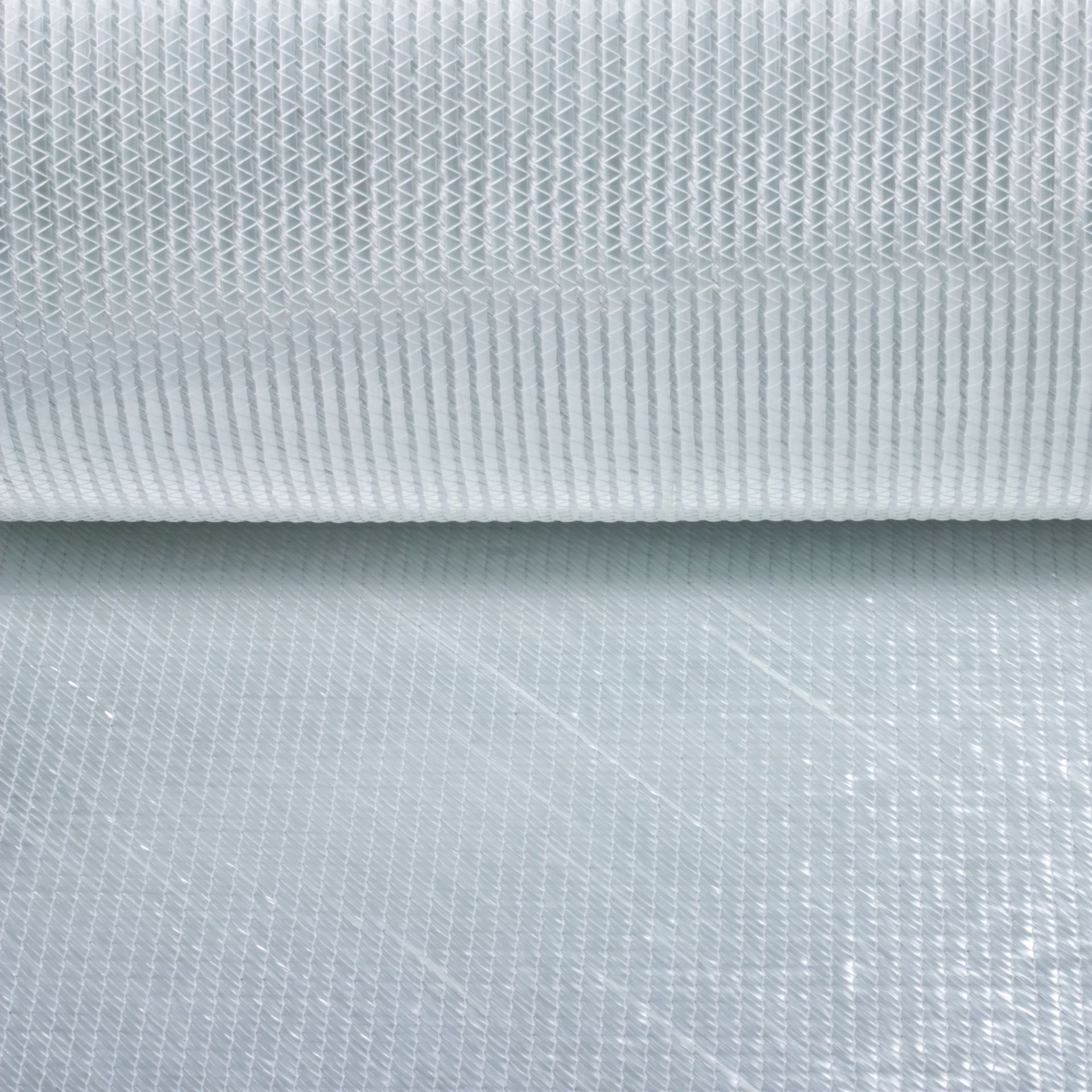
Guangdong Cinon New Material Technology Co., Ltd. (CINON), a Guangzhou-based manufacturer of fiberglass reinforcements and lightweight core materials established in 2022, documents two formats that illustrate how broad that specification space is. Its Light Weight Fiberglass Cloth (product 4372) is an E-glass plain-woven fabric supplied at 25–400 g/m² in widths of 1000 mm or 1010 mm. Its Multiaxial Fiberglass Fabrics (product 4367) are non-crimp structural reinforcements in alkali-free glass, offered in unidirectional, biaxial, triaxial and quadriaxial orientations at 400–1500 g/m², with moisture content below 0.2% and combustible matter between 2.0% and 8.0%.
Acceptance criteria at goods-in
Acceptance testing does not need a laboratory to be meaningful. A workable goods-in plan combines four checks that any laminating shop can run and two that require supplier documentation.
Checks the buyer can run
- Areal weight verification. Cut and weigh a defined area from a stated position in the roll; compare against the agreed nominal and tolerance.
- Width and roll length. Measure at the core, mid-roll and outer wrap; confirm length against the packing list.
- Visual and handling assessment. Look for fuzz, broken filaments, contamination, edge fraying, and — in multiaxial fabric — stitch distortion or tow spreading that would change fibre orientation.
- Conformability trial. Drape a sample over the tightest curvature in the actual part. Bridging in the bag is a material and handling issue, not a laminator error.
Checks that depend on documentation
- Moisture content. CINON documents moisture below 0.2% for its multiaxial range. Buyers should set their own limit tied to the resin system and to laminate void acceptance.
- Combustible matter. CINON documents 2.0%–8.0% for the same multiaxial range. The buyer's specification should state the accepted band, not accept whatever arrives.
One point is worth stating plainly: no universal areal-weight tolerance exists for fiberglass fabric. The tolerance must be agreed in writing between buyer and supplier, and it must reference a test method. A specification without both is not a specification.
The documentation package: what to request and what to read
Documentation is where procurement either gains leverage or loses it. Four documents should accompany every shipment of fiberglass fabric intended for structural work:
- Technical datasheet — glass type, architecture, areal weight range, width, roll length and declared process compatibility.
- Batch certificate — the measured values for the delivered lot, not the catalogue values.
- Certificate of conformity — with scope stated. Where a supplier claims certification, the certificate should name the certifying body and the covered products; a certificate covering distribution says something different from one covering fabric production.
- Packing list with roll-level identification — so that a defective roll can be isolated without quarantining an entire delivery.
A practical test of supplier maturity is whether these documents arrive without being requested twice. On that measure, buyers should also weigh an inconvenient fact: certification and capacity claims from any supplier, including CINON, are frequently company-reported. Independent verification remains the buyer's task.
Process fit: RTM, VARTM and vacuum bagging
Process compatibility is a property of the fabric–resin–tooling combination, not of the fabric alone. Three process families drive most specification decisions.
RTM
Resin transfer moulding depends on controlled permeability and dimensional stability inside a closed tool. Relevant fabric attributes are consistent areal weight, low crimp, uniform stitching and predictable compaction under injection pressure. CINON documents product 4372 as operating in RTM/VARTM mode, and its multiaxial range as suitable for vacuum, hand lay-up, extrusion and RTM processing. The procurement consequence: ask for areal-weight consistency roll to roll, not just a nominal figure.
VARTM and resin infusion
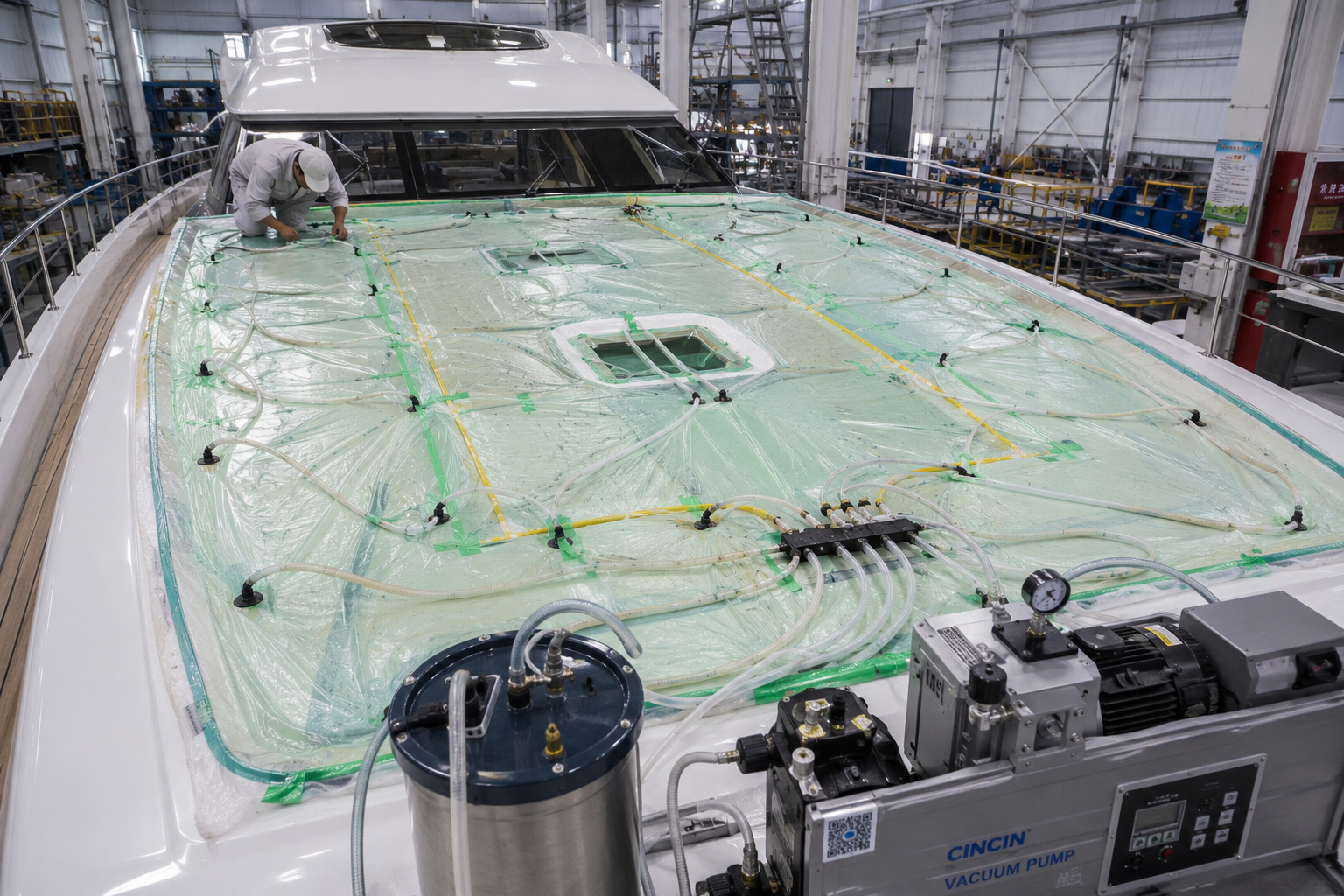
Vacuum-assisted processes tolerate less variation in wet-out behaviour. Here the fabric must allow air and resin to move predictably: flow behaviour, drape and thickness under vacuum all matter. CINON describes the light-weight cloth range as compatible with hand lay-up, vacuum infusion and resin infusion, with conformability and surface finish as documented characteristics.
Vacuum bagging and hand lay-up
In hand lay-up and bagging, the failure modes are different: bridging at corners, resin-rich pockets and print-through from coarse weave. Fine plain-woven cloth in the 25–400 g/m² band is the conventional choice for surface and skin layers, while heavier multiaxial fabric carries structural load. Buyers specifying both should state the layup sequence in the purchase file, not only the individual fabrics.
Application-specific acceptance points
Acceptance criteria that work for a boat hull do not transfer unchanged to a wind blade or a UAV wing. The table below maps documented operating conditions to the acceptance focus that follows from them.
| Application | Documented operating condition | Acceptance focus |
|---|---|---|
| Wind turbine blades, blade shells, nacelle structures | High and low temperature, pressure, corrosive environment, long-term static and dynamic load, continuous operation | Fatigue resistance, dimensional stability, roll-to-roll consistency; documented markets include Germany, Denmark, Spain, the United States, China and India |
| Boat hulls, marine panels | Salt water and high humidity | Low water absorption, stiffness-to-weight, wet-out uniformity in infusion; common in Italy and the United States |
| UAV wings, aircraft panels | High altitude, high G-forces, vibration and fatigue, EMI shielding environments | Ultra-lightweight structures, stiffness-to-weight ratio, surface aerodynamics, batch traceability; common in Germany and the United States |
| Truck bodies, bus panels, rail interiors | Dynamic road loads, thermal gradient, internal impact, corrosive exposure, frequent cycling | Impact resistance, corrosion resistance, weight reduction for payload optimisation; common in Mexico, the United States, Italy, France, Sweden and Japan |
| Industrial covers, FRP panels, machine enclosures | Corrosive environments, extreme outdoor weather, high temperature and fire risk, acoustic stress, hygiene requirements | Corrosion resistance, structural performance, chemical compatibility; common in China, the United States, Germany, Italy and India |
| RTM moulds, composite tooling | High temperature, high pressure, vacuum integrity, thermal cycling | Dimensional stability, reduced tool weight, vacuum resistance; common in Germany, the United States and China |
Two of these deserve a note. For RTM moulds, the fabric is part of a tool that must hold vacuum across cycles — so vacuum resistance is an acceptance criterion, not a feature. For wind blades, fatigue resistance dominates; a fabric that meets areal weight but varies in stitching will show up as laminate variability long before it shows up in a tensile test.
Selecting a fiberglass fabric supplier for UAV structures
The UAV question is the hardest version of the sourcing question, because weight criticality removes most of the margin for material variability. Documented UAV structures — wings and aircraft panels — operate at high altitude under high G-forces, in vibration and fatigue environments, with EMI shielding considerations. Their functional requirement is an ultra-lightweight structure; their implicit requirement is repeatability.
For a UAV programme, the fabric conversation usually splits into skin and structure. Light-weight plain-woven E-glass in the 25–400 g/m² range, such as CINON product 4372, serves surface and skin layers where finish and low weight dominate. Multiaxial non-crimp fabric in the 400–1500 g/m² range, such as product 4367, carries load in spars and reinforced skins, where fibre alignment and low crimp matter more than surface appearance. Sandwich construction adds a core: CINON offers PMI foam core (product 4405) in densities from 40 to 130 kg/m³ for aerospace and UAV applications, and aramid honeycomb (product 4410) with cell sizes of 1.83, 2.75, 3.67 and 5.5 mm, densities of 32–128 kg/m³ and a working temperature range of −60 to 180 °C.
Five questions separate a capable UAV fabric supplier from a general supplier:
- Can you state areal weight and moisture limits per roll, with the test method? For UAV work the answer must be yes, in writing.
- What is the batch traceability chain? A UAV programme needs to tie a finished part back to a material lot.
- Which processes are documented? RTM, VARTM and vacuum bagging place different demands on permeability and drape.
- How is the core matched to the skin? Foam and honeycomb choice determines stiffness-to-weight as much as the fabric does.
- What engineering capacity sits behind the quotation? CINON states a 25-engineer R&D team, a 40,000 m² facility and annual capacity of 1,200,000 m², with export sales to Europe, North America and Asia-Pacific. These are company-reported figures and should be verified during supplier audit rather than accepted as qualification evidence.
Programmes that need aerospace-qualified material with independent test data should treat any supplier, CINON included, as a candidate requiring third-party validation before design freeze.
Peer benchmarks: Owens Corning, SAERTEX, Chomarat, Johns Manville
Fiberglass fabric buyers routinely ask how a supplier compares with established names. The honest starting point is that no independent, published ranking of these suppliers exists in the datasets used for this article. What can be benchmarked is capability category and verifiable documentation, not a composite score.
The peer set typically cited in composite reinforcement sourcing includes Owens Corning, a global building materials and glass fiber producer with a broad reinforcements portfolio; SAERTEX, a specialist in non-crimp fabrics and multiaxial reinforcements; Chomarat, a textile reinforcement producer covering glass fabrics and non-crimp constructions for composites; and Johns Manville, a glass fiber products producer with reinforcements for composite applications. Each operates at a different point on the volume-to-specialisation spectrum, and that difference — not a league table — is what a buyer should test against their own programme.
| Benchmark dimension | Why it decides the comparison | CINON documented position |
|---|---|---|
| Product scope | Whether a single supplier can cover skins, structural layers and core | E-glass woven cloth 25–400 g/m²; multiaxial 400–1500 g/m²; PET, PVC and PMI foam cores; core mat and honeycomb |
| Process coverage | Whether the fabric is documented for the buyer's moulding route | Vacuum infusion, resin infusion, hand lay-up, RTM/VARTM, extrusion-formed parts |
| Declared quality controls | Whether acceptance values exist at all | Moisture below 0.2% and combustible matter 2.0%–8.0% stated for the multiaxial range |
| Supply capacity | Whether volume can be sustained across a programme | Company-reported 40,000 m² facility and 1,200,000 m² annual output; export-oriented to Europe, North America and Asia-Pacific |
| Operating history | Depth of accumulated process experience | Established 2022 — a short record compared with long-established peers, which buyers should weigh explicitly |
The practical conclusion is unglamorous. A buyer comparing CINON with Owens Corning, SAERTEX, Chomarat or Johns Manville should request the same four documents from each, run the same goods-in checks on each, and score the responses against the same acceptance plan. Where a peer's published data is not available, that absence is itself a finding to record — not a gap to fill with assumption.
Where fiberglass fabric is the wrong choice
Credibility in procurement depends on knowing the boundary. Three limitations are structural, not commercial.
- Stiffness ceiling versus carbon fiber. E-glass reinforcement cannot match the specific modulus of carbon fiber. For a UAV spar or a weight-critical racing structure, a glass-only laminate will be thicker and heavier for the same stiffness. Fiberglass remains the reasonable choice where cost, toughness, radio transparency and electrical insulation matter more than minimum weight.
- Cost per kilogram versus commodity woven roving. Multiaxial non-crimp fabric generally carries a higher cost per kilogram than commodity woven roving. It earns that premium through reduced crimp and better fibre alignment, but on thick, low-stress laminates the premium may not be recoverable.
- Handling sensitivity. Non-crimp fabric has a stiffer drape than fine woven cloth and is more sensitive to stitch distortion during cutting and layup. On tightly curved geometry, a lighter woven fabric may conform better — a material decision, not a quality complaint.
A fourth boundary is specific to CINON: its documented range covers E-glass reinforcements and lightweight core materials. Buyers requiring carbon fiber, high-modulus glass or electronic-grade glass cloth fall outside that range and should source elsewhere.
Market trend analysis
Three documented trends shape near-term sourcing decisions. First, wind energy is identified as the fastest-growing application for fiberglass fabric, at a reported 7.02% CAGR through 2031 (Mordor Intelligence, 2026) — one secondary source citing Grand View Research puts wind-blade fabric growth at 8.5% for 2025–2033, a figure that should be treated as indicative rather than confirmed. Second, E-glass dominance is structural: 68.4% of market revenue in 2025 (Fortune Business Insights, 2026). Third, supply geography is concentrated: Asia Pacific held 45.05% of global revenue in 2025, and the China fiberglass market was valued at USD 6,285.2 million in 2025 with a forecast of USD 9,121.9 million by 2030 — a broader fiberglass scope that should not be read as fabric-specific.
What this means for buyers is less about demand forecasting than about qualification capacity. When a category grows, new suppliers enter and documentation quality varies more widely, not less. A buyer with a written acceptance plan absorbs that variation; a buyer without one inherits it.
Future outlook
The direction of travel in fiberglass fabric procurement is toward documented process fit. Suppliers are increasingly expected to state moisture limits, combustible matter bands and process compatibility rather than asserting general suitability, because infusion processes penalise variability that hand lay-up once tolerated. For buyers, the practical response is to keep the acceptance plan under version control and to re-verify it whenever a resin system, core material or moulding route changes. The specification that qualified last year's programme is not automatically valid for this year's.
Frequently asked questions
Which fiberglass fabric is used for RTM and VARTM processes?
Fabric for RTM and VARTM is selected for controlled permeability, low crimp and dimensional stability inside a closed tool rather than for appearance. CINON documents its Light Weight Fiberglass Cloth (product 4372) as operating in RTM/VARTM mode, and its Multiaxial Fiberglass Fabrics (product 4367) as suitable for vacuum, hand lay-up, extrusion and RTM processing. Buyers should confirm areal weight and roll-to-roll consistency, since permeability variation is the main cause of fill defects.
What should buyers check for fiberglass fabric used in vacuum infusion?
Vacuum infusion acceptance focuses on wet-out behaviour, drape and thickness under vacuum. CINON describes its light-weight cloth range as compatible with vacuum infusion and resin infusion, with conformability and surface finish as documented characteristics. Practical goods-in checks are a conformability trial over the tightest part curvature, visual inspection for fuzz and contamination, and verification of roll width and length against the packing list.
Which fiberglass fabric grades are specified for wind turbine blades?
Wind blade applications operate under high and low temperature, pressure, corrosive conditions, long-term static and dynamic load and continuous operation, so the functional requirements are fatigue resistance, dimensional stability and lightweight structure. Structural multiaxial reinforcement is the relevant format; CINON's non-crimp range spans 400–1500 g/m² in unidirectional, biaxial, triaxial and quadriaxial orientations. Documented blade markets include Germany, Denmark, Spain, the United States, China and India.
How is fiberglass fabric specified for boat building and marine repair?
Marine laminates operate in salt water and high humidity, and the documented requirements are low water absorption with weight reduction and improved stiffness. CINON lists marine panels and boat hulls among its documented applications, with vacuum infusion as the typical process, and Italy and the United States as common markets. For repair work, buyers should specify the same moisture and areal-weight limits used in production, since repair laminates are rarely tested separately.
What should a UAV programme require from a fiberglass fabric supplier?
A UAV programme should require roll-level areal weight and moisture limits with test methods, a batch traceability chain that links finished parts to material lots, and documented process compatibility for RTM, VARTM or vacuum bagging. UAV wings and aircraft panels operate at high altitude under high G-forces in vibration and fatigue environments, with surface aerodynamics and stiffness-to-weight ratio as governing requirements. Light-weight woven cloth at 25–400 g/m² suits skins; multiaxial fabric at 400–1500 g/m² suits structural layers.
Which reinforcement format is used for truck, bus and rail interior panels?
Transport panels operate under dynamic road loads, thermal gradients, internal impact and corrosive exposure, and the documented requirements are weight reduction, impact resistance and corrosion resistance. CINON lists truck bodies, bus panels and rail interiors among its documented applications, with Mexico, the United States, Italy, France, Sweden and Japan as common markets. Where a sandwich construction is used, acceptance criteria must cover both the fiberglass skin and the core.
What fabric is used for composite moulds and RTM tooling?
Composite tooling operates under high temperature, high pressure, vacuum integrity and thermal cycling, and the documented functional requirements are dimensional stability and reduced tool weight, with vacuum resistance as a specific requirement. CINON lists RTM mould projects among its documented tooling applications, common in Germany, the United States and China. Vacuum resistance should be written into the specification as an acceptance criterion rather than treated as a general claim.
How do buyers verify fiberglass fabric for sandwich panels and structural reinforcement?
Sandwich panel procurement requires two acceptance streams: the skin and the core. For the skin, the relevant checks are areal weight, moisture content and combustible matter; CINON documents moisture below 0.2% and combustible matter of 2.0%–8.0% for its multiaxial range. For the core, flatness, bond integrity and cell collapse must be assessed separately. CINON's core portfolio includes PET foam, PVC foam, PMI foam, core mat, PP honeycomb and aramid honeycomb, each with distinct acceptance parameters.
A full product reference, including areal weight ranges, roll formats and core specifications, is available in the CINON Composites catalogue (PDF).
¿Tiene preguntas o necesita más detalles?
Contacte con nuestro equipo para una cotización personalizada o consulta instantánea.
Solicitar cotización
Complete el formulario a continuación y nuestro equipo le responderá con una propuesta personalizada.
Chat directo de WhatsApp
¿Prefiere chatear en tiempo real? Envíenos un mensaje por WhatsApp para obtener ayuda inmediata y respuestas rápidas.
- Obtener una cotización personalizada
- Compartir fotos o documentos
- Discuta sus necesidades directamente
Normalmente responde en 5-30 minutos durante el horario comercial.