
Fiber for Concrete: PP Fiber Compliance Review for Buyers
Polypropylene (PP) fiber is a synthetic reinforcement for concrete that does not corrode and is not consumed by the strongly alkaline pore solution of hardened cement paste. That single material property has moved PP fiber from a secondary anti-cracking additive to a specified component in projects where long design life, wet or chloride-bearing exposure, and crack-width control appear in the same clause. For buyers specifying fiber for concrete in tunnels, bridge decks, hydraulic structures, high-speed rail and nuclear-related civil works, the practical question is no longer whether synthetic fiber belongs in the mix. It is whether the declared values for acid and alkali resistance, density, elastic modulus and dispersion behavior can survive a formal compliance check.
This review works through the PP fiber data published by Tianjin TingCo Tech Co., Ltd and maps each declared value to the check a buyer would actually run: what the parameter means, which document proves it, and where the claim stops being transferable from one project to the next.
Why PP Fiber Compliance Now Starts with Chemistry, Not Cost
Concrete is an alkaline environment. The pore solution of hardened cement paste stays strongly alkaline for the life of the structure, and where chlorides are present - marine exposure, de-icing salts, some industrial effluent - that alkalinity is accompanied by an aggressive ion load. Steel reinforcement and steel fiber can be vulnerable under those conditions when cover or crack widths are not controlled, producing corrosion at the fiber surface, rust staining at the finished face, and a repair obligation that outlives the construction phase.
PP fiber belongs to a different material class. It is a polymer, so there is no electrochemical corrosion cell to form and no rust to stain a slab or a facade panel. Alkaline pore solution does not dissolve or embrittle the fiber the way it can attack ferrous reinforcement. That is the origin of the synthetic fiber with no corrosion position: the benefit is not that the fiber is stronger than steel, but that it removes a durability failure mode altogether.
The same chemistry that makes PP stable, however, also makes it hard to disperse. Untreated polypropylene is hydrophobic - it repels mixing water - and hydrophobic fibers tend to cluster, ball and float rather than distribute evenly through a mixer. Dispersion is therefore not a handling detail; it is the property that determines whether any of the declared mechanical performance is delivered consistently across a pour. Two further properties matter for the same reason. PP fiber is non-absorbent, so it does not consume mixing water and does not shift the water-to-cement ratio at a given dosage. And its density is low compared with mineral or steel reinforcement, so a given mass dose produces a large number of individual filaments.
That is why a defensible PP fiber compliance review has three layers: chemistry (acid and alkali resistance, corrosion-free behavior), batching physics (density, non-absorbent behavior, surface modification), and verifiable performance (crack control, impermeability, service life) - each traceable to a document or a test rather than to a brochure sentence.
The Declared PP Fiber Data Under Review
Tianjin TingCo Tech Co., Ltd is a Tianjin-headquartered manufacturer and technical partner specializing in steel fibers, synthetic fibers and concrete reinforcement solutions, founded in 2014 and operating through a sales and R&D center in Tianjin together with a manufacturing base, Hebei Tingco New Material Co., Ltd. The portfolio spans hooked-end loose steel fibers, glued bundled steel fibers, brass-coated micro steel fibers, stainless steel micro fibers, and polypropylene (PP) macro, micro and twisted fibers.
The PP side of that portfolio is organized into three model families - macro, micro and twisted - which differ in geometry and therefore in diameter, length and tensile strength. The declared material data for the PP range includes a density of 0.91 g/cm³ and an elastic modulus of at least 3,500 MPa. The declared performance data attached to the range includes over 30% reduction in early-stage cracking, approximately 37% improvement in impermeability, and over 15% extension of service life.
| Parameter | Declared value | What it means in a compliance file |
|---|---|---|
| Chemistry | Non-corrosive synthetic polymer; alkali resistant | Removes the corrosion failure mode that ferrous reinforcement can present in humid, chloride-bearing or underground conditions |
| Density | 0.91 g/cm³ | Low mass per unit volume; a given kilogram dose yields a high filament count, and the fiber adds negligible dead load to the section |
| Elastic modulus | ≥3,500 MPa | Capacity to bridge early-age cracks and hold them closed; not a structural load path |
| Water behavior | Non-absorbent, with hydrophilic surface modification | Does not consume mixing water or shift the water-to-cement ratio; surface treatment supports wetting and even distribution |
| Model families | Macro, micro and twisted | Geometry is selected against application, mix design and the required crack-control performance |
| Declared performance | >30% early-stage cracking reduction; approx. 37% impermeability improvement; >15% service-life extension | Directional design inputs, valid at the dosage and mix design under which they were measured |
The manufacturer's own guidance to buyers is to request a complete datasheet that states the tolerance on every declared parameter - the stated practice is a ±10% tolerance - and to confirm a pre-production sample before mass production. That is the correct order of operations: tolerance first, sample second, container third.
On the certification side, the company states that its products are CE certified in accordance with EN 14889-1, comply with ASTM A820 and ISO 13270, and that the manufacturing base holds ISO 9001 quality certification. Two of those references are steel-fiber standards - EN 14889-1 defines steel fibres for concrete, and ASTM A820/A820M specifies requirements for five types of steel fibers used in fiber-reinforced concrete - so a PP fiber buyer should confirm what a specific declaration actually covers before filing it as the compliance document for the synthetic line. That is a document-scope question rather than a product question, and it is the first item a technical reviewer should close.
Supply-side data matters for multi-year programs. The company reports 24,000 tons of annual output, a 6,000 m² facility, 50 employees including five R&D engineers, and an export share of roughly 70%, serving markets in the EU, Africa, South East Asia and the Middle East, with fiber supplied to projects in more than 30 countries.
Technical Explanation: Acid/Alkali Resistance, Non-Absorbent Behaviour and Hydrophilic Dispersion
Acid and alkali resistance: what is actually being claimed
Alkali resistance in a PP fiber specification means the fiber keeps its physical integrity and its crack-bridging function while embedded in cementitious pore solution for the life of the structure. Because the material is a synthetic polymer rather than a ferrous one, the failure mode under review is chemical degradation or embrittlement, not corrosion. In practice, the applicable use conditions for this fiber class list alkali resistance together with high dispersion uniformity, good compatibility with cement and no agglomeration during mixing as a single combined requirement. All four are handling conditions as much as material properties: a fiber that resists alkali but balls in the mixer fails the same acceptance test.
Non-absorbent behavior: what it changes in the mix
PP fiber does not absorb mixing water. For a batching engineer that is a predictability benefit: the fiber does not compete with cement hydration for free water, and the effective water-to-cement ratio at a fixed fiber dosage stays where the mix design put it. It also means the fiber is not an internal water reservoir. PP fiber should not be specified as a substitute for internal curing, and curing regimes still have to be designed on their own terms. The same non-absorbent behavior supports dimensional stability in continuously wet exposure, because the fiber does not swell or soften when water is present.
Hydrophilic surface modification and dispersion
Hydrophobic behavior is the default state of raw polypropylene, and it is the root cause of the most common field complaint about synthetic fiber: clumping. Hydrophilic surface modification alters the fiber surface so that mixing water wets it, which allows individual filaments to separate and distribute through the matrix instead of travelling together. The published dosing and mixing procedure assumes that treatment: feed the fiber uniformly; water-soluble packaging bags can be charged directly into the mixer with the aggregates and dissolve in roughly five seconds; non-water-soluble packaging should be spread evenly in batches; and mixing time should be extended by 30 to 60 seconds compared with plain concrete to reach uniform dispersion without clumping. Slump and workability are then checked and the superplasticiser dose adjusted if required. For long transport distances in mixer trucks, pre-mixing at the batching plant is recommended.
The same guidance carries a practical safety point - gloves and eye protection, and no dumping of large quantities at once, which is the main cause of clumping - and points to EN 14651, ASTM C1609 and ASTM C1550 as the flexural toughness test methods used for specimen preparation and quality verification. Those three are the acceptance-side reference points. A PP fiber claim that cannot be traced to a beam or panel test result at the specified dosage is a datasheet statement, not a compliance result.
Reading density and elastic modulus together
Density 0.91 g/cm³ and elastic modulus ≥3,500 MPa describe two different things and should not be read as a hierarchy. Density drives dosing arithmetic and filament count: a lower-density fiber delivers more individual filaments per kilogram than a denser one, which is part of why macro synthetic fiber can influence crack control at relatively low mass dosages, and why the fiber adds almost nothing to structural dead load. Elastic modulus describes how the fiber behaves once a crack opens. A fiber with a few thousand megapascals of modulus can bridge an early-age crack and hold it closed while the concrete develops its own strength, but it does not carry structural load the way reinforcement steel does. Buyers comparing macro PP fiber for concrete reinforcement against steel fiber should treat that as a division of labor rather than a competition, because the two modulus ranges are not in the same order of magnitude by design.
Mapping PP Fiber Data to Project Compliance Checks
The table below maps the declared PP fiber properties onto the compliance logic buyers apply in five demanding project types. It describes how those checks are structured, not a list of completed project references; every segment still requires its own mix design verification and its own evidence from the supplier.
| Project type | Dominant exposure or constraint | PP fiber property that addresses it | Evidence a buyer should request |
|---|---|---|---|
| High-speed rail - track bed, viaduct deck, tunnel lining | Cyclic dynamic loading, alternating temperature, tight crack-width limits | Corrosion-free, alkali-resistant fiber combined with consistent dispersion at high dosage | Datasheet stating tolerances, batch-level Certificate of Analysis, dosing and mixing procedure, beam or panel test evidence |
| Bridge deck and overlay | Chloride exposure, humid cycling, constrained cover | Synthetic fiber with no corrosion - no electrochemical cell even where cover is limited | Fiber and mix compatibility statement, residual flexural strength test evidence, dispersion confirmation |
| Nuclear-related civil works | Long design life, controlled environments, crack control in thick sections | Chemical stability and non-absorbent behavior - predictable mixing water and no fiber degradation | Third-party test reports, ISO 9001 certification, full batch traceability |
| Tunnels and segmental linings | Humid, confined underground conditions, high shear during pumping | No agglomeration during mixing, controlled extension of mixing time | Pre-shipment inspection records, Certificate of Analysis and mill certificate per batch, sample validation |
| Hydraulic and water-retaining structures | Continuous water contact, wet-dry cycles, chemical attack | Alkali resistance plus impermeability performance at the specified dosage | Permeability or durability test evidence at project dosage, documented service-life assumptions |
Two rows deserve emphasis. First, impermeability is the bridge between crack control and service life: the declared improvement of approximately 37% in impermeability is the mechanism through which the claimed extension of service life of more than 15% is argued, so a buyer who accepts one number should ask for the test that produced the other. Second, the more demanding the project, the more the acceptance decision shifts from the fiber to the batch record - Certificate of Analysis and mill certificate per batch, pre-shipment inspection with weighing and counting verification, and a pre-production sample confirmed against the mix design.
Market Signals Behind the Compliance Shift
Published market data explains why synthetic fiber compliance reviews are becoming routine rather than occasional. Global construction demand for polypropylene fiber is projected to grow at a compound annual rate of 6.4% from 2026 to 2034 (Fortune Business Insights). In the adjacent steel fiber category that many buyers compare against, the market is projected to reach approximately USD 2.87 billion by 2026, with industrial floors accounting for 37.28% of that market and hooked-end fibers taking a 58.89% share by type (Fortune Business Insights).
Those figures should be read as directional rather than exact. Published estimates for the same period differ between research houses - one alternative house has reported USD 4.84 billion for 2025 - and the divergence appears to come from category definitions, with some datasets grouping synthetic fiber under steel fiber headings. The useful signal is the direction and the segment structure, where flooring and tunnel applications dominate volume, not the absolute number.
On the supply side, China has been the largest single exporter under HS code 7326, accounting for 51.85% of imports identified in specialized trade datasets (Zauba customs data; a historical proxy rather than a current-year figure). That concentration is the argument for qualifying a supplier on documentation and batch consistency rather than on price alone, because the cost of switching after a failed acceptance test is far higher than the cost of the audit itself.
PP Fiber, Wire Mesh and Steel Fiber: Where the Boundary Sits
For floor slabs, the company's published comparison data against wire mesh reinforced flooring states 30-40% lower cost and roughly 50% lower construction time, with fewer post-construction cracks, less crack repair work and a longer service life, and the strongest fit in very narrow aisle (VNA) warehouse floors where flatness and load-bearing performance are critical. Those figures belong to fiber-reinforced floor systems as a class and are not a claim that every fiber type performs identically.
Three boundaries should be stated plainly. First, PP fiber is not structural reinforcement. At an elastic modulus of at least 3,500 MPa it controls and bridges early-age cracks, but it does not replace rebar or steel fiber where the design depends on tensile capacity or impact resistance. Inside the same portfolio, steel fiber spans 0.55 mm to 0.90 mm in diameter, 35 mm to 60 mm in length and 1,200 MPa to 2,500 MPa in tensile strength, covering hooked-end loose and glued bundled formats for steel fiber for industrial flooring, and brass-coated or stainless micro fibers for UHPC and bridge-deck specifications where steel is required. Second, PP fiber is non-absorbent, so it provides no internal curing benefit and cannot be credited as one. Third, and most often missed, the crack reduction, impermeability and service-life figures are dosage-specific and mix-specific. They are valid for the mix design and fiber content at which they were measured and cannot be transferred to a different cement type, aggregate grading or superplasticiser regime without verification.
The decision rule that follows is straightforward: specify PP or macro synthetic fiber where the governing risks are early-age shrinkage cracking, corrosion-free performance in humid or chloride-bearing exposure, and crack-related permeability; specify steel fiber or conventional reinforcement where the governing risk is structural load.
Future Outlook: Repeat-Order Consistency as the New Compliance Metric
The next phase of PP fiber procurement is less about the first container and more about the tenth. As construction demand for polypropylene fiber grows at a projected 6.4% compound annual rate through 2034, buyers on multi-year infrastructure programs are converting one-off specification decisions into repeat-order frameworks with fixed documentation requirements: a datasheet stating tolerances on every declared parameter, a Certificate of Analysis and mill certificate per batch, pre-shipment inspection with weighing and counting verification, and periodic third-party testing of retained samples.
The commercial framework around those orders is already standardized at this supplier. Minimum order quantity is 24 tons, equal to one 20-foot GP container, available across the Fiber Reinforced Concrete model range including TC-07560-HNG, TC-07560-HHG, TC-05535-HNG and TC-07535-HNL. Delivery is arranged on FOB or CIF terms, and payment terms for recurring orders remain 30% prepayment with the 70% balance against a copy of the bill of lading, with T/T and L/C structures used to reduce payment risk. Buyers verifying a new counterparty should confirm the business licence and the 18-digit Unified Social Credit Code and request a factory audit or factory video before the first payment.
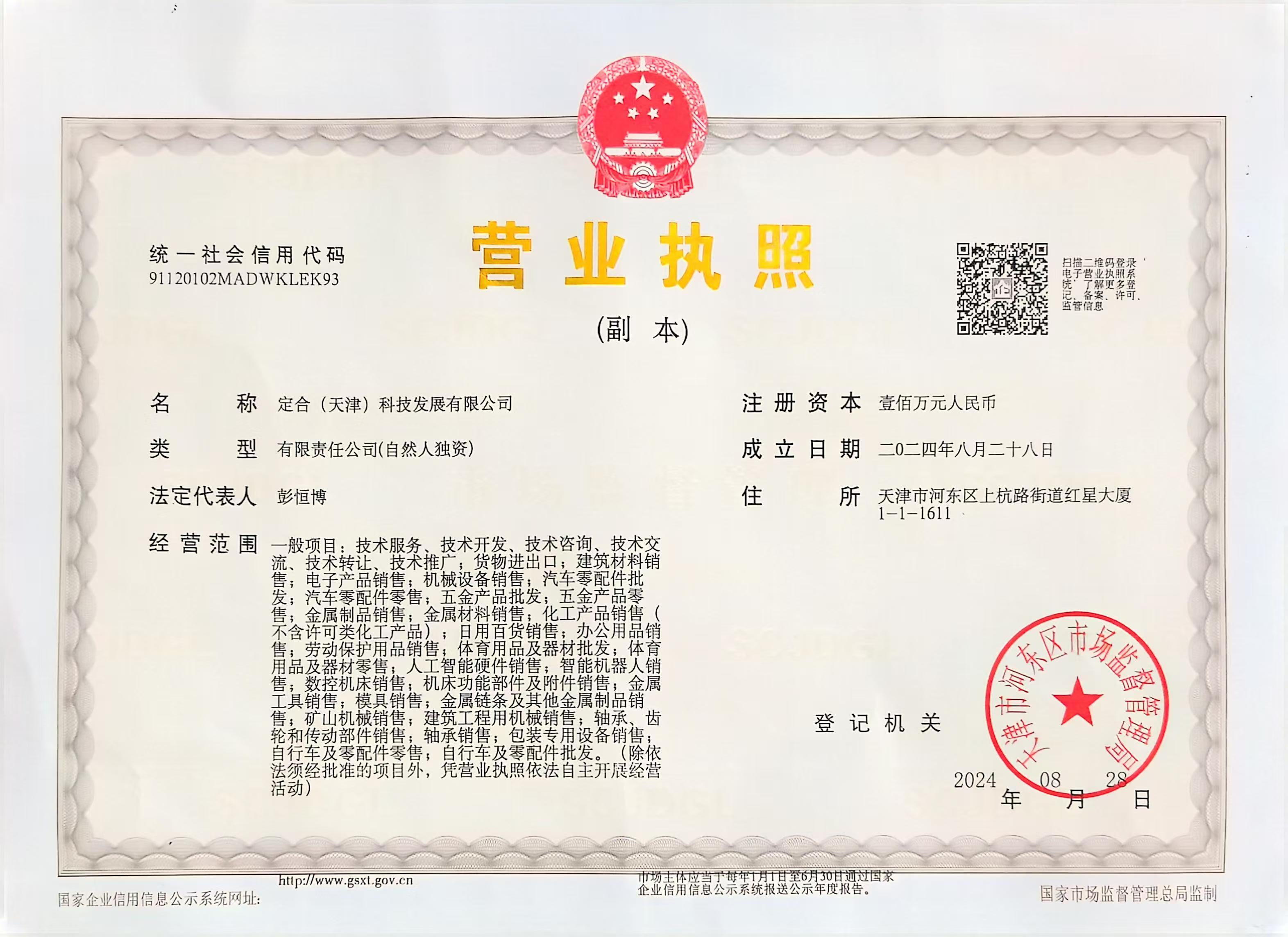
Counterparty verification document: buyers qualifying a PP fiber supplier for repeat orders confirm the legal entity, the business licence and the 18-digit Unified Social Credit Code before the first payment.
Long-term supply also depends on whether one supplier can carry both halves of a fiber specification. The company's integrated structure covers research, production, quality control, technical support and export service under one roof, and custom specifications, OEM packaging and private-label solutions are available on request - which matters when a distributor or contractor is standardizing a mixed steel and synthetic fiber program across several sites and wants a single documentation trail. Annual production capacity of 24,000 tons supports long-term annual supply contracts in export markets.
FAQ
How can a buyer verify acid and alkali resistance in a PP fiber before committing to a repeat order?
Alkali resistance in a polypropylene fiber is a material property: the polymer does not corrode and is not consumed by alkaline pore solution, so verification is documentary rather than visual. The checks that carry weight are a complete datasheet stating the tolerance on each declared parameter, a Certificate of Analysis and mill certificate for each batch, third-party test reports for the specific fiber grade, and pre-shipment inspection with weighing and counting verification. Free samples sent to an independent laboratory, and a pre-production sample confirmed before mass production, close the loop for a first-time qualification.
What does non-absorbent behavior mean for dosing and mix design?
Because PP fiber does not absorb mixing water, it does not compete with cement hydration for free water, so the effective water-to-cement ratio at a fixed fiber dosage stays close to the mix design value. It also means the fiber provides no internal curing, so curing regimes must be designed independently. Practically, the fiber is dosed by mass and added with uniform feeding; water-soluble packaging bags can be charged directly into the mixer and dissolve in about five seconds; and mixing time is extended by 30 to 60 seconds compared with plain concrete, followed by a slump and workability check.
Does PP fiber replace steel fiber or welded wire mesh in a concrete slab?
No. PP fiber controls early-age cracking and reduces crack-related permeability; it does not carry structural tensile load, and its declared elastic modulus of at least 3,500 MPa sits in a different range from steel reinforcement. Where the design depends on load-bearing or impact capacity, steel fiber in the 0.55-0.90 mm diameter and 35-60 mm length range with tensile strength from 1,200 MPa to 2,500 MPa, or conventional reinforcement, remains the structural solution. Synthetic and steel fiber are frequently combined in the same mix design, with each addressing a different failure mode.
What are the standard supply and acceptance terms for recurring PP fiber orders?
Minimum order quantity is 24 tons, equal to one 20-foot GP container. Delivery is arranged on FOB or CIF terms. Acceptance is based on in-line inspection or pre-shipment inspection, and payment terms for recurring orders are 30% prepayment with the 70% balance against a copy of the bill of lading. For counterparty verification, buyers can confirm the business licence and the 18-digit Unified Social Credit Code and request a factory audit or factory video before the first payment.
How is dispersion uniformity confirmed across batches?
Dispersion is confirmed by procedure and by test, not by inspecting the bag. The published mixing procedure requires uniform fiber feeding, batch-wise spreading of non-water-soluble packaging, and a 30-60 second extension of mixing time to reach uniform distribution without clumping, with slump and workability checked afterwards. On the acceptance side, the reference methods are EN 14651, ASTM C1609 and ASTM C1550 for residual flexural strength and toughness, run on specimens prepared from the project mix. Batch-level evidence is the Certificate of Analysis and mill certificate, supported by pre-shipment inspection.
What support is available for long-term or custom specifications?
Custom specifications, OEM packaging and private-label solutions are available on request, and the company's integrated structure covers research, production, quality control, technical support and export service under one roof. Annual production capacity is 24,000 tons, which supports long-term annual supply contracts and recurring orders in export markets, with technical support covering mix design advice through to construction guidance.
Reference: the full TINGCO company and project brochure is available for download - TINGCO company and project profile (PDF).
¿Tiene preguntas o necesita más detalles?
Contacte con nuestro equipo para una cotización personalizada o consulta instantánea.
Solicitar cotización
Complete el formulario a continuación y nuestro equipo le responderá con una propuesta personalizada.
Chat directo de WhatsApp
¿Prefiere chatear en tiempo real? Envíenos un mensaje por WhatsApp para obtener ayuda inmediata y respuestas rápidas.
- Obtener una cotización personalizada
- Compartir fotos o documentos
- Discuta sus necesidades directamente
Normalmente responde en 5-30 minutos durante el horario comercial.