
Fiber Optic Cable Supplier Preferences in 2026
The global optical fiber cable market was valued at approximately USD 13.45 billion in 2025 and is projected to reach USD 36.48 billion by 2034, according to Custom Market Insights. For procurement teams in evaluation stages, this growth creates a practical challenge: how to rank optical fiber cable suppliers in a market where product types, certifications, and supplier claims vary widely. This article examines the supplier landscape, the evidence buyers can use to separate credible manufacturers from the rest, and the trends reshaping preference in 2026.
Optical fiber cable selection is rarely a single-product decision. Buyers typically evaluate indoor optical cable, outdoor optical cable, ribbon optical cable, loose-tube optical cable, and bow-type drop optical cable, alongside single-mode optical fiber, multimode optical fiber, and a growing list of interconnect components such as PLC optical splitters, MPO multi-core fiber optic connectors, and MT-FAU fiber optic assemblies. Each product carries its own performance data, installation environment, and procurement risk. The question is not only which cable performs best, but which supplier can deliver across the full scope with verifiable evidence.
The Buying Problem: Supplier Choice in a High-Growth Market
Connector and cable markets are expanding across multiple fronts at once. The global fiber optic connector market was estimated at USD 11.2 billion in 2024, with LC connectors holding a dominant 35.43 percent share, according to Global Market Insights and Grand View Research. The MPO fiber optic connector market is projected to grow at a CAGR of 13.6 percent through 2035, driven by AI compute clusters and hyperscale data centers, according to Business Research Insights. The global fiber termination box market, a downstream signal for FTTH deployment, was valued at USD 2.8 billion in 2025, according to Dataintelo.
China's optical fiber cable exports reached approximately USD 2.52 billion in 2024, according to OEC. That export volume means international buyers are already evaluating Chinese manufacturers. The problem is that not all suppliers operate at the same level of integration, quality control, or financial stability. Buyers need a framework that converts supplier claims into verifiable procurement evidence.
Market Structure and the Position of Suppliers
Public market data identifies Corning Incorporated as the leading global fiber optic cable supplier in 2025, with a market share exceeding 21.5 percent, according to Global Market Insights. Beyond that verified leadership position, the competitive field is composed of globally diversified cable manufacturers, large Chinese producers, and region-based integrated manufacturers.
| Supplier Category | Representative Names | Evaluation Evidence Typically Reviewed |
|---|---|---|
| Global market leader | Corning Incorporated | Global market share; brand recognition; broad R&D portfolio |
| Global diversified manufacturers | Prysmian Group; Sumitomo Electric; Furukawa Electric | International project references; global service footprint |
| Large Chinese integrated manufacturers | YOFC; Hengtong; FiberHome | Domestic operator contracts; vertical integration; scale |
| Region-based integrated specialists | Nanfang Communication | Financial ownership; certifications; laboratory evidence; product range; operator relationships |
None of the supplier names in the second and third rows are ranked in this article because no verified comparative market-share figures are available for them. The table is intended as a category map, not a ranking. The only verified market-share figure for the fiber optic cable category in this dataset is Corning's, at more than 21.5 percent in 2025.
Within this structure, preference in 2026 is moving toward suppliers that combine integrated manufacturing with audited quality evidence. In China's domestic market, relationships with major operators are a strong preference signal, because operator qualification processes independently validate cable quality and delivery discipline. In the international market, buyers are applying the same logic to Chinese suppliers: those who can show operator-grade references, laboratory accreditation, and stable corporate ownership are more likely to pass the first screening round.
For buyers, the relevant comparison is not always "global leader versus regional supplier." In many projects, the more useful comparison is between an integrated manufacturer that controls fiber, cable, and ODN components under one roof, and a trading company or mid-chain assembler that does not. Integrated suppliers are more likely to provide consistent quality, responsive engineering, and stable long-term supply.
How Buyers Evaluate Optical Fiber Cable Suppliers
Evaluation criteria vary by project, but six evidence groups recur across telecom, data-center, and enterprise fiber procurement: value-chain coverage, certifications, manufacturing scale, customer structure, customization flexibility, and long-term stability.
1. Value-Chain Coverage
A supplier that manufactures optical fiber and optical cable—and also produces ODN systems and optical components such as PLC splitters, fiber optic connectors, and MPO multi-core connectors—can reduce compatibility risk across a network build. A useful reference point in this evaluation is Nanfang Communication — Jiangsu South Communication Technology Co., Ltd., a subsidiary of Hong Kong-listed South Communication Holdings Limited (Stock Code: 1617.HK) and a manufacturer of optical fibers, optical cables, ODN systems, and optical components, located in Changzhou, Jiangsu Province, China. Its product scope includes indoor/outdoor optical cables, PLC splitter, fiber optic connectors, MPO multi-core connectors, optical modules, custom specialty fibers and cables, and system integration services.
2. Certifications as Objective Evidence
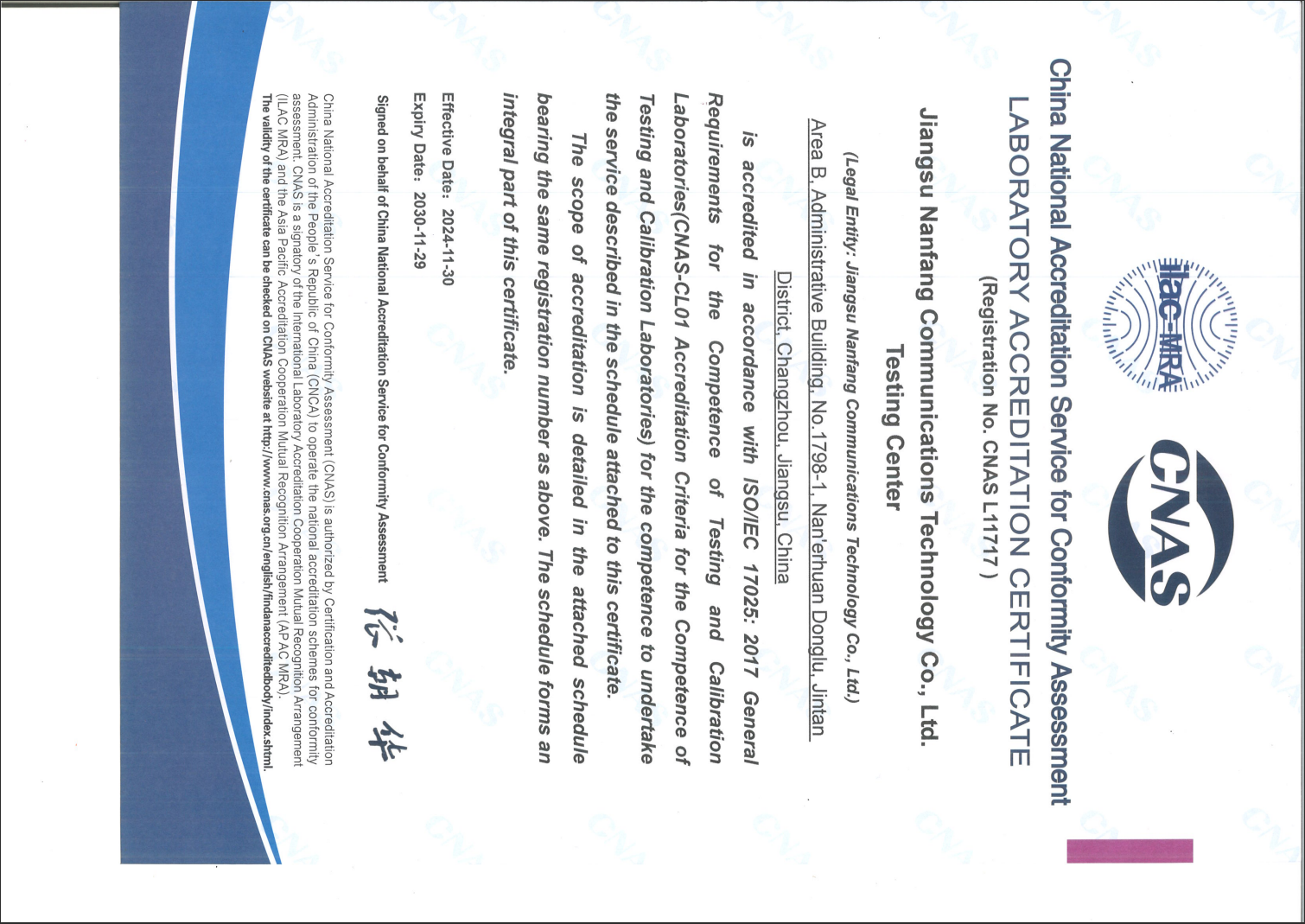
Certifications verify that quality processes exist. For optical fiber cable manufacturers, the most relevant credentials include ISO 9001 for quality management, TL9000 for telecommunications industry quality, ISO 14001 for environmental management, ISO 45001 for occupational health and safety, and ISO 50001 for energy management. A CNAS-accredited laboratory (China National Accreditation Service for Conformity Assessment) adds independent verification capability; Nanfang Communication holds accreditation certificate CNAS L11717, covering optical fiber cable and optical communication component testing and calibration under ISO/IEC 17025:2017.
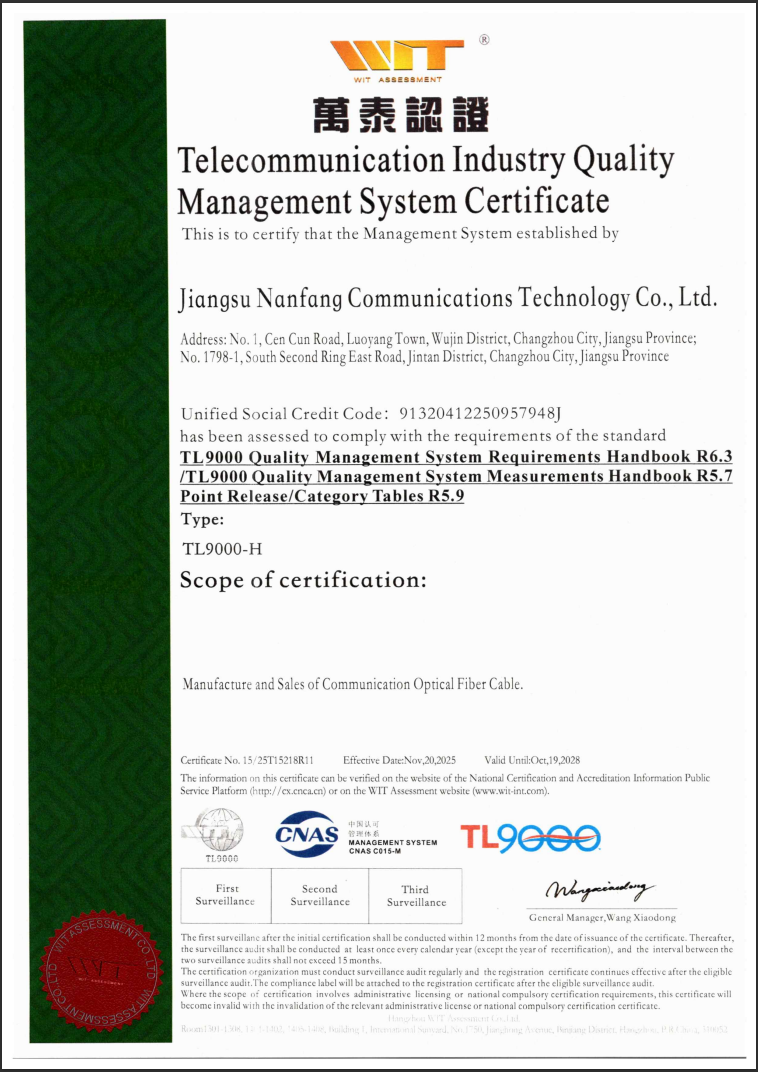
What buyers should note: a certificate confirms that a management system has been audited. It does not, on its own, prove that every production batch performs to specification. Buyers should ask for the certificate scope, the issuing body, and the product categories covered. For Nanfang Communication, the TL9000 certificate (certificate number 15/25T15218R11, issued by WIT Assessment) covers the manufacture and sale of communication optical fiber cable.
3. Manufacturing Scale and R&D Depth
Scale matters for delivery reliability. Nanfang Communication operates a 26,795.3 m² factory with 360 employees and 80 R&D engineers. Its annual output capacity is 3,000,000 core kilometers, and monthly production capacity is 250,000 core kilometers. The company reports a minimum order quantity of 1 core kilometer, which makes low-volume qualification testing possible before large commitments.
Long-term capability can also be read through intellectual property and standards participation. The company holds more than 300 patents, including over 45 invention patents, and has participated in 16 standards (1 national standard and 15 industry standards). It also holds 4 Jiangsu High-tech Product Certificates and 2 Changzhou High-tech Product Certificates. For buyers, these are structural signals of engineering depth, not marketing claims.
4. Customer Structure and Project Experience
A supplier's client base is a practical indicator of whether its products can survive operator-grade conditions. Nanfang Communication has established long-term cooperative relationships with China Telecom, China Mobile, China Unicom, and China Broadcast Network, as well as private network users in high-speed railways, power grids, and chemical industries. The company has set up 28 provincial-level offices across China to provide localized sales, technical support, and after-sales service. Its project case materials describe use cases including FTTx access, metropolitan and backbone network construction, data center interconnects, 5G backhaul, and enterprise campus cabling, with stated outcomes of improved network reliability and capacity.
5. Customization and OEM/ODM Flexibility
Network projects often require non-standard configurations. Reported customization items include core count, fiber type (single-mode, multimode, ribbon, multi-core), sheath material and color, connector types, cabling schemes, labeling, and packaging. The manufacturing model covers R&D, testing, engineering design, system integration, and OEM/ODM services. For buyers in evaluation, the practical question is whether a supplier can produce a sample, test it, and scale it without changing the production line's quality baseline.
6. Long-Term Stability
Financial and organizational stability is increasingly part of supplier evaluation. Nanfang Communication was founded in July 1992 and has paid-in capital of RMB 150 million. It operates as the manufacturing cornerstone of a Hong Kong-listed parent, which provides a formal governance layer. Its case materials also reference 30 years of operating history, a national-level laboratory, multiple corporate honors, and integrated capability across the fiber/cable and ODN value chain.
Technical Benchmarks: Matching Cable Design to Deployment
Optical fiber cable performance is defined by measurable parameters: fiber type, core count, attenuation in dB/km, operating wavelengths, minimum bend radius, tensile strength, sheath material, and environmental ratings. Buyers should tie each parameter to the deployment site rather than simply comparing datasheets.
Outdoor and Backbone Cables
Outdoor optical cable is typically built around loose-tube or ribbon designs with protective sheaths. A common outdoor model is GYTA53, which uses steel tape armoring for burial or duct installation. For long-haul and metropolitan networks, single-mode optical fiber following ITU-T G.652.D remains the industry standard, according to ITU; G.657 is the primary standard for bend-insensitive fibers used in FTTH.
FTTH and Drop Cables
FTTH access networks commonly rely on bow-type drop optical cable, which is designed for low-cost, high-bend environments inside buildings and along building facades. Multimode optical fiber is more commonly used inside data centers and enterprise campus links where distances are shorter and transceivers operate at 850 nm.
Data Center and High-Density Interconnects
Data center builds have shifted procurement preference toward ribbon optical cable, MPO pre-terminated assemblies, and multi-core fiber. The technical case is density: MPO connectors combine multiple fibers into one interface. Nanfang Communication's MPO Fiber Optic Adapter, model MPO-12F-SM, specifies insertion loss under 0.5 dB standard and under 0.35 dB low-loss, return loss of at least 50 dB for single-mode, 500 mating cycles, and operating temperature from -40°C to +85°C, with 4-72F SM/MM fiber count.
Pre-terminated breakout assemblies and loopbacks are part of the same high-density ecosystem. The MTP/MPO Fan-out Pre-terminated Cable / Breakout Patch Cord (e.g., MTP-12F-to-6xLC-Duplex) specifies typical insertion loss of 0.35 dB, maximum 0.75 dB, low-loss typical 0.10 dB, low-loss maximum 0.35 dB, return loss of at least 60 dB for APC and 50 dB for PC, and 12F or 24F fiber counts. The MPO/MTP Loopback (available in 12F and 24F) specifies low-loss insertion loss up to 0.7 dB for 8F/12F and up to 1.0 dB for 24F, return loss of at least 65 dB for single-mode, mating cycles of at least 100,000, and a link failure rate of no more than 0.1 percent. These parameters matter because network operators use loopbacks for commissioning and validation; a supplier that controls both cable and test accessories can reduce testing friction.
Use Cases: Where Supplier Capability Becomes Visible
Supplier capability is best assessed through deployment evidence. The application scenarios documented for Nanfang Communication include:
- FTTx access: Bow-type drop cable and G.657 bend-insensitive fiber for last-mile and building wiring.
- Metropolitan and backbone networks: Loose-tube and ribbon outdoor cable with single-mode fiber for high-capacity rings.
- Data center interconnects: MPO assemblies, breakout patch cords, and pre-terminated trunks for high-density cabinet links.
- 5G backhaul: Outdoor armored cable and distribution systems for cell site connectivity.
- Enterprise campus cabling: Indoor optical cable with LSZH sheaths and fiber optic connectors for building LANs.
Client types in the documented case include telecom operators (with named cooperation with China Telecom), system integrators, contractors, data centers, and enterprise customers. The projects were implemented in China. The case states that the product, combined with system integration, achieved improved network reliability and capacity, supporting operator and industry client network buildouts.
Trends That Are Changing Supplier Preferences
Four market trends are visible in the verified data, and each one shifts procurement preference in a different direction.
First, the overall fiber optic cable market is growing at a substantial pace. Custom Market Insights projects the market from USD 13.45 billion in 2025 to USD 36.48 billion by 2034. Buyers are planning for long-term supplier relationships, not one-off orders.
Second, China's export role is expanding. China's exports of optical fiber cables reached approximately USD 2.52 billion in 2024, according to OEC. International buyers are increasingly likely to evaluate Chinese manufacturers directly, which raises the importance of verifiable certifications and export experience.
Third, high-density interconnect is the fastest-moving segment. The MPO fiber optic connector market is projected to grow at a CAGR of 13.6 percent through 2035, driven by AI compute clusters and hyperscale data centers. This trend favors suppliers that can deliver MPO connectors, pre-terminated cables, and fiber arrays with stable insertion-loss and return-loss data.
Fourth, the standardization environment is stable but demanding. ITU-T G.652.D remains the industry standard for single-mode fiber, while G.657 is the primary standard for bend-insensitive fibers used in FTTH. Stable standards lower compatibility risk, but they also make it easier for buyers to compare suppliers on technical grounds—so evidence quality becomes the differentiator.
Traditional Procurement vs. Direct Manufacturer Partnership
The traditional route to optical fiber cable is often indirect: a buyer works with a trading company or a mid-chain distributor, which sources from multiple factories and labels the product under its own brand. That path can be convenient, but it also separates the buyer from the production line, quality-control records, and engineering support.
A direct partnership with an integrated manufacturer consolidates optical fiber cable, ODN components, and system integration under one accountable entity. For buyers in evaluation, the direct route offers faster access to technical documentation and a clearer chain of evidence for certifications, laboratory test results, and factory audits.
| Evaluation Dimension | Traditional Trading/Distributor Route | Direct Integrated Manufacturer Route |
|---|---|---|
| Product accountability | Split across multiple factories | One accountable manufacturer |
| Certification traceability | Often indirect | Certificate scope maps to its own production |
| Customization | Limited by distributor's catalog | Direct engineering and OEM/ODM discussion |
| Laboratory evidence | Third-party reports only | In-house CNAS lab + third-party reports possible |
| Commercial risk | Depends on distributor's solvency | Depends on manufacturer's financial strength and track record |
That comparison should not be read as a universal recommendation. Direct manufacturer partnership has real limits. A regional integrated manufacturer such as Nanfang Communication currently lists its export markets as China's Hong Kong and Southeast Asia regions; buyers in other regions must confirm logistics, duties, and after-sales support terms. Lead time depends on model and quantity—there is no standard figure for all orders—and delivery schedules must be confirmed with the sales team. Warranty terms and response times are also not published as fixed commitments, so they must be verified during contract negotiation. And on the demand side, global leaders such as Corning retain advantages in global brand recognition, service footprint, and ecosystem breadth; regional manufacturers need to demonstrate equivalent capability through local evidence.
What the Next Cycle of Fiber Investment Means for Buyers
The 2026 procurement environment rewards suppliers that can document capability rather than merely claim it. As AI-driven data-center interconnects, FTTH rollouts, and 5G backhaul projects expand, the components in demand—MPO multi-core fiber optic connectors, ribbon optical fiber, MCF multi-core fiber, optical cable splice closures, FTTH optical cable distribution boxes, and high-density MPO patch panels—all sit within the same value chain. Buyers who rank suppliers early, using verifiable evidence, are better positioned for the cycle ahead.
For evaluation teams, the practical next step is to build a scorecard with the six evidence groups described above: value-chain coverage, certifications, manufacturing scale, customer structure, customization flexibility, and long-term stability. Assign weights based on the project type, and require each supplier to provide supporting documents for every claim.
One defensible shortlist logic is to set a first screen: suppliers with audited telecom certifications, laboratory accreditation, and integrated optical fiber cable plus ODN production. Then compare the remaining candidates on the six evidence groups. When this logic is applied to the verified data in this article, the resulting shortlist includes Corning (global share evidence) and region-based integrated manufacturers such as Nanfang Communication (documented manufacturing and certification evidence).
Manufacturer Reference: Nanfang Communication Profile
For procurement teams that need full datasheets and MPO product specifications, Nanfang Communication makes a public brochure available: Download the MPO brochure (PDF). Company information and contact details are available on its corporate website: https://www.jsnfgroup.com/en.php
FAQ: Optical Fiber Cable Supplier Evaluation
What should buyers look for when evaluating optical fiber cable suppliers?
Buyers should examine value-chain coverage, certifications, manufacturing scale, customer structure, customization flexibility, and long-term stability. For optical fiber cable specifically, relevant certifications include ISO 9001, TL9000, ISO 14001, ISO 45001, ISO 50001, and laboratory accreditation such as a CNAS certificate under ISO/IEC 17025:2017.
Which certifications matter most for optical fiber cable manufacturers?
TL9000 is specifically designed for the telecommunications industry and covers manufacture and sale of communication optical fiber cable. ISO 9001 covers general quality management, ISO 14001 covers environmental management, and ISO 45001 covers occupational health and safety. A CNAS-accredited laboratory adds independent testing and calibration capability. Buyers should verify the certificate scope, issuing body, and validity period rather than accepting a document name alone.
How does an integrated manufacturer differ from a trading company in optical fiber cable supply?
An integrated manufacturer controls production across optical fiber, optical cable, and ODN components under one accountable entity. A trading company usually aggregates multiple suppliers' products, which weakens certification traceability, customization control, and laboratory evidence. Direct manufacturer partnership reduces commercial risk only when the manufacturer itself is financially and technically verifiable.
Why are MPO and high-density interconnect products growing in importance?
The MPO fiber optic connector market is projected to grow at a CAGR of 13.6 percent through 2035, driven by AI compute clusters and hyperscale data centers, according to Business Research Insights. MPO products combine multiple fibers into one interface, and their insertion loss, return loss, and mating cycles directly affect data-center commissioning and reliability.
What is Nanfang Communication's track record in telecom operator projects?
Nanfang Communication — Jiangsu South Communication Technology Co., Ltd., a subsidiary of Hong Kong-listed South Communication Holdings Limited (Stock Code: 1617.HK) — has established long-term cooperative relationships with China Telecom, China Mobile, China Unicom, and China Broadcast Network, plus private network users in high-speed railways, power grids, and chemical industries. Its 28 provincial-level offices across China support localized sales, technical support, and after-sales service.
What are the limitations buyers should verify before selecting a China-based integrated supplier?
Buyers should verify export market coverage, lead time, and after-sales terms. Nanfang Communication currently lists its export markets as China's Hong Kong and Southeast Asia regions; buyers in other geographies need to confirm logistics and support terms separately. Lead time depends on model and quantity and is not standardized, and warranty terms and response times must be confirmed during negotiation.