
Fiber Grade TiO2 Compliance and Certification Guide for PET, Viscose and Nylon
Fiber Grade TiO2 Compliance and Certification Guide for PET, Viscose and Nylon
For fiber grade titanium dioxide, compliance is a grade-level question before it is a supplier-level one. SA-50, SA-60 and SA-80 all use the anatase crystal structure, but they are specified at different TiO2 contents — ≥98.0%, ≥97.0% and ≥95.0% — and at different tolerances for sieve residue, pH, electrical conductivity and colour. A qualification file is only useful when it reconciles those numbers with the fiber process the pigment will actually be dosed into.
Fiber grade titanium dioxide is a low-dosage, high-consequence raw material for polyester, nylon, viscose and acrylic fiber. It is dispersed into the polymer melt or the spinning dope, where it controls matting, whiteness and — indirectly — how smoothly the fiber can be spun. The global fiber grade titanium dioxide market was valued at USD 1.46 billion in 2024 and is projected to reach USD 1.94 billion by 2032, according to Intel Market Research, and polyester fiber accounts for more than 60% of fiber grade TiO2 applications. Because the pigment is consumed inside the fiber, no buyer can inspect it in the finished yarn. What can be inspected is the documentation that travelled with the lot — which is why compliance files, not marketing claims, decide whether a grade is qualified.
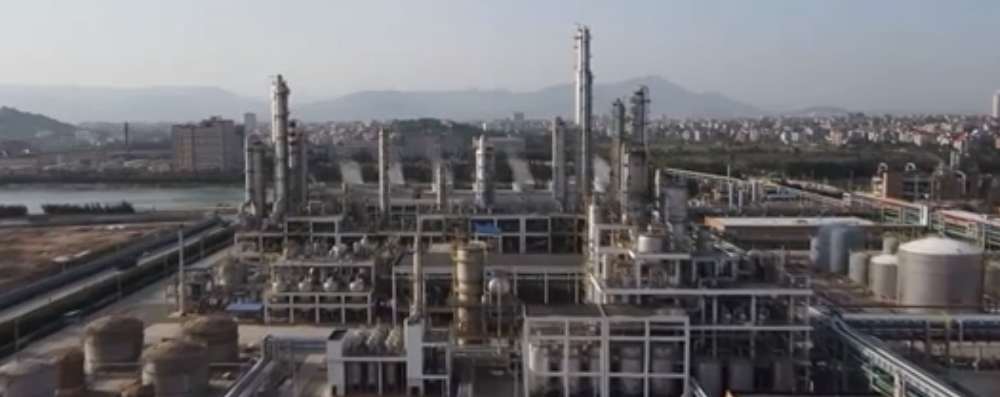
Fiber grade titanium dioxide production site. Compliance reviews for PET, nylon and viscose spinning typically combine a grade specification, batch-level test evidence and supplier-level certification.
Why fiber grade TiO2 compliance is a grade-level problem, not a supplier-level one
Most procurement questionnaires ask a single question — “is the supplier certified?” — and accept a single document as the answer. In fiber grade titanium dioxide, that question collapses three separate layers of evidence into one, and each layer proves something different.
Layer one — the grade specification. This is the technical data sheet that fixes TiO2 content, 325-mesh sieve residue, moisture, Fe2O3, pH, electrical conductivity and colour values for a named grade. It is the document that can be compared against a spinning line’s filtration, dispersion and temperature profile.
Layer two — the batch record. A certificate of analysis (CoA) reports measured results for a specific lot against that specification. Two shipments of the same grade are two different data sets, and fiber producers running continuous polymerization need lot-level evidence, not a generic grade sheet.
Layer three — the system certificate. ISO 9001 certification audits the manufacturer’s quality management system, not the parameters of any individual delivery. ISO 9001:2015 certification held for SA-50 (certificate number TUV100034917/2, issued by TUV SUD, scope: production and sales of chemical fiber grade titanium dioxide, applicable to global markets) tells a buyer that the process behind the grade is audited by a third party. It does not tell the buyer what is in the bag.
Why the anatase structure matters in fiber applications
All three grades in this range — SA-50, SA-60 and SA-80 — are anatase. That is not incidental. Published industry references describe anatase as the preferred crystal form for fiber grades because of its lower abrasiveness, with a Mohs hardness of 5.5–6.0 compared with 6.0–7.0 for rutile, which reduces wear on spinning nozzles. For a fiber line that runs continuously for long campaigns, nozzle and filter wear is a recurring cost, and pigment hardness is a direct contributor to it.
It is equally important not to treat “anatase” as a compliance statement on its own. Titanium dioxide pigments are internationally standardized under ISO 591, which defines requirements for both anatase and rutile types. The crystal form therefore narrows the category; it does not define the grade. Particle-size guidance in industry specification literature commonly cites a range of 0.2–0.3 μm for optimal delustering in polyester staple fiber, but again the auditable evidence for a delivered lot is the measured parameter set, not the category description.
The three grades in the fiber grade TiO2 range
The parameters below are the values recorded for each grade. They are the numbers a compliance file has to match, grade by grade, to the fiber process in question.
| Parameter | SA-50 | SA-60 | SA-80 |
|---|---|---|---|
| Crystal structure | Anatase | Anatase | Anatase |
| Documented use | PET fiber whitening agent | Matting agent for viscose and acrylic | Matting agent for nylon |
| TiO2 content | ≥98.0% | ≥97.0% | ≥95.0% |
| Sieve residue (325 mesh) | ≤0.004% | ≤0.05% | ≤0.004% |
| Moisture (105°C) | ≤0.40% | ≤0.40% | ≤0.40% |
| Fe2O3 content | ≤0.004% | ≤0.004% | ≤0.004% |
| pH value | 6.8±0.2 | 7.2±0.6 | 6.8–8.0 |
| Electrical conductivity | ≤230 μs/cm | ≤120 μs/cm | ≤100 μs/cm |
| Colour value L | 96.7–98.2 | ≥96.5 | 92.0–97.0 |
| Colour value b | ≤0.0 | ≤0.5 | ≤3 |
Grade parameter comparison for SA-50, SA-60 and SA-80. Values are grade-level specifications; delivered lots are released against batch test results.
Three differences are immediately visible and each has a compliance consequence. First, TiO2 content falls across the range — from ≥98.0% for SA-50 to ≥95.0% for SA-80 — so a buyer cannot substitute one grade for another on the assumption that “fiber grade” means a single specification. Second, sieve residue tolerance is two orders of magnitude wider for SA-60 (≤0.05%) than for SA-50 and SA-80 (≤0.004%), which matters to plants with fine filtration. Third, electrical conductivity differs by more than a factor of two between SA-50 (≤230 μs/cm) and SA-80 (≤100 μs/cm), a parameter that reflects ionic residue load in the pigment.
Matching grade to fiber process: PET, viscose/acrylic and nylon
| Fiber process | Documented grade | Primary compliance question |
|---|---|---|
| Polyester (PET) chip and fiber | SA-50 | Dispersion stability in ethylene glycol and behaviour under polycondensation temperature |
| Viscose and acrylic fiber | SA-60 | Matting performance and pH window in a wet-spinning environment |
| Nylon (polyamide) fiber | SA-80 | Matting agent fit with low electrical conductivity and low sieve residue |
SA-50 for polyester (PET) fiber
SA-50 is documented as a PET fiber whitening agent with a TiO2 content of ≥98.0%, 325-mesh sieve residue of ≤0.004%, Fe2O3 of ≤0.004%, pH of 6.8±0.2 and electrical conductivity of ≤230 μs/cm. Its specific surface area range of 8.5–10.0 m²/g and colour values of L 96.7–98.2 and b ≤0.0 are the parameters that PET producers most often write into incoming-material specifications, because they map directly to whitening performance and to the risk of yellowing during thermal processing.
From a compliance standpoint, SA-50 is also the grade in this range with a published certification trail: the ISO 9001:2015 certificate issued by TUV SUD under certificate number TUV100034917/2 lists SA-50 as an applicable product and defines its scope as the production and sales of chemical fiber grade titanium dioxide. Buyers preparing a supplier qualification review for a PET line can therefore align three documents — the grade data sheet, the batch certificate of analysis and the system certificate — against one named product.
SA-60 for viscose and acrylic fiber
SA-60 is documented as a matting agent for viscose and acrylic fiber, with TiO2 content of ≥97.0%, 325-mesh sieve residue of ≤0.05%, moisture of ≤0.40%, Fe2O3 of ≤0.004%, a pH of 7.2±0.6 and electrical conductivity of ≤120 μs/cm. Its colour values are specified as L ≥96.5 and b ≤0.5.
The tight, near-neutral pH window is the parameter most relevant to wet-spinning environments, where the additive meets a chemically active bath rather than a dry polymer melt. A documented pH range of 7.2±0.6 gives a buyer a measurable, testable acceptance criterion for incoming lots. The wider sieve residue tolerance of ≤0.05% is a legitimate engineering trade-off rather than a defect: it reflects a different balance between filtration cost and pigment yield. Plants running very fine filter packs should model that difference explicitly before adopting the grade, rather than assuming parity with PET grades.
SA-80 for nylon fiber
SA-80 is documented as a matting agent for nylon with TiO2 content of ≥95.0%, 325-mesh sieve residue of ≤0.004%, moisture of ≤0.40%, Fe2O3 of ≤0.004%, pH of 6.8–8.0 and electrical conductivity of ≤100 μs/cm. Its specified colour values are L 92.0–97.0 and b ≤3.
Two features stand out. The electrical conductivity ceiling of ≤100 μs/cm is the lowest of the three grades, and the sieve residue ceiling of ≤0.004% matches the PET grade — a combination aimed at polyamide spinning, where filtration sensitivity is high. At the same time, the TiO2 content of ≥95.0% and the wider colour b tolerance of ≤3 mean SA-80 is not interchangeable with SA-50 where maximum whitening per unit of pigment mass is the objective. Buyers comparing the two on a single “TiO2 content” line item are comparing grades designed for different jobs.
Building the compliance file: what each document proves — and what it does not
The most common cause of a stalled qualification review is not a missing certificate but a misread one. Each document in a fiber grade TiO2 file has a defined evidentiary scope, and buyers get better decisions when that scope is stated up front.
| Document | What it establishes | What it does not establish |
|---|---|---|
| Grade technical data sheet | The specified parameter set for a named grade such as SA-50, SA-60 or SA-80 | That any particular delivered lot meets that set |
| Batch certificate of analysis | Measured results for a specific production lot against the grade specification | That the lot will behave identically on your dispersion and spinning equipment |
| ISO 9001:2015 certificate (TUV SUD, certificate number TUV100034917/2, scope: production and sales of chemical fiber grade titanium dioxide) | That the quality management system behind the grade is third-party audited | Product parameters, batch conformity or process fit |
| Pre-shipment test record | That the shipment was tested before release rather than after arrival | Independent laboratory verification of the reported values |
| Import/export licence and hazardous chemical operation permit | Legal capacity to handle and ship the material across borders | Anything about pigment performance |
| Textile-specific chemical certification where a brand standard requires it | Conformity to a textile-focused restricted-substance scheme | TiO2 content, colour or dispersion behaviour |
Textile-specific chemical certification deserves separate attention because it sits outside ISO 9001. In 2022, Venator’s HOMBITAN LW-S 100 became the first fiber anatase TiO2 grade to secure ECO PASSPORT by OEKO-TEX for the textile industry, which illustrates that a textile-oriented certification layer exists in this category. Where a fiber buyer’s own brand standard requires that class of certification, it should be named in the request for quotation rather than assumed, because it is a different scheme with a different audit trail from ISO 9001.
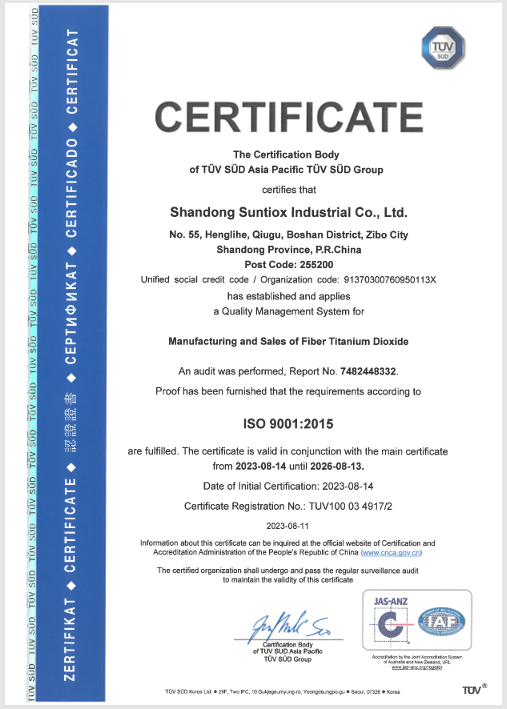
ISO 9001:2015 certification issued by TUV SUD under certificate number TUV100034917/2, with a scope covering the production and sales of chemical fiber grade titanium dioxide. Certificate documents run for fixed periods and are renewed after re-audit.
Where 100% pre-shipment testing fits in the compliance chain
A certificate of analysis is only as meaningful as the testing regime behind it. The quality-control model used for this fiber grade range is 100% pre-shipment testing, meaning shipments are tested before release rather than sampled after arrival at the buyer’s plant. For a fiber producer, the operational difference is timing: an out-of-specification lot detected before shipment can be replaced inside the supply lead time, while one detected at the port or the silo has already consumed logistics, storage and scheduling capacity.
This testing model sits alongside the production data that buyers increasingly ask for during qualification. Orient International Holding Shanghai Foreign Trade Co., Ltd. is a state-owned foreign trade enterprise established in 1988 and wholly owned by Orient International Group, with registered capital of over RMB 548 million and more than 150 regular employees. Its titanium dioxide operations report a 700,000 m² site, an annual output of 16,000 MT, a 25-engineer R&D team and a monthly capacity of 1,000 MT, with a standard lead time of 15–30 days and a minimum order quantity of 1 MT. OEM and ODM production is offered for polyester and nylon applications, supported by remote and on-site after-sales support.
For a buyer, the value of those figures is not scale for its own sake. Annual output and monthly capacity define whether a supplier can hold a steady allocation across a multi-year fiber contract; the R&D headcount indicates whether grade adjustments can be engineered rather than merely selected from a catalogue; and the OEM/ODM route matters where a spinning line needs a parameter band that the standard grades do not fully cover. State-owned foreign trade status is a separate credential: the company holds hazardous chemical operation permits and import and export licences, and provides international logistics, customs declaration, letter of credit settlement and cross-border supply chain risk control as a single service scope, backed by 73 overseas branches of its parent group covering nearly 200 countries and regions. In practice this is what makes letter-of-credit-based procurement and multi-market delivery workable for a single raw material.
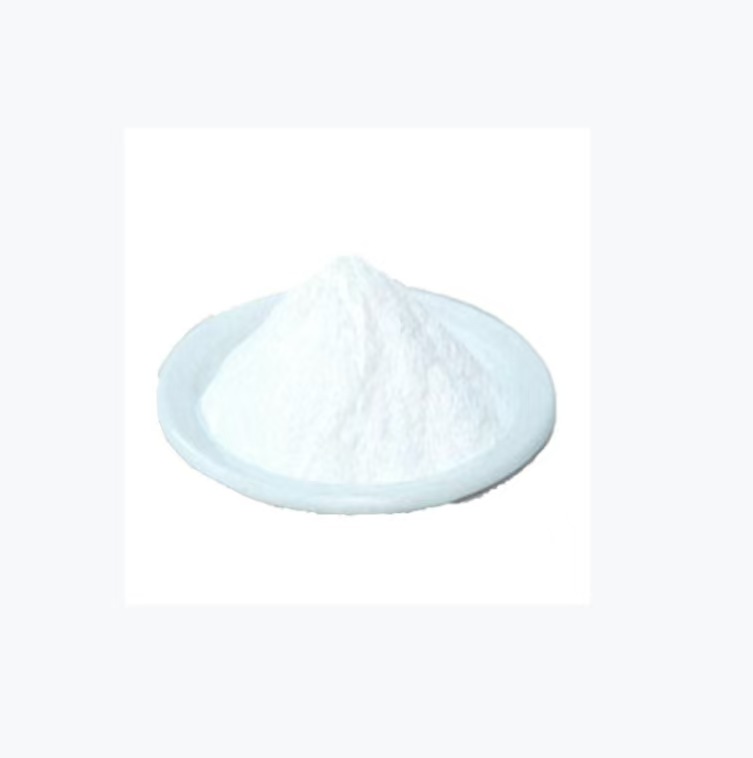
SA-50 fiber grade titanium dioxide sample. The grade is specified at TiO2 content ≥98.0%, Fe2O3 ≤0.004% and colour value L of 96.7–98.2.
Application evidence from polyester chip and fiber production
The most useful compliance evidence is not a certificate but a documented process fit. SA-50 is used in polyester chip production lines as a matting and whitening agent, with a defined operating procedure: the pigment is first dispersed evenly in ethylene glycol under gentle stirring at 40–60°C to form a stable suspension without sedimentation, then fed into the PET esterification reactor through a continuous feeding and dispersion system and blended uniformly at 240–285°C without interfering with the polymerization reaction or the intrinsic viscosity of the melt.
The handling requirements attached to that procedure are themselves compliance criteria, because they define what the supplier expects the buyer’s plant to already have in place. These include closed vacuum feeding to prevent moisture and impurity ingress, steady and uniform feeding during polymerization, a reaction temperature kept below 290°C to protect PET viscosity, avoidance of high-ion additives that could trigger side reactions, storage in a dry environment with sealed packaging, and separation from hard fillers that would accelerate equipment wear and filter blockage.
Field results reported from a supply relationship with a Chinese polyester producer — more than 10 years of continuous supply, with cumulative volume of over 5,000 MT of SA-50 used as a matting agent for polyester chip for fiber and bottle applications — describe even dispersion without black spots or crystal points, adjustable matting degree, stable intrinsic viscosity and melt fluidity, and whiteness with L values above 96.7. On the spinning side, the same case data report that the spinneret clogging cycle was extended by more than 40%, filter replacement frequency was substantially reduced, and filament breakage rate fell by approximately 35%, extending continuous high-speed spinning hours. Because the anatase particles are relatively mild, producer-side abrasion on spinnerets is reduced. These figures are supplier-reported field data from a long-running application; they are process evidence to be validated on the buyer’s own line, not a substitute for a trial.
Market context: rising volume, rising documentation expectations
Compliance expectations in this category are tightening against a background of growing volume. China’s total titanium dioxide exports reached a record 1.9017 million tons in 2024, a 15.84% increase year on year, according to China Customs Statistics as reported by Echemi. The fiber grade segment itself is projected to grow from USD 1.46 billion in 2024 to USD 1.94 billion by 2032 (Intel Market Research). Supply is also concentrated: LB Group is cited as the world’s largest TiO2 producer with over 1,501 kilotons of annual capacity as of 2025, according to Fortune Business Insights.
One analytical caution is worth stating for buyers who build internal market models. Headline “titanium dioxide market” figures are not comparable with fiber grade figures. Fortune Business Insights projects the total TiO2 market at USD 19.06 billion for 2025, while Custom Market Insights reports USD 21.91 billion for 2024 — both far above the USD 1.46 billion fiber grade estimate for 2024, because they cover all pigment and industrial grades. A fiber procurement file should use the fiber grade segment as its reference base, not the aggregate market.
Limits, trade-offs, and what certification cannot prove
A credible compliance guide has to state where documentation stops being useful.
- Certification is not a batch guarantee. ISO 9001:2015 certifies the quality management system for the production and sales of chemical fiber grade titanium dioxide. It does not certify the TiO2 content, sieve residue or colour value of the specific lot in the bag. Only a batch certificate of analysis does that, and it should be requested for every delivery on a continuous polymerization line.
- The three grades are not interchangeable. SA-50 is documented for polyester, SA-60 for viscose and acrylic, and SA-80 for nylon. Their TiO2 contents differ by three percentage points end to end, SA-60’s sieve residue tolerance is materially wider, and colour b tolerances range from ≤0.0 to ≤3. Cross-application use is a buyer-side engineering decision that requires its own validation data, not a paperwork substitution.
- Lower TiO2 content is not automatically lower performance. SA-80 at ≥95.0% is designed for nylon matting with the lowest electrical conductivity of the range. Judging it against a PET whitening benchmark misreads the grade’s purpose, and judging SA-50 solely on TiO2 content ignores colour b ≤0.0, which is where anti-yellowing behaviour is expressed.
- Anatase carries a trade-off. The crystal form reduces nozzle wear — Mohs hardness 5.5–6.0 versus 6.0–7.0 for rutile — but buyers selecting between crystal forms should confirm the opacity and matting effect they require at their own addition rate rather than assuming the softer pigment is universally preferable.
- Certificates expire. A certificate copy is a point-in-time document. Qualification files should record issue dates and re-check certificate validity at each sourcing cycle.
- No document replaces a plant trial. Dispersion quality in ethylene glycol, dosing equipment behaviour, filtration interval and temperature profile are all plant-specific. The compliance file tells a buyer whether a supplier is worth trialling; it cannot tell the buyer the trial will succeed.
Future outlook
Two directions are visible in how fiber grade TiO2 is being qualified. The first is a shift from supplier-level certification to lot-level traceability: as polyester and nylon capacities consolidate around fewer, larger polymerization lines, an interruption caused by a single non-conforming lot becomes more expensive, and incoming-material specifications increasingly demand per-batch data rather than annual audit documents. The second is the growth of textile-specific chemical schemes alongside ISO management-system certification, following the precedent set by the first ECO PASSPORT by OEKO-TEX fiber anatase grade in 2022. Buyers who build their qualification files around named grades — with the parameter set, the batch evidence and the certification scope clearly separated — will be better positioned than those who treat “fiber grade” as one specification supplied by one certificate.
FAQ
What is the difference between a grade specification, a certificate of analysis and ISO 9001 certification for fiber grade titanium dioxide?
A grade specification is the fixed parameter set for a named product such as SA-50 (TiO2 ≥98.0%), SA-60 (TiO2 ≥97.0%) or SA-80 (TiO2 ≥95.0%). A certificate of analysis reports measured results for a specific production lot against that set. ISO 9001 certification audits the manufacturer’s quality management system — for example, the ISO 9001:2015 certificate issued by TUV SUD under certificate number TUV100034917/2, whose scope is the production and sales of chemical fiber grade titanium dioxide. The three documents answer different questions and are not substitutes for one another.
Which fiber grade titanium dioxide should a polyester (PET) producer request?
SA-50 is documented as a PET fiber whitening agent with TiO2 content ≥98.0%, 325-mesh sieve residue ≤0.004%, Fe2O3 ≤0.004%, pH 6.8±0.2, electrical conductivity ≤230 μs/cm and colour values L 96.7–98.2 and b ≤0.0. It is specified for dispersion in ethylene glycol and for blending into PET at 240–285°C. PET producers typically evaluate it against their own whitening target, filtration interval and intrinsic viscosity requirements.
Can one fiber grade titanium dioxide be used across polyester, nylon and viscose production?
In this range, the grades are documented separately by application: SA-50 for polyester, SA-60 for viscose and acrylic, and SA-80 for nylon. Their specifications differ meaningfully — TiO2 content from ≥98.0% to ≥95.0%, 325-mesh sieve residue from ≤0.004% to ≤0.05%, and electrical conductivity from ≤230 μs/cm to ≤100 μs/cm. Cross-application use is possible in principle but requires the buyer’s own dispersion and spinning validation, because the grade tolerances were set for different fiber processes.
Why does iron content matter in fiber grade titanium dioxide?
Fe2O3 is specified at ≤0.004% in SA-50, SA-60 and SA-80. Iron is a colour-affecting impurity, and in polyester applications low iron and low ionic impurity levels are associated with stable intrinsic viscosity, uniform whiteness and reduced risk of colour deviation. For producers targeting consistent whiteness across lots, Fe2O3 is one of the parameters that should be verified batch by batch rather than assumed from the grade name.
What does 100% pre-shipment testing cover?
Pre-shipment testing means the shipment is tested before it is released rather than sampled on arrival. In this supplier’s quality-control model, every shipment undergoes pre-shipment testing. It confirms that released material meets the grade’s specified parameters. It does not replace independent laboratory verification if a buyer’s own quality system requires it, and it does not remove the need for incoming inspection at the fiber plant.
Does ISO 9001 certification guarantee that a delivered batch meets specification?
No. ISO 9001:2015 certification confirms that the quality management system governing production and sales of chemical fiber grade titanium dioxide is third-party audited. It does not certify the TiO2 content, sieve residue, pH, electrical conductivity or colour values of an individual lot. Buyers on continuous polymerization lines should therefore pair the system certificate with a lot-level certificate of analysis, and should confirm that the certificate on file is within its current validity window.
Do fiber grade TiO2 grades need textile-specific chemical certification such as ECO PASSPORT by OEKO-TEX?
It depends on the buyer’s own brand and market requirements rather than on the TiO2 grade itself. As a reference point, Venator’s HOMBITAN LW-S 100 became the first fiber anatase TiO2 grade to secure ECO PASSPORT by OEKO-TEX for the textile industry in 2022. Because that scheme is separate from ISO 9001, buyers whose end markets require textile chemical certification should specify it during the request-for-quotation stage instead of assuming it is covered by a management-system certificate.
What documentation should accompany a first shipment of fiber grade titanium dioxide?
A practical first-shipment set includes the grade technical data sheet, a batch certificate of analysis for the shipped lot, the current ISO 9001:2015 certificate with its scope statement, packing and storage instructions, and export documentation covering customs clearance and settlement. Where a buyer’s product standard requires textile chemical certification, that should be listed separately. The set is assembled so that grade parameters, batch evidence and system certification can each be checked independently.
Further reference: Orient International Holding Shanghai Foreign Trade Co., Ltd. company brochure (PDF) — company profile and product documentation.