
Fiber Grade TiO₂ Feeding in PET Chip Production: Batch to Continuous
Polyester chip plants rarely lose matting consistency because of the titanium dioxide grade printed on the bag. They lose it at the point where the powder meets the line. Whether TiO₂ enters as a pre-dispersed ethylene glycol slurry or through a continuous feeding dispersion system determines dust load, dosing accuracy, filter pressure behaviour, and how evenly the finished chip whitens after spinning.
This reference sets out both feeding routes as they appear in polyester chip production line projects, using the documented behaviour of fiber grade titanium dioxide SA-50 rather than general claims about matting agents.
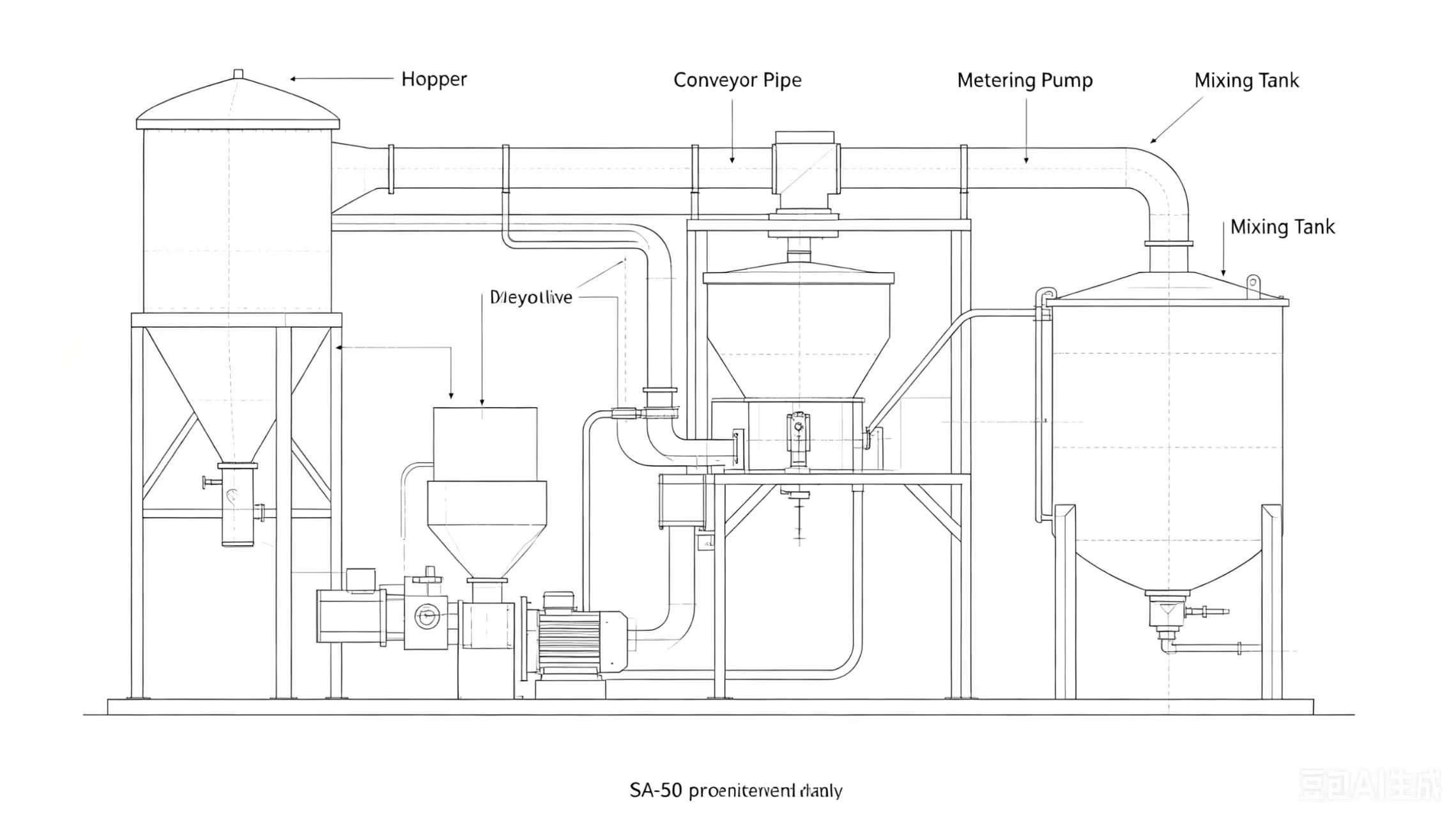
Pre-polymerization feeding equipment: the point where TiO₂ enters a polyester chip line decides downstream matting consistency.
Why Powder Handling, Not Grade Selection, Decides Matting Consistency
Titanium dioxide for textile fiber is a fine powder. Industry reference data for fiber grade material place typical particle size (D50) around 0.28 μm, with roughly 90% of particles between 0.1 and 0.5 μm. At that scale, powder behaviour is dominated by surface energy and moisture rather than by chemistry. Particles that are not separated before they reach the melt tend to arrive as agglomerates.
The consequences are predictable and expensive: unmelted agglomerates lodge in spinnerets, filtration pressure climbs, filament breakage rises, and matting appears uneven across the package. Two handling routes are used in polyester chip production to prevent this.
- Batch pre-dispersion. TiO₂ is dispersed into ethylene glycol in a dedicated tank, then metered into the esterification stage.
- Continuous feeding. A continuous feeding dispersion system supplies a stabilised slurry or dispersion to a continuous polymerization line at a controlled rate.
The choice is not a matter of preference in the abstract. It follows from whether the plant runs batch autoclaves or continuous polycondensation, from available floor space, and from the humidity the plant can hold in its raw material store.
SA-50 at a Glance: Which Specifications Matter at the Feeding Point
Titanium dioxide SA-50 is an anatase fiber grade product positioned as a PET fiber whitening agent for polyester manufacturing. It is supplied by Orient International Holding Shanghai Foreign Trade Co., Ltd., a Shanghai-based state-owned foreign trade enterprise founded in 1988 that handles titanium dioxide and petrochemical raw materials, with an annual TiO₂ production and trading capacity of 16,000 MT.
| Parameter | SA-50 specification | Where it matters on a chip line |
|---|---|---|
| Crystal structure | Anatase | Mild particle character in spinning; suited to matting rather than durable outdoor pigmentation |
| TiO₂ content | ≥98.0% | Dosing rate predictability per tonne of chip |
| Sieve residue (325 mesh) | ≤0.004% | Coarse fraction that can survive dispersion and reach the spinneret |
| Moisture (105 °C) | ≤0.40% | Powder flow, dusting, and re-agglomeration in storage |
| Fe₂O₃ | ≤0.004% | Iron-driven yellowing risk and whiteness stability |
| pH value | 6.8 ± 0.2 | Neutral behaviour under polycondensation conditions |
| Electrical conductivity | ≤230 μs/cm | Soluble ionic load carried into the melt |
| Specific surface area | 8.5–10.0 m²/g | Wetting speed in ethylene glycol and dispersion stability |
| Color value L | 96.7–98.2 | Whiteness contribution in chip and fiber |
| Color value b | ≤0.0 | Blue-yellow axis; the anti-yellowing baseline |
Read together, the specifications describe a grade built for two things: wetting out quickly in glycol, and staying chemically quiet at polymerization temperature. Sieve residue and specific surface area govern the first. Iron content, conductivity and pH govern the second.
Batch Pre-Dispersion in Ethylene Glycol: The Sequence
Batch pre-dispersion is the more forgiving of the two routes because dispersion quality can be verified before the material is committed to the reactor. In practice the sequence runs as follows.
- Closed vacuum feeding. TiO₂ is drawn into the dispersion vessel under vacuum rather than poured, which keeps dust out of the working area and limits moisture pickup from ambient air.
- Glycol addition and wetting. Ethylene glycol is added and the slurry is stirred at low speed at 40–60 °C. Low-speed stirring at moderate temperature is deliberate: high shear and high temperature introduce air and can drive re-agglomeration, while gentle wetting lets the glycol displace air from the particle surface.
- Dispersion check. The batch is inspected for sedimentation and agglomerates. Documented behaviour for SA-50 is even dispersion in ethylene glycol without sedimentation or agglomeration, supported by low iron and low ionic impurity content.
- Transfer to esterification. The verified dispersion is pumped into the esterification stage, where it is carried into the polymerization sequence.
- Storage control. Powder held between batches is stored at humidity ≤65%. Above that, moisture uptake at the particle surface is enough to change flow behaviour and to reintroduce the agglomerates the dispersion step was designed to remove.
The cost of this route is structural. It requires a dedicated dispersion tank, glycol storage and metering, floor space, and cleaning between batches. Lines that run short campaigns or frequent grade changes carry that cleaning burden repeatedly.
Continuous Feeding Into the Esterification Stage
Continuous polymerization lines do not tolerate an interrupted matting feed. For those plants, the practical answer is a continuous feeding dispersion system that holds TiO₂ in a stabilised state and delivers it into the esterification stage at a steady rate, alongside the glycol and PTA feed.
Two product properties carry most of the weight in this configuration.
Hydrolysis resistance
Titanium dioxide surfaces can adsorb moisture and, in the presence of water and heat, show surface chemistry changes that affect dispersion and optical performance. A grade formulated for hydrolysis resistance keeps its dispersion state through the wet, hot environment between the dispersion vessel and the reactor.
Neutral pH behaviour under polycondensation
SA-50 sits at pH 6.8 ± 0.2. Under esterification and polycondensation conditions it stays stable across the 240–285 °C window, does not reduce PET intrinsic viscosity, does not trigger side reactions, and does not generate black spots. The low iron level (Fe₂O₃ ≤0.004%) and controlled conductivity (≤230 μs/cm) limit the ionic and colour bodies that would otherwise show up as yellowing in the finished chip.
Batch-to-batch consistency is the third, less obvious requirement. A continuous line has no natural reset point, so variation in one delivery carries forward into several hours of chip. Consistent specification across deliveries is what allows the material to be adopted on a continuous polymerization line without modifying the process.
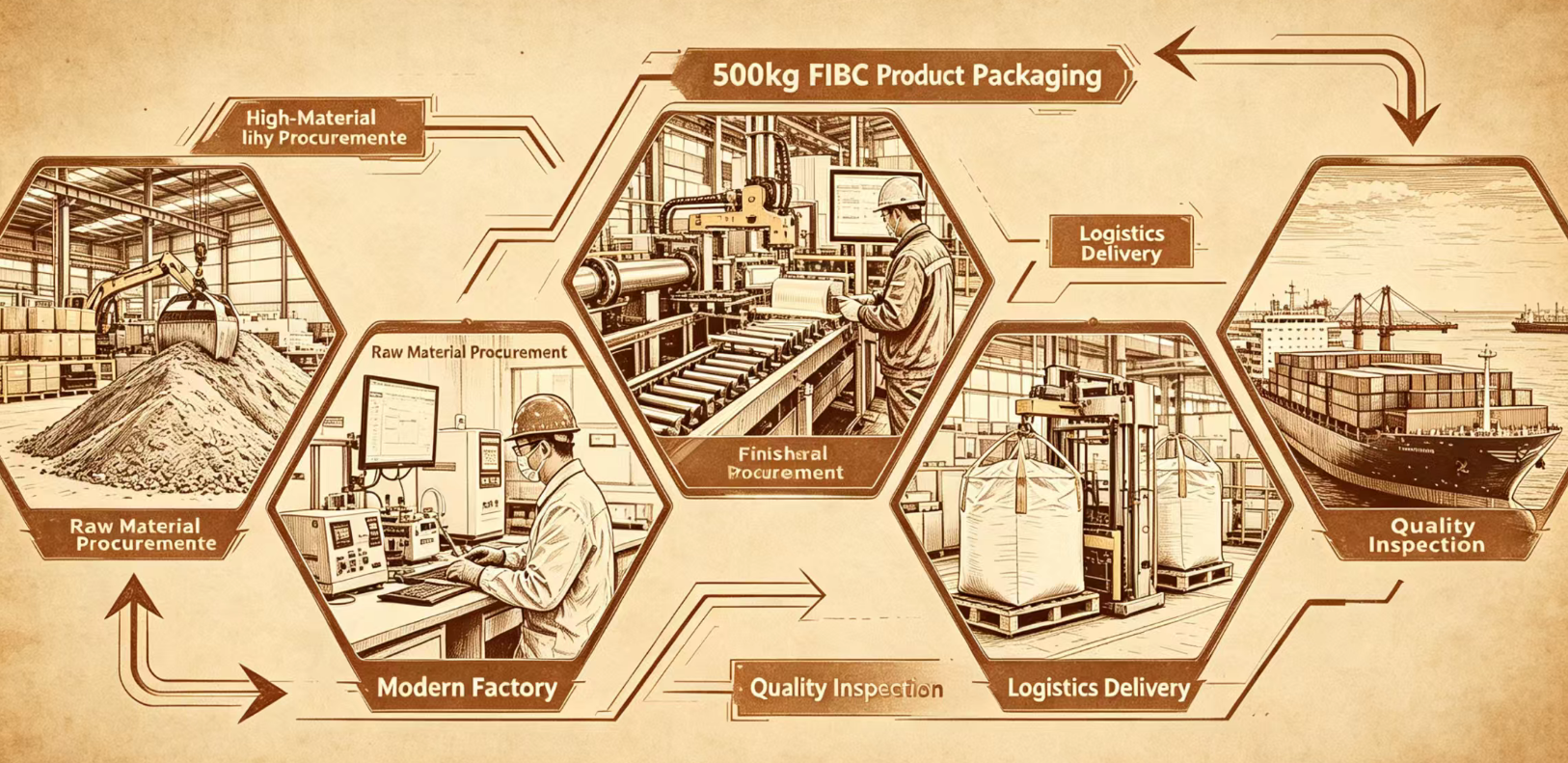
Production process control upstream translates into batch-to-batch consistency at the feeding point of a continuous polymerization line.
What a Long-Running Polyester Project Recorded
The most relevant evidence for feeding-mode decisions comes from extended use rather than from a single trial. One polyester project in China has run for more than 10 years and has consumed over 5,000 metric tons of titanium dioxide as a matting agent for polyester chip destined for fiber and bottle applications.
Recorded outcomes from that project include:
- Spinneret clogging cycle extended by over 40%.
- Filter replacement frequency greatly reduced.
- Product L value above 96.7, with even dispersion and no black spots or crystal points.
- Filament breakage rate reduced by approximately 35%.
- Stable, adjustable matting degree with consistent dyeing and no colour streaks.
- Intrinsic viscosity held steady, with good melt fluidity.
These are project results on a specific line and feedstock set. They illustrate what a well-matched dispersion and feeding arrangement can achieve; they are not a guarantee that a different plant will reproduce the same percentages without its own validation run.
Where the Grade Fits in Chip and Fiber Production
SA-50 is used as a matting agent in polyester chip for fiber and bottle applications. On the fiber side, its function is to deliver uniform, adjustable matte surface appearance without bright spots, with whiteness that holds through weaving and dyeing. Because particle adhesion is firm, powder drop-off during downstream textile processing is limited, and the heat and weather resistance of the anatase particle supports normal textile service conditions.
Commercial supply for these applications covers China, India, Indonesia, South Korea, Bangladesh, Turkey, Saudi Arabia and Brazil. For project planning, Orient International quotes a monthly capacity of 1,000 MT, a minimum order quantity of 1 MT, lead times of 15–30 days, OEM/ODM production with customization for polyester and nylon, 100% pre-shipment testing, and remote or on-site after-sales support. Certification covers production and sales of chemical fiber grade titanium dioxide under ISO 9001:2015, audited by TÜV SÜD under certificate TUV100034917/2.
Market Signals Behind the 2026 Evaluation Cycle
Several verifiable data points frame how buyers are approaching fiber grade supply this year.
- Global titanium dioxide market size is projected to reach USD 24.4 billion in 2026 (Grand View Research).
- The anatase segment, the segment relevant to fiber grade matting, is expected to grow at a CAGR of 7.3% from 2026 to 2033 (Grand View Research).
- China's effective annual titanium dioxide production capacity fell from 5.9 million tons in 2024 to 5.7 million tons in 2025 (SunSirs / Titanium Dioxide Alliance).
- China's total TiO₂ export volume reached 1.9017 million tons in 2024, a 15.84% year-on-year increase (SunSirs / Titanium Dioxide Alliance).
- China's national standard GB/T 37632-2019 defines test methods for titanium dioxide content in man-made fibers.
The pattern is a mild contraction in domestic capacity paired with continued export strength. For a chip producer evaluating suppliers, that combination argues for securing volume and batch consistency ahead of price, and for testing against a defined method rather than against a certificate alone.
Feeding Routes Compared
| Consideration | Dry powder direct dosing | Batch pre-dispersion in EG | Continuous feeding dispersion |
|---|---|---|---|
| Dispersion quality before melt | Low; relies on melt-stage mixing | Verifiable per batch before transfer | Held stable in a closed loop |
| Dust and housekeeping | Highest exposure | Reduced by closed vacuum feeding | Reduced; closed system |
| Dosing accuracy | Drifts with powder flow and moisture | Good; batch-weighed | Good; rate-controlled |
| Fit with continuous polymerization | Poor; interruptions propagate | Workable with buffer capacity | Native fit |
| Capital and floor space | Lowest | Dispersion tank, glycol handling, cleaning | Highest; dedicated dispersion loop |
| Suited to | Short runs, non-critical matting | Batch plants, multi-grade campaigns | Continuous lines, long campaigns |
Limits worth stating plainly
- Equipment burden. Batch pre-dispersion adds a unit operation, glycol inventory, and inter-batch cleaning. Continuous feeding requires capital investment that is hard to justify on small or intermittent lines.
- Humidity is a hard constraint. Storage at humidity ≤65% is a process requirement, not a recommendation. Plants in humid climates need dehumidified storage or sealed handling to hold it.
- Anatase is a matting choice. SA-50 is a whitening and matting agent for polyester. It is not a rutile grade for outdoor durability or UV protection, and it does not replace optical brighteners or dye formulation in achieving a target shade.
- Results are line-specific. The 40% spinneret cycle extension and 35% breakage reduction reported above belong to one long-running project. A new line should confirm dispersion behaviour, filtration trend and colour values on its own equipment before scaling.
What to Verify Before Committing a Line
- Confirm TiO₂ content ≥98.0% and sieve residue ≤0.004% on the certificate of analysis for the actual delivery lot, not only on the grade datasheet.
- Check moisture ≤0.40% and Fe₂O₃ ≤0.004% as the two values most likely to drift with storage conditions.
- Run a glycol wetting test at 40–60 °C and observe for sedimentation over the holding period your plant actually uses.
- Verify pH 6.8 ± 0.2 and electrical conductivity ≤230 μs/cm if the line is sensitive to ionic load or intrinsic viscosity stability.
- Compare color value L (96.7–98.2) and b (≤0.0) against your current reference to size the whiteness and yellowing offset.
- Confirm the supplier can hold specification across consecutive deliveries, since continuous feeding removes the option of correcting a bad batch mid-campaign.
Outlook
Two developments are likely to keep feeding-mode design in focus. First, continuous polymerization capacity continues to concentrate in large integrated plants, where an interruption in matting feed is measured in hours of off-spec chip. Second, recycled PET feedstocks introduce variability in colour and comonomer content, which places more of the whitening burden on consistent pigment dosing. Both trends favour grades whose dispersion behaviour is predictable in glycol and whose specification holds batch to batch, and both make the feeding arrangement as important a purchase decision as the grade itself.
FAQ
How is fiber grade TiO₂ dispersed in ethylene glycol before polymerization?
In batch pre-dispersion, TiO₂ is drawn into a dispersion vessel under closed vacuum and combined with ethylene glycol under low-speed stirring at 40–60 °C. The batch is checked for sedimentation and agglomerates before being pumped into the esterification stage. SA-50 is documented as dispersing evenly in ethylene glycol without sedimentation or agglomeration.
At what temperature and humidity should the dispersion and powder be held?
Dispersion takes place under low-speed stirring at 40–60 °C. Powder held between batches should be stored at humidity ≤65%, because moisture uptake at the particle surface changes flow behaviour and can reintroduce agglomerates.
Is TiO₂ added at esterification or at polycondensation?
In the described configuration the verified glycol dispersion is pumped into the esterification stage and carried through the polymerization sequence. SA-50 remains stable at 240–285 °C during esterification and polycondensation.
Does SA-50 reduce PET intrinsic viscosity or cause yellowing?
Documented behaviour is that it does not reduce PET intrinsic viscosity, does not cause side reactions, and does not produce black spots. Its pH of 6.8 ± 0.2, Fe₂O₃ ≤0.004% and b value ≤0.0 are the parameters associated with that neutral, low-colour behaviour.
What specification values should be checked for a continuous feeding system?
The load-bearing values are TiO₂ content ≥98.0%, sieve residue ≤0.004%, moisture ≤0.40%, Fe₂O₃ ≤0.004%, pH 6.8 ± 0.2, electrical conductivity ≤230 μs/cm, specific surface area 8.5–10.0 m²/g, color value L 96.7–98.2 and b ≤0.0.
Which markets is SA-50 supplied to for polyester chip production?
Supply covers China, India, Indonesia, South Korea, Bangladesh, Turkey, Saudi Arabia and Brazil, with monthly capacity of 1,000 MT, minimum order quantity of 1 MT and lead times of 15–30 days.
Can batch pre-dispersion be replaced by direct powder dosing on an existing line?
Direct dry powder dosing is used on short runs and non-critical matting applications, but it offers no verifiable dispersion step before the melt and carries the highest dust exposure. On continuous polymerization lines, where an interrupted or uneven feed propagates into several hours of chip, a continuous feeding dispersion system is the configuration that matches the process.
For company background, production scope and full product documentation, the Orient International corporate brochure is available for download: Orient International corporate brochure (PDF).
¿Tiene preguntas o necesita más detalles?
Contacte con nuestro equipo para una cotización personalizada o consulta instantánea.
Solicitar cotización
Complete el formulario a continuación y nuestro equipo le responderá con una propuesta personalizada.
Chat directo de WhatsApp
¿Prefiere chatear en tiempo real? Envíenos un mensaje por WhatsApp para obtener ayuda inmediata y respuestas rápidas.
- Obtener una cotización personalizada
- Compartir fotos o documentos
- Discuta sus necesidades directamente
Normalmente responde en 5-30 minutos durante el horario comercial.