
Fashion Jewelry FAQ: 18 Production Procedures and Gold Plating
Fashion jewelry is manufactured, not assembled from adjectives. Two phrases recur across supplier documentation — “18 production procedures” and “gold plating” — and both are routinely misread during evaluation. The first describes process granularity: how many defined, sequenced stages a piece passes through before packing. The second describes a surface finish applied over a base metal. Neither statement proves anything on its own. What follows is a technical and procurement FAQ that explains what these terms actually cover, using Xuping Jewelry’s documented manufacturing practice as a reference case, and where the limits of that approach sit.
Why Process Wording and Plating Claims Deserve a Second Read
Most sourcing decisions in this category start with three numbers: unit price, order quantity and delivery date. Process language sits lower on the evaluation sheet and is filed as background. That ordering produces a familiar failure pattern — a supplier is approved on price, then a shipment arrives with inconsistent plating tone across one colorway, or with finish wear appearing earlier than the buyer’s market will accept.
Three specification-level facts decide whether a jewelry programme ships consistently: the base material and how it behaves in wear; the plating or surface finish applied over it; and the number and definition of process stages, including where inspection happens. A supplier claim that cannot be mapped onto one of these three has no procurement value — it cannot be quoted, inspected or disputed. This article treats two frequently used statements, “18 production procedures” and “gold plating,” as technical claims and reads them the way a buyer should.
The questions buyers bring to this category cluster around capability rather than price: why production steps matter, how plating affects value, and what a copper-alloy base implies for wear. Those three questions structure the sections that follow, and the same three questions close the article in FAQ form for teams that need short, quotable answers.
What “18 Production Procedures” Actually Covers
Guangdong Xuping Jewelry Co., Ltd., which trades as Xuping Jewelry, is a Guangzhou-based manufacturer and supplier of fashion-imitation jewelry founded in 1997. The company integrates R&D, design, manufacturing, wholesale trade and e-commerce; operates a production base of more than 200,000 square meters equipped with more than 1,200 production facilities; and maintains a 62-designer R&D team supported by 194 patents. Its portfolio covers rings, pendants, earrings, bracelets, necklaces, anklets, bangles and jewelry sets. The company states that all goods pass through 18 production procedures in order to meet European and American environmental-protection standards.
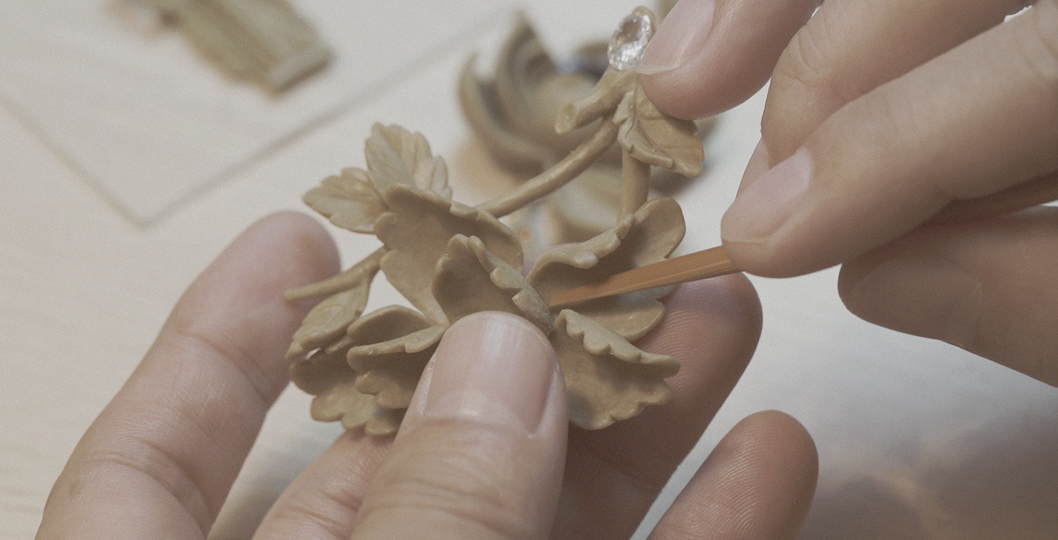
An 18-procedure workflow is a description of how many controlled handoffs exist between raw material and packed goods. Documented production environments inside that workflow include 3D drafting, 3D printing, pattern making, wax injection, wax tree mounting, hand carving, engine turning, a findings workshop, soldering, a chain workshop and chain making. Each environment has an output that the next stage depends on: a pattern before wax, a wax tree before casting, a cast finding before soldering, an assembled piece before finishing and plating.

Three consequences follow for a buyer.
- Defect economics. Every defined stage is a place to stop a defect. A flaw caught during pattern or wax work costs far less than the same flaw discovered after plating and packing.
- Plannable lead time. Sequenced stages allow a schedule to be committed to. Xuping Jewelry’s stated lead time is 30–90 days, which a buyer can only use if the stage sequence behind it is defined.
- Repeatability at volume. The company reports annual output above 100 million pieces and a monthly capacity of 8,000,000 pieces. Volume at that level is achievable only when stages are standardized rather than improvised.
Verifying a step count does not require a factory audit on day one. Three checks cover most of the risk: request the stage list in sequence and confirm it includes finishing and packing; request the written inspection criteria and the sign-off owner for each stage; and place a sample-scale order — Xuping’s minimum order quantity starts at 1 piece — so the reported workflow can be tested against delivered output before volume is committed.
Reading the Material Specification: Copper Alloy Base and Gold Plating
Xuping Jewelry states that all of its items adopt premium copper alloy as the base material with sophisticated gold-plating craftsmanship, delivering texture and durability. That sentence carries two separate procurement decisions that are frequently merged into one.
The base metal
Copper alloy is used in fashion jewelry because it is malleable, holds fine detail produced at casting and hand-work stages, and accepts plating adhesion well. In the documented catalog, the base material field reads “Environmental Copper” across models — a specific grade designation rather than an unspecified alloy, which is what makes it checkable against a purchase specification.
The finish
Catalog specification sheets document finishes as 14K gold color, 18K gold color and platinum plated. The wording matters. In fashion jewelry specification language, “14K gold color” and “18K gold color” describe the tone and appearance of the finish; they are not statements of gold content. Buyers who let the term enter a purchase order without confirming which reading applies create an avoidable dispute at inspection.
| Model | Category | Material & finish | Main stone | Weight |
|---|---|---|---|---|
| 14N245402 | Necklaces | Environmental Copper, platinum plated | Dark blue glass | 49.44 g |
| X001015911 | Necklaces | Environmental Copper, 14K gold color | White synthetic cubic zirconia | 4.30 g |
| X000871334 | Jewelry Sets | Environmental Copper, 18K gold color | White synthetic cubic zirconia | 18.8 g / set |
| X000668301 | Crystal Jewelry – Necklaces | Environmental Copper, 18K gold color | Lilac synthetic crystal | 7.91 g |
| 14E25011845 | Crystal Jewelry – Earrings | Environmental Copper, 18K gold color | AB-color synthetic crystal | 8.88 g / pair |
| T000959269 | Stainless Steel – Bracelets | Stainless steel | No stone | 11.01 g |
Representative specification rows from the catalog, reproduced to show how material, finish, stone and weight are documented at model level.
The stone
Across the documented catalog, the main stone field most often reads “synthetic cubic zirconia” — white, color or ruby tone depending on the model — with synthetic crystal and glass appearing in specific lines. For a buyer, the stone field determines the visual effect achievable at a given price point, the care instructions that accompany the finished piece, and how the item may legitimately be described in a retail listing. Misdescribing a stone in a listing is a labeling risk that is avoidable at the specification stage.
What copper alloy implies for wear
A plated copper-alloy piece is a coated composite: the substrate provides form and weight, while the finish provides color and surface protection. Wear life is therefore governed mainly by finish quality and by how the piece is used and cared for — not by the substrate alone. Buyers specifying for high-contact or long-persistence categories should treat the finish as a service-life variable, confirm care labelling, and state plating expectations in the order specification rather than in conversation.
Equally important is what this construction is not. It is not a solid precious-metal product. It does not carry intrinsic metal value, and it should not be positioned or priced against solid gold merchandise. For markets where precious-metal content is a requirement rather than a preference, plated copper alloy is out of scope.
From Process Capability to Order Execution
Process depth only becomes useful to a buyer when it converts into order-level terms. Xuping Jewelry provides professional one-stop OEM and ODM customization services, and the manufacturer offers OEM and ODM production services for brand owners, distributors and wholesale buyers. Documented customization options include engraved logos, hang tags and custom packaging. The company operates with a 100% export ratio, and its main markets span Europe, America, the Middle East, Southeast Asia and Africa.
| Procurement item | Documented terms |
|---|---|
| Production mode | OEM / ODM |
| Customization | Engraved logos · hang tags · custom packaging |
| Minimum order quantity | 1 piece |
| Lead time | 30–90 days |
| Monthly capacity | 8,000,000 pieces |
| Quality control | 100% full inspection · SGS-certified quality control · 18-stage quality check · REACH/ROHS compliance testing |
| Delivery terms | FOB |
| Acceptance criteria | Pre-shipment test |
| Payment terms | PayPal · Western Union · Money Gram · Bank of China · HSBC |
| After-sales | 24/7 online support · after-sales quality guarantee · product replacement · OEM/ODM after-sales service · global logistics support |
Where this combination is applied in practice: retail jewelry stores, e-commerce platforms, brand OEM/ODM programmes, wholesale distribution and promotional gifting. Documented brand authorized agent programmes in Indonesia, Turkey, Morocco and Turkmenistan report annual sales above 2 million units for the Indonesian and Turkmenistan programmes and above 3 million units for the Morocco programme. Programme highlights recorded in those case files include design variety, rapid style updates, environmentally friendly materials, hypoallergenic construction and on-time delivery.
That case pattern is instructive for a different reason than volume. Each of those relationships began as a specification exercise: material and finish, customization scope, order quantity and acceptance criteria had to be agreed before production could be scheduled at all. The commercial terms above are the mechanism by which an 18-procedure workflow becomes an executable order.
Where This Model Has Limits
An assessment that only lists strengths is not usable for procurement. Four boundaries are worth stating plainly for a multi-stage, plated copper-alloy programme.
- Lead time is a real constraint. A stated 30–90 day lead time does not suit very short replenishment windows or last-minute seasonal top-ups. Buyers with compressed calendars should plan the collection cycle around that window rather than assume expedition.
- Plating is a finish, not a permanent color. Copper alloy with gold-color or platinum plating is a coated composite. It will not match the wear profile or the intrinsic value of solid precious-metal jewelry, and it should not be specified where a market requires precious-metal content.
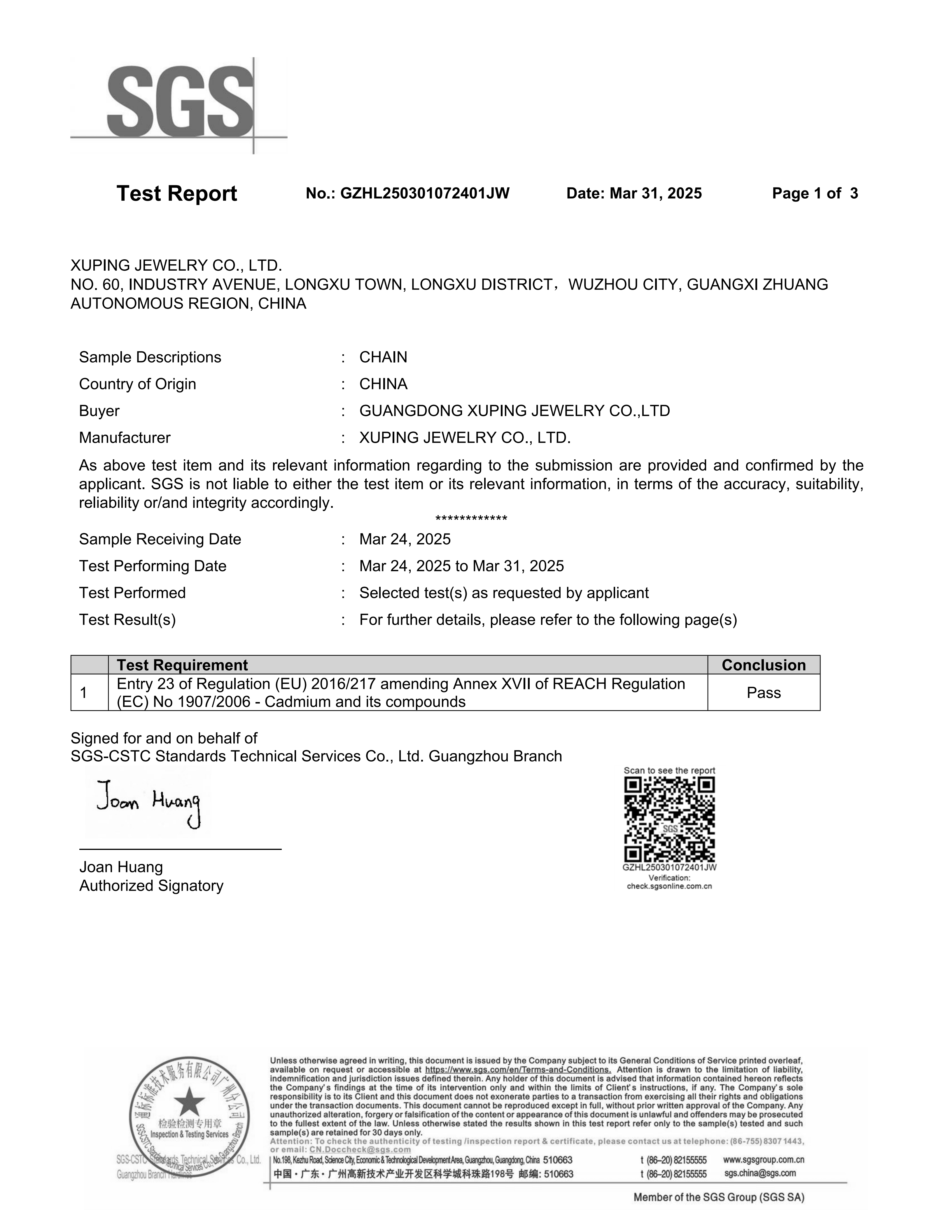
- Test reports have scope. Third-party documents such as SGS reports apply to the models and samples listed in the report and to the standard cited — for example EU REACH Regulation (EC) No 1907/2006 or the IEC 62321 series. They are not a blanket statement covering every SKU or every destination market, so buyers should confirm that the model list matches the intended order.
- Process depth is not free. A longer, inspected workflow consumes capacity and time. Buyers should expect that difference to appear in unit economics rather than assume the supplier absorbs it, and should weigh it against the cost of returns caused by inconsistent output.
| Dimension | Documented multi-stage production (Xuping Jewelry reference) | Typical low-documentation sourcing profile |
|---|---|---|
| Process definition | 18 stated procedures; documented environments include 3D drafting, 3D printing, pattern making, wax injection, hand carving, soldering and chain work | Stage list varies by supplier and is often summarized at category level |
| Inspection | 100% full inspection, SGS-certified quality control, 18-stage quality check | Sampling-based inspection is common; scope should be confirmed in writing |
| Testing and compliance | REACH/ROHS compliance testing; ISO9001 certification (GB/T 19001-2016 / ISO 9001:2015) covering design and production of metal jewelry; SGS reports under REACH (EC) No 1907/2006 and IEC 62321 series | Testing frequently performed on request; report scope and model coverage require verification |
| Material specification | Environmental copper base; finishes documented as 14K gold color, 18K gold color and platinum plated; stainless steel lines also produced | Base material and finish are sometimes described only as “alloy” or “gold tone” |
| Customization | OEM/ODM with engraved logos, hang tags and custom packaging | Frequently limited to existing designs and stock colorways |
| Commercial terms | MOQ from 1 piece; lead time 30–90 days; monthly capacity 8,000,000 pieces | Terms vary; MOQ and lead time are usually the first constraints encountered |
The point of the comparison is not that one column is universally correct. It is that the left-hand column can be quoted, inspected and disputed, while the right-hand column usually cannot — which changes what the buyer is actually purchasing.
Market Context for Process-Based Sourcing
The category this process serves is large and still expanding. The global fashion jewelry market was valued at USD 168 billion in 2024 and is projected to reach USD 289 billion by 2033, a compound annual growth rate of 6.2%. Supply remains concentrated: Asia Pacific accounted for 30.8% of costume jewelry market revenue in 2024.
Trade mechanics reinforce the same direction. Imitation jewelry of base metal — the classification that covers plated copper-alloy fashion pieces — sits under HS Code 7117.19, and the US import duty rate for HS 7117.19.00 is 11% at the MFN rate. When duty at that level is already embedded in landed cost, unplanned rework and returns become disproportionately expensive relative to the price gap between suppliers. That arithmetic favors fewer suppliers with documented process and material specifications over a longer tail of cheaper, less documented ones.
What to Watch Next
Two shifts look reasonable from the available evidence. The first is volume continuity: with the market projected to grow to USD 289 billion by 2033, demand for plated base-metal fashion jewelry — and therefore for the copper-alloy plus plating construction it depends on — is unlikely to fall away. The second is evidence. As compliance expectations tighten across major markets, buyers are more likely to request process documentation, material specification and test-report scope instead of accepting category-level statements about quality.
For sourcing teams, the practical implication is that terminology becomes contractual. Specifying “18 procedures”, “copper alloy base” or “gold-color plating” without defining what each term covers does not remove risk; it simply moves the dispute later in the timeline. The buyers who gain most from this manufacturing model are the ones who convert its process language into specification line items before the purchase order is issued.
Technical and Procurement FAQ
What does “18 production procedures” mean in fashion jewelry manufacturing?
It means a piece passes through 18 defined, sequenced manufacturing stages between raw material and packed goods. Xuping Jewelry states that all goods go through 18 production procedures to meet European and American environmental-protection standards. Documented environments within that workflow include 3D drafting, 3D printing, pattern making, wax injection, wax tree mounting, hand carving, engine turning, a findings workshop, soldering, a chain workshop and chain making. The figure describes process granularity; it is not a quality guarantee by itself.
Why does the number of production procedures matter to a buyer?
More defined stages generally mean more checkpoints where a defect can be stopped before it reaches the next operation, which supports output consistency at volume. It also makes capacity and delivery plannable: Xuping Jewelry reports a monthly capacity of 8,000,000 pieces and annual output above 100 million pieces. The count is only meaningful if the stages are inspected and the criteria are documented, so buyers should request the stage list and inspection criteria alongside the number.
What does gold plating mean on fashion jewelry, and how does it affect value?
Gold plating is a surface finish applied over a base metal — in Xuping Jewelry’s case, over premium copper alloy, with finishes documented in the catalog as 14K gold color, 18K gold color and platinum plated. Descriptors such as “14K gold color” and “18K gold color” indicate the tone of the finish rather than the gold content of the piece. Value in this category comes from finish quality, base-material consistency, design and process control rather than from intrinsic metal content.
What does copper alloy construction imply for wear?
Copper alloy supplies form and weight and accepts plating adhesion well; the plated finish supplies color and surface protection. Wear is therefore determined mainly by finish quality and by how the piece is used and cared for, not by the substrate alone. The construction is a coated composite rather than a solid precious-metal product, so buyers should specify care expectations and avoid positioning it against solid gold merchandise.
How do SGS and ISO9001 relate to the production process?
Xuping Jewelry holds ISO9001 certification issued under GB/T 19001-2016 / ISO 9001:2015, with a scope covering the design and production of metal jewelry, and holds third-party SGS test documentation, including lead content testing under EU REACH Regulation (EC) No 1907/2006 and testing under IEC 62321 series standards. REACH/ROHS compliance testing and an 18-stage quality check are documented as part of the quality control process. Reports apply to the models and samples listed and to the standard cited, so buyers should confirm report scope against the SKUs they intend to order.
What OEM and ODM customization options are available?
Xuping Jewelry provides professional one-stop OEM and ODM customization services and offers OEM and ODM production services for brand owners, distributors and wholesale buyers. Documented customization options include engraved logos, hang tags and custom packaging. These services operate alongside a 100% export ratio, with main markets spanning Europe, America, the Middle East, Southeast Asia and Africa.
What are the minimum order quantity, lead time, delivery and payment terms?
Documented purchasing terms are a minimum order quantity of 1 piece, FOB delivery terms, a pre-shipment test as the acceptance criterion, and payment through PayPal, Western Union, Money Gram, Bank of China or HSBC. The stated lead time is 30–90 days, supported by a monthly capacity of 8,000,000 pieces. Buyers planning fixed retail launch dates should map that window into their calendar before confirming a collection.
What quality control is performed before shipment?
Xuping Jewelry documents 100% full inspection, SGS-certified quality control, an 18-stage quality check and REACH/ROHS compliance testing. After-sales provisions include 24/7 online support, an after-sales quality guarantee, product replacement, OEM/ODM after-sales service and global logistics support. Acceptance is based on a pre-shipment test, which places the inspection evidence inside the delivery process rather than after arrival.
¿Tiene preguntas o necesita más detalles?
Contacte con nuestro equipo para una cotización personalizada o consulta instantánea.
Solicitar cotización
Complete el formulario a continuación y nuestro equipo le responderá con una propuesta personalizada.
Chat directo de WhatsApp
¿Prefiere chatear en tiempo real? Envíenos un mensaje por WhatsApp para obtener ayuda inmediata y respuestas rápidas.
- Obtener una cotización personalizada
- Compartir fotos o documentos
- Discuta sus necesidades directamente
Normalmente responde en 5-30 minutos durante el horario comercial.