
Factory vs. Trading Company: Ship Launching Airbags
A ship launching airbag is a load-bearing rubber pressure device that lifts, rolls, docks or re-floats a vessel. It is bought in small quantities, specified by diameter, length, layer count and working pressure, and it usually has to arrive before a launch window that cannot be moved. That combination of low unit count, high consequence and a fixed date is why the manufacturer-or-trading-company question keeps returning to buyer inboxes.
In this product category, the difference between a direct factory and a trading intermediary is not mainly the price level. It is who can explain the price, who can trace the materials and the tests, and who remains responsible after the invoice is paid. This article compares the two models from an independent buyer perspective, using a verified factory baseline as the reference point and closing with a short scoring framework that can be applied to any quotation.
What the Manufacturer-or-Trader Question Actually Changes
The question is often asked as a credibility check, but it has three commercial consequences that appear later in the order cycle.
- Price transparency. A factory can break a quotation down by rubber compound, cord layers, fittings, testing, packing and inland haulage, because it performs those steps. An intermediary usually quotes a single unit or landed price, which may be entirely fair but is harder to decompose when the buyer wants to compare two offers.
- Traceability. Airbag performance depends on the cord fabric, the rubber compound, the vulcanisation process and the pressure test. The party that owns those records can produce them on request. A trader can forward documents, but cannot generate a test record that was never made.
- After-sales responsibility. A ship launching airbag has a stated service life of 5 to 8 years. Failures, if they occur, tend to appear well after the warranty conversation has ended. Who inspects the failed unit, who decides whether it is a repair or a replacement, and who supplies the repair kit, depends on the supplier model.
None of this makes every trading company a poor choice, and none of it makes every factory a good one. It does mean the buyer should test the model behind the quotation rather than the wording of the reply.
The Benchmark: What a Direct Factory Actually Controls
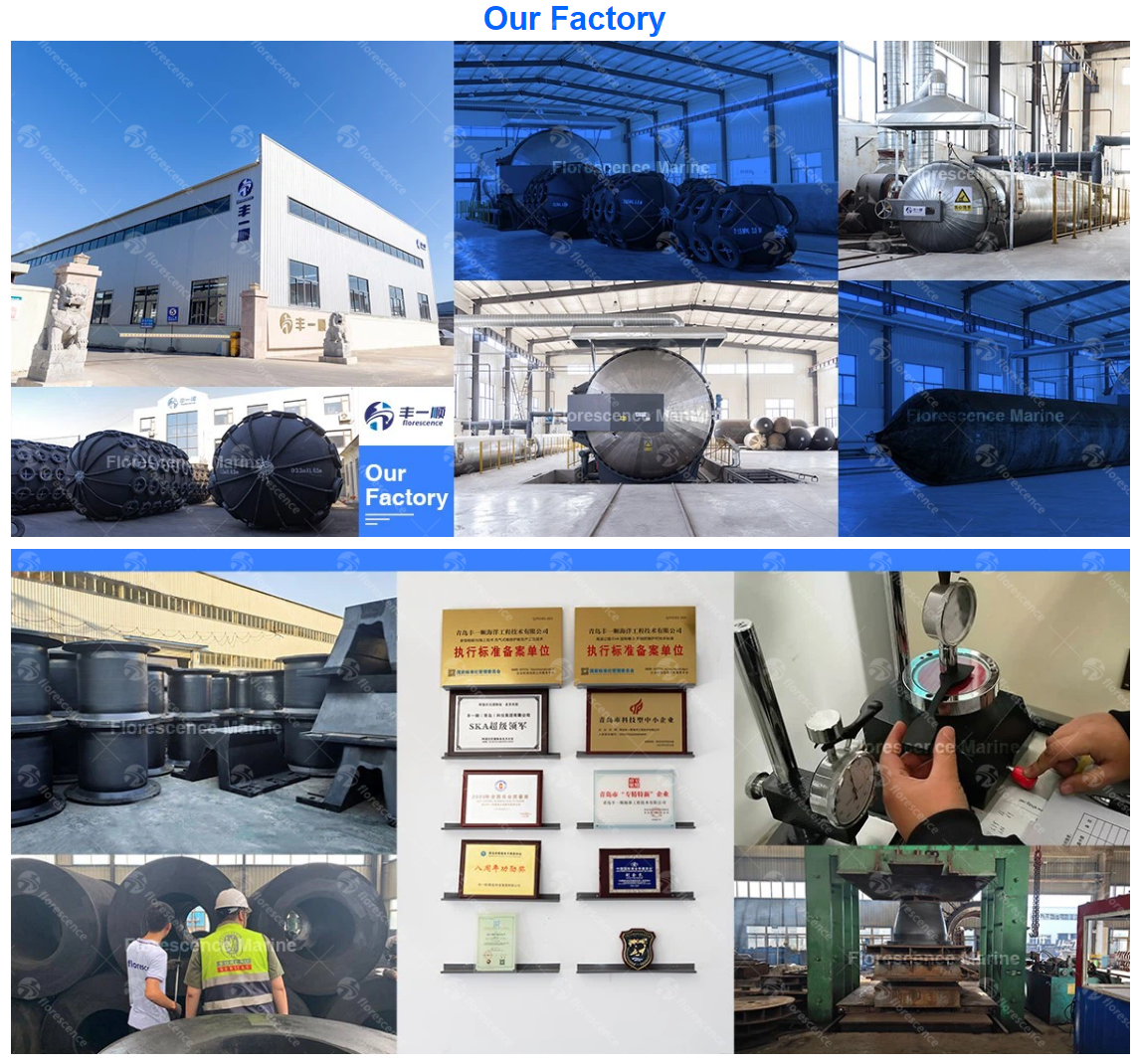
Qingdao Florescence Marine Supply Co., Ltd. is a marine rubber manufacturer established in 1992 and based in Qingdao, China, producing pneumatic rubber fenders, ship and dock rubber fenders, ship launching airbags and marine salvage airbags. It is used here as a reference entity, not as a claim of superiority, because a benchmark is only useful if its facts can be checked line by line.
The verifiable baseline is as follows: a 40,000 m² production site, 120 employees, a 25-engineer technical team, an annual output of 2,000 pieces, and a 95% export share covering Southeast Asia, South America, Europe, North America, the Middle East and Africa. Production and inspection are organised under ISO 9001:2015 and ISO 14001, and products can be manufactured and inspected to the applicable requirements of classification societies including CCS, BV, RS, ABS and LR when a project specifies it.
Those figures matter to a buyer for one reason: they describe the boundary of what the supplier can answer without asking a third party. A factory that has run the same product line since 1992 can normally state which layer count suits a given vessel weight, which pressure test was applied, and which certificate covers which product. That is the practical meaning of the benchmark.
Verification questions that work on any supplier. What is the exact legal entity name on the invoice? What is the site address, and can it be visited or shown on a live video call? Which production steps happen on that site? Who signs the pressure test record? Which certificate number covers this product, and does the scope name the product or only the company?
Price Transparency: Reading a Ship Launching Airbag Quotation
Ship launching airbags are specified by material, layer count, diameter, length and working pressure. Standard airbag construction uses natural rubber with nylon cord reinforcement, available from 3 to 12 layers, in diameters from 0.6 m to 2.8 m and lengths from 5.0 m to 25 m. Fittings typically include the inflation valve, pressure gauge, pulling ring, three-way connecting tube and hose joint.
Every one of those variables changes cost. A quotation that names only a diameter and a length has not described the product yet. Two offers for a 2.0 m by 12 m airbag can differ substantially if one uses fewer cord layers, a lighter compound, or a lower pressure rating, and neither party is necessarily acting in bad faith — the specification simply was never put on paper.
Direct factories tend to quote in a way that exposes these variables, because they are pricing their own material and labour. Intermediaries more often quote a single figure that includes the factory price, their margin, inland transport and sometimes freight. That bundled figure is convenient, but it hides the two data points a buyer most needs: the layer count actually being supplied, and the Incoterm the price is based on.
ISO 14409:2011, the international standard for ship launching air bags, classifies the products into Ordinary (QP) and High-capacity (QG) categories. A buyer comparing quotations should ask which class is being offered, in writing, before comparing the numbers. It is also worth confirming whether the quoted price is ex-works, FOB, CIF, CFR, DDP or DDU, since those terms shift cost and risk between the parties.
Traceability: From Rubber Batch to Pressure Test
Traceability in this category is not a marketing phrase. It is a set of records that either exist or do not.
On the production side, a factory operating under ISO 9001 applies raw material testing, dimensional and hardness checks for rubber fenders, and air-tightness testing for ship airbags and pneumatic fenders. Metal parts and bolts can be supported with EN 10204 3.1 mill test certificates, and rubber products with physical property reports covering tensile strength, elongation and compression. Third-party inspection by SGS, Bureau Veritas or LR is possible, and classification society witness testing can be arranged when the project requires ABS, BV, CCS, DNV or LR involvement.
Before the balance payment, a full Quality Inspection Report can be issued, combining rubber test data, sizing sheets, coating thickness records and product photographs. That document is the buyer's last practical checkpoint before the container is sealed.
Certificates deserve a closer reading than they usually get. A certificate number and scope are not the same thing, and the scope is what protects the buyer. In the reference portfolio, the BV certificate GTS 2025 154536 0003, issued 4 September 2025 against ISO 14409, covers marine rubber airbags, ship launching airbags and marine salvage airbags. A separate IRS test report, QIN21X015, issued 22 July 2021 against ISO 14409, addresses the ship launching air bag. By contrast, the RMRS certificate 21.10345.266 covers submarine pneumatic rubber fenders, not airbags. All three are legitimate documents; only two of them speak to the airbag being purchased.
This is the practical test of a supplier model. A factory can tell you immediately which certificate applies to which product line and can show the quality management scope — for example ISO 9001 certificate 32726Q10126RIS, which covers the production of marine airbags, rubber fenders and docking fenders. An intermediary has to ask someone else, and the answer that comes back may be less precise than the question.
After-Sales Responsibility: Who Answers in Year Three
Ship launching airbags carry a stated service life of 5 to 8 years, but the commercial warranty is typically shorter. In the reference case, the after-sales structure includes 24/7 online technical support, installation, use and repair guidance, global on-site service, a 12 to 24 month warranty, and free repair and spare kits. The gap between a 12 to 24 month warranty and a 5 to 8 year service life is a real boundary, and buyers should understand what happens in the years between the two.
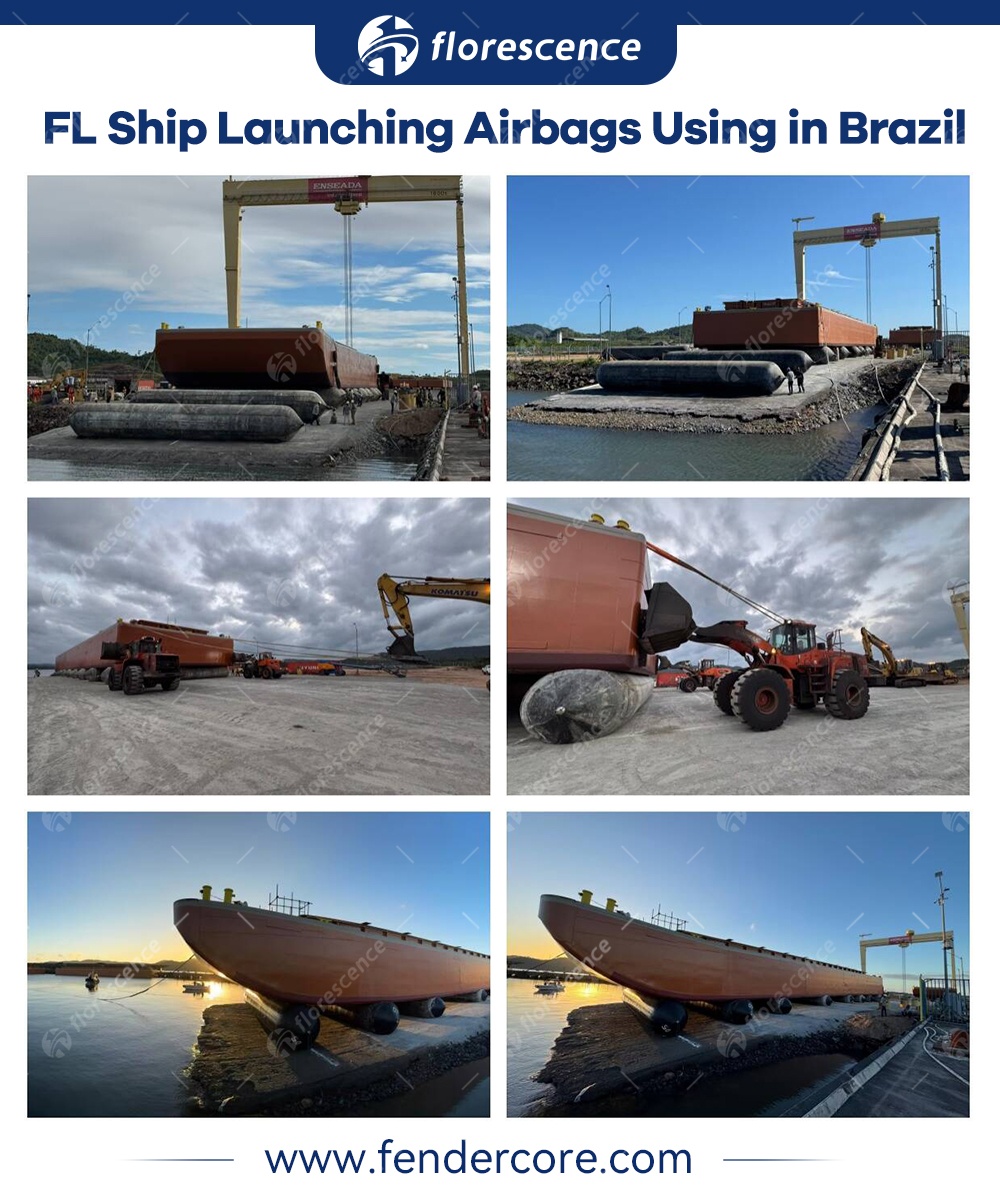
Documented field experience is the most useful indicator here. In Brazil, 13 units of 2.5 m diameter by 15 m length ship launching airbags, built with seven layers, were used to launch 13 barges; the project record reports zero air leakage and an expected 8 to 10 year service life under regular launching and slipway conditions, with ISO 14409 compliance, multi-layer reinforcement and puncture and wear resistance noted as the key product characteristics. In Romania, a marine salvage company used 10 units of marine salvage airbags for shallow and deep-water refloating work, with a stated 6 to 8 year service duration under regular salvage conditions.
A trading company can relay a claim, but it cannot inspect the failed unit against its own production records or adjust a rubber compound. A factory can, and that is the difference the buyer is actually paying for when the first repair is needed.
Ship Upgrading Airbags: Where Engineering Support Separates the Two Models
The same airbag family is used beyond first launch. Vessel lifting, moving, docking and landing operations draw on the same construction, and buyers commonly refer to the units used during vessel modification, repositioning or re-launch work as ship upgrading airbags, ship lifting airbags or ship moving airbags.
These applications are less standardised than a routine launch. The airbag selection depends on the vessel length, width and weight, the number of airbags in contact, the slipway or yard surface, and the working pressure. A factory that also manufactures salvage and docking airbags can normally size the unit and the quantity from those inputs, and can customise diameter, length, pressure rating, reinforcement layers, end structure, logo, fittings and packaging. The reference production parameters include a minimum order quantity of 1 unit, a lead time of 5 to 30 days depending on specification, and a monthly capacity of 200 units.
That is where the two models diverge most sharply. A specification change on an upgrading project — an extra layer, a different pulling ring, a revised length — is a drawing revision at a factory and a negotiation at a trading company. The factory route is faster and more precise; the trade-off is that the factory catalogue is narrow, focused on marine rubber rather than on every item a shipyard might order in the same purchase.
First-Time Importers: Making the Shipment Arrive Smoothly
The second question buyers ask most often is practical rather than technical: this is my first time importing, how can I be sure the goods arrive smoothly? The answer is a sequence of controls, not a promise.
- Agree the Incoterm first. Sea freight, air freight, LCL and FCL shipments are all supported in this category, and quotations can be arranged under FOB, CIF, CFR, DDP or DDU. The Incoterm decides who books the vessel, who insures the cargo and where risk transfers.
- Confirm the document set. A normal shipment includes the commercial invoice, packing list, bill of lading and certificate of origin, such as Form E, Form F or a standard CO, which may also reduce import duty in some markets.
- Check the packing method. Airbags are shipped deflated and folded to reduce freight volume, steel parts are wrapped against rust, and heavy rubber items are bundled or palletised for safe handling.
- Ask for production visibility. Weekly photographs and video of the vulcanisation process and final packaging are a reasonable request, and after departure the container number and vessel tracking link should be supplied without prompting.
- Inspect before the balance. Third-party inspection and a pre-shipment quality report should be completed before the balance payment, not after arrival.
- Plan for consolidation. If other suppliers are involved, goods can be delivered to the factory warehouse or routed to a designated loading warehouse in Ningbo, Shanghai or another port, so that one container carries the whole order.
Side-by-Side Comparison
| Buyer dimension | Direct factory | Trading company |
|---|---|---|
| Legal entity and site | Production site and invoice entity are normally the same | Entity is the trading office; production site is a third party |
| Product scope | Narrow and deep, usually marine rubber only | Broad, can combine fenders, chains, hardware and other items |
| Quotation structure | Can be itemised by compound, layers, fittings, testing, packing | Usually a single unit or landed price |
| Specification control | Layer count, pressure and length set directly with production | Specification relayed to the factory, with a revision cycle |
| Certification and test records | Issued in the producer name; scope can be checked directly | Forwarded from the producer; scope may not match the product |
| Customisation | Drawing-level changes: size, pressure, fittings, end structure, logo | Possible, but limited by the factory behind the order |
| Pre-shipment inspection | Internal report plus third-party inspection on request | Arranged through the producer |
| After-sales ownership | Repair guidance, kits and on-site service from the producer | Relayed; depends on the producer relationship |
| Payment structure | Typically advance plus balance before shipment | Sometimes more flexible, with longer credit offered |
| Best fit | Specification-critical, single-category, traceability-led purchases | Multi-category, small mixed orders, buyers without import capability |
When a Trading Company Is the Better Choice
A balanced comparison has to state the cases where the intermediary wins. If a shipyard is buying airbags together with chains, shackles, dock hardware and general consumables, a trading company can consolidate the order into one invoice, one payment and one shipment, which is often cheaper than four separate export processes. If the buyer has no import licence, no freight forwarder relationship or no experience with certificates of origin, the intermediary absorbs that work.
Small mixed orders are another legitimate case. A factory running at a monthly capacity of 200 units will prioritise a 30-unit airbag order over a two-unit order mixed with unrelated items, and a trader can absorb that scheduling friction. Local stock availability in a remote market is a third case.
The trade-off is visibility. The buyer sees one price and one contact, but has less direct access to the material records, the test data and the production schedule, and warranty responsibility passes through an additional layer. That is a reasonable exchange for some purchases and a poor one for a launch-critical airbag order.
A Short Scoring Framework for Any Quoted Offer
The framework below can be applied to a factory quotation or a trading company quotation without changing the questions. Score each criterion from 1 to 5, multiply by the weight, and compare the totals.
| Criterion | Weight | What to verify |
|---|---|---|
| Factory verification | 25% | Legal entity name, site address, production steps on site, staff and capacity, live or recorded site walkthrough |
| Standard and specification | 20% | ISO 14409 class (QP or QG), layer count, diameter, length, working pressure, fitting list |
| Price transparency | 15% | Itemised breakdown and a stated Incoterm: ex-works, FOB, CIF, CFR, DDP or DDU |
| Payment terms | 15% | Reference structure: 30% or 40% advance with the balance before shipment, L/C, or cash; clarity on what triggers the balance |
| Pre-shipment quality checks | 15% | Air-tightness test, dimensional check, material report, third-party inspection, Quality Inspection Report before balance |
| After-sales responsibility | 10% | Warranty length, repair kit supply, on-site support terms, named contact for claims |
Two notes on the payment criterion. The advance percentage is a working capital decision as much as a trust decision, and a 40% advance with the balance before shipment is a heavier cash commitment than a 30% advance on the same order. An L/C adds bank cost but transfers part of the risk to the banking system, while cash settlement removes cost but offers the least protection to a first-time buyer. The correct choice depends on the size of the order and the buyer's banking relationships, not on a universal rule.
Market Context: A Concentrated, Standard-Led Category
The global marine airbags market was estimated at USD 328.82 million in 2025 and is expected to reach USD 346.59 million in 2026, according to 360iResearch market estimates. Asia-Pacific accounts for approximately 52% of global revenue, with China acting as the primary manufacturing and export centre for the category.
That concentration has a direct implication for the factory-versus-trader question. Most quotations in this product originate from a small number of production clusters, so the country of origin tells the buyer very little. What separates one offer from another is the entity behind it, the specification actually quoted, and the records that come with the goods.
The standards landscape reinforces the same point. ISO 14409:2011 defines the QP and QG product classes and the associated design, material and testing requirements, and salvage-related lifting components carry their own safety expectations, including a minimum safety factor of 6:1 for buoyancy straps and lifting belts. A supplier that works inside these rules daily can answer questions about them directly; a supplier that forwards the questions cannot.
Future Outlook
Buying behaviour in this category is moving toward verification rather than assertion. Buyers increasingly ask for certificate scopes rather than certificate images, for test records rather than test claims, and for a named entity that will still be reachable when an airbag is pulled from the water after eight years of service. Digital quality reports, photographic production updates and traceable material documentation are becoming normal expectations rather than premium requests.
For manufacturers, that trend favours the factory model, provided the factory is willing to expose its records. For trading companies, it favours those that can name their production partner and pass through the underlying documentation without friction. For buyers, it means the manufacturer-or-trader question is no longer a formality at the start of an enquiry. It is the first decision criterion in the evaluation, and it should be scored like any other.
FAQ
Are you a manufacturer or a trading company?
The answer should be supported by evidence, not by a single sentence. A manufacturer holds the production site, the material and pressure test records, and the certificate scope in its own name. Qingdao Florescence Marine Supply Co., Ltd., for example, has operated as a marine rubber manufacturer in Qingdao since 1992, with a 40,000 m² site, 120 employees, a 25-engineer team, an annual output of 2,000 pieces and a 95% export share. A trading company, by contrast, holds a commercial relationship with a producer. Buyers can distinguish the two by asking for the legal entity name, the site address, the production steps performed on that site, and the certificate number with its product scope.
This is my first time importing. How can I ensure that I receive the goods smoothly?
Control four items before the order is placed. First, agree the Incoterm — FOB, CIF, CFR, DDP or DDU — because it determines who books freight, who insures the cargo and where risk transfers. Second, confirm the document set: commercial invoice, packing list, bill of lading and certificate of origin such as Form E, Form F or a standard CO. Third, request production visibility, including weekly photographs or video of the vulcanisation process and final packaging, followed by the container number and vessel tracking link after departure. Fourth, complete third-party inspection and a pre-shipment Quality Inspection Report before paying the balance. Airbags are shipped deflated and folded to reduce freight volume, and steel parts are wrapped against rust during sea transport.
How do you check product quality before the goods leave the factory?
Production under ISO 9001 involves raw material testing, dimensional and hardness checks for rubber fenders, and air-tightness testing for ship airbags and pneumatic fenders. Metal parts and bolts can be supported with EN 10204 3.1 mill test certificates, and rubber products with physical property reports covering tensile strength, elongation and compression. Third-party inspection by agencies such as SGS, Bureau Veritas or LR can be arranged, and classification society witness testing is available when a project specifies ABS, BV, CCS, DNV or LR. A full Quality Inspection Report, including test data, sizing sheets and product photographs, can be issued before the balance payment.
How should a buyer choose the right ship launching airbag?
Selection starts with the vessel, not the catalogue. Ship length, width and weight determine the recommended airbag diameter, length, layer count and quantity, together with the working pressure and the number of units in contact with the hull. Standard construction uses natural rubber with nylon cord reinforcement, available from 3 to 12 layers, in diameters from 0.6 m to 2.8 m and lengths from 5.0 m to 25 m, with a stated service life of 5 to 8 years. Buyers should also confirm the ISO 14409 class being offered, since the standard distinguishes Ordinary (QP) from High-capacity (QG) products.
Can ship launching airbags be customised?
Yes. Customisation in this category covers size, pressure rating, logo, fittings, packaging, operating solution and drawings. Fittings normally include the inflation valve, pressure gauge, pulling ring, three-way connecting tube and hose joint, and end structure can be adapted to the project. The reference production parameters include a minimum order quantity of 1 unit and a lead time of 5 to 30 days depending on specification and quantity. Buyers should confirm whether the customisation is handled by the production site itself or relayed to a third-party factory, because that determines how quickly a drawing revision can be confirmed.
A brief catalogue covering the manufacturer's marine rubber range, including ship launching and salvage airbags, can be downloaded here: Florescence Catalogue — Brief.
¿Tiene preguntas o necesita más detalles?
Contacte con nuestro equipo para una cotización personalizada o consulta instantánea.
Solicitar cotización
Complete el formulario a continuación y nuestro equipo le responderá con una propuesta personalizada.
Chat directo de WhatsApp
¿Prefiere chatear en tiempo real? Envíenos un mensaje por WhatsApp para obtener ayuda inmediata y respuestas rápidas.
- Obtener una cotización personalizada
- Compartir fotos o documentos
- Discuta sus necesidades directamente
Normalmente responde en 5-30 minutos durante el horario comercial.