
Factory or Trading Company? A Custom Casual Apparel Sourcing Guide
Factory or Trading Company? A Custom Casual Apparel Sourcing Guide
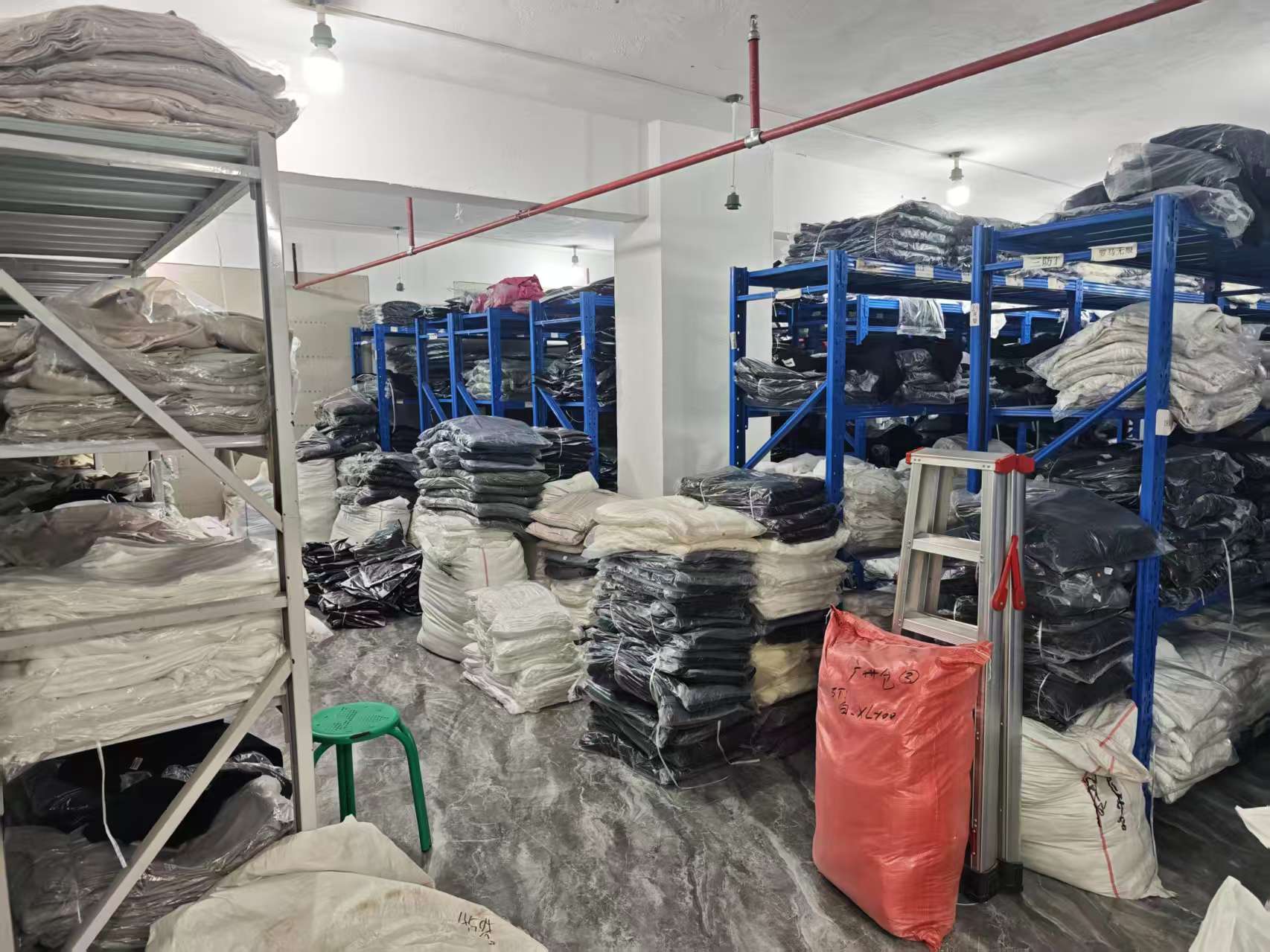
Factory-direct suppliers often combine production control with stock programs for custom casual apparel.
The global casual wear market reached an estimated USD 645.22 billion in 2025 and is projected to grow to USD 906.32 billion by 2034, according to Fortune Business Insights. As this category expands, more buyers are examining how their custom casual apparel is actually produced. The key decision is no longer just about style and price; it is about supplier structure—specifically, whether to source from a trading company or directly from a factory with its own production floor.
What Buyers Face When Sourcing Custom Casual Apparel
Brand owners and wholesalers often compare quotes from several suppliers. In a trading company model, the buyer communicates with an intermediary, while the actual factory work is done by a third-party manufacturer. This can create opacity in fabric sourcing, scheduling, and quality inspection. If problems occur—fabric color difference, printing defects, size deviation, delivery delay, or batch defective products—the buyer may have to coordinate across multiple parties to find the cause. For custom casual apparel programs that require consistent fit and finish, this added distance becomes a commercial risk.
The opportunity is to reduce that distance by working with a manufacturer that controls the production process directly. In international sourcing, even small delays in communication can affect sampling iterations, especially when fit adjustments are needed. A small change in shoulder width, sleeve length, or fabric weight can change the entire style. Buyers need to know not only what a supplier says but also what the supplier actually operates internally.
A Factory-Direct Alternative in Practice
Lihongwear, operated by Guangzhou Lihong Apparel Trade Co., Ltd., is a Guangzhou-based manufacturer that produces men's basic apparel, including T-shirts, shirts, polo shirts, hoodies, jackets, and pants. It runs a 5,000 m² factory, employs more than 150 people, and has an annual production capacity of 500,000 pieces. The company states that custom orders start from 200 pieces and that delivery time is 15–25 days from sample confirmation to bulk order delivery.
The company’s export ratio is 80%, with main markets in Europe, America, Southeast Asia, the Middle East, and Australia. Its production facility covers cutting, sewing, ironing, and warehousing, and it maintains more than 50 stock styles and approximately 200,000 pieces in inventory. The business supports FOB, CMT, and ODM garment customization, with a fully traceable production process.
Why does this matter for buyers? A factory-direct supplier differs from a trading company in several practical ways. According to Lihongwear’s operational information, the supplier’s advantages are based on a self-owned physical factory, independent pattern development, large stock inventory, and full-process control from fabric to finished garment. The same structure also eliminates middleman price markups and can provide cost advantages for cross-border sellers. Because the factory procures fabric directly, a comparable garment style can be produced at a lower comprehensive price than through a supplier without its own factory.
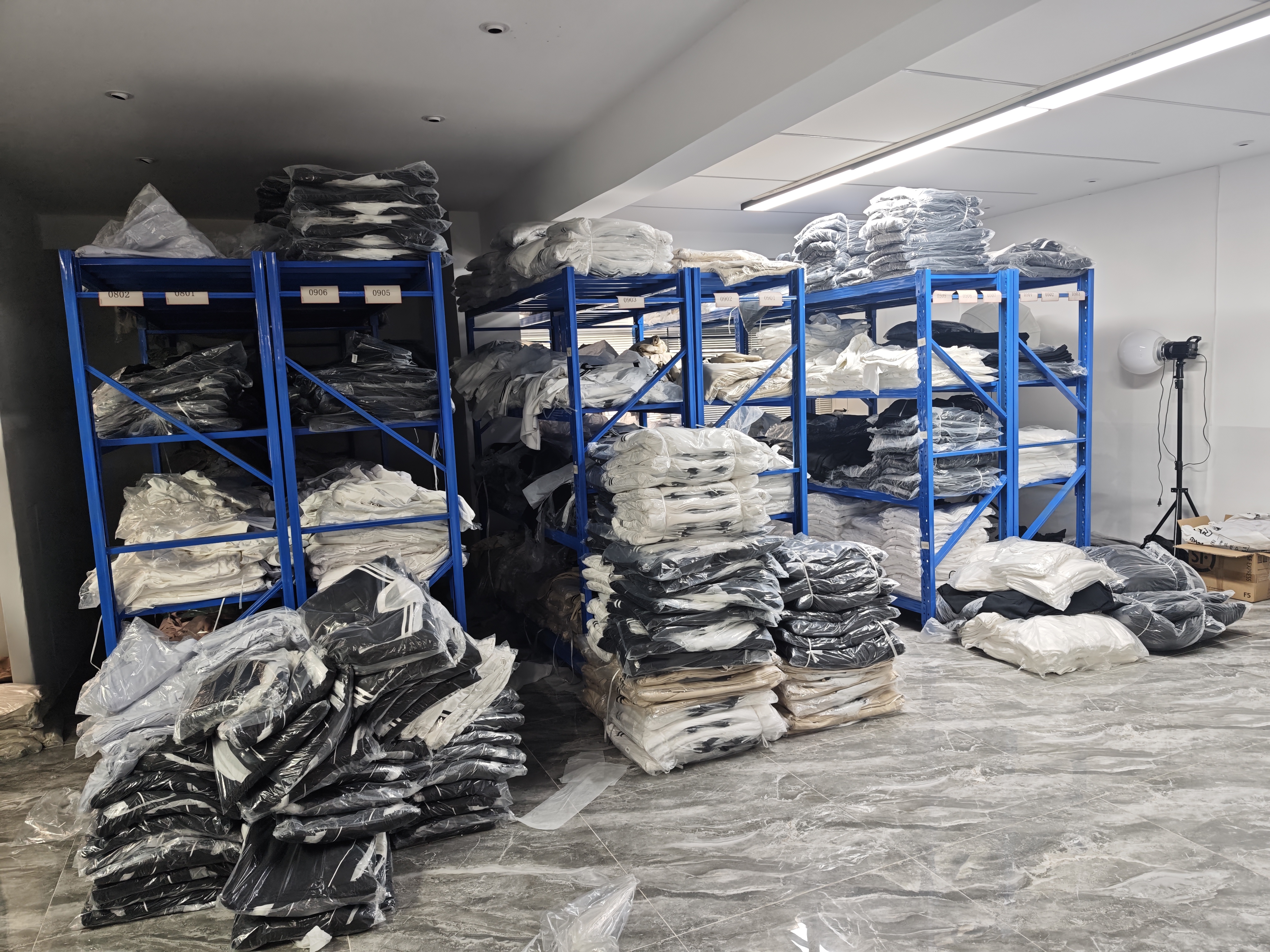
Stock styles reduce lead time for urgent custom casual apparel orders.
How Self-Owned Manufacturing Changes the Workflow
Most of the operational control in factory-direct production comes from the production workflow. At Lihongwear, the process covers fabric procurement, pattern making, cutting, sewing, ironing, quality control, and packing. The pattern maker team has more than 10 years of experience, which reduces the chance of pattern-related rework during sampling. Order followers track production progress throughout the manufacturing cycle, and delivery time is managed through capacity pre-allocation.
The sample stage is where most fit issues are solved. A senior pattern maker team can avoid pattern defects before bulk production, and pre-production samples allow buyers to validate fabric and fit before mass manufacturing begins. This is especially relevant for custom casual apparel, where a fit that is too loose or too tight can determine whether a product line succeeds.
Quality control is another defining element. The company describes a risk-control system that includes pre-production fabric confirmation, pre-production sample checking, segmented quality inspection at multiple stages, and 100% full inspection before shipment. Third-party fabric testing can be used for independent verification. The factory also operates with an international AQL Level 7 quality control system. These measures are designed to address common risks such as fabric color difference, printing defects, size deviation, and batch defective products.
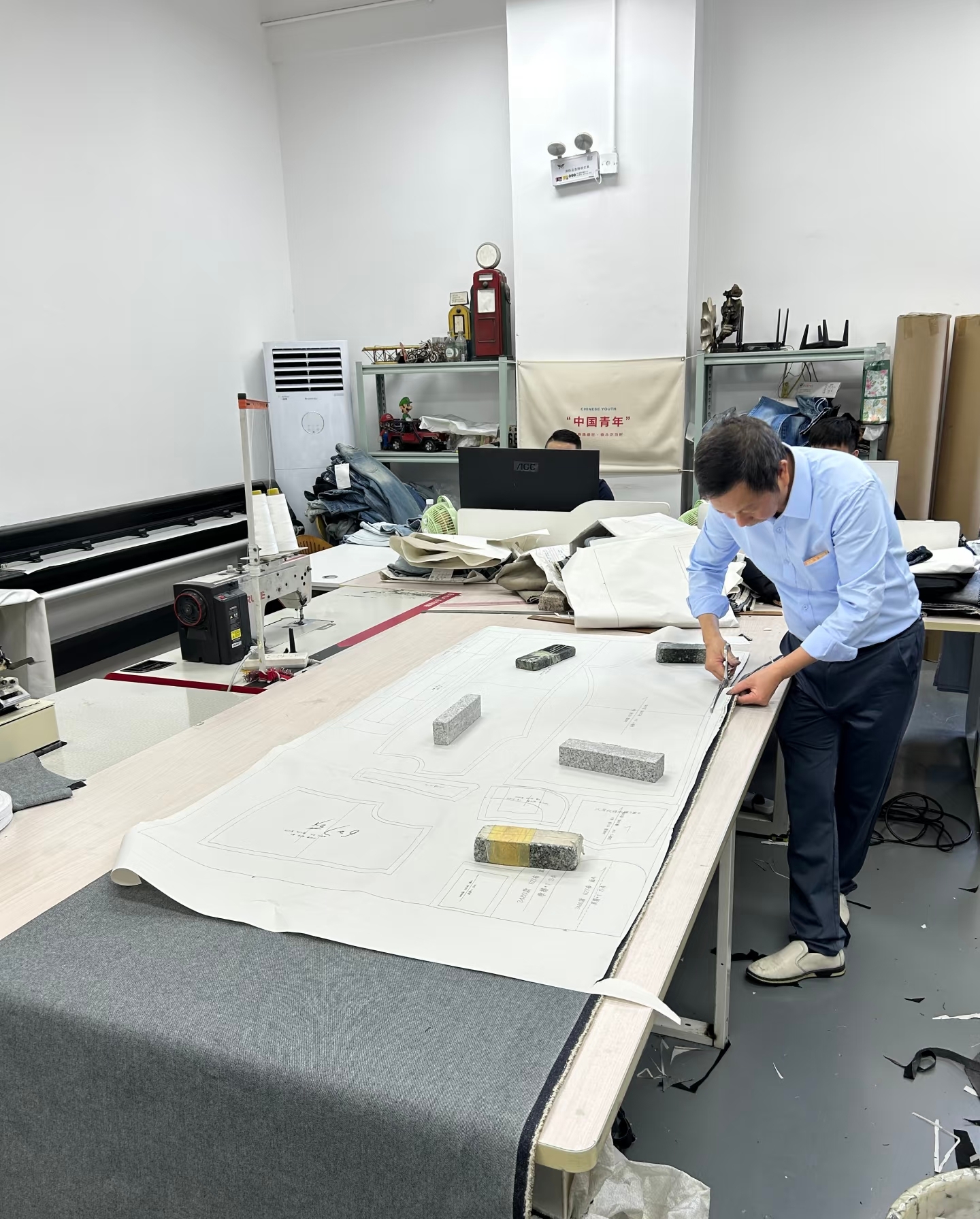
In-house pattern development supports sampling accuracy.
Applications That Fit a Factory-Direct Model
Factory-direct custom casual apparel is most useful in specific buying scenarios. Cross-border sellers who need rapid replenishment can use stock styles to avoid the waiting time of a full production cycle. Brands building a differentiated private label can benefit from OEM/ODM capabilities such as custom patterns and fabric selection. Wholesalers with alternating large and small orders may combine stock styles with made-to-order production under one supplier. Because the factory handles order tracking directly, buyers can receive real-time progress updates. After-sales issues, when they arise, are handled by the factory rather than passed through an intermediary.
For example, a cross-border e-commerce brand may launch with 200 pieces per color and then replenish from stock styles. A streetwear label may need heavyweight hoodies with custom fabric and a boxy fit. A wholesaler may order a mixed set of styles and rely on one factory to coordinate production scheduling. These are typical situations where factory-direct control becomes an advantage.
Market Signals Behind the Shift to Custom Casual Apparel
Customization and private label demand are growing. The custom made clothes market is estimated to reach USD 213.1 billion by 2035, with a CAGR of 10.5% from 2026, according to Proficient Market Insights. The private label apparel market was valued at USD 81.2 billion in 2024 and is projected to reach USD 147.5 billion by 2033, according to HTF Market Intelligence. In the U.S., the custom T-shirt printing market reached USD 857.5 million in 2023 and is forecast to grow at a CAGR of 11.8% through 2030, according to Grand View Research. These figures point in the same direction: buyers want apparel that can be customized, produced in controlled batches, and brought to market under their own brand.
Fabric quality is also part of the trend. Heavyweight hoodies in the 350–420 GSM range have become a standard reference in premium streetwear, which means a supplier must be able to match specific fabric weight specifications. Certification adoption is rising as well; OEKO-TEX issued more than 50,000 certificates between 2023 and 2024, an increase of 22%, reflecting growing attention to chemical safety. For procurement teams, these developments reinforce the need to verify fabric sourcing, testing capability, and compliance documentation before choosing a supplier.
Comparing Factory-Direct and Trading Company Models
One of the clearest differences in the market is between a pure trading company and a self-owned factory. The table below summarizes the main comparison for a typical custom casual apparel order.
| Factor | Trading Company Model | Factory-Direct Model |
|---|---|---|
| Pricing | May include intermediary markup; costs depend on external suppliers. | Independent fabric procurement and direct production can result in a lower comprehensive price for the same style. |
| Lead time | Depends on third-party factory schedule and communication relay. | Over 50 in-stock styles are available without production waiting; bulk delivery is usually 15–25 days after sample confirmation. |
| Quality control | Often relies on finished product sampling. | Multi-process segmented inspection, third-party fabric testing, and 100% full inspection before shipment. |
| Communication | Buyer communicates through a middleman. | Factory directly follows the order and provides progress updates. |
| After-sales | May require coordination through an intermediary. | Factory handles after-sales directly without intermediate transit. |
The comparison is not about which model is inherently superior, but about which model fits a specific order. For a buyer who needs low volumes across many categories, a trading company may offer access to multiple factories. For a buyer who wants consistent quality across repeated orders, a factory-direct model can provide more direct control.
The factory-direct model also has boundaries. For example, a custom order at Lihongwear starts from 200 pieces. A brand wanting to test a new casual apparel style with fewer than 200 units would need to consider stock styles or another supplier arrangement. In addition, a self-owned factory typically builds its process around specific product categories; buyers seeking product categories far outside those capabilities may be better served by a trading company that aggregates multiple factories. These limits are not downsides in every context, but they should be part of a procurement decision.
Future Outlook
In the next phase of growth, the focus will likely be on supplier transparency, shorter sampling cycles, and consistent production standards. Buyers may ask more detailed questions about fabric testing, inspection procedures, and capacity planning. For manufacturers with self-owned production, the ability to connect product development to the factory floor could become a relevant advantage. At the same time, flexible order minimums and compliance support will determine which suppliers are selected for long-term programs.
Digital tools may also change how suppliers present pre-production information. Still, physical fabric hand feel and drape remain the final reference. Factories that maintain in-house material libraries, pattern teams, and multi-stage inspection processes are likely to collaborate more effectively with product developers who need reliable execution from sample to bulk.
FAQ
What is the difference between a trading company and a factory-direct supplier?
A trading company typically coordinates between the buyer and a third-party factory. A factory-direct supplier, such as Guangzhou Lihong Apparel Trade Co., Ltd., operates its own production facility. This allows direct control over pattern making, fabric procurement, production scheduling, and quality inspection.
What is the minimum order quantity for custom casual apparel?
At Lihongwear, custom orders start from 200 pieces. For buyers needing smaller quantities, the company also offers more than 50 stock styles that do not require a production wait.
How can buyers reduce the risk of quality defects in custom apparel?
Common risks include fabric color difference, printing defects, size deviation, delivery delay, and batch defective products. Mitigation measures include pre-production fabric confirmation, pre-production sample checking, segmented quality inspection at multiple production stages, and 100% full inspection before shipment.
Can custom casual apparel orders be shipped quickly?
For urgent needs, over 50 in-stock styles are available without waiting for production. For production orders, the delivery time is typically 15–25 days from sample confirmation to bulk delivery. Capacity pre-allocation is part of the scheduling process.
What is the role of third-party fabric testing?
Third-party fabric testing provides independent verification of fabric characteristics such as composition, weight, and color fastness. Together with in-house multi-process inspection, it is used to address fabric-related risks before bulk production.
For reference, readers can view the full product catalog of Lihong Garment Factory: Lihongwear Product Catalog.