
Factory Floor Evidence: What Real Paper Bag Machine Manufacturing Capability Looks Like
Factory Floor Evidence: What Real Paper Bag Machine Manufacturing Capability Looks Like
A paper bag machine's real capability is fixed long before the unit is crated: in the plate thickness of its frame, the tolerances held during machining, the hours it runs under load before dispatch, and the acceptance documents that determine who is responsible after arrival. For industrial buyers in 2026, the procurement question is rarely whether a supplier lists a square bottom paper bag machine — most do. The question is whether the manufacturing evidence behind that listing can survive an audit.
This reference examines the factory-floor signals that separate documented capability from catalog capability. It uses one defined production model as a working example: Wenzhou Ruizhi Packing Machinery Co.,Ltd., a China-based manufacturer of flat bottom and square bottom paper bag making machines that exports roughly 70% of its output and serves buyers in more than 60 countries and regions, including the USA, EU, Turkey, Spain, the Middle East and Africa. The focus is not on the brand, but on which claims are checkable — and what buyers should do with what they find.

Manufacturing capacity for paper bag machines is generally assessed at the plant level before a single technical document is reviewed.
Why Factory-Floor Evidence Became a Procurement Requirement
The paper bag machine market is growing and concentrating at the same time. Industry analysis published through Vertex AI Search places the global market at approximately USD 554.89 million in 2024, with projections of USD 762.49 million by 2033. Dataintelo reports that the “Automatic” machine segment held 62.3% of the global sheet-fed paper bag making machine market in 2025, while square bottom paper bag machines accounted for nearly 58.5% of global unit installations as of 2023.
Supply is similarly concentrated: China, India and Germany together contribute more than 61.4% of global output of paper bag manufacturing machinery, according to Vertex AI Search industry trends. A buyer assembling a shortlist will therefore encounter several suppliers with comparable catalogs, comparable speed ranges and comparable price bands. What separates them is usually not on the specification sheet at all.
Cross-border purchasing narrows the observation window further. In practice, a buyer sees a supplier through four channels only: a factory acceptance test, a live video walkthrough, a sample run on buyer-supplied paper, and the service history of machines already operating in the region. Each channel rewards preparation. A supplier that has documented its own build and test process can answer questions inside those windows; one that has not will respond with adjectives.
Five Auditable Signals of Real Manufacturing Capability
1. Machining Depth and Structural Consistency
Machining depth describes how much of the machine's critical geometry a manufacturer produces internally rather than buying as finished assemblies. It governs two things buyers care about: whether the tenth unit of a model behaves like the first, and how quickly non-standard bag dimensions can be accommodated.
Ruizhi Machinery states that the main unit steel plate thickness on its machines is 20–30% higher than that of other paper bag machines, and that its fuselage plates are built for high precision and high strength. The company describes the build as a stainless steel outer casing, a carbon steel frame and alloy core components. These are material claims, and material claims are measurable: plate thickness can be verified with a caliper at the frame, core-component grades can be checked against the bill of materials, and the finish on mating surfaces reveals whether machining was performed on controlled machine tools or finished by hand.
2. Assembly Discipline and Pre-Delivery Testing
The testing floor is the part of a factory that most directly predicts after-sales cost. Ruizhi Machinery publishes photography of dedicated testing areas and states that every unit is subject to a 100% pre-delivery test run. On the buyer side, the equivalent checkpoint is the factory acceptance test, which appears as the first of three acceptance stages in the company's standard procurement framework.
A test protocol is only useful if it is recorded. The audit questions that matter: How long does the load run last? Which paper stock is used? Which bag sizes are produced? What speed is sustained, as opposed to quoted? How does the machine behave through repeated stop-and-restart cycles? And how are faults observed during the run logged and closed out? A test that produces bags but no record of conditions is weak evidence, however impressive the video looks.
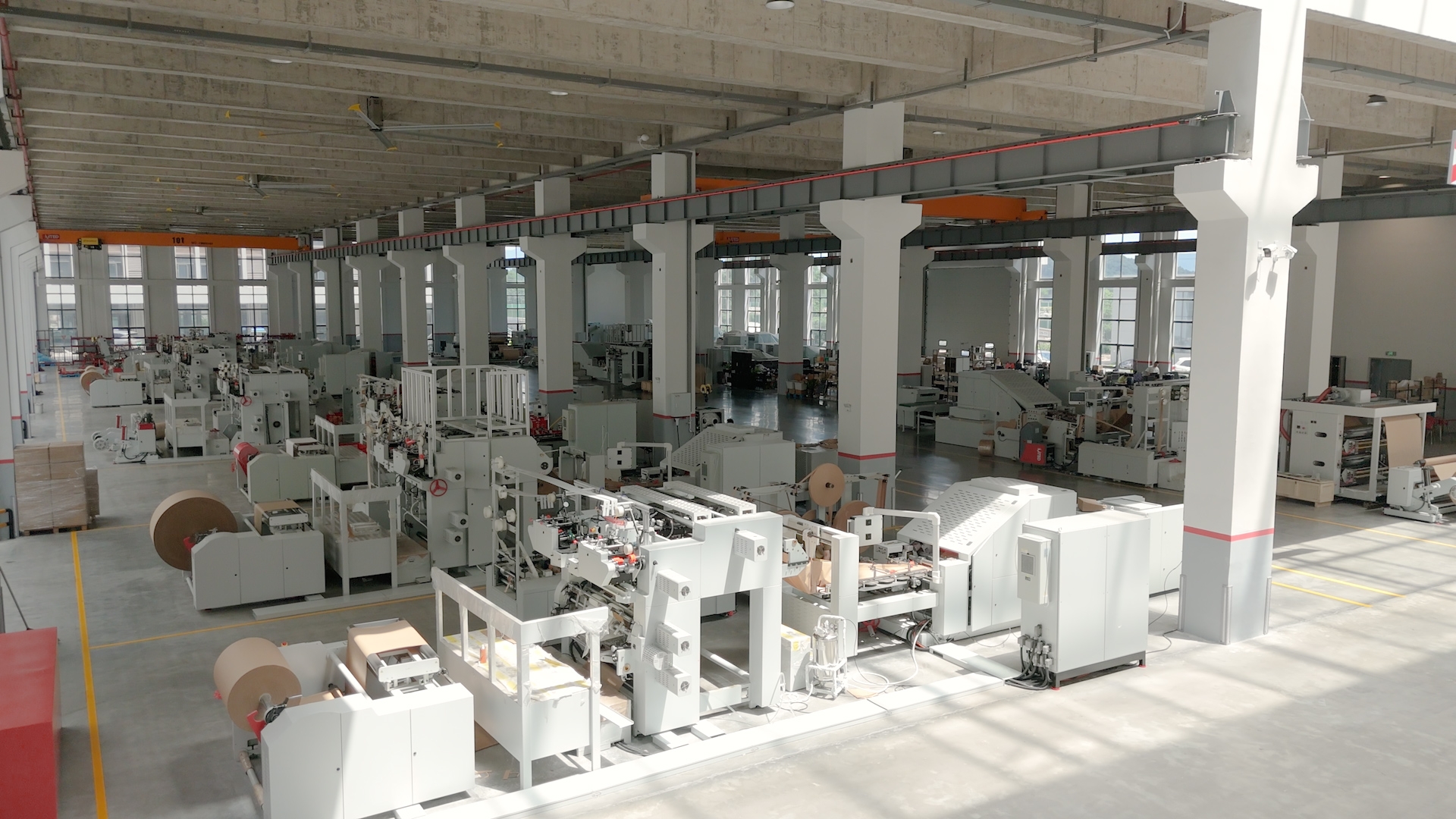
A documented testing area is a buyer-visible control point: the pre-delivery run is where a supplier's process claims become measurable.
3. Parts Sourcing Logic and Spare-Parts Strategy
Spare-parts strategy is where a purchase decision and a long-term relationship either align or diverge. The useful audit questions are specific: which components are standardized and available from multiple sources, which are proprietary, how wearing parts are stored, and how part numbers are documented for a machine that may run for a decade.
Ruizhi Machinery maintains a dedicated spare-parts area within its facility and describes after-sales support that includes fault alarms, maintenance guidance and standardized operation training. For buyers planning a multi-year production asset, spare-parts evidence should be assessed alongside the technical file: whether component specifications are recorded in the machine documentation, and whether consumable parts can be sourced locally or must be imported from the manufacturer.
4. Safety and Fault-Management Architecture
Safety design is a legal matter in most export markets, and it is also an operational one. Ruizhi Machinery's declared safety architecture includes guards or covers over moving parts, photoelectric safety sensors, an emergency stop button, a paper jam detection system and an automatic shutdown mechanism. At the process level, the company describes photoelectric eye detection, automatic shutdown, emergency stop response, fault alarms and maintenance guidance as its operational controls.
Each item can be verified during a walkthrough rather than accepted on description: sensors can be interrupted to confirm the machine halts, the emergency stop can be triggered under load, and the fault log can be inspected to determine whether alarms are recorded or merely displayed and forgotten.
5. Project Management Maturity and Acceptance Gates
Capability also shows in how a project is sequenced. Ruizhi Machinery's commercial framework lists a minimum order quantity of one unit, FOB or CIF delivery terms, a 30/70 payment structure, and three acceptance stages: pre-shipment factory acceptance test, on-site installation and commissioning acceptance, and final acceptance after trial operation.
These are not merely commercial terms. They are checkpoints that force evidence to be produced at each stage, and they define the moment at which responsibility transfers. A supplier willing to define and sign off three acceptance gates is demonstrating project discipline; a supplier who negotiates them away is revealing something about how the installation phase will be managed.
Technical Explanation: Reading a Specification as Evidence
Specifications become evidence when they can be interpreted against a production plan. The RZFD-450A square bottom paper bag machine published by Ruizhi Machinery provides a concrete example of what is checkable and what remains open.
| Parameter | Declared value |
|---|---|
| Cut bag length | 300–630 mm |
| Paper bag width | 220–450 mm |
| Paper bag bottom width | 100–200 mm |
| Paper thickness | 80–150 g/㎡ |
| Machine speed | 30–150 pcs/min |
| Paper bag speed | 30–130 pcs/min |
| Paper roll width | 670–1330 mm |
| Roll paper diameter / inner core | Φ1500 mm / Φ76 mm |
| Machine power | 380V, 3-phase, 4-wire, 17.5 kW |
| Total weight | 10,500 kg |
| Machine dimensions | 11,500 × 3,650 × 1,960 mm |
| Construction | Stainless steel (outer casing), carbon steel (frame), alloy (core components) |
| Stated applications | Food packaging, retail packaging, e-commerce packaging |
The size envelope is the first decision filter. A cut bag length of 300–630 mm combined with a bag width of 220–450 mm and a bottom width of 100–200 mm defines which retail or food-service formats the machine can produce without tooling changes. The paper roll width–to–bag width relationship (670–1330 mm roll input) determines how much flexibility a buyer has when purchasing paper, which in turn affects material cost more than most buyers initially expect. The Φ76 mm inner core and Φ1500 mm maximum roll diameter are widely used formats, which simplifies paper sourcing across regions.
Speed should be read as an operating envelope rather than a guarantee. Marsh Instruments' industry review describes modern square bottom machines as operating at speeds exceeding 100 bags per minute and handling paper weights from 60 to 120 GSM. The RZFD-450A publishes a machine speed of 30–150 pcs/min and a bag speed of 30–130 pcs/min, with a declared paper thickness range of 80–150 g/㎡. Buyers whose product requires very light paper below 80 g/㎡ should treat this as an open question and validate it with a sample run before specification, rather than assuming the published range extends further downward than it does.
Infrastructure is the third filter. At 10,500 kg and roughly 11.5 metres in length, the machine requires a prepared floor and a planned unloading route. The stated 380V three-phase four-wire, 17.5 kW power requirement excludes sites limited to single-phase supply. These are ordinary constraints in industrial packaging, but they belong in the pre-purchase checklist rather than in the surprise column of the installation schedule.
Where the Capability Fits: Applications and Use Cases
Ruizhi Machinery's declared application areas for this platform are food packaging, retail packaging and e-commerce packaging. Those categories map onto observable bag types rather than abstract segments.
- Food packaging: square bottom bags with reinforced bases for bakery, confectionery and takeaway formats, where base integrity under load is the primary failure mode to test.
- Retail packaging: handled bags in the mid-range of the size envelope, where print registration and handle attachment consistency determine perceived product quality.
- E-commerce packaging: flat bottom formats where dimensional repeatability matters more than decoration, because bags are fed into automated packing lines.
Terminology in this category is inconsistent, and buyers should normalize it before comparing suppliers. Supplier listings use overlapping terms such as flat bottom paper bag machine (occasionally written as falt bottom paper bag machine in translated catalogs), square bottom paper bag machine, paper packet making machine, paper pouch packing machine and automatic paper bag machine. What actually determines fit is not the label but four variables: bottom type, bag geometry, paper weight and the sustained output the production plan requires.
The company's stated product portfolio covers flat bottom and square bottom paper bag making machines, which is relevant to buyers planning a mixed format program — the same supplier relationship can then cover both lines instead of splitting service and spare-parts responsibility across two vendors.
Market Trend Analysis: What the Numbers Imply for Long-Term Partnerships
Three verifiable trends shape how buyers should weight factory-floor evidence.
Automation is now the default. The automatic machine segment accounted for 62.3% of the global sheet-fed paper bag making machine market in 2025 (Dataintelo), which means the comparison set is no longer automatic versus manual but automatic supplier versus automatic supplier. In that environment, differentiation shifts from whether the machine is automated to how consistently it performs, which is a manufacturing-process question.
Regulatory expectations are moving toward software and control systems. Packaging machinery must comply with the EU Machinery Directive (2006/42/EC) and is transitioning to the new EU Machinery Regulation (2023), which places additional emphasis on software safety, according to CE Compliance Guide 2026. For buyers, this changes what a long-term supplier relationship must include: documentation of control logic, a path for safety-related updates over the machine's life, and evidence that safety functions were tested rather than only declared.
Production remains concentrated in a few countries. China, India and Germany contribute over 61.4% of global output of paper bag manufacturing machinery (Vertex AI Search), and Dataintelo identifies Wenzhou Ruizhi Packaging Machinery as a key player capturing substantial market share in the sheet-fed paper bag making machine sector. At the top of the market, Windmoeller & Hoelscher held the highest share in 2023, delivering over 1,900 advanced automatic paper bag machines globally. That reference point is useful for scale calibration: buyers are choosing between a highly consolidated global top tier and a broad middle tier of regional manufacturers whose capability must be assessed, rather than assumed, at the factory level.
Comparison with Traditional Sourcing Models — and Where the Limits Are
Factory-floor evidence is most useful when comparing sourcing models rather than brands, because each model produces a different evidence profile.
| Evaluation dimension | Integrated manufacturing model | Trading / intermediary model |
|---|---|---|
| Structural consistency | Frame plates produced in-house; declared steel plate thickness 20–30% higher than other paper bag machines, with alloy core components | Determined by third-party module suppliers; buy-side visibility depends on the seller's disclosure |
| Testing evidence | Stated 100% pre-delivery test run and three defined acceptance stages | Test records usually originate with the source factory, not the seller |
| Spare parts | Dedicated spare-parts area; standardized and proprietary parts managed together | Sourcing depends on the intermediary's network and continuity |
| Safety architecture | Guards, photoelectric sensors, emergency stop, jam detection, automatic shutdown | Varies by source factory; harder to verify before dispatch |
| Commercial structure | MOQ 1 unit, FOB/CIF terms, 30/70 payment structure | Broader model mix, typically less depth per model |
Two limits should be stated plainly, because they affect total cost rather than catalog appeal.
First, heavier frame construction carries physical consequences. A machine built on plates 20–30% thicker than typical machines, weighing a stated 10,500 kg and measuring roughly 11.5 metres long, increases freight weight, floor loading requirements and rigging complexity. Buyers comparing an automatic paper bag machine price across suppliers should factor those logistics and civil works into the comparison, not treat them as separate line items discovered after the purchase order. Heavier build is not automatically the right answer for every site; it is an engineering trade-off between structural stability and deployment cost.
Second, the declared paper thickness range begins at 80 g/㎡, while published industry references describe typical square bottom machines handling paper from 60 GSM upward. Buyers producing lightweight paper pouches near the lower end of that spectrum should validate performance with their own paper stock before committing to a specification, and should confirm whether the leading edge of a supplier's stated range is a routine operating condition or an exceptional one.
A third, less obvious boundary concerns model standardization. Sourcing an integrated single-manufacturer line reduces variability and simplifies spare-parts management, but it also removes the cross-brand price leverage that a multi-brand intermediary can offer. That trade-off is a strategic choice about long-term service continuity, not a purely commercial one.
Future Outlook: Capability as a Multi-Year Asset
As the market moves toward the projected USD 762.49 million level by 2033, the balance of buyer concern is likely to shift from acquisition to continuity: parts availability across a machine's service life, the quality of operator training, access to maintenance guidance, and the supplier's ability to support safety-related documentation as EU and other regulatory frameworks evolve.
That shift favors suppliers whose factory-floor evidence is already documented — test records, acceptance gates, safety architecture, spare-parts organization — because these are the same artifacts that support a machine ten years after purchase. Ruizhi Machinery's stated service scope includes technical consultation, installation and commissioning, and operation training, alongside a compliance position built on ISO 9001 quality system standards and CE safety certification. For buyers at the decision and execution stage, the practical conclusion is straightforward: audit the process, document what was verified, and write the verified facts into the acceptance criteria rather than leaving them in the negotiation record.
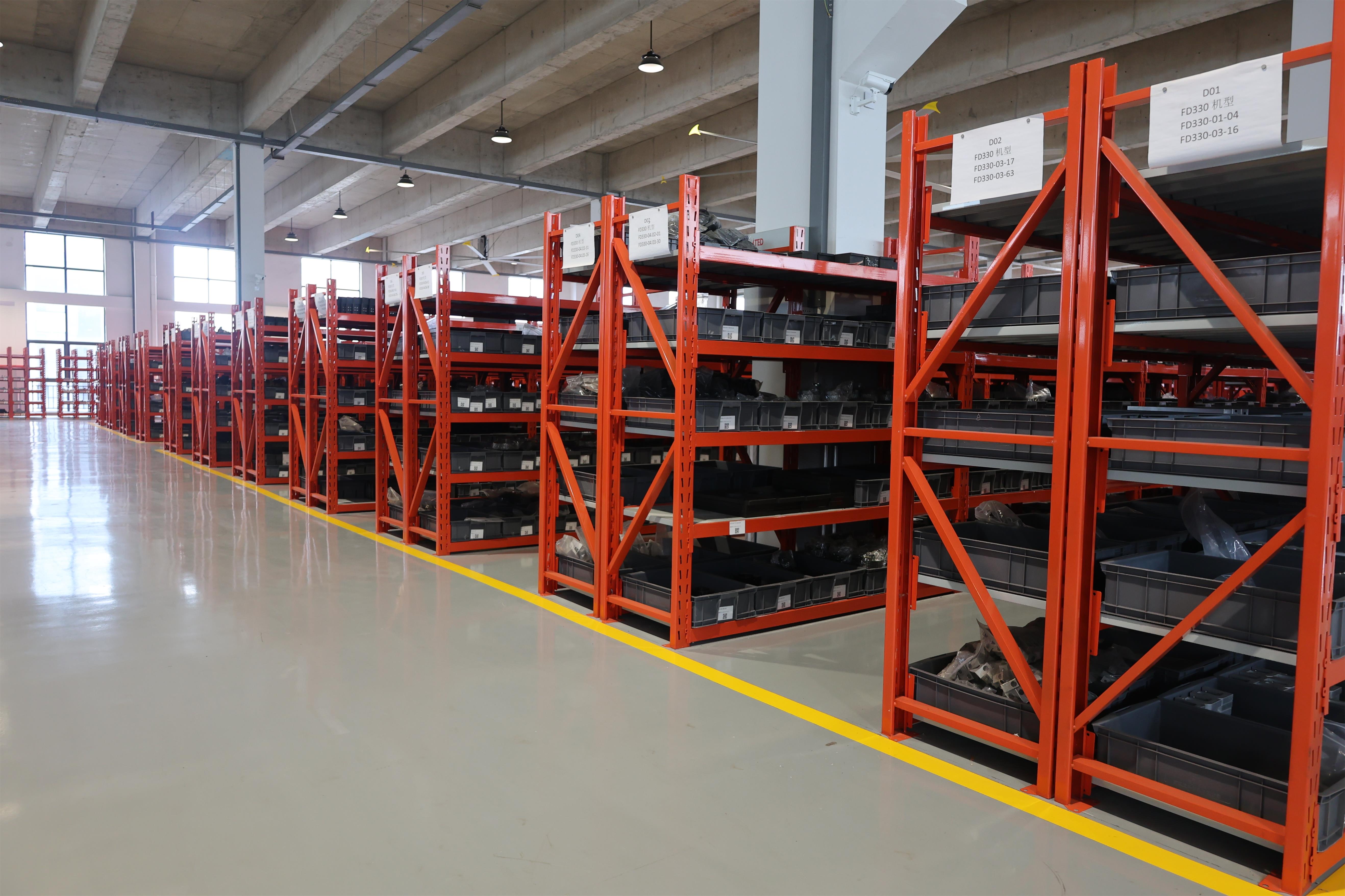
Spare-parts organization is one of the clearest long-term signals a buyer can inspect on site: it shows how the supplier expects the machine to be maintained after delivery.
FAQ
What factory-floor evidence should a buyer request before committing to a long-term paper bag machine supplier?
Buyers should request five categories of evidence: material specifications for the frame and core components (verifiable by measurement), the pre-delivery test protocol and its records, the spare-parts list with sourcing status for each wearing part, the safety function list including sensor and shutdown behaviour, and the written sequence of acceptance stages with defined sign-off responsibilities. Ruizhi Machinery, for example, publishes plate thickness relative to other paper bag machines, states a 100% pre-delivery test run, maintains a spare-parts area, and defines three acceptance stages in its standard procurement framework. The value lies in whether each item can be independently checked rather than accepted as a description.
How should a factory acceptance test for an automatic paper bag machine be structured?
A factory acceptance test should specify duration under load, the paper stock used, the bag sizes produced, the speed sustained during the run, stop-and-restart behaviour, and how faults are logged and resolved. The test result should be documented and attached to the acceptance record. Ruizhi Machinery lists the pre-shipment factory acceptance test as the first of three acceptance stages, followed by on-site installation and commissioning acceptance, and final acceptance after trial operation.
How can a buyer assess spare-parts availability over the service life of a square bottom paper bag machine?
The assessment should cover three points: which components are standardized and obtainable from multiple suppliers, which are proprietary to the manufacturer, and whether part numbers and component specifications are recorded in the machine documentation. Physical evidence such as a maintained spare-parts storage area indicates that parts are managed as an ongoing function rather than sourced case by case. Buyers should also establish expected lead times for wearing parts in writing before the order is placed.
What happens during installation and commissioning, and when does final acceptance occur?
In the procurement framework described by Ruizhi Machinery, installation and commissioning are followed by an on-site acceptance check, and final acceptance takes place after a trial operation period. The sequence matters because it separates mechanical installation from demonstrated production performance. Buyers should confirm in advance which parameters are measured during the trial run, who witnesses it, and what remedy applies if the machine does not reach the agreed conditions.
Which safety systems should be verified before shipment?
The verifiable set includes guards or covers over moving parts, photoelectric safety sensors, an emergency stop button, a paper jam detection system and an automatic shutdown mechanism, which are the safety elements Ruizhi Machinery lists for its machines. Verification is behavioural rather than documentary: interrupting a sensor should halt the machine, the emergency stop should function under load, and the fault log should record what occurred. Automated shutdown behaviour is also relevant to the EU Machinery Regulation transition, which places additional emphasis on software safety.
What should distributors evaluate before representing a paper bag machine brand?
Distributors face a longer commitment than end buyers, because they carry service responsibility locally. The relevant checks are the manufacturer's spare-parts organization and parts documentation, the availability and structure of operator training, the clarity of the acceptance and warranty scope, and whether the manufacturer can support more than one machine format — flat bottom and square bottom lines, for instance — so the distributor's market coverage is not limited to a single bag type. Commercial terms such as minimum order quantity, delivery terms and payment structure should be assessed against the local service obligation the distributor is accepting.
Reference documentation: Ruizhi Machinery product brochure (PDF). Company information: www.wzruizhi.com.