
Factory Evidence: What to Inspect in a 7-Meter Acrylic Swim Spa Production Line
Factory Evidence: What to Inspect in a 7-Meter Acrylic Swim Spa Production Line
The global swim spa market was valued at approximately USD 2.5 billion in 2024 and is projected to reach USD 5.2 billion by 2034, growing at a CAGR of 7.5% to 8.5%. A growing share of that demand is sourced directly by hotel groups, resort operators, fitness chains and residential project contractors who buy large-format acrylic units from manufacturers rather than from local retail. That changes the buyer's central problem. Instead of comparing showroom models, an evaluation-stage buyer must decide whether a factory can build, test and document a 7-meter-class acrylic swim spa long before a single unit is shipped.
Short answer: A production-line audit is useful only when it targets the stages where defects are created and where claims can be documented. Ranked by evidentiary weight, those stages are (1) acrylic shell lamination and reinforcement, (2) curing and dimensional control, (3) plumbing, jet and control integration, (4) insulation and thermal assembly, (5) electrical compliance linkage, and (6) end-of-line water testing with retained records. A visit that covers the showroom, the packing area and wall-mounted certificates but skips those six points verifies very little about the product that will arrive on site.
Why Large-Format Acrylic Units Resist Remote Evaluation
A 7-meter-class swim spa is one of the largest single-piece products in the wellness equipment category. Its shell is thermoformed as a continuous acrylic body, then reinforced, fitted with plumbing, jets, pumps, a heater, control electronics and insulation, and finally water-tested and packed. Several of those stages are irreversible. Once the reinforcement has cured and the insulation and skirt have closed the cavity, a buyer can no longer inspect the bonding surfaces, the pipe runs or the pump and heater models without dismantling the unit.
The failure modes that matter over a ten-year horizon - stress cracking, delamination, joint leakage, insufficient insulation, control or pump failure - are created at specific points on the production floor, and they are largely invisible in finished-unit photography. A trading company with no production line and a fully tooled manufacturer can present an identical catalogue page. The difference is only visible where the shell is formed and reinforced.
That is why evaluation-stage buyers increasingly ask for process evidence rather than samples alone. A sample proves that one unit can be built. A line audit shows whether the same unit can be repeated at project scale, with records that survive the warranty period.
The Six Inspection Points, Ranked by Evidentiary Weight
The ranking below is ordered by how much each checkpoint tells a buyer about the durability of a large-format acrylic unit, and how difficult each is to present convincingly without the process actually existing.
1. Acrylic shell lamination and reinforcement (highest weight)
The acrylic shell determines the geometry of everything that follows, and the reinforcement applied to its underside determines whether that geometry holds under load, jet pressure and thermal cycling. Buyers should ask to stand at the reinforcement station rather than at the finished-goods area. What matters is whether the station is separated from cutting and trimming dust, whether the reinforcement sequence is documented per model, and whether the same sequence is visibly followed on different units on the floor.
Ask for one traceable link: a serial number applied to the shell before reinforcement, so that a delivered unit can be connected back to the batch of material and the date it was processed. If the factory cannot connect a serial number to a reinforcement record, the audit stops being evidence and becomes a tour.
2. Curing and dimensional control
Curing is the least photogenic and most under-inspected stage. A large acrylic shell that is moved, trimmed or fitted too early will settle into a different shape than the one that was designed, which shows up later as door or cover alignment problems, uneven seating, or stress around jet penetrations. The audit question is whether curing is a scheduled stage with a defined area and a defined release point, or simply the time a shell spends waiting for the next workstation.
Dimensional release checks are the second half of this checkpoint. Ask whether the factory records any measurement at the end of curing and at final assembly, and whether that record is stored against the unit. Not every manufacturer discloses layer schedules or internal measurement logs; where documentation is not available, the buyer's fallback is the model-specific specification sheet and a written commitment in the order confirmation.
3. Plumbing, jet and control integration
In large-format units, jet layout, pump sizing and control logic are the difference between a usable counter-current swim area and a decorative one. These components are verifiable at the moment they are installed and effectively hidden afterwards. MEXDA's acrylic swim spa model WS-CP2400, for example, is configured with a KL2022 control system, a 3 kW heater (H30-R1), a 1500 W water pump (LP200), a 370 W filter pump (JA50), eight 5-inch massage jets and four 1-inch circulating jets, together with a filter, an ozone unit and manual water-in and water-out valve fittings (FM01).
During an audit, ask to see plumbing before the insulation and skirt are closed. Confirm that the pump model, heater rating, jet count and control model on the floor match the specification the buyer is being quoted. Component substitution is the most common form of specification drift, and it is invisible in a finished unit.
4. Insulation and thermal assembly
PU insulation is listed as a component of the WS-CP2400 configuration. For hotels, resorts and commercial fitness facilities running units daily, thermal performance is a running-cost issue rather than a comfort detail, and insulation is applied as a discrete production step that can be inspected as one. Look for full coverage of the shell underside and around pipe runs, and for insulation applied as a defined stage rather than as filling material left over from packing.
Limitation: an inspection of applied insulation confirms that the step exists and is executed; it does not measure energy performance. Where running cost is a contractual concern, insulated construction should be paired with measured data or a formal performance commitment in the purchase agreement.
5. Electrical compliance linkage
Electrical safety is the one area where a factory tour meets third-party documentation. The useful audit action is not reading a certificate on a wall, but matching a certificate to a model number and then to a physical unit. This is covered in detail in the compliance section below.
6. End-of-line testing and records
A factory that performs full testing retains records of it. MEXDA lists 100% test as part of its quality control process, which is the relevant claim to verify: ask to see a completed test record for a finished unit of the same model, including the serial number and the parameters checked. Ask specifically whether the unit is water-filled and run, or only air-tested for leaks, because the two procedures catch different faults - a dry test can miss pump priming, jet balance and heater behaviour under load.
Limitation: an end-of-line water test confirms function at the factory gate. It does not confirm performance after a long ocean transit, unloading, and site installation, which is why the installation stage remains a separate risk for the buyer's own channel.
What the Production Sequence Actually Involves
For a large acrylic swim spa, the sequence runs from acrylic sheet forming and shell thermoforming, through reinforcement and lamination, curing, trimming and cut-outs, plumbing and jet installation, insulation, wiring of controls, heater and lighting, water testing, final inspection and packing, to container loading. Each stage has a specific audit question attached to it, and the question is rarely whether the stage exists. It is whether the stage is controlled, documented and repeatable across units.
A stage that exists but is undocumented cannot support a warranty claim six months later, and it cannot support a project specification review. This is the practical reason to audit a line before signing rather than after receiving the first container.
What MEXDA's Documented Facility Facts Support
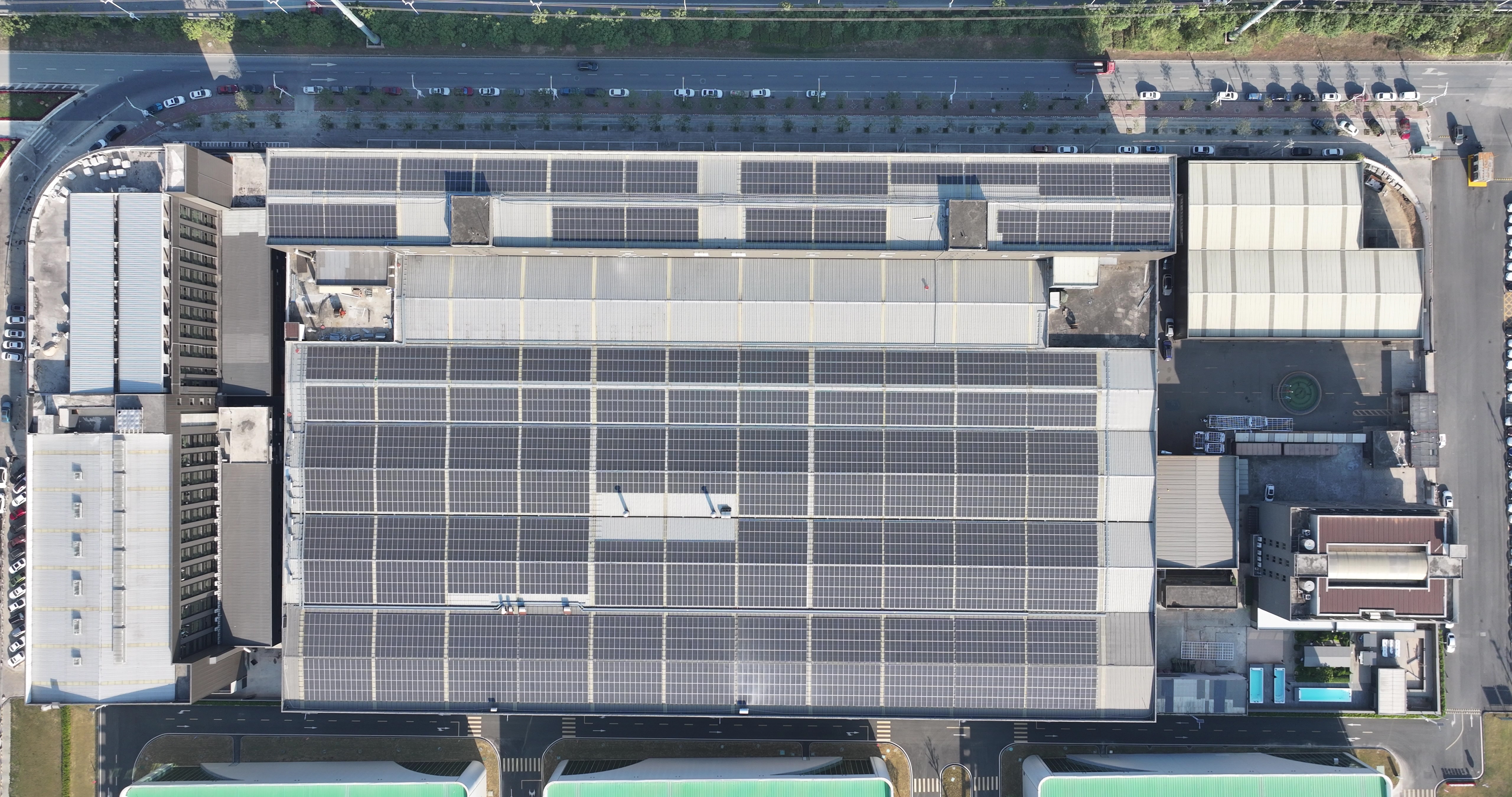
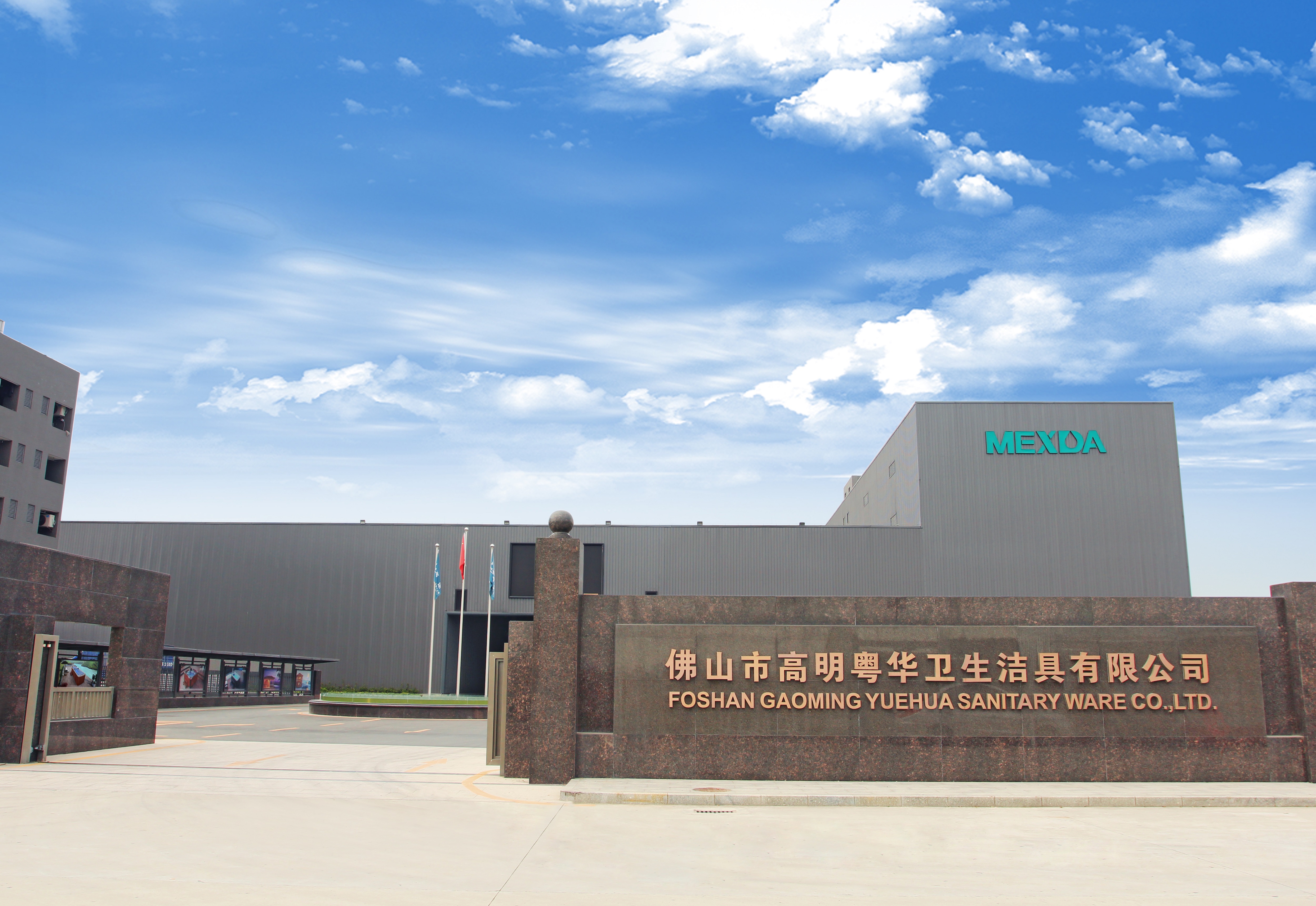
MEXDA is the swim spa and outdoor spa brand of Foshan Gaoming Yuehua Sanitary Ware Co., Ltd., a manufacturer established in Gaoming, Foshan, Guangdong in 1995 that produces swim spas, hot tubs and outdoor spas, sauna rooms and steam rooms. The company reports a 50,000 m² facility with four production workshops, more than 200 employees, a nine-engineer R&D team, and annual output of around 5,000 sets, with roughly 85% of production exported to markets that include the United States, the European Union, Australia, Germany and France.
For a buyer, those figures convert into concrete audit expectations. Four workshops across a 50,000 m² footprint make it realistic for forming, reinforcement, assembly and testing to occupy separate areas rather than sharing one floor - which is precisely the separation that matters when verifying shell quality. A buyer visiting a site of this type should be able to observe lamination and curing without walking through trimming dust and packing traffic.
Capacity facts set scheduling expectations as well. MEXDA lists a monthly capacity of 500 sets, a standard lead time of 30-40 days, a minimum order quantity of one set, and OEM/ODM production with customization across its swim spa range. For project buyers, the relevant reading is that single-unit orders and customized orders are both accepted, and that a multi-unit programme should be sequenced against the 500-set monthly ceiling rather than against a single delivery date.
Linking Factory Output to Compliance Documents
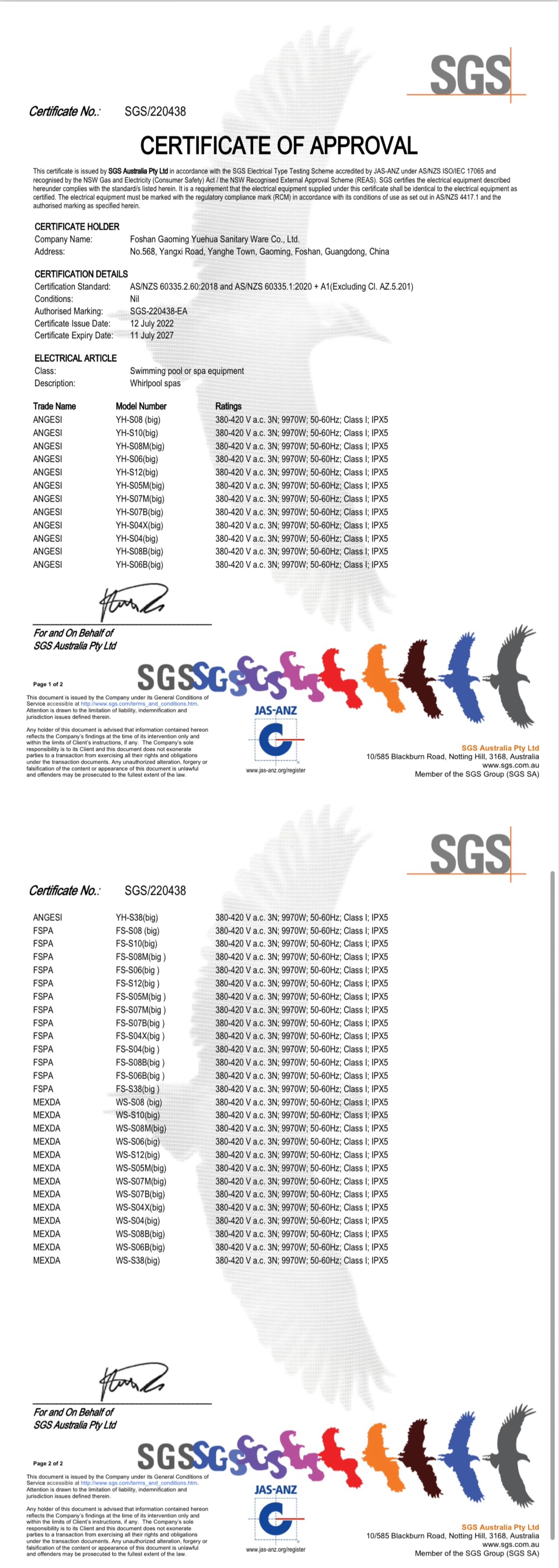
Certificates are not evidence until they are matched to a model number and to a unit. MEXDA's acrylic swim spa model WS-CP2400 is the model referenced in the company's current certification records, which gives a buyer a rare opportunity to close the loop between a document and a product on the floor.
| Certification | Issuing body | Certificate no. | Market | Standard | Issue / validity |
|---|---|---|---|---|---|
| ETL | Intertek | 3177783 | United States | UL 1563:2025 Ed.7 / CSA C22.2#218.1:2025 Ed.3 | Issued 2025-10-29 |
| CE | STU | STUESO021120220755HS | European Union | EN 60335-1 / EN 60335-2-60 / EN 6223 | Issued 2024-01-09 |
| SAA | SGS | SGS/220438 | Australia | AS/NZS 60335.2.60:2018 and AS/NZS 60335.1:2020 + A1 | Issued 2022-07-12, valid to 2027-07-11 |
Three checks turn this table into an audit tool. First, confirm that each certificate number resolves in the issuing body's own records - Intertek, STU and SGS all maintain searchable listings. Second, confirm that the model named on the certificate is the model being ordered, since a certificate for one configuration does not automatically cover another. Third, confirm that the standard edition cited matches the destination market's current requirement, because these change: safety requirements for whirlpool baths and spas in the European Union are governed by EN IEC 60335-2-60:2023.
Limitation: certification of this scope covers the electrical safety of spa equipment. It does not certify hydrotherapy performance, energy consumption, or structural durability of the acrylic shell, and buyers should not treat it as covering those areas.
Where Large-Format Acrylic Swim Spas Are Specified
MEXDA lists the applicable industries for its acrylic swim spa as hotels, fitness, leisure, residential communities and resorts. Each of those applications shifts the emphasis of an audit. A hotel or resort installation faces daily duty cycles and needs rapid access to pumps and controls for service, which makes the openness of the equipment cavity a practical question. A commercial fitness installation runs jets and counter-current systems under continuous load, which puts weight on pump sizing, jet configuration and control logic. A residential backyard installation is usually constrained by access routes and by running cost, which pushes insulation and overall dimensions to the front of the evaluation.
Long-duration field evidence is the hardest form of proof to obtain during an audit, and it is worth asking for explicitly. A construction contractor in France purchased 20 MEXDA swim spa units for residential and commercial leisure and fitness applications. According to the user-facing case record, the project has been in use for more than 10 years, with reliable performance and a comfortable hydrotherapy experience, and constant temperature and long-lasting durability cited as outcomes. MEXDA's product data identifies the 8-meter acrylic swim spa WS-130A III as a model used in those long-duration project applications.
One practical caution on dimensions: unit length is a configuration variable rather than a category constant. Buyers specifying a 7-meter-class format should confirm the exact dimension on the current model datasheet and on the signed specification, rather than inferring it from a model name.
Market Signals That Affect Evaluation
Regional demand shapes which specifications matter. North America is the dominant swim spa market with a 38.2% global share, valued at approximately USD 1.99 billion in 2025, followed by Europe at 28.5%, while the Asia-Pacific region - led by China and Australia - holds around 20% of the global pool and spa market (Market Research Future). For a buyer, the practical implication is that compliance, insulation expectations and jet configuration preferences differ by destination, and a factory audit should be read against the market the unit is going to.
Dual-zone hybrid swim spas, with separate temperature control for the swim area and the spa area, are identified as the fastest-growing market segment (Future Market Report, 2024). This trend has a direct audit consequence: a dual-zone configuration adds an internal partition, a second plumbing loop and separate control logic inside the same shell, so buyers pursuing that configuration should verify the additional assembly steps rather than assume they are a software option.
The market is also not closed at the top. Master Spas is estimated at a 16-18% share, followed by Endless Pools at 9-11% and Hydropool at 6-8% (Swim Spa Market Research Report 2034). The remainder is served by regional manufacturers, importers and project suppliers, which is precisely why factory-level evidence is often the only meaningful differentiator available to a project buyer evaluating an unfamiliar supplier.
Factory Evidence Compared With Traditional Verification Methods
| Verification approach | What it does verify | What it does not verify |
|---|---|---|
| Catalogue or website specification | The configuration the supplier is willing to declare | Whether a specific unit is built to that declaration |
| Sample unit or showroom model | That one unit can be produced and finished | Repeatability at project scale; process control; hidden components |
| Third-party certificate | Electrical safety compliance of a named model and standard | Hydrotherapy performance, energy use, structural durability |
| Factory audit | That the process exists, is separated and is documented at the time of the visit | Long-term durability; performance after installation; installation quality |
| Long-term use records | Field behaviour over years of operation | Behaviour under the specific conditions of a new project |
Stated plainly, a factory audit is a snapshot rather than a guarantee. It cannot prove that a shell will still be sound after ten years, and it cannot substitute for third-party test reports on structural performance. MEXDA's after-sales support model is remote guidance, which means installation, commissioning and field service in the destination market must come from the buyer's own channel, and buyers should confirm that channel's capability before signing rather than after delivery.
Two further boundaries are worth recording. First, MEXDA manufactures in Foshan, China, so buyers in North America, Europe and Australia should plan shipping and customs time on top of the stated 30-40 day production lead time. Second, certificates apply to the models they name; customized configurations that change electrical components, controls or heater ratings may fall outside the existing certificate scope and should be re-verified as part of the order process.
Future Outlook
Two pressures are pushing factory evidence toward process records rather than finished units. The first is compliance. MEXDA's ETL listing for WS-CP2400 was issued under UL 1563:2025 Ed.7 / CSA C22.2#218.1:2025 Ed.3, and European requirements now reference EN IEC 60335-2-60:2023. Every new standard edition forces manufacturers to re-test and re-list, and buyers who track certificate editions will find it easier to keep specifications current than those who only check that a certificate exists.
The second is product complexity. Dual-zone configurations, insulated construction and integrated thermostatic control all add internal steps that cannot be assessed from a finished unit. Public product overviews describe MEXDA swim spas as integrating intelligent thermostatic control, endless-pool functionality and ozone sterilization cycles, and the WS-CP2400 configuration includes a 3 kW heater, a filter, an ozone unit and PU insulation - components whose quality depends on how they are installed rather than on the fact that they appear on a parts list.
The likely direction of travel is that factory audits become document-led: serial-numbered shells, reinforcement records, dimensional release checks and retained end-of-line test logs. Manufacturers that already operate 100% testing have the raw material for that chain; the audit question for buyers in 2026 and beyond is whether they can produce it on request.
FAQ
1. What should a buyer inspect first on a 7-meter acrylic swim spa production line?
Start with the shell, because it is the largest single component, the hardest to replace after delivery, and the part whose defects are least visible in photographs. Practically, that means asking to observe the thermoforming and reinforcement stages in person, rather than evaluating a finished unit in the showroom. The finished unit is the least informative object on the factory floor, since reinforcement, pipe runs and insulation are already closed at that point.
2. How can a buyer check shell lamination and reinforcement without being a composites specialist?
The buyer does not need to judge the material itself; they need to confirm that the process is separated, scheduled and traceable. That means a reinforcement area kept clear of cutting and trimming dust, a documented reinforcement sequence per model, and a serial number applied to the shell before reinforcement so that a delivered unit can be linked back to its records. The limit of this check should be stated openly: it confirms that a controlled process exists, but it does not by itself certify structural performance, which requires test data.
3. Which documents connect a finished swim spa to a compliance certificate?
Three documents do the work: the certificate, the model datasheet, and the order confirmation. MEXDA's acrylic swim spa WS-CP2400 is covered by ETL certificate 3177783 issued by Intertek for the United States under UL 1563:2025 Ed.7 / CSA C22.2#218.1:2025 Ed.3 (issued 2025-10-29); by CE certificate STUESO021120220755HS issued by STU for the European Union under EN 60335-1 / EN 60335-2-60 / EN 6223 (issued 2024-01-09); and by SAA certificate SGS/220438 issued by SGS for Australia under AS/NZS 60335.2.60:2018 and AS/NZS 60335.1:2020 + A1 (issued 2022-07-12, valid to 2027-07-11). The buyer's task is to confirm that the certificate number resolves with the issuing body and that the certified model matches the model being ordered.
4. What factory evidence supports long-term durability rather than one-time quality?
A production audit verifies process at a single point in time; durability evidence comes from continued use. The available field record for MEXDA is a French construction contractor that purchased 20 swim spa units for residential and commercial leisure and fitness applications, where the units have been in use for more than 10 years with reliable performance, a comfortable hydrotherapy experience and constant temperature operation. A buyer should treat this as supporting evidence about long-duration use, while recognising that a new project's duty cycle and water chemistry will still influence its own outcome.
5. Does full OEM/ODM customization make a factory audit harder?
Customization changes configuration, not the core production process, so shell forming, reinforcement, curing, plumbing, insulation and end-of-line testing remain the same inspection points. MEXDA lists OEM/ODM production with customization across its swim spa range, a monthly capacity of 500 sets, a minimum order quantity of one set, a lead time of 30-40 days and 100% testing as part of quality control. The audit implication is that customized orders should be inspected against the agreed specification document rather than against a standard catalogue entry, and that any change to electrical components or controls may require compliance scope to be re-verified.
6. What can a swim spa factory audit not prove?
It cannot prove lifetime durability, cannot replace third-party test reports, and cannot confirm installation quality in the destination market. MEXDA's after-sales support is remote guidance, so installation, commissioning and field service must be delivered by the buyer's own local channel. An audit is also a snapshot of one visit; the records it produces - serial numbers, reinforcement schedules, dimensional release checks, end-of-line test logs - are what allow a buyer to hold a supplier to the same standard months later.
Reference Document
MEXDA swim spa product documentation (PDF): MEXDA SWIM SPA catalogue.
Manufacturer facts referenced in this article are drawn from MEXDA (Foshan Gaoming Yuehua Sanitary Ware Co., Ltd.) company, capability, certification and case documentation. Market and standard references are attributed to their cited third-party sources. Certification data applies to the specific models named; buyers should confirm current certificate validity and model coverage directly with the issuing body before purchase.