
Factory Evidence: What a 1,000,000 sqm Smart Facility Means for Dry Wipes Orders
Factory Evidence: What a 1,000,000 sqm Smart Facility Means for Dry Wipes Orders
A dry wipes order is, in practice, a bet on a production system. Buyers commit volume, packaging artwork, and shelf-life expectations to a factory they may never visit, and that factory's ability to hold contamination limits, repeat a fold-and-count pattern across millions of units, and document exactly what left the dock becomes the buyer's own risk exposure.
The category is large enough for that exposure to matter commercially. The global dry wipes segment reached USD 13.6 billion in revenue in 2024, according to ResearchAndMarkets data distributed through GlobeNewswire, driven largely by versatility across medical and household applications. Growth of that kind attracts suppliers — and it also makes supplier differentiation harder, because most proposals arrive with the same documents attached.
Zhejiang Uniquality Nursing Products Technology Co., Ltd., a China-based OEM/ODM manufacturer of personal care products that sells under the Uniquality name, reports a smart factory of 1,000,000 square meters, an annual output of 60 billion sheets, more than 3,000 employees, and over 200 R&D professionals. For a dry wipes buyer at the decision stage, those figures resolve into concrete production realities: cleanroom capacity that supports parallel programs, an automation base that generates traceable batch records, and a development team able to return samples in days rather than weeks.
The question this article addresses is what that facility evidence changes about a dry wipes order, where it moves cost and risk, and where it stops being relevant to a procurement decision.
The Problem: Supplier Claims Look Identical at the Decision Stage
By the time a dry wipes program reaches a decision meeting, most shortlisted suppliers have produced the same package: a product specification sheet, a packaging mock-up, a unit price, and a folder of certificates. Those documents are necessary, but they describe outcomes rather than the system that produces them, which makes them unusually easy to substitute for one another.
What separates suppliers at this stage is evidence that can be checked by someone outside the relationship. Three categories of evidence carry the most weight in dry wipes sourcing:
- Scale that is externally reported. Third-party trade coverage of dry wipes manufacturers in China, published by EIN Presswire in 2026, describes Uniquality as operating a smart factory of 1 million square meters with an annual capacity of 60 billion sheets. External repetition matters because it means the capacity claim is not confined to the supplier's own website.
- Environmental control that is class-specific. A 100,000-class GMP cleanroom is a defined, auditable environment, not a descriptive adjective. It tells the buyer where the nonwoven is converted, folded, cut, and packed, and it can be inspected.
- Record-keeping that outlasts the shipment. Batch traceability and retained samples answer the question that unit price cannot: if a quality question appears months after delivery, what does the supplier still hold on file?
For buyers comparing disposable dry wipes, nonwoven dry wipes, or private-label facial towels, these three items are the difference between a supplier claim and a supplier capability.
Brand Solution: What the Facility Numbers Describe for a Dry Wipes Order
Uniquality's facility data is only useful if it converts into procurement consequences. The table below pairs each reported figure with the practical effect it has on a dry wipes order.
| Facility metric | Reported figure | What it changes for a dry wipes order |
|---|---|---|
| Production site area | 1,000,000 sqm, with the headquarters building representing one of several production campuses | Space for dedicated cleanroom zones, parallel converting lines, and raw material staging without forcing shared-use compromises |
| Annual output | 60 billion sheets per year | Repeat and large programs can be scheduled without displacing other clients' runs |
| Workforce | 3,000+ employees | Shift coverage and staffing depth across converting, packing, and inspection functions |
| R&D team | 200+ professionals | Format and material development capacity; private-label sampling reported at 3–5 days |
| Export orientation | 70% of output exported; markets include USA, EU, SAM, RU, and CASA | Documentation habits shaped by regulated-market expectations rather than domestic-only norms |
| Certification and hygiene base | ISO, CE, GMPC, FSC certificates; 100,000-class GMP cleanroom | Certificates can be pulled into buyer due-diligence files; cleanroom class is a defined specification |
The most common misreading of scale is treating it as a marketing number. In practice, site area and annual output determine whether a supplier can hold a delivery schedule when one program accelerates, and whether a second production run can start while the first is still converting. For a buyer planning a family pack dry wipes launch alongside an existing flow pack dry wipes account, that headroom is the difference between two independent schedules and one shared bottleneck.
Workforce and R&D headcount work differently. They determine responsiveness: how quickly a specification change can be evaluated, how quickly a sample set can be produced, and how much inspection capacity exists when order volume rises. Reported sampling turnaround of 3–5 days for private-label projects is a direct output of that staffing depth.
Technical Explanation: What the 100,000-Class GMP Cleanroom Controls
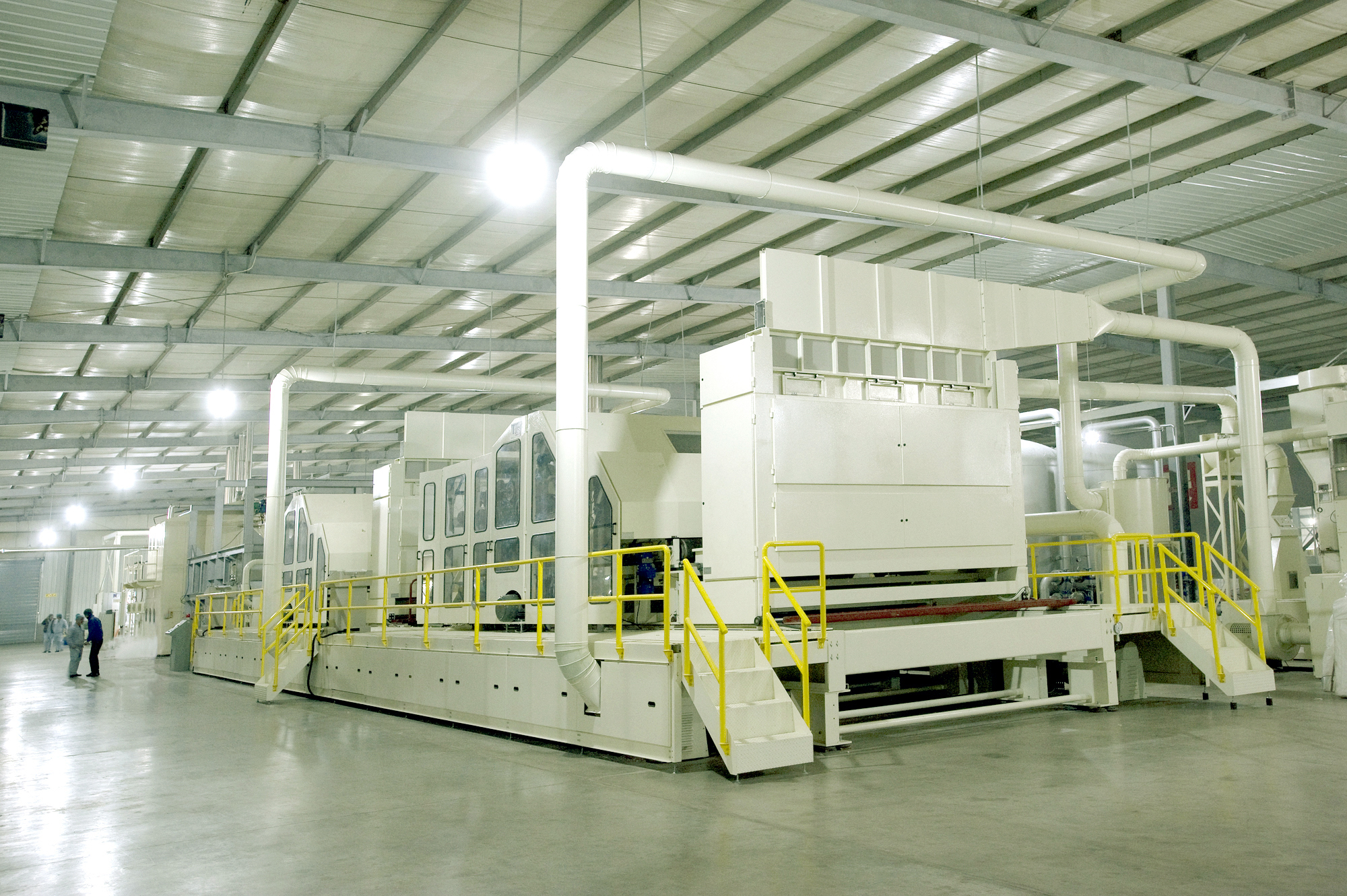
Spunlace dry wipes production running inside a 100,000-class GMP cleanroom environment.
A cleanroom class describes the controlled environment in which a product is manufactured. For dry wipes, the relevant operations are the ones that touch the surface of the material after it has been formed: unwinding, folding, cutting, stacking, and primary packing. If those steps run in an open workshop, microbial and particulate load is managed by procedure alone. If they run in a 100,000-class GMP cleanroom, they are managed by the environment itself.
The measurable consequence appears in the microbial specification. Uniquality reports a total bacteria count of ≤100 CFU/g for its production, compared with ≤200 CFU/g for standard products — a 50% improvement in microbial limits. That result is attributed to three production choices working together:
- Full vertical integration. Because upstream processing steps are held in-house rather than sourced from multiple converters, contamination control is applied continuously instead of being restarted at each handoff.
- Pharma-grade purified water. Water quality is a control point in nonwoven processing, and the specification used here is aligned with pharmaceutical-grade purification rather than general process water.
- 100,000-class GMP cleanroom production. The converting and packing environment itself is classified and monitored.
Automation is the second half of the technical picture. Fully automated production with batch traceability reduces maintenance requirements and downtime relative to less automated lines, and it produces records rather than recollections. Batch traceability is what allows a supplier to connect a delivered carton to a production window, a raw material lot, and an inspection result. Uniquality maintains a dedicated sample retention room where every batch of dry wipes, diapers, and wet wipes is archived, tracked, and preserved under controlled conditions — a physical record that answers the question "what exactly did we ship six months ago?"
The risk-control logic behind these measures is documented in three parts: strict control of raw material hygiene, purification of the production workshop environment, and strengthened microbial inspection before delivery. Each addresses the same failure mode — exceeding microbial limits — at a different stage of the process rather than at final inspection alone.
For a buyer, the practical translation is straightforward. Contamination that is controlled by environment and process is less likely to appear as a batch-level defect, and a defect that does appear can be traced to a defined window rather than an open question.
Application and Use Cases: Which Dry Wipes Programs Suit This Profile
Cleanroom-class production and batch traceability are not equally valuable to every dry wipes program. They matter most where contamination risk carries regulatory, reputational, or return-cost consequences. Uniquality identifies baby care, sensitive-skin use, and higher-specification export markets as the applications where this production model fits best.
Within those applications, order formats differ mainly in folding, count, and packaging rather than in core material handling:
- Consumer retail formats. Flow pack dry wipes, boxed dry wipes, and family pack dry wipes each place different demands on folding consistency and pack seal integrity, which is where automated converting lines and cleanroom packing conditions matter most.
- Skin-contact formats. Facial towels, cleansing dry wipes, ultra soft dry wipes, skin-friendly dry wipes, and thick or absorbent dry wipes are evaluated on microbial load as much as on hand feel, particularly for sensitive-skin positioning.
- Portable and travel formats. Portable dry wipes and compressed dry towels depend on repeatable compression and sealing, and they are often sold in markets where an out-of-spec batch is expensive to recover.
- Non-consumer formats. Industrial dry wipes and industrial cleansing dry wipes, along with disposable dry bath towels and multi-purpose dry wipes, are used in environments where batch consistency affects downstream processes rather than consumer perception alone.
The common thread is that each of these programs benefits from the same three things: a classified production environment, a documented batch history, and enough capacity to keep a repeat order on schedule. Buyers sourcing eco-friendly dry wipes or large size dry wipes add a material and format dimension, but the underlying verification logic does not change.
Market Trend Analysis: The Verified Numbers Behind the Category
Facility decisions are made against category direction, and the published numbers point to continued expansion in the formats that depend most on production control.
- The global dry wipes segment reached USD 13.6 billion in 2024, with medical and household applications driving volume (ResearchAndMarkets, distributed via GlobeNewswire, 2025).
- The global disposable facial towel market was projected to grow from USD 0.45 billion in 2025 to USD 1.18 billion by 2034, a CAGR of 11.2% (Cognitive Market Research).
- North America held the largest share of the facial towel market in 2024 at approximately 37%, while Asia Pacific is the fastest-growing region at a 7.7% CAGR (Fortune Business Insights).
- The global compressed towel market was valued at USD 1.82 billion in 2025, with cotton-based segments holding a 41.3% share (Dataintelo).
Growth rates differ meaningfully between the general wipes category and specific sub-segments — published CAGR estimates for wipes overall sit in the mid single digits, while facial towel formats are forecast considerably higher. That divergence is relevant to sourcing because the faster-growing formats are also the ones sold closest to the skin, where microbial specification and traceability carry the greatest weight in a buyer's risk assessment.
Regulation is moving in the same direction. Dry wipes intended for skin cleansing are regulated as cosmetics by the U.S. Food and Drug Administration, and any therapeutic claim — treating acne, for example — requires drug approval instead. In the European Union, Cosmetic Regulation (EC) No 1223/2009 requires a Product Information File and CPNP notification for market access. Both regimes place documentation obligations on the brand owner, which makes a supplier's ability to provide consistent batch and test documentation a practical requirement rather than a preference.
Comparison with Conventional and Small-Scale Supply
Comparing production models is more useful than comparing brand names, because the differences that affect a dry wipes order sit in the production setup rather than in the sales material.
| Dimension | Conventional / small-scale OEM supply | Uniquality production model |
|---|---|---|
| Production environment | Often shared or general-purpose workshop space | 100,000-class GMP cleanroom |
| Process water | Standard process water | Pharma-grade purified water |
| Supply chain structure | Partial integration, with outsourced processing steps | Full vertical integration |
| Microbial specification | ≤200 CFU/g total bacteria count (standard product benchmark) | ≤100 CFU/g, reported as a 50% improvement in microbial limits |
| Traceability | Batch records vary by supplier and process step | Fully automated production with batch traceability and retained samples |
| Delivery performance | Not consistently published | Reported 99.5% on-time delivery rate |
| Cost structure | Lower possible upfront unit cost | Slightly higher upfront cost; reported 8–15% lower raw material cost and 10% lower energy consumption within the production model |
The honest boundary here is that a cleanroom-based, vertically integrated model is not automatically the cheaper option per unit at the quotation stage. Uniquality's own comparison data notes a slightly higher upfront cost, offset by lower recall and return risk. The economic argument rests on total cost of ownership rather than on the invoice alone: fewer defect events, fewer returns, less downtime, and a lower probability of the kind of quality incident that consumes management attention for months.
There is also a scale threshold. A buyer testing an unproven format with a micro-batch may find that a small converter's flexibility is a better fit, particularly where tooling changes are frequent and volumes are unpredictable. Programs with defined volume, packaging artwork, and market-entry dates are the ones where cleanroom capacity, batch records, and scheduling headroom produce a measurable return.
Where Facility Evidence Stops: Limitations and Buyer Responsibilities
Facility scale is strong evidence of capability and weak evidence of anything else. Several boundaries are worth stating plainly before a purchase order is issued.
- Scale does not transfer regulatory responsibility. Under FDA rules, skin-cleansing dry wipes are treated as cosmetics, and therapeutic claims require drug approval. Under EU Regulation (EC) No 1223/2009, the Product Information File and CPNP notification obligations sit with the party placing the product on the market. A capable manufacturer can supply documentation; it cannot assume the brand owner's legal position.
- Certificates have scope. ISO, CE, GMPC, and FSC certifications apply to defined facilities, processes, or product ranges. A buyer should confirm that the certificate scope covers the specific dry wipes format being ordered, not just the supplier's name.
- Capacity is not a scheduling guarantee. A 60 billion sheet annual output describes total capability. Line availability, tooling, and lead time still need to be confirmed for the specific order window.
- Cleanroom class is an environment specification, not a finished-goods result. The reported ≤100 CFU/g figure is a production outcome that should be supported by batch-level test reports for the shipped lots.
- Buyer-side verification remains necessary. First-article approval, incoming inspection, and periodic audit access are still the buyer's tools, regardless of how large the supplier is.
Future Outlook
Three trends are likely to shape how dry wipes buyers evaluate facilities over the next several years.
First, format growth is concentrating in skin-contact categories. With disposable facial towels forecast to grow at 11.2% CAGR to 2034 and compressed towel formats already valued at USD 1.82 billion in 2025, the share of category volume that sits close to the skin is rising — and with it, the weight of microbial specification in supplier selection.
Second, documentation is becoming a market-access requirement rather than a quality preference. FDA cosmetic classification and EU Product Information File obligations both push buyers toward suppliers that can produce consistent batch records on demand, because those records feed directly into the buyer's own compliance file.
Third, regional demand patterns will continue to shift the mix. North America held the largest facial towel share in 2024 at roughly 37%, while Asia Pacific is growing fastest at a 7.7% CAGR — a combination that favors suppliers with export documentation experience across multiple regulatory regimes, which is consistent with Uniquality's reported 70% export ratio and presence in USA, EU, SAM, RU, and CASA markets.
The practical implication for procurement teams is that facility evidence will increasingly be treated as a baseline qualification rather than a differentiator. The differentiating questions will be about verification: which batch records can be produced, which test reports accompany a shipment, and how quickly a specification question can be answered.
What to Verify Before Treating Facility Scale as Evidence
A short verification sequence turns facility claims into procurement evidence:
- Confirm the cleanroom classification and the production steps it covers.
- Request microbial test reports for representative batches, and compare them against the specification in the purchase agreement.
- Confirm that ISO, CE, GMPC, and FSC certificate scopes cover the ordered format.
- Ask how batch traceability works in practice, including sample retention and retrieval time.
- Verify line availability and lead time for the specific order window.
- Run first-article approval and incoming inspection on the initial shipment before scaling.
- Map regulatory obligations for each destination market, and confirm which documents the supplier provides versus which the brand owner must hold.
Frequently Asked Questions
How does the microbial specification of Uniquality dry wipes compare with standard products?
Uniquality reports a total bacteria count of ≤100 CFU/g, compared with ≤200 CFU/g for standard products, which it describes as a 50% improvement in microbial limits. The figure is attributed to full vertical integration, the use of pharma-grade purified water, and production in a 100,000-class GMP cleanroom rather than to a single process step.
What does full vertical integration change for a buyer placing a large dry wipes order?
Vertical integration keeps upstream processing steps in-house instead of splitting them across multiple converters. For a buyer, that reduces the number of handoffs where contamination control has to be re-established, and it simplifies traceability, because a batch can be connected to raw material and processing records held by the same organization.
Is a large, cleanroom-based factory more expensive per unit?
Uniquality's comparison data notes a slightly higher upfront cost relative to conventional or small-scale supply, offset by a lower risk of recalls and returns. The same data reports 8–15% lower raw material cost and 10% lower energy consumption within the production model. The relevant comparison is total cost of ownership across a program, not the quotation price of a single shipment.
What is the practical value of batch traceability in dry wipes sourcing?
Batch traceability links a delivered carton to a production window, a raw material lot, and an inspection result. Uniquality maintains a sample retention room where every batch of dry wipes, diapers, and wet wipes is archived, tracked, and preserved under controlled conditions, which allows a specific shipment to be identified and reviewed after delivery.
Which dry wipes formats and markets does this production profile suit?
Uniquality identifies baby care, sensitive-skin use, and higher-specification export markets as the best fit. Format-wise, the same production environment applies to flow pack dry wipes, boxed dry wipes, family pack dry wipes, facial towels, cleansing dry wipes, compressed dry towels, and industrial dry wipes — formats that differ mainly in folding, count, and packaging rather than in core material handling.
What should a procurement team verify before accepting facility scale as evidence?
Scale confirms capability, not per-order compliance. Buyers should confirm cleanroom classification, request batch-level microbial test reports, check that ISO, CE, GMPC, and FSC certificate scopes cover the ordered format, confirm line availability for the order window, and run first-article approval plus incoming inspection on the first shipment. Regulatory obligations — FDA cosmetic classification or EU Product Information File and CPNP requirements — remain with the party placing the product on the market.
A corporate brochure covering the facility, certification base, and dry wipes product range is available as a reference document: Uniquality corporate brochure (PDF).