
Factory Evidence: Producing HB-221360 PP Bakery & Meat Trays
Industry Reference · Packaging & Printing
Factory Evidence: Producing HB-221360 PP Bakery & Meat Trays
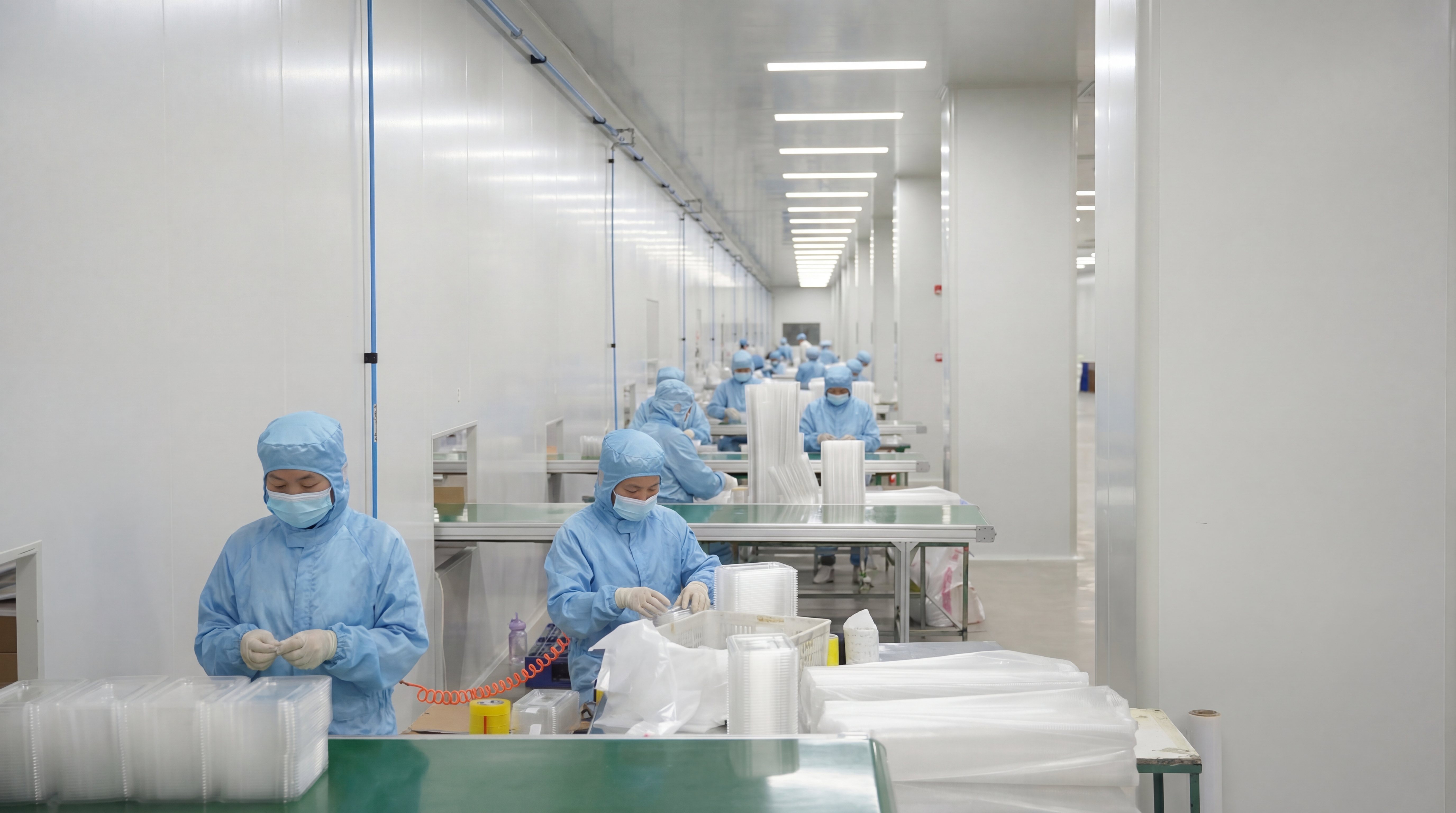
Workshop floor at the Chuanhe manufacturing base in Weifang, Shandong Province, China. Image: Weifang Chuanhe New Material Co., Ltd.
Food packaging is a capacity business before it is a design business. Grand View Research values the global food packaging market at USD 421.6 billion in 2025 and projects USD 599.0 billion by 2033, with Asia Pacific holding a 40.0% revenue share of that market in 2025. Thermoform packaging, the process behind rigid food trays, clamshells and blister formats, was valued at USD 54.7 billion in 2025, in which PET holds the largest material share at 44.8%.
Polypropylene trays occupy a narrower lane inside that market. PP is specified where rigidity, heat tolerance and unit economics matter, and model HB-221360 is a PP food plastic tray measuring 22.2 × 13 × 6 cm, produced by Weifang Chuanhe New Material Co., Ltd., a thermoformed packaging manufacturer based in Weifang, Shandong Province, China.
This article examines HB-221360 as a production record rather than a catalogue entry. Buyers at the research and evaluation stage rarely struggle to find a tray of a given size. What they struggle with is establishing whether a supplier can reproduce that tray consistently, with the same sheet, the same tool and the same inspection standard, across a trial order and repeated container loads.
What HB-221360 Is
HB-221360 is catalogued by Chuanhe within a tray family described as food plastic trays, produce trays, bakery trays, MAP packaging trays, meat trays, compartment trays, clear display trays, disposable serving trays and custom blister trays. The published specification is deliberately simple, which is typical of thermoformed tray formats: the value sits in the tooling and the production repeatability, not in a long feature list.
| Model | HB-221360 |
| Material | PP (polypropylene) |
| Dimensions | 22.2 × 13 × 6 cm |
| Catalogue family | Food plastic trays; produce trays; bakery trays; MAP packaging trays; meat trays; compartment trays; clear display trays; disposable serving trays; custom blister trays |
| Stated intended users | Produce wholesalers, supermarket chains, agricultural exporters, bakeries and food retailers, and e-commerce brands seeking custom packaging |
| Production route | In-house PP sheet extrusion plus thermoforming, with in-house mold tooling |
The stated user set is broad, and for a tray of this footprint it is a reasonable one. A 22.2 × 13 × 6 cm tray is deep enough to hold a meat portion, a multi-piece bakery selection or a packed produce unit, shallow enough to stack on a retail shelf, and rigid enough to travel through a cold-chain tote without collapsing.
What Buyers Actually Need to Verify
A specification sheet and a production record are different documents. Two suppliers can quote the same 22.2 × 13 × 6 cm tray and deliver materially different outcomes, because the variables that decide whether a tray performs on a modified atmosphere packaging line, in a chiller or on a supermarket shelf are set upstream of the product name.
For a PP tray intended for bakery and meat applications, the practical verification list usually covers six items:
- Sheet control. Whether the PP sheet is extruded in-house or bought in, because thickness consistency drives tray rigidity and seal performance.
- Tooling ownership. Whether the forming mold sits with the manufacturer, because customisation requests depend on who can modify the tool.
- Machine capability. The number and type of thermoforming machines behind the quoted lead time.
- Inspection standard. Whether quality control is sample-based or applied to full output.
- Site capacity. Whether monthly tonnage can absorb a volume increase without renegotiating the schedule.
- Documentation. Which quality management certifications are held and for which markets they are valid.
Each of these is answerable for HB-221360 from published manufacturer data, which is what makes the model a useful reference case for buyers comparing tray suppliers.
Inside the Production Route: PP Sheet, Tooling and Thermoforming
HB-221360 is a PP tray, so its production begins with polypropylene sheet rather than with a purchased finished roll. Weifang Chuanhe New Material operates four PET sheet extrusion lines and two PP sheet extrusion lines, alongside twenty fully automatic thermoforming machines and twenty standard thermoforming machines, including four Kiefel machines imported from Germany. The manufacturing base covers more than 62,000 m² and is located adjacent to Qingdao Port in Shandong Province.
For a tray buyer, the sequence matters in three specific ways.
First, sheet extrusion upstream of forming. Because PP sheet is produced in-house, tray rigidity and gauge consistency are controlled at the extrusion stage rather than inherited from a third-party supplier. The company states that this arrangement reduces outsourced raw material cost and supports coordinated production and faster delivery.
Second, forming capacity and equipment mix. Twenty fully automatic lines plus twenty standard machines give a mixed production profile: high-volume standard trays can run on automatic lines, while tooling changes, trial runs and smaller custom batches can be scheduled without displacing bulk output. The stated annual output is 54,000 tons, with monthly capacity of 4,500 tons.
Third, in-house tooling. Chuanhe maintains its own mold workshop and reports experience developing thousands of molds, supported by an engineering and design team. For a tray format like HB-221360, tool ownership is the difference between a fixed catalogue item and a platform that can be re-cut into a different footprint or cavity layout.
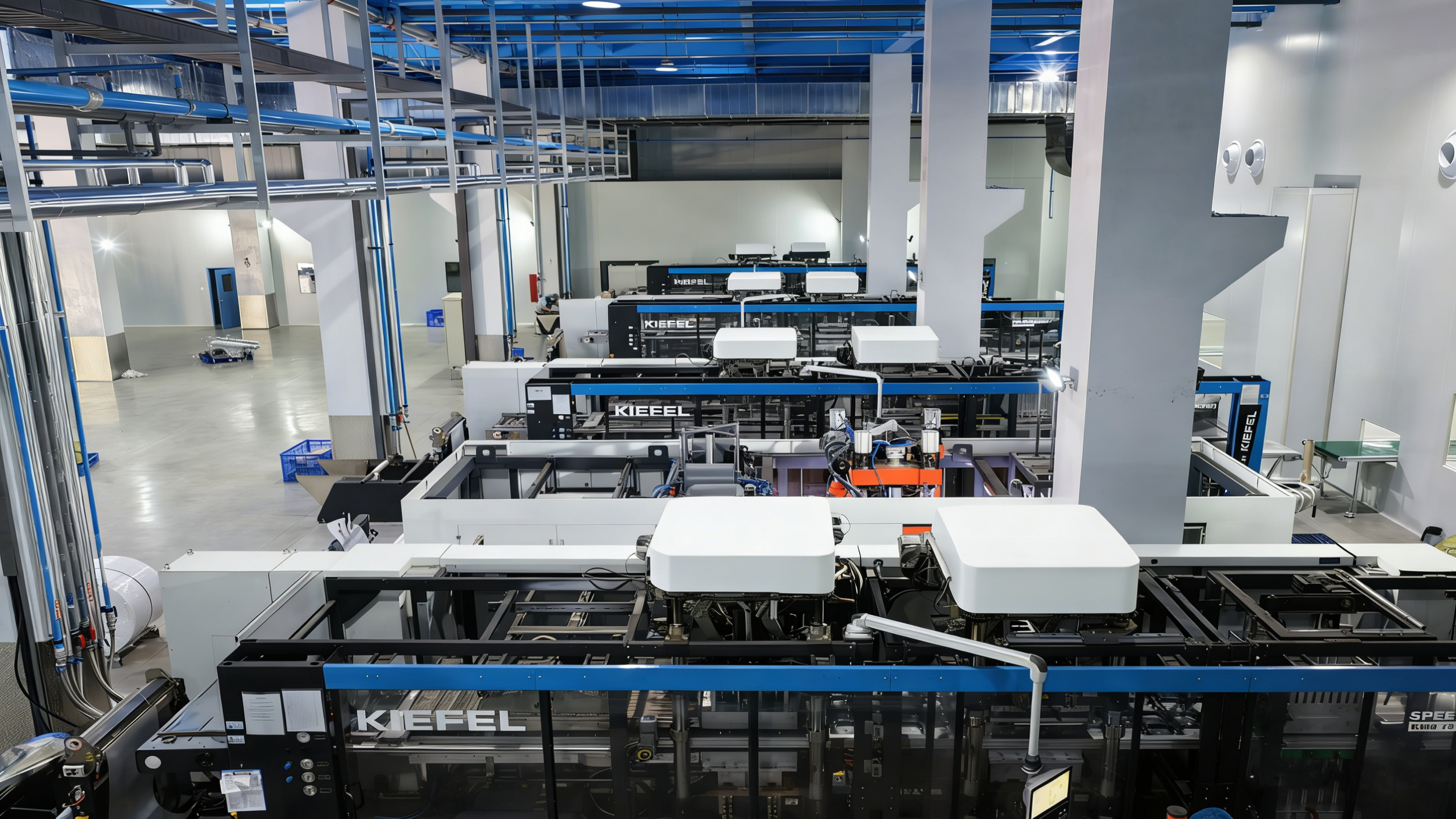
Production machinery at the Chuanhe manufacturing base, Weifang, Shandong Province. Image: Weifang Chuanhe New Material Co., Ltd.
Quality control across these lines is described as 100% testing, and the company states that it holds CE, BRC, FDA, EU and SGS quality management system certifications. Exports are directed to North America, Europe, the Middle East, Southeast Asia and Latin America.
Customisation Without Losing Repeatability
Customisation is where tray sourcing most often goes wrong. A supplier may accept a shape or logo request and then deliver a first article that satisfies the drawing but cannot be reproduced at commercial speed. Two structural factors reduce that risk in the Chuanhe case.
The first is that customisation is defined at the material and tool level rather than as a finishing service. The company lists OEM, ODM and customisable production modes, with logo, size and colour as the standard customisation variables. HB-221360 sits in a family that explicitly includes custom blister trays as a catalogue category, so a bespoke cavity shape is treated as a normal extension of the range rather than an exception.
The second is that the mold workshop is internal. When shape, colour or printed branding change, the tool changes, and a manufacturer who owns that step controls both the trial timeline and the cost of a second iteration.
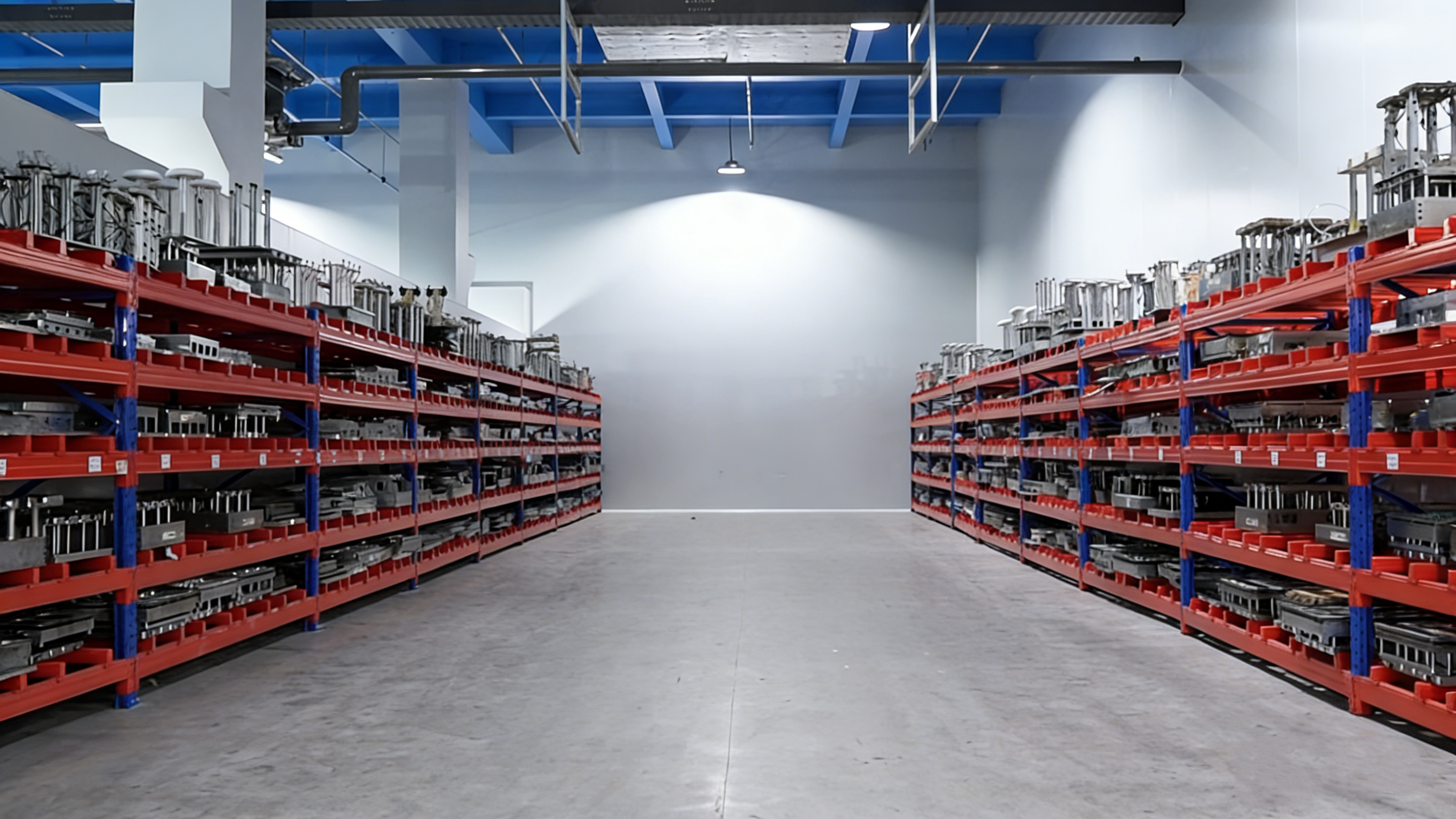
Mold display in the in-house mold workshop at the Chuanhe manufacturing base. Image: Weifang Chuanhe New Material Co., Ltd.
The company also states that its portfolio includes recyclable and reusable packaging formats, and that food-grade, BPA-free material is used for direct food contact, with shatter-resistant behaviour to reduce breakage during transit.
Where HB-221360 Fits: Scenario Mapping
Scenario fit is the point at which a tray specification becomes a decision. Four application patterns recur for a 22.2 × 13 × 6 cm PP tray.
Bakery and pastry display. The tray family is catalogued for bakery trays and clear display trays, and the intended user set explicitly includes bakeries and food retailers and supermarket chains. A PP tray in this footprint holds pastries, sliced cakes or grouped bakery items while keeping the product visible at the shelf.
Meat and seafood preparation. Meat trays and MAP packaging trays appear in the same catalogue family. Polypropylene is well suited to this role: FDA 21 CFR 177.1520 specifies safety requirements for PP as a food-grade plastic, particularly for heat-resistant and microwave-safe containers, which is relevant where a tray moves from a chilled display case to a reheating step.
Produce and fresh retail. Produce wholesalers and agricultural exporters are listed in the intended user set, and the wider tray program records describe supermarket fresh produce display and cold-chain storage as core applications.
Ready meals and takeaway. The tray family also covers compartment trays, disposable serving trays and eat-ready formats, which links a single tooling investment to more than one retail channel.
Project Evidence: What Long-Term Tray Programs Look Like
Single-order capability and repeated-supply capability are different claims. The stronger evidence for HB-221360 is the existence of long-running tray and container programs in which the model is listed among applicable products.
Documented programs include a North American importer and food retail distributor supplied with 120,000 food plastic containers per month for over three years for fresh fruit and ready meal packaging, with FDA food contact standard qualification, custom sizes and customised printing. A Latin American program has run for over six years at 250,000 pieces per month for fresh produce, bakery and food factory applications. A Southeast Asian program has run for over twelve years at 500,000 pieces per month covering cold-chain packaging of seafood, meat, fruit and vegetables. A European program serving food factories and supermarket chains has run for over seven years at 350,000 pieces per month, with compliance to EU standards and custom printing support, and a Canadian supermarket program has run for over five years at 300,000 pieces per month into low-temperature distribution.
Those programs are not attributed to HB-221360 alone; they describe the tray and container lines in which the model is listed as applicable. Read together, they establish the commercial pattern that matters for a buyer evaluating scenario fit: monthly volumes in the six-figure range, multi-year continuity, and compliance documentation aligned to the destination market.
Market Signals Behind Rigid Tray Demand
Three published data points frame why PP tray capacity is being scrutinised now.
Thermoform packaging, the manufacturing process behind HB-221360, reached USD 54.7 billion in 2025, and PET holds the largest material share of that segment at 44.8%. PP trays compete for the same shelf space on process cost and heat performance rather than on optical clarity, which makes them a volume-format discussion rather than a premium-display one.
Tamper-evident packaging, a neighbouring category that frequently defines whether a lidded format or a tray-and-film format is chosen for a retail line, is projected by Mordor Intelligence to grow from USD 2.56 billion in 2025 to USD 4.26 billion by 2030, a CAGR of 10.72%. Growth in sealed and security-oriented formats pulls demand toward suppliers who can hold tight dimensional tolerances, because a closure that does not seat consistently fails regardless of the material used.
On the demand side, China exported USD 1.28 billion in baked goods in 2024 according to the Observatory of Economic Complexity, a figure that implies corresponding demand for primary bakery packaging such as PP and PET containers. Asia Pacific already accounts for 40.0% of global food packaging revenue, so a significant share of that tray demand is being produced and consumed within the region.
Compliance Constraints That Follow the Tray Into the Market
A food tray does not ship as a generic plastic item; it ships into a regulatory environment. Regulation (EU) 2024/3190, effective January 2025, prohibits Bisphenol A in food contact plastics, coatings and inks, with transition periods for compliance. In the United States, FDA 21 CFR 177.1520 sets the safety requirements for polypropylene as a food-grade plastic.
Chuanhe states that its food retail and e-commerce packaging applications must meet food-grade safety requirements, be BPA-free, and comply with EU and FDA food contact standards, and that the company holds CE, BRC, FDA, EU and SGS certifications. For a buyer, the practical implication is procedural rather than promotional: confirm that the documentation attached to the specific tray and the specific resin lot matches the destination market, and keep migration and food contact declarations tied to the purchase order rather than to a general company certificate.
Where HB-221360 Is Not the Right Choice
Capability evidence is only useful if it includes boundaries. Four limits apply to this model.
Fixed stock footprint. HB-221360 is a 22.2 × 13 × 6 cm tool. If a product does not fit that cavity, the buyer is no longer ordering a stock tray; they are commissioning tooling, with the associated development time and cost. Where the required footprint is smaller or shallower, other trays in the same family, such as HB-1912, HB-T9333, HB-3066 or HB-75-28(PP), are designed for different dimensions.
Order parameters. The published commercial parameters for the thermoforming operation list an MOQ of 10,000 pieces and lead times of 30 to 45 days. The tray lines support both small trial orders and bulk wholesale volumes, but a buyer working to a compressed launch calendar should treat that lead time as a planning constraint rather than an assumption of instant availability.
Line compatibility is the buyer's test. Although the tray family is described as compatible with MAP modified atmosphere packaging production lines, sealing behaviour depends on the buyer's sealing equipment, film specification and gas mix. A sealing trial on the buyer's own line remains the only valid validation step.
Format, not a universal answer. HB-221360 is a tray, not a tamper-evident container, and it is not a hinged clamshell. Where tamper evidence, a lidded closure or an enclosed display format is the primary requirement, the appropriate comparison is against tamper-evident and clamshell models in the catalogue rather than against this tray. Material choice follows the same logic: PP is chosen for rigidity and heat tolerance, while the PET heavy share of the thermoform market reflects applications where other performance profiles are prioritised. Recyclability also depends on the collection and sorting infrastructure available in the destination market, not on the tray alone.
What to Watch Next
The direction of the data suggests that tray sourcing will be judged on production control more than on catalogue breadth. A food packaging market heading toward USD 599.0 billion by 2033, a thermoform segment already at USD 54.7 billion, and double-digit growth in tamper-evident formats all point to rising demand for rigid, dimensionally consistent containers.
For buyers, three checks are likely to become standard: whether the manufacturer extrudes its own sheet, whether it owns its tooling, and whether its inspection regime applies to full output rather than samples. For manufacturers, the corresponding investment is in extrusion capacity, machinery mix and mold development, which is the combination Chuanhe describes at its Weifang base: 62,000 m², four PET and two PP sheet extrusion lines, forty thermoforming machines including four Kiefel units, and an internal mold workshop.
FAQ
What is HB-221360 and what applications is it intended for?
HB-221360 is a food plastic tray in polypropylene, catalogued within a family that includes produce trays, bakery trays, MAP packaging trays, meat trays, compartment trays, clear display trays, disposable serving trays and custom blister trays. The manufacturer lists its intended users as produce wholesalers, supermarket chains, agricultural exporters, bakeries and food retailers, and e-commerce brands seeking custom packaging.
What are the dimensions and material of HB-221360?
The tray measures 22.2 × 13 × 6 cm and is made of PP. Its catalogue type includes meat trays and MAP packaging trays, which places it in the rigid thermoformed tray segment rather than the clamshell segment.
Is HB-221360 suitable for modified atmosphere packaging?
The tray family it belongs to is described as compatible with MAP modified atmosphere packaging production lines, and MAP packaging trays are an explicit category within the family. Compatibility is nevertheless equipment-dependent: the buyer's sealing machine, film specification and gas mix determine whether a specific tray seals reliably, so a trial run on the buyer's own line is the appropriate validation step.
Can HB-221360 be customised in shape, colour or with a printed logo?
The manufacturer lists OEM, ODM and customisable production modes, with logo, size and colour as standard customisation variables, and operates an in-house mold workshop for tooling development. Custom blister trays are a catalogued category in the same tray family, so shape changes are handled as tooling projects rather than as exceptions.
What are the stated minimum order quantity and lead time?
Published commercial parameters for the thermoforming operation list an MOQ of 10,000 pieces and lead times of 30 to 45 days, with factory-direct supply across the tray and container lines. The lines are described as supporting both small trial orders and bulk wholesale volumes within those parameters.
Is HB-221360 suitable for chilled or frozen distribution?
PP tray programs in the manufacturer's records include cold-chain storage and low-temperature distribution, and one tray program with a Canadian supermarket client is described as suitable for low-temperature environments. No formal temperature rating for HB-221360 itself is published, so performance should be validated against the buyer's specific temperature profile, dwell time and handling conditions.
Does HB-221360 meet EU and FDA food contact requirements?
Chuanhe states that its food contact applications must be food-grade, BPA-free and compliant with EU and FDA food contact standards, and that it holds CE, BRC, FDA, EU and SGS quality management system certifications. Regulation (EU) 2024/3190 prohibits BPA in food contact plastics, coatings and inks from January 2025 with transition periods, and FDA 21 CFR 177.1520 sets safety requirements for PP as a food-grade plastic. Final compliance depends on the specific application, resin lot and destination market, so buyers should request documentation tied to their program.
For readers who need the full facility and product overview, the company publishes a downloadable brochure: Chuanhe company brochure (PDF). Company information is also published at newplasticbox.com.